REVIEW 3 major objections 4 minor 3 cited by
Discrete diffusion language models lose continuous reasoning state between denoising steps; a small persistent memory layer restores it and consistently improves math and code reasoning.
Reviewed by Pith at T0; open to challenge. T0 means a machine referee read the full paper against a public rubric. the ladder, T0–T4 →
T0 review · deepseek-v4-flash
2026-08-02 19:39 UTC pith:4CGFVNQM
load-bearing objection A novel persistent-memory add-on for discrete diffusion LLMs with clean ablations, but the headline causal claim is not fully secured by the Dream w/o-recurrence ablation and the teacher-forced training vs. self-generated inference mismatch. the 3 major comments →
MetaState: Persistent Working Memory Enhances Reasoning in Discrete Diffusion Language Models
The pith
A machine-rendered reading of the paper's core claim, the machinery that carries it, and where it could break.
Core claim
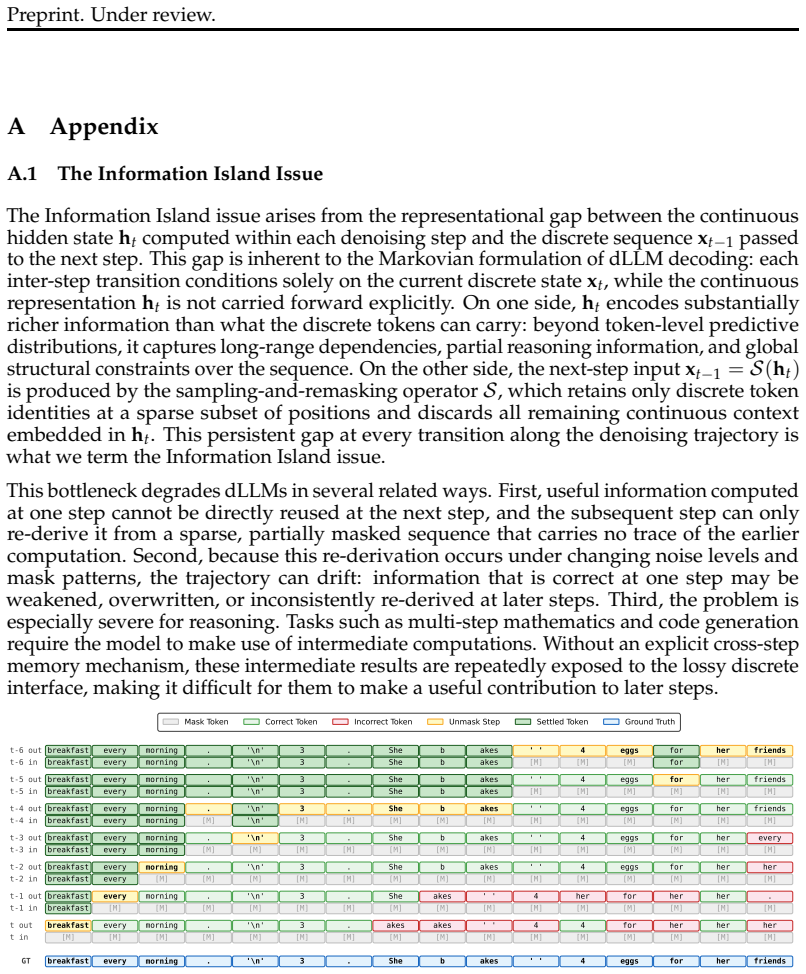
The paper identifies the Information Island issue: in standard masked diffusion decoding, each step's transition is Markovian over the discrete token sequence, so the rich continuous hidden state computed at step t is compressed into sparse discrete tokens and remasking indicators before step t+1. This repeated lossy compression forces later steps to re-derive intermediate reasoning content from scratch, causing cross-step drift that is especially harmful for mathematical reasoning and code generation. To address this, the paper introduces MetaState, a recurrent augmentation that maintains a constant number of memory slots across the denoising trajectory. A Mixer uses cross-attention to read
What carries the argument
The central object is the augmented transition pθ(xt-1 | xt, st) with state update st-1 = gθ(st, ht, t), where st is a fixed-size set of M continuous memory slots. The mechanism is the recurrent loop formed by three modules: the Mixer (cross-attention reading backbone activations into slots), the Updater (gated recurrent unit that retains and overwrites slot content), and the Injector (cross-attention adding a zero-initialized positional modulation to the backbone's input embeddings). The paper also introduces K-step iterative unrolling with backpropagation through time, which trains the modules to learn multi-step dynamics rather than single-step denoising.
Load-bearing premise
The entire argument rests on the claim that continuous hidden activations from one denoising step contain task-relevant information that the next step cannot reconstruct from the discrete masked sequence; if that premise fails, the reported gains could be due to the added trainable parameters or to exposure to the training data rather than to persistent memory.
What would settle it
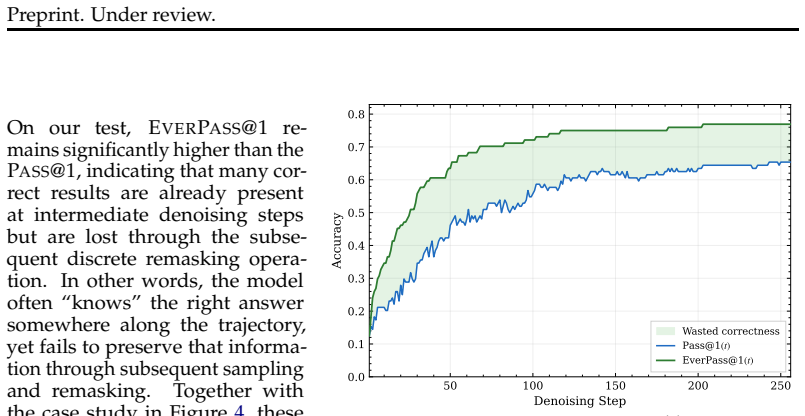
Run the same MetaState training but zero out the memory state at every step while keeping all modules (no recurrence). If accuracy over the frozen baseline stays comparable, the Information Island premise is not needed to explain the gains. Alternatively, measure EVERPASS@1 minus PASS@1 on multiple models and benchmarks with repeated runs: if the gap is consistently small or absent, the claim that correct intermediate outputs are routinely lost to remasking lacks support.
If this is right
- If the Information Island bottleneck is real, then any discrete diffusion LM that adds a cross-step continuous memory should see similar reasoning gains, regardless of architecture details.
- Because the backbone is frozen and only external modules are trained, the method can be layered onto an already-deployed diffusion model without retraining its weights.
- MetaState is compatible with soft-diffusion decoding; combining them gives the best results, indicating the memory path and the token-refinement path improve different parts of the pipeline.
- The ablation shows that backpropagation through time is necessary: detaching the state across steps consistently hurts, so the memory must learn to update, not just accumulate.
- The fixed-size memory means the extra storage and compute do not grow with sequence length, making the approach applicable to long generations.
Where Pith is reading between the lines
- We read the paper as predicting that the same memory mechanism would improve any generation process with a discrete interface between computation steps, such as block-wise autoregressive or semi-autoregressive models, since those also discard continuous state.
- One could directly probe the memory slots during a math problem: if the slots do not encode intermediate quantities like partial sums or remainders shortly after they are computed, the memory is not carrying the reasoning state the paper claims.
- The EVERPASS@1 vs PASS@1 gap suggests a cheaper baseline: simply retaining the best full prediction seen so far along the trajectory might capture part of the gain, which would test whether the memory's advantage is about preservation rather than refinement.
- Training the memory on an unrelated corpus instead of an instruction-tuning mixture would isolate whether the reported gains come from the recurrent mechanism or from exposure to the training distribution; the paper's LoRA control argues against the latter, but that control trains the backbone while MetaState does not.
Editorial analysis
A structured set of objections, weighed in public.
Referee Report
Summary. The paper proposes MetaState, a recurrent augmentation for frozen discrete diffusion LLMs. It maintains M fixed memory slots across denoising steps via a Mixer, a GRU-style Updater, and an Injector with a shared time conditioner. Training uses K-step unrolling with teacher forcing and BPTT. Experiments on Dream-7B and LLaDA-8B, in Base and Instruct variants, over GSM8K, MATH-500, HumanEval, and MBPP, show an average 4.5-point gain, supported by ablations, a LoRA control, and hyperparameter sensitivity runs. The central causal claim is that persistent working memory mitigates the 'Information Island' bottleneck.
Significance. If validated, the proposal is practically attractive: it adds only ~0.6% trainable parameters, keeps the backbone frozen, and shows consistent gains across two architecturally different dLLM families. The K-step BPTT training recipe and the LoRA control are thoughtful and go beyond a simple adapter comparison. However, the current evidence does not yet isolate the cross-step memory channel from per-step trainable capacity or from training-data exposure, and the absence of uncertainty quantification makes several of the smaller reported deltas unreliable. The core idea is plausible and worth pursuing after targeted revisions.
major comments (3)
- [§5.1–5.2, Table 1] The central empirical claim rests on single-run accuracy values with no error bars, confidence intervals, or significance tests. HumanEval contains only 164 problems, so deltas such as Dream-Base MBPP (+1.0) or LLaDA-Instruct GSM8K/MATH (+1.0) are within binomial sampling noise; even larger deltas on MATH-500 (500 examples) need quantification. I request bootstrap confidence intervals or repeated-seed runs for every benchmark-backbone pair. Without this, 'consistently improves' is not statistically established at the reported granularity.
- [§4.2, Algorithm 2 vs. §5.1 inference] Training uses teacher-forced K-step unrolling: ground-truth tokens are revealed in random order, so the recurrent state is trained on contexts that are always consistent with the clean sequence. Evaluation uses the model's own sampled tokens and confidence-based remasking (block size 32, threshold 0.9), a systematically different context distribution. This exposure-bias gap is acknowledged only as a future direction in §A.10. Because the paper's mechanism claim is that the state carries information across self-generated denoising trajectories, the authors should either train with scheduled sampling or self-generated unrolling, or provide an analysis of state behavior under self-generated contexts. As it stands, the evaluation may show test-time behavior of a module optimized for cleaner contexts.
- [§5.4, Table 3] The w/o recurrence ablation is the most direct test of the memory mechanism, but its results weaken the causal claim. On Dream-Instruct, removing recurrence retains almost all of MetaState's average improvement (59.25 vs. 59.88 for full MetaState; backbone-only is 56.73). Thus on one of the two backbone families the cross-step state contributes only ~0.6 points on average, and the gains are mostly attributable to other components or to training. The paper's explanation that 'Dream retains stronger per-step coherence' is not tested. I ask for a clearer implementation description of the w/o recurrence variant and for per-benchmark decompositions showing what the memory channel itself buys; a parameter-matched non-recurrent control is needed to support the persistent-memory interpretation.
minor comments (4)
- [§5.3, Table 2, and §A.5] Soft Diffusion hyperparameters (p, r_f) are selected per benchmark by a grid search over six configurations, while MetaState uses one fixed setting. This gives Soft Diffusion a selection advantage and makes the comparison 'MetaState outperforms Soft Diffusion' difficult to interpret. Report results with fixed hyperparameters or with averaged/uncertainty-aware selection.
- [§A.8, Figures 7–10] The hyperparameter sensitivity figures appear garbled with unicode escape sequences in the text; the axis labels and legends are not readable. Please replace with clean figures.
- [§A.3.1] Random seeds and the number of independent evaluation runs are not specified. This is essential for assessing variance, especially given the small HumanEval set.
- [Abstract and §1] The abstract says '4.5 percentage points' while the introduction says '4.5% average improvement'; please use consistent terminology.
Circularity Check
No circular derivation: the reported gains are measured benchmark comparisons, not fitted-input predictions; only a non-load-bearing self-citation appears in related work.
full rationale
The paper's central claim is empirical rather than derivational: MetaState's 4.5% average gain is the sum of Table 1 deltas against frozen backbones, and no equation maps a fitted constant to those deltas. The Information Island premise (Eq. 1 and Appendix A.1) is a definitional observation about the standard dLLM transition, not a conclusion derived from MetaState's success. The paper includes an explicit control for the main non-circular confound: Appendix A.6/Table 8 compares against LoRA trained on the same 50k Tulu-3 sequences, which speaks to data-exposure. The A.10 limitation paragraph ('may also help close the training-to-inference extrapolation gap') and the Table 3 Dream w/o-recurrence row (59.25 vs. 59.88 full) are real threats to the causal attribution of the gains to persistent memory, but they are validity concerns, not circularity. The only self-citation is Shi et al. 2025 (SwiReasoning, with overlapping authors) in §2.2, listed as one of several latent-reasoning methods; it is contextual and load-bearing nowhere. Thus no circular step is established.
Axiom & Free-Parameter Ledger
free parameters (7)
- M (number of memory slots) =
64
- Ds, dm, db (memory and bottleneck dimensions) =
1024 / 768 / 768
- K (unroll depth) =
4
- lambda_d (dense/reveal loss mixing ratio) =
0.75
- lambda_s, tau (state-norm regularizer weight and threshold) =
1e-4 / 1.0
- Soft Diffusion (p, r_f) per benchmark =
Best of 6 grid pairs per benchmark (Table 7)
- Inference confidence threshold and block size =
0.9 / 32
axioms (5)
- standard math The Markovian discrete-state factorization of dLLM decoding is a correct description of the base system.
- domain assumption Continuous hidden activations contain information not captured by the remasked discrete tokens.
- domain assumption The zero-initialized Injector bridge preserves the frozen backbone's per-step behavior at initialization and remains stable during training.
- domain assumption K=4 teacher-forced unrolling transfers to the longer self-sampled inference trajectory.
- domain assumption The 50k Tulu-3 SFT training sequences do not meaningfully overlap the evaluation benchmarks.
invented entities (1)
-
Persistent memory state s_t (M slots of dimension D_s)
no independent evidence
read the original abstract
Discrete diffusion language models (dLLMs) generate text by iteratively denoising a masked sequence. However, standard dLLMs condition each denoising step solely on the current hard-masked sequence, while intermediate continuous representations are discarded after sampling and remasking. We term this bottleneck the \textbf{Information Island} issue: continuous information remains isolated within individual denoising steps and fails to propagate across the trajectory. This bottleneck is especially harmful for reasoning, which requires intermediate reasoning state to be preserved and updated across many denoising steps. To address this limitation, we introduce \textbf{MetaState}, a lightweight recurrent augmentation that equips a frozen dLLM backbone with persistent, fixed-size working memory. MetaState comprises three modules with a shared time conditioner: a cross-attention \textbf{Mixer} that reads backbone activations into memory slots, a GRU-style \textbf{Updater} that integrates information across steps, and a cross-attention \textbf{Injector} that writes the updated memory back into the backbone. We train these modules with a dedicated $K$-step unrolling pipeline to learn multi-step dynamics. MetaState adds only ${\sim}0.6\%$ trainable parameters while keeping the backbone frozen, and consistently improves reasoning performance over frozen baselines on mathematical reasoning and code generation benchmarks, with an average gain of 4.5 percentage points across all evaluations.
Figures




Forward citations
Cited by 3 Pith papers
-
Learned Relay Representations for Forward-Thinking Discrete Diffusion Models
Learned Relay Representations enable masked diffusion models to propagate useful latent information across denoising steps, scaling to Fast-dLLM v2 to outperform supervised finetuning on coding tasks while cutting inf...
-
CopT: Contrastive On-Policy Thinking with Continuous Spaces for General and Agentic Reasoning
CopT reverses CoT by eliciting a draft answer first then using continuous-embedding contrastive verification and on-policy thinking to reflect and correct, yielding up to 23% higher accuracy and 57% fewer tokens witho...
-
Learned Relay Representations for Forward-Thinking Discrete Diffusion Models
Learned Relay Representations add a differentiable per-token channel to masked diffusion models so they can propagate latent information across iterative denoising steps, yielding better coding performance and up to 3...
Reference graph
Works this paper leans on
-
[1]
Marianne Arriola, Aaron Gokaslan, Justin T Chiu, Zhihan Yang, Zhixuan Qi, Jiaqi Han, Subham Sekhar Sahoo, and Volodymyr Kuleshov. Block diffusion: Interpolating between autoregressive and diffusion language models.arXiv preprint arXiv:2503.09573,
-
[3]
Language models are few-shot learners.Advances in neural information processing systems, 33:1877–1901,
Tom Brown, Benjamin Mann, Nick Ryder, Melanie Subbiah, Jared D Kaplan, Prafulla Dhariwal, Arvind Neelakantan, Pranav Shyam, Girish Sastry, Amanda Askell, et al. Language models are few-shot learners.Advances in neural information processing systems, 33:1877–1901,
1901
-
[5]
Training verifiers to solve math word problems.arXiv preprint arXiv:2110.14168,
Karl Cobbe, Vineet Kosaraju, Mohammad Bavarian, Mark Chen, Heewoo Jun, Lukasz Kaiser, Matthias Plappert, Jerry Tworek, Jacob Hilton, Reiichiro Nakano, Christopher Hesse, and John Schulman. Training verifiers to solve math word problems.arXiv preprint arXiv:2110.14168,
-
[10]
Scalable adaptive computation for iterative generation.arXiv preprint arXiv:2212.11972,
Allan Jabri, David Fleet, and Ting Chen. Scalable adaptive computation for iterative generation.arXiv preprint arXiv:2212.11972,
-
[11]
Ladir: Latent diffusion enhances llms for text reasoning.arXiv preprint arXiv:2510.04573,
Haoqiang Kang, Yizhe Zhang, Nikki Lijing Kuang, Nicklas Majamaki, Navdeep Jaitly, Yi-An Ma, and Lianhui Qin. Ladir: Latent diffusion enhances llms for text reasoning.arXiv preprint arXiv:2510.04573,
-
[12]
A survey on diffusion language models.arXiv preprint arXiv:2508.10875,
Tianyi Li, Mingda Chen, Bowei Guo, and Zhiqiang Shen. A survey on diffusion language models.arXiv preprint arXiv:2508.10875,
-
[13]
Zhiyuan Liu, Yicun Yang, Yaojie Zhang, Junjie Chen, Chang Zou, Qingyuan Wei, Shaobo Wang, and Linfeng Zhang. dllm-cache: Accelerating diffusion large language models with adaptive caching.arXiv preprint arXiv:2506.06295,
-
[14]
Aaron Lou, Chenlin Meng, and Stefano Ermon. Discrete diffusion modeling by estimating the ratios of the data distribution.arXiv preprint arXiv:2310.16834,
-
[16]
Large language diffusion models.arXiv preprint arXiv:2502.09992,
Shen Nie, Fengqi Zhu, Zebin You, Xiaolu Zhang, Jingyang Ou, Jun Hu, Jun Zhou, Yankai Lin, Ji-Rong Wen, and Chongxuan Li. Large language diffusion models.arXiv preprint arXiv:2502.09992,
-
[17]
11 Preprint. Under review. Jingyang Ou, Shen Nie, Kaiwen Xue, Fengqi Zhu, Jiacheng Sun, Zhenguo Li, and Chongxuan Li. Your absorbing discrete diffusion secretly models the conditional distributions of clean data.arXiv preprint arXiv:2406.03736,
-
[18]
Candi: Hybrid discrete-continuous diffusion models.arXiv preprint arXiv:2510.22510,
Patrick Pynadath, Jiaxin Shi, and Ruqi Zhang. Candi: Hybrid discrete-continuous diffusion models.arXiv preprint arXiv:2510.22510,
-
[19]
Codi: Compressing chain-of-thought into continuous space via self-distillation
Zhenyi Shen, Hanqi Yan, Linhai Zhang, Zhanghao Hu, Yali Du, and Yulan He. Codi: Compressing chain-of-thought into continuous space via self-distillation. InProceedings of the 2025 Conference on Empirical Methods in Natural Language Processing, pp. 677–693,
2025
-
[20]
Dachuan Shi, Abedelkadir Asi, Keying Li, Xiangchi Yuan, Leyan Pan, Wenke Lee, and Wen Xiao. Swireasoning: Switch-thinking in latent and explicit for pareto-superior reasoning llms.arXiv preprint arXiv:2510.05069,
-
[22]
Chengyue Wu, Hao Zhang, Shuchen Xue, Zhijian Liu, Shizhe Diao, Ligeng Zhu, Ping Luo, Song Han, and Enze Xie. Fast-dllm: Training-free acceleration of diffusion llm by enabling kv cache and parallel decoding.arXiv preprint arXiv:2505.22618,
-
[23]
Dream 7b: Diffusion large language models.arXiv preprint arXiv:2508.15487,
Jiacheng Ye, Zhihui Xie, Lin Zheng, Jiahui Gao, Zirui Wu, Xin Jiang, Zhenguo Li, and Ling- peng Kong. Dream 7b: Diffusion large language models.arXiv preprint arXiv:2508.15487,
-
[25]
Zhen Zhang, Xuehai He, Weixiang Yan, Ao Shen, Chenyang Zhao, Shuohang Wang, Yelong Shen, and Xin Eric Wang. Soft thinking: Unlocking the reasoning potential of llms in continuous concept space.arXiv preprint arXiv:2505.15778,
-
[26]
12 Preprint. Under review. Huangjie Zheng, Shansan Gong, Ruixiang Zhang, Tianrong Chen, Jiatao Gu, Mingyuan Zhou, Navdeep Jaitly, and Yizhe Zhang. Continuously augmented discrete diffusion model for categorical generative modeling.arXiv preprint arXiv:2510.01329,
-
[27]
Fengqi Zhu, Rongzhen Wang, Shen Nie, Xiaolu Zhang, Chunwei Wu, Jun Hu, Jun Zhou, Jianfei Chen, Yankai Lin, Ji-Rong Wen, et al. Llada 1.5: Variance-reduced preference optimization for large language diffusion models.arXiv preprint arXiv:2505.19223, 2025a. Fengqi Zhu, Zebin You, Yipeng Xing, Zenan Huang, Lin Liu, Yihong Zhuang, Guoshan Lu, Kangyu Wang, Xudo...
Pith/arXiv arXiv 2025
-
[28]
,nK ∼Dir-Multi 4:Sample random reveal ranks forM 5:L ←0 6:fork=1 toKdo 7:t← |still masked|/N m ▷Continuous timestep 8:(logits,s,t cond)←Forward(x,s,t cond,t)▷Alg
3:Sample reveal countsn 1, . . . ,nK ∼Dir-Multi 4:Sample random reveal ranks forM 5:L ←0 6:fork=1 toKdo 7:t← |still masked|/N m ▷Continuous timestep 8:(logits,s,t cond)←Forward(x,s,t cond,t)▷Alg. 1 9:L ← L+L k(logits,x 0,M k,R k) 10:Revealn k positions (teacher forcing), updatex 11:end for 12:returnL+λ sReg s A.3 Experimental Details and Hyperparameters A...
2024
-
[2002]
Shansan Gong, Shivam Agarwal, Yizhe Zhang, Jiacheng Ye, Lin Zheng, Mukai Li, Chenxin An, Peilin Zhao, Wei Bi, Jiawei Han, et al. Scaling diffusion language models via adapta- tion from autoregressive models.arXiv preprint arXiv:2410.17891,
-
[2017]
Wen Wang, Bozhen Fang, Chenchen Jing, Yongliang Shen, Yangyi Shen, Qiuyu Wang, Hao Ouyang, Hao Chen, and Chunhua Shen. Time is a feature: Exploiting temporal dynamics in diffusion language models.arXiv preprint arXiv:2508.09138,
-
[2019]
Working memory identifies reasoning limits in language models
Chunhui Zhang, Yiren Jian, Zhongyu Ouyang, and Soroush Vosoughi. Working memory identifies reasoning limits in language models. InProceedings of the 2024 Conference on Empirical Methods in Natural Language Processing, pp. 16896–16922,
2024
-
[2021]
Shuang Cheng, Yihan Bian, Dawei Liu, Linfeng Zhang, Qian Yao, Zhongbo Tian, Wen- hai Wang, Qipeng Guo, Kai Chen, Biqing Qi, et al. Sdar: A synergistic diffusion- autoregression paradigm for scalable sequence generation.arXiv preprint arXiv:2510.06303,
-
[2022]
Residual context diffusion language models.arXiv preprint arXiv:2601.22954,
Yuezhou Hu, Harman Singh, Monishwaran Maheswaran, Haocheng Xi, Coleman Hooper, Jintao Zhang, Aditya Tomar, Michael W Mahoney, Sewon Min, Mehrdad Farajtabar, et al. Residual context diffusion language models.arXiv preprint arXiv:2601.22954,
-
[2023]
Justin Lovelace, Christian Belardi, Sofian Zalouk, Adhitya Polavaram, Srivatsa Kundurthy, and Kilian Q Weinberger. Stop-think-autoregress: Language modeling with latent diffu- sion planning.arXiv preprint arXiv:2602.20528,
-
[2024]
Shibo Hao, Sainbayar Sukhbaatar, DiJia Su, Xian Li, Zhiting Hu, Jason Weston, and Yuan- dong Tian. Training large language models to reason in a continuous latent space.arXiv preprint arXiv:2412.06769,
-
[2025]
Jacob Austin, Daniel D Johnson, Jonathan Ho, Daniel Tarlow, and Rianne Van Den Berg. Structured denoising diffusion models in discrete state-spaces.Advances in neural informa- tion processing systems, 34:17981–17993, 2021a. Jacob Austin, Augustus Odena, Maxwell Nye, Maarten Bosma, Henryk Michalewski, David Dohan, Ellen Jiang, Carrie Cai, Michael Terry, Qu...
-
[2026]
Zemin Huang, Zhiyang Chen, Zijun Wang, Tiancheng Li, and Guo-Jun Qi. Reinforcing the diffusion chain of lateral thought with diffusion language models.arXiv preprint arXiv:2505.10446,
discussion (0)
Sign in with ORCID, Apple, or X to comment. Anyone can read and Pith papers without signing in.