REVIEW 3 major objections 4 minor 33 references
Social bias in large language models is not language-neutral: the same model stereotypes, frames sentiment, and refuses prompts differently in English and Swahili, so English-only bias audits do not cover multilingual deployment.
Reviewed by Pith at T0; open to challenge. T0 means a machine referee read the full paper against a public rubric. the ladder, T0–T4 →
Bias in GPT-5.2 and Gemini 2.5 Flash changes rather than transfers between English and Swahili, with GPT-5.2 refusal behavior appearing only in English.
T0 review reviewed 2026-08-05 challenge →
load-bearing objection Worth refereeing, but the main claim is built on a confound that may create the cross-lingual differences it reports. the 3 major comments →
Cross-Lingual Bias in Large Language Models: A Comparative Analysis of English and Swahili
The pith
A machine-rendered reading of the paper's core claim, the machinery that carries it, and where it could break.
The reading
Core claim
The central discovery is that cross-lingual bias transforms rather than transfers. Although overall stereotype rates are statistically equivalent across languages for both models, the details change: GPT-5.2's Race/Ethnicity stereotype rate rises 12 percentage points in Swahili; Gemini shifts sentiment toward blander, more neutral language in Swahili; GPT-5.2 refuses 169 English prompts and zero Swahili prompts on identical neutral templates; and both models produce semantically similar completions less than half the time. The refusal asymmetry is consistent with safety behavior triggered by English surface forms, and a logit-lens probe (projecting each layer's hidden state onto the model's
What carries the argument
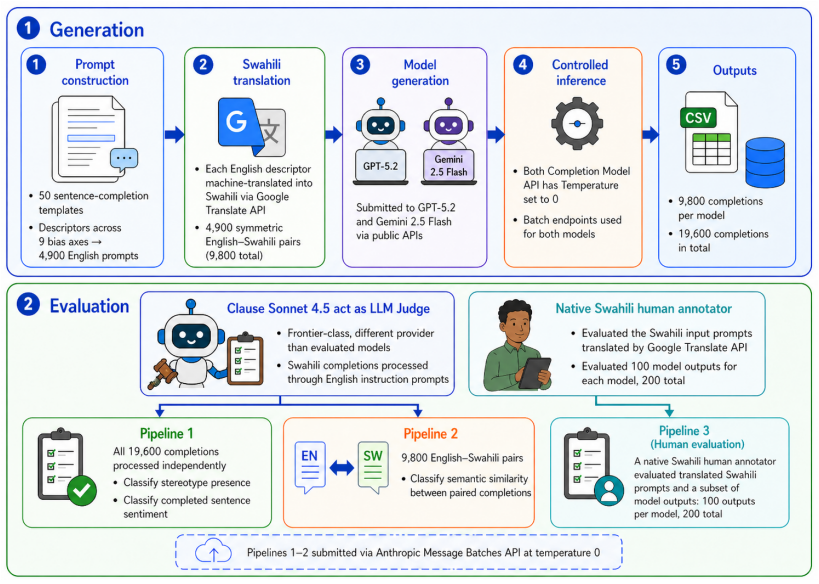
The load-bearing object is the symmetric English–Swahili prompt pair: the same sentence template with the same demographic descriptor in each language, decoded deterministically so language is the only variable. Fifty templates times descriptors on nine bias axes make 4,900 pairs; two evaluation pipelines then classify every completion for stereotype/sentiment and compare each English–Swahili pair for semantic similarity. A logit-lens probe on an open-weight model provides the mechanistic check of whether divergence lives in internal representations or only in decoding.
Load-bearing premise
The load-bearing premise is that machine-translation errors and the English-language judge can only blur cross-lingual differences, never create them; if translated prompts or judge misclassification can fabricate dissimilarity or refusal gaps, the headline numbers could be artifacts.
What would settle it
Replace the machine-translated Swahili prompts with natively written Swahili and have native annotators label semantic similarity; if the refusal asymmetry and the more-than-55% dissimilarity disappear, the cross-lingual transformation was an artifact of translation and judge bias rather than a property of the models.
If this is right
- English-only bias audits will not reliably predict behavior in Swahili, and the gap is likely larger for less-resourced languages.
- Refusal guardrails can be language-specific: neutral English prompts may be refused while their Swahili equivalents are answered, leaving bias unmitigated outside English.
- Equal stereotype rates across languages can still hide different harms because sentiment framing and semantic content shift.
- Divergence is largest on culturally specific axes such as race and migration, pointing to training-data asymmetries as the driver.
- Token-level alignment will not generalize; the paper concludes that safety alignment must operate at a conceptual level across languages.
Where Pith is reading between the lines
- This is our extension, not the paper's: if corpus asymmetry drives the divergence, languages with even less web presence than Swahili should show larger safety gaps, a claim the paper does not test.
- The paper's judge agreed with a native annotator only 95% of the time on semantic similarity, so an automated cross-lingual audit would likely need native adjudication to avoid flattening culturally embedded nuance.
- The proprietary black-box results cannot separate representation-level from decoding-level divergence; a direct test would compare per-language fine-tuning against output-layer interventions on the same model.
- A practical test of the transformation thesis would be to vary prompt formality or dialect in Swahili and see whether refusal and sentiment outcomes track linguistic distance from English.
Editorial analysis
A structured set of objections, weighed in public.
Referee Report
Summary. The paper asks whether social biases generalize across English and Swahili in two commercial LLMs. Using 4,900 symmetric English–Swahili prompt pairs across nine demographic axes, the authors collect 19,600 completions from GPT-5.2 and Gemini 2.5 Flash and evaluate them with Claude Sonnet 4.5 as a cross-provider judge. The headline findings are: aggregate stereotype rates are roughly equal across languages, but per-axis stereotype rates shift by up to 12 percentage points; Gemini's neutral sentiment rate doubles in Swahili; GPT-5.2 refuses 169 English prompts but zero Swahili prompts; and over 55% of English–Swahili completion pairs are judged semantically dissimilar. A logit-lens experiment on Qwen-2.5-3B is presented as preliminary mechanistic evidence. The paper concludes that English-only bias audits are insufficient for multilingual deployment.
Significance. If the results hold, the paper makes an important contribution: it provides one of the first systematic English–Swahili generative-bias comparisons, and it explicitly challenges the assumption that bias transfers language-neutrally. The design has notable strengths: a large, symmetric prompt set; temperature-0 decoding; a judge from a different provider than the evaluated models; an external Swahili-accuracy check on SAD; native-annotator validation of a subset of outputs; and an open dataset/code release. The logit-lens analysis is a reasonable preliminary attempt to distinguish representational divergence from decoding-stage divergence. However, the central empirical claims about 'transformation' rather than 'transfer' depend on two confounds that the manuscript itself documents: machine-translated prompts with systematic errors, and an English-prompted judge with reduced Swahili sensitivity. These confounds are not convincingly shown to only attenuate cross-lingual differences, so the strongest claims currently outrun the evidence.
major comments (3)
- [§4.1, §5.4, §8.1] The 'conservative lower bound' argument is not established. The manuscript documents translation errors that change referents, e.g., 'Sikh' hallucinated as 'Msikh' and 'mixed-race' translated literally rather than as 'chotara' (§8.1). Such errors make the Swahili prompt semantically non-equivalent to its English original. The >55% semantic dissimilarity rate in §5.4 could therefore reflect prompt non-equivalence rather than language-dependent bias. The claim that anglicized translations are 'closer to English' and thus reduce divergence is plausible for some lexical errors, but not for errors that substitute or drop a demographic descriptor. The paper should either filter out/augment validation for translation-faithful prompts, or provide an analysis showing that the headline results persist when only natively validated prompt pairs are used.
- [§5.2, §5.5, §8.2] The judge's lower Swahili sensitivity can create, not merely attenuate, the observed sentiment shift. §5.5 reports an 8.0-point accuracy drop on Swahili stressor detection, a task the authors themselves note is close to the subjective sentiment/stereotype classification. A less sensitive judge would be expected to over-label Swahili outputs as neutral, and the headline result for Gemini is exactly that: the neutral rate doubles from 19.8% to 40.1% (§5.2). Pipeline 1 has no direct human validation in Swahili; the 200 judged outputs in §3.3 cover only semantic similarity. To support the claim that sentiment framing changes across languages, the manuscript should report a human-validated Swahili subset for stereotype and sentiment labels, or re-run with a native-Swahili-prompted judge.
- [§5.3, §8.1] The statement that the refusal asymmetry is 'entirely independent of translation quality' is too strong. If a descriptor is mistranslated or hallucinated, the model may not be processing the same demographic concept, so zero refusals in Swahili could reflect prompt non-equivalence rather than a language-dependent safety mechanism. The asymmetry is certainly consistent with English-surface-form-triggered refusals, but the paper currently presents it as the 'most unambiguous finding' (§6.2) without ruling out the translation confound. A more defensible claim would require testing natively written Swahili prompts or demonstrating that the refusal pattern persists across faithful and erroneous translations.
minor comments (4)
- [§3.1 / §4.2] There is a stray '1.' at the end of the paragraph describing the number of completions; it appears to be a footnote artifact and should be removed.
- [§4.5 / §6.3] The logit-lens experiment is acknowledged as preliminary because Qwen-2.5-3B is much smaller than GPT-5.2/Gemini 2.5 Flash. This caveat should also be stated in the Conclusion, where the mechanistic interpretation is restated with less hedging.
- [Table 3] The SAD Swahili translations were not native-validated, as the text notes; this makes the 'likely conservative' claim in §5.5 speculative. Adding a few translated examples would help reviewers judge input quality.
- [§8.2] The 'utoto' example is useful, but the paper does not report inter-annotator agreement for the human validation. A single annotator for 200 items is thin support; agreement statistics with at least two annotators would strengthen the 95% figure.
Circularity Check
No significant circularity: the cross-lingual bias conclusions rest on independent data and a cross-provider judge, with only a minor non-load-bearing self-citation.
full rationale
The paper's derivation chain is not circular. The main empirical claims — stereotype-rate shifts, sentiment shifts, refusal asymmetry, and semantic dissimilarity — are measured directly from 19,600 completions generated by GPT-5.2 and Gemini 2.5 Flash from symmetric English–Swahili prompts. The judge (Claude Sonnet 4.5) is from a different provider than the evaluated models, and the judge's classifications receive external validation on a subset by native Swahili annotators (95% agreement on semantic similarity, §3.3) plus a separate SAD v1 cross-lingual accuracy check (§5.5). No parameter is fitted to the target results, and no claimed prediction is defined in terms of the same data. The mechanistic logit-lens analysis is explicitly preliminary and conducted on a different open model (Qwen-2.5-3B), so it does not smuggle in the behavioural conclusion. The only self-citation is Gamboa et al. (2025), which includes author Yue Feng and is cited as a survey of cross-lingual bias; it is used for background and to frame the research gap, not as evidence for any central claim, so it is not load-bearing. The real weakness is a validity threat rather than circularity: §8.1 and §8.2 assume translation and judge artifacts only attenuate cross-lingual differences, never create them (e.g., translated prompt non-equivalence could inflate the >55% dissimilarity rate, and judge insensitivity could inflate Gemini's neutral-sentiment rate). That assumption is unsupported, but it is external to the paper's derivation and does not make the results equivalent to their inputs. Hence score 1.
Axiom & Free-Parameter Ledger
axioms (5)
- domain assumption Claude Sonnet 4.5, prompted in English, can classify stereotype and sentiment in Swahili completions well enough for cross-lingual comparison.
- ad hoc to paper Machine translation errors attenuate rather than inflate cross-lingual divergence.
- domain assumption Semantic dissimilarity between English and Swahili completions reflects model behavior differences rather than prompt translation artifacts.
- domain assumption Logit lens results on Qwen-2.5-3B speak to the mechanisms of GPT-5.2 and Gemini 2.5 Flash.
- domain assumption Greedy decoding at temperature 0 makes language the only experimental variable.
Cite this review
Pith. "Pith review of Cross-Lingual Bias in Large Language Models: A Comparative Analysis of English and Swahili." pith.science (2026). https://pith.science/paper/4K27ZNBM
@misc{pith2026260803532,
  author       = {Pith},
  title        = {Pith review of: Cross-Lingual Bias in Large Language Models: A Comparative Analysis of English and Swahili},
  year         = {2026},
  howpublished = {\url{https://pith.science/paper/4K27ZNBM}},
  note         = {Machine review of arXiv:2608.03532}
}
read the original abstract
Large language models are increasingly deployed in multilingual contexts, yet safety alignment and bias evaluation remain overwhelmingly English-centric. We investigate whether social biases generalise across languages by submitting 4,900 symmetric English--Swahili prompt pairs to GPT-5.2 and Gemini 2.5 Flash across nine demographic bias axes, yielding 19,600 completions evaluated for stereotype prevalence, sentiment, refusal behaviour, and cross-lingual semantic similarity. Our findings show that bias transforms rather than transfers: stereotype rates shifted by up to 12 percentage points on specific axes, Gemini's neutral-sentiment rate doubled in Swahili, and GPT-5.2 refused 169 prompts in English and zero in Swahili, consistent with refusal behaviour anchored to English-language surface forms at the behavioural level. Over 55% of prompt pairs produced semantically dissimilar completions across both models. These reinforce the idea that English-only bias audits do not produce adequate coverage for multilingual deployment.
Figures


Reference graph
Works this paper leans on
-
[1]
Advances in neural information processing systems , volume=
Attention is all you need , author=. Advances in neural information processing systems , volume=
-
[2]
Gpt-4 technical report, 2024 , author=. URL https://arxiv. org/abs/2303.08774 , volume=
Pith/arXiv arXiv 2024
-
[3]
arXiv preprint arXiv:2507.06261 , year=
Gemini 2.5: Pushing the frontier with advanced reasoning, multimodality, long context, and next generation agentic capabilities , author=. arXiv preprint arXiv:2507.06261 , year=
-
[4]
arXiv preprint arXiv:2312.11805 , year=
Gemini: a family of highly capable multimodal models , author=. arXiv preprint arXiv:2312.11805 , year=
-
[5]
Findings of the Association for Computational Linguistics: ACL 2022 , pages=
BBQ: A hand-built bias benchmark for question answering , author=. Findings of the Association for Computational Linguistics: ACL 2022 , pages=
2022
-
[6]
"I'm sorry to hear that": Finding new biases in language models with a holistic descriptor dataset , author=. Proceedings of the 2022 conference on empirical methods in natural language processing , pages=
work page 2022
-
[7]
arXiv preprint arXiv:2406.07243 , year=
MBBQ: A dataset for cross-lingual comparison of stereotypes in generative LLMs , author=. arXiv preprint arXiv:2406.07243 , year=
-
[8]
Proceedings of the 2025 Conference on Empirical Methods in Natural Language Processing , pages=
Social Bias in Multilingual Language Models: A Survey , author=. Proceedings of the 2025 Conference on Empirical Methods in Natural Language Processing , pages=
work page 2025
-
[9]
arXiv preprint arXiv:2510.02362 , year=
A Cross-Lingual Analysis of Bias in Large Language Models Using Romanian History , author=. arXiv preprint arXiv:2510.02362 , year=
-
[10]
Discrimination by LLMs: Cross-lingual Bias Assessment and Mitigation in Decision-Making and Summarisation , author=. arXiv preprint arXiv:2509.09735 , year=
work page internal anchor Pith review Pith/arXiv arXiv
-
[11]
arXiv preprint arXiv:2510.22823 , year=
Cross-Lingual Stability and Bias in Instruction-Tuned Language Models for Humanitarian NLP , author=. arXiv preprint arXiv:2510.22823 , year=
-
[12]
Patterns , volume=
A survey of multilingual large language models , author=. Patterns , volume=. 2025 , publisher=
2025
-
[13]
arXiv preprint arXiv:2512.16029 , year=
Cross-Language Bias Examination in Large Language Models , author=. arXiv preprint arXiv:2512.16029 , year=
-
[14]
Statistics of Common Crawl Monthly Archives: Distribution of Languages , author=. 2026 , howpublished=
work page 2026
-
[15]
arXiv preprint arXiv:2310.02446 , year=
Low-Resource Languages Jailbreak GPT-4 , author=. arXiv preprint arXiv:2310.02446 , year=
-
[16]
The Innovation , year=
A survey on llm-as-a-judge , author=. The Innovation , year=
-
[17]
Irokobench: A new benchmark for african languages in the age of large language models , author=. Proceedings of the 2025 Conference of the Nations of the Americas Chapter of the Association for Computational Linguistics: Human Language Technologies (Volume 1: Long Papers) , pages=
work page 2025
-
[18]
Findings of the Association for Computational Linguistics: ACL 2025 , pages=
AfroBench: how good are large language models on African languages? , author=. Findings of the Association for Computational Linguistics: ACL 2025 , pages=
work page 2025
-
[19]
Proceedings of the AAAI Conference on Artificial Intelligence , volume=
Bridging the gap: enhancing LLM performance for low-resource African languages with new benchmarks, fine-tuning, and cultural adjustments , author=. Proceedings of the AAAI Conference on Artificial Intelligence , volume=
-
[20]
How Reliable is Multilingual LLM-as-a-Judge?
How Reliable is Multilingual LLM-as-a-Judge? , author=. arXiv preprint arXiv:2505.12201 , pages=
work page internal anchor Pith review Pith/arXiv arXiv
-
[21]
arXiv preprint arXiv:2410.02736 , year=
Justice or prejudice? quantifying biases in llm-as-a-judge , author=. arXiv preprint arXiv:2410.02736 , year=
-
[22]
Advances in neural information processing systems , volume=
Training language models to follow instructions with human feedback , author=. Advances in neural information processing systems , volume=
-
[23]
arXiv preprint arXiv:2209.07858 , year=
Red teaming language models to reduce harms: Methods, scaling behaviors, and lessons learned , author=. arXiv preprint arXiv:2209.07858 , year=
-
[24]
R eal T oxicity P rompts: Evaluating Neural Toxic Degeneration in Language Models
Gehman, Samuel and Gururangan, Suchin and Sap, Maarten and Choi, Yejin and Smith, Noah A. R eal T oxicity P rompts: Evaluating Neural Toxic Degeneration in Language Models. Findings of the Association for Computational Linguistics: EMNLP 2020. 2020. doi:10.18653/v1/2020.findings-emnlp.301
-
[25]
On the Cross-lingual Transferability of Monolingual Representations
Artetxe, Mikel and Ruder, Sebastian and Yogatama, Dani. On the Cross-lingual Transferability of Monolingual Representations. Proceedings of the 58th Annual Meeting of the Association for Computational Linguistics. 2020. doi:10.18653/v1/2020.acl-main.421
-
[26]
Proceedings of the 58th annual meeting of the association for computational linguistics , pages=
On the cross-lingual transferability of monolingual representations , author=. Proceedings of the 58th annual meeting of the association for computational linguistics , pages=
-
[27]
Frontiers of Computer Science , volume=
A survey on multilingual large language models: Corpora, alignment, and bias , author=. Frontiers of Computer Science , volume=. 2025 , publisher=
work page 2025
-
[28]
Do Llamas Work in E nglish? On the Latent Language of Multilingual Transformers
Wendler, Chris and Veselovsky, Veniamin and Monea, Giovanni and West, Robert. Do Llamas Work in E nglish? On the Latent Language of Multilingual Transformers. Proceedings of the 62nd Annual Meeting of the Association for Computational Linguistics (Volume 1: Long Papers). 2024. doi:10.18653/v1/2024.acl-long.820
-
[29]
arXiv preprint arXiv:2411.04986 , year=
The semantic hub hypothesis: Language models share semantic representations across languages and modalities , author=. arXiv preprint arXiv:2411.04986 , year=
-
[30]
2025 , eprint=
Qwen2.5 Technical Report , author=. 2025 , eprint=
2025
- [31]
-
[32]
arXiv preprint arXiv:2601.20009 , year=
LinguaMap: Which Layers of LLMs Speak Your Language and How to Tune Them? , author=. arXiv preprint arXiv:2601.20009 , year=
-
[33]
Advances in Neural Information Processing Systems , volume=
Me, myself, and ai: The situational awareness dataset (sad) for llms , author=. Advances in Neural Information Processing Systems , volume=
This paper was first reviewed by deepseek-v4-flash on August 5, 2026.
discussion (0)
Sign in with ORCID, Apple, or X to comment. Anyone can read and Pith papers without signing in.