MorphOPC: Advancing Mask Optimization with Multi-scale Hierarchical Morphological Learning
Pith reviewed 2026-05-14 21:10 UTC · model grok-4.3
The pith
A neural model learns optimal photomasks by sequencing morphological operations on local layout features.
A machine-rendered reading of the paper's core claim, the machinery that carries it, and where it could break.
Core claim
MorphOPC formulates mask generation as a sequence of morphological operations on local layout features and introduces a multi-scale hierarchical model with neural morphological modules to learn the transformations from target layouts to optimal masks.
What carries the argument
Multi-scale hierarchical architecture whose neural morphological modules apply sequences of shape operations such as dilation and erosion to local layout features.
If this is right
- Higher printing fidelity than prior methods on edge-based OPC and ILT benchmarks for both metal and via layers.
- Lower manufacturing cost while maintaining or improving pattern accuracy.
- Scalable performance across multiple layout types without requiring full physical simulation at every step.
Where Pith is reading between the lines
- The same morphological-module idea could be tested on other inverse problems such as source-mask optimization or resist modeling.
- Hybrid systems that feed the neural output into a fast lithography simulator might close any remaining accuracy gap.
- If the learned operations prove robust, they could reduce reliance on hand-crafted correction rules in production flows.
Load-bearing premise
The premise that the needed mask corrections can be expressed and learned as sequences of basic shape-expanding and shape-shrinking operations applied to parts of the layout pattern.
What would settle it
A test on a new set of benchmarks with smaller feature sizes or different layer types in which MorphOPC produces lower printing fidelity than the current best methods.
Figures


read the original abstract
As feature sizes shrink to the nanometer scale, accurately transferring circuit patterns from photomasks to silicon wafers becomes increasingly challenging. Optical proximity correction (OPC) is widely used to ensure pattern fidelity and manufacturability. Recent generative mask optimization models based on encoder-decoder architecture can synthesize near-optimal masks, serving as fast machine learning (ML) surrogates for traditional OPC. However, these models often fail to capture the geometric transformations from target layouts to mask patterns, leading to suboptimal quality. In this work, we formulate mask generation as a sequence of morphological operations on local layout features and propose \textit{MorphOPC}, a multi-scale hierarchical model with neural morphological modules to learn these transformations. Experiments on edge-based OPC and ILT benchmarks across metal and via layers show that \textit{MorphOPC} consistently outperforms state-of-the-art methods, achieving higher printing fidelity and lower manufacturing cost, demonstrating strong potential for scalable mask optimization.
Editorial analysis
A structured set of objections, weighed in public.
Referee Report
Summary. The manuscript proposes MorphOPC, a multi-scale hierarchical model that formulates mask generation for optical proximity correction (OPC) as a sequence of morphological operations on local layout features. Neural morphological modules are introduced to learn geometric transformations from target layouts to optimal masks. Experiments on edge-based OPC and ILT benchmarks across metal and via layers are reported to show consistent outperformance over state-of-the-art methods in printing fidelity and manufacturing cost.
Significance. If the reported outperformance holds under detailed scrutiny, the work offers a structured inductive bias via morphological operations that could improve upon standard encoder-decoder architectures for mask optimization, potentially enabling faster and more accurate surrogates for traditional OPC in nanometer-scale lithography. The evaluation on standard benchmarks for both metal and via layers provides a reasonable testbed, and the modeling choice of hierarchical morphological modules is a clear contribution worth exploring further.
major comments (2)
- [Experiments] Experiments section: the central claim of consistent outperformance on benchmarks is load-bearing for the paper's contribution, yet the description provides no quantitative tables, specific baseline methods (e.g., which encoder-decoder or ILT solvers), exact metric definitions for printing fidelity and manufacturing cost, or ablation results isolating the multi-scale hierarchy and neural morphological modules. Without these, it is impossible to verify robustness against post-hoc choices or benchmark construction details.
- [Method] Method section on neural morphological modules: the formulation assumes these modules can accurately capture required geometric transformations, but no details are given on differentiability of the morphological operations, the precise multi-scale fusion mechanism, or any constraints on receptive fields that would ensure the hierarchy actually learns scale-specific features rather than defaulting to generic convolutions.
minor comments (2)
- [Abstract] Abstract: the phrase 'lower manufacturing cost' is used without a parenthetical definition or reference to the specific cost model; adding this would improve clarity for readers unfamiliar with OPC metrics.
- [Introduction] Notation: the term 'neural morphological modules' is introduced without an explicit equation or diagram reference in the initial description; a short formal definition or pointer to the relevant figure would aid reproducibility.
Simulated Author's Rebuttal
We thank the referee for the constructive feedback. We address the major comments point by point below and will revise the manuscript accordingly.
read point-by-point responses
-
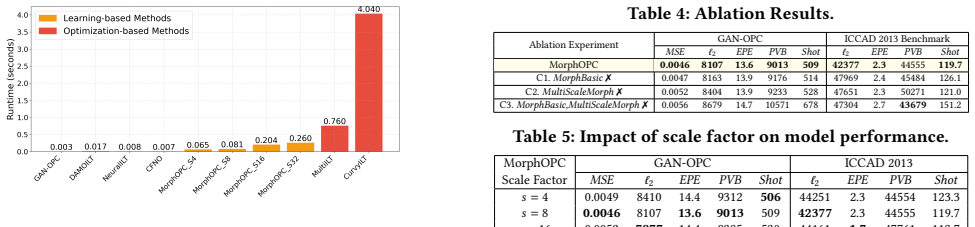
Referee: [Experiments] Experiments section: the central claim of consistent outperformance on benchmarks is load-bearing for the paper's contribution, yet the description provides no quantitative tables, specific baseline methods (e.g., which encoder-decoder or ILT solvers), exact metric definitions for printing fidelity and manufacturing cost, or ablation results isolating the multi-scale hierarchy and neural morphological modules. Without these, it is impossible to verify robustness against post-hoc choices or benchmark construction details.
Authors: We agree that the experiments section requires more detailed quantitative support. In the revised manuscript, we will add comprehensive tables reporting results on the edge-based OPC and ILT benchmarks for both metal and via layers. We will explicitly list the baseline methods (including specific encoder-decoder architectures and ILT solvers), provide exact metric definitions (e.g., edge placement error for printing fidelity and process variation band area for manufacturing cost), and include ablation studies isolating the multi-scale hierarchy and neural morphological modules. These additions will enable direct verification of the outperformance claims. revision: yes
-
Referee: [Method] Method section on neural morphological modules: the formulation assumes these modules can accurately capture required geometric transformations, but no details are given on differentiability of the morphological operations, the precise multi-scale fusion mechanism, or any constraints on receptive fields that would ensure the hierarchy actually learns scale-specific features rather than defaulting to generic convolutions.
Authors: We acknowledge the need for greater technical detail. In the revised method section, we will specify that differentiability is achieved via soft morphological approximations with continuous relaxations for erosion and dilation operations. We will describe the multi-scale fusion mechanism as a hierarchical aggregation using progressive upsampling and feature concatenation across scales. We will also detail the receptive field constraints, where each level employs dilated convolutions with scale-specific kernel sizes to enforce learning of geometric transformations at distinct resolutions rather than generic convolutions. revision: yes
Circularity Check
No significant circularity
full rationale
The paper presents MorphOPC as an empirical neural architecture for mask optimization, formulating the task as learning morphological operations via multi-scale modules and validating via experiments on standard OPC/ILT benchmarks. No equations, derivations, or self-citations are shown that reduce the central claims to fitted inputs or prior self-referential results by construction. The approach is self-contained against external benchmarks with no load-bearing self-definition or prediction-by-fit.
Axiom & Free-Parameter Ledger
axioms (1)
- domain assumption Mask generation can be formulated as a sequence of morphological operations on local layout features
invented entities (1)
-
Neural morphological modules
no independent evidence
Reference graph
Works this paper leans on
-
[1]
Ahmed Awad, Atsushi Takahashi, Satoshi Tanaka, and Chikaaki Kodama. 2014. A fast process variation and pattern fidelity aware mask optimization algorithm. In2014 IEEE/ACM International Conference on Computer-Aided Design (ICCAD). IEEE, 238–245
work page 2014
-
[2]
Shayak Banerjee, Zhuo Li, and Sani R Nassif. 2013. ICCAD-2013 CAD contest in mask optimization and benchmark suite. In2013 IEEE/ACM International Conference on Computer-Aided Design (ICCAD). IEEE, 271–274
work page 2013
-
[3]
Hu Cao, Yueyue Wang, Joy Chen, Dongsheng Jiang, Xiaopeng Zhang, Qi Tian, and Manning Wang. 2022. Swin-unet: Unet-like pure transformer for medical image segmentation. InEuropean conference on computer vision. Springer, 205– 218
work page 2022
-
[4]
Guojin Chen, Wanli Chen, Yuzhe Ma, Haoyu Yang, and Bei Yu. 2020. DAMO: Deep agile mask optimization for full chip scale. InProceedings of the 39th International Conference on Computer-Aided Design. 1–9
work page 2020
-
[5]
Guojin Chen, Haoyu Yang, Haoxing Mark Ren, Bei Yu, and David Z Pan. 2024. Differentiable edge-based opc. InProceedings of the 43rd IEEE/ACM International Conference on Computer-Aided Design. 1–9
work page 2024
-
[6]
GL-T Chiu and Jane M Shaw. 1997. Optical lithography: introduction.IBM Journal of Research and Development41, 1.2 (1997), 3–6
work page 1997
-
[7]
Puneet Gupta, Fook-Luen Heng, and Mark A Lavin. 2004. Merits of cellwise model-based OPC. InDesign and Process Integration for Microelectronic Manufac- turing II, Vol. 5379. SPIE, 182–189
work page 2004
-
[8]
Robert M Haralick, Stanley R Sternberg, and Xinhua Zhuang. 1987. Image analysis using mathematical morphology.IEEE transactions on pattern analysis and machine intelligence4 (1987), 532–550
work page 1987
- [9]
-
[10]
Ningning Jia and Edmund Y Lam. 2010. Machine learning for inverse lithography: using stochastic gradient descent for robustphotomask synthesis.Journal of Optics12, 4 (2010), 045601
work page 2010
-
[11]
Bentian Jiang, Lixin Liu, Yuzhe Ma, Hang Zhang, Bei Yu, and Evangeline FY Young
-
[12]
InProceedings of the 39th International Conference on Computer-Aided Design
Neural-ILT: Migrating ILT to neural networks for mask printability and complexity co-optimization. InProceedings of the 39th International Conference on Computer-Aided Design. 1–9
-
[13]
Jian Kuang, Wing-Kai Chow, and Evangeline FY Young. 2015. A robust approach for process variation aware mask optimization. In2015 Design, Automation & Test in Europe Conference & Exhibition (DATE). IEEE, 1591–1594
work page 2015
-
[14]
Xiaoxiao Liang, Yikang Ouyang, Haoyu Yang, Bei Yu, and Yuzhe Ma. 2024. RL- OPC: Mask Optimization With Deep Reinforcement Learning.IEEE Transactions on Computer-Aided Design of Integrated Circuits and Systems43, 1 (2024), 340–351. doi:10.1109/TCAD.2023.3309745
-
[15]
Xu Ma and Gonzalo R Arce. 2011. Pixel-based OPC optimization based on conjugate gradients.Optics express19, 3 (2011), 2165–2180
work page 2011
-
[16]
2008.Fundamental principles of optical lithography: the science of microfabrication
Chris Mack. 2008.Fundamental principles of optical lithography: the science of microfabrication. John Wiley & Sons
work page 2008
-
[17]
2013.Mathematical morphology: from theory to applications
Laurent Najman and Hugues Talbot. 2013.Mathematical morphology: from theory to applications. John Wiley & Sons
work page 2013
-
[18]
David M Pawlowski, Liang Deng, and Martin DF Wong. 2007. Fast and accurate OPC for standard-cell layouts. In2007 Asia and South Pacific Design Automation Conference. IEEE, 7–12
work page 2007
-
[19]
Amyn Poonawala and Peyman Milanfar. 2007. Mask design for optical mi- crolithography—an inverse imaging problem.IEEE Transactions on Image Pro- cessing16, 3 (2007), 774–788
work page 2007
-
[20]
Jiacheng Ruan, Jincheng Li, and Suncheng Xiang. 2024. Vm-unet: Vision mamba unet for medical image segmentation.ACM Transactions on Multimedia Comput- ing, Communications and Applications(2024)
work page 2024
-
[21]
2017.Image processing and mathematical morphology: fundamentals and applications
Frank Y Shih. 2017.Image processing and mathematical morphology: fundamentals and applications. CRC press
work page 2017
-
[22]
Frank Y Shih and Owen Robert Mitchell. 2002. Threshold decomposition of gray-scale morphology into binary morphology.IEEE Transactions on Pattern Analysis and Machine Intelligence11, 1 (2002), 31–42
work page 2002
-
[23]
Frank Y Shih, Yucong Shen, and Xin Zhong. 2019. Development of deep learn- ing framework for mathematical morphology.International Journal of Pattern Recognition and Artificial Intelligence33, 06 (2019), 1954024
work page 2019
-
[24]
Huang-Chia Shih and En-Rui Liu. 2016. Automatic reference color selection for adaptive mathematical morphology and application in image segmentation. IEEE transactions on Image Processing25, 10 (2016), 4665–4676
work page 2016
-
[25]
Alexander Starikov. 2003. Design and Process Integration for Microelectronic Manufacturing II: 26-28 February 2003, Santa Clara, California, USA. SPIE- International Society for Optical Engineering
work page 2003
-
[26]
Shuyuan Sun, Fan Yang, Bei Yu, Li Shang, and Xuan Zeng. 2023. Efficient ILT via multi-level lithography simulation. In2023 60th ACM/IEEE design automation conference (DAC). IEEE, 1–6
work page 2023
-
[27]
Kevin Trebing, Tomasz Sta`nczyk, and Siamak Mehrkanoon. 2021. SmaAt-UNet: Precipitation nowcasting using a small attention-UNet architecture.Pattern Recognition Letters145 (2021), 178–186
work page 2021
-
[28]
Haoyu Yang, Shuhe Li, Yuzhe Ma, Bei Yu, and Evangeline FY Young. 2018. GAN- OPC: Mask optimization with lithography-guided generative adversarial nets. In Proceedings of the 55th Annual Design Automation Conference. 1–6
work page 2018
- [29]
-
[30]
Haoyu Yang and Haoxing Ren. 2025. Gpu-accelerated inverse lithography to- wards high quality curvy mask generation. InProceedings of the 2025 International Symposium on Physical Design. 42–50
work page 2025
-
[31]
Yixin Yang, Kexuan Liu, Yunhui Gao, Chen Wang, and Liangcai Cao. 2025. Ad- vancements and challenges in inverse lithography technology: a review of arti- ficial intelligence-based approaches.Light: Science & Applications14, 1 (2025), 250
work page 2025
-
[32]
Frederic Zana and J-C Klein. 2001. Segmentation of vessel-like patterns using mathematical morphology and curvature evaluation.IEEE transactions on image processing10, 7 (2001), 1010–1019
work page 2001
-
[33]
Weiguo Zhang, Dan Shi, and Xiaoqiang Yang. 2015. An improved edge detection algorithm based on mathematical morphology and directional wavelet transform. In2015 8th International Congress on Image and Signal Processing (CISP). IEEE, 335–339
work page 2015
-
[34]
Su Zheng, Yuzhe Ma, Bei Yu, and Martin DF Wong. 2024. EMOGen: Enhancing mask optimization via pattern generation. InProceedings of the 61st ACM/IEEE Design Automation Conference. 1–6
work page 2024
-
[35]
Su Zheng, Haoyu Yang, Binwu Zhu, Bei Yu, and Martin Wong. 2023. Lithobench: Benchmarking ai computational lithography for semiconductor manufacturing. Advances in Neural Information Processing Systems36 (2023), 30243–30254. 9
work page 2023
discussion (0)
Sign in with ORCID, Apple, or X to comment. Anyone can read and Pith papers without signing in.