REVIEW 1 major objections 5 minor 61 references
This paper claims that a classification API can poison the soft labels it serves so that a distilling student suffers large accuracy drops while the teacher's top-1 prediction is preserved exactly, per query.
Reviewed by Pith at T0; open to challenge. T0 means a machine referee read the full paper against a public rubric. the ladder, T0–T4 →
T0 review · deepseek-v4-flash
2026-08-01 23:14 UTC pith:56F7N37U
load-bearing objection Sharp analytical defense with a real zero-cost guarantee, but the headline resistance numbers are only shown against a proxy that matches the attacker's student. the 1 major comments →
ADS-C: Antidistillation Sampling for Classification
The pith
A machine-rendered reading of the paper's core claim, the machinery that carries it, and where it could break.
Core claim
On its own terms, the paper's discovery is that the effectiveness of antidistillation sampling in classification is governed by the distribution of the teacher's per-input confidence margins. Well-trained teachers are overconfident, so the unmodified defense is inert at low strength, degrades the teacher faster than the student at moderate strength, and saturates with both parties near floors. The repair composes the perturbation under a per-input margin budget: each query receives the largest penalty strength that provably keeps its served top-1 unchanged (Proposition 1), making teacher cost exactly zero and reversing the incentive to distill from soft outputs.
What carries the argument
The per-input margin budget (Equation 8) is the device that carries the argument. For each query it computes, in closed form, the largest poison strength λ(x) that keeps the top-class logit at least m log-units ahead of every rival, using the teacher's logit gaps and the poison's per-rival gain rates. Proposition 1 then guarantees log p̂_t − log p̂_j ≥ min(m, gap_j) > 0, so the argmax is preserved per query, deterministically. The companion flip-threshold cumulative distribution F(λ) makes the unbudgeted defense's teacher cost predictable from teacher and proxy outputs alone.
Load-bearing premise
The proxy student trained on the teacher's training split must be a faithful stand-in for the actual attacker's student; if the attacker uses a very different architecture or data distribution, the gradient-directed poison may be aimed at the wrong weaknesses and the reported student degradation could shrink.
What would settle it
Train an attacker's student with an architecture substantially different from the defender's proxy (e.g., a transformer or a much larger CNN) on the same defended API and measure distilled-student top-1. If degradation on CIFAR-100 drops well below the reported 17.4 pp at λ=3 while teacher top-1 stays constant, the proxy-fidelity premise is violated. Alternatively, compute F(λ) from teacher and proxy outputs on a new dataset and check whether the measured teacher-cost curve under unmodified ADS matches the closed-form prediction to within about 2 pp; a mismatch would falsify the overconfidence
If this is right
- A defender can deploy ADS-C without losing any top-1 accuracy, eliminating the utility argument for serving undefended soft labels.
- Hard-label attackers gain nothing beyond the distillation floor, since the served argmax never changes; soft-label students fall below that floor, reversing the extraction incentive.
- Temperature softening is not a remedy: it shifts the phase transition according to F(τλ) but all configurations lie on the same unfavorable trade-off curve.
- The defended teacher's cost under unmodified ADS can be predicted in closed form from F(λ) before any student is trained.
- Relaxations (stochastic enforcement, minimum served strength) allow a defender to trade controlled teacher cost for attacker uncertainty, priced in closed form against the attacker's best response.
Where Pith is reading between the lines
- The margin-budget principle—cap any perturbation by the quantity it must not disturb—may generalize to other API services that expose continuous outputs, such as embedding or ranking endpoints, where a similar closed-form budget could be derived.
- The proxy-fidelity premise is the untested hinge: if attackers use student architectures or query distributions far from the defender's proxy, the poison direction may be misaimed and the measured degradation could shrink; the paper provides no sensitivity analysis over attacker architectures.
- The decomposition into argmax-safe versus flip-collateral damage suggests that future defenses should target informative non-target structure on representative inputs rather than maximize distributional distortion on uncertain rows.
- Because F(λ) is computable from teacher and proxy outputs alone, a deployment-time audit is possible: operators can pre-register the expected teacher-cost curve and monitor live attacks for deviations from it.
Editorial analysis
A structured set of objections, weighed in public.
Referee Report
Summary. This paper adapts Antidistillation Sampling (ADS) to image classification. It first diagnoses the direct transfer: because well-trained classifiers are overconfident and their per-input margins are heterogeneous, a global strength sweep passes through an inert window, a phase transition, and saturation, with the teacher-side cost predicted by the CDF F(λ) of per-input flip thresholds. It then proves that temperature softening rescales this transition by F_τ(λ)=F(τλ). The proposed method, ADS-C, composes the ADS perturbation under a per-input margin budget (Algorithm 1) so that the served top-1 prediction is provably unchanged for every query (Proposition 1), while the served probability vector is still perturbed. Empirically, ADS-C gives exactly zero teacher top-1 drop and lowers distilled-student accuracy by 17.4/29.6/13.3 pp on CIFAR-100/CIFAR-10/Tiny-ImageNet, below the hard-label distillation floor. The paper also analyzes stochastic budget enforcement and a minimum-strength floor, reports a negative result on margin-ranked sacrifice, and releases code and experiment drivers.
Significance. If the empirical student-degradation results are robust, this is a valuable contribution: it provides a clean, analytically predicted transition-curve characterization of an inference-time perturbation defense, a deterministic argmax-preservation guarantee with a correct and simple proof, careful ablations including a hard-label control and a served-fidelity comparison, and reproducible code. The analytical core is genuinely parameter-free: F(λ) is computed from teacher and proxy outputs before any student is trained, the temperature rescaling F_τ(λ)=F(τλ) is a closed-form prediction, and Proposition 1 is proven. The main caveat is that the headline security claim is demonstrated only for a proxy that matches the attacker's student architecture, which is narrower than the stated threat model; this is the load-bearing gap that the major comment below addresses.
major comments (1)
- [III, IV-B, VIII-A] The threat model (Sec. III) explicitly gives the adversary a student architecture of its choosing, but in the evaluation the proxy always matches the student architecture (Sec. VIII-A: 'The proxy always matches the student architecture'), and the only proxy-state variation tested (Sec. V-C) changes the proxy's training signal, not its architecture or query distribution. The student-degradation numbers (17.4/29.6/13.3 pp) are therefore established only for an attacker whose student coincides with the defender's proxy. Nothing in the mechanism guarantees that the gradient direction computed from P also degrades a differently structured student: the finite-difference Δ̂ is a direction in P's output space, not a universal poison. If a mismatched student partially ignores that direction, the reported drops could shrink and the 'reversed incentive' claim of Sec. VIII-E could fail, even though
minor comments (5)
- [V-D] The definition of the inert window is stated three ways: 'λ < 0.12 on CIFAR-100, λ < 0.30 on CIFAR-10', the strict transition threshold λ_c≈0.02/0.09, and the teacher-cost onset at 0.066/0.135. Please clarify which definition is used for the shaded inert region and reconcile the numbers, since 'inert' should mean both teacher and student are within noise.
- [VI-B] The text calls F(τλ) 'the pre-registered prediction'. Since there is no evidence of a formal preregistration, 'analytically predicted' or 'closed-form prediction' would be more accurate.
- [III vs IV-B] The threat model grants the defender only a 'modest labeled holdout set', but the proxy is trained on the teacher's full training split (Sec. IV-B). These are different resource assumptions. Please state clearly whether the defender is assumed to have the original labeled training data.
- [VIII-B, Table 2] Under a deterministic argmax-preservation guarantee, the reported 'observed ≤1.4×10^-6 pp' teacher drop is surprising; if the served argmax is identical to the teacher argmax on every query, the accuracy difference should be exactly zero. Please explain how this number is computed (e.g., floating-point summation of identical booleans) so readers do not think the guarantee is approximate.
- [VIII (general)] The experimental section compares ADS-C only with unmodified ADS and its own ablations. A direct comparison with an existing perturbation defense (e.g., Reverse Sigmoid or ModelGuard) on the same teacher/student pairs would support the claim of being 'the first antidistillation defense for classification whose utility cost is exactly zero' and would help place the trade-off-rate improvement in context.
Circularity Check
No significant circularity; the zero-cost guarantee is a stated construction, and the transition/temperature predictions are parameter-free forward models validated against measurements.
full rationale
I walked the derivation chain and found no step that reduces to its own inputs by construction or by a load-bearing self-citation. The transition-curve prediction F(λ) is computed as the flip-threshold CDF (Eqs. 5–6) from teacher logits and proxy outputs, then compared with measured teacher-accuracy drops; the reported 1–2 pp residual shows it is an empirical forward model, not an identity. The temperature rescaling Fτ(λ) = F(τλ) follows from softmax logit scaling and is verified against trained student runs with no parameter fit to the outcome. Proposition 1 is an analytic guarantee about Algorithm 1: the budget (8) is explicitly the flip threshold with a margin floor held in reserve, so argmax preservation and zero teacher cost follow by algebra; the paper transparently presents this as a construction rather than as an independent empirical prediction. The headline student-degradation numbers (17.4/29.6/13.3 pp) are fresh measurements from students trained on the served vectors, not fitted or read off from the proxy. The only self-referential citation is an acknowledgment of RIT Research Computing, which is not load-bearing. The proxy-matches-student-architecture choice is a threat-model limitation with implications for external validity, but that is a robustness/correctness concern, not a circular step. The paper's stated limitations (e.g., no formal analysis of poison-subtraction attacks, no large-scale validation) are explicit scope caveats and do not indicate circularity.
Axiom & Free-Parameter Ledger
free parameters (3)
- Defense strength λ =
swept 0.1–3 (ADS-C); 0–10 (unmodified ADS)
- Margin floor m =
0.05
- Finite-difference step ε =
3e-3 (CIFAR-10/100), 1e-2 (Tiny-ImageNet)
axioms (6)
- domain assumption The proxy student P, trained on the teacher's training split, faithfully represents the unknown attacker's student, so the gradient of ℓ(θ_P) points in a direction that harms the true distiller.
- domain assumption The attacker uses unlabeled in-distribution queries and pure soft-label KL loss at temperature 1, with no ground-truth labels.
- domain assumption The defender holds a labeled holdout set and can train a small proxy offline; the teacher cannot be retrained.
- domain assumption Served utility is measured exclusively by top-1 label accuracy; full-vector consumers bear a separate served-fidelity cost.
- domain assumption Every input has a unique teacher argmax, so Proposition 1's condition is met.
- standard math Softmax is invariant to additive logit constants and log-probability differences equal logit gaps; standard calculus used in Proposition 1 proof.
read the original abstract
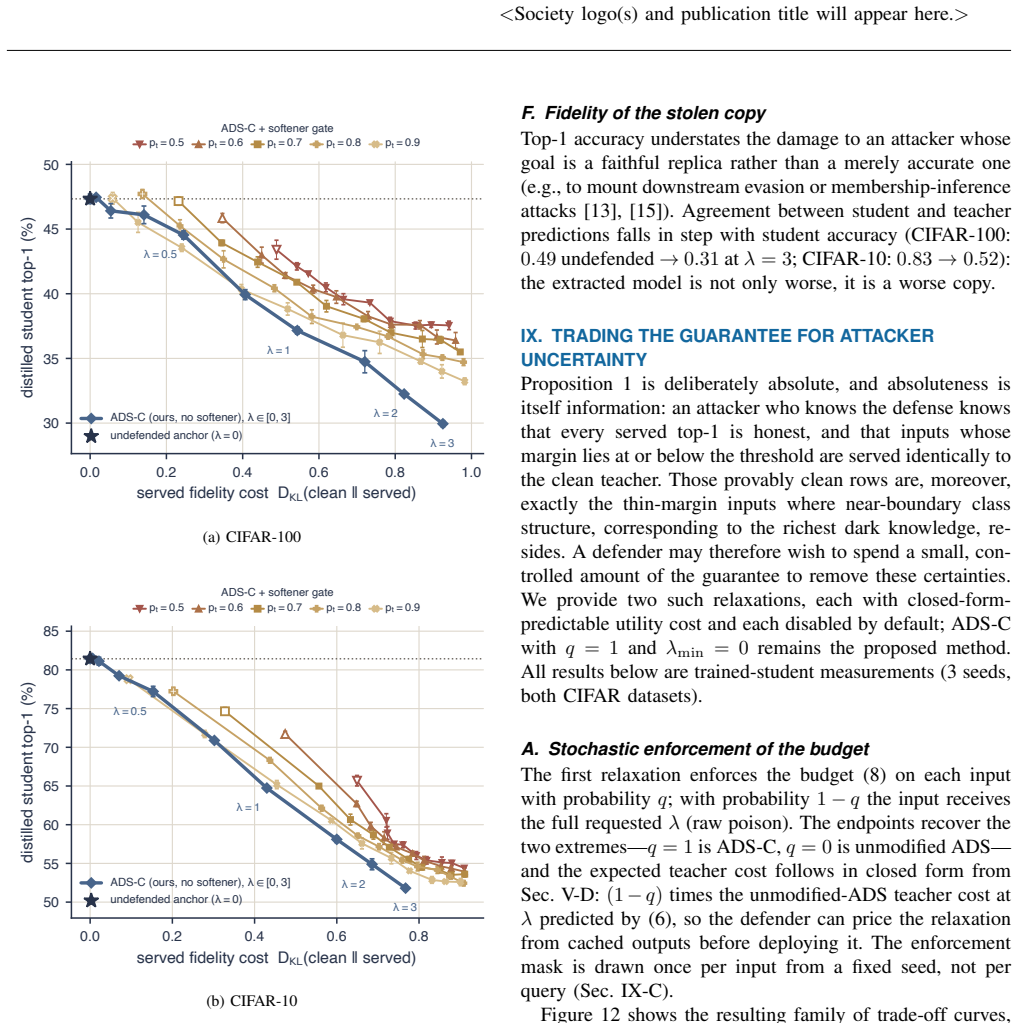
Knowledge distillation enables an adversary to replicate a proprietary classifier by querying its prediction interface and training a surrogate on the returned probability vectors. Antidistillation sampling, proposed for large language models, counters this threat with an input-dependent, gradient-directed perturbation of the served distribution; its transfer to classification has not been studied. Adapting the defense to classification, we show its behavior is governed by the distribution of the teacher's per-input confidence margins. Because well-trained classifiers are severely overconfident, the direct transfer exhibits an inert window: below a closed-form-predictable threshold, it affects neither attacker nor defender; beyond it, the defense undergoes a phase transition and degrades the teacher faster than the attacker's student. Temperature softening rescales the transition in closed form, and every temperature configuration lies on the same unfavorable trade-off curve. Our method, ADS-C, composes the perturbation under a closed-form, per-input margin budget that provably preserves every served top-1 prediction, so the defended teacher's accuracy equals the undefended teacher's identically. Under this guarantee the distilled student still loses 17.4 percentage points on CIFAR-100, 29.6 on CIFAR-10, and 13.3 on Tiny-ImageNet; matching this degradation with the unmodified defense costs 27.5, 32.9, and 22.2 points of teacher accuracy. Because served labels are unchanged, a hard-label attacker gains nothing, while the defended soft output trains a student up to 29.7 points below that floor: the incentive to distill served probabilities is not merely removed but reversed. To our knowledge, ADS-C is the first antidistillation defense for classification whose utility cost is exactly zero.
Figures




Reference graph
Works this paper leans on
-
[1]
Learning complex, extended sequences using the principle of history compression,
J. Schmidhuber, “Learning complex, extended sequences using the principle of history compression,”Neural computation, vol. 4, no. 2, pp. 234–242, 1992
1992
-
[2]
Distilling the knowledge in a neural network,
G. Hinton, O. Vinyals, and J. Dean, “Distilling the knowledge in a neural network,”arXiv preprint arXiv:1503.02531, 2015
Pith/arXiv arXiv 2015
-
[3]
Mobilenets: Efficient convolutional neural networks for mobile vision applications,
A. G. Howard, M. Zhu, B. Chen, D. Kalenichenko, W. Wang, T. Weyand, M. Andreetto, and H. Adam, “Mobilenets: Efficient convolutional neural networks for mobile vision applications,”arXiv preprint arXiv:1704.04861, 2017
Pith/arXiv arXiv 2017
-
[4]
Distilbert, a distilled version of bert: smaller, faster, cheaper and lighter,
V . Sanh, L. Debut, J. Chaumond, and T. Wolf, “Distilbert, a distilled version of bert: smaller, faster, cheaper and lighter,”arXiv preprint arXiv:1910.01108, 2019
Pith/arXiv arXiv 1910
-
[5]
Training data-efficient image transformers & distillation through attention,
H. Touvron, M. Cord, M. Douze, F. Massa, A. Sablayrolles, and H. J ´egou, “Training data-efficient image transformers & distillation through attention,” inInternational conference on machine learning. PMLR, 2021, pp. 10 347–10 357
2021
-
[6]
Knowledge distillation: A survey,
J. Gou, B. Yu, S. J. Maybank, and D. Tao, “Knowledge distillation: A survey,”International journal of computer vision, vol. 129, no. 6, pp. 1789–1819, 2021
2021
-
[7]
Stealing machine learning models via prediction{APIs},
F. Tram `er, F. Zhang, A. Juels, M. K. Reiter, and T. Ristenpart, “Stealing machine learning models via prediction{APIs},” in25th USENIX security symposium (USENIX Security 16), 2016, pp. 601–618
2016
-
[8]
A survey on model extraction attacks and defenses for large language models,
K. Zhao, L. Li, K. Ding, N. Z. Gong, Y . Zhao, and Y . Dong, “A survey on model extraction attacks and defenses for large language models,” inProceedings of the 31st ACM SIGKDD Conference on Knowledge Discovery and Data Mining V . 2, 2025, pp. 6227–6236
2025
-
[9]
DeepSeek trained AI model using distillation, now a dis- ruptive force,
CNBC, “DeepSeek trained AI model using distillation, now a dis- ruptive force,” CNBC, Feb. 2025, https://www.cnbc.com/2025/02/21/ deepseek-trained-ai-model-using-distillation-now-a-disruptive-force. html
2025
-
[10]
Detecting and preventing distillation attacks,
Anthropic, “Detecting and preventing distillation attacks,” Anthropic News, February 2026, accessed: March 23,
2026
-
[11]
Deep intellectual property protection: A survey,
Y . Sun, T. Liu, P. Hu, Q. Liao, S. Fu, N. Yu, D. Guo, Y . Liu, and L. Liu, “Deep intellectual property protection: A survey,”arXiv preprint arXiv:2304.14613, 2023
Pith/arXiv arXiv 2023
-
[12]
Intellectual property protection for deep learning model and dataset intelligence,
Y . Jiang, Y . Gao, C. Zhou, H. Hu, S. Chen, A. Fu, and W. Susilo, “Intellectual property protection for deep learning model and dataset intelligence,”Engineering Applications of Artificial Intelligence, vol. 163, p. 113024, 2026
2026
-
[13]
Membership inference attacks against machine learning models,
R. Shokri, M. Stronati, C. Song, and V . Shmatikov, “Membership inference attacks against machine learning models,” in2017 IEEE symposium on security and privacy (SP). IEEE, 2017, pp. 3–18
2017
-
[14]
A. Salem, Y . Zhang, M. Humbert, P. Berrang, M. Fritz, and M. Backes, “Ml-leaks: Model and data independent membership inference at- tacks and defenses on machine learning models,”arXiv preprint arXiv:1806.01246, 2018
Pith/arXiv arXiv 2018
-
[15]
Practical black-box attacks against machine learning,
N. Papernot, P. McDaniel, I. Goodfellow, S. Jha, Z. B. Celik, and A. Swami, “Practical black-box attacks against machine learning,” in Proceedings of the 2017 ACM on Asia conference on computer and communications security, 2017, pp. 506–519
2017
-
[16]
Evasion attacks against machine learning at test time,
B. Biggio, I. Corona, D. Maiorca, B. Nelson, N. ˇSrndi´c, P. Laskov, G. Giacinto, and F. Roli, “Evasion attacks against machine learning at test time,” inJoint European conference on machine learning and knowledge discovery in databases. Springer, 2013, pp. 387–402
2013
-
[17]
Adversarial learning,
D. Lowd and C. Meek, “Adversarial learning,” inProceedings of the eleventh ACM SIGKDD international conference on Knowledge discovery in data mining, 2005, pp. 641–647
2005
-
[18]
Privacy in pharmacogenetics: An{End-to-End}case study of person- alized warfarin dosing,
M. Fredrikson, E. Lantz, S. Jha, S. Lin, D. Page, and T. Ristenpart, “Privacy in pharmacogenetics: An{End-to-End}case study of person- alized warfarin dosing,” in23rd USENIX security symposium (USENIX Security 14), 2014, pp. 17–32
2014
-
[19]
Model inversion attacks that exploit confidence information and basic countermeasures,
M. Fredrikson, S. Jha, and T. Ristenpart, “Model inversion attacks that exploit confidence information and basic countermeasures,” in Proceedings of the 22nd ACM SIGSAC conference on computer and communications security, 2015, pp. 1322–1333
2015
-
[20]
Hacking smart machines with smarter ones: How to extract meaningful data from machine learning classifiers,
G. Ateniese, L. V . Mancini, A. Spognardi, A. Villani, D. Vitali, and G. Felici, “Hacking smart machines with smarter ones: How to extract meaningful data from machine learning classifiers,”International Journal of Security and Networks, vol. 10, no. 3, pp. 137–150, 2015
2015
-
[21]
Artificial intelligence and machine learn- ing in clinical medicine, 2023,
C. J. Haug and J. M. Drazen, “Artificial intelligence and machine learn- ing in clinical medicine, 2023,”New England Journal of Medicine, vol. 388, no. 13, pp. 1201–1208, 2023
2023
-
[22]
Financial fraud detection through the application of machine learning techniques: a literature review,
L. Hernandez Aros, L. X. Bustamante Molano, F. Gutierrez-Portela, J. J. Moreno Hernandez, and M. S. Rodr ´ıguez Barrero, “Financial fraud detection through the application of machine learning techniques: a literature review,”Humanities and Social Sciences Communications, vol. 11, no. 1, pp. 1–22, 2024
2024
-
[23]
Learn- ing lightweight object detectors via multi-teacher progressive distilla- tion,
S. Cao, M. Li, J. Hays, D. Ramanan, Y .-X. Wang, and L. Gui, “Learn- ing lightweight object detectors via multi-teacher progressive distilla- tion,” inInternational Conference on Machine Learning. PMLR, 2023, pp. 3577–3598
2023
-
[24]
Y . Savani, A. Trockman, Z. Feng, A. Schwarzschild, A. Robey, M. Finzi, and J. Z. Kolter, “Antidistillation sampling,”arXiv preprint arXiv:2504.13146, 2025
arXiv 2025
-
[25]
Defending against neural network model stealing attacks using deceptive perturbations,
T. Lee, B. Edwards, I. Molloy, and D. Su, “Defending against neural network model stealing attacks using deceptive perturbations,” in2019 IEEE Security and Privacy Workshops (SPW). IEEE, 2019, pp. 43– 49
2019
-
[26]
D-dae: Defense- penetrating model extraction attacks,
Y . Chen, R. Guan, X. Gong, J. Dong, and M. Xue, “D-dae: Defense- penetrating model extraction attacks,” in2023 IEEE Symposium on Security and Privacy (SP). IEEE, 2023, pp. 382–399
2023
-
[27]
On calibration of modern neural networks,
C. Guo, G. Pleiss, Y . Sun, and K. Q. Weinberger, “On calibration of modern neural networks,” inInternational conference on machine learning. PMLR, 2017, pp. 1321–1330
2017
-
[28]
Model compres- sion,
C. Bucilu ˇa, R. Caruana, and A. Niculescu-Mizil, “Model compres- sion,” inProceedings of the 12th ACM SIGKDD international confer- ence on Knowledge discovery and data mining, 2006, pp. 535–541
2006
-
[29]
Do deep nets really need to be deep?
J. Ba and R. Caruana, “Do deep nets really need to be deep?”Advances in neural information processing systems, vol. 27, 2014
2014
-
[30]
Born again neural networks,
T. Furlanello, Z. Lipton, M. Tschannen, L. Itti, and A. Anandkumar, “Born again neural networks,” inInternational conference on machine learning. PMLR, 2018, pp. 1607–1616
2018
-
[31]
Understanding and improving knowledge distillation,
J. Tang, R. Shivanna, Z. Zhao, D. Lin, A. Singh, E. H. Chi, and S. Jain, “Understanding and improving knowledge distillation,”arXiv preprint arXiv:2002.03532, 2020
Pith/arXiv arXiv 2002
-
[32]
Knockoff nets: Stealing functionality of black-box models,
T. Orekondy, B. Schiele, and M. Fritz, “Knockoff nets: Stealing functionality of black-box models,” inProceedings of the IEEE/CVF conference on computer vision and pattern recognition, 2019, pp. 4954–4963
2019
-
[33]
Data-free model extraction,
J.-B. Truong, P. Maini, R. J. Walls, and N. Papernot, “Data-free model extraction,” inProceedings of the IEEE/CVF conference on computer vision and pattern recognition, 2021, pp. 4771–4780
2021
-
[34]
Black-box behavioral distillation breaks safety alignment in medical llms,
S. Jahan and R. Sun, “Black-box behavioral distillation breaks safety alignment in medical llms,”arXiv preprint arXiv:2512.09403, 2025
arXiv 2025
-
[35]
I know what you trained last summer: A survey on stealing machine learning models and defences,
D. Oliynyk, R. Mayer, and A. Rauber, “I know what you trained last summer: A survey on stealing machine learning models and defences,” ACM Computing Surveys, vol. 55, no. 14s, pp. 1–41, 2023
2023
-
[36]
A comprehensive de- fense framework against model extraction attacks,
W. Jiang, H. Li, G. Xu, T. Zhang, and R. Lu, “A comprehensive de- fense framework against model extraction attacks,”IEEE Transactions on Dependable and Secure Computing, vol. 21, no. 2, pp. 685–700, 2023
2023
-
[37]
A survey on knowledge distillation of large language models,
X. Xu, M. Li, C. Tao, T. Shen, R. Cheng, J. Li, C. Xu, D. Tao, and T. Zhou, “A survey on knowledge distillation of large language models,”arXiv preprint arXiv:2402.13116, 2024
Pith/arXiv arXiv 2024
-
[38]
Undistillable: Making a nasty teacher that cannot teach students,
H. Ma, T. Chen, T.-K. Hu, C. You, X. Xie, and Z. Wang, “Undistillable: Making a nasty teacher that cannot teach students,”arXiv preprint arXiv:2105.07381, 2021
Pith/arXiv arXiv 2021
-
[39]
Adversarial sparse teacher: Defense against distillation-based model stealing attacks using adversarial examples,
E. Yilmaz and H. Y . Keles, “Adversarial sparse teacher: Defense against distillation-based model stealing attacks using adversarial examples,”IEEE Access, 2025
2025
-
[40]
Defending against model extraction attacks with ood feature learning and decision boundary confusion,
C. Liang, J. Huang, Z. Zhang, and S. Zhang, “Defending against model extraction attacks with ood feature learning and decision boundary confusion,”Computers & Security, vol. 136, p. 103563, 2024
2024
-
[41]
Misleader: Defending against model extraction with ensembles of distilled models,
X. Cheng, M. Zheng, S. Zhu, and Y . Dong, “Misleader: Defending against model extraction with ensembles of distilled models,”arXiv preprint arXiv:2506.02362, 2025
Pith/arXiv arXiv 2025
-
[42]
Prada: protecting against dnn model stealing attacks,
M. Juuti, S. Szyller, S. Marchal, and N. Asokan, “Prada: protecting against dnn model stealing attacks,” in2019 IEEE European Sympo- sium on Security and Privacy (EuroS&P). IEEE, 2019, pp. 512–527. VOLUME , 17 Ullah et al.:
2019
-
[43]
Misguide: Defense against data-free deep learning model extraction,
M. Gurve, S. Behera, S. Ahlawat, and Y . Prasad, “Misguide: Defense against data-free deep learning model extraction,”arXiv preprint arXiv:2403.18580, 2024
Pith/arXiv arXiv 2024
-
[44]
Radep: A resilient adaptive defense framework against model extraction attacks,
A. Chakraborty, S. F. Ahamed, S. Roy, S. Banerjee, K. Choi, A. Rah- man, A. Hu, E. Bowen, and S. Shetty, “Radep: A resilient adaptive defense framework against model extraction attacks,” in2025 Inter- national Wireless Communications and Mobile Computing (IWCMC). IEEE, 2025, pp. 1241–1246
2025
-
[45]
The Sybil attack,
J. R. Douceur, “The Sybil attack,” inInternational Workshop on Peer- to-Peer Systems. Springer, 2002, pp. 251–260
2002
-
[46]
Cloudleak: Large-scale deep learning models stealing through adversarial exam- ples
H. Yu, K. Yang, T. Zhang, Y .-Y . Tsai, T.-Y . Ho, and Y . Jin, “Cloudleak: Large-scale deep learning models stealing through adversarial exam- ples.” inNDSS, vol. 38, 2020, p. 102
2020
-
[47]
Embedding water- marks into deep neural networks,
Y . Uchida, Y . Nagai, S. Sakazawa, and S. Satoh, “Embedding water- marks into deep neural networks,” inProceedings of the 2017 ACM on international conference on multimedia retrieval, 2017, pp. 269–277
2017
-
[48]
Entangled watermarks as a defense against model extraction,
H. Jia, C. A. Choquette-Choo, V . Chandrasekaran, and N. Papernot, “Entangled watermarks as a defense against model extraction,” in30th USENIX security symposium (USENIX Security 21), 2021, pp. 1937– 1954
2021
-
[49]
Dawn: Dynamic adversarial watermarking of neural networks,
S. Szyller, B. G. Atli, S. Marchal, and N. Asokan, “Dawn: Dynamic adversarial watermarking of neural networks,” inProceedings of the 29th ACM international conference on multimedia, 2021, pp. 4417– 4425
2021
-
[50]
Defense against model extraction attack by bayesian active watermarking,
Z. Wang, Y . Wu, and H. Huang, “Defense against model extraction attack by bayesian active watermarking,” inForty-first International Conference on Machine Learning, 2024
2024
-
[51]
Prediction poisoning: To- wards defenses against dnn model stealing attacks,
T. Orekondy, B. Schiele, and M. Fritz, “Prediction poisoning: To- wards defenses against dnn model stealing attacks,”arXiv preprint arXiv:1906.10908, 2019
Pith/arXiv arXiv 1906
-
[52]
{ModelGuard}:{Information-Theoretic}defense against model extraction attacks,
M. Tang, A. Dai, L. DiValentin, A. Ding, A. Hass, N. Z. Gong, Y . Chen et al., “{ModelGuard}:{Information-Theoretic}defense against model extraction attacks,” in33rd USENIX Security Symposium (USENIX Security 24), 2024, pp. 5305–5322
2024
-
[53]
Efficient model stealing defense with noise transition matrix,
D.-D. Wu, C. Fu, W. Wu, W. Xia, X. Zhang, J. Zhou, and M.-L. Zhang, “Efficient model stealing defense with noise transition matrix,” inProceedings of the IEEE/CVF Conference on Computer Vision and Pattern Recognition, 2024, pp. 24 305–24 315
2024
-
[54]
Towards distillation-resistant large lan- guage models: An information-theoretic perspective,
H. Fang, T. Zhang, T. Zhuang, J. Kong, K. Gao, B. Chen, L. Liang, S.-T. Xia, and K. Xu, “Towards distillation-resistant large lan- guage models: An information-theoretic perspective,”arXiv preprint arXiv:2602.03396, 2026
Pith/arXiv arXiv 2026
-
[55]
Regu- larizing neural networks by penalizing confident output distributions,
G. Pereyra, G. Tucker, J. Chorowski, Ł. Kaiser, and G. Hinton, “Regu- larizing neural networks by penalizing confident output distributions,” arXiv preprint arXiv:1701.06548, 2017
Pith/arXiv arXiv 2017
-
[56]
Adaptive temperature scal- ing for robust calibration of deep neural networks,
S. A. Balanya, J. Maronas, and D. Ramos, “Adaptive temperature scal- ing for robust calibration of deep neural networks,”Neural Computing and Applications, vol. 36, no. 14, pp. 8073–8095, 2024
2024
-
[57]
Sample- dependent adaptive temperature scaling for improved calibration,
T. Joy, F. Pinto, S.-N. Lim, P. H. Torr, and P. K. Dokania, “Sample- dependent adaptive temperature scaling for improved calibration,” in Proceedings of the AAAI Conference on Artificial Intelligence, vol. 37, no. 12, 2023, pp. 14 919–14 926
2023
-
[58]
Attended temperature scaling: a practical approach for calibrating deep neural networks,
A. S. Mozafari, H. S. Gomes, W. Le ˜ao, S. Janny, and C. Gagn ´e, “Attended temperature scaling: a practical approach for calibrating deep neural networks,”arXiv preprint arXiv:1810.11586, 2018
Pith/arXiv arXiv 2018
-
[59]
Asymmetric temperature scaling makes larger networks teach well again,
X.-C. Li, W.-S. Fan, S. Song, Y . Li, S. Yunfeng, D.-C. Zhanet al., “Asymmetric temperature scaling makes larger networks teach well again,”Advances in neural information processing systems, vol. 35, pp. 3830–3842, 2022
2022
-
[60]
Research computing services,
R. I. of Technology, “Research computing services,” 2026. [Online]. Available: https://www.rit.edu/researchcomputing/ Khawaja Abaid Ullahreceived the B.S. de- gree in Computer Science from the University of Narowal, Pakistan in 2021, and the M.S. degree in Artificial Intelligence from the Rochester Insti- tute of Technology (RIT), Rochester, NY , USA, in ...
2026
-
[2026]
Available: https://www.anthropic.com/news/ detecting-and-preventing-distillation-attacks
[Online]. Available: https://www.anthropic.com/news/ detecting-and-preventing-distillation-attacks
discussion (0)
Sign in with ORCID, Apple, or X to comment. Anyone can read and Pith papers without signing in.