OrbitForge: Text-to-3D Scene Generation via Reconstruction-Anchored Video Synthesis
Pith reviewed 2026-06-26 00:10 UTC · model grok-4.3
The pith
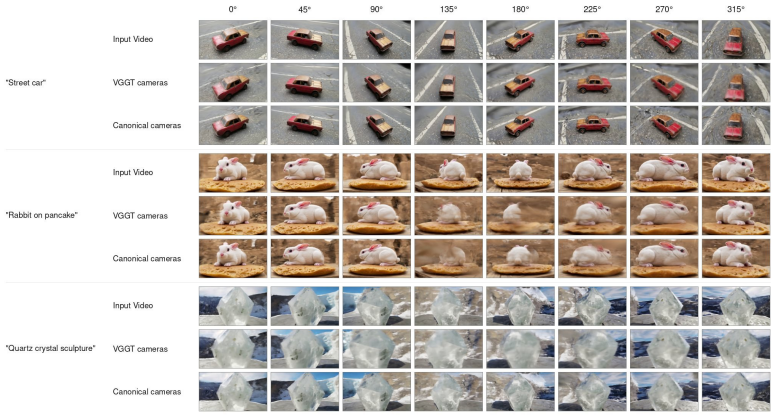
OrbitForge converts a single text-generated video into a consistent closed-orbit 3D Gaussian Splatting scene by anchoring reconstruction to complete missing viewpoints.
A machine-rendered reading of the paper's core claim, the machinery that carries it, and where it could break.
Core claim
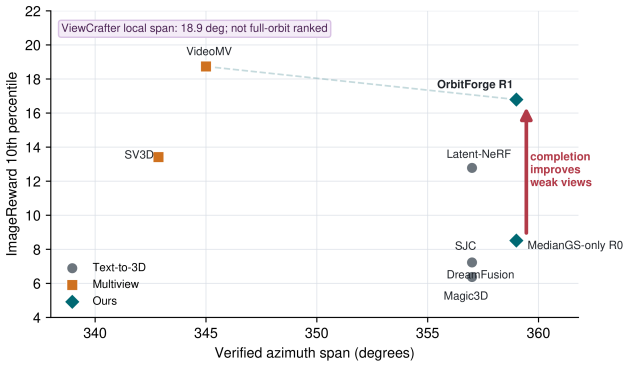
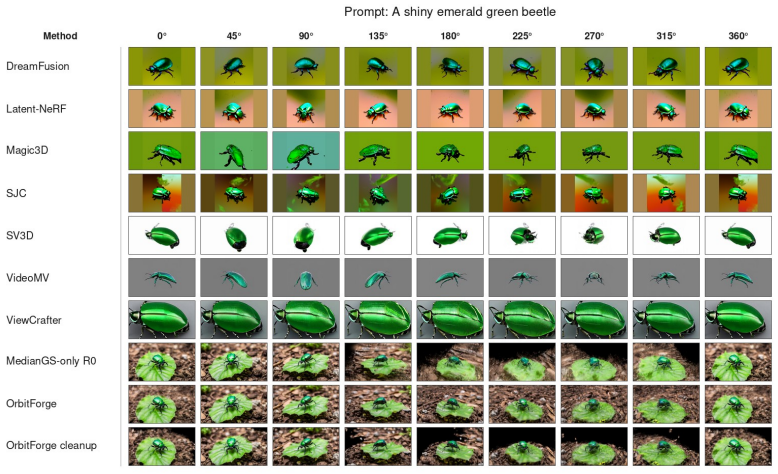
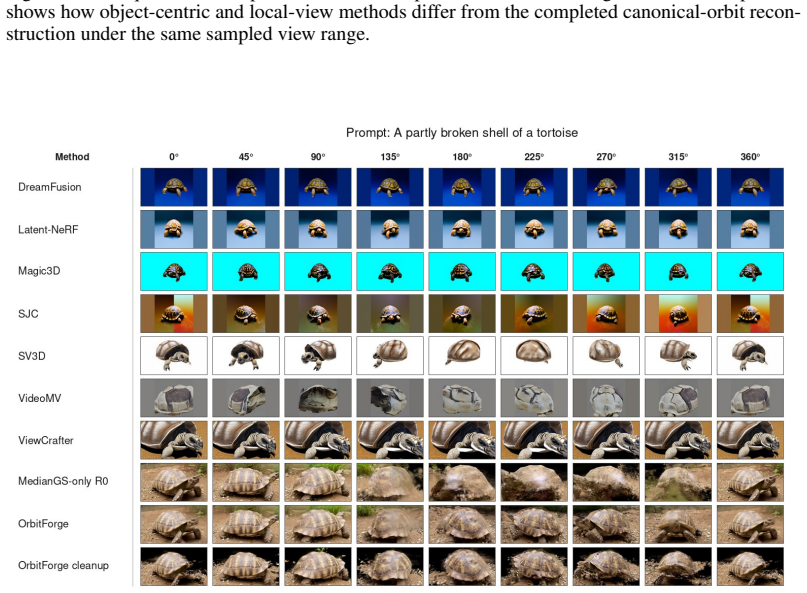
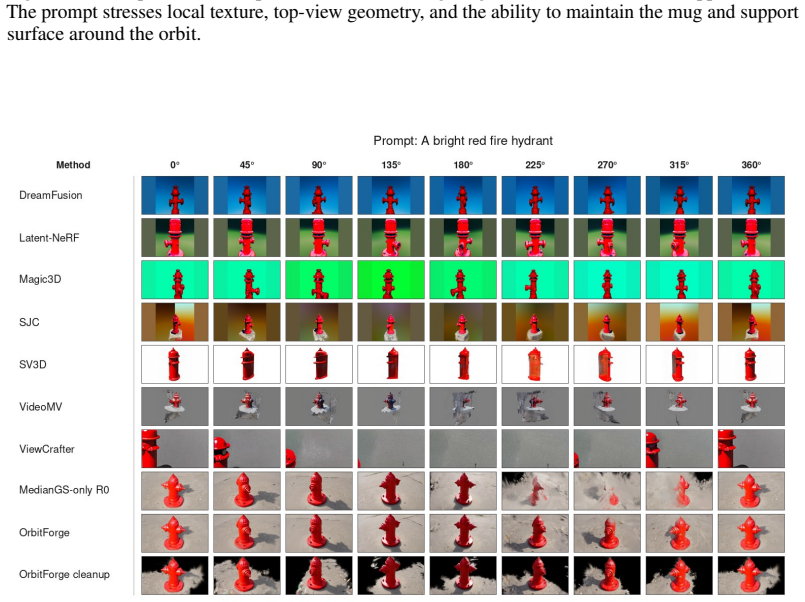
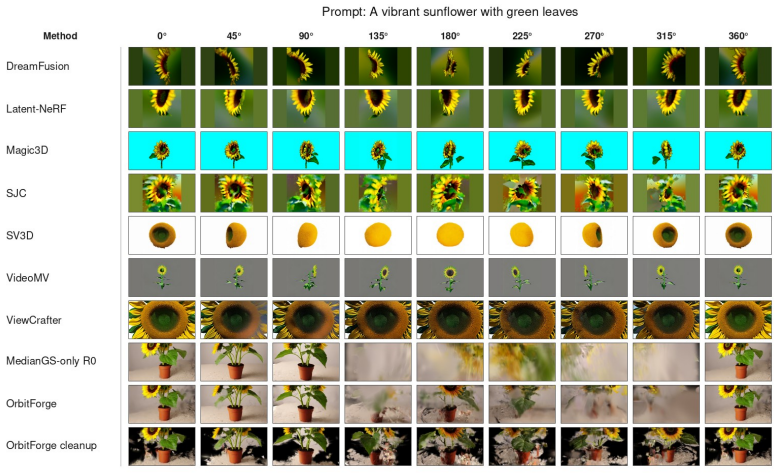
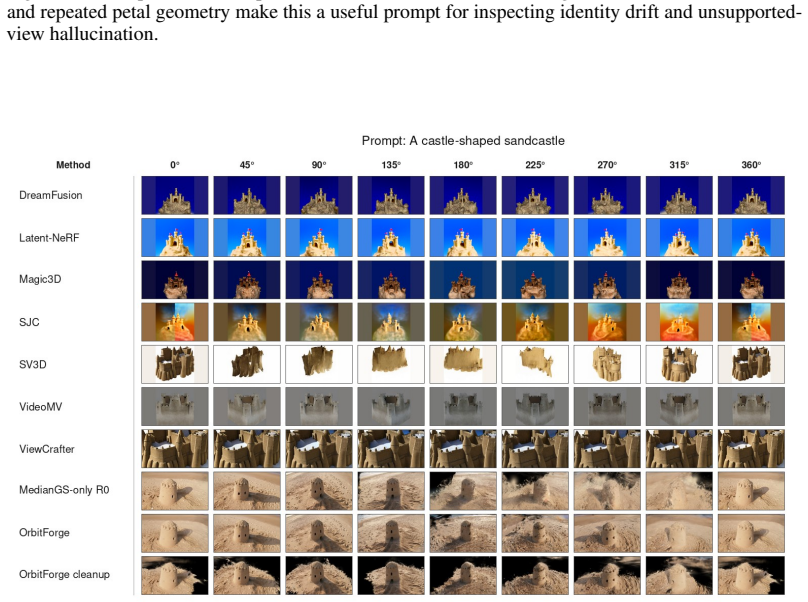
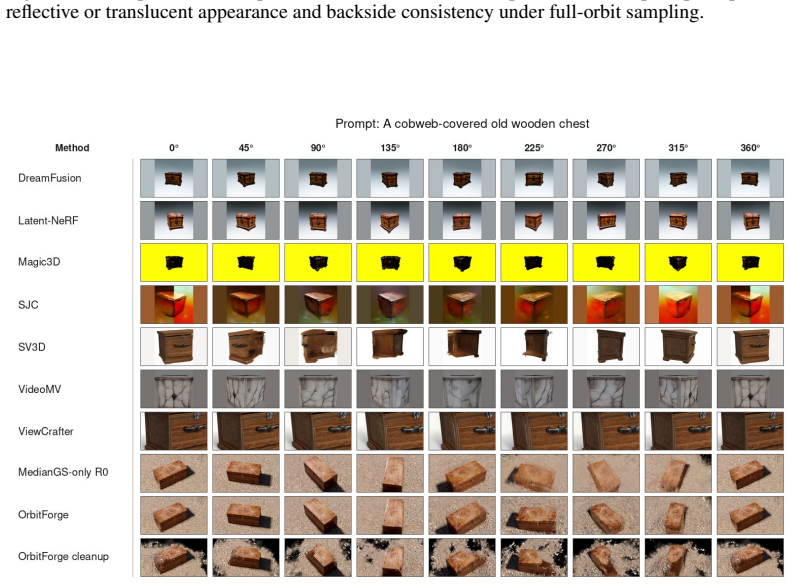
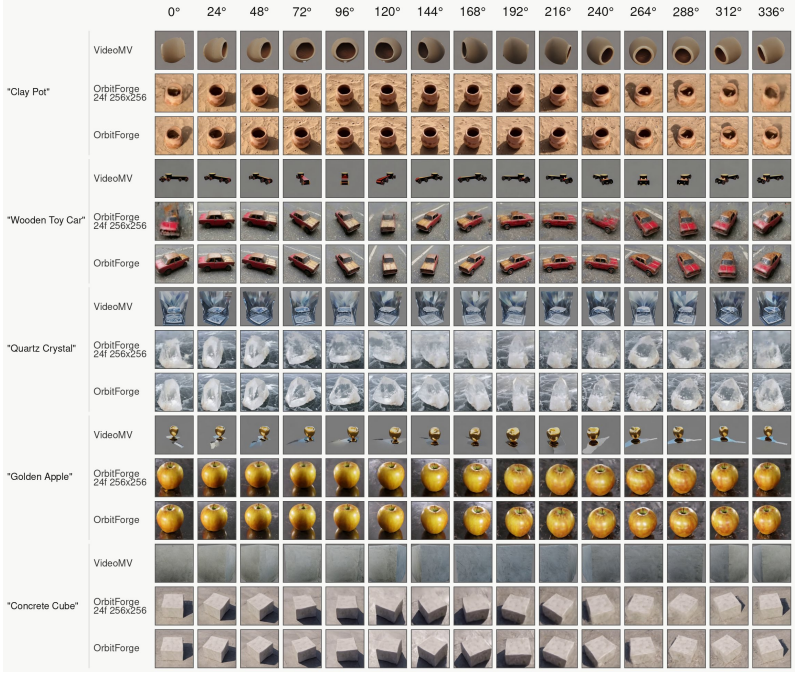
OrbitForge uses 3D reconstruction as an anchor to detect missing viewpoints in a text-generated video, prompts the video model to synthesize only those views, and reconstructs the completed orbit into a final Gaussian Splatting scene; on a 300-prompt audit this yields a 359.0-degree median span and raises unsupported-bin Q10 ImageReward from 8.07 to 16.36 relative to MedianGS-only reconstruction while staying competitive on coverage-quality metrics.
What carries the argument
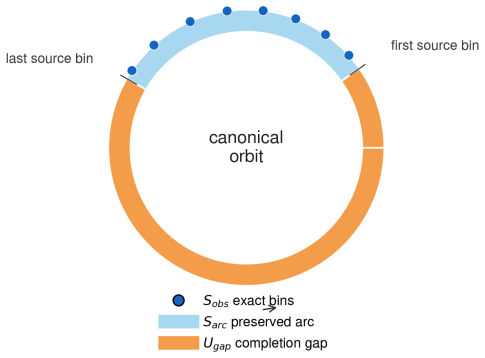
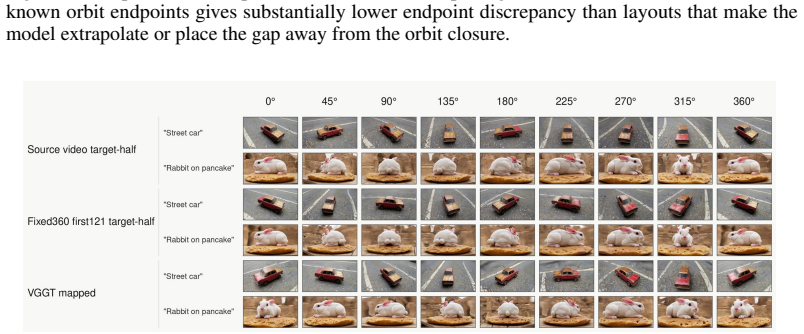
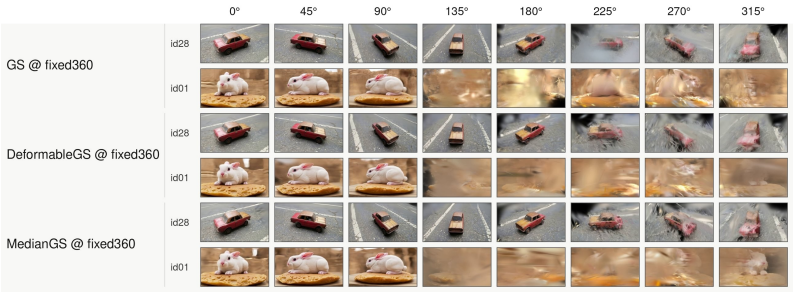
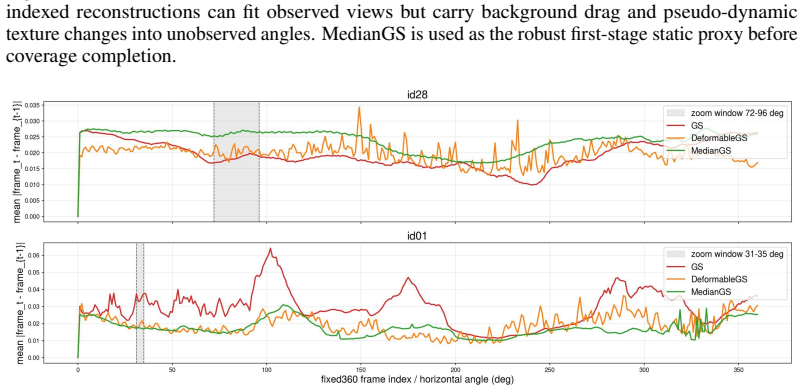
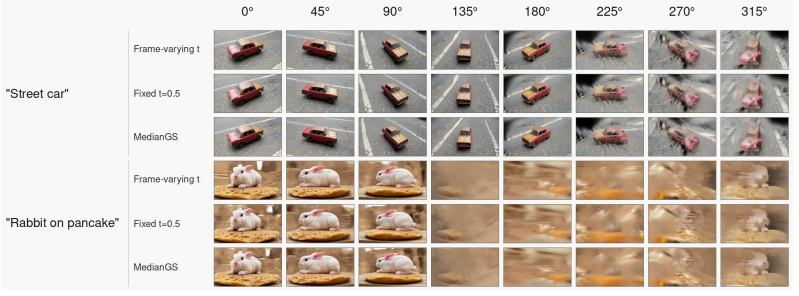
Reconstruction-anchored video synthesis: an adapter that detects gaps via preliminary Deformable Gaussian Splatting reconstruction and uses frozen text-to-video priors to fill only those views before final optimization.
If this is right
- The method produces scenes whose measured view span reaches a 359.0-degree median without progressive view-by-view generation.
- It improves originally unsupported-bin Q10 ImageReward from 8.07 to 16.36 over MedianGS-only reconstruction on the audit set.
- The approach requires no task-specific video or multiview fine-tuning and avoids per-prompt score-distillation optimization.
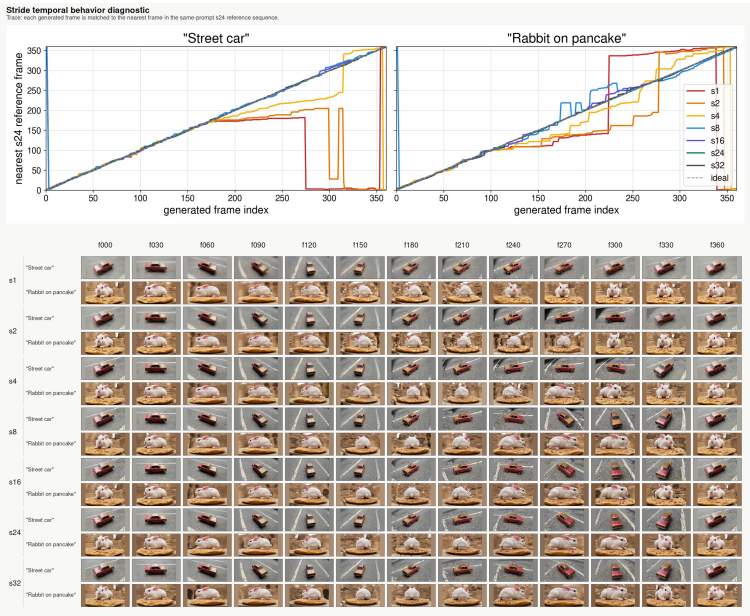
- Evaluation must use coverage-aware metrics because local smoothness alone favors methods that never attempt full orbits.
- The design remains competitive with VideoMV on combined coverage-quality measures.
Where Pith is reading between the lines
- The same anchoring principle could be applied to other generative priors such as text-to-image models to enforce 3D consistency in single-image to 3D pipelines.
- Coverage-aware metrics introduced here might become standard for any text-to-3D method that claims full-scene output.
- The orbit-completion loop suggests a general pattern where reconstruction feedback iteratively improves generative consistency across modalities.
- Testing the method on dynamic scenes or non-circular camera paths would reveal whether the closed-orbit assumption is necessary for the observed consistency gains.
Load-bearing premise
The text-to-video model can generate completions for the detected missing viewpoints without introducing new temporal or geometric inconsistencies that would degrade the final Gaussian Splatting optimization.
What would settle it
Measure the median orbit span and Q10 ImageReward on the same 300-prompt T3Bench-derived audit after replacing the completion step with a video model known to produce inconsistent frames; if the span falls below 300 degrees or the reward gain disappears, the anchoring claim does not hold.
Figures

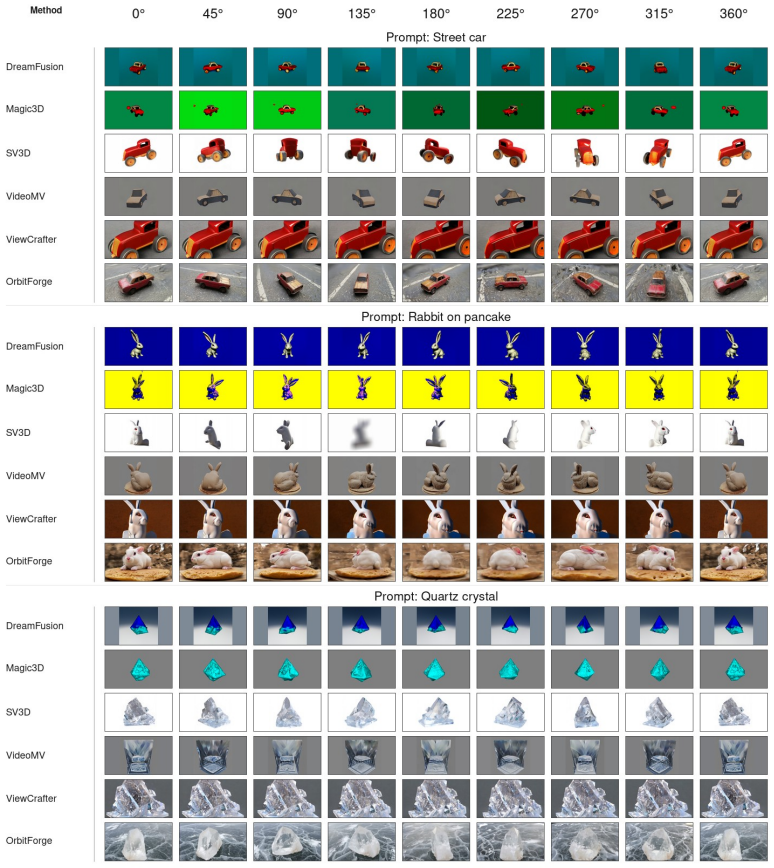












read the original abstract
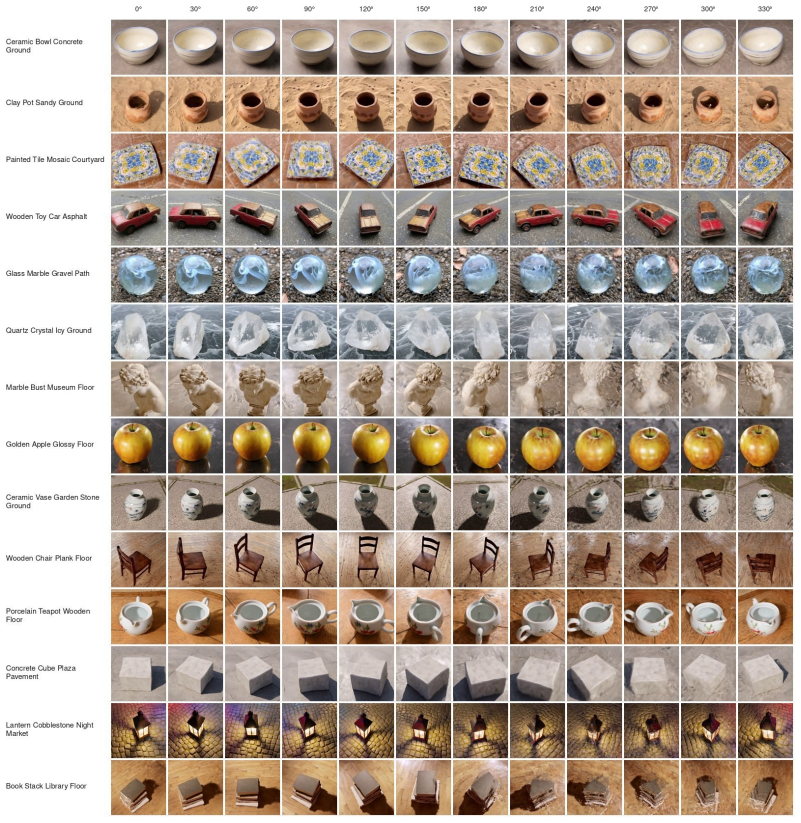
Generic text-to-video models can be used as rich open-world scene priors. Despite the high quality of today's generated videos, they do not directly yield reliable 3D assets: camera motion is difficult to control, view coverage is partial, and frames often contain inconsistencies across time. We introduce OrbitForge, an adapter built from frozen video priors and per-prompt Gaussian Splatting reconstruction optimization that converts a single text-generated video into a canonical closed-orbit 3D Gaussian Splatting scene. We use 3D reconstruction as an anchor to improve the 3D consistency of the generated video. We obtain a preliminary 3D reconstruction from a first generated video via Deformable Gaussian Splatting with a robust MedianGS proxy. We render views from a prescribed orbit to detect missing viewpoints. OrbitForge uses the text-to-video model to complete only the missing views, and reconstructs the completed orbit into a final Gaussian Splatting scene. This design requires no task-specific video or multiview fine-tuning, avoids per-prompt score-distillation optimization, and does not progressively generate views one step at a time. We further argue that this setting demands coverage-aware evaluation: local smoothness alone rewards methods that never attempt a full orbit. On a frozen 300-prompt T3Bench-derived audit, OrbitForge reconstruction attains a 359.0-degree measured median span, raises originally unsupported-bin Q10 ImageReward from 8.07 to 16.36 relative to MedianGS-only reconstruction, while remaining competitive with VideoMV on the coverage-quality.
Editorial analysis
A structured set of objections, weighed in public.
Referee Report
Summary. The paper introduces OrbitForge, an adapter that converts a single text-generated video into a canonical closed-orbit 3D Gaussian Splatting scene. It first obtains a preliminary reconstruction via Deformable Gaussian Splatting with a MedianGS proxy, renders prescribed-orbit views to detect gaps, prompts the frozen text-to-video model to synthesize only the missing frames, and performs a final GS optimization on the completed orbit. On a frozen 300-prompt T3Bench-derived audit, it reports a 359.0-degree median span and raises Q10 ImageReward from 8.07 to 16.36 relative to MedianGS-only, while remaining competitive with VideoMV on coverage-quality; the method requires no task-specific fine-tuning or per-prompt SDS.
Significance. If the central assumption holds, the work offers a practical, no-fine-tuning route to high-coverage text-to-3D assets that anchors video priors with reconstruction rather than progressive generation or distillation; the emphasis on coverage-aware evaluation (versus local smoothness) is a useful framing that could shape future benchmarks.
major comments (2)
- [Abstract] Abstract: the headline metrics (359.0° median span, Q10 ImageReward lift from 8.07 to 16.36) rest on the claim that T2V completion of detected missing views introduces no new geometric or temporal inconsistencies that degrade the final GS optimization, yet the abstract supplies no supporting quantitative evidence such as view-consistency scores, pose-drift measurements, or an ablation that removes the completion step.
- [Abstract] Abstract: the measurement protocol for median span, the precise definition of unsupported bins, and the robustness of the MedianGS proxy are not verifiable from the given description, which directly affects the soundness of the reported coverage and quality gains.
Simulated Author's Rebuttal
We thank the referee for the detailed feedback on the abstract. We address each major comment below and will revise the abstract accordingly to improve clarity and verifiability while preserving its concise nature.
read point-by-point responses
-
Referee: [Abstract] Abstract: the headline metrics (359.0° median span, Q10 ImageReward lift from 8.07 to 16.36) rest on the claim that T2V completion of detected missing views introduces no new geometric or temporal inconsistencies that degrade the final GS optimization, yet the abstract supplies no supporting quantitative evidence such as view-consistency scores, pose-drift measurements, or an ablation that removes the completion step.
Authors: We agree that the abstract does not embed the supporting quantitative evidence. The full manuscript reports view-consistency metrics, pose-drift measurements, and an ablation removing the completion step in Sections 4.2 and 4.3. To address the concern directly in the abstract, we will add one sentence summarizing that the completion step preserves geometric consistency (as measured by the reported metrics) without introducing degradations. revision: yes
-
Referee: [Abstract] Abstract: the measurement protocol for median span, the precise definition of unsupported bins, and the robustness of the MedianGS proxy are not verifiable from the given description, which directly affects the soundness of the reported coverage and quality gains.
Authors: The measurement protocol for median span, the definition of unsupported bins (angular bins without sufficient projected Gaussians), and the MedianGS proxy (median-filtered deformable GS) are fully specified in Sections 3.2 and 4.1 of the manuscript, including pseudocode and parameter settings. Because these details are absent from the abstract itself, we will insert a short parenthetical clarification in the revised abstract to make the protocol verifiable at first reading. revision: yes
Circularity Check
No circularity detected in derivation or claims
full rationale
The paper presents a procedural pipeline (initial video generation, Deformable GS + MedianGS reconstruction, orbit rendering for gap detection, T2V completion of missing views, final GS optimization) whose outputs are evaluated empirically via measured median orbit span and ImageReward on an external 300-prompt audit, with comparisons to an internal MedianGS baseline and external VideoMV. No equations, fitted parameters renamed as predictions, self-definitional relations, or load-bearing self-citations appear in the provided text; the coverage-aware evaluation argument is a methodological preference, not a derivation that reduces to its own inputs. The central claims rest on observable reconstruction quality rather than any self-referential construction.
Axiom & Free-Parameter Ledger
axioms (2)
- domain assumption Deformable Gaussian Splatting with MedianGS proxy yields a usable initial 3D reconstruction from a single generated video
- domain assumption Text-to-video models can generate consistent frames for prescribed missing viewpoints when conditioned appropriately
Reference graph
Works this paper leans on
-
[1]
Text-to-3D generation using Jensen-Shannon score distillation
Khoi Do and Binh-Son Hua. Text-to-3D generation using Jensen-Shannon score distillation. arXiv preprint arXiv:2503.10660, 2025
-
[2]
WonderVerse: Extendable 3D scene generation with video generative models
Hao Feng, Zhi Zuo, Jia-hui Pan, and collaborators. WonderVerse: Extendable 3D scene generation with video generative models. arXiv preprint arXiv:2503.09160, 2025
-
[3]
Srinivasan, Jonathan T
Ruiqi Gao, Aleksander Holynski, Philipp Henzler, Arthur Brussee, Ricardo Martin-Brualla, Pratul P. Srinivasan, Jonathan T. Barron, and Ben Poole. CAT3D: Create anything in 3D with multi-view diffusion models. InAdvances in Neural Information Processing Systems, 2024
2024
-
[4]
T3Bench: Benchmarking current progress in text-to-3D generation
Yuze He, Yushi Bai, Matthieu Lin, Wang Zhao, Yubin Hu, Jenny Sheng, Ran Yi, Juanzi Li, and Yong-Jin Liu. T3Bench: Benchmarking current progress in text-to-3D generation. arXiv preprint arXiv:2310.02977, 2023
-
[5]
3D Gaussian Splatting for real-time radiance field rendering.ACM Transactions on Graphics, 42(4), 2023
Bernhard Kerbl, Georgios Kopanas, Thomas Leimkühler, and George Drettakis. 3D Gaussian Splatting for real-time radiance field rendering.ACM Transactions on Graphics, 42(4), 2023
2023
-
[6]
ViVid-1-to-3: Novel view synthesis with video diffusion models
Jeong-gi Kwak, Erqun Dong, Yuhe Jin, Hanseok Ko, Shweta Mahajan, and Kwang Moo Yi. ViVid-1-to-3: Novel view synthesis with video diffusion models. arXiv preprint arXiv:2312.01305, 2023
-
[7]
CoSER: Towards consistent dense multiview text-to-image generator for 3D creation
Bonan Li, Zicheng Zhang, Xingyi Yang, and Xinchao Wang. CoSER: Towards consistent dense multiview text-to-image generator for 3D creation. InCVPR, 2025
2025
-
[8]
Magic3D: High-resolution text-to-3D content creation
Chen-Hsuan Lin, Jun Gao, Luming Tang, Towaki Takikawa, Xiaohui Zeng, Xun Huang, Karsten Kreis, Sanja Fidler, Ming-Yu Liu, and Tsung-Yi Lin. Magic3D: High-resolution text-to-3D content creation. InCVPR, 2023
2023
-
[9]
ReconX: Reconstruct any scene from sparse views with video diffusion model
Fangfu Liu, Wenqiang Sun, Hanyang Wang, Yikai Wang, Haowen Sun, Junliang Ye, Jun Zhang, and Yueqi Duan. ReconX: Reconstruct any scene from sparse views with video diffusion model. IEEE Transactions on Image Processing, 2026
2026
-
[10]
V3D: Video diffusion models are effective 3D generators
Zilong Chen, Yikai Wang, Feng Wang, Zhengyi Wang, and Huaping Liu. V3D: Video diffusion models are effective 3D generators. arXiv preprint arXiv:2403.06738, 2024
-
[11]
Latent-NeRF for shape-guided generation of 3D shapes and textures
Galen Metzer, Elad Richardson, Or Patashnik, Raja Giryes, and Daniel Cohen-Or. Latent-NeRF for shape-guided generation of 3D shapes and textures. InCVPR, 2023
2023
-
[12]
G4Splat: Geometry-guided Gaussian Splatting with generative prior
Junfeng Ni, Yixin Chen, Zhifei Yang, Yu Liu, Ruijie Lu, Song-Chun Zhu, and Siyuan Huang. G4Splat: Geometry-guided Gaussian Splatting with generative prior. InICLR, 2026
2026
-
[13]
DreamFusion: Text-to-3D using 2D Diffusion
Ben Poole, Ajay Jain, Jonathan T. Barron, and Ben Mildenhall. DreamFusion: Text-to-3D using 2D diffusion. arXiv preprint arXiv:2209.14988, 2022
work page internal anchor Pith review Pith/arXiv arXiv 2022
-
[14]
MVDream: Multi-view Diffusion for 3D Generation
Yichun Shi, Peng Wang, Jianglong Ye, Mai Long, Kejie Li, and Xiao Yang. MVDream: Multi-view diffusion for 3D generation. arXiv preprint arXiv:2308.16512, 2023
work page internal anchor Pith review Pith/arXiv arXiv 2023
-
[15]
Generative Gaussian Splatting: Generating 3D scenes with video diffusion priors
Katja Schwarz, Norman Mueller, and Peter Kontschieder. Generative Gaussian Splatting: Generating 3D scenes with video diffusion priors. arXiv preprint arXiv:2503.13272, 2025
-
[16]
SV3D: Novel multi-view synthesis and 3D generation from a single image using latent video diffusion
Vikram V oleti, Chun-Han Yao, Mark Boss, Adam Letts, David Pankratz, Dmitry Tochilkin, Christian Laforte, Robin Rombach, and Varun Jampani. SV3D: Novel multi-view synthesis and 3D generation from a single image using latent video diffusion. InECCV, 2024
2024
-
[17]
Yeh, and Greg Shakhnarovich
Haochen Wang, Xiaodan Du, Jiahao Li, Raymond A. Yeh, and Greg Shakhnarovich. Score Jacobian chaining: Lifting pretrained 2D diffusion models for 3D generation. InCVPR, 2023
2023
-
[18]
Pro- lificDreamer: High-fidelity and diverse text-to-3D generation with variational score distillation
Zhengyi Wang, Cheng Lu, Yikai Wang, Fan Bao, Chongxuan Li, Hang Su, and Jun Zhu. Pro- lificDreamer: High-fidelity and diverse text-to-3D generation with variational score distillation. InAdvances in Neural Information Processing Systems, 2023
2023
-
[19]
Deformable 3D Gaussians for high-fidelity monocular dynamic scene reconstruction
Ziyi Yang, Xinyu Gao, Wen Zhou, Shaohui Jiao, Yuqing Zhang, and Xiaogang Jin. Deformable 3D Gaussians for high-fidelity monocular dynamic scene reconstruction. InCVPR, 2024. 10
2024
-
[20]
ViewCrafter: Taming Video Diffusion Models for High-fidelity Novel View Synthesis
Wangbo Yu, Jinbo Xing, Li Yuan, Wenbo Hu, Xiaoyu Li, Zhipeng Huang, Xiangjun Gao, Tien-Tsin Wong, Ying Shan, and Yonghong Tian. ViewCrafter: Taming video diffusion models for high-fidelity novel view synthesis. arXiv preprint arXiv:2409.02048, 2024
work page internal anchor Pith review Pith/arXiv arXiv 2024
-
[21]
A pair of polka-dotted sneakers
Qi Zuo, Xiaodong Gu, Lingteng Qiu, Yuan Dong, Zhengyi Zhao, Weihao Yuan, Rui Peng, Siyu Zhu, Zilong Dong, Liefeng Bo, and Qixing Huang. VideoMV: Consistent multi-view generation based on large video generative model. arXiv preprint arXiv:2403.12010, 2024. 11 Stage Example content Purpose Original benchmark item “A pair of polka-dotted sneakers” Defines th...
discussion (0)
Sign in with ORCID, Apple, or X to comment. Anyone can read and Pith papers without signing in.