Charm quark production in heavy-ion collisions as a signature of pre-equilibrium
Pith reviewed 2026-06-27 14:25 UTC · model grok-4.3
The pith
Charm quark production receives a non-negligible contribution from the pre-equilibrium phase in heavy-ion collisions.
A machine-rendered reading of the paper's core claim, the machinery that carries it, and where it could break.
Core claim
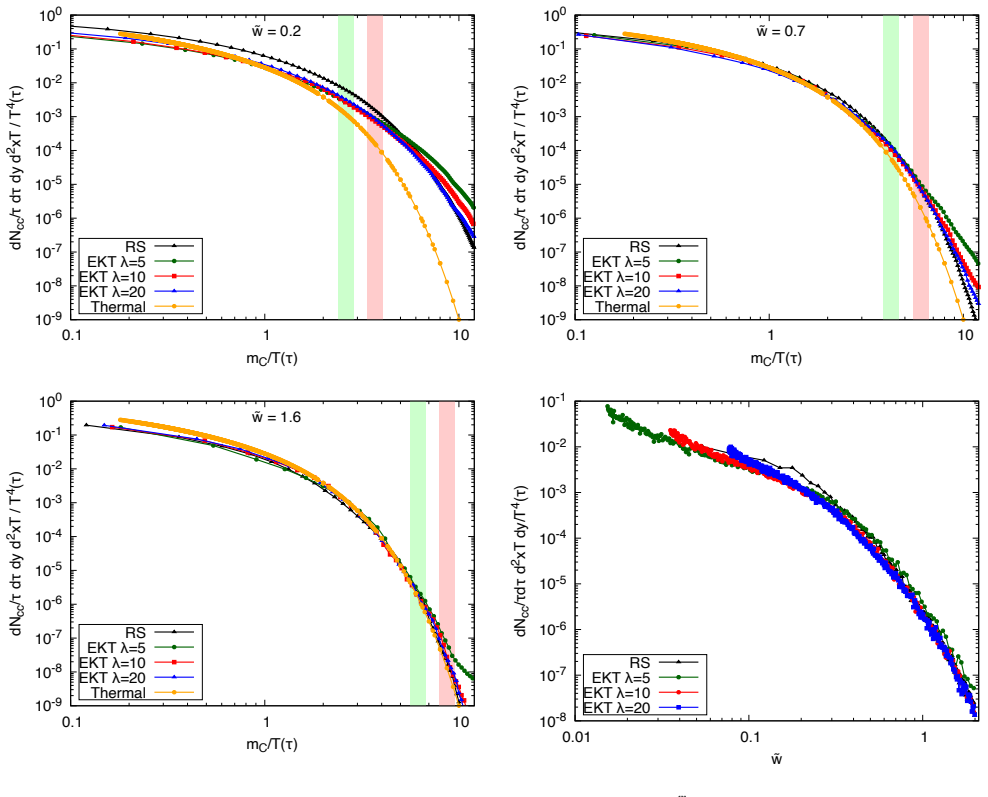
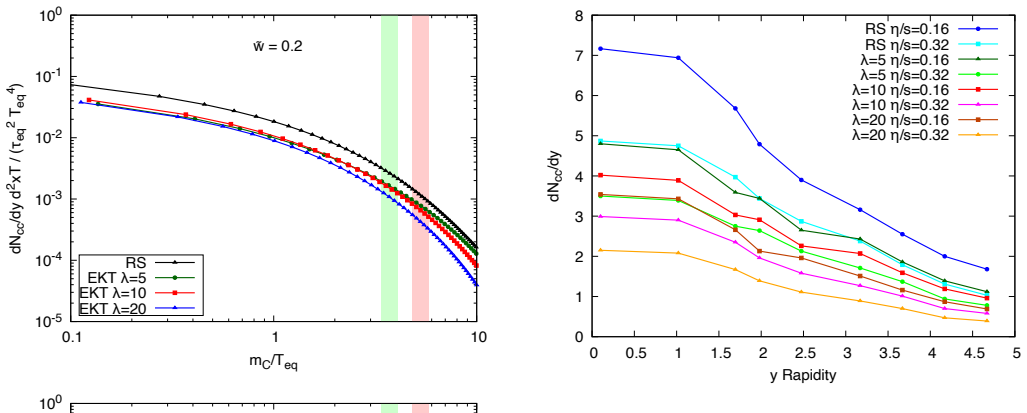
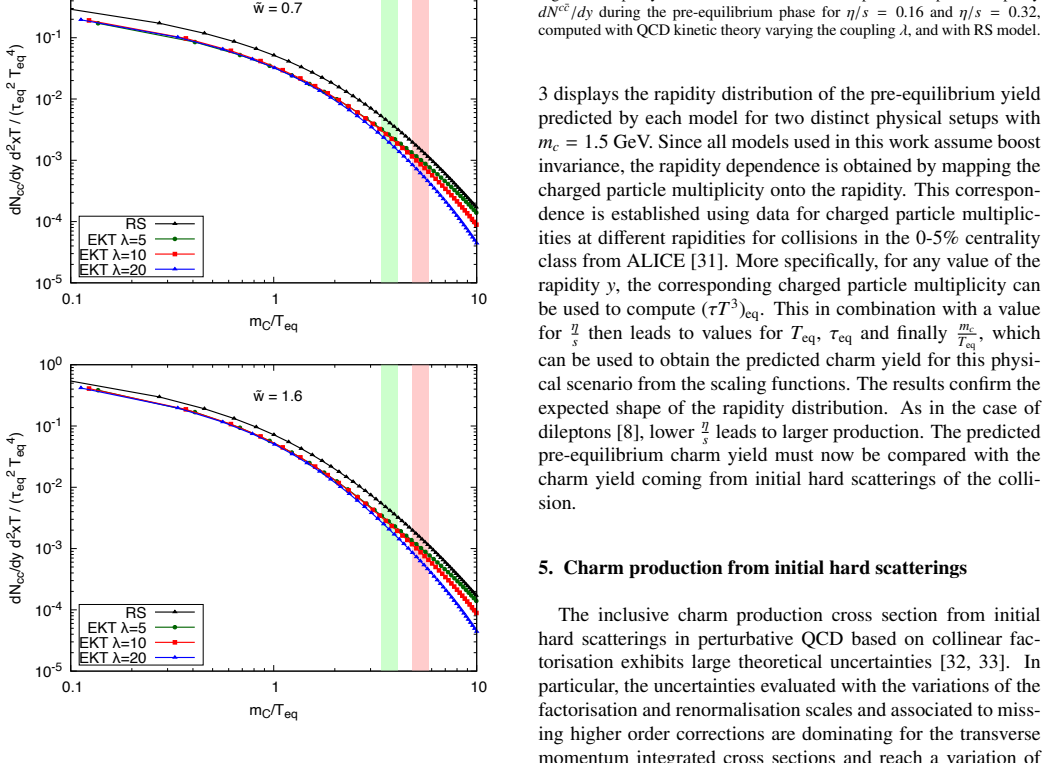
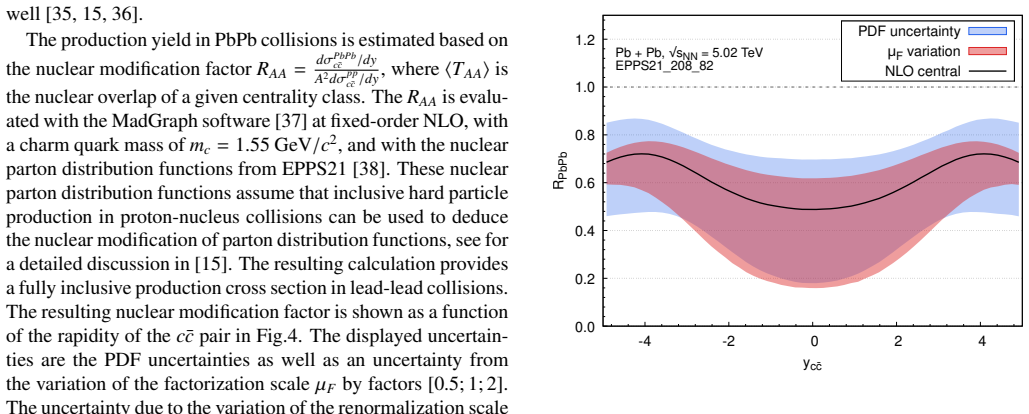
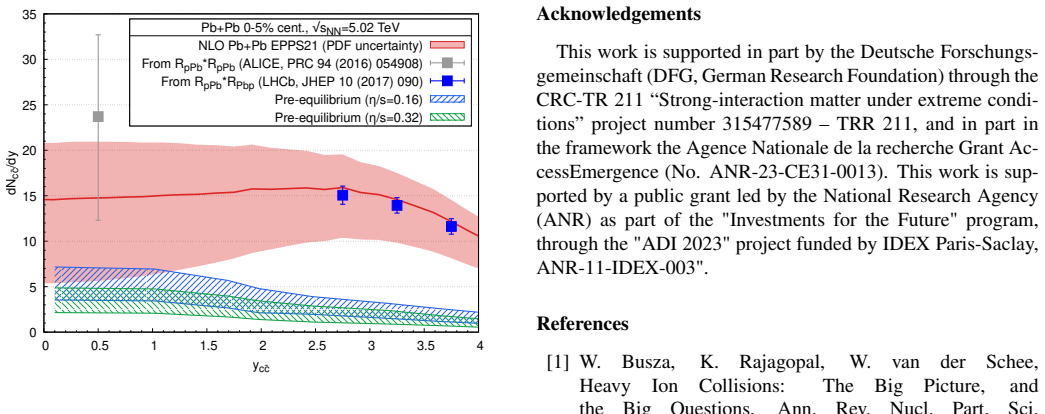
Based on previous studies on dilepton production, the (anti)charm quark production from the pre-equilibrium phase is evaluated. A non-negligible contribution to the overall charm quark production is found, albeit with large theoretical uncertainties. Precise total charm production measurements combined with progress on charm production calculations from the initial hard scatterings can be used to infer information on the pre-equilibrium stage.
What carries the argument
Pre-equilibrium charm quark pair production calculated via adaptation of dilepton production methods.
If this is right
- Precise measurements of total charm yields can be combined with improved initial production calculations to extract pre-equilibrium information.
- Charm production serves as a potential signature for pre-equilibrium dynamics alongside dilepton observables.
- The contribution is limited by current theoretical uncertainties in the modeling.
Where Pith is reading between the lines
- Extending this to bottom quarks could test if the pre-equilibrium effect scales with quark mass.
- Unified early-time models might need to account for both light and heavy parton production consistently.
- Future calculations of pre-equilibrium pair production could reduce the uncertainties.
Load-bearing premise
The modeling framework and approximations validated for dilepton production transfer directly to charm quark production with similar accuracy.
What would settle it
Observation of a total charm cross section that matches hard-scattering predictions without any excess that could be attributed to pre-equilibrium production.
Figures
read the original abstract
The relative abundances and kinematic distributions of hadrons containing (anti)charm quarks are key observables for deconfinement, heavy-quark diffusion and hadronization in heavy-ion collisions. The production of (anti)charm quarks is commonly associated to the initial hard scatterings in hadronic collisions. Based on previous studies on dilepton production, we evaluate the (anti)charm quark production from the pre-equilibrium phase. A non-negligible contribution to the overall charm quark production is found albeit large theoretical uncertainties are limiting factors. We conclude that precise total charm production measurements combined with progress on charm production calculations from the initial hard scatterings can be used to infer information on the pre-equilibrium stage.
Editorial analysis
A structured set of objections, weighed in public.
Referee Report
Summary. The paper claims that (anti)charm quark production in the pre-equilibrium phase of heavy-ion collisions can be evaluated by adapting results from prior dilepton production studies. It reports a non-negligible contribution to the total charm yield, subject to large theoretical uncertainties, and concludes that precise total charm measurements combined with better initial hard-scattering calculations could constrain the pre-equilibrium stage.
Significance. If the central claim holds after addressing the modeling transfer, the work would identify a potential new observable linking pre-equilibrium gluon dynamics to heavy-flavor production. The explicit acknowledgment of large uncertainties is a strength, but the result's utility hinges on whether the adaptation from dilepton rates to massive charm production can be made robust.
major comments (1)
- [Abstract] Abstract: The evaluation of charm production 'based on previous studies on dilepton production' is the load-bearing step for the non-negligible contribution claim, yet the manuscript provides no explicit demonstration that the gluon-fusion matrix elements, charm-mass threshold (~3 GeV), and steeply falling pre-equilibrium gluon spectra yield comparable reliability to the massless q-qbar or virtual-photon channels used for dileptons. This leaves the transferability untested in the region where modeling uncertainties (occupation number, anisotropy, cutoff) are largest.
Simulated Author's Rebuttal
We thank the referee for the detailed review and for identifying the central methodological step in our work. We address the concern about the adaptation from dilepton studies to charm production below and agree that additional explicit justification is warranted.
read point-by-point responses
-
Referee: [Abstract] Abstract: The evaluation of charm production 'based on previous studies on dilepton production' is the load-bearing step for the non-negligible contribution claim, yet the manuscript provides no explicit demonstration that the gluon-fusion matrix elements, charm-mass threshold (~3 GeV), and steeply falling pre-equilibrium gluon spectra yield comparable reliability to the massless q-qbar or virtual-photon channels used for dileptons. This leaves the transferability untested in the region where modeling uncertainties (occupation number, anisotropy, cutoff) are largest.
Authors: We agree that the manuscript would benefit from an explicit demonstration of the adaptation. The pre-equilibrium gluon spectra and occupation numbers are taken from the same class of studies used for dileptons, but the charm channel employs the standard gluon-fusion matrix element for massive quarks (with threshold ~3 GeV) rather than the massless q-qbar or virtual-photon channels. Because the spectra fall steeply, the mass threshold shifts the dominant contribution to somewhat lower momenta where the modeling uncertainties are still present but can be quantified. In the revised version we will add a short dedicated subsection (or expanded methods paragraph) that (i) states the relevant matrix elements, (ii) shows how the integration limits change with the charm mass, and (iii) illustrates the sensitivity to the cutoff, anisotropy, and occupation-number parameters for the massive case. This will make the transferability transparent without altering the central claim or the already-stated large uncertainties. revision: yes
Circularity Check
Minor reliance on prior dilepton studies; central evaluation remains independent of self-referential fitting
full rationale
The paper evaluates charm production by extending methods from prior dilepton work in the pre-equilibrium phase, as stated in the abstract. No equations or steps show a parameter fitted to charm data then renamed as a prediction, nor any self-definition where the output is constructed from the input by algebraic identity. The cited prior studies provide external methodological support rather than a load-bearing chain that forces the result; the claim of non-negligible contribution is presented as an application with acknowledged uncertainties, not a tautological renaming or ansatz smuggling. This qualifies as normal self-citation without circular reduction of the derivation.
Axiom & Free-Parameter Ledger
Reference graph
Works this paper leans on
-
[1]
Heavy Ion Collisions: The Big Picture, and the Big Questions
W. Busza, K. Rajagopal, W. van der Schee, Heavy Ion Collisions: The Big Picture, and the Big Questions, Ann. Rev. Nucl. Part. Sci. 68 (2018) 339–376.arXiv:1802.04801, doi:10.1146/annurev-nucl-101917-020852
work page internal anchor Pith review Pith/arXiv arXiv doi:10.1146/annurev-nucl-101917-020852 2018
-
[2]
S. Schlichting, D. Teaney, The First fm/c of Heavy-Ion Collisions, Ann. Rev. Nucl. Part. Sci. 69 (2019) 447–476.arXiv:1908.02113, doi:10.1146/annurev-nucl-101918-023825
-
[3]
J. Berges, M. P. Heller, A. Mazeliauskas, R. Venugopalan, QCD thermalization: Ab initio approaches and interdisci- plinary connections, Rev. Mod. Phys. 93 (2021) 035003. arXiv:2005.12299,doi:10.1103/RevModPhys.93. 035003
-
[4]
J. D. Bjorken, Highly Relativistic Nucleus-Nucleus Col- lisions: The Central Rapidity Region, Phys. Rev. D 27 (1983) 140–151.doi:10.1103/PhysRevD.27.140
-
[5]
J. Y . Ollitrault, Relativistic hydrodynamics for heavy-ion collisions, Eur. J. Phys. 29 (2008) 275–302.arXiv: 0708.2433,doi:10.1088/0143-0807/29/2/010
work page internal anchor Pith review Pith/arXiv arXiv doi:10.1088/0143-0807/29/2/010 2008
-
[6]
T. Lappi, L. McLerran, Some features of the glasma, Nucl. Phys. A 772 (2006) 200–212.arXiv:hep-ph/0602189, doi:10.1016/j.nuclphysa.2006.04.001
work page internal anchor Pith review Pith/arXiv arXiv doi:10.1016/j.nuclphysa.2006.04.001 2006
-
[7]
J. Churchill, L. Yan, S. Jeon, C. Gale, Emission of electromagnetic radiation from the early stages of rel- ativistic heavy-ion collisions, Phys. Rev. C 103 (2) (2021) 024904.arXiv:2008.02902,doi:10.1103/ PhysRevC.103.024904
arXiv 2021
-
[9]
M. Coquet, X. Du, J. Y . Ollitrault, S. Schlichting, M. Winn, Transverse mass scaling of dilepton radia- tion offa quark-gluon plasma, Nucl. Phys. A 1030 (2023) 122579.arXiv:2112.13876,doi:10.1016/j. nuclphysa.2022.122579. 7
work page doi:10.1016/j 2023
-
[10]
O. Garcia-Montero, P. Plaschke, S. Schlichting, Scal- ing of pre-equilibrium dilepton production in qcd kinetic theory, Phys. Rev. D 111 (2025) 034036. doi:10.1103/PhysRevD.111.034036. URLhttps://link.aps.org/doi/10.1103/ PhysRevD.111.034036
-
[11]
X.-Y . Wu, L. Du, C. Gale, S. Jeon, Probing the equilibration of the QCD matter created in heavy- ion collisions with dileptons, Phys. Rev. C 110 (5) (2024) 054904.arXiv:2407.04156,doi:10.1103/ PhysRevC.110.054904
arXiv 2024
- [12]
-
[13]
A. Andronic, P. Braun-Munzinger, K. Redlich, J. Stachel, Statistical hadronization of heavy quarks in ultra- relativistic nucleus-nucleus collisions, Nucl. Phys. A 789 (2007) 334–356.arXiv:nucl-th/0611023,doi:10. 1016/j.nuclphysa.2007.02.013
Pith/arXiv arXiv 2007
-
[14]
R. Rapp, P. B. Gossiaux, A. Andronic, R. Averbeck, S. Masciocchi, A. Beraudo, E. Bratkovskaya, P. Braun- Munzinger, S. Cao, A. Dainese, et al., Extraction of Heavy-Flavor Transport Coefficients in QCD Matter, Nucl. Phys. A 979 (2018) 21–86.arXiv:1803.03824, doi:10.1016/j.nuclphysa.2018.09.002
work page internal anchor Pith review Pith/arXiv arXiv doi:10.1016/j.nuclphysa.2018.09.002 2018
-
[15]
L. Apolinário, Y . J. Lee, M. Winn, Heavy quarks and jets as probes of the QGP, Prog. Part. Nucl. Phys. 127 (2022) 103990.arXiv:2203.16352,doi:10.1016/j.ppnp. 2022.103990
-
[16]
A. Andronic, R. Arnaldi, Quarkonia and De- confined Quark–Gluon Matter in Heavy-Ion Collisions, Ann. Rev. Nucl. Part. Sci. 75 (1) (2025) 351–375.arXiv:2501.08290,doi: 10.1146/annurev-nucl-121423-101041
-
[17]
D. Adamová, G. Aglieri Rinella, M. Agnello, Z. Ahammed, D. Aleksandrov, A. Alici, A. Alkin, T. Alt, I. Altsybeev, D. Andreou, et al., A next-generation LHC heavy-ion experiment (2019).arXiv:1902.01211
Pith/arXiv arXiv 2019
-
[18]
URLhttps://cds.cern.ch/record/2928780
European Strategy for Particle Physics 2026: Input from the ALICE Collaboration (2025). URLhttps://cds.cern.ch/record/2928780
arXiv 2026
-
[19]
R. Aaij, et al., Physics case for an LHCb Upgrade II - Opportunities in flavour physics, and beyond, in the HL- LHC era (2018).arXiv:1808.08865
Pith/arXiv arXiv 2018
-
[20]
Vagnoni, Heavy ion physics at LHCb Upgrade II (3 2025).arXiv:2503.23093
V . Vagnoni, Heavy ion physics at LHCb Upgrade II (3 2025).arXiv:2503.23093
arXiv 2025
-
[21]
B. W. Zhang, C. M. Ko, W. Liu, Thermal charm pro- duction in a quark-gluon plasma in Pb-Pb collisions at s**(1/2)(NN)=5.5-TeV, Phys. Rev. C 77 (2008) 024901.arXiv:0709.1684,doi:10.1103/PhysRevC. 77.024901
work page internal anchor Pith review Pith/arXiv arXiv doi:10.1103/physrevc 2008
-
[22]
J. Uphoff, O. Fochler, Z. Xu, C. Greiner, Heavy quark production at RHIC and LHC within a partonic transport model, Phys. Rev. C 82 (2010) 044906.arXiv:1003. 4200,doi:10.1103/PhysRevC.82.044906
-
[23]
K. Zhou, Z. Chen, C. Greiner, P. Zhuang, Thermal Charm and Charmonium Production in Quark Gluon Plasma, Phys. Lett. B 758 (2016) 434–439.arXiv:1602.01667, doi:10.1016/j.physletb.2016.05.051
work page internal anchor Pith review Pith/arXiv arXiv doi:10.1016/j.physletb.2016.05.051 2016
-
[24]
T. Song, I. Grishmanovskii, O. Soloveva, E. Bratkovskaya, Thermal production of charm quarks in relativistic heavy-ion collisions, Phys. Rev. C 110 (2024) 034906.arXiv:2404.00425, doi:10.1103/PhysRevC.110.034906
-
[25]
P. B. Arnold, G. D. Moore, L. G. Yaffe, Effective ki- netic theory for high temperature gauge theories, Jour- nal of High Energy Physics 2003 (01) (2003) 030.doi: 10.1088/1126-6708/2003/01/030. URLhttps://doi.org/10.1088/1126-6708/2003/ 01/030
-
[26]
O. Garcia-Montero, A. Mazeliauskas, P. Plaschke, S. Schlichting, Pre-equilibrium photons from the early stages of heavy-ion collisions, JHEP 03 (2024) 053.arXiv:2308.09747,doi: 10.1007/JHEP03(2024)053
-
[27]
G. Giacalone, A. Mazeliauskas, S. Schlichting, Hydrody- namic attractors, initial state energy and particle produc- tion in relativistic nuclear collisions, Phys. Rev. Lett. 123 (2019) 262301.arXiv:1908.02866,doi:10.1103/ PhysRevLett.123.262301
arXiv 2019
-
[28]
X. Du, S. Schlichting, Equilibration of the Quark-Gluon Plasma at Finite Net-Baryon Density in QCD Kinetic The- ory, Phys. Rev. Lett. 127 (2021) 122301.arXiv:2012. 09068,doi:10.1103/PhysRevLett.127.122301
-
[29]
X. Du, S. Schlichting, Equilibration of weakly coupled QCD plasmas, Phys. Rev. D 104 (2021) 054011.arXiv: 2012.09079,doi:10.1103/PhysRevD.104.054011
- [30]
-
[31]
J. Adam, et al., Centrality dependence of the pseudo- rapidity density distribution for charged particles in Pb- Pb collisions at √sNN =5.02 TeV, Phys. Lett. B 772 (2017) 567–577.arXiv:1612.08966,doi:10.1016/ j.physletb.2017.07.017. 8
Pith/arXiv arXiv 2017
-
[32]
The p_T Spectrum in Heavy-Flavour Hadroproduction
M. Cacciari, M. Greco, P. Nason, Thep T spectrum in heavy-flavour hadroproduction, JHEP 05 (1998) 007. arXiv:hep-ph/9803400,doi:10.1088/1126-6708/ 1998/05/007
work page internal anchor Pith review Pith/arXiv arXiv doi:10.1088/1126-6708/ 1998
-
[33]
B. A. Kniehl, G. Kramer, I. Schienbein, H. Spiesberger, Inclusive Charmed-Meson Production at the CERN LHC, Eur. Phys. J. C 72 (2012) 2082.arXiv:1202.0439,doi: 10.1140/epjc/s10052-012-2082-2
work page internal anchor Pith review Pith/arXiv arXiv doi:10.1140/epjc/s10052-012-2082-2 2012
- [34]
-
[35]
J. J. Ethier, E. R. Nocera, Parton Distributions in Nucleons and Nuclei, Ann. Rev. Nucl. Part. Sci. 70 (2020) 43–76.arXiv:2001.07722,doi:10.1146/ annurev-nucl-011720-042725
arXiv 2020
- [36]
-
[37]
J. Alwall, R. Frederix, S. Frixione, V . Hirschi, F. Maltoni, O. Mattelaer, H. S. Shao, T. Stelzer, P. Torrielli, M. Zaro, The automated computation of tree-level and next-to- leading order differential cross sections, and their match- ing to parton shower simulations, JHEP 07 (2014) 079. arXiv:1405.0301,doi:10.1007/JHEP07(2014)079
work page internal anchor Pith review Pith/arXiv arXiv doi:10.1007/jhep07(2014)079 2014
-
[38]
K. J. Eskola, P. Paakkinen, H. Paukkunen, C. A. Salgado, EPPS21: a global QCD analysis of nuclear PDFs, Eur. Phys. J. C 82 (5) (2022) 413.arXiv:2112.12462,doi: 10.1140/epjc/s10052-022-10359-0
-
[39]
S. Acharya, et al., Charm production and fragmenta- tion fractions at midrapidity in pp collisions at √s=13 TeV, JHEP 12 (2023) 086.arXiv:2308.04877,doi: 10.1007/JHEP12(2023)086
-
[40]
New CTEQ global analysis of quantum chromodynamics with high-precision data from the LHC
T.-J. Hou, et al., New CTEQ global analysis of quan- tum chromodynamics with high-precision data from the LHC, Phys. Rev. D 103 (1) (2021) 014013.arXiv: 1912.10053,doi:10.1103/PhysRevD.103.014013
work page internal anchor Pith review Pith/arXiv arXiv doi:10.1103/physrevd.103.014013 2021
-
[41]
M. L. Miller, K. Reygers, S. J. Sanders, P. Stein- berg, Glauber modeling in high energy nu- clear collisions, Ann. Rev. Nucl. Part. Sci. 57 (2007) 205–243.arXiv:nucl-ex/0701025, doi:10.1146/annurev.nucl.57.090506.123020
work page internal anchor Pith review Pith/arXiv arXiv doi:10.1146/annurev.nucl.57.090506.123020 2007
-
[42]
Improved Monte Carlo Glauber predictions at present and future nuclear colliders
C. Loizides, J. Kamin, D. d’Enterria, Improved Monte Carlo Glauber predictions at present and future nuclear colliders, Phys. Rev. C 97 (5) (2018) 054910, [Erratum: Phys.Rev.C 99, 019901 (2019)].arXiv:1710.07098, doi:10.1103/PhysRevC.97.054910
work page internal anchor Pith review Pith/arXiv arXiv doi:10.1103/physrevc.97.054910 2018
-
[43]
J. Adam, et al., Rapidity and transverse-momentum de- pendence of the inclusive J/ψnuclear modification fac- tor in p-Pb collisions at √sN N =5.02 TeV, JHEP 06 (2015) 055.arXiv:1503.07179,doi:10.1007/ JHEP06(2015)055
Pith/arXiv arXiv 2015
-
[44]
J. Adam, et al.,D-meson production inp-Pb collisions at √sNN =5.02 TeV and in pp collisions at √s=7 TeV, Phys. Rev. C 94 (5) (2016) 054908.arXiv:1605.07569, doi:10.1103/PhysRevC.94.054908
work page internal anchor Pith review Pith/arXiv arXiv doi:10.1103/physrevc.94.054908 2016
-
[45]
R. Aaij, et al., Study of prompt D 0 meson produc- tion inpPb collisions at √sNN =5 TeV, JHEP 10 (2017) 090.arXiv:1707.02750,doi:10.1007/ JHEP10(2017)090. 9
Pith/arXiv arXiv 2017
discussion (0)
Sign in with ORCID, Apple, or X to comment. Anyone can read and Pith papers without signing in.