REVIEW 3 major objections 5 minor 16 references
Learning Dolly-In Filming From Demonstration Using a Ground-Based Robot
T0 review · 3 major / 5 minor · reviewed 2026-08-05 · deepseek-v4-flash
Pith's one-line read A robot can learn a dolly-in shot from 25 joystick demonstrations in simulation and then perform it on real hardware with no fine-tuning.
desk verdict Solid new application of GAIL to ground-robot dolly-in shots, but missing observation/perception details and a variance claim that its own table contradicts. read the letter →
The pith
A machine-rendered reading of the paper's core claim, the machinery that carries it, and where it could break.
The reading
What carries the argument
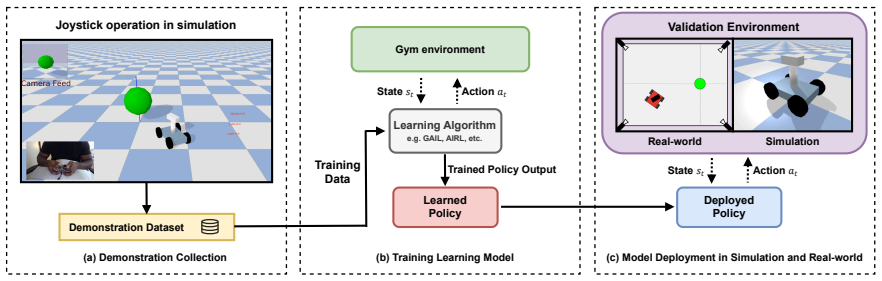
The central machinery is Generative Adversarial Imitation Learning (GAIL), a two-player game in which a discriminator tries to tell expert state-action pairs from pairs produced by the learned policy, and the policy is trained to fool that discriminator. The discriminator's confidence acts as a learned reward, so no handcrafted reward function is needed. The state relevant to the task is the subject's position and apparent size in the frame, and the training set deliberately varies the robot's starting position across the scene; the paper shows that greater starting-position diversity improves learning stability and generalization.
What would settle it
A decisive check: run the deployed GAIL policy from the three canonical starting positions while changing the subject's distance, lighting, or partial occlusion, and compare the object-area Sim2Real Correlation Coefficient to the reported >0.97. A drop below roughly 0.6, or any failed trial with the subject visible, would count as evidence against the zero-shot transfer claim.
Extended reading notes
Core claim
The paper establishes that a dolly-in shot—a camera move that travels smoothly toward a subject while keeping it centered and growing in the frame—can be learned purely from expert demonstrations, with no handcrafted reward. A GAIL policy trained only on 25 joystick-operated trajectories in a physics-based simulator outperforms a PPO baseline trained with a tuned reward: higher average episodic reward (8.4% gain in the throttle/steering task, 4.3% in the task adding pan/tilt), faster convergence, and lower variance across seeds. The same policy, with no fine-tuning, transfers to a physical wheeled robot, earning higher cumulative rewards than the prior TD3-based reinforcement-learning method
Load-bearing premise
The policy's observation space and the real-world perception system are never specified; the zero-shot transfer claim rests on the real camera supplying the same subject-position and subject-scale features that the simulation provided, and no description of the detection or state-estimation pipeline is given.
Editorial extensions
If this is right
- A filmmaker can author a new dolly-in style by recording a handful of joystick demonstrations; no reward function design or tuning is required.
- The same policy runs in simulation and on real hardware without a fine-tuning stage, so deployment effort drops to transferring the trained network.
- Spreading the demonstration starting positions across the scene improves learning stability and generalization more than simply adding more demonstrations from one spot.
- The imitation advantage over reward-shaped RL is not uniform: it is larger in the simpler throttle/steering task (8.4%) than when pan and tilt control are added (4.3%).
Reading between the lines
- Beyond the paper, if subject position and scale are the operative features, the same zero-shot recipe should transfer to other single-subject shots (push-in variations, slight arcs) by collecting new demonstrations, without changing the policy architecture.
- Beyond the paper, a cheap way to stress-test the transfer claim is to inject sensor noise or small occlusions in simulation and measure how much GAIL's framing error grows compared with PPO's; imitation policies may be less sensitive than reward-shaped policies to imperfect observations, but that is testable.
- Beyond the paper, because all demonstrations came from a single operator, the learned 'style' is one person's timing; multi-operator data would separate universally cinematic motion from idiosyncratic preference.
- Beyond the paper, real-world behavior with a moving subject or visual clutter is untested; a natural next experiment is a moving subject with the same GAIL policy to find where imitation transfer breaks.
Editorial analysis
A structured set of objections, weighed in public.
Referee Report
Summary. The paper proposes a Learning from Demonstration (LfD) pipeline, based on Generative Adversarial Imitation Learning (GAIL), for automating dolly-in shots with a ground-based wheeled robot. Expert trajectories are collected by a single operator via joystick teleoperation in a PyBullet simulation. GAIL is trained on 25 demonstrations per task, with no handcrafted reward, and compared in simulation against a PPO baseline trained on a handcrafted reward from the authors' prior work [2]. The authors report that GAIL achieves higher episodic reward and faster convergence than PPO, and that the GAIL policy transfers zero-shot to a physical robot, outperforming a prior TD3 method in framing metrics. The paper additionally studies the effect of demonstration diversity and reports real-world results with cumulative reward, object-area error, X/Y alignment error, and Sim2Real Correlation Coefficient (SRCC).
Significance. If the claims are supported, the paper would provide a useful demonstration that imitation learning can replace reward engineering for a narrow but representative cinematographic task, with modest data requirements and zero-shot sim-to-real transfer. The strengths of the paper are that it uses standard public implementations (imitation library, Stable Baselines3), reports three-seed learning curves, evaluates against an RL baseline in the same environment, and includes real-world experiments with quantitative framing metrics. The contribution is incremental relative to the authors' prior RL work [2], since the environment, robot model, and reward structure are reused; the novelty lies in replacing the RL core with GAIL. Section VI candidly acknowledges limitations such as single-expert data, simplified simulator, and controlled real-world conditions, which is appropriate. However, the central zero-shot transfer claim is presently hard to verify because the observation and perception pipeline are not specified, and the 'lower variance' claim is contradicted by the paper's own table.
major comments (3)
- [Section V-C (and Section II)] The observation space is never defined. Section II only declares states S; Section V-A specifies actions and reward terms but not the state vector; Section V-C states that the real setup 'mirror[s] the simulation setup' but gives no detector, feature extraction, camera calibration, or state-estimation pipeline. Since zero-shot transfer rests on the deployed policy receiving exactly the same observation features used in simulation, the reader cannot verify whether the real policy saw ground-truth object area, a segmentation blob, or a learned detector, or whether feature scaling matched the simulator. Please specify the observation features, their normalization, and the real-world perception/state-estimation procedure; without this, Tables II–V cannot be interpreted as evidence for the transfer claim.
- [V-B, Table I; Abstract] The claim of 'lower variance' for GAIL is contradicted by the reported numbers. The Abstract and Section V-B state that GAIL exhibits lower variance, but Table I reports GAIL as -116.3 ± 36.0 versus PPO -127 ± 25.0 for Base Control, and -126.3 ± 25.6 versus PPO -132 ± 24.1 for Full Control. GAIL's standard deviation is larger in both settings. Please correct the claim or report the variance measure actually used (e.g., variance of learning curves, variance across seeds, or interquartile range). Given the overlapping intervals, also report per-seed values or confidence intervals to support the claimed 8.4% and 4.3% improvements.
- [V-C, Tables II–V] The real-world comparison lacks statistical characterization. Tables II–V report single point values without stating the number of trials, error bars, or run-to-run variation, although the text claims 'consistent' and 'more consistent' behavior and mentions 75 additional randomized trials. State how many runs each table entry is based on, whether the 75 trials are included in the tables or reported separately, and provide means with standard deviations (or equivalent) for the real-world metrics. The SRCC values in Table II also need a sample size and a description of the paired data used to compute them. Without this, the claimed improvement over TD3 cannot be assessed beyond anecdotal single-run evidence.
minor comments (5)
- [Section VII] Typo: 'e presented' should be 'We presented'.
- [Throughout] The notation 'GAIL (PPO)' is confusing because PPO is also used as a baseline. Clarify that PPO is the policy optimizer used for GAIL's policy update, not a separate method.
- [Figure 5] The legend lists 'PPO (RL Baseline)', but the plot does not clearly show a PPO curve separate from the expert range; please make the PPO curve explicit or remove the legend entry.
- [Section IV-B] The sentence 'we evaluated newer methods (e.g., LS-IQ, IQ-Learn)' gives no experimental details. Either add a brief setup/results table or remove the claim, as it is currently unverifiable.
- [Section V-B] The demonstration-diversity experiment says GAIL is trained on 25 demonstrations sampled from 1, 3, or 5 starting positions, but the text is ambiguous about how the 25 demonstrations are distributed across those positions. Clarify the sampling procedure.
Circularity Check
No significant circularity; GAIL training is reward-free and the evaluation metric is external to the learning objective.
full rationale
The paper's derivation chain is empirically self-contained. GAIL is trained solely on joystick demonstrations (Section IV-B) with no access to the handcrafted reward used for PPO or for evaluation. The PPO reward in Section V-A is introduced only as a baseline training signal and evaluation metric; it is not used in GAIL's loss, so the claim that GAIL outperforms PPO is a measured comparison, not a fitted parameter renamed as a prediction. The self-citations to [2] provide the simulation environment, reward structure, and TD3 baseline numbers. These are external published results, and while the TD3 comparison depends on them, this is a baseline-reuse issue, not circular reasoning: the GAIL policy's behavior and measured rewards are not defined by or derived from [2]. The zero-shot transfer claim rests on an under-specified observation/perception pipeline (Section V-C), which is a reproducibility gap and correctness risk, not a circularity. The 'lower variance' statement in Section V-B is contradicted by Table I, but that is an internal inconsistency, not a derivation that reduces to its own inputs. No equation in the paper defines its target in terms of its inputs, and no self-citation is used to forbid alternative methods or to justify the core LfD mechanism. The paper honestly lists limitations (Section VI), including simplified simulation and controlled real-world conditions, which further supports that the claims are empirical rather than definitional.
Assumptions & free parameters
free parameters (3)
- lambda_area =
not reported
- lambda_steer =
not reported
- lambda_cam =
not reported
assumptions (4)
- domain assumption Simulated joystick demonstrations faithfully represent expert dolly-in behavior
- domain assumption The PyBullet simulator is a sufficiently accurate proxy for the real robot to allow zero-shot transfer
- domain assumption The real-world robot can produce observation features equivalent to the simulator's observations
- standard math GAIL converges to a policy matching the expert distribution
Cite this review
Pith. "Pith review of Learning Dolly-In Filming From Demonstration Using a Ground-Based Robot." pith.science (2026). https://pith.science/paper/5GPTSWN6
@misc{pith2026250900574,
  author       = {Pith},
  title        = {Pith review of: Learning Dolly-In Filming From Demonstration Using a Ground-Based Robot},
  year         = {2026},
  howpublished = {\url{https://pith.science/paper/5GPTSWN6}},
  note         = {Machine review of arXiv:2509.00574}
}
read the original abstract
Cinematic camera control demands a balance of precision and artistry - qualities that are difficult to encode through handcrafted reward functions. While reinforcement learning (RL) has been applied to robotic filmmaking, its reliance on bespoke rewards and extensive tuning limits creative usability. We propose a Learning from Demonstration (LfD) approach using Generative Adversarial Imitation Learning (GAIL) to automate dolly-in shots with a free-roaming, ground-based filming robot. Expert trajectories are collected via joystick teleoperation in simulation, capturing smooth, expressive motion without explicit objective design. Trained exclusively on these demonstrations, our GAIL policy outperforms a PPO baseline in simulation, achieving higher rewards, faster convergence, and lower variance. Crucially, it transfers directly to a real-world robot without fine-tuning, achieving more consistent framing and subject alignment than a prior TD3-based method. These results show that LfD offers a robust, reward-free alternative to RL in cinematic domains, enabling real-time deployment with minimal technical effort. Our pipeline brings intuitive, stylized camera control within reach of creative professionals, bridging the gap between artistic intent and robotic autonomy.
Figures


Figures from the paper (4 more)


Reference graph
Works this paper leans on
-
[2]
Reinforcement learning of dolly-in filming using a ground-based robot,
P. Lorimer, J. Saunders, A. Hunter, and W. Li, “Reinforcement learning of dolly-in filming using a ground-based robot,” in 2024 IEEE/RSJ International Conference on Intelligent Robots and Systems (IROS) , pp. 549–556, 2024
work page 2024
-
[1]
Autonomous camera systems: A survey,
J. Chen and P. Carr, “Autonomous camera systems: A survey,” AAAI Workshop - Technical Report , vol. WS-14-06, pp. 18–22, 2014
work page 2014
-
[3]
Argall, Learning Mobile Robot Motion Control from Demonstration and Corrective Feedback
B. Argall, Learning Mobile Robot Motion Control from Demonstration and Corrective Feedback . PhD thesis, Carnegie Mellon University, Pittsburgh, PA, March 2009
work page 2009
-
[4]
R. Bonatti, Y . Zhang, S. Choudhury, W. Wang, and S. Scherer, Autonomous Drone Cinematographer: Using Artistic Principles to Create Smooth, Safe, Occlusion-Free Trajectories for Aerial Filming , pp. 119–129. 01 2020
work page 2020
-
[5]
Can we enable the drone to be a filmmaker?,
Y . Dang, “Can we enable the drone to be a filmmaker?,” 2020
work page 2020
-
[6]
Shinners, “Pygame.” http://pygame.org/, 2011
P. Shinners, “Pygame.” http://pygame.org/, 2011
work page 2011
-
[7]
Pybullet, a python module for physics simulation for games, robotics and machine learning
E. Coumans and Y . Bai, “Pybullet, a python module for physics simulation for games, robotics and machine learning.” http:// pybullet.org, 2016–2023
work page 2016
-
[8]
G. Brockman, V . Cheung, L. Pettersson, J. Schneider, J. Schul- man, J. Tang, and W. Zaremba, “Openai gym,” arXiv preprint arXiv:1606.01540, 2016
arXiv 2016
Show all 16 references
-
[9]
An algorithmic perspective on imitation learning,
T. Osa, J. Pajarinen, G. Neumann, J. Bagnell, P. Abbeel, and J. Peters, “An algorithmic perspective on imitation learning,” F oundations and Trends in Robotics , vol. 7, pp. 1–179, 11 2018
2018
-
[10]
imita- tion: Clean imitation learning implementations
A. Gleave, M. Taufeeque, J. Rocamonde, E. Jenner, S. H. Wang, S. Toyer, M. Ernestus, N. Belrose, S. Emmons, and S. Russell, “imita- tion: Clean imitation learning implementations.” arXiv:2211.11972v1 [cs.LG], 2022
2022 arXiv
-
[11]
Proximal policy optimization algorithms,
J. Schulman, F. Wolski, P. Dhariwal, A. Radford, and O. Klimov, “Proximal policy optimization algorithms,” 2017
2017
-
[12]
Stable-baselines3: Reliable reinforcement learning implemen- tations,
A. Raffin, A. Hill, A. Gleave, A. Kanervisto, M. Ernestus, and N. Dor- mann, “Stable-baselines3: Reliable reinforcement learning implemen- tations,” Journal of Machine Learning Research , vol. 22, no. 268, pp. 1–8, 2021
2021
-
[13]
Generative adversarial imitation learning,
J. Ho and S. Ermon, “Generative adversarial imitation learning,” in Proceedings of the 30th International Conference on Neural Information Processing Systems , NIPS’16, (Red Hook, NY , USA), p. 4572–4580, Curran Associates Inc., 2016
2016
-
[14]
Enhancing construction robot learning for collabo- rative and long-horizon tasks using generative adversarial imitation learning,
R. Li and Z. Zou, “Enhancing construction robot learning for collabo- rative and long-horizon tasks using generative adversarial imitation learning,” Advanced Engineering Informatics , vol. 58, p. 102140, 2023
2023
-
[15]
Generative adversarial imitation learning with deep p-network for robotic cloth manipulation,
Y . Tsurumine, Y . Cui, K. Yamazaki, and T. Matsubara, “Generative adversarial imitation learning with deep p-network for robotic cloth manipulation,” in 2019 IEEE-RAS 19th International Conference on Humanoid Robots (Humanoids) , pp. 274–280, 2019
2019
-
[16]
Sim2real predictivity: Does evaluation in simulation predict real-world performance,
A. Kadian, J. Truong, A. Gokaslan, A. Clegg, E. Wijmans, S. Lee, M. Savva, S. Chernova, and D. Batra, “Sim2real predictivity: Does evaluation in simulation predict real-world performance,” IEEE Robotics and Automation Letters , vol. PP, pp. 1–1, 08 2020
2020
Reviewed August 5, 2026 · model on record in the stance chip above.
Discussion (0). Continue with ORCID to comment.