Unifying spacetime approaches to quantum mechanics
Pith reviewed 2026-06-27 09:29 UTC · model grok-4.3
The pith
Spacetime states give rise to path integrals, pseudo-density matrices, Page-Wootters, and other spacetime quantum formalisms via specific operations.
A machine-rendered reading of the paper's core claim, the machinery that carries it, and where it could break.
Core claim
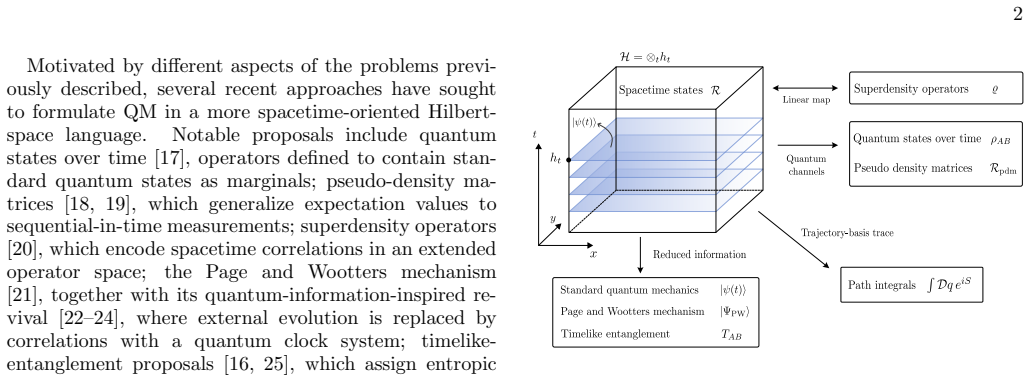
Spacetime states, the objects that play the role of quantum states in spacetime quantum mechanics, are the single source from which path integrals, quantum states over time, pseudo-density matrices, the Page and Wootters mechanism, superdensity operators, and timelike-entanglement proposals all arise through particular evaluations, reduced information, linear maps, or quantum channels. The unification supplies explicit mathematical representations of these formalisms, reveals relations among them, and clarifies the spacetime information each one captures.
What carries the argument
Spacetime states, which serve as the quantum-state analogues in the spacetime quantum mechanics framework, together with the operations of evaluations, reduced information, linear maps, or quantum channels that extract the listed formalisms from them.
If this is right
- The same spacetime-state object supplies representations relevant to Leggett-Garg inequalities, out-of-time-order correlators, temporal tensor networks, fermionic systems, relativistic quantum field theories, quantum reference frames, and classical physics.
- Relations between the formalisms become directly visible once each is expressed as an operation on the shared spacetime state.
- The spacetime information retained or discarded by each formalism can be read off from the reduction step that produces it.
- Additional insights into temporal correlations follow from choosing different evaluations or channels on the same spacetime state.
Where Pith is reading between the lines
- Choosing different reduction maps from one spacetime state could generate hybrid formalisms that combine features of path integrals and pseudo-density matrices.
- The unification suggests that discrepancies between two spacetime approaches might be traceable to the choice of which information is kept or discarded during the reduction step.
- In settings with multiple observers, the spacetime-state picture might allow consistent treatment of temporal entanglement across different reference frames without separate constructions.
- Testing whether a newly proposed spacetime formalism fits inside the same recovery scheme would immediately place it in relation to the existing ones.
Load-bearing premise
That each listed formalism can be recovered from the spacetime-state object by the stated operations without extra structure or loss of the features that originally distinguished the proposals.
What would settle it
A demonstration that recovering the Page and Wootters mechanism from a spacetime state requires additional assumptions or loses a feature that the original mechanism treats as essential.
Figures

read the original abstract
Recent efforts to formulate quantum mechanics in a way that treats space and time on a more equal footing have led to a large variety of spacetime-oriented approaches. In this work we present a detailed study of spacetime states, the objects that play the role of quantum states in the recently introduced framework of spacetime quantum mechanics, and show that the main proposals in the literature are different manifestations of the same underlying object. Path integrals, quantum states over time, pseudo-density matrices, the Page and Wootters mechanism, superdensity operators, and timelike-entanglement proposals all arise from spacetime states through particular evaluations, reduced information, linear maps, or quantum channels. This unification provides explicit mathematical representations of these formalisms, reveals relations among them, and clarifies the spacetime information each one captures. We also study the broader relevance of the spacetime-state point of view for Leggett-Garg inequalities, OTOCs, temporal tensor networks, fermionic systems, relativistic QFTs, quantum reference frames, and classical physics, together with additional insights and perspectives revealed by the common unifying framework.
Editorial analysis
A structured set of objections, weighed in public.
Referee Report
Summary. The manuscript claims that spacetime states serve as the unifying object in spacetime quantum mechanics, from which path integrals, quantum states over time, pseudo-density matrices, the Page and Wootters mechanism, superdensity operators, and timelike-entanglement proposals all arise via particular evaluations, reduced information, linear maps, or quantum channels. It further examines the framework's relevance to Leggett-Garg inequalities, OTOCs, temporal tensor networks, fermionic systems, relativistic QFTs, quantum reference frames, and classical physics.
Significance. If the mappings are faithful and preserve the distinguishing features of each formalism without additional ad-hoc structure, the work would supply explicit mathematical representations and relations among existing spacetime approaches, clarifying the spacetime information each captures and offering a common lens for applications in relativistic and temporal quantum settings.
major comments (2)
- [Abstract] Abstract: the unification result is stated without derivations, explicit constructions, or error analysis, making it impossible to assess whether the claimed mappings from spacetime states are faithful or introduce hidden assumptions or loss of essential features.
- The central claim rests on the assumption that the listed formalisms recover from a single spacetime-state object via the stated operations; no concrete test or counter-example analysis is supplied to confirm independence from target formalisms.
minor comments (1)
- A summary table listing each formalism, the corresponding operation on spacetime states, and the information retained or discarded would improve clarity.
Simulated Author's Rebuttal
We thank the referee for their careful reading of the manuscript. The abstract provides a concise overview of the unification, while the body supplies the explicit constructions, derivations, and mappings. We address the major comments point by point below.
read point-by-point responses
-
Referee: [Abstract] Abstract: the unification result is stated without derivations, explicit constructions, or error analysis, making it impossible to assess whether the claimed mappings from spacetime states are faithful or introduce hidden assumptions or loss of essential features.
Authors: The abstract is a high-level summary by design. The manuscript provides the requested explicit constructions and derivations in Sections 3–7, showing how each listed formalism (path integrals, pseudo-density matrices, Page-Wootters, etc.) is recovered from the spacetime state via concrete evaluations, reduced information, linear maps, or quantum channels. Preservation of distinguishing features and any information loss are analyzed in the relevant sections for each mapping. revision: no
-
Referee: The central claim rests on the assumption that the listed formalisms recover from a single spacetime-state object via the stated operations; no concrete test or counter-example analysis is supplied to confirm independence from target formalisms.
Authors: Section 2 defines the spacetime state independently of the target formalisms. Sections 4–7 then supply explicit, constructive derivations demonstrating recovery of each formalism’s standard results and features through the stated operations, without additional ad-hoc structure. These positive constructions across multiple distinct approaches constitute the primary evidence of the unification and independence; we do not claim exhaustive counter-example searches. revision: no
Circularity Check
No significant circularity identified
full rationale
The paper defines spacetime states within the spacetime quantum mechanics framework and claims that path integrals, pseudo-density matrices, Page-Wootters, and related formalisms arise from them via evaluations, reduced information, linear maps, or channels. No equations, self-citations, or derivations are exhibited that reduce the spacetime-state object to any of the target formalisms by construction, nor do any 'predictions' reduce to fitted inputs. The unification is presented as showing explicit representations and relations among independently motivated proposals, making the derivation self-contained against external benchmarks.
Axiom & Free-Parameter Ledger
axioms (1)
- domain assumption Spacetime states exist as the fundamental objects from which the listed formalisms derive
invented entities (1)
-
spacetime states
no independent evidence
Reference graph
Works this paper leans on
-
[1]
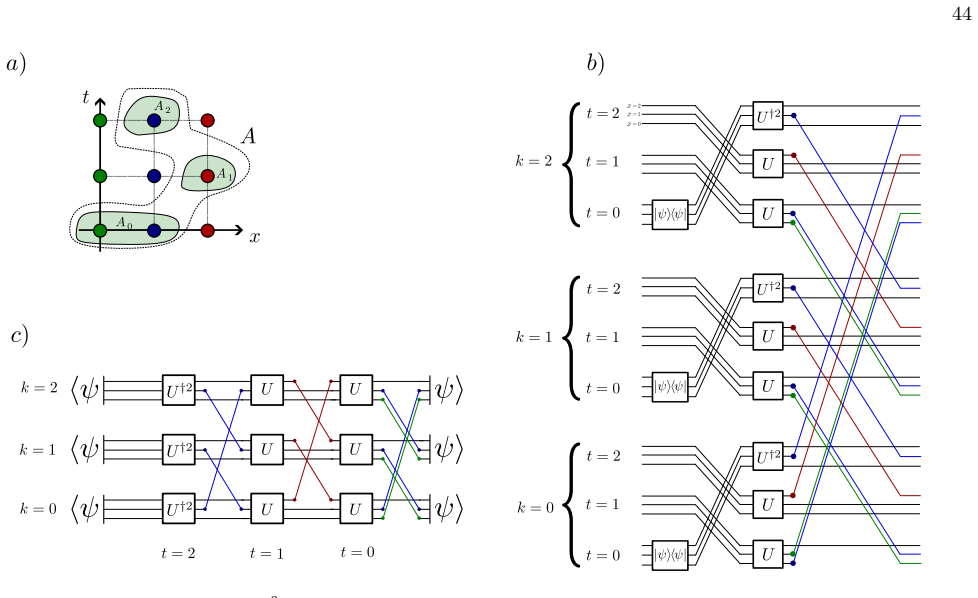
The operatorsU⊗U⊗(U †)2 acting on the left of the time translations across slices on panel b) get replaced byU 10 ⊗U 21 ⊗U † 20 forU tt′ ≡U(ϵt ′, ϵt)
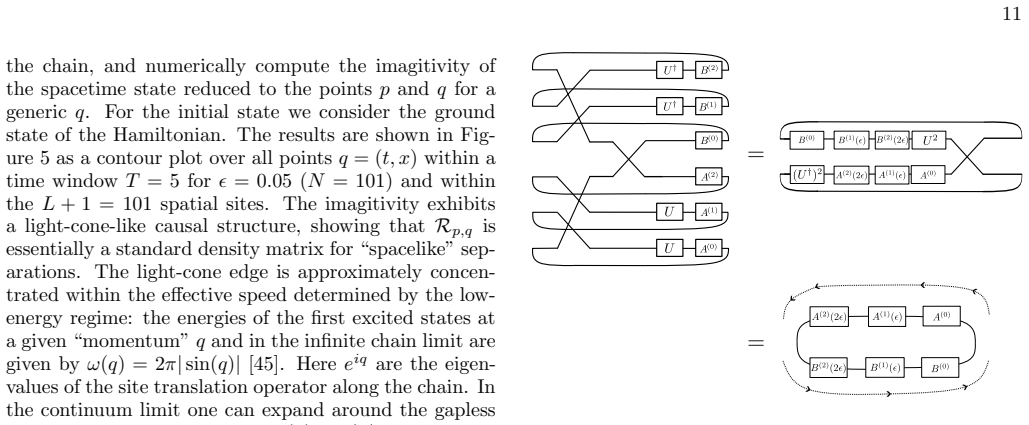
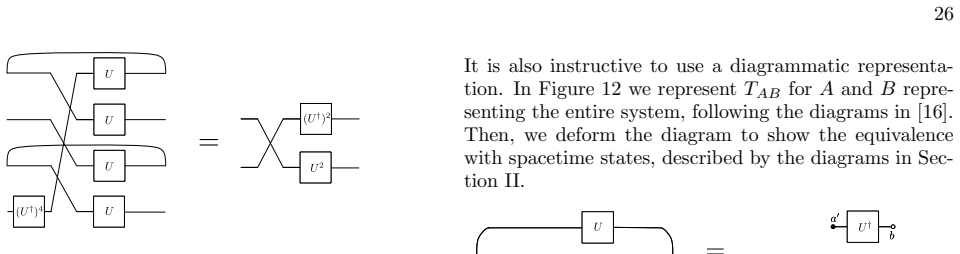
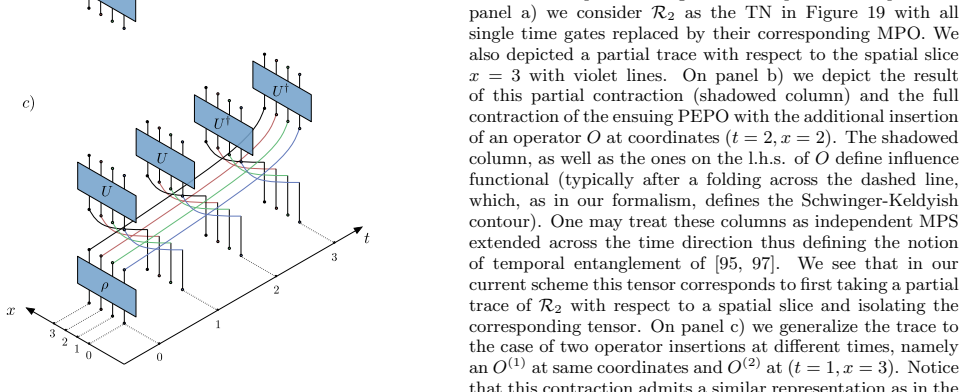
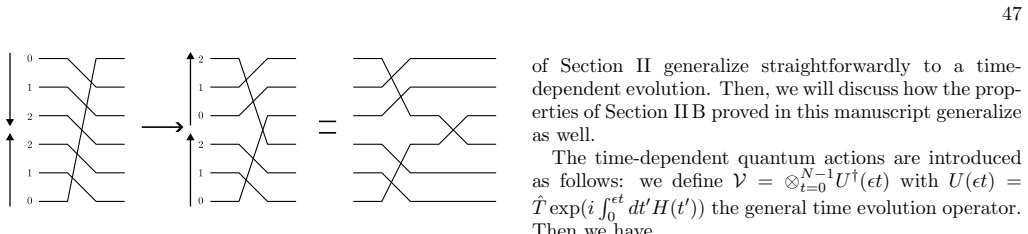
Notably it is trivial to generalize to the time- dependent case: consider the example of the Figure 21. The operatorsU⊗U⊗(U †)2 acting on the left of the time translations across slices on panel b) get replaced byU 10 ⊗U 21 ⊗U † 20 forU tt′ ≡U(ϵt ′, ϵt). This happens in the 3-copies ofR. Then, on panel c) we just need to replace again each (U †)2 →U † 20,...
-
[2]
By writing the cor- responding expression forR † A and using Corollary 2 we obtain RA − R† A = 1 4 X i,j ⟨ψ|[Pi(t), Pj]|ψ⟩Pi ⊗P j .(B1) where we assumed a pure initial state|ψ⟩
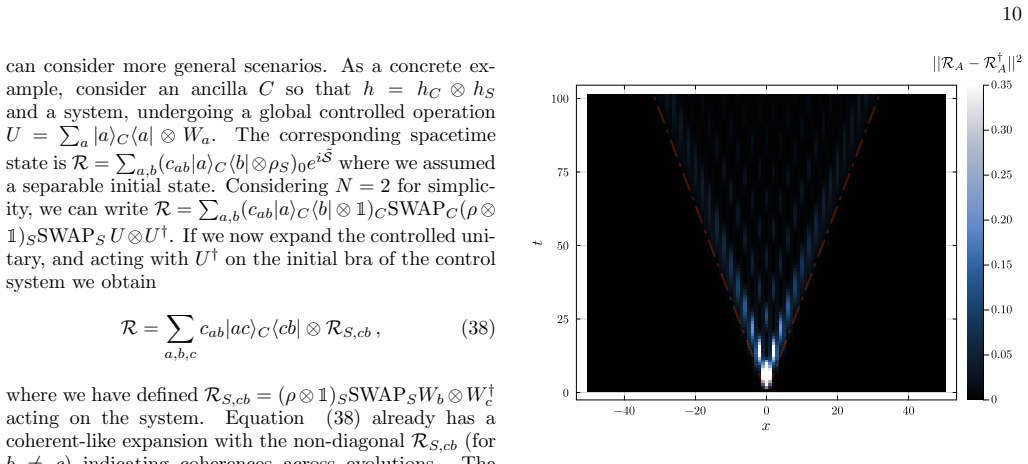
Imagitivity To describe our method let us first notice that since we are considering only two sitesR A = 1 4 P i,j Tr[RPi ⊗ 48 Pj]Pi ⊗P j whereP i are the Pauli matrices which form a complete orthogonal basis ofh. By writing the cor- responding expression forR † A and using Corollary 2 we obtain RA − R† A = 1 4 X i,j ⟨ψ|[Pi(t), Pj]|ψ⟩Pi ⊗P j .(B1) where w...
-
[3]
states” through MPS, evolved via Trotter steps, i.e., TEBD method applied to the vec- torized “external
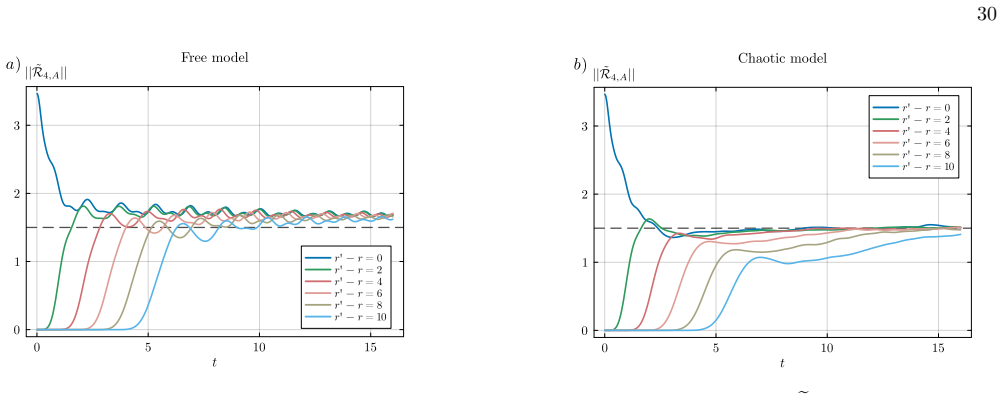
OTOCs Consider the operator ˜R4 restricted to the support of sitesr, r ′ and timest 1 = 0, t2 ≡t. From Eq. (144) we get eR4,A = 1 16 X i,j,k,l Cij;kl(r, r′;t)P i ⊗P j ⊗P k ⊗P l (B3) where we recall that the tensor, forr, r ′ sites andP i the Pauli matrices (i=x, y, z), is given by Cij;kl(r, r′;t) = tr[[P r,i(t), Pr′,j]†[Pr,k(t), Pr′,l]].(B4) This implies|...
-
[4]
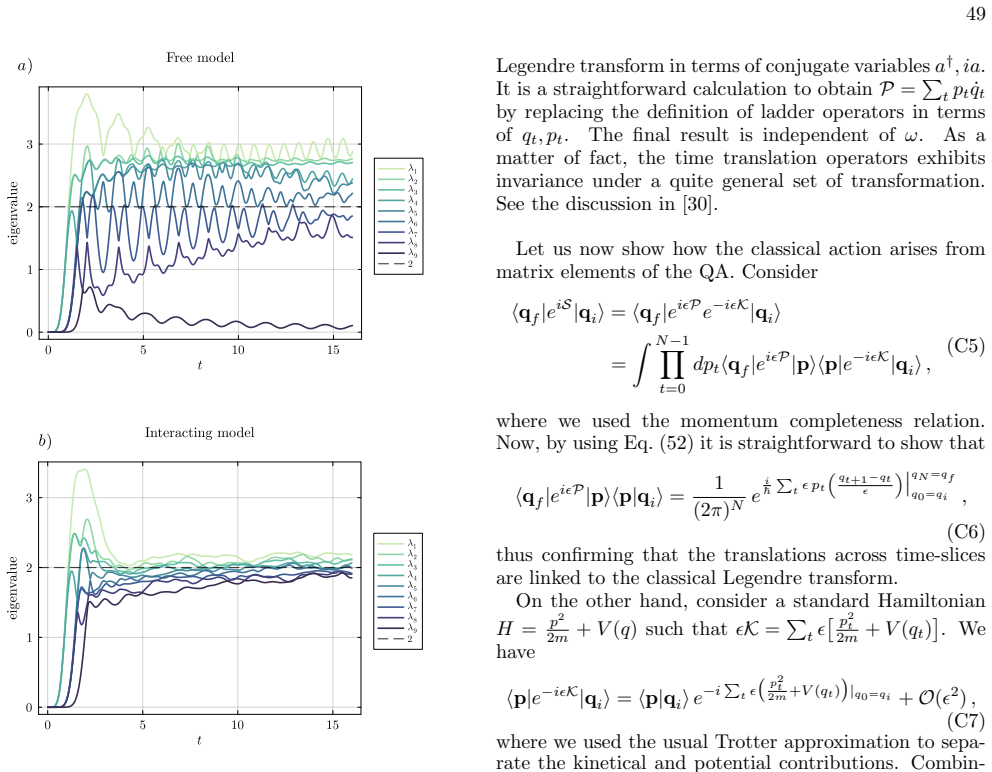
Feynman PI Let us briefly explain how to obtain the close expres- sion forPof Eq. (53). We first notice than rather than employing operatorsq t, pt we can work with ladder op- eratorsa t, a† t satisfying [at, a† t′] =δ tt′ ,(C1) with other commutators vanishing. In fact, we can al- ways definea t =p ω 2 (qt +ip t/ω),a † t =p ω 2 (qt −ip t/ω) for arbitrary...
-
[5]
Let us focus first in the time translation operator de- fined in Eq
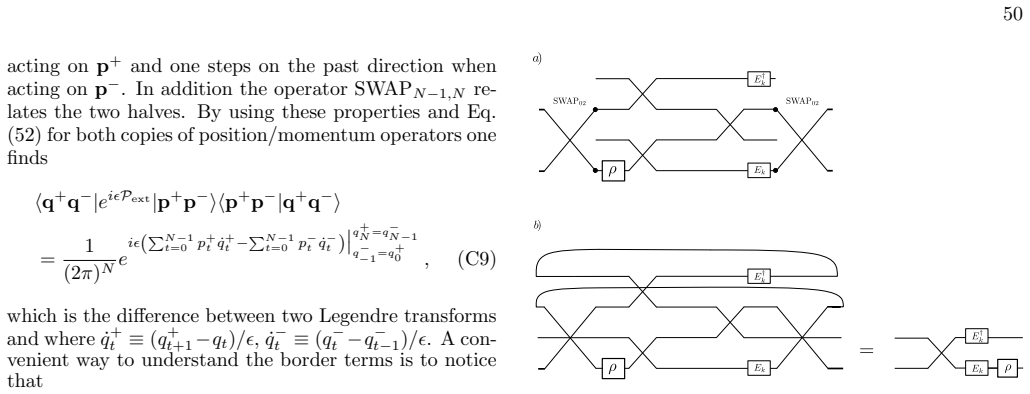
Schwinger–Keldysh PI Here we provide an explicit derivation of the ma- trix elements ofe iSext needed to connect it to the Schwinger–Keldysh PI. Let us focus first in the time translation operator de- fined in Eq. (42). Notice that acting on the right it es- sentially translates one step in the future direction when 50 acting onp + and one steps on the pa...
-
[6]
Under the hypothesis of the theorem we consider a state of the form|ψ⟩= P k ψka† k|0⟩and a quadratic (particle preserving) HamiltonianH= P k,k′ Mkk′a† kak′
Here ladder operators are evolved in the Heisenberg picturea k(t) =e iHt ake−iHt and|ψ⟩is a general state inh F . Under the hypothesis of the theorem we consider a state of the form|ψ⟩= P k ψka† k|0⟩and a quadratic (particle preserving) HamiltonianH= P k,k′ Mkk′a† kak′. Then, ladder operator evolve as follows, ak(t) = X k′ e−itM kk′ ak′ a† k(t) = X k′ eit...
-
[7]
Minkowski, Raum und Zeit, Physikalische Zeitschrift 10, 104 (1909)
H. Minkowski, Raum und Zeit, Physikalische Zeitschrift 10, 104 (1909)
1909
-
[8]
P. A. M. Dirac, The evolution of the physicist’s picture of nature, Scientific American208, 45 (1963)
1963
-
[9]
A. S. Eddington,Space, Time and Gravitation: An Out- line of the General Relativity Theory(Cambridge Uni- versity Press, Cambridge, 1920)
1920
-
[10]
P. A. M. Dirac, The theory of gravitation in hamiltonian form, Proceedings of the Royal Society of London. Series A. Mathematical and Physical Sciences246, 333 (1958)
1958
-
[11]
C. J. Isham, Canonical quantum gravity and the prob- lem of time, Integrable systems, quantum groups, and quantum field theories , 157 (1993)
1993
-
[12]
Anderson, Problem of time in quantum gravity, An- nalen der Physik524, 757 (2012)
E. Anderson, Problem of time in quantum gravity, An- nalen der Physik524, 757 (2012)
2012
-
[13]
W. H. Zurek, Decoherence, einselection, and the quan- tum origins of the classical, Reviews of modern physics 75, 715 (2003)
2003
-
[14]
D. A. Abanin, E. Altman, I. Bloch, and M. Serbyn, Col- loquium: Many-body localization, thermalization, and entanglement, Reviews of Modern Physics91, 021001 (2019)
2019
-
[15]
W. H. Zurek, Quantum darwinism, Nature physics5, 181 (2009)
2009
-
[16]
Touil, F
A. Touil, F. Anza, S. Deffner, and J. P. Crutchfield, Branching states as the emergent structure of a quan- tum universe, Quantum8, 1494 (2024)
2024
-
[17]
Ryu and T
S. Ryu and T. Takayanagi, Holographic derivation of entanglement entropy from the anti–de sitter space/conformal field theory correspondence, Physical review letters96, 181602 (2006)
2006
-
[18]
Van Raamsdonk, Building up space–time with quan- tum entanglement, International Journal of Modern Physics D19, 2429 (2010)
M. Van Raamsdonk, Building up space–time with quan- tum entanglement, International Journal of Modern Physics D19, 2429 (2010)
2010
-
[19]
C. Cao, S. M. Carroll, and S. Michalakis, Space from hilbert space: Recovering geometry from bulk entangle- ment, Physical Review D95, 024031 (2017)
2017
-
[20]
Harper, A
J. Harper, A. Mollabashi, T. Takayanagi, Y. Taki,et al., Timelike entanglement entropy, Journal of High Energy Physics2023, 1 (2023)
2023
-
[21]
M. P. Heller, F. Ori, and A. Serantes, Temporal entan- glement from holographic entanglement entropy, Phys- ical Review X15, 041022 (2025)
2025
-
[22]
A. Milekhin, Z. Adamska, and J. Preskill, Observable and computable entanglement in time, arXiv preprint arXiv:2502.12240 (2025)
arXiv 2025
-
[23]
Horsman, C
D. Horsman, C. Heunen, M. F. Pusey, J. Barrett, and R. W. Spekkens, Can a quantum state over time resem- ble a quantum state at a single time?, Proceedings of the Royal Society A: Mathematical, Physical and Engi- neering Sciences473, 20170395 (2017)
2017
-
[24]
J. F. Fitzsimons, J. A. Jones, and V. Vedral, Quantum correlations which imply causation, Scientific reports5, 18281 (2015)
2015
-
[25]
J. Fullwood and A. J. Parzygnat, Operator represen- tation of spatiotemporal quantum correlations, arXiv preprint arXiv:2405.17555 (2024)
arXiv 2024
-
[26]
Cotler, C.-M
J. Cotler, C.-M. Jian, X.-L. Qi, and F. Wilczek, Su- perdensity operators for spacetime quantum mechanics, Journal of High Energy Physics2018, 1 (2018)
2018
-
[27]
D. N. Page and W. K. Wootters, Evolution without evo- lution: Dynamics described by stationary observables, Physical Review D27, 2885 (1983)
1983
-
[28]
Giovannetti, S
V. Giovannetti, S. Lloyd, and L. Maccone, Quantum time, Physical Review D92, 045033 (2015)
2015
-
[29]
Boette, R
A. Boette, R. Rossignoli, N. Gigena, and M. Cerezo, System-time entanglement in a discrete-time model, Physical Review A93, 062127 (2016)
2016
-
[30]
Giovannetti, S
V. Giovannetti, S. Lloyd, and L. Maccone, Geomet- ric event-based quantum mechanics, New Journal of Physics25, 023027 (2023)
2023
-
[31]
Guo, Spacetime density matrix: Formalism and properties, J
W.-z. Guo, Spacetime density matrix: Formalism and properties, J. High Energ. Phys.2026(128)
2026
-
[32]
Giacomini, E
F. Giacomini, E. Castro-Ruiz, and ˇC. Brukner, Quan- tum mechanics and the covariance of physical laws in quantum reference frames, Nature communications10, 494 (2019)
2019
-
[33]
Castro-Ruiz, F
E. Castro-Ruiz, F. Giacomini, and ˇC. Brukner, Dynam- ics of quantum causal structures, Physical Review X8, 011047 (2018)
2018
-
[34]
N. L. Diaz, J. M. Matera, and R. Rossignoli, Spacetime quantum and classical mechanics with dynamical folia- tion, Phys. Rev. D109, 105008 (2024)
2024
-
[35]
N. L. Diaz and R. Rossignoli, Spacetime quantum me- chanics for bosonic and fermionic systems, Physical Re- view Research8, 10.1103/zmky-mmwb (2026)
-
[36]
N. L. Diaz, J. M. Matera, and R. Rossignoli, Space- time quantum actions, Physical Review D103, 065011 (2021)
2021
-
[37]
N. L. Diaz, From quantum time to manifestly covariant QFT: On the need for a quantum-action-based quanti- zation, Entropy28, 425 (2026)
2026
-
[38]
R. P. Feynman, Space-time approach to non-relativistic quantum mechanics, Reviews of modern physics20, 367 (1948)
1948
-
[39]
N. L. Diaz, J. M. Matera, and R. Rossignoli, Path integrals from spacetime quantum actions, Annals of Physics , 170052 (2025)
2025
-
[40]
The corresponding Weyl algebra factorizes in time, and Stone-von Neumann givesH ≃ ⊗ thup to unitary equiv- alence
For a finite number of time labels, [q t, pt′] =iδ tt′ de- fines a direct sum of independent canonical algebras. The corresponding Weyl algebra factorizes in time, and Stone-von Neumann givesH ≃ ⊗ thup to unitary equiv- alence
-
[41]
The case of fermions is however not equivalent to a tensor-product structure; for this reason we study it in the separate Section IV D
-
[42]
J. G. Kirkwood, Quantum statistics of almost classical assemblies, Physical Review44, 31 (1933)
1933
-
[43]
P. A. M. Dirac, On the analogy between classical and quantum mechanics, Reviews of Modern Physics17, 195 (1945)
1945
- [44]
-
[45]
Aharonov, D
Y. Aharonov, D. Z. Albert, and L. Vaidman, How the result of a measurement of a component of the spin of a spin-1/2 particle can turn out to be 100, Physical review letters60, 1351 (1988)
1988
-
[46]
A. J. Leggett and A. Garg, Quantum mechanics ver- sus macroscopic realism: Is the flux there when nobody 54 looks?, Physical Review Letters54, 857 (1985)
1985
-
[47]
Singh and N
S. Singh and N. Datta, Detecting positive quantum ca- pacities of quantum channels, npj Quantum Information 8, 50 (2022)
2022
-
[48]
Chiribella, G
G. Chiribella, G. M. D’Ariano, P. Perinotti, and B. Val- iron, Quantum computations without definite causal structure, Physical Review A—Atomic, Molecular, and Optical Physics88, 022318 (2013)
2013
-
[49]
Ara´ ujo, C
M. Ara´ ujo, C. Branciard, F. Costa, A. Feix, C. Giar- matzi, and ˇC. Brukner, Witnessing causal nonsepara- bility, New Journal of Physics17, 102001 (2015)
2015
-
[50]
Cerezo, R
M. Cerezo, R. Rossignoli, N. Canosa, and E. R´ ıos, Fac- torization and criticality in finitexxzsystems of arbi- trary spin, Physical Review Letters119, 220605 (2017)
2017
-
[51]
Des Cloizeaux and J
J. Des Cloizeaux and J. Pearson, Spin-wave spectrum of the antiferromagnetic linear chain, Physical Review 128, 2131 (1962)
1962
-
[52]
Y.-T. Lee, K. Kumaran, B. Pokharel, A. Scheie, C. L. Sarkis, D. A. Tennant, T. Humble, A. Schleife, A. Kandala, and A. Banerjee, Benchmarking quantum simulation with neutron-scattering experiments, arXiv preprint arXiv:2603.15608 10.48550/arXiv.2603.15608 (2026)
work page internal anchor Pith review Pith/arXiv arXiv doi:10.48550/arxiv.2603.15608 2026
-
[53]
Schwinger, Brownian motion of a quantum oscillator, Journal of Mathematical Physics2, 407 (1961)
J. Schwinger, Brownian motion of a quantum oscillator, Journal of Mathematical Physics2, 407 (1961)
1961
-
[54]
L. V. Keldysh, Diagram technique for nonequilibrium processes, Sov. Phys. JETP20(1965)
1965
-
[55]
R. B. Griffiths, Consistent histories and the interpre- tation of quantum mechanics, Journal of Statistical Physics36, 219 (1984)
1984
-
[56]
Gell-Mann and J
M. Gell-Mann and J. B. Hartle, Quantum mechanics in the light of quantum cosmology, inMurray Gell-Mann: Selected Papers(World Scientific, 2010) pp. 303–325
2010
-
[57]
C. J. Isham, Quantum logic and the histories approach to quantum theory, Journal of Mathematical Physics 35, 2157 (1994)
1994
-
[58]
C. J. Isham, N. Linden, and S. Schreckenberg, The classification of decoherence functionals: An analog of gleason’s theorem, Journal of Mathematical Physics35, 6360 (1994)
1994
-
[59]
Several results of this subsection are based on [33], where further mathematical details have been discussed
-
[60]
At finite temperature and out of equilibrium standard PI techniques are no longer feasi- ble [113]
In many field theoretical applications at zero tempera- ture a PI suffices as one is interested in vacuum corre- lation functions, which can be obtained by the quotient of two Feynman PIs. At finite temperature and out of equilibrium standard PI techniques are no longer feasi- ble [113]
-
[61]
Brif and A
C. Brif and A. Mann, Phase-space formulation of quan- tum mechanics and quantum-state reconstruction for physical systems with lie-group symmetries, Physical Review A59, 971 (1999)
1999
-
[62]
S. H. Lie and J. Fullwood, Multipartite quantum states over time from two fundamental assumptions, Physical Review Letters135, 230204 (2025)
2025
-
[63]
Marletto, V
C. Marletto, V. Vedral, S. Virz` ı, E. Rebufello, A. Avella, F. Piacentini, M. Gramegna, I. P. Degiovanni, and M. Genovese, Non-monogamy of spatio-temporal cor- relations and the black hole information loss paradox, Entropy22, 228 (2020)
2020
-
[64]
M. Song, V. Narasimhachar, B. Regula, T. J. El- liott, and M. Gu, Causal classification of spatiotempo- ral quantum correlations, Physical Review Letters133, 110202 (2024)
2024
-
[65]
Fullwood, Quantum dynamics as a pseudo-density matrix, Quantum9, 1719 (2025)
J. Fullwood, Quantum dynamics as a pseudo-density matrix, Quantum9, 1719 (2025)
2025
-
[66]
Zhang, O
T. Zhang, O. Dahlsten, and V. Vedral, Different in- stances of time as different quantum modes: quantum states across space-time for continuous variables, New Journal of Physics22, 023029 (2020)
2020
-
[67]
We also mostly focus on uni- tary evolution as our discussion can be extended to quantum channels by simply extending the system
We consider that between each measurements a fixed amount of timeϵlapsed. We also mostly focus on uni- tary evolution as our discussion can be extended to quantum channels by simply extending the system
-
[68]
X. Liu, Y. Qiu, O. Dahlsten, and V. Vedral, Quantum causal inference with extremely light touch, npj Quan- tum Information11, 1 (2025)
2025
-
[69]
To our knowledge, this connection was not made explicit in [56]
In this sense, that Markovian QSOT extension may be naturally identified with the multipartite PDM. To our knowledge, this connection was not made explicit in [56]
-
[70]
Rudolph, Some properties of the computable cross- norm criterion for separability, Physical Review A67, 032312 (2003)
O. Rudolph, Some properties of the computable cross- norm criterion for separability, Physical Review A67, 032312 (2003)
2003
-
[71]
Chen and L.-A
K. Chen and L.-A. Wu, A matrix realignment method for recognizing entanglement, Quantum Information and Computation3, 193 (2003)
2003
-
[72]
Peres, Separability criterion for density matrices, Physical Review Letters77, 1413 (1996)
A. Peres, Separability criterion for density matrices, Physical Review Letters77, 1413 (1996)
1996
-
[73]
Horodecki, P
M. Horodecki, P. Horodecki, and R. Horodecki, Sepa- rability of n-particle mixed states: necessary and suffi- cient conditions in terms of linear maps, Physics Letters A283, 1 (2001)
2001
-
[74]
B. S. DeWitt, Quantum theory of gravity. i. the canon- ical theory, Physical Review160, 1113 (1967)
1967
-
[75]
W. G. Unruh and R. M. Wald, Time and the interpre- tation of canonical quantum gravity, Physical Review D 40, 2598 (1989)
1989
-
[76]
K. V. Kuchaˇ r, Time and interpretations of quantum gravity, International Journal of Modern Physics D20, 3 (2011)
2011
-
[77]
Boette and R
A. Boette and R. Rossignoli, History states of systems and operators, Physical Review A98, 032108 (2018)
2018
-
[78]
I. L. Paiva, A. Te’eni, B. Y. Peled, E. Cohen, and Y. Aharonov, Non-inertial quantum clock frames lead to non-hermitian dynamics, Communications Physics5, 298 (2022)
2022
-
[79]
N. L. Diaz, P. Braccia, M. Larocca, J. M. Matera, R. Rossignoli, and M. Cerezo, Parallel-in-time quantum simulation via Page and Wootters quantum time, Phys. Rev. Res.7, 033294 (2025)
2025
-
[80]
Cafasso, N
D. Cafasso, N. Pranzini, J. Y. Malo, V. Giovannetti, and M. Chiofalo, Quantum time and the time-dilation induced interaction transfer mechanism, Physical Re- view D110, 106014 (2024)
2024
discussion (0)
Sign in with ORCID, Apple, or X to comment. Anyone can read and Pith papers without signing in.