REVIEW 3 major objections 6 minor 1 cited by
Spike times alone can be mapped to whole degenerate populations of conductance-based neuron models via DIC intermediates, enabling fast inference of the many conductance sets behind one observed firing pattern.
Reviewed by Pith at T0; open to challenge. T0 means a machine referee read the full paper against a public rubric. the ladder, T0–T4 →
2026-08-04 16:32 UTC pith:5S2QEPLV
load-bearing objection Genuinely useful methods paper: learned spike-to-DIC mapping plus iterative compensation works well in silico, but the fixed-threshold Vth assumption and lack of external validation keep it from being the final word. the 3 major comments →
Fast reconstruction of degenerate populations of conductance-based neuron models from spike times
The pith
A machine-rendered reading of the paper's core claim, the machinery that carries it, and where it could break.
Core claim
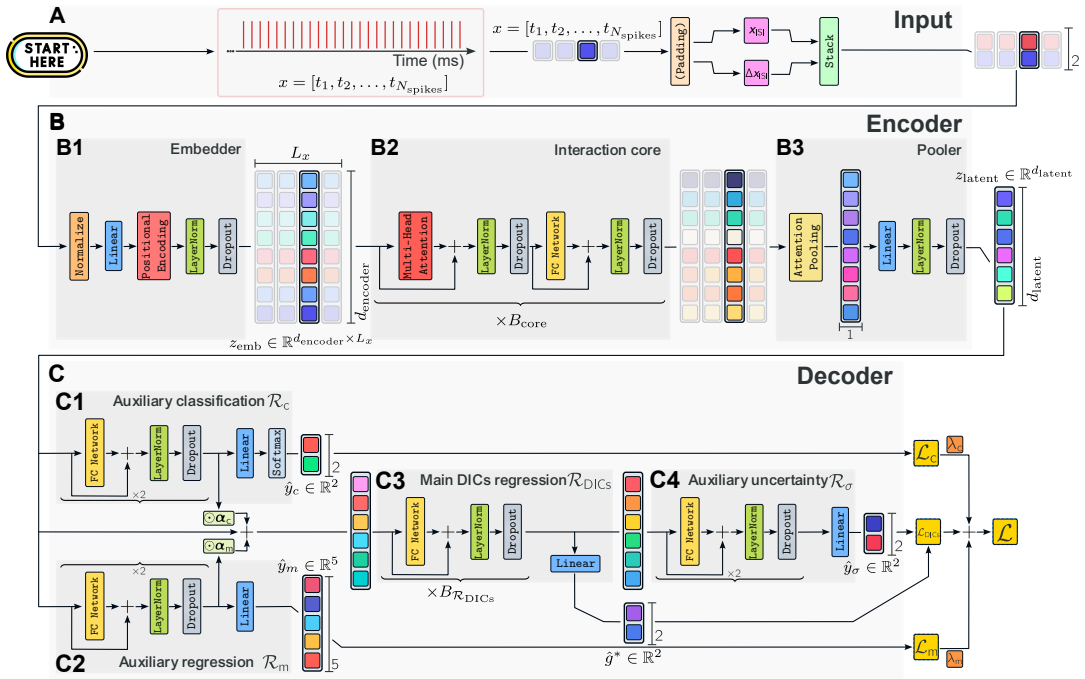
The central claim is that the inverse problem of mapping spike times to conductance-based model parameters becomes tractable when routed through Dynamic Input Conductances (DICs) evaluated at threshold. DICs reduce each high-dimensional conductance vector to three scalars — fast, slow, and ultra-slow feedback gains — through the identity g_DICs(Vth)=S(Vth;gbar)·gbar. The paper trains an attention-based encoder–decoder to predict the slow and ultra-slow DIC values directly from raw spike times, then uses an iterative compensation algorithm that recomputes the sensitivity matrix at each step to generate diverse conductance vectors satisfying those targets. After five iterations the residual DI
What carries the argument
Dynamic Input Conductances (DICs): three voltage-dependent curves — fast, slow, ultra-slow — that aggregate all ionic currents in a CBM into interpretable feedback components; their values at the threshold voltage Vth summarize a model in three scalars via the identity g_DICs(Vth)=S(Vth;gbar)·gbar, where S is the sensitivity matrix. The iterative compensation algorithm updates compensable conductances by repeatedly solving A(gbar_comp^(k))·gbar_comp^(k+1)=b(gbar_comp^(k)), recomputing S at each step, so that nonlinear models with calcium-dependent currents can satisfy DIC constraints.
Load-bearing premise
The pipeline treats the threshold voltage Vth as a fixed constant (−51 mV for STG, −55.5 mV for DA) across all conductance samples; if true threshold varies with conductances, DIC constraints are enforced at the wrong voltage and populations could deviate from intended firing patterns.
What would settle it
Sample a broad set of conductance vectors from the analysis distribution, compute each instance's true threshold from g_t(Vth)=0, and compare against the fixed a priori value; if the spread of true thresholds exceeds a few millivolts in a way that changes DIC-predicted firing class, the constant-threshold approximation fails. Alternatively, retrain the pipeline with per-instance thresholds and check whether generated population activity matches inputs more closely than the fixed-threshold version.
If this is right
- Spike recordings alone suffice to generate in silico populations of conductance-based models that reproduce the recorded firing statistics, removing the need for voltage traces in parameter inference.
- Because the pipeline outputs many conductance vectors rather than one, it makes neuronal degeneracy explicit and lets experiments ask how variable channel densities can be while preserving activity.
- The speed of the method (about 1.25e-5 seconds per forward pass on GPU, milliseconds per population) makes real-time or near-real-time inference feasible during experiments.
- The pipeline transfers to a new neuron model with only about 34% additional parameters via low-rank adaptation, suggesting reuse across cell types with minimal retraining.
- Robustness to Poisson-distributed spike trains indicates the method can handle irregular, physiologically realistic variability despite training on regular spontaneous activity.
Where Pith is reading between the lines
- A natural testable extension is to build datasets with DIC constraints at multiple voltages; the paper notes subthreshold features such as after-depolarizations are currently invisible, and multi-voltage DICs would recover them.
- The one-dimensional manifold found for spiking DIC predictions implies that spike trains alone may not uniquely determine slow and ultra-slow DICs in the spiking regime; combining spike times with voltage snippets or stimuli may disambiguate them.
- The same DIC-space sampling could be used to visualise how neuromodulators shift conductance distributions by comparing inferred populations before and after drug application.
- The iterative compensation algorithm should apply to other nonlinear CBMs (the paper suggests models with calcium or SK dynamics); testing it on a model with a different nonlinearity would show whether the factor-15 improvement generalises.
Editorial analysis
A structured set of objections, weighed in public.
Referee Report
Summary. The paper proposes a two-stage pipeline for inferring degenerate populations of conductance-based neuron models from spike times alone. In the first stage, an attention-based encoder-decoder network maps variable-length spike-time sequences to slow and ultra-slow Dynamic Input Conductance (DIC) values evaluated at an a priori threshold voltage Vth. In the second stage, an iterative compensation algorithm converts the predicted DIC targets into populations of conductance vectors that approximately satisfy those targets, exploiting degeneracy. The method is validated on two conductance-based models (STG and DA) using synthetic datasets of 1.2 million instances, on Poisson-generated irregular spike trains, and with LoRA-based transfer from STG to DA. The authors report that five compensation iterations reduce the DIC residual norm by a factor of 15 relative to the previous linear method, that generated populations reproduce input spiking and bursting statistics with low bias across 500 test points, and that inference requires on the order of tens of microseconds per spike train.
Significance. If the claims hold, the paper is a significant methodological contribution: it provides an interpretable, low-dimensional intermediate (DICs) that makes spike-only reconstruction of degenerate populations tractable and fast, with open-source software. The engineering is careful in several respects: populations are kept together in train/validation/test splits, the dataset is balanced across spiking and bursting regimes, residual reduction is quantified, bias is analyzed across 500 populations, and robustness to Poisson inputs is explicitly tested. The LoRA transfer is a useful practical addition. However, the evaluation is entirely synthetic and generated by the same DIC-based compensation pipeline that is used at inference, so the quantitative agreement in Figs. 6-7 partly reflects internal consistency rather than external predictive power. The fixed-threshold approximation is also load-bearing and is not validated on the extreme DIC targets used for training. These issues are addressable and do not undermine the core idea, but they must be resolved before the experimental-applicability claims in the abstract and discussion are justified.
major comments (3)
- [Materials and Methods, 'Choice of a priori threshold voltage'; Eq. (10); Eq. (5); Eq. (14)] The entire pipeline evaluates DIC targets, residuals, and iterative updates at a fixed a priori Vth (-51 mV for STG, -55.5 mV for DA), while Eq. (10) defines Vth as a per-instance quantity: the first decreasing zero of gt = gf + gs + gu. The only support is an empirical distribution over 4,000 conductance vectors sampled from D_analysis, which does not cover the extreme targets used in the training dataset (e.g., gs ∈ [-20,20], gu ∈ [0,20] for STG). If the true threshold shifts by several mV for those extreme targets, the residual metric Eq. (5), the dataset labels, and the compensation update Eq. (14) all enforce constraints at a voltage that is not the threshold of the generated neuron. The rare outliers reported at extreme conditions in Fig. 7B are exactly where such a shift would appear. Please provide either a theoretical bound on the Vth shift over the sampled DIC box, an empirical
- [Results, 'Building a synthetic dataset...' and 'The full generative pipeline...'] The evaluation is a closed loop: the dataset is generated by sampling DIC targets and using the iterative compensation algorithm to produce populations (Fig. 3B), the network is trained to predict those same DIC targets, and the final validation (Figs. 6-7) compares activity of populations generated by the same algorithm from the predicted DICs against activity of populations generated by the same algorithm from the true DICs. This makes the reported agreement a test of self-consistency, not of predictive power on independently defined ground truth. I recommend adding an external validation in which conductance vectors are sampled directly from a biological prior (D_analysis or a held-out region), simulated without the DIC compensation step, and the resulting spike trains are passed through the pipeline; success should be measured by whether the generated populations reproduce the activi
- [Introduction; Results, 'Benchmarking...' and Discussion] The paper positions the method against existing inference approaches (refs. 13-22) and against the linear compensation method of [24], and claims speed and scalability. However, no quantitative comparison with any external inference method is provided. Fig. 2A compares iterative compensation only with its own linear predecessor, and the reported inference time (1.25e-5 s per forward pass) has no baseline. To make the 'fast' and 'scalable' claims meaningful, please include at least one comparison on a common task: e.g., recovering conductance populations or reproducing activity from a held-out set of spike trains, using an existing method such as a Bayesian sampler or the linear compensation of [24] as a baseline. This does not require exhaustive benchmarking, but it is necessary to locate the contribution relative to the state of the art.
minor comments (6)
- [General] The manuscript repeatedly defers essential details to S1 Appendix (model equations, DIC definitions, hyperparameters, threshold-distribution plots, DA dataset sizes). The appendix was not included with the submitted text; without it, reproducibility cannot be assessed. Please ensure the appendix is available to reviewers and that all referenced figures and tables are present.
- [Eq. (5)] The residual definition uses \(S\(V; [g_random; g_comp])\) and \S(V; g)\, but \hat{S}\ is not explicitly defined at that point. It would help to state that \hat{S}\ is the sensitivity matrix evaluated at a fixed default value of the compensated conductances.
- [Table 1] Table 1b reports MAE for gs and gu but does not report the standard deviation of these DIC values in the dataset, unlike Table 1a for activity descriptors. Adding DIC variability would help interpret the MAE magnitudes, especially for the spiking regime where degeneracy is invoked.
- [Fig. 2A] The caption states 1,633 target DICs, while the dataset section describes 75,000 sampled DIC couples. Please clarify the provenance of the 1,633 targets and why this subset is used for the residual comparison.
- [Fig. 7] The text says '16×16 neurons per point' and '500 random points', but Fig. 6 mentions 500 generated neurons per regime and Fig. 8 uses 16 generated instances per input. Please make the sample sizes consistent and explicit in each figure caption.
- [Results, robustness section] At high Poisson rates, the method sometimes classifies spiking inputs as bursting. The authors attribute this to the lack of a refractory period in Poisson processes. This is reasonable, but it would be useful to report how often this occurs as a function of λ, since it directly affects the practical operating range of the method.
Circularity Check
No significant circularity: the spike-to-DIC-to-conductance pipeline is a learned inverse of forward ODE simulation, not an input-output tautology.
full rationale
The pipeline is x → g_hat_DICs (neural network) → g_bar (iterative compensation) → simulated spike trains. DIC labels in the training set are the sampled (gs, gu) targets fed to the compensation algorithm; spike times are produced by full ODE simulation of the generated conductance vectors. Thus the network must genuinely invert a stochastic forward map. Held-out test populations and Poisson-based generalization inputs are not used to fit any parameter. The iterative compensation solves Eq (13)-(14) for conductance vectors matching target DICs; Eq (5) is a residual metric, not a fitted-output-as-prediction. The fixed a priori Vth is a stated modeling simplification validated on 4000 samples, and is not tuned to the test DIC targets. Self-citations to DIC theory [23,24] are backed by explicit equations (Eq 8-10) and by the paper's own dataset mapping, so they are not load-bearing in a circular way. The closed-loop synthetic evaluation tests internal consistency of the DIC intermediate, but the central claim of reconstructing degenerate populations from spike times retains independent empirical content.
Axiom & Free-Parameter Ledger
free parameters (5)
- Fixed threshold voltage V_th =
-51 mV (STG), -55.5 mV (DA)
- Number of compensation iterations K =
5
- DIC sampling bounds =
[-20,20] x [0,20] (STG), [-10,15] x [0,20] (DA)
- Neural network parameters =
115,627 trainable parameters
- LoRA rank r =
32
axioms (5)
- domain assumption The CBM structure (equations, gating dynamics, reversal potentials) is fixed and known; only maximal conductances are unknown.
- domain assumption DIC values at a single threshold voltage are sufficient to characterize spontaneous firing patterns.
- domain assumption The threshold voltage can be replaced by a fixed constant per model.
- domain assumption Synthetic data generated by the same model and compensation algorithm is representative of the target application domain.
- ad hoc to paper Iterative compensation converges to a small residual in K=5 iterations for the models considered.
Cite this review
Pith. "Pith review of Fast reconstruction of degenerate populations of conductance-based neuron models from spike times." pith.science (2026). https://pith.science/paper/5S2QEPLV
@misc{pith2026250912783,
  author       = {Pith},
  title        = {Pith review of: Fast reconstruction of degenerate populations of conductance-based neuron models from spike times},
  year         = {2026},
  howpublished = {\url{https://pith.science/paper/5S2QEPLV}},
  note         = {Machine review of arXiv:2509.12783}
}
read the original abstract
Inferring the biophysical parameters of conductance-based models (CBMs) from experimentally accessible recordings remains a central challenge in computational neuroscience. Spike times are the most widely available data, yet they reveal little about which combinations of ion channel conductances generate the observed activity. This inverse problem is further complicated by neuronal degeneracy, where multiple distinct conductance sets yield similar spiking patterns. We introduce a method that addresses this challenge by combining deep learning with Dynamic Input Conductances (DICs), a theoretical framework that reduces complex CBMs to three interpretable feedback components governing excitability and firing patterns. Our approach first maps spike times to DIC densities at threshold using a neural network that learns a low-dimensional representation of neuronal activity. The predicted DIC values are then used to generate degenerate CBM populations via an iterative compensation algorithm, ensuring compatibility with the intermediate target DICs, and thereby reproducing the corresponding firing patterns, even in high-dimensional models. Applied to two models, this algorithmic pipeline reconstructs spiking and bursting regimes with high accuracy and robustness to variability, including spike trains generated under noisy current injection mimicking physiological stochasticity. It produces diverse degenerate populations within milliseconds on standard hardware, enabling scalable and efficient inference from spike recordings alone. Together, this work positions DICs as a practical and interpretable link between experimentally observed activity and mechanistic models. By enabling fast and scalable reconstruction of degenerate populations directly from spike times, our approach provides a powerful way to investigate how neurons exploit conductance variability to achieve reliable computation.
Figures


Forward citations
Cited by 1 Pith paper
-
Neuromodulation supports robust rhythmic pattern transitions in degenerate central pattern generators with fixed connectivity
An adaptive neuromodulation controller using equivariant bifurcation theory enables robust gait transitions in degenerate central pattern generators with fixed connectivity.
Reference graph
Works this paper leans on
-
[1]
Regulation of Spike Timing in Visual Cortical Circuits
Tiesinga P, Fellous JM, Sejnowski TJ. Regulation of Spike Timing in Visual Cortical Circuits. Nature Reviews Neuroscience. 2008;9(2):97-107. arXiv:18200026. doi:10.1038/nrn2315
doi:10.1038/nrn2315 2008
-
[2]
Reliability of Spike Timing in Neocortical Neurons
Mainen ZF, Sejnowski TJ. Reliability of Spike Timing in Neocortical Neurons. Science (New York, NY). 1995;268(5216):1503-6. arXiv:7770778. doi:10.1126/science.7770778
-
[3]
Williams AH, Poole B, Maheswaranathan N, Dhawale AK, Fisher T, Wilson CD, et al. Discovering Precise Temporal Patterns in Large-Scale Neural Recordings through Robust and Interpretable Time Warping. Neuron. 2020;105(2):246-59.e8. arXiv:31786013. doi:10.1016/j.neuron.2019.10.020
-
[4]
Neuromodulation of Neuronal Circuits: Back to the Future
Marder E. Neuromodulation of Neuronal Circuits: Back to the Future. Neuron. 2012;76(1):1-11. doi:10.1016/j.neuron.2012.09.010
-
[5]
From the Connectome to Brain Function
Bargmann CI, Marder E. From the Connectome to Brain Function. Nature Methods. 2013 Jun;10(6):483-90. doi:10.1038/nmeth.2451. September 17, 2025 49/54
-
[6]
Neuromodulation of Brain State and Behavior
McCormick DA, Nestvogel DB, He BJ. Neuromodulation of Brain State and Behavior. Annual Review of Neuroscience. 2020 Jul;43(Volume 43, 2020):391-415. doi:10.1146/annurev-neuro-100219-105424
-
[7]
Ion Channel Degeneracy, Variability, and Covariation in Neuron and Circuit Resilience
Goaillard JM, Marder E. Ion Channel Degeneracy, Variability, and Covariation in Neuron and Circuit Resilience. Annual Review of Neuroscience. 2021;44:335-57. doi:10.1146/annurev-neuro-092920-121538
-
[8]
Global Structure, Robustness, and Modulation of Neuronal Models
Goldman MS, Golowasch J, Marder E, Abbott LF. Global Structure, Robustness, and Modulation of Neuronal Models. Journal of Neuroscience. 2001;21(14):5229-38. arXiv:11438598. doi:10.1523/JNEUROSCI.21-14-05229.2001
arXiv 2001
-
[9]
A Model Neuron with Activity-Dependent Conductances Regulated by Multiple Calcium Sensors
Liu Z, Golowasch J, Marder E, Abbott LF. A Model Neuron with Activity-Dependent Conductances Regulated by Multiple Calcium Sensors. Journal of Neuroscience. 1998;18(7):2309-20. arXiv:9502792. doi:10.1523/JNEUROSCI.18-07-02309.1998
arXiv 1998
-
[10]
Golowasch J, Abbott LF, Marder E. Activity-Dependent Regulation of Potassium Currents in an Identified Neuron of the Stomatogastric Ganglion of the Crab Cancer Borealis. Journal of Neuroscience. 1999;19(20):RC33-3. arXiv:10516335. doi:10.1523/JNEUROSCI.19-20-j0004.1999
arXiv 1999
-
[11]
How Multiple Conductances Determine Electrophysiological Properties in a Multicompartment Model
Taylor AL, Goaillard JM, Marder E. How Multiple Conductances Determine Electrophysiological Properties in a Multicompartment Model. Journal of Neuroscience. 2009;29(17):5573-86. arXiv:19403824. doi:10.1523/JNEUROSCI.4438-08.2009
-
[12]
Yu N, Canavier CC. A Mathematical Model of a Midbrain Dopamine Neuron Identifies Two Slow Variables Likely Responsible for Bursts Evoked by SK Channel Antagonists and Terminated by Depolarization Block. The Journal of Mathematical Neuroscience (JMN). 2015;5(1):5. doi:10.1186/s13408-015-0017-6
-
[13]
Druckmann S, Banitt Y, Gidon AA, Sch¨ urmann F, Markram H, Segev I. A Novel Multiple Objective Optimization Framework for Constraining Conductance-Based Neuron Models by Experimental Data. Frontiers in Neuroscience. 2007 Oct;1. doi:10.3389/neuro.01.1.1.001.2007. September 17, 2025 50/54
-
[14]
Prinz AA, Billimoria CP, Marder E. Alternative to Hand-Tuning Conductance-Based Models: Construction and Analysis of Databases of Model Neurons. Journal of Neurophysiology. 2003;90(6):3998-4015. doi:10.1152/jn.00641.2003
arXiv 2003
-
[15]
Algorithms for Inverting Hodgkin-Huxley Type Neuron Models [Ph.D
Shepardson D. Algorithms for Inverting Hodgkin-Huxley Type Neuron Models [Ph.D. Thesis]. Georgia Institute of Technology; 2009. Available from: http://hdl.handle.net/1853/31686
2009
-
[16]
Efficient Estimation of Detailed Single-Neuron Models
Huys QJM, Ahrens MB, Paninski L. Efficient Estimation of Detailed Single-Neuron Models. Journal of Neurophysiology. 2006 Aug;96(2):872-90. doi:10.1152/jn.00079.2006
arXiv 2006
-
[17]
Feedback Identification of Conductance-Based Models
Burghi TB, Schoukens M, Sepulchre R. Feedback Identification of Conductance-Based Models. Automatica. 2021 Jan;123:109297. doi:10.1016/j.automatica.2020.109297
arXiv 2021
-
[18]
Distributed Online Estimation of Biophysical Neural Networks
Burghi TB, O’Leary T, Sepulchre R. Distributed Online Estimation of Biophysical Neural Networks. In: 2022 IEEE 61st Conference on Decision and Control (CDC); 2022. p. 628-34. doi:10.1109/CDC51059.2022.9993018
arXiv 2022
-
[19]
A Sequential Monte Carlo Approach to Estimate Biophysical Neural Models from Spikes
Meng L, Kramer MA, Eden UT. A Sequential Monte Carlo Approach to Estimate Biophysical Neural Models from Spikes. Journal of Neural Engineering. 2011;8(6):065006. arXiv:22058277. doi:10.1088/1741-2560/8/6/065006
-
[20]
Meng L, Kramer MA, Middleton SJ, Whittington MA, Eden UT. A Unified Approach to Linking Experimental, Statistical and Computational Analysis of Spike Train Data. PLOS ONE. 2014;9(1):e85269. doi:10.1371/journal.pone.0085269
-
[21]
Ditlevsen S, Samson A. Estimation in the Partially Observed Stochastic Morris–Lecar Neuronal Model with Particle Filter and Stochastic Approximation Methods. The Annals of Applied Statistics. 2014 Jun;8(2):674-702. doi:10.1214/14-AOAS729. September 17, 2025 51/54
-
[22]
Training Deep Neural Density Estimators to Identify Mechanistic Models of Neural Dynamics
Gon¸ calves PJ, Lueckmann JM, Deistler M, Nonnenmacher M, ¨Ocal K, Bassetto G, et al. Training Deep Neural Density Estimators to Identify Mechanistic Models of Neural Dynamics. eLife. 2020;9:e56261. doi:10.7554/eLife.56261
-
[23]
Dynamic Input Conductances Shape Neuronal Spiking
Drion G, Franci A, Dethier J, Sepulchre R. Dynamic Input Conductances Shape Neuronal Spiking. eNeuro. 2015;2(1). doi:10.1523/ENEURO.0031-14.2015
-
[24]
Dimensionality Reduction of Neuronal Degeneracy Reveals Two Interfering Physiological Mechanisms
Fyon A, Franci A, Sacr´ e P, Drion G. Dimensionality Reduction of Neuronal Degeneracy Reveals Two Interfering Physiological Mechanisms. PNAS Nexus. 2024 Oct;3(10):pgae415. doi:10.1093/pnasnexus/pgae415
-
[25]
Spike2Pop: Bridging Experimental Neuroscience and Computational Modeling [Software]
Brandoit J. Spike2Pop: Bridging Experimental Neuroscience and Computational Modeling [Software]. GitHub
-
[26]
Multiple Models to Capture the Variability in Biological Neurons and Networks
Marder E, Taylor AL. Multiple Models to Capture the Variability in Biological Neurons and Networks. Nature Neuroscience. 2011;14(2):133-8. doi:10.1038/nn.2735
doi:10.1038/nn.2735 2011
-
[27]
Failure of Averaging in the Construction of a Conductance-Based Neuron Model
Golowasch J, Goldman MS, Abbott LF, Marder E. Failure of Averaging in the Construction of a Conductance-Based Neuron Model. Journal of Neurophysiology. 2002;87(2):1129-31. doi:10.1152/jn.00412.2001
arXiv 2002
-
[28]
Reliable Neuromodulation from Adaptive Control of Ion Channel Expression
Fyon A, Sacr´ e P, Franci A, Drion G. Reliable Neuromodulation from Adaptive Control of Ion Channel Expression. IF AC-PapersOnLine. 2023;56(2):458-63. doi:10.1016/j.ifacol.2023.10.1610
-
[29]
Degenerate Conductance-Based Models Populations Datasets: STG and DA models
Brandoit J, Ernst D, Drion G, Fyon A. Degenerate Conductance-Based Models Populations Datasets: STG and DA models. Zenodo; 2025. doi:10.5281/zenodo.16912161
-
[30]
Neuromodulation of Neurons and Synapses
Nadim F, Bucher D. Neuromodulation of Neurons and Synapses. Current Opinion in Neurobiology. 2014;29:48-56. doi:10.1016/j.conb.2014.05.003
-
[31]
Input Synchrony and the Irregular Firing of Cortical Neurons
Stevens CF, Zador AM. Input Synchrony and the Irregular Firing of Cortical Neurons. Nature Neuroscience. 1998;1(3):210-7. doi:10.1038/659. September 17, 2025 52/54
work page doi:10.1038/659 1998
-
[32]
Softky WR, Koch C. The Highly Irregular Firing of Cortical Cells Is Inconsistent with Temporal Integration of Random EPSPs. The Journal of Neuroscience: The Official Journal of the Society for Neuroscience. 1993;13(1):334-50. doi:10.1523/JNEUROSCI.13-01-00334.1993
arXiv 1993
-
[33]
Stimulus Onset Quenches Neural Variability: A Widespread Cortical Phenomenon
Churchland MM, Yu BM, Cunningham JP, Sugrue LP, Cohen MR, Corrado GS, et al. Stimulus Onset Quenches Neural Variability: A Widespread Cortical Phenomenon. Nature Neuroscience. 2010;13(3):369-78. doi:10.1038/nn.2501
doi:10.1038/nn.2501 2010
-
[34]
Spike Count Reliability and the Poisson Hypothesis
Amarasingham A, Chen TL, Geman S, Harrison MT, Sheinberg DL. Spike Count Reliability and the Poisson Hypothesis. The Journal of Neuroscience: The Official Journal of the Society for Neuroscience. 2006;26(3):801-9. arXiv:16421300. doi:10.1523/JNEUROSCI.2948-05.2006
-
[35]
LoRA: Low-Rank Adaptation of Large Language Models
Hu EJ, Shen Y, Wallis P, Allen-Zhu Z, Li Y, Wang S, et al.. LoRA: Low-Rank Adaptation of Large Language Models. arXiv; 2021. arXiv:2106.09685
Pith/arXiv arXiv 2021
-
[36]
Drion G, Massotte L, Sepulchre R, Seutin V. How Modeling Can Reconcile Apparently Discrepant Experimental Results: The Case of Pacemaking in Dopaminergic Neurons. PLOS Computational Biology. 2011;7(5):e1002050. doi:10.1371/journal.pcbi.1002050
-
[37]
Similar Network Activity from Disparate Circuit Parameters
Prinz AA, Bucher D, Marder E. Similar Network Activity from Disparate Circuit Parameters. Nature Neuroscience. 2004;7(12):1345-52. doi:10.1038/nn1352
doi:10.1038/nn1352 2004
-
[38]
Creating the Feedback Loop: Closed-Loop Neurostimulation
Hebb AO, Zhang JJ, Mahoor MH, Tsiokos C, Matlack C, Chizeck HJ, et al. Creating the Feedback Loop: Closed-Loop Neurostimulation. Neurosurgery Clinics of North America. 2014;25(1):187-204. arXiv:24262909. doi:10.1016/j.nec.2013.08.006
-
[39]
Designing, Tuning and Building Ultra-low-power Neuromodulable Mixed-feedback Silicon Neurons
Mendolia L, Franci A. Designing, Tuning and Building Ultra-low-power Neuromodulable Mixed-feedback Silicon Neurons. In: 44th Benelux Meeting on Systems and Control; 2025
2025
-
[40]
Qian K, Yu N, Tucker KR, Levitan ES, Canavier CC. Mathematical Analysis of Depolarization Block Mediated by Slow Inactivation of Fast Sodium Channels in September 17, 2025 53/54 Midbrain Dopamine Neurons. Journal of Neurophysiology. 2014;112(11):2779-90. doi:10.1152/jn.00578.2014
arXiv 2025
-
[41]
SciPy 1.0: Fundamental Algorithms for Scientific Computing in Python
Virtanen P, Gommers R, Oliphant TE, Haberland M, Reddy T, Cournapeau D, et al. SciPy 1.0: Fundamental Algorithms for Scientific Computing in Python. Nature Methods. 2020;17:261-72. doi:10.1038/s41592-019-0686-2
-
[42]
Shampine LF, Reichelt MW. The MATLAB ODE Suite. SIAM Journal on Scientific Computing. 1997;18(1):1-22. doi:10.1137/S1064827594276424
-
[43]
Attention is all you need
Vaswani A, Shazeer N, Parmar N, Uszkoreit J, Jones L, Gomez AN, et al. Attention is all you need. In: Proceedings of the 31st International Conference on Neural Information Processing Systems. NIPS’17. Red Hook, NY, USA: Curran Associates Inc.; 2017. p. 6000–6010
2017
-
[44]
Ba JL, Kiros JR, Hinton GE. Layer Normalization; 2016. arXiv:1607.06450
Pith/arXiv arXiv 2016
-
[45]
Improving Neural Networks by Preventing Co-adaptation of Feature Detectors
Hinton GE, Srivastava N, Krizhevsky A, Sutskever I, Salakhutdinov RR. Improving Neural Networks by Preventing Co-adaptation of Feature Detectors
-
[46]
Gaussian Error Linear Units (GELUs)
Hendrycks D, Gimpel K. Gaussian Error Linear Units (GELUs). arXiv; 2023. arXiv:1606.08415
Pith/arXiv arXiv 2023
-
[47]
Robust Estimation of a Location Parameter
Huber PJ. Robust Estimation of a Location Parameter. The Annals of Mathematical Statistics. 1964;35(1):73-101. doi:10.1214/aoms/1177703732
arXiv 1964
-
[48]
Random Search for Hyper-Parameter Optimization
Bergstra J, Bengio Y. Random Search for Hyper-Parameter Optimization. J Mach Learn Res. 2012 Feb;13(null):281-305
2012
-
[49]
Decoupled Weight Decay Regularization
Loshchilov I, Hutter F. Decoupled Weight Decay Regularization. arXiv; 2019. doi:10.48550/arXiv.1711.05101. September 17, 2025 54/54
-
[2025]
Software available athttps://github.com/julienbrandoit/ Spike2Pop---Bridging-Experimental-Neuroscience-and-Computational-Modeling
Version 1.1.1. Software available athttps://github.com/julienbrandoit/ Spike2Pop---Bridging-Experimental-Neuroscience-and-Computational-Modeling
This paper was first reviewed by deepseek-v4-flash on August 4, 2026.
discussion (0)
Sign in with ORCID, Apple, or X to comment. Anyone can read and Pith papers without signing in.