Critical Lin-Lunin-Maldacena geometries
Pith reviewed 2026-07-01 04:46 UTC · model grok-4.3
The pith
Near a cusp tip, the LLM metric takes a universal ISO(1,3)×SO(5) form with a naked line singularity that traps particles.
A machine-rendered reading of the paper's core claim, the machinery that carries it, and where it could break.
Core claim
In the vicinity of the cusp tip the supergravity dual given by the LLM metric acquires a universal ISO(1,3)×SO(5) symmetric form containing a naked singularity along a half-infinite line. Both massless and massive particles become trapped by this singularity for almost any impact parameter. Generic trajectories ending on the singular line reach it in finite affine time while the corresponding observer time diverges. An explicit analytic solution exists for a large class of massless trajectories, and the dynamics near the cusp exhibit no stochastic behavior, hinting at integrability.
What carries the argument
The LLM metric evaluated in the immediate vicinity of the cusp tip of the base-space droplet, which produces the naked line singularity.
If this is right
- Particles are trapped by the line singularity for almost every impact parameter.
- Generic trajectories reach the singularity in finite affine time but infinite observer time.
- A large class of massless trajectories admits explicit analytic solutions.
- The absence of stochastic behavior near the cusp indicates local integrability.
Where Pith is reading between the lines
- The universal local form implies that the physics near any cusp tip is independent of the global shape of the droplet.
- The trapping and time divergence may affect how correlation functions in the dual matrix model probe the critical regime.
- Similar cusps appearing in other matrix-model critical points could produce analogous singular structures in their gravity duals.
Load-bearing premise
The cusp in the density of complex eigenvalues produces a corresponding cusp in the LLM base-space droplet so that the supergravity description remains valid right at the tip.
What would settle it
An explicit computation of the metric near the cusp tip that fails to reduce to the claimed ISO(1,3)×SO(5) symmetric form, or a numerical integration of geodesics showing that trajectories avoid the singular line or require infinite affine time to reach it.
Figures
read the original abstract
We study the critical behavior of the Lin-Lunin-Maldacena (LLM) geometry in the case when a droplet in the LLM base space develops a cusp. This cusp is a generic feature of the density of complex eigenvalues in the dual complex matrix model (CMM) computing the correlation functions of huge 1/2-BPS operators in $\mathcal{N}=4$ SYM theory. It is also related to the criticality in CMM describing the pure $2D$ quantum gravity behavior. The supergravity dual -- LLM metric in the vicinity of the tip of the cusp -- acquires a universal $ISO(1,3)\times SO(5)$ symmetric form, with a naked singularity along a half-infinite line. Both massless and massive particles get trapped by this line singularity for almost any impact parameter. Generic trajectories ending on the singular line reach it in finite affine time, while the corresponding observer time diverges. An explicit analytic solution for a large class of massless trajectories together with the absence of stochastic behavior in the vicinity of the cusp hint on a certain integrability of the problem.
Editorial analysis
A structured set of objections, weighed in public.
Referee Report
Summary. The paper examines the critical behavior of Lin-Lunin-Maldacena (LLM) geometries associated with cusps in the base-space droplet, arising from the eigenvalue density in the dual complex matrix model for 1/2-BPS operators in N=4 SYM. It asserts that near the cusp tip, the LLM metric assumes a universal ISO(1,3)×SO(5)-symmetric form featuring a naked singularity along a half-infinite line. Particles are trapped by this singularity, with generic trajectories reaching it in finite affine parameter but infinite observer time. Explicit analytic solutions for a large class of massless geodesics are presented, and the absence of stochastic behavior is noted as suggesting integrability.
Significance. If the local analysis holds, the result identifies a universal singular structure in LLM geometries at critical points linked to 2D quantum gravity, with implications for particle dynamics and potential integrability in the supergravity dual. The provision of explicit analytic solutions for massless trajectories and the observation of non-stochastic behavior represent concrete strengths that could facilitate further study of these geometries.
major comments (1)
- [Abstract and §1] The central claim that a cusp in the density of complex eigenvalues in the CMM directly produces a cusp in the LLM droplet boundary (enabling the local metric expansion to the claimed ISO(1,3)×SO(5) form with line singularity) is stated without an explicit local derivation of the mapping. This step is load-bearing for the trapping and geodesic results.
Simulated Author's Rebuttal
We thank the referee for the careful reading and for highlighting the significance of the local singular structure. We address the major comment below.
read point-by-point responses
-
Referee: [Abstract and §1] The central claim that a cusp in the density of complex eigenvalues in the CMM directly produces a cusp in the LLM droplet boundary (enabling the local metric expansion to the claimed ISO(1,3)×SO(5) form with line singularity) is stated without an explicit local derivation of the mapping. This step is load-bearing for the trapping and geodesic results.
Authors: We agree that an explicit local derivation of the mapping from the cusp in the CMM eigenvalue density to the cusp in the LLM droplet boundary is load-bearing and would strengthen the manuscript. While the general correspondence between the CMM and LLM geometries is standard, the original version did not include a self-contained local expansion near the critical point. In the revised manuscript we will add this derivation (in §1 or a dedicated subsection), showing how the square-root vanishing of the density at the critical eigenvalue produces the required cusp geometry on the droplet edge and thereby the universal ISO(1,3)×SO(5) metric form with the half-infinite line singularity. revision: yes
Circularity Check
No circularity: LLM metric derived from standard construction on assumed cusp input
full rationale
The paper takes the cusp shape as an input feature of the dual CMM eigenvalue density and applies the standard LLM supergravity construction (solution of the 3d Laplace equation with Dirichlet data on the droplet boundary). The local ISO(1,3)×SO(5) form and geodesic analysis follow directly from that boundary-value problem without any self-definition, fitted-parameter renaming, or load-bearing self-citation chain. The correspondence between CMM cusp and LLM droplet is an external modeling assumption, not a reduction internal to the derivation. No quoted step equates a claimed result to its own input by construction.
Axiom & Free-Parameter Ledger
axioms (1)
- domain assumption The standard LLM metric construction remains valid in the vicinity of a cusp in the base-space droplet.
Reference graph
Works this paper leans on
-
[1]
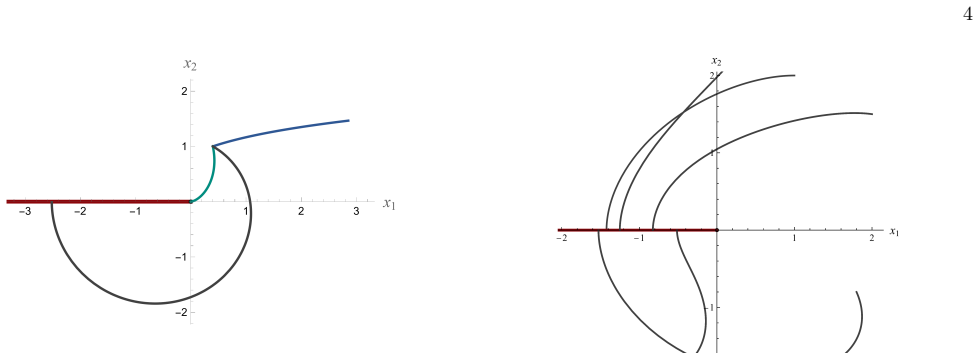
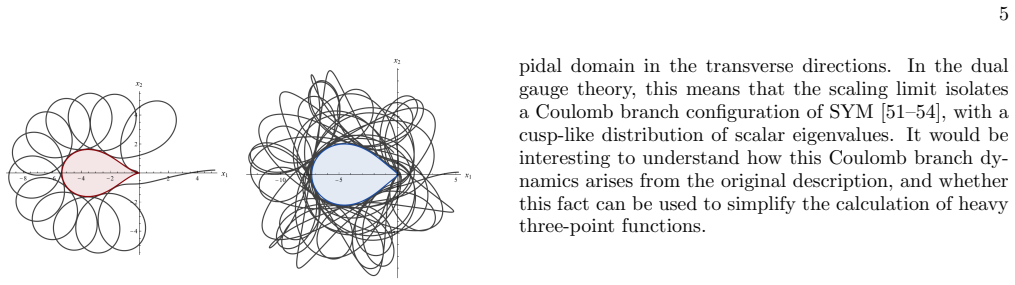
The choice of the astroid shape is dictated by simplicity, but the results related to the cusp singularity will not depend on the rest of the boundary shape
(herez=x 1 +i x 2). The choice of the astroid shape is dictated by simplicity, but the results related to the cusp singularity will not depend on the rest of the boundary shape. For example, the relation between the quantities ∆ = R D d2z 2π ¯zz 2 − 1 2 R D d2z 2π )2 2 andA= 4π 2N l4 p representing in the dual theory the energy (dimension) of the state an...
-
[2]
The above parametrization is valid on each monotonic branch 0< ξ <1
The Euler-Lagrange equations for null geodesics are ¨r−r ˙θ 2 − 3 ˙r 4r − 3 4 tan θ 2 ˙θ ˙r+ 3P 2 4r = 0, r2¨θ+ 2r˙r ˙θ− 3 ˙r 4r − 3 4 tan θ 2 ˙θ r2 ˙θ− 3P 2 4 tan θ 2 = 0, Introduce the angleφdefined by sinφ= r ˙θcos θ 2 −˙rsin θ 2 P , ξ= sin 2 φ, η= tan θ 2 6 σ1 = sgn(sinφ 0), σ 2 = sgn(sin 2φ0). The above parametrization is valid on each monotonic bran...
-
[3]
This gives the linear equation dη dξ + η 3ξ =− σ2 3 p ξ(1−ξ) , d dξ ξ1/3η =− σ2 3 ξ−1/6(1−ξ) −1/2
For a non-cardioid geodesic, one may divide ˙ηby ˙ξ. This gives the linear equation dη dξ + η 3ξ =− σ2 3 p ξ(1−ξ) , d dξ ξ1/3η =− σ2 3 ξ−1/6(1−ξ) −1/2. with solutionη(ξ) =ξ −1/3 Cθ − σ2 3 Bξ 5 6 , 1 2 , Cθ =ξ 1/3 0 tan θ0 2 + σ2 3 Bξ0 5 6 , 1 2 . Restoringr(ξ) from the introduction ofξone has: r(ξ) = CR ξ2/3 1 +η(ξ) 2 = CR ξ2/3 + Cθ − σ2 3 Bξ 5 6 , 1 2 2 ...
-
[4]
J. M. Maldacena, The LargeNlimit of superconformal field theories and supergravity, Adv. Theor. Math. Phys. 2, 231 (1998), arXiv:hep-th/9711200
work page internal anchor Pith review Pith/arXiv arXiv 1998
-
[5]
S. S. Gubser, I. R. Klebanov, and A. M. Polyakov, Gauge theory correlators from noncritical string theory, Phys. Lett. B428, 105 (1998), arXiv:hep-th/9802109
work page internal anchor Pith review Pith/arXiv arXiv 1998
-
[6]
Anti De Sitter Space And Holography
E. Witten, Anti de Sitter space and holography, Adv. Theor. Math. Phys.2, 253 (1998), arXiv:hep-th/9802150
work page internal anchor Pith review Pith/arXiv arXiv 1998
-
[7]
Review of AdS/CFT Integrability: An Overview
N. Beisertet al., Review of AdS/CFT Integrabil- ity: An Overview, Lett. Math. Phys.99, 3 (2012), arXiv:1012.3982 [hep-th]
work page internal anchor Pith review Pith/arXiv arXiv 2012
-
[8]
Quantum spectral curve for AdS_5/CFT_4
N. Gromov, V. Kazakov, S. Leurent, and D. Volin, Quantum Spectral Curve for PlanarN= 4 Super- Yang-Mills Theory, Phys. Rev. Lett.112, 011602 (2014), arXiv:1305.1939 [hep-th]
work page internal anchor Pith review Pith/arXiv arXiv 2014
-
[9]
Quantum spectral curve for arbitrary state/operator in AdS$_5$/CFT$_4$
N. Gromov, V. Kazakov, S. Leurent, and D. Volin, Quantum spectral curve for arbitrary state/operator in AdS5/CFT4, JHEP09, 187, arXiv:1405.4857 [hep-th]
work page internal anchor Pith review Pith/arXiv arXiv
-
[10]
Quantum Spectral Curve of $\gamma$-twisted ${\cal N}=4$ SYM theory and fishnet CFT
V. Kazakov, Quantum Spectral Curve ofγ-twistedN= 4 SYM theory and fishnet CFT, Rev. Math. Phys. , 293 (2018), arXiv:1802.02160 [hep-th]
work page internal anchor Pith review Pith/arXiv arXiv 2018
-
[11]
Introduction to the Spectrum of N=4 SYM and the Quantum Spectral Curve
N. Gromov, Introduction to the Spectrum ofN= 4 SYM and the Quantum Spectral Curve, (2017), arXiv:1708.03648 [hep-th]
work page internal anchor Pith review Pith/arXiv arXiv 2017
-
[12]
Space-time S-matrix and Flux-tube S-matrix at Finite Coupling
B. Basso, A. Sever, and P. Vieira, Spacetime and Flux Tube S-Matrices at Finite Coupling for N=4 Supersym- metric Yang-Mills Theory, Phys. Rev. Lett.111, 091602 (2013), arXiv:1303.1396 [hep-th]
work page internal anchor Pith review Pith/arXiv arXiv 2013
-
[13]
Structure Constants and Integrable Bootstrap in Planar N=4 SYM Theory
B. Basso, S. Komatsu, and P. Vieira, Structure Constants and Integrable Bootstrap in Planar N=4 SYM Theory, (2015), arXiv:1505.06745 [hep-th]. [11]N≫λ≫1, whereλis the ’t Hooft coupling
work page internal anchor Pith review Pith/arXiv arXiv 2015
- [14]
-
[15]
Complex Matrix Model and Fermion Phase Space for Bubbling AdS Geometries
Y. Takayama and A. Tsuchiya, Complex matrix model 7 and fermion phase space for bubbling AdS geometries, JHEP10, 004, arXiv:hep-th/0507070
work page internal anchor Pith review Pith/arXiv arXiv
-
[16]
S. E. Vazquez, Reconstructing 1/2 BPS Space-Time Met- rics from Matrix Models and Spin Chains, Phys. Rev. D 75, 125012 (2007), arXiv:hep-th/0612014
work page internal anchor Pith review Pith/arXiv arXiv 2007
-
[17]
A toy model for the AdS/CFT correspondence
D. Berenstein, A Toy model for the AdS / CFT corre- spondence, JHEP07, 018, arXiv:hep-th/0403110
work page internal anchor Pith review Pith/arXiv arXiv
-
[18]
D. Berenstein and A. Holguin, Open giant magnons on LLM geometries, JHEP01, 080, arXiv:2010.02236 [hep- th]
-
[19]
K. Skenderis and M. Taylor, Anatomy of bubbling solu- tions, JHEP09, 019, arXiv:0706.0216 [hep-th]
work page internal anchor Pith review Pith/arXiv arXiv
-
[20]
(Un)solvable Matrix Models for BPS Correlators
P. Anempodistov, A. Holguin, V. Kazakov, and H. Mu- rali, (Un)solvable matrix models for bps correlators, JHEP04, 069, arXiv:2508.20094 [hep-th]
work page internal anchor Pith review Pith/arXiv arXiv
-
[21]
Exact Correlators of Giant Gravitons from dual N=4 SYM
S. Corley, A. Jevicki, and S. Ramgoolam, Exact correla- tors of giant gravitons from dual N=4 SYM theory, Adv. Theor. Math. Phys.5, 809 (2002), arXiv:hep-th/0111222
work page internal anchor Pith review Pith/arXiv arXiv 2002
-
[22]
D. Berenstein and S. Wang, BPS coherent states and localization, JHEP08, 164, arXiv:2203.15820 [hep-th]
-
[23]
D. E. Berenstein, J. M. Maldacena, and H. S. Nastase, Strings in flat space and pp waves from N=4 superYang- Mills, JHEP04, 013, arXiv:hep-th/0202021
work page internal anchor Pith review Pith/arXiv arXiv
-
[24]
New applications of non-hermitian random matrices
A. Zabrodin, New applications of nonHermitian ran- dom matrices, Annales Henri Poincare4, S851 (2003), arXiv:cond-mat/0210331
work page internal anchor Pith review Pith/arXiv arXiv 2003
-
[25]
A. Zabrodin, Matrix models and growth processes: From viscous flows to the quantum Hall effect, inNATO Ad- vanced Study Institute: Marie Curie Training Course: Applications of Random Matrices in Physics(2004) pp. 261–318, arXiv:hep-th/0412219
work page internal anchor Pith review Pith/arXiv arXiv 2004
-
[26]
V. A. Kazakov and A. Marshakov, Complex curve of the two matrix model and its tau function, J. Phys. A36, 3107 (2003), arXiv:hep-th/0211236
work page internal anchor Pith review Pith/arXiv arXiv 2003
- [27]
-
[28]
Normal random matrix ensemble as a growth problem
R. Teodorescu, E. Bettelheim, O. Agam, A. Zabrodin, and P. Wiegmann, Normal random matrix ensemble as a growth problem: Evolution of the spectral curve, Nucl. Phys. B704, 407 (2005), arXiv:hep-th/0401165
work page internal anchor Pith review Pith/arXiv arXiv 2005
-
[29]
D. Berenstein, E. Maderazo, R. Mancilla, and A. Ramirez, Chaotic LLM billiards, JHEP08, 056, arXiv:2305.19321 [hep-th]
-
[30]
D. Berenstein, M. ˇCubrovi´ c, and V. Djuki´ c, Trapping, chaos and averaging in bubbling AdS spaces, JHEP02, 157, arXiv:2508.09669 [hep-th]
-
[31]
See in [18] the example of cubic potentials giving the hypotrochoid algebraic curve
-
[32]
V. A. Kazakov, Bilocal Regularization of Models of Ran- dom Surfaces, Phys. Lett. B150, 282 (1985)
1985
-
[33]
David, Planar Diagrams, Two-Dimensional Lattice Gravity and Surface Models, Nucl
F. David, Planar Diagrams, Two-Dimensional Lattice Gravity and Surface Models, Nucl. Phys. B257, 45 (1985)
1985
-
[34]
V. A. Kazakov, A. A. Migdal, and I. K. Kostov, Criti- cal Properties of Randomly Triangulated Planar Random Surfaces, Phys. Lett. B157, 295 (1985)
1985
-
[35]
This singularity (in that case∼δ 3/2) will persist in the protected three point correlator of two such huge 1 2- BPS operators and a sufficiently light probe (with dimen- sion≪N 2)
-
[36]
V. A. Kazakov, The Appearance of Matter Fields from Quantum Fluctuations of 2D Gravity, Mod. Phys. Lett. A4, 2125 (1989)
1989
-
[37]
J. M. Daul, V. A. Kazakov, and I. K. Kostov, Rational theories of 2-D gravity from the two matrix model, Nucl. Phys. B409, 311 (1993), arXiv:hep-th/9303093
work page internal anchor Pith review Pith/arXiv arXiv 1993
-
[38]
Notice that in this scaling the metric sees only the flat tangent spaceR 3 of the sphere ˜S3
-
[39]
We assume for simplicity that the bulk of the droplet is smooth and resides entirely to the left of the cusp, as in Fig.3
-
[40]
We thank Shota Komatsu and Juan Maldacena for bring- ing this important point to our attention
-
[41]
V. Kazakov, H. Murali, and P. Vieira, Huge BPS Op- erators and Fluid Dynamics inN= 4 SYM, (2024), arXiv:2406.01798 [hep-th]
-
[42]
Holographic two-point functions of heavy operators revisited
P. Anempodistov, Holographic two-point functions of heavy operators revisited, (2026), arXiv:2603.28880 [hep-th]
work page internal anchor Pith review Pith/arXiv arXiv 2026
-
[43]
D. Turton and A. Tyukov, Four-point correlators inN= 4 SYM from AdS 5 bubbling geometries, JHEP10, 244, arXiv:2408.16834 [hep-th]
- [44]
-
[45]
Brezin and V
E. Brezin and V. A. Kazakov, Exactly Solvable Field Theories of Closed Strings, Phys. Lett. B236, 144 (1990)
1990
-
[46]
M. R. Douglas and S. H. Shenker, Strings in Less Than One-Dimension, Nucl. Phys. B335, 635 (1990)
1990
-
[47]
D. J. Gross and A. A. Migdal, Nonperturbative Two- Dimensional Quantum Gravity, Phys. Rev. Lett.64, 127 (1990)
1990
-
[48]
M. R. Douglas, Strings in Less Than One-dimension and the GeneralizedK −D−VHierarchies, Phys. Lett. B238, 176 (1990)
1990
-
[49]
A description of 1/4 BPS configurations in minimal type IIB SUGRA
A. Donos, A Description of 1/4 BPS configurations in minimal type IIB SUGRA, Phys. Rev. D75, 025010 (2007), arXiv:hep-th/0606199
work page internal anchor Pith review Pith/arXiv arXiv 2007
-
[50]
B. Chen, S. Cremonini, A. Donos, F.-L. Lin, H. Lin, J. T. Liu, D. Vaman, and W.-Y. Wen, Bubbling AdS and droplet descriptions of BPS geometries in IIB super- gravity, JHEP10, 003, arXiv:0704.2233 [hep-th]
work page internal anchor Pith review Pith/arXiv arXiv
- [51]
-
[52]
Brane webs and 1/4-BPS geometries
O. Lunin, Brane webs and 1/4-BPS geometries, JHEP 09, 028, arXiv:0802.0735 [hep-th]
work page internal anchor Pith review Pith/arXiv arXiv
- [53]
-
[54]
Wilson loops from multicentre and rotating branes, mass gaps and phase structure in gauge theories
A. Brandhuber and K. Sfetsos, Wilson loops from multi- center and rotating branes, mass gaps and phase struc- ture in gauge theories, Adv. Theor. Math. Phys.3, 851 (1999), arXiv:hep-th/9906201
work page internal anchor Pith review Pith/arXiv arXiv 1999
-
[55]
Holographic Coulomb branch vevs
K. Skenderis and M. Taylor, Holographic Coulomb branch vevs, JHEP08, 001, arXiv:hep-th/0604169
work page internal anchor Pith review Pith/arXiv arXiv
-
[56]
K. Skenderis and M. Taylor, Kaluza-Klein holography, JHEP05, 057, arXiv:hep-th/0603016. 8 Supplementary Material
work page internal anchor Pith review Pith/arXiv arXiv
-
[57]
We assume that, in a neighbourhood of the origin, the boundary of the droplet has a multicritical cusp of the form x1 =−t+o(t), x 2 =±t α +o(t α), t→0 +, with 1< α <3, α̸= 2
DERIV A TION OF UNIVERSAL CUSP METRIC Let us study the functions that define LLM metric. We assume that, in a neighbourhood of the origin, the boundary of the droplet has a multicritical cusp of the form x1 =−t+o(t), x 2 =±t α +o(t α), t→0 +, with 1< α <3, α̸= 2. We now study the scaling limit of our functions under (x1, x2, y)7→(ϵx 1, ϵx2, ϵy) asϵ→0 +. T...
-
[58]
In the blown-up variables this becomes Dcusp = (t, s) : 0< t <Λ, h−(−ϵt) ϵ < s < h+(−ϵt) ϵ
:−ϵΛ< x ′ 1 <0, h −(x′ 1)< x ′ 2 < h+(x′ 1) . In the blown-up variables this becomes Dcusp = (t, s) : 0< t <Λ, h−(−ϵt) ϵ < s < h+(−ϵt) ϵ . We first compute the contribution ofD cusp to the scaling limit ofVandζ− 1
-
[59]
Let FV (t, s) = x1 +t+i(x 2 −s) [(x1 +t) 2 + (x2 −s) 2 +y 2]2 , Fζ(t, s) = y2 [(x1 +t) 2 + (x2 −s) 2 +y 2]2
These become Vcusp = 1 ϵ Z Λ 0 dt Z h+(−ϵt)/ϵ h−(−ϵt)/ϵ ds 1 π x1 +t+i(x 2 −s) [(x1 +t) 2 + (x2 −s) 2 +y 2]2 , and ζcusp− 1 2 =− Z Λ 0 dt Z h+(−ϵt)/ϵ h−(−ϵt)/ϵ ds 1 π y2 [(x1 +t) 2 + (x2 −s) 2 +y 2]2 . Let FV (t, s) = x1 +t+i(x 2 −s) [(x1 +t) 2 + (x2 −s) 2 +y 2]2 , Fζ(t, s) = y2 [(x1 +t) 2 + (x2 −s) 2 +y 2]2 . For fixed finite Λ, the denominator is positi...
-
[60]
NAKED SINGULARITY Now let us calculate the Kretschmann scalar for the scaled met- ric. Denoting Hα ≡ H(r, θ),H r ≡∂ rH,H θ ≡∂ θH, Hrr ≡∂ 2 r H,H θθ ≡∂ 2 θ H,H rθ ≡∂ r∂θH, one obtains K= 1 H2r4 " 9H2H2 θθ + 2H2Hrr Hθθ r2 −10HH 2 rHθθ r2+ +26H2HrHθθ r+ 8H 2HθHθθ cotθ−10HH 2 θHθθ+ +16H2H2 rθ r2 −32H 2HθHrθ r+ 9H 2H2 rr r4− −10HH2 rHrr r4 + 10H2HrHrr r3 + 8H2...
-
[61]
The remaining four transverse directions are denoted collectively by⃗ u∈R 4
D3-BRANE INTERPRET A TION OF THE CUSP METRIC The metric for the stack of D3-branes is ds2 =H −1/2 D3 ds2 R1,3 +H 1/2 D3 dr2 +r 2dθ2 +r 2 sin2 θ dΩ2 4 , whereH D3 is a harmonic function in six-dimensional flat space transversal to the branes Let us consider a D3-brane distribution in a two-dimensional plane of the transverseR 6, with coordinates (X, Y). Th...
discussion (0)
Sign in with ORCID, Apple, or X to comment. Anyone can read and Pith papers without signing in.