REVIEW 4 major objections 5 minor 14 references
Graphenylene-1 Membrane: An Excellent Candidate for Hydrogen Purification and Helium Separation
T0 review · 4 major / 5 minor · reviewed 2026-08-14 · deepseek-v4-flash
Pith's one-line read Graphenylene-1, a one-atom-thick carbon sheet, is predicted to purify H2 and separate He with selectivities up to 10^46 and industrial-grade permeance.
desk verdict DFT/MD inconsistency undermines the reported selectivities and permeances, but the qualitative barrier ordering is plausible — the paper needs major revision before its quantitative claims can be trusted. read the letter →
The pith
A machine-rendered reading of the paper's core claim, the machinery that carries it, and where it could break.
The reading
What carries the argument
The central object is the 2.20 Å trigonal pore of the graphenylene-1 monolayer, with its electron-density isosurface at 0.007 e Å$^{-3}$ defining the effective opening. The argument runs on three linked computed quantities: the diffusion energy barrier $E_{\mathrm{barrier}} = E_{\mathrm{TS}} - E_{\mathrm{SS}}$ for each gas; the Arrhenius selectivity ratio $S_{x/\mathrm{gas}} = A_x e^{-E_x/RT} / (A_{\mathrm{gas}} e^{-E_{\mathrm{gas}}/RT})$, evaluated with a common prefactor $A = 10^{11}$ s$^{-1}$; and the permeance obtained from the molecular collision flux $N = P/\sqrt{2\pi M R T}$ times the Maxwell–Boltzmann crossing probability. Electron-density overlaps between the passing gas and the pore rim set the barrier ordering, so the entire separation prediction reduces to a single computed quantity per gas.
What would settle it
Measure the permeance of pure H2, CH4, CO2, N2, and He through a free-standing or supported graphenylene-1 sheet at 300 K with a 1 bar pressure drop. If the measured H2/CH4 selectivity is orders of magnitude below the computed values, or if H2 flux is negligible, the rigid-membrane DFT barriers and the common-prefactor assumption are wrong. A purely computational check: recompute the minimum-energy paths with the membrane atoms allowed to relax during passage; if the H2 barrier rises above roughly 1 eV, the predicted room-temperature permeance disappears.
Extended reading notes
Core claim
The central claim is that graphenylene-1 is an excellent H$_2$ purification and He separation membrane because its pore size sits in a narrow window: small enough to block CO, N$_2$, CO$_2$, Ar, and CH$_4$, yet large enough to let H$_2$ and He through with surmountable barriers. The reported diffusion barriers are $0.384$ eV for H$_2$ and $0.178$ eV for He, versus $1.407$ eV (CO), $1.472$ eV (N$_2$), $2.017$ eV (CO$_2$), $2.271$ eV (Ar), and $3.167$ eV (CH$_4$). Using Arrhenius selectivity with a common attempt frequency of $10^{11}$ s$^{-1}$, the paper obtains at 300 K selectivities such as $\mathrm{H_2/CO_2} = 3 \times 10^{27}$, $\mathrm{H_2/CH_4} = 6 \times 10^{46}$, and $\mathrm{He/CH_4} = 2 \times 10^{50}$. The same barrier set fed into a Maxwell–Boltzmann collision model yields H$_2$ and He permeances above the industrial line at temperatures above 300 K and 150 K respectively, while impurity gases remain below it even at 600 K. MD simulations of a reservoir with 120 H$_2$, 40 H$_2$O, 40 CO$_2$, 40 N$_2$, 40 CO, and 40 CH$_4$ molecules show 8, 15, 34, 42, and 47 H$_2$ molecules crossing after 1 ns at 200, 300, 400, 500, and 600 K, with no other gas crossing; this is offered as confirmation of the DFT picture.
Load-bearing premise
The load-bearing assumption is that the membrane stays rigid as molecules pass and that every gas attempts to cross the pore at the same rate ($A = 10^{11}$ s$^{-1}$), so the entire selectivity ranking comes from energy-barrier differences alone.
Editorial extensions
If this is right
- At 300 K, the membrane separates H$_2$ from CO$_2$, N$_2$, CO, and CH$_4$ with computed selectivities between $10^{17}$ and $10^{46}$, putting it orders of magnitude above previously proposed 2D carbon membranes.
- Above 300 K for H$_2$ and 150 K for He, the predicted permeance clears the industrial benchmark at a 1 bar pressure drop, so the membrane would not force the usual selectivity-throughput trade-off.
- MD results indicate that in a realistic reformate-like mixture (H$_2$ with H$_2$O, CO$_2$, N$_2$, CO, CH$_4$) only H$_2$ crosses on a nanosecond timescale, so the membrane would clean steam-methane reforming output in one stage.
- He separation from natural gas would work at lower temperatures than H$_2$ purification, with He/CH$_4$ selectivity near $2 \times 10^{50}$ at 300 K.
- Because the membrane is one atom thick, its permeance is intrinsically higher than polymeric or zeolite membranes of similar selectivity.
Reading between the lines
- The paper's rigid-pore picture suggests a tunable family: chemically functionalizing the pore rim, or straining the sheet, should shift the 2.20 Å window and could extend the same mechanism to other small-molecule separations, such as Ne from He or isotopic hydrogen.
- The selectivity figures are upper-bound estimates; transition-state theory with molecule-specific prefactors, or a flexible membrane, would likely lower them while preserving the qualitative order.
- A direct experimental target is a permeation measurement on a synthesized sheet; if single-stage H$_2$/CH$_4$ selectivity falls below $10^5$, pore flexibility or defect leakage, not barrier physics, would be the limiting factor.
- The same DFT plus Arrhenius pipeline could be applied to a library of porous 2D carbons to screen for pore sizes that trade some selectivity for dramatically higher flux.
Signed reviews
Editorial analysis
A structured set of objections, weighed in public.
Referee Report
Summary. The manuscript uses DFT and MD simulations to evaluate a synthesized 2D carbon allotrope, graphenylene-1, as a membrane for H2 purification and He separation. DFT energy barriers along the pore center are computed for H2, He, Ne, N2, CO2, CO, Ar, and CH4, yielding low barriers for H2 (0.384 eV) and He (0.178 eV). Using Eq. 4 with an assumed common prefactor, the authors report enormous room-temperature selectivities (up to 6×10^46 for H2/CH4). Using kinetic theory (Eqs. 5–6), they report permeances that surpass industrial targets above 300 K for H2 and 150 K for He. MD simulations with the COMPASS force field are presented as confirmation, reporting an H2 permeance of 3×10^7 GPU at 300 K. The central claim is that graphenylene-1 offers high selectivity and permeance simultaneously.
Significance. If the reported energy barriers and permeances were quantitatively reliable, the paper would provide a useful computational screening result for a synthesizable carbon monolayer in gas separation. The structure is experimentally known, and the comparison to prior graphyne-type membranes is relevant. However, the paper's quantitative claims rest on two unvalidated pillars: the equal-prefactor Arrhenius model of Eq. 4, and an asserted agreement between DFT and MD that is contradicted by the paper's own numbers. The strengths are the relatively complete set of gases considered and the direct comparison with other proposed membranes; the weaknesses are the lack of convergence checks for the central barriers and the absence of any benchmark of the COMPASS force field against the DFT barriers. Because the headline selectivities and permeances are exponential functions of these barriers, the significance of the results cannot be assessed until the methodological inconsistencies are resolved.
major comments (4)
- [Eq. 4 and Tables 2–3] The selectivity formula assumes a single diffusion prefactor A=1×10^11 s^-1 for all gases. This assumption is load-bearing because the reported selectivities, e.g., 6×10^46 for H2/CH4, are entirely exponential in the barrier differences multiplied by 1/kT. Real prefactors depend on molecular mass, rotational partition functions, and transition-state vibrational modes, and can differ by orders of magnitude between H2 and CH4 or N2. The authors provide no justification and no sensitivity analysis. The selectivity values should be recomputed with transition-state theory partition functions or with independently computed prefactors, or the claims should be reduced to qualitative statements based on barrier ordering only.
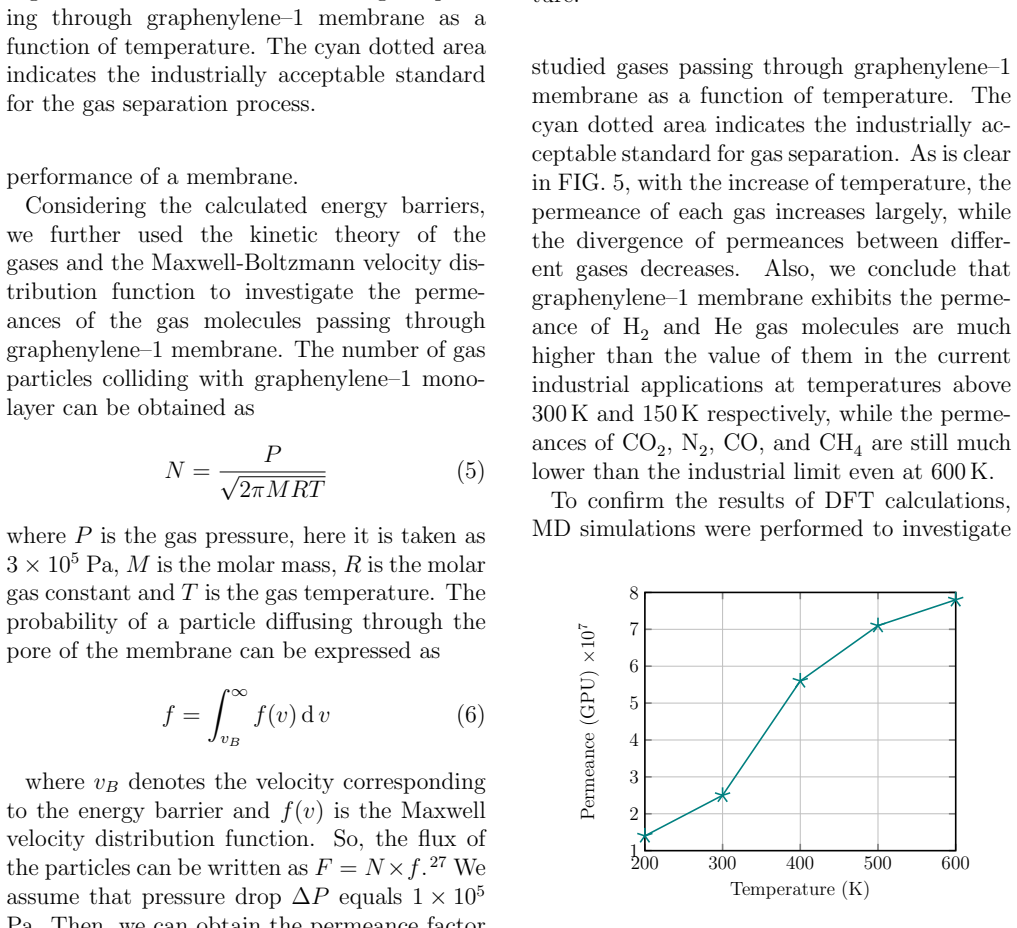
- [Fig. 7, Table 4, and Eqs. 5–6] The claimed MD confirmation is quantitatively inconsistent with the DFT barrier. Using the paper's own H2 barrier of 0.384 eV in Eq. 5 with P=3×10^5 Pa and ΔP=1×10^5 Pa gives a permeance at 300 K of roughly 2×10^-7 to 8×10^-7 mol m^-2 s^-1 Pa^-1, i.e., about 10^2–10^3 GPU. The MD value in Table 4 and Fig. 7 is 3×10^7 GPU, four to five orders of magnitude larger. The implied effective COMPASS barrier is near 0.1 eV, not 0.384 eV. Thus either the rigid-pore DFT barrier is too high because membrane flexibility lowers it, or the COMPASS force field underestimates the pore repulsion. Either way, the manuscript's statement that MD results are in 'perfect agreement' with DFT is not supported by the reported numbers, and the permeance values derived from the DFT barrier are not confirmed.
- [DFT barrier calculations, Computational Methods and Fig. 2] The central energy barriers are computed with a rigid membrane and a single molecule, using a 2×2 supercell, but no tests are reported for supercell size, k-point convergence of the barrier, dispersion-correction scheme, or the dependence of the barrier and pore size on the electron-density isovalue. Since the entire selectivity and permeance analysis is exponential in these barriers, the quantitative claims require at least: (i) relaxation of the membrane at the transition state to assess flexibility effects, and (ii) a convergence check of the 0.384 eV and 0.178 eV barriers with respect to cell size and dispersion treatment.
- [Eq. 7 and MD permeance statistics] The MD permeance is extracted from a single 1 ns trajectory with only 8 H2 molecules crossing at 200 K and 15 at 300 K, and no error bars or independent repeats are reported. With such small counts, the permeance in Table 4 is subject to large statistical uncertainty. The pressure-drop definition ΔP=1 bar and the finite reservoir size also need justification. At minimum, the authors should report block averages or multiple independent trajectories and provide a statistical uncertainty for the 3×10^7 GPU value.
minor comments (5)
- [Table 1] The kinetic diameter column for He appears garbled as '43 2.60' in the text; He should be around 2.6 Å. Please check the typesetting of the table.
- [General text] There are numerous typographical errors, including 'challable' in the Introduction, 'regrad' in the Introduction, 'permenace' in the Conclusion, 'towrad' in the Results, and 'comparision' in the Results. A careful proofread is needed.
- [Figure 5 caption] The y-axis of Fig. 5 is labeled 'Permeance (mol/m2 s Pa)' while the text also refers to GPU; please make the units consistent and specify the conversion factor used.
- [References] Some references are incomplete or inconsistently formatted (e.g., ref. 46 'Tain Z.' should be 'Tian Z.', ref. 51 is duplicated as ref. 43, and several author names are garbled such as 'Mllen'). Please standardize the bibliography.
- [Conclusion] The phrase 'perfect agreement with DFT calculations' should be removed or replaced with a quantitative comparison once the DFT and MD permeance discrepancy is resolved.
Circularity Check
No significant circularity: DFT-computed barriers drive the selectivity/permeance claims, and the MD step is supporting rather than load-bearing.
full rationale
The central selectivity and permeance results are derived from DFT-computed energy barriers through the Arrhenius selectivity expression (Eq. 4) and the Maxwell-Boltzmann kinetic-theory permeance expression (Eqs. 5-6). These barriers are computed from first-principles total-energy differences (Eq. 3) and are not fitted to the claimed selectivities or permeances. The identical prefactor A=1e11 s^-1 in Eq. 4 is an externally adopted assumption, not a parameter fitted to the target outcomes, so it does not make the prediction equivalent to an input. The MD simulations are presented as confirmation of the DFT results, but they use a COMPASS force field that is not benchmarked against the DFT barriers, and the claimed 'perfect agreement' is not quantitatively demonstrated; this is a correctness and internal-consistency concern, not circularity, because the main conclusions do not depend on the MD step. There is no evidence of self-definitional reasoning, fitted inputs being renamed as predictions, load-bearing self-citation, imported uniqueness theorems, or renaming of a known result. The manuscript's limitations, such as rigid-membrane DFT barriers and the assumed equal prefactor, affect accuracy but do not reduce the derivation to its inputs by construction.
Assumptions & free parameters
free parameters (3)
- Diffusion prefactor A =
1e11 s^-1
- Electron density isovalue for pore size =
0.007 e Å^-3
- Gas pressure for permeance =
3e5 Pa
assumptions (4)
- domain assumption Density functional theory (PBE-DNP-D3) accurately describes the interaction between gas molecules and the membrane
- domain assumption The Arrhenius model with a common prefactor A describes the diffusion rate of all gases
- ad hoc to paper The membrane is rigid during gas passage
- domain assumption COMPASS force field reproduces the DFT permeation behavior
Cite this review
Pith. "Pith review of Graphenylene-1 Membrane: An Excellent Candidate for Hydrogen Purification and Helium Separation." pith.science (2026). https://pith.science/paper/5VLLFZAN
@misc{pith2026190902112,
  author       = {Pith},
  title        = {Pith review of: Graphenylene-1 Membrane: An Excellent Candidate for Hydrogen Purification and Helium Separation},
  year         = {2026},
  howpublished = {\url{https://pith.science/paper/5VLLFZAN}},
  note         = {Machine review of arXiv:1909.02112}
}
abstract
In this study, we use the density functional theory (DFT) calculations and the molecular dynamics (MD) simulations to investigate the performance of graphenylene--1 membrane for hydrogen ($H_2$) purification and helium ($He$) separation. The stability of this membrane is confirmed by calculating its cohesive energy. Our results show that a surmountable energy barrier for $H_2$ (0.384 eV) and $He$ (0.178 eV) molecules passing through graphenylene-1 membrane. At room temperature, the selectivity of $H_2$/$CO_2$, $H_2$/$N_2$, $H_2$/$CO$ and $H_2$/$CH_4$ are obtained as $3 \times 10^{27}$, $2 \times 10^{18}$, $1 \times 10^{17}$ and $6 \times 10^{46}$, respectively. Furthermore, we demonstrate that graphenylene-1 membrane exhibits the permeance of $H_2$ and He molecules are much higher than the value of them in the current industrial applications specially at temperatures above 300 K and 150 K, respectively. We further performed MD simulations to confirm the results of DFT calculations. All these results show that graphenylene-1 monolayer membrane is an excellent candidate for $H_2$ purification and He separation.
Figures


Figures from the paper (3 more)


Reference graph
Works this paper leans on
-
[1]
(1) Winter M. and Brodd R. J., What are batteries, fuel cells, and supercapacitors?, Chemical Review, 2004, 104, 4245-70. (2) Andrews J. and Shabani B., Re-envisioning the role of hydrogen in a sustainable energy economy, International Journal of Hydro- gen Energy 2012; 37, 1184-203. (3) Schlapbach L. and Zttel A., Hydrogen- storage materials for mobile a...
work page 2004
-
[26]
(38) Bartolomei M., Carmona-Novillo E., Her- nandez M
(37) Liu Y., Narita A.,Teyssandier J., Wagner M., De Feyter S., Feng X., and Mullen K., A Shape-persistent polyphenylene spoked wheel, Journal of American Chemical So- ciety 2016, 138, 15539-15542. (38) Bartolomei M., Carmona-Novillo E., Her- nandez M. I., Campos- Martnez J, Pirani F. and Giorgi G., Graphdiyne pores: Ad Hoc openings for helium separation ...
work page 2016
-
[42]
(24) Herm Z. R., Swisher J. A., Smit B., Kr- ishna R. and Long J. R., Metal organic frameworks as adsorbents for hydrogen pu- rification and precombustion carbon diox- ide capture, Journal of American Chemical Society, 2011, 133, 5664-7. (25) Chandrasekhar N. and Sholl D. S., Large- scale computational screening of binary in- termetallics for membrane-base...
work page 2011
-
[517]
(13) Zhu L., Xue Q., Li X., Wu T., Jin Y. and Xing W., C2N: an excellent two- dimensional monolayer membrane for He separation, Journal of Material Chemistry A 2015, 3, 213516. (14) Gao G., Jiao Y., Jiao Y., Ma F., Kou .L and Du A., Calculations of helium sepa- ration via uniform pores of stanene-based membranes, Beilstein Journal of nanotech- nology 2015...
work page 2015
-
[757]
(8) Zhu L., Xue Q., Li X., Jin Y., Zheng H., Wu T. and Guo Q., Theoretical predic- tion of hydrogen separation performance of two- dimensional carbon network of fused 9 pentagon, Applied Materials and Interfaces 2015, 7, 2850228507. (9) Freemantle M., Membranes for gas separa- tion, Chemical and Engineering News 2005, 83,
work page 2015
-
[1180]
(33) Giraudet S., Zhu X. H., Yao X. D. and Lu. G. Q., Ordered mesoporous carbons en- riched with nitrogen: application to hydro- gen storage, Journal of Physical Chemistry C 2010, 114, 86398645. (34) Jiao Y., Du A., hankel M., Zhu Z., Ruodolph V. and Smith S. C., Graphdiyne: A versatile nanomaterial for electronics and hydrogen purification, Chemical Commu...
work page 2010
-
[2009]
(46) Tain Z., Dai S., and Jiang D., Ex- panded porphyrins as two-dimensional porous membranes for CO 2 separartion, ACS Applied Materials and Interfaces 2015, 7, 13073-13079. 11 (47) Sun H. COMPASS: an Ab initio force- field optimized for condensed-phase appli- cations overview with details on alkane and benzene compounds, Journal of Physical Chemistry B 1...
work page 2009
-
[4024]
(62) Zhu L., Chang X., He D., Xue Q., Xiong Y., Zhang J., Pan X. and Xing, W. Theo- retical study of H 2 separation performance of two-dimensional graphitic carbon oxide membrane. International Journal of Hydro- gen Energy 2017, 42, 13120-13126. 12 (63) Du H., Li J., Zhang J., Su G., Li X. and Zhao Y., Separation of hydrogen and nitro- gen gases with poro...
work page 2017
Show all 14 references
-
[4162]
D., Toy L
(23) Lin H., Van Wagner E., Freeman B. D., Toy L. G. and Gupta R. P., Plasticization- enhanced hydrogen purification using poly- meric membranes, Science 2006, 311, 639-
2006
-
[4957]
F., Schmidt V., Stimming U
(10) Oetjen H. F., Schmidt V., Stimming U. and Trila F., Performance data of a proton exchange membrane fuel cell using H2/CO as fuel gas, Journal of the Electrochemical Society 1996, 143, 3838-42. (11) Alves H.J., Bley Junior C., Niklevicz R. R., Frigo E. P., Frigo M. S. and ...
1996
-
[5583]
and Tao B., 585 divacancy-defective ger- manene as a hydrogen separation mem- brane: a DFT study, International Journal of Hydrogen Energy 2017, 42, 24189-24196
(31) Chang X, Xue Q., He D., Zhu L., Li X. and Tao B., 585 divacancy-defective ger- manene as a hydrogen separation mem- brane: a DFT study, International Journal of Hydrogen Energy 2017, 42, 24189-24196. (32) Kang K. Y., Lee B. I. and Lee J. S., Hy- drogen adsorption on nitro...
2017
-
[5735]
(16) Cho A., Helium-3 shortage could put freeze on low temperature research, Science 2009, 326,
2009
-
[7789]
P., The impact of helium shortages on basic research, Nature Physics 2014, 10, 467470
(17) Halperin W. P., The impact of helium shortages on basic research, Nature Physics 2014, 10, 467470. (18) Jiao Y., Du A. and Smith S. C., H2 sepa- ration by functionalized graphdiyne-role of nitrogen doping. Journal of Material Chem- istry A 2015, 3, 6767-71. (19) David E. ...
2014
-
[9062]
(59) Blankenburg S., Bieri M., Fase, R., Mllen K., Pignedoli C. A. and Passerone D., Porous graphene as an atmospheric nanofil- ter. Small 2010, 6, 2266-2271. (60) Song Q., Wang B., Deng K., Feng X., Wagner M., Gale J. D., Mllen K. and Zhi L., Graphenylene, a unique two- dimens...
2010
Reviewed August 14, 2026 · model on record in the stance chip above.
Discussion (0). Continue with ORCID to comment.