Towards Instrument-Agnostic Exoplanet Candidate Prioritization
Pith reviewed 2026-06-27 20:42 UTC · model grok-4.3
The pith
Joint training on Kepler and TESS data allows machine learning models to prioritize exoplanet candidates effectively on both instruments.
A machine-rendered reading of the paper's core claim, the machinery that carries it, and where it could break.
Core claim
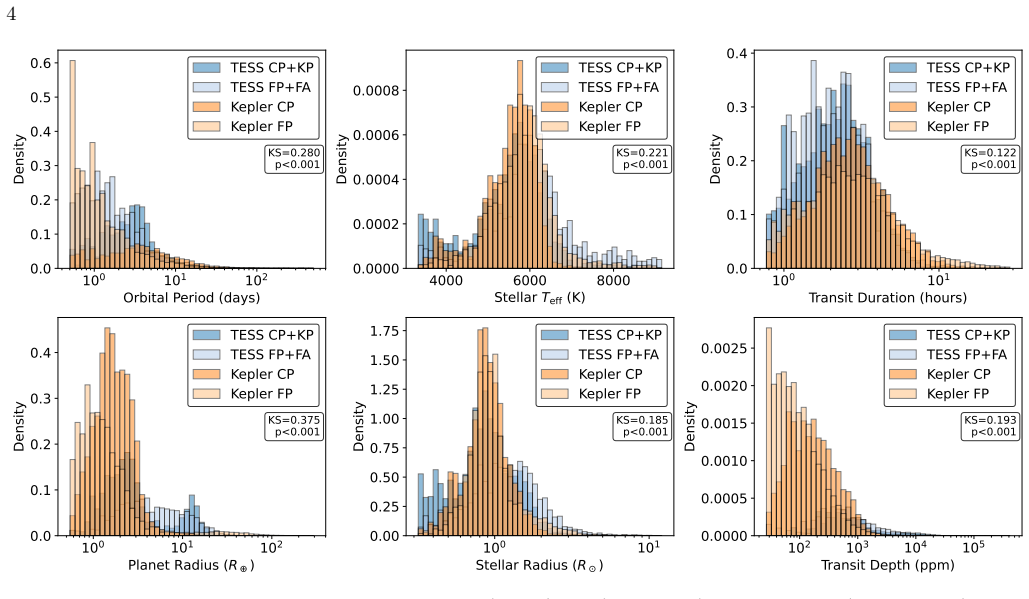
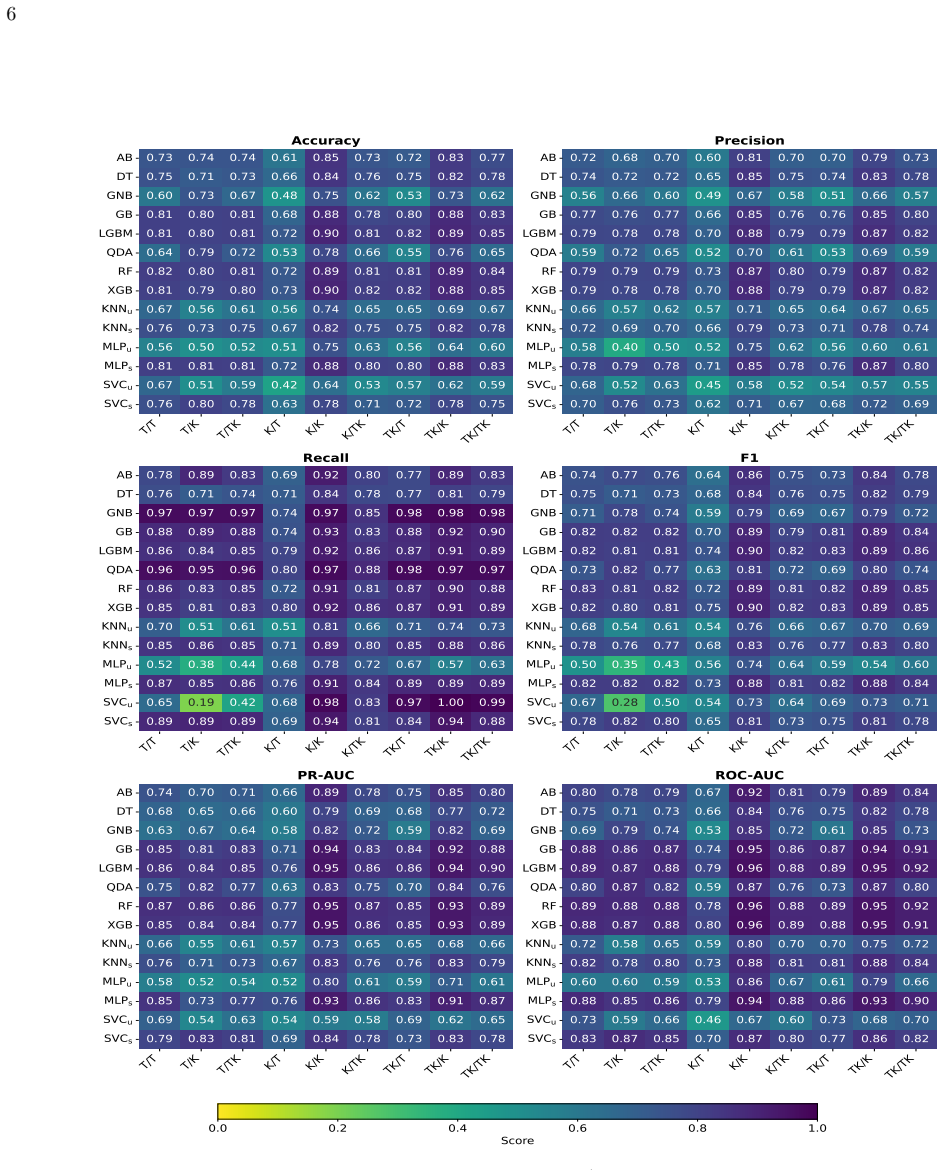
Models trained jointly with both TESS and Kepler data can perform well on both, whereas models trained on data from only one instrument have difficulty predicting the other because of substantially different distributions in the chosen parameters; an ensemble of the best such jointly trained models can therefore be used to rank planet candidates in either archive.
What carries the argument
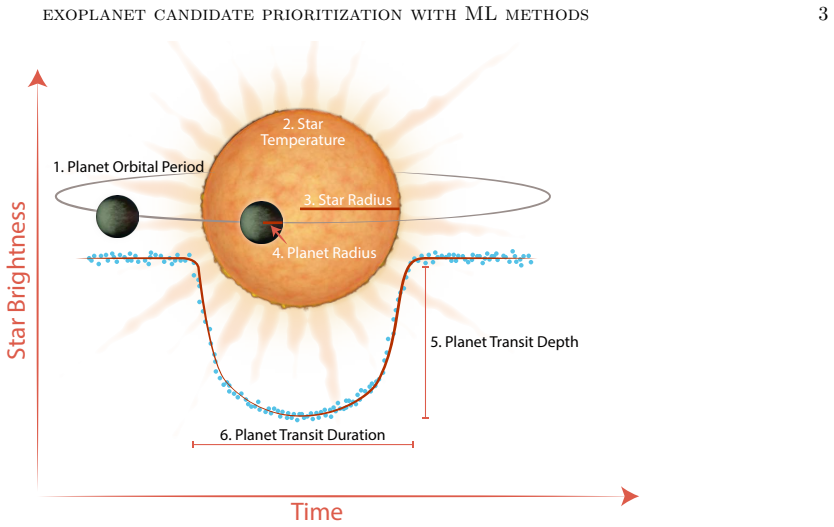
Ensemble of eleven machine-learning classifiers trained on the six parameters (orbital period, planet radius, stellar temperature, stellar radius, transit depth, transit duration) using combined Kepler and TESS labels.
If this is right
- Joint training removes the need to build separate instrument-specific models for candidate vetting.
- The same six-parameter feature set and ensemble can be applied directly to new candidates from either archive.
- Top-ranked candidates from the model are more likely to be confirmed upon further observation.
- The approach scales to the order-of-magnitude increase in candidates expected from the Roman Space Telescope.
Where Pith is reading between the lines
- The method could be tested on simulated Roman data to check whether the same six parameters remain sufficient when the instrument changes again.
- If the joint-training benefit holds, similar cross-mission ensembles might reduce the need for mission-specific training sets in other time-domain surveys.
- Discrepancies between the model's top candidates and follow-up results would point to missing parameters or label noise rather than instrument-specific effects.
Load-bearing premise
The archival labels of confirmed planets versus false positives are accurate enough to serve as reliable training targets, and the six chosen parameters capture the essential distinguishing features across instruments.
What would settle it
A list of newly confirmed planets or false positives from either Kepler or TESS that were not used in training; if the ensemble's rankings systematically disagree with these new labels on one instrument but not the other, the joint-training claim fails.
Figures
read the original abstract
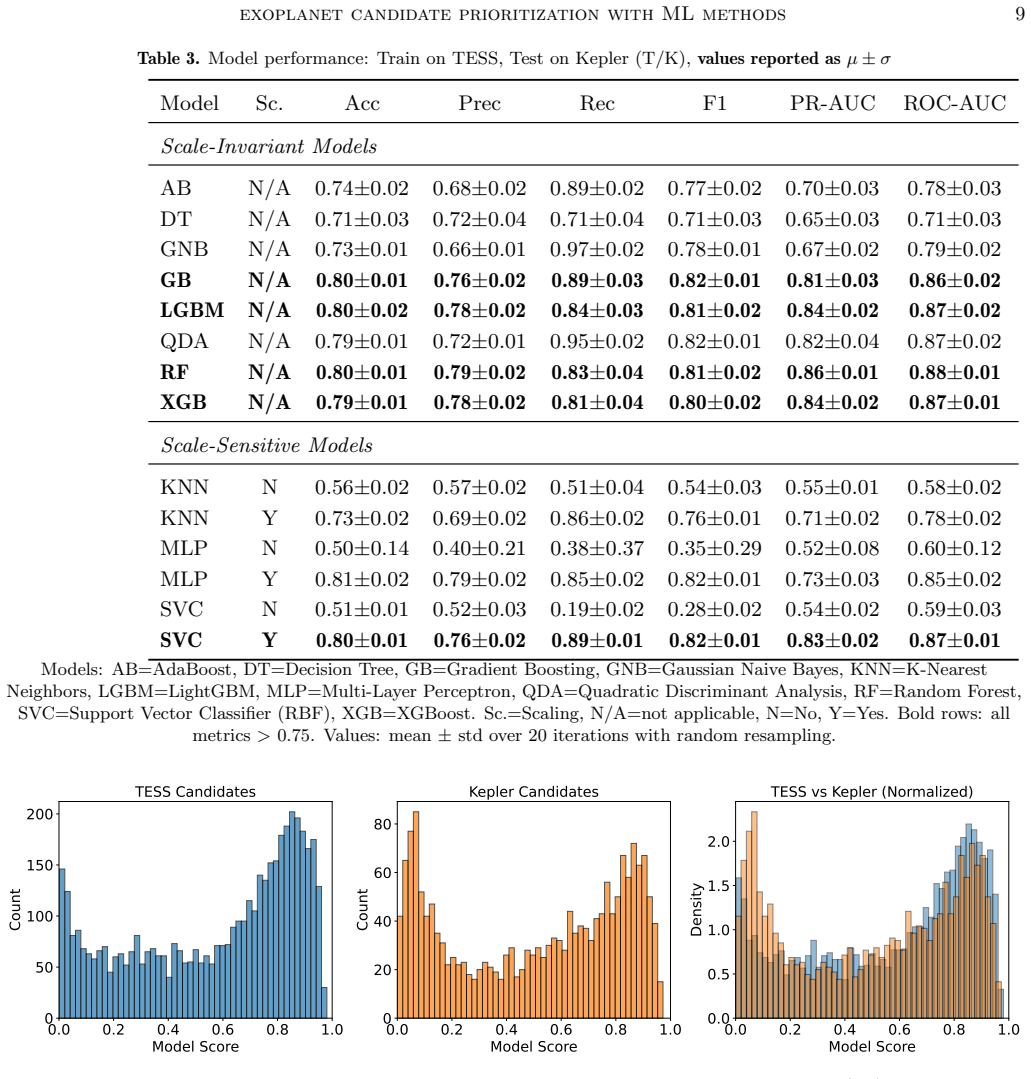
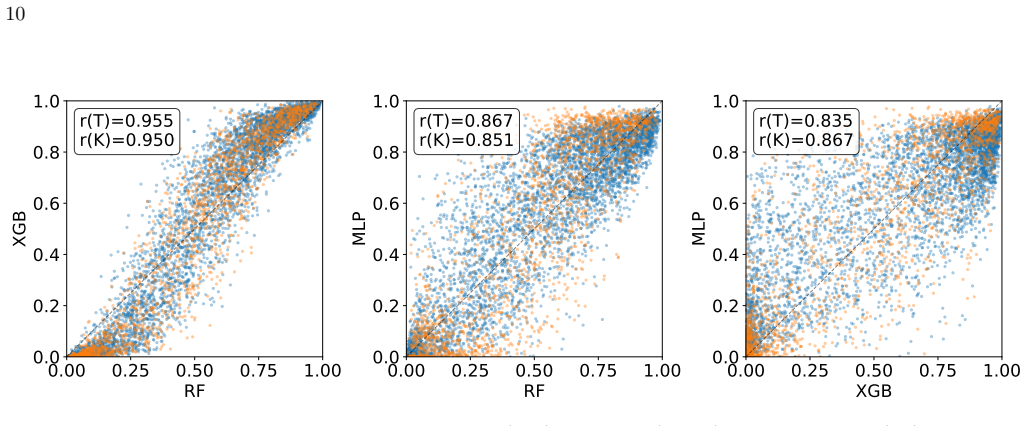
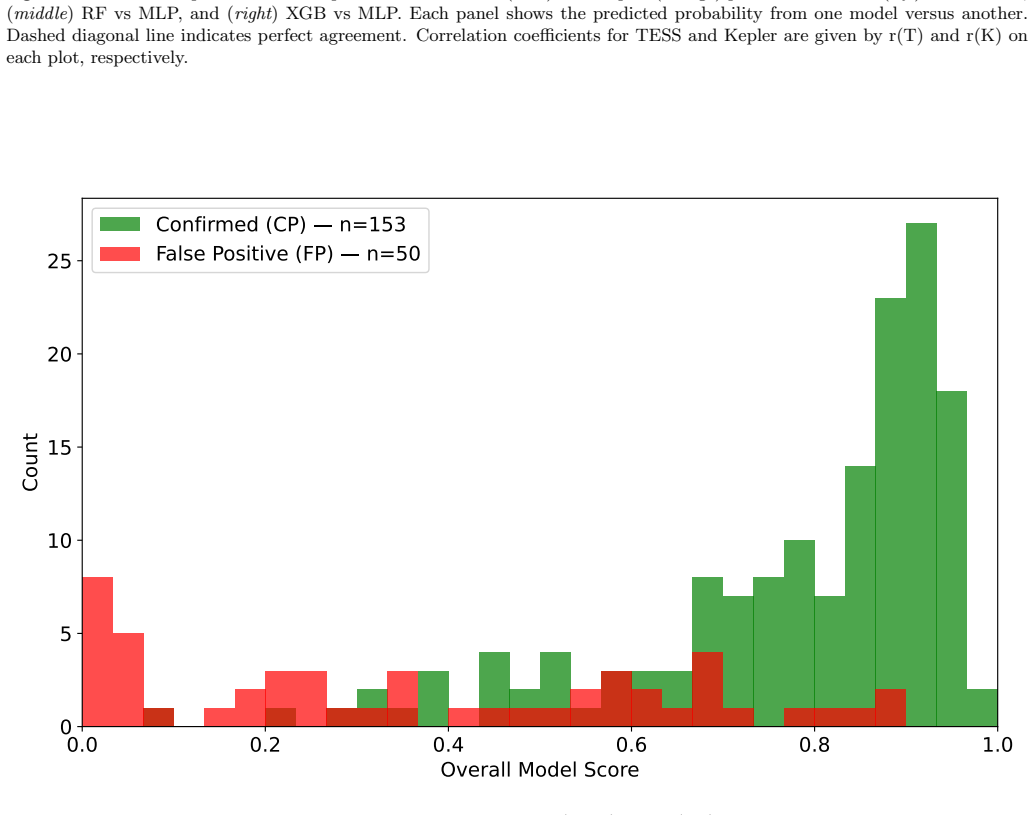
We have developed a novel machine learning (ML) approach for predicting the likelihood of exoplanet candidate confirmation equally capable of performance on both TESS and Kepler data. From the NASA exoplanet archival post-processed Kepler and TESS databases, we chose six parameters that we assessed to be predictive to the planet transit signature: planet orbital period (P), planet radius ($R_{\rm p}$), stellar temperature ($T_{\rm eff}$), stellar radius ($R_{\rm star}$), planet transit depth ($\delta$), and planet transit duration ($t_{\rm d}$). We used these parameters to evaluate eleven different ML models on all possible train/test combinations of TESS and Kepler data, using the confirmed planet and false positive labels as our training targets. We found that, due to substantially different distributions of our chosen parameters in Kepler and TESS databases, models trained with data from one instrument have difficulty predicting the other. However, models trained jointly with both TESS and Kepler data can perform well on both. We combined our best models into a statistically robust ensemble to evaluate the planet candidates in both Kepler and TESS, and we provide a list of the top candidates predicted by our model for each. Confirmed planets and false positives that have been resolved since the completion of our analysis demonstrate the effectiveness of our model and suggest that our top candidates are likely to be confirmed if they are further analyzed by the community. With the upcoming launch of the Nancy Grace Roman Space Telescope (Roman) and the expected order-of-magnitude increase in planet candidates, we suggest that our method can be extended to Roman data for robust and effective prioritization for analysis.
Editorial analysis
A structured set of objections, weighed in public.
Referee Report
Summary. The manuscript presents an empirical ML study that selects six parameters (orbital period P, planet radius Rp, stellar effective temperature Teff, stellar radius Rstar, transit depth δ, transit duration td) from NASA exoplanet archives and trains eleven models on all combinations of Kepler and TESS data, using archival confirmed-planet versus false-positive labels as targets. It reports that single-instrument training fails to generalize across the differing parameter distributions, while joint training succeeds on both instruments; an ensemble of the best models is then applied to rank candidates in each survey, with a short list of top candidates provided and anecdotal post-analysis confirmations cited as supporting evidence. The work suggests the method can be extended to future missions such as Roman.
Significance. If the joint-training improvement can be shown to be robust to label noise and distribution shifts, the approach offers a practical, instrument-agnostic prioritization tool that could scale to the order-of-magnitude increase in candidates expected from Roman. The use of standard archival labels and off-the-shelf models makes the method immediately reproducible, but the absence of reported performance numbers means the claimed advantage remains unevaluated.
major comments (3)
- [Abstract] Abstract and the paragraph reporting results: the central claim that 'models trained jointly with both TESS and Kepler data can perform well on both' is stated without any accompanying quantitative metrics (accuracy, precision, recall, F1, AUC, or cross-validation scores), error bars, or ablation tables. Without these numbers the empirical result cannot be assessed and the comparison to single-instrument training remains qualitative.
- [Methods / data preparation] Section describing label usage and training targets: the manuscript relies directly on archival confirmed-planet versus false-positive labels without any audit of label noise, completeness, or instrument-specific systematics (e.g., Kepler’s longer baseline and more extensive follow-up versus TESS). If label errors correlate with the six chosen parameters or with instrument, the apparent benefit of joint training could be an artifact rather than a reflection of intrinsic transit signatures.
- [Results] Results section on ensemble ranking: no feature-importance analysis, ablation on the six parameters, or comparison against simple threshold baselines on the same parameters is reported. This leaves open whether the ML ensemble adds predictive power beyond the input features themselves.
minor comments (2)
- [Introduction / parameter selection] The six parameters are introduced with the phrase 'we assessed to be predictive' but no supporting correlation table or justification appears in the text.
- [Abstract] Notation for transit depth (δ) and duration (td) should be defined at first use and kept consistent with standard exoplanet literature.
Simulated Author's Rebuttal
We thank the referee for the constructive comments, which highlight areas where the manuscript can be strengthened with additional quantitative details and analyses. We address each major comment below and will revise the manuscript accordingly to include the requested metrics, discussions, and comparisons.
read point-by-point responses
-
Referee: [Abstract] Abstract and the paragraph reporting results: the central claim that 'models trained jointly with both TESS and Kepler data can perform well on both' is stated without any accompanying quantitative metrics (accuracy, precision, recall, F1, AUC, or cross-validation scores), error bars, or ablation tables. Without these numbers the empirical result cannot be assessed and the comparison to single-instrument training remains qualitative.
Authors: We agree that quantitative metrics are necessary to substantiate the central claim. In the revised manuscript we will report accuracy, precision, recall, F1, and AUC scores (with standard deviations from 5-fold cross-validation) for all eleven models across the four train/test combinations (Kepler-only, TESS-only, joint training on both, and joint testing on each). These numbers will be added to both the abstract and the results section, together with a compact table comparing single-instrument versus joint-training performance. revision: yes
-
Referee: [Methods / data preparation] Section describing label usage and training targets: the manuscript relies directly on archival confirmed-planet versus false-positive labels without any audit of label noise, completeness, or instrument-specific systematics (e.g., Kepler’s longer baseline and more extensive follow-up versus TESS). If label errors correlate with the six chosen parameters or with instrument, the apparent benefit of joint training could be an artifact rather than a reflection of intrinsic transit signatures.
Authors: We acknowledge that archival labels carry potential noise and instrument-dependent biases. A full independent audit of label completeness and systematics lies outside the scope of the present empirical study, which deliberately uses the standard NASA Exoplanet Archive labels to ensure immediate reproducibility. In revision we will add an explicit limitations paragraph discussing possible label noise, its possible correlation with the chosen parameters, and the fact that any such noise would affect both single- and joint-training regimes. We will also note that the observed cross-instrument generalization remains an empirical result even if label quality varies. revision: partial
-
Referee: [Results] Results section on ensemble ranking: no feature-importance analysis, ablation on the six parameters, or comparison against simple threshold baselines on the same parameters is reported. This leaves open whether the ML ensemble adds predictive power beyond the input features themselves.
Authors: We agree that these analyses would strengthen the claim that the ensemble contributes beyond the raw parameters. The revised manuscript will include (i) permutation-based feature-importance rankings averaged across the best models, (ii) an ablation table showing performance when each of the six parameters is removed in turn, and (iii) direct comparisons of the ensemble against simple threshold baselines (e.g., cuts on transit depth, period, and radius) applied to the same test sets. These additions will quantify the incremental value of the learned models. revision: yes
Circularity Check
No circularity; empirical ML on external archival labels
full rationale
The paper trains standard ML classifiers on six transit-related parameters using NASA archival confirmed-planet versus false-positive labels as targets. All reported results are obtained from explicit train/test splits (including cross-instrument combinations) and evaluated on held-out data plus post-analysis resolved cases. No derivations, equations, uniqueness theorems, or self-citations are invoked to justify the central claims; the pipeline is self-contained against external benchmarks with no reduction of predictions to fitted inputs by construction.
Axiom & Free-Parameter Ledger
free parameters (1)
- ML model hyperparameters for the eleven models
axioms (2)
- domain assumption The six selected parameters capture the essential differences between confirmed planets and false positives
- domain assumption Archival confirmed-planet and false-positive labels constitute reliable supervised training targets
Reference graph
Works this paper leans on
-
[1]
Identifying Exoplanets with Deep Learning: A Five-planet Resonant Chain around Kepler-80 and an Eighth Planet around Kepler-90. , keywords =. doi:10.3847/1538-3881/aa9e09 , archivePrefix =. 1712.05044 , primaryClass =
work page internal anchor Pith review Pith/arXiv arXiv doi:10.3847/1538-3881/aa9e09
-
[2]
Science , volume=
Kepler planet-detection mission: introduction and first results , author=. Science , volume=. 2010 , publisher=
2010
-
[3]
Journal of Machine Learning Research , volume=
Scikit-learn: Machine Learning in Python , author=. Journal of Machine Learning Research , volume=. 2011 , url=
2011
-
[4]
The Astrophysical Journal Letters , volume=
Kepler mission design, realized photometric performance, and early science , author=. The Astrophysical Journal Letters , volume=. 2010 , publisher=
2010
-
[5]
The Astrophysical Journal Letters , volume=
Initial characteristics of Kepler long cadence data for detecting transiting planets , author=. The Astrophysical Journal Letters , volume=. 2010 , publisher=
2010
-
[6]
Caldwell, D. A. and et al. , title =. ApJL , year =
-
[7]
Ricker, G. R. and et al. , title =. JATIS , year =
-
[8]
, title =
Massey, Frank J. , title =. Journal of the American Statistical Association , year =
-
[9]
Identifying Exoplanets with Deep Learning. III. Automated Triage and Vetting of TESS Candidates. , keywords =. doi:10.3847/1538-3881/ab21d6 , archivePrefix =. 1904.02726 , primaryClass =
work page internal anchor Pith review Pith/arXiv arXiv doi:10.3847/1538-3881/ab21d6 1904
-
[10]
ExoMiner: A Highly Accurate and Explainable Deep Learning Classifier That Validates 301 New Exoplanets. , keywords =. doi:10.3847/1538-4357/ac4399 , archivePrefix =. 2111.10009 , primaryClass =
-
[11]
Identification of the Top TESS Objects of Interest for Atmospheric Characterization of Transiting Exoplanets with JWST. , keywords =. doi:10.3847/1538-3881/ad3068 , archivePrefix =. 2308.09617 , primaryClass =
-
[12]
Identifying Exoplanets with Deep Learning. V. Improved Light-curve Classification for TESS Full-frame Image Observations. , keywords =. doi:10.3847/1538-3881/acad85 , archivePrefix =. 2301.01371 , primaryClass =
-
[13]
Experimental Astronomy , keywords =
The PLATO mission. Experimental Astronomy , keywords =. doi:10.1007/s10686-025-09985-9 , archivePrefix =. 2406.05447 , primaryClass =
-
[14]
Exoplanet validation with machine learning: 50 new validated Kepler planets. , keywords =. doi:10.1093/mnras/staa2498 , archivePrefix =. 2008.10516 , primaryClass =
-
[15]
Predictions of the WFIRST Microlensing Survey. I. Bound Planet Detection Rates. , keywords =. doi:10.3847/1538-4365/aafb69 , archivePrefix =. 1808.02490 , primaryClass =
work page internal anchor Pith review Pith/arXiv arXiv doi:10.3847/1538-4365/aafb69
-
[16]
ExoMiner++: Enhanced Transit Classification and a New Vetting Catalog for 2-minute TESS Data. , keywords =. doi:10.3847/1538-3881/ae03a4 , archivePrefix =. 2502.09790 , primaryClass =
-
[17]
Multiplicity Boost of Transit Signal Classifiers: Validation of 69 New Exoplanets using the Multiplicity Boost of ExoMiner. , keywords =. doi:10.3847/1538-3881/acd344 , archivePrefix =. 2305.02470 , primaryClass =
-
[18]
Validation of Kepler's Multiple Planet Candidates. II. Refined Statistical Framework and Descriptions of Systems of Special Interest. , keywords =. doi:10.1088/0004-637X/784/1/44 , archivePrefix =. 1402.6352 , primaryClass =
work page internal anchor Pith review Pith/arXiv arXiv doi:10.1088/0004-637x/784/1/44
-
[19]
Almost All of Kepler's Multiple Planet Candidates are Planets
Almost All of Kepler's Multiple-planet Candidates Are Planets. , keywords =. doi:10.1088/0004-637X/750/2/112 , archivePrefix =. 1201.5424 , primaryClass =
work page internal anchor Pith review Pith/arXiv arXiv doi:10.1088/0004-637x/750/2/112
-
[20]
WATSON-Net: Vetting, Validation, and Analysis of Transits from Space Observations with Neural Networks. arXiv e-prints , keywords =. doi:10.48550/arXiv.2511.08768 , archivePrefix =. 2511.08768 , primaryClass =
-
[21]
Characterization of two new transiting sub-Neptunes and a terrestrial planet around M-dwarf hosts. , keywords =. doi:10.1051/0004-6361/202557155 , archivePrefix =. 2601.07414 , primaryClass =
-
[22]
Automatic search for transiting planets in TESS-SPOC FFIs with RAVEN: over 100 newly validated planets and over 2000 vetted candidates. , keywords =. doi:10.1093/mnras/stag512 , archivePrefix =. 2603.22597 , primaryClass =
work page internal anchor Pith review Pith/arXiv arXiv doi:10.1093/mnras/stag512 2000
-
[23]
RAVEN: RAnking and Validation of ExoplaNets. arXiv e-prints , keywords =. doi:10.48550/arXiv.2509.17645 , archivePrefix =. 2509.17645 , primaryClass =
-
[24]
Discovery and Vetting of Exoplanets. I. Benchmarking K2 Vetting Tools. , keywords =. doi:10.3847/1538-3881/ab0110 , archivePrefix =. 1901.07459 , primaryClass =
work page internal anchor Pith review Pith/arXiv arXiv doi:10.3847/1538-3881/ab0110 1901
-
[25]
Planetary Candidates Observed by Kepler. VIII. A Fully Automated Catalog with Measured Completeness and Reliability Based on Data Release 25. , keywords =. doi:10.3847/1538-4365/aab4f9 , archivePrefix =. 1710.06758 , primaryClass =
work page internal anchor Pith review Pith/arXiv arXiv doi:10.3847/1538-4365/aab4f9
-
[26]
The Astronomical Journal , volume =
Kunimoto, Michelle and others , title =. The Astronomical Journal , volume =. 2025 , month =
2025
-
[27]
A Machine Learning Technique to Identify Transit Shaped Signals
A Machine Learning Technique to Identify Transit Shaped Signals. , keywords =. doi:10.1088/0004-637X/812/1/46 , archivePrefix =. 1509.00041 , primaryClass =
work page internal anchor Pith review Pith/arXiv arXiv doi:10.1088/0004-637x/812/1/46
-
[28]
Automatic Classification of Kepler Planetary Transit Candidates
Automatic Classification of Kepler Planetary Transit Candidates. , keywords =. doi:10.1088/0004-637X/806/1/6 , archivePrefix =. 1408.1496 , primaryClass =
work page internal anchor Pith review Pith/arXiv arXiv doi:10.1088/0004-637x/806/1/6
-
[29]
Vetting of 384 TESS Objects of Interest with TRICERATOPS and Statistical Validation of 12 Planet Candidates. , keywords =. doi:10.3847/1538-3881/abc6af , archivePrefix =. 2002.00691 , primaryClass =
-
[30]
An Efficient Automated Validation Procedure for Exoplanet Transit Candidates
An Efficient Automated Validation Procedure for Exoplanet Transit Candidates. , keywords =. doi:10.1088/0004-637X/761/1/6 , archivePrefix =. 1206.1568 , primaryClass =
work page internal anchor Pith review Pith/arXiv arXiv doi:10.1088/0004-637x/761/1/6
-
[31]
An ultra-short period super-Earth and sub-Neptune spanning the Radius Valley orbiting the kinematic thick disc star TOI-2345. , keywords =. doi:10.1093/mnras/staf1806 , archivePrefix =. 2510.12783 , primaryClass =
-
[32]
TESS Observatory Guide v1.1 , howpublished =
-
[33]
TESS Science: Observations (cadences and FFIs) , howpublished =
-
[34]
Jenkins, J. M. and et al. , title =. SPIE Software and Cyberinfrastructure for Astronomy IV , year =
-
[35]
Huang, C. X. and et al. , title =. RNAAS , year =
-
[36]
and et al
Kunimoto, M. and et al. , title =. arXiv , year =
-
[37]
and et al
Kunimoto, M. and et al. , title =. RNAAS , year =
-
[38]
Burke, C. J. and et al. , title =. ApJ , year =
-
[39]
Hsu, D. C. and Ford, E. B. and Ragozzine, D. and Morehead, R. C. , title =. AJ , year =
-
[40]
and et al
Bryson, S. and et al. , title =. AJ , year =
-
[41]
and Matthews, J
Kunimoto, M. and Matthews, J. M. , title =. AJ , year =
-
[42]
The Occurrence Rate of Terrestrial Planets Orbiting Nearby Mid-to-late M Dwarfs from TESS Sectors 1-42. , keywords =. doi:10.3847/1538-3881/acd175 , archivePrefix =. 2302.04242 , primaryClass =
-
[43]
The Gaia-Kepler Stellar Properties Catalog. II. Planet Radius Demographics as a Function of Stellar Mass and Age. , keywords =. doi:10.3847/1538-3881/aba18a , archivePrefix =. 2005.14671 , primaryClass =
-
[44]
The TESS Objects of Interest Catalog from the TESS Prime Mission. , keywords =. doi:10.3847/1538-4365/abefe1 , archivePrefix =. 2103.12538 , primaryClass =
-
[45]
Bryant, E. M. and Bayliss, D. and Van Eylen, V. , title =. MNRAS , year =
-
[46]
Howell, S. B. and et al. , title =. PASP , year =
-
[47]
Henderson, C. B. and et al. , title =. PASP , year =
-
[48]
and Johnson, J
Vanderburg, A. and Johnson, J. A. , title =. PASP , year =
-
[49]
and et al
Luger, R. and et al. , title =. AJ , year =
-
[50]
Crossfield, I. J. M. and et al. , title =. ApJ , year =
-
[51]
Montet, B. T. and et al. , title =. ApJ , year =
-
[52]
The Astronomical Journal , volume=
No Evidence for More Earth-sized Planets in the Habitable Zone of Kepler's M versus FGK Stars , author=. The Astronomical Journal , volume=. 2023 , publisher=
2023
-
[53]
The Astronomical Journal , volume=
The occurrence rate of terrestrial planets orbiting nearby mid-to-late M dwarfs from TESS sectors 1--42 , author=. The Astronomical Journal , volume=. 2023 , publisher=
2023
-
[54]
CASA, the Common Astronomy Software Applications for Radio Astronomy
CASA, the Common Astronomy Software Applications for Radio Astronomy. , keywords =. doi:10.1088/1538-3873/ac9642 , archivePrefix =. 2210.02276 , primaryClass =
work page internal anchor Pith review Pith/arXiv arXiv doi:10.1088/1538-3873/ac9642
-
[55]
Indecent Exposure in Seyfert 2 Galaxies: A Close Look
Indecent Exposure in Seyfert 2 Galaxies: A Close Look. , keywords =. doi:10.1088/2041-8205/726/2/L21 , archivePrefix =. 1012.1865 , primaryClass =
work page internal anchor Pith review Pith/arXiv arXiv doi:10.1088/2041-8205/726/2/l21 2041
-
[56]
A Reemerging Bright Soft X-Ray State of the Changing-look Active Galactic Nucleus 1ES 1927+654: A Multiwavelength View. , keywords =. doi:10.3847/1538-4357/aced92 , archivePrefix =. 2308.03602 , primaryClass =
-
[57]
Rapid luminosity decline and subsequent reformation of the innermost dust distribution in the changing-look AGN Mrk 590. , keywords =. doi:10.1093/mnras/stz3397 , archivePrefix =. 1904.08946 , primaryClass =
-
[58]
Lifting the curtain: The Seyfert galaxy Mrk 335 emerges from deep low-state in a sequence of rapid flare events. , keywords =. doi:10.1051/0004-6361/202039098 , archivePrefix =. 2011.04996 , primaryClass =
-
[59]
A Radio, Optical, UV, and X-Ray View of the Enigmatic Changing-look Active Galactic Nucleus 1ES 1927+654 from Its Pre- to Postflare States. , keywords =. doi:10.3847/1538-4357/ac63aa , archivePrefix =. 2203.07446 , primaryClass =
-
[60]
The Changing-Look Quasar Mrk 590 is Awakening
The Changing-look Quasar Mrk 590 Is Awakening. , keywords =. doi:10.3847/1538-4357/aadd91 , archivePrefix =. 1810.06616 , primaryClass =
work page internal anchor Pith review Pith/arXiv arXiv doi:10.3847/1538-4357/aadd91
-
[61]
Astronomical Data Analysis Software and Systems XVI , year = 2007, editor =
CASA Architecture and Applications. Astronomical Data Analysis Software and Systems XVI , year = 2007, editor =
2007
-
[62]
15th European VLBI Network Mini-Symposium and Users' Meeting , year = 2023, month = aug, eid =
ngDIFMAP : new generation DIFMAP for Modelfitting Interferometric Data. 15th European VLBI Network Mini-Symposium and Users' Meeting , year = 2023, month = aug, eid =
2023
-
[63]
1ES 1927+654: An AGN Caught Changing Look on a Timescale of Months. , keywords =. doi:10.3847/1538-4357/ab39e4 , archivePrefix =. 1903.11084 , primaryClass =
-
[64]
SOAR TESS Survey. II. The Impact of Stellar Companions on Planetary Populations. , keywords =. doi:10.3847/1538-3881/ac17f6 , archivePrefix =. 2103.12076 , primaryClass =
-
[65]
The California-Kepler Survey. III. A Gap in the Radius Distribution of Small Planets. , keywords =. doi:10.3847/1538-3881/aa80eb , archivePrefix =. 1703.10375 , primaryClass =
work page internal anchor Pith review Pith/arXiv arXiv doi:10.3847/1538-3881/aa80eb
-
[66]
The false positive rate of Kepler and the occurrence of planets
The False Positive Rate of Kepler and the Occurrence of Planets. , keywords =. doi:10.1088/0004-637X/766/2/81 , archivePrefix =. 1301.0842 , primaryClass =
work page internal anchor Pith review Pith/arXiv arXiv doi:10.1088/0004-637x/766/2/81
-
[67]
The Transiting Exoplanet Survey Satellite: Simulations of Planet Detections and Astrophysical False Positives. , keywords =. doi:10.1088/0004-637X/809/1/77 , archivePrefix =. 1506.03845 , primaryClass =
work page internal anchor Pith review Pith/arXiv arXiv doi:10.1088/0004-637x/809/1/77
-
[68]
Proceedings of the 14th International Joint Conference on Artificial Intelligence (IJCAI) , year =
Kohavi, Ron , title =. Proceedings of the 14th International Joint Conference on Artificial Intelligence (IJCAI) , year =
-
[69]
Transiting Exoplanet Yields for the Roman Galactic Bulge Time Domain Survey Predicted from Pixel-level Simulations. , keywords =. doi:10.3847/1538-4365/acf3df , archivePrefix =. 2305.16204 , primaryClass =
-
[70]
Sibling Sub-Neptunes Around Sibling M Dwarfs: TOI-521 and TOI-912. arXiv e-prints , keywords =. doi:10.48550/arXiv.2509.14782 , archivePrefix =. 2509.14782 , primaryClass =
-
[71]
OrCAS: Origins, Compositions, and Atmospheres of Sub-Neptunes. I. Survey Definition. , keywords =. doi:10.3847/1538-3881/ad9aa6 , archivePrefix =. 2411.16836 , primaryClass =
-
[72]
High Five From ASTEP: Three Validated Planets and Two Eclipsing Binaries in a Diverse Set of Long-Period Candidates. arXiv e-prints , keywords =. doi:10.48550/arXiv.2510.01725 , archivePrefix =. 2510.01725 , primaryClass =
work page internal anchor Pith review Pith/arXiv arXiv doi:10.48550/arxiv.2510.01725
-
[73]
From Earths to Super-Earths: Five New Small Planets Transiting M Dwarf Stars. , keywords =. doi:10.3847/1538-3881/ae246f , archivePrefix =. 2512.11971 , primaryClass =
-
[74]
Advances in Neural Information Processing Systems 30 , series =
Ke, Guolin and Meng, Qi and Finley, Thomas and Wang, Taifeng and Chen, Wei and Ma, Weidong and Ye, Qiwei and Liu, Tie-Yan , title =. Advances in Neural Information Processing Systems 30 , series =. 2017 , pages =
2017
-
[75]
Proceedings of the 22nd ACM SIGKDD International Conference on Knowledge Discovery and Data Mining , series =
Chen, Tianqi and Guestrin, Carlos , title =. Proceedings of the 22nd ACM SIGKDD International Conference on Knowledge Discovery and Data Mining , series =. 2016 , pages =
2016
-
[76]
Astronomical Data Analysis Software and Systems V , year = 1996, editor =
AIPS Developments in the Nineties. Astronomical Data Analysis Software and Systems V , year = 1996, editor =
1996
discussion (0)
Sign in with ORCID, Apple, or X to comment. Anyone can read and Pith papers without signing in.