Helical Domain-Wall-Ring Networks Reshape Superconducting Correlations
Pith reviewed 2026-06-26 06:57 UTC · model grok-4.3
The pith
Ring networks of helical domain walls produce superconducting correlations qualitatively distinct from infinite-size limits.
A machine-rendered reading of the paper's core claim, the machinery that carries it, and where it could break.
Core claim
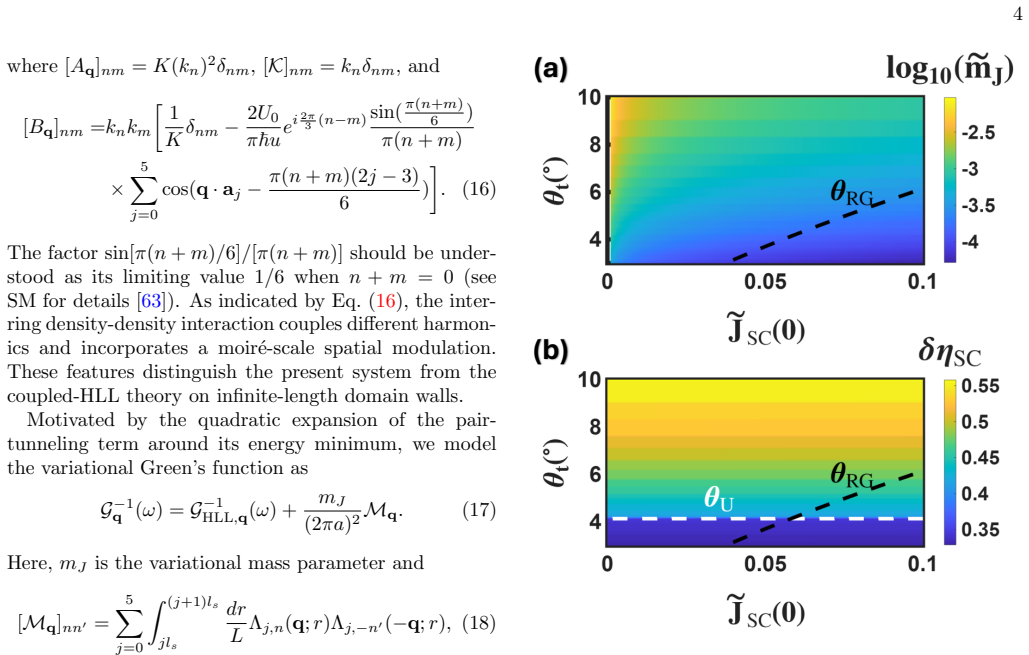
In helical domain-wall-ring networks, the superconducting scaling dimension continues to decrease with decreasing twist angle and remains insensitive to pair-tunneling strength, while the phase-locking scale is strongly suppressed; this reveals a qualitative mismatch from the infinite-size expectation that inter-ring pair tunneling enhances correlations through phase locking.
What carries the argument
Self-consistent variational approach to finite-size effects in ring-network geometry, which decouples the scaling dimension from pair-tunneling strength unlike the renormalization-group flow of the infinite-size theory.
If this is right
- Superconducting correlations in confined domain-wall networks are dominated by geometry rather than tunneling strength.
- Phase locking between rings is suppressed despite relevant tunneling predicted by infinite-size renormalization-group analysis.
- The twist-angle dependence of the scaling dimension persists independently of inter-ring coupling.
- Collective behavior in closed topological domains differs qualitatively from extended or infinite networks.
Where Pith is reading between the lines
- The same finite-size suppression of phase locking could appear in other closed network topologies such as polygons or linked rings.
- Twist-angle sweeps in transport or tunneling spectroscopy could distinguish ring-network behavior from bulk predictions.
- The variational method may be adaptable to other interaction-driven orders such as magnetism within similar confined geometries.
Load-bearing premise
The self-consistent variational approach accurately captures finite-size effects in the ring-network geometry without uncontrolled approximations.
What would settle it
Direct measurement showing that the superconducting scaling dimension in finite ring networks depends on pair-tunneling strength, or that phase-locking scales remain unsuppressed at small twist angles.
Figures
read the original abstract
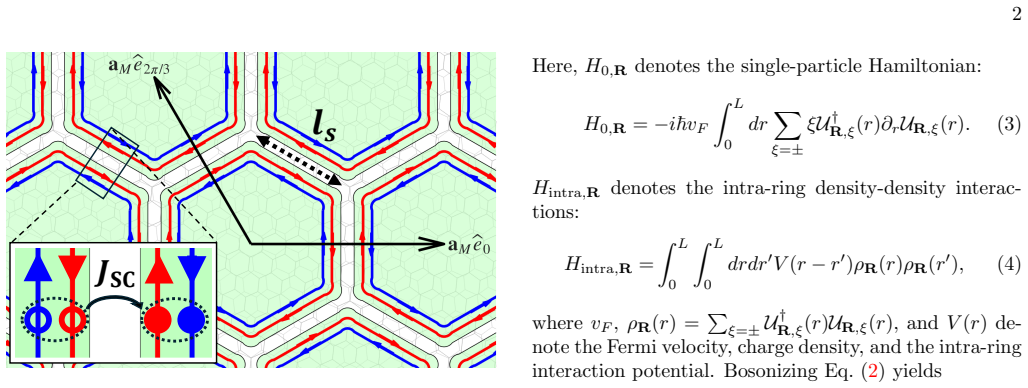
Extended domain-wall networks emerging in moir\'e materials provide a distinct platform for quasi-one-dimensional electronic states. However, the interaction-driven orders in confined networks remain largely unexplored. Here, we discuss superconducting (SC) correlations in interacting helical domain-wall-ring networks that emerge in the closed topological domains formed within the moir\'e patterns of an underlying twisted bilayer honeycomb lattice. We first analyze the system within the framework of an infinite-size theory and show that inter-ring SC-pair tunneling is renormalization-group relevant and thus enhances SC correlations through inter-ring phase locking. To address finite-size effects resulting from the ring-network geometry, we present a self-consistent variational approach. Our analysis shows that even in the regime where the infinite-size theory predicts strongly-coupled pair tunneling, the induced phase-locking scale remains strongly suppressed. In contrast, the SC scaling dimension continues to decrease with decreasing twist angle and remains insensitive to the pair-tunneling strength, revealing a qualitative mismatch from the infinite-size expectation. This discrepancy demonstrates that ring networks do not simply approach their infinite-size counterparts but can exhibit qualitatively distinct collective behavior. Our study highlights how the interplay of confinement effects and ring-network geometry can reshape SC correlations.
Editorial analysis
A structured set of objections, weighed in public.
Referee Report
Summary. The paper examines superconducting correlations in helical domain-wall-ring networks arising in moiré patterns of twisted bilayer honeycomb lattices. Infinite-size RG analysis shows inter-ring pair tunneling to be relevant, promoting phase locking and enhanced SC correlations. A self-consistent variational treatment of finite-size effects in the ring geometry finds the phase-locking scale strongly suppressed even when tunneling is relevant, while the SC scaling dimension decreases with twist angle and remains insensitive to tunneling strength, indicating qualitatively distinct collective behavior from the infinite-size limit.
Significance. If the finite-size variational results are reliable, the demonstration that confinement and ring-network geometry can produce SC correlations qualitatively different from infinite-size expectations would be of interest for quasi-1D interaction-driven orders in moiré systems, underscoring geometry-dependent reshaping of correlations.
major comments (2)
- [finite-size analysis] The central claim of qualitatively distinct collective behavior rests on the mismatch between infinite-size RG and the finite-size variational results (abstract, paragraph on finite-size analysis). The self-consistent variational approach lacks any benchmark against controlled methods such as DMRG or exact diagonalization on the same Hamiltonian, leaving open whether the reported suppression of phase locking and insensitivity of the scaling dimension are physical or artifacts of the trial wavefunction and convergence criteria.
- [finite-size analysis] The reported insensitivity of the SC scaling dimension to pair-tunneling strength in the variational treatment appears to contradict the RG relevance established in the infinite-size theory; without explicit equations showing how the variational ansatz incorporates the tunneling term and enforces self-consistency, it is unclear whether this insensitivity is a genuine geometric effect or follows by construction from the approximation.
minor comments (1)
- Clarify the precise definition of the variational ansatz and the convergence criteria used in the self-consistency loop.
Simulated Author's Rebuttal
We thank the referee for their careful reading and constructive comments. Below we respond point by point to the major comments.
read point-by-point responses
-
Referee: [finite-size analysis] The central claim of qualitatively distinct collective behavior rests on the mismatch between infinite-size RG and the finite-size variational results (abstract, paragraph on finite-size analysis). The self-consistent variational approach lacks any benchmark against controlled methods such as DMRG or exact diagonalization on the same Hamiltonian, leaving open whether the reported suppression of phase locking and insensitivity of the scaling dimension are physical or artifacts of the trial wavefunction and convergence criteria.
Authors: We acknowledge that direct numerical benchmarks with DMRG or exact diagonalization would provide additional validation. Such calculations are, however, computationally prohibitive for the multi-ring network geometry at the relevant system sizes and with the long-range interactions considered. The variational ansatz follows standard self-consistent treatments of relevant perturbations in Luttinger-liquid models, and we have verified convergence with respect to the variational parameters. In the revised manuscript we will add an expanded discussion of the method's regime of applicability and its limitations. revision: partial
-
Referee: [finite-size analysis] The reported insensitivity of the SC scaling dimension to pair-tunneling strength in the variational treatment appears to contradict the RG relevance established in the infinite-size theory; without explicit equations showing how the variational ansatz incorporates the tunneling term and enforces self-consistency, it is unclear whether this insensitivity is a genuine geometric effect or follows by construction from the approximation.
Authors: The pair-tunneling term enters the variational ansatz through a self-consistent mean-field decoupling that generates an effective single-particle Hamiltonian; the SC scaling dimension is then obtained from the resulting Green's function. The observed insensitivity follows because the finite ring geometry strongly suppresses the phase-locking order parameter, rendering the effective tunneling too weak to modify intra-ring correlations appreciably. We will include the explicit form of the ansatz, the decoupling procedure, and the self-consistency equations in the supplementary material of the revised version. revision: yes
Circularity Check
No circularity: infinite-size RG and finite-size variational steps remain independent
full rationale
The provided abstract and description present a standard two-stage analysis: first an infinite-size RG treatment establishing relevance of inter-ring pair tunneling, then a separate self-consistent variational method introduced specifically to capture ring-network finite-size effects. The reported mismatch (suppressed phase-locking yet twist-angle-dependent scaling dimension) is framed as an output of applying the variational treatment, not as a quantity forced by redefinition or by feeding fitted parameters back as predictions. No equations, self-citations, or ansatzes are quoted that reduce any central claim to its own inputs by construction. The derivation chain is therefore self-contained against external benchmarks.
Axiom & Free-Parameter Ledger
Reference graph
Works this paper leans on
-
[1]
Balents, C
L. Balents, C. R. Dean, D. K. Efetov, and A. F. Young, Superconductivity and strong correlations in moir´ e flat bands, Nature Physics16, 725 (2020)
2020
-
[2]
Isobe, N
H. Isobe, N. F. Q. Yuan, and L. Fu, Unconventional superconductivity and density waves in twisted bilayer graphene, Phys. Rev. X8, 041041 (2018)
2018
-
[3]
Yankowitz, S
M. Yankowitz, S. Chen, H. Polshyn, Y. Zhang, K. Watan- abe, T. Taniguchi, D. Graf, A. F. Young, and C. R. Dean, Tuning superconductivity in twisted bilayer graphene, Science363, 1059 (2019)
2019
-
[5]
Y. Cao, V. Fatemi, S. Fang, K. Watanabe, T. Taniguchi, E. Kaxiras, and P. Jarillo-Herrero, Unconventional super- conductivity in magic-angle graphene superlattices, Na- ture556, 43 (2018)
2018
-
[6]
M. Oh, K. P. Nuckolls, D. Wong, R. L. Lee, X. Liu, K. Watanabe, T. Taniguchi, and A. Yazdani, Evidence for unconventional superconductivity in twisted bilayer graphene, Nature600, 240 (2021)
2021
-
[7]
Y. Guo, J. Pack, J. Swann, L. Holtzman, M. Cothrine, K. Watanabe, T. Taniguchi, D. G. Mandrus, K. Barmak, J. Hone, A. J. Millis, A. Pasupathy, and C. R. Dean, Superconductivity in 5.0°twisted bilayer wse2, Nature 637, 839 (2025)
2025
-
[8]
Regnault and B
N. Regnault and B. A. Bernevig, Fractional chern insu- lator, Phys. Rev. X1, 021014 (2011)
2011
-
[9]
F. Xu, Z. Sun, T. Jia, C. Liu, C. Xu, C. Li, Y. Gu, K. Watanabe, T. Taniguchi, B. Tong, J. Jia, Z. Shi, S. Jiang, Y. Zhang, X. Liu, and T. Li, Observation of integer and fractional quantum anomalous hall effects in twisted bilayer MoTe2, Phys. Rev. X13, 031037 (2023)
2023
-
[10]
A. P. Reddy, F. Alsallom, Y. Zhang, T. Devakul, and L. Fu, Fractional quantum anomalous hall states in twisted bilayer MoTe 2 and WSe 2, Phys. Rev. B108, 085117 (2023)
2023
-
[11]
H. Park, J. Cai, E. Anderson, Y. Zhang, J. Zhu, X. Liu, C. Wang, W. Holtzmann, C. Hu, Z. Liu, T. Taniguchi, K. Watanabe, J.-H. Chu, T. Cao, L. Fu, W. Yao, C.-Z. Chang, D. Cobden, D. Xiao, and X. Xu, Observation of fractionally quantized anomalous hall effect, Nature622, 74 (2023)
2023
-
[12]
J. Cai, E. Anderson, C. Wang, X. Zhang, X. Liu, W. Holtzmann, Y. Zhang, F. Fan, T. Taniguchi, K. Watanabe, Y. Ran, T. Cao, L. Fu, D. Xiao, W. Yao, and X. Xu, Signatures of fractional quantum anomalous hall states in twisted MoTe 2, Nature622, 63 (2023)
2023
-
[13]
Wu, C.-M
X.-C. Wu, C.-M. Jian, and C. Xu, Coupled-wire descrip- tion of the correlated physics in twisted bilayer graphene, Phys. Rev. B99, 161405(R) (2019)
2019
-
[14]
C. Chen, A. H. Castro Neto, and V. M. Pereira, Corre- lated states of a triangular net of coupled quantum wires: Implications for the phase diagram of marginally twisted bilayer graphene, Phys. Rev. B101, 165431 (2020)
2020
-
[15]
S. Carr, S. Fang, Z. Zhu, and E. Kaxiras, Exact con- tinuum model for low-energy electronic states of twisted bilayer graphene, Phys. Rev. Res.1, 013001 (2019)
2019
-
[16]
J. S. Alden, A. W. Tsen, P. Y. Huang, R. Hov- den, L. Brown, J. Park, D. A. Muller, and P. L. 6 McEuen, Strain solitons and topological defects in bi- layer graphene, Proceedings of the National Academy of Sciences110, 11256 (2013)
2013
-
[17]
Wang and C.-H
H.-C. Wang and C.-H. Hsu, Electrically tunable corre- lated domain wall network in twisted bilayer graphene, 2D Materials11, 035007 (2024)
2024
-
[18]
Gargiulo and O
F. Gargiulo and O. V. Yazyev, Structural and electronic transformation in low-angle twisted bilayer graphene, 2D Materials5, 015019 (2017)
2017
-
[19]
H. Wang, Z. Liu, Y. Jiang, and J. Wang, Giant anisotropic band flattening in twisted Γ-valley semicon- ductor bilayers, Phys. Rev. B108, L201120 (2023)
2023
-
[20]
Kang, W.-T
P. Kang, W.-T. Zhang, V. Michaud-Rioux, X.-H. Kong, C. Hu, G.-H. Yu, and H. Guo, Moir´ e impurities in twisted bilayer black phosphorus: Effects on the carrier mobility, Phys. Rev. B96, 195406 (2017)
2017
-
[21]
D. J. P. de Sousa, S. Lee, F. Guinea, and T. Low, Moir´ e collapse and luttinger liquids in twisted anisotropic ho- mobilayers, Proceedings of the National Academy of Sci- ences123, e2527371123 (2026)
2026
-
[22]
Wang and X
E. Wang and X. Zou, Moir´ e bands in twisted trilayer black phosphorene: effects of pressure and electric field, Nanoscale14, 3758 (2022)
2022
-
[23]
Huang, B
S. Huang, B. Yu, Y. Ma, C. Pan, J. Ma, Y. Zhou, Y. Ma, K. Yang, H. Wu, Y. Lei, Q. Xing, L. Mu, J. Zhang, Y. Mou, and H. Yan, Bright dipolar excitons in twisted black phosphorus homostructures, Science386, 526 (2024)
2024
-
[24]
T. Cao, Z. Li, D. Y. Qiu, and S. G. Louie, Gate switchable transport and optical anisotropy in 90°twisted bilayer black phosphorus, Nano Letters16, 5542 (2016)
2016
-
[25]
C. Lei, P. T. Mahon, and A. H. MacDonald, Moir´ e band theory for m-valley twisted transition metal dichalco- genides, Phys. Rev. Lett.135, 196402 (2025)
2025
-
[26]
C˘ alug˘ aru, Y
D. C˘ alug˘ aru, Y. Jiang, H. Hu, H. Pi, J. Yu, M. G. Vergniory, J. Shan, C. Felser, L. M. Schoop, D. K. Efetov, K. F. Mak, and B. A. Bernevig, Moir´ e materials based on m-point twisting, Nature643, 376 (2025)
2025
-
[27]
Y. Jiang, U. Petralanda, G. Skorupskii, Q. Xu, H. Pi, D. C˘ alug˘ aru, H. Hu, J. Xie, R. A. Mustaf, P. H¨ ohn, V. Haase, M. G. Vergniory, M. Claassen, L. Elcoro, N. Regnault, J. Shan, K. F. Mak, D. K. Efetov, E. Mo- rosan, D. M. Kennes, A. Rubio, L. Xian, C. Felser, L. M. Schoop, and B. A. Bernevig, 2d theoretically twistable material database (2024), arX...
arXiv 2024
-
[28]
Tomonaga, Remarks on bloch’s method of sound waves applied to many-fermion problems, Progress of Theoretical Physics5, 544 (1950)
S.-i. Tomonaga, Remarks on bloch’s method of sound waves applied to many-fermion problems, Progress of Theoretical Physics5, 544 (1950)
1950
-
[29]
J. M. Luttinger, An exactly soluble model of a many- fermion system, Journal of Mathematical Physics4, 1154 (1963)
1963
-
[30]
D. C. Mattis and E. H. Lieb, Exact solution of a many- fermion system and its associated boson field, Journal of Mathematical Physics6, 304 (1965)
1965
-
[31]
C.-H. Hsu, P. Stano, J. Klinovaja, and D. Loss, Heli- cal liquids in semiconductors, Semiconductor Science and Technology36, 123003 (2021)
2021
-
[32]
C.-H. Hsu, J. Klinovaja, and D. Loss, On the cutting edge: helical liquids in time-reversal-invariant topolog- ical materials, Journal of Physics: Materials9, 011001 (2025)
2025
-
[33]
C. L. Kane and E. J. Mele, Quantum spin hall effect in graphene, Phys. Rev. Lett.95, 226801 (2005)
2005
-
[34]
C. L. Kane and E. J. Mele,Z 2 topological order and the quantum spin hall effect, Phys. Rev. Lett.95, 146802 (2005)
2005
-
[35]
Gresch, G
D. Gresch, G. Aut` es, O. V. Yazyev, M. Troyer, D. Van- derbilt, B. A. Bernevig, and A. A. Soluyanov, Z2pack: Numerical implementation of hybrid wannier centers for identifying topological materials, Phys. Rev. B95, 075146 (2017)
2017
-
[36]
Fu and C
L. Fu and C. L. Kane, Time reversal polarization and a Z2 adiabatic spin pump, Phys. Rev. B74, 195312 (2006)
2006
-
[37]
C. Wu, B. A. Bernevig, and S.-C. Zhang, Helical liquid and the edge of quantum spin hall systems, Phys. Rev. Lett.96, 106401 (2006)
2006
-
[38]
Q. Li, Y. Han, K. Zhang, Y.-T. Zhang, J.-J. Liu, and Z. Qiao, Multiple majorana edge modes in mag- netic topological insulator–superconductor heterostruc- tures, Phys. Rev. B102, 205402 (2020)
2020
-
[39]
Schulz, J
F. Schulz, J. C. Budich, E. G. Novik, P. Recher, and B. Trauzettel, Voltage-tunable majorana bound states in time-reversal symmetric bilayer quantum spin hall hybrid systems, Phys. Rev. B100, 165420 (2019)
2019
-
[40]
Kheirkhah, Y
M. Kheirkhah, Y. Nagai, C. Chen, and F. Marsiglio, Ma- jorana corner flat bands in two-dimensional second-order topological superconductors, Phys. Rev. B101, 104502 (2020)
2020
-
[41]
Wang, C.-C
Q. Wang, C.-C. Liu, Y.-M. Lu, and F. Zhang, High- temperature majorana corner states, Phys. Rev. Lett. 121, 186801 (2018)
2018
-
[42]
Z. Yan, F. Song, and Z. Wang, Majorana corner modes in a high-temperature platform, Phys. Rev. Lett.121, 096803 (2018)
2018
-
[43]
Kheirkhah, D
M. Kheirkhah, D. Zhu, J. Maciejko, and Z. Yan, Corner- and sublattice-sensitive majorana zero modes on the kagome lattice, Phys. Rev. B106, 085420 (2022)
2022
-
[44]
Hsu, Interaction- and phonon-induced topologi- cal phase transitions in double helical liquids, Nanoscale Horiz.9, 1725 (2024)
C.-H. Hsu, Interaction- and phonon-induced topologi- cal phase transitions in double helical liquids, Nanoscale Horiz.9, 1725 (2024)
2024
-
[45]
Klinovaja, A
J. Klinovaja, A. Yacoby, and D. Loss, Kramers pairs of majorana fermions and parafermions in fractional topo- logical insulators, Phys. Rev. B90, 155447 (2014)
2014
-
[46]
Zhang and C
F. Zhang and C. L. Kane, Time-reversal-invariantZ 4 fractional josephson effect, Phys. Rev. Lett.113, 036401 (2014)
2014
-
[47]
C. P. Orth, R. P. Tiwari, T. Meng, and T. L. Schmidt, Non-abelian parafermions in time-reversal-invariant in- teracting helical systems, Phys. Rev. B91, 081406(R) (2015)
2015
-
[48]
Fleckenstein, N
C. Fleckenstein, N. T. Ziani, and B. Trauzettel,z 4 parafermions in weakly interacting superconducting con- strictions at the helical edge of quantum spin hall insu- lators, Phys. Rev. Lett.122, 066801 (2019)
2019
-
[49]
Chou and S
Y.-Z. Chou and S. Das Sarma, Composite helical edges from abelian fractional topological insulators, Phys. Rev. B110, 155117 (2024)
2024
-
[50]
C.-H. Hsu, P. Stano, J. Klinovaja, and D. Loss, Majo- rana kramers pairs in higher-order topological insulators, Phys. Rev. Lett.121, 196801 (2018)
2018
-
[51]
Laubscher, D
K. Laubscher, D. Chughtai, D. Loss, and J. Klinovaja, Kramers pairs of majorana corner states in a topological insulator bilayer, Phys. Rev. B102, 195401 (2020)
2020
-
[52]
Hung, C.-H
Y.-C. Hung, C.-H. Hsu, and A. Bansil, Majorana kramers pairs in synthetic high-spin chern insulators, Phys. Rev. B111, 245145 (2025). 7
2025
-
[53]
Y.-C. Hung, B. Wang, C.-H. Hsu, A. Bansil, and H. Lin, Time-reversal soliton pairs in even spin chern number higher-order topological insulators, Phys. Rev. B110, 035125 (2024)
2024
-
[54]
Wang, Y.-C
B. Wang, Y.-C. Hung, X. Zhou, A. Bansil, and H. Lin, Higher-order topological phases hidden in quantum spin hall insulators, Phys. Rev. B108, 245103 (2023)
2023
-
[55]
B. Wang, X. Zhou, Y.-C. Hung, Y.-C. Lin, H. Lin, and A. Bansil, High spin-chern-number insulator inα- antimonene with a hidden topological phase, 2D Materi- als11, 025033 (2024)
2024
-
[56]
Chung, D.-H
C.-H. Chung, D.-H. Lee, and S.-P. Chao, Kane-mele hub- bard model on a zigzag ribbon: Stability of the topolog- ical edge states and quantum phase transitions, Phys. Rev. B90, 035116 (2014)
2014
-
[57]
Kainaris, I
N. Kainaris, I. V. Gornyi, A. Levchenko, and D. G. Polyakov, Coulomb drag between helical luttinger liq- uids, Phys. Rev. B95, 045150 (2017)
2017
-
[58]
Chou, Localization-driven correlated states of two isolated interacting helical edges, Phys
Y.-Z. Chou, Localization-driven correlated states of two isolated interacting helical edges, Phys. Rev. B99, 045125 (2019)
2019
-
[59]
Tsantilas, T
A. Tsantilas, T. Devakul, and J. May-Mann, Shot noise in strongly correlated double quantum spin hall edges, Phys. Rev. B113, 075125 (2026)
2026
-
[60]
Hung, C.-H
Y.-C. Hung, C.-H. Hsu, and A. Bansil, Tunable compet- ing electronic orders in double quantum spin hall super- lattices, Phys. Rev. B112, 195127 (2025)
2025
-
[61]
A. Bordoloi, D. Kaplan, and S. Singh, Relaxation- driven topological domains in moir´ e materials (2026), arXiv:2605.27548 [cond-mat.mtrl-sci]
Pith/arXiv arXiv 2026
-
[62]
The corner re- gion, therefore, contributes only local corrections and can be neglected in the low-energy physics
In the small twist-angle limit, the size of the rounded cornerl c remains much smaller than the length of the connecting domain-wall segment,l c ≪L. The corner re- gion, therefore, contributes only local corrections and can be neglected in the low-energy physics
-
[63]
See Supplemental Materials at [link-inserted-by-the- editor] for more details, which includes Refs. [64–66]
-
[64]
Maciejko, C
J. Maciejko, C. Liu, Y. Oreg, X.-L. Qi, C. Wu, and S.- C. Zhang, Kondo effect in the helical edge liquid of the quantum spin hall state, Phys. Rev. Lett.102, 256803 (2009)
2009
-
[65]
Z. Li, H. Pan, H. Chu, Z. Pan, Y. Li, S. Zhao, and D. Li, Optoelectronic and mechanical properties of monolayer bismuthene under strain modulation: Insight from first- principles calculations, Phys. Rev. B110, 125429 (2024)
2024
-
[66]
Singh, S
D. Singh, S. K. Gupta, Y. Sonvane, and I. Lukaˇ cevi´ c, Antimonene: a monolayer material for ultraviolet optical nanodevices, J. Mater. Chem. C4, 6386 (2016)
2016
-
[67]
Thakurathi, P
M. Thakurathi, P. Simon, I. Mandal, J. Klinovaja, and D. Loss, Majorana kramers pairs in rashba double nanowires with interactions and disorder, Phys. Rev. B 97, 045415 (2018)
2018
-
[68]
Bistritzer and A
R. Bistritzer and A. H. MacDonald, Moir´ e bands in twisted double-layer graphene, Proceedings of the Na- tional Academy of Sciences108, 12233 (2011)
2011
-
[69]
Feynman,Statistical mechanics: a set of lectures, Frontiers in physics : a lecture note and reprint series (Sarat Book Distributors, 1972)
R. Feynman,Statistical mechanics: a set of lectures, Frontiers in physics : a lecture note and reprint series (Sarat Book Distributors, 1972)
1972
-
[70]
Giamarchi,Quantum Physics in One Dimension(Ox- ford University Press, New York, 2003)
T. Giamarchi,Quantum Physics in One Dimension(Ox- ford University Press, New York, 2003)
2003
-
[71]
J. L. Cardy, Conformal invariance and universality in finite-size scaling, Journal of Physics A: Mathematical and General17, L385 (1984). 8 Supplemental Materials: Helical Domain-Wall-Ring Networks Reshape Superconducting Correlations CONTENTS References 5 S1. Bosonization conventions 8 S2. Single-particle inter-ring tunneling 8 S3. Estimation of effectiv...
1984
discussion (0)
Sign in with ORCID, Apple, or X to comment. Anyone can read and Pith papers without signing in.