Testing Supersymmetric Hidden Sectors with Long-Baseline Atom Interferometers
Pith reviewed 2026-06-27 16:35 UTC · model grok-4.3
The pith
Long-baseline atom interferometers can map measured atomic phase directly to derivatives of supersymmetric gauge kinetic functions and Kähler metrics along hidden directions.
A machine-rendered reading of the paper's core claim, the machinery that carries it, and where it could break.
Core claim
In the presence of ultralight moduli, dilatons or hidden scalars that induce coherent phase oscillations, the atomic phase measured by long-baseline interferometers is related to derivatives of supersymmetric gauge kinetic functions, Kähler metrics, Yukawa couplings, Higgs sector parameters and the QCD scale along light hidden sector directions. The paper derives the mapping from a generic SUSY/SUGRA modulus to the effective atom interferometric coupling and shows that projected phase sensitivities can probe very small visible sector admixtures of otherwise hidden fields.
What carries the argument
The mapping from a generic SUSY/SUGRA modulus to the effective atom interferometric coupling, which converts hidden-sector field derivatives into a measurable phase shift.
If this is right
- Future phase sensitivities can reach very small visible-sector admixtures of otherwise hidden fields.
- Long-baseline atom interferometers function as non-collider probes of supersymmetric and string-motivated infrared relics.
- The probes are complementary to gravitational-wave, astrophysical and collider searches.
- The measured phase constrains derivatives of the listed supersymmetric quantities along light hidden directions rather than a single phenomenological coupling.
Where Pith is reading between the lines
- If the mapping holds, precision atom interferometry could serve as a direct window onto the infrared remnants of string compactifications that contain light moduli.
- The same phase data might be reanalyzed to extract bounds on the hidden-sector dependence of the QCD scale or Higgs parameters without new hardware.
- Similar mappings could be worked out for other quantum sensors such as optical clocks or atom gravimeters that also respond to scalar fields.
Load-bearing premise
The hidden sectors contain ultralight moduli, dilatons or hidden scalars that induce coherent phase oscillations in the atom interferometer.
What would settle it
A null result for coherent phase oscillations at the frequencies and amplitudes predicted by the modulus mapping, at the phase sensitivity levels projected for long-baseline interferometers, would show that these hidden-sector admixtures cannot be reached by this method.
Figures
read the original abstract
Atomic interferometry provides a sensitive near Earth probe of high energy physics through precision measurements of quantum phase. In this Letter, we point out that MAGIS and AION like long-baseline atom interferometers can also be used to test supersymmetric hidden sectors, if these sectors contain ultralight moduli, dilatons or hidden scalars that induce coherent phase oscillations. In such a setup, the measured atomic phase does not only constrain an effective phenomenological scalar coupling. It can be related to derivatives of supersymmetric gauge kinetic functions, K\"ahler metrics, Yukawa couplings, Higgs sector parameters and the QCD scale along light hidden sector directions. We derive the mapping from a generic SUSY/SUGRA modulus to the effective atom interferometric coupling, and show that future phase sensitivities may probe very small visible sector admixtures of otherwise hidden fields. This identifies MAGIS/AION type experiments as non-collider probes of supersymmetric and string-motivated infrared relics, complementary to gravitational wave, astrophysical and collider searches.
Editorial analysis
A structured set of objections, weighed in public.
Referee Report
Summary. The paper claims that long-baseline atom interferometers (MAGIS/AION) can probe supersymmetric hidden sectors containing ultralight moduli, dilatons or hidden scalars. The measured atomic phase is mapped to derivatives of supersymmetric gauge kinetic functions, Kähler metrics, Yukawa couplings, Higgs sector parameters and the QCD scale along light hidden-sector directions. A derivation is provided from a generic SUSY/SUGRA modulus to the effective interferometric coupling, with the suggestion that future phase sensitivities could constrain small visible-sector admixtures of otherwise hidden fields.
Significance. If the mapping is valid, the work supplies a concrete EFT dictionary that turns precision atom-interferometry data into constraints on supersymmetric and string-motivated infrared relics. This constitutes a genuine non-collider probe complementary to gravitational-wave, astrophysical and collider searches, with the explicit connection to SUGRA quantities as its main technical contribution.
minor comments (3)
- [Introduction / §2] The abstract states that the mapping is derived, but the main text should explicitly list the leading-order assumptions (e.g., coherent oscillation regime, neglect of back-reaction on the visible sector) in a dedicated paragraph or table for reproducibility.
- Notation for the effective coupling (presumably defined after Eq. (X)) should be introduced once and used consistently; several symbols appear to be redefined in different sections without cross-reference.
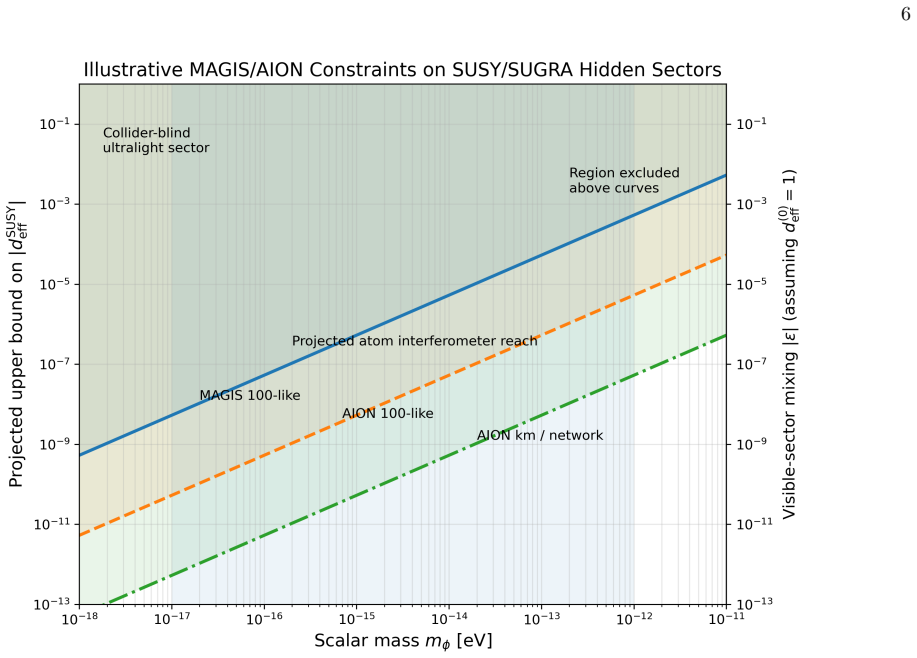
- [Results / Discussion] A short numerical example or plot showing the size of the predicted phase shift for a benchmark modulus mass and mixing angle would help readers assess the reach of the proposed experiments.
Simulated Author's Rebuttal
We thank the referee for their positive assessment of the manuscript, including the summary and significance statements, and for recommending minor revision. We note that no specific major comments were raised in the report. We will incorporate any minor editorial or clarification changes as appropriate in the revised version.
Circularity Check
No significant circularity identified
full rationale
The paper derives a theoretical mapping from a generic SUSY/SUGRA modulus to an effective atom-interferometric coupling, expressing the measured phase in terms of derivatives of gauge kinetic functions, Kähler metrics, Yukawas, Higgs parameters and the QCD scale. This is an EFT dictionary construction under the assumption of ultralight hidden-sector scalars; no step reduces a claimed prediction to a fitted parameter by construction, no load-bearing self-citation chain is invoked, and no ansatz is smuggled via prior work. The central result is a conditional derivation from standard supergravity, self-contained against external benchmarks.
Axiom & Free-Parameter Ledger
axioms (1)
- domain assumption Hidden sectors contain ultralight moduli, dilatons or hidden scalars that induce coherent phase oscillations.
Reference graph
Works this paper leans on
-
[1]
A. D. Cronin, J. Schmiedmayer, and D. E. Pritchard, Op- tics and interferometry with atoms and molecules, Rev. Mod. Phys.81, 1051 (2009), arXiv:0712.3703 [quant-ph]
Pith/arXiv arXiv 2009
-
[2]
Abend, M
S. Abend, M. Gersemann, C. Schubert, D. Schlippert, E. M. Rasel, M. Zimmermann, M. A. Efremov, A. Roura, F. A. Narducci, W. P. Schleich,et al., Atom interferome- try and its applications, Foundations of quantum theory 197, 345 (2019)
2019
-
[3]
O. Buchmueller, J. Ellis, and U. Schneider, Large-scale atom interferometry for fundamental physics, Contemp. Phys.64, 93 (2023), arXiv:2306.17726 [astro-ph.CO]
arXiv 2023
-
[4]
A. Abdallaet al., Terrestrial Very-Long-Baseline Atom Interferometry: summary of the second workshop, EPJ Quant. Technol.12, 42 (2025), arXiv:2412.14960 [hep- ex]
arXiv 2025
- [5]
-
[6]
Roura, Atom interferometer as a freely falling clock for time-dilation measurements, Quantum Sci
A. Roura, Atom interferometer as a freely falling clock for time-dilation measurements, Quantum Sci. Technol. 10, 025004 (2025), arXiv:2402.11065 [physics.atom-ph]
arXiv 2025
- [7]
-
[8]
G. Premawardhana, J. Kunjummen, S. Subhankar, and J. M. Taylor, Feasibility of a trapped atom interferometer with accelerating optical traps, Phys. Rev. A109, 053316 (2024), arXiv:2308.12246 [physics.atom-ph]
arXiv 2024
-
[9]
S. Dimopoulos, P. W. Graham, J. M. Hogan, M. A. Ka- sevich, and S. Rajendran, Gravitational Wave Detection with Atom Interferometry, Phys. Lett. B678, 37 (2009), arXiv:0712.1250 [gr-qc]
Pith/arXiv arXiv 2009
-
[10]
P. W. Graham, J. M. Hogan, M. A. Kasevich, and S. Ra- jendran, A New Method for Gravitational Wave Detec- tion with Atomic Sensors, Phys. Rev. Lett.110, 171102 (2013), arXiv:1206.0818 [quant-ph]
Pith/arXiv arXiv 2013
-
[11]
P. W. Graham, J. M. Hogan, M. A. Kasevich, and S. Ra- jendran, Resonant mode for gravitational wave detectors based on atom interferometry, Phys. Rev. D94, 104022 (2016), arXiv:1606.01860 [physics.atom-ph]
Pith/arXiv arXiv 2016
-
[12]
Y. A. El-Neajet al.(AEDGE), AEDGE: Atomic Experi- ment for Dark Matter and Gravity Exploration in Space, EPJ Quant. Technol.7, 6 (2020), arXiv:1908.00802 [gr- qc]
arXiv 2020
-
[13]
Canuelet al., ELGAR—a European Laboratory for Gravitation and Atom-interferometric Research, Class
B. Canuelet al., ELGAR—a European Laboratory for Gravitation and Atom-interferometric Research, Class. Quant. Grav.37, 225017 (2020), arXiv:1911.03701 7 [physics.atom-ph]
arXiv 2020
-
[14]
R. Geigeret al., Matter-wave laser Interferometric Grav- itation Antenna (MIGA): New perspectives for funda- mental physics and geosciences, in50th Rencontres de Moriond on Gravitation: 100 years after GR(2015) pp. 163–172, arXiv:1505.07137 [physics.atom-ph]
Pith/arXiv arXiv 2015
-
[15]
A. Arvanitaki, P. W. Graham, J. M. Hogan, S. Rajen- dran, and K. Van Tilburg, Search for light scalar dark matter with atomic gravitational wave detectors, Phys. Rev. D97, 075020 (2018), arXiv:1606.04541 [hep-ph]
Pith/arXiv arXiv 2018
-
[16]
M. Abe, P. Adamson, M. Borcean, D. Bortoletto, K. Bridges, S. P. Carman, S. Chattopadhyay, J. Cole- man, N. M. Curfman, K. DeRose,et al., Matter-wave atomic gradiometer interferometric sensor (magis-100), Quantum Science & Technology6, 044003 (2021)
2021
-
[17]
Adamson, S
P. Adamson, S. Chattopadhyay, J. Coleman, P. Graham, S. Geer, R. Harnik, S. Hahn, J. Hogan, M. Kasevich, T. Kovachy,et al.,PROPOSAL: P-1101 matter-wave atomic gradiometer interferometric sensor (MAGIS- 100), Tech. Rep. (Northwestern U.; Liverpool U.; UC, Berkeley; Northern Illinois U.; Fermi . . . , 2018)
2018
-
[18]
J. Coleman (MAGIS-100), Matter-wave Atomic Gra- diometer InterferometricSensor (MAGIS-100) at Fermi- lab, PoSICHEP2018, 021 (2019), arXiv:1812.00482 [physics.ins-det]
Pith/arXiv arXiv 2019
-
[19]
J. T. Mitchell, T. Kovachy, S. Hahn, P. Adamson, and S. Chattopadhyay, MAGIS-100 environmental charac- terization and noise analysis, JINST17(01), P01007, [Erratum: JINST 17, E02001 (2022)], arXiv:2202.04763 [physics.atom-ph]
arXiv 2022
-
[20]
J. Jachinowski, N. Sachdeva, and T. Kovachy, Beam Pro- filing With Noise Reduction From Computer Vision and Principal Component Analysis for the MAGIS-100 Ex- periment, inIEEE International Conference on Antenna Measurements and Applications(2021) arXiv:2203.03380 [physics.ins-det]
arXiv 2021
-
[21]
L. Badurinaet al., AION: An Atom Interferometer Ob- servatory and Network, JCAP05, 011, arXiv:1911.11755 [astro-ph.CO]
arXiv 1911
-
[22]
Buchmuller, The atom interferometer observatory net- work (2018)
O. Buchmuller, The atom interferometer observatory net- work (2018)
2018
-
[23]
L. Badurina, D. Blas, and C. McCabe, Refined ul- tralight scalar dark matter searches with compact atom gradiometers, Phys. Rev. D105, 023006 (2022), arXiv:2109.10965 [astro-ph.CO]
arXiv 2022
-
[24]
L. Badurina, V. Gibson, C. McCabe, and J. Mitchell, Ultralight dark matter searches at the sub-Hz frontier with atom multigradiometry, Phys. Rev. D107, 055002 (2023), arXiv:2211.01854 [hep-ph]
arXiv 2023
-
[25]
L. Badurina, A. Beniwal, and C. McCabe, Super- Nyquist ultralight dark matter searches with broadband atom gradiometers, Phys. Rev. D108, 083016 (2023), arXiv:2306.16477 [hep-ph]
arXiv 2023
-
[26]
L. Badurina, O. Buchmueller, J. Ellis, M. Lewicki, C. Mc- Cabe, and V. Vaskonen, Prospective sensitivities of atom interferometers to gravitational waves and ultralight dark matter, Phil. Trans. A. Math. Phys. Eng. Sci.380, 20210060 (2021), arXiv:2108.02468 [gr-qc]
arXiv 2021
-
[27]
B. P. Abbottet al.(LIGO Scientific, Virgo), Observation of Gravitational Waves from a Binary Black Hole Merger, Phys. Rev. Lett.116, 061102 (2016), arXiv:1602.03837 [gr-qc]
Pith/arXiv arXiv 2016
-
[28]
B. P. Abbottet al.(LIGO Scientific), LIGO: The Laser interferometer gravitational-wave observatory, Rept. Prog. Phys.72, 076901 (2009), arXiv:0711.3041 [gr-qc]
Pith/arXiv arXiv 2009
-
[29]
Cacciapaglia, A
G. Cacciapaglia, A. Deandrea, and W. Isnard, Hidden supersymmetric dark sectors, Physical Review D109, 015024 (2024)
2024
-
[30]
Feldman, Z
D. Feldman, Z. Liu, P. Nath, and G. Peim, Multicompo- nent dark matter in supersymmetric hidden sector exten- sions, Physical Review D—Particles, Fields, Gravitation, and Cosmology81, 095017 (2010)
2010
-
[31]
Blinov, D
N. Blinov, D. E. Morrissey, K. Sigurdson, and S. Tulin, Dark matter antibaryons from a supersymmetric hidden sector, Physical Review D—Particles, Fields, Gravita- tion, and Cosmology86, 095021 (2012)
2012
-
[32]
Andreas, M
S. Andreas, M. D. Goodsell, and A. Ringwald, Dark mat- ter and dark forces from a supersymmetric hidden sector, Physical Review D—Particles, Fields, Gravitation, and Cosmology87, 025007 (2013)
2013
-
[33]
Braun, Y.-H
V. Braun, Y.-H. He, and B. A. Ovrut, Supersymmetric hidden sectors for heterotic standard models, Journal of High Energy Physics2013, 1 (2013)
2013
-
[34]
M. J. Strassler, Possible effects of a hidden valley on supersymmetric phenomenology, arXiv preprint hep- ph/0607160 (2006)
arXiv 2006
-
[35]
B. S. Acharya, S. A. Ellis, G. L. Kane, B. D. Nelson, and M. J. Perry, Lightest visible-sector supersymmetric particle is likely to be unstable, Physical Review Letters 117, 181802 (2016)
2016
-
[36]
M. Dine, P. Fox, E. Gorbatov, Y. Shadmi, Y. Shirman, and S. Thomas, Visible effects of the hidden sector, Phys- ical Review D70, 045023 (2004)
2004
-
[37]
Murayama, Y
H. Murayama, Y. Nomura, and D. Poland, More visible effects of the hidden sector, Physical Review D—Particles, Fields, Gravitation, and Cosmology77, 015005 (2008)
2008
-
[38]
Y. F. Chan, M. Low, D. E. Morrissey, and A. P. Spray, Lhc signatures of a minimal supersymmetric hidden val- ley, Journal of High Energy Physics2012, 1 (2012)
2012
-
[39]
A. Arvanitaki, S. Dimopoulos, S. Dubovsky, N. Kaloper, and J. March-Russell, String axiverse, Physical Review D81, 123530 (2010), arXiv:0905.4720 [hep-th]
Pith/arXiv arXiv 2010
-
[40]
Fayet and S
P. Fayet and S. Ferrara, Supersymmetry, Physics Reports 32, 249 (1977)
1977
-
[41]
S. P. Martin, A supersymmetry primer, Adv. Ser. Direct. High Energy Phys21, 1 (2010)
2010
-
[42]
J. L. Feng, Naturalness and the status of supersymmetry, Annual Review of Nuclear and Particle Science63, 351 (2013)
2013
-
[43]
M. F. Sohnius, Introducing supersymmetry, Physics re- ports128, 39 (1985)
1985
-
[44]
Witten, Constraints on supersymmetry breaking, Nu- clear Physics B202, 253 (1982)
E. Witten, Constraints on supersymmetry breaking, Nu- clear Physics B202, 253 (1982)
1982
-
[45]
G. Kane, K. Sinha, and S. Watson, Cosmological mod- uli and the post-inflationary universe: A critical review, International Journal of Modern Physics D24, 1530022 (2015), arXiv:1502.07746 [hep-th]
Pith/arXiv arXiv 2015
-
[46]
T. Damour and J. F. Donoghue, Equivalence principle vi- olations and couplings of a light dilaton, Physical Review D82, 084033 (2010), arXiv:1007.2792 [gr-qc]
Pith/arXiv arXiv 2010
-
[47]
B. S. Acharya, G. Kane, E. Kuflik, and R. Lu, Non- thermal dark matter and the moduli problem in string frameworks, Journal of High Energy Physics2008, 084 (2008), arXiv:0804.0863 [hep-ph]
Pith/arXiv arXiv 2008
-
[48]
D. B. Kaplan and M. B. Wise, Couplings of a light dila- ton and violations of the equivalence principle, Journal of High Energy Physics2000, 037 (2000), arXiv:hep- 8 ph/0008116 [hep-ph]
arXiv 2000
-
[49]
S. Kachru, R. Kallosh, A. D. Linde, and S. P. Trivedi, De Sitter vacua in string theory, Phys. Rev. D68, 046005 (2003), arXiv:hep-th/0301240
Pith/arXiv arXiv 2003
-
[50]
V. Balasubramanian, P. Berglund, J. P. Conlon, and F. Quevedo, Systematics of moduli stabilisation in Calabi-Yau flux compactifications, JHEP03, 007, arXiv:hep-th/0502058
-
[51]
T. Damour and A. M. Polyakov, The String dilaton and a least coupling principle, Nucl. Phys. B423, 532 (1994), arXiv:hep-th/9401069
Pith/arXiv arXiv 1994
discussion (0)
Sign in with ORCID, Apple, or X to comment. Anyone can read and Pith papers without signing in.