REVIEW 5 major objections 6 minor 3 cited by
ConciseRL: Conciseness-Guided Reinforcement Learning for Efficient Reasoning Models
T0 review · 5 major / 6 minor · reviewed 2026-08-07 · deepseek-v4-flash
Pith's one-line read Training on an LLM-judged conciseness reward cuts reasoning tokens by up to 31x while improving accuracy.
desk verdict Practical RL method for length-efficient reasoning with real token savings, but the headline numbers mix two variants and the 'semantic' conciseness claim outruns the evidence. read the letter →
The pith
A machine-rendered reading of the paper's core claim, the machinery that carries it, and where it could break.
The reading
What carries the argument
The load-bearing object is the LLM-judged conciseness score $C(y)=s/10$, where the judge is instructed to score semantic compactness from 1 to 10 while ignoring correctness, structural tags, and raw brevity. It supplies a dense, context-aware reward that distinguishes “concise” from merely “short”; combined with the deterministic accuracy gate $A(y,x)$, it becomes the reward used in the main experiments. A leave-one-out baseline over $n$ sampled traces estimates the advantage for the PPO update, and a KL penalty keeps the policy near the initial model. This machinery converts a judgment about what counts as unnecessary reasoning into a training signal, which is why the paper describes the approach as free of conciseness-specific hyperparameters.
What would settle it
Take pairs of reasoning traces with identical token counts but clearly different human-rated conciseness, and ask the judge to score them; if the judge cannot reproduce the human ordering, the reward signal is not semantic. A second check: rerun training with a judge that returns random scores or scores based only on length; if the resulting traces are as short and accurate as those trained with the real judge, conciseness itself is not the active ingredient.
Extended reading notes
Core claim
ConciseRL's claim is that conciseness can be treated as a learnable target and optimized directly. The method samples multiple reasoning traces from a base policy, has an external LLM judge score each trace from 1 (overly verbose) to 10 (clear reasoning) while deliberately ignoring correctness, normalizes that score to $C(y)\in[0,1]$, and uses either the pure conciseness reward $R_c(y,x)=C(y)$ or the accuracy-gated reward $R_{ac}(y,x)=A(y,x)C(y)$ inside a proximal policy optimization objective with a leave-one-out advantage baseline. On MATH500 the paper reports token reductions up to 31x with accuracy gains of 7% on the easiest problems and +7.5% accuracy with 3.6x fewer tokens on the hardest ones, and on TheoremQA +2.2% accuracy with 12.5x fewer tokens. The paper interprets these results as evidence that brevity is a side effect of semantic compactness: equal-length traces can receive very different conciseness scores, and static penalties cannot reproduce that distinction.
Load-bearing premise
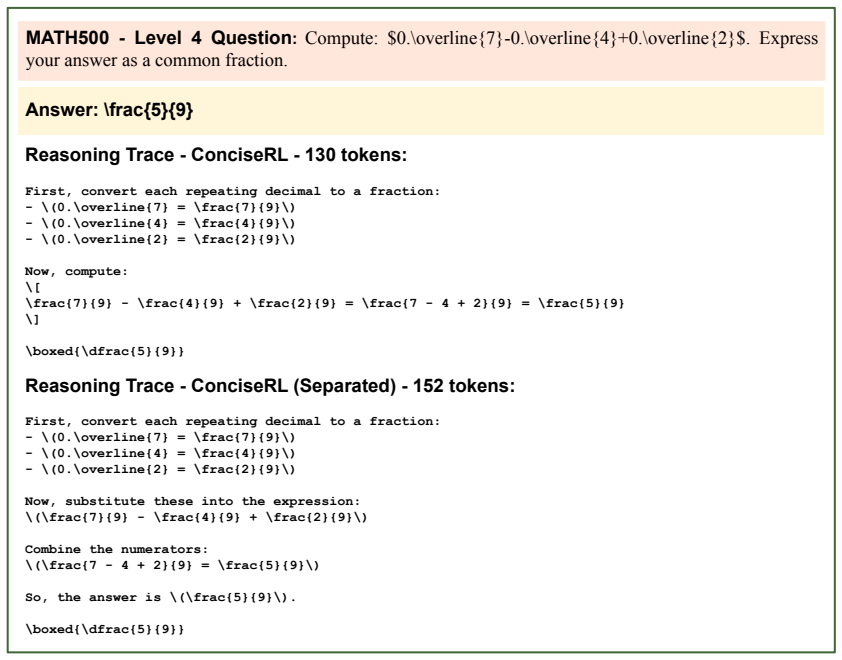
The load-bearing premise is that the LLM judge's 1–10 conciseness score is a valid, non-gameable measure of semantic compactness, distinct from correctness and from token count. If the judge is noisy, biased, or exploitable, the method degrades into a soft length penalty and the claimed advantage over static penalties disappears.
Editorial extensions
If this is right
- If the judged-conciseness signal is trustworthy, reasoning models can be trained to shorten outputs without a hand-set token budget or penalty coefficient.
- Training cost stays low because the accuracy-gated variant queries the judge only on correct traces, and no judge is needed at inference time, so deployment adds no overhead.
- Reasoning length automatically tracks problem difficulty: easy problems get very short traces, hard problems get longer ones, a property the paper shows static length penalties do not exhibit.
- Judge quality is a first-order lever: a stronger judge yields more compression with stable accuracy, while a noisier judge produces little compression, as shown in the ablation across judge models.
- The conciseness reward is orthogonal to explicit token-budget methods, so it can be combined with them rather than competing with their length constraints.
Reading between the lines
- If the reward transfers, judged-conciseness training could extend beyond 1.5B math/reasoning models to larger policies and to domains such as code generation or tool use, but the paper only demonstrates it at small scale.
- A testable scaling prediction follows from the judge ablations: as judges become more reliable, the semantic signal should support both larger token savings and better accuracy, while a judge with a systematic stylistic bias could silently steer the policy toward that style, a risk the paper acknowledges.
- A natural extension is to score equal-length trace pairs with both the judge and human raters; agreement on those pairs would separate semantic conciseness from token-length confounds.
Editorial analysis
A structured set of objections, weighed in public.
Referee Report
Summary. The paper proposes ConciseRL, a reinforcement-learning method that rewards reasoning traces with an LLM-judged conciseness score on a 1-10 scale, rather than with a fixed token-count penalty. The score is combined with answer correctness in two reward variants, referred to as ConciseRL and ConciseRL (Separated), and optimized with PPO on top of DeepSeek-R1-Distill-Qwen-1.5B and STILL-3-1.5B-preview. The authors report large token reductions on MATH500 (up to about 31x on easy problems and about 3.6x on hard problems), small accuracy gains on several benchmarks, and reasoning length that adapts to problem difficulty.
Significance. The practical direction is valuable: if an LLM-judged conciseness reward can compress reasoning traces while preserving or improving accuracy, it would reduce inference cost and improve readability without hand-tuned length penalties. The paper has concrete strengths: it open-sources code, weights, and datasets; it reports external token counts and accuracy in addition to judge scores; and the adaptive-length behavior across MATH500 difficulty levels is a useful result. However, the central semantic claim—that the judge score measures conciseness beyond token count—is not yet validated, and the headline efficiency-accuracy numbers are not attributable to a single method variant as advertised. With additional validation and corrected reporting the contribution would be solid, but in its current form the evidence does not yet support the claims as stated.
major comments (5)
- [Abstract/§1 and §4.5, Table 4] The headline claim that on the hardest problems ConciseRL 'outperforms full reasoning by +7.5% accuracy with up to 3.6x fewer tokens' is not supported by Table 4. At Level 5, ConciseRL (Separated) uses 4431 tokens versus 16157 for Full Reasoning (3.65x fewer) but its accuracy is 47.78 versus 50.00, i.e., a 2.2-point drop. The non-separated ConciseRL variant achieves 57.46 accuracy (a +7.46-point gain over Full Reasoning) but uses 8029 tokens, only 2.0x fewer. The abstract and Section 1 therefore conflate the two variants. A similar pattern appears in the TheoremQA claim in §4.5: the +2.2% and 12.5x figures come from ConciseRL (Separated), whereas the non-separated variant gives +6.2% but only about 4.8x fewer tokens (Table 1). The paper must report each claim with the exact variant that produced it, and should not imply that a single variant achieves both numbers.
- [§3.2, Eqs. (2)-(3)] The reward-variant definitions are internally inconsistent. Item 1 defines the 'Pure conciseness' reward as R_c = C(y), and item 2 defines the 'Accuracy-gated conciseness' reward as R_ac = A(y,x)*C(y). The text then says that ConciseRL uses the accuracy-gated reward and that ConciseRL (Separated) is the 'Pure conciseness reward,' but immediately adds that the Separated variant 'includes both conciseness and accuracy as rewards during training.' These statements cannot both be true under Eqs. (2)-(3). Since the headline 31x and +7% results in §4.5 are reported for ConciseRL (Separated), the exact optimized objective is ambiguous. Please specify for each variant which mathematical reward was used, including how 'separated' is computed if it differs from Eq. (2).
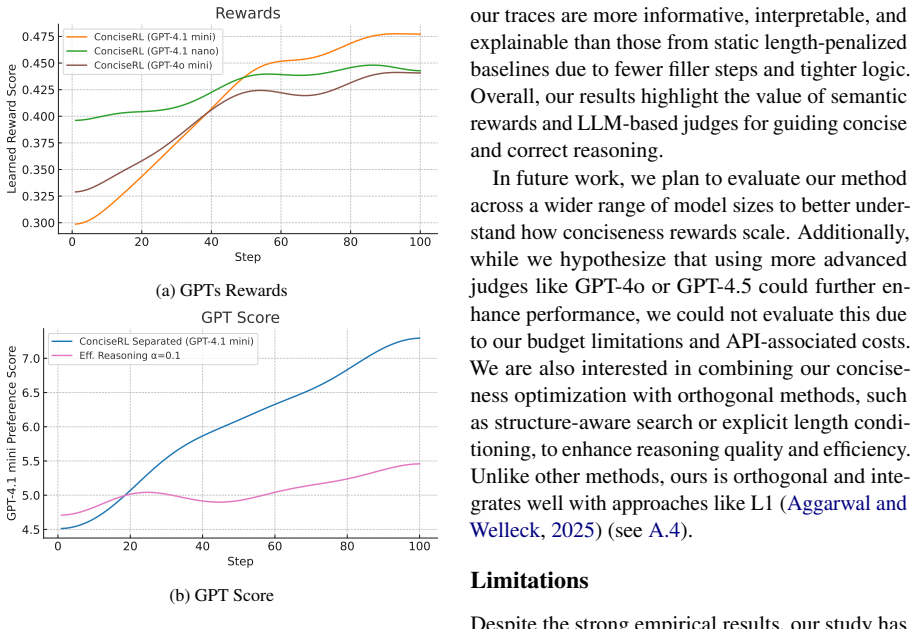
- [§3.1, Figure 4b, Figure 8] The load-bearing premise that C(y) measures semantic conciseness rather than surface brevity is never validated. Figure 4b compares GPT-4.1 mini preference scores for traces from ConciseRL Separated versus Efficient Reasoning alpha=0.1, but GPT-4.1 mini is the same model family used as the training judge, so the comparison is partly circular: the policy is directly optimizing that judge's score. There is no human agreement study, no held-out judge from a different model family, and no analysis of which surface features drive the judge's score. Because the judge prompt in Figure 8 instructs the model to ignore correctness and 'Evaluate ONLY conciseness,' the remaining available signals are largely stylistic; if the policy exploits terse formatting or reduced connectives, the method reduces to a soft length penalty and the claimed advantage over static length penalties disappears. Please add an independent validation of the judge (e.g., human ratings on a sample of traces, a held-out judge, or a controlled equal-token comparison showing that C(y) discriminates traces independently of length).
- [Tables 1-6, §4.5] All reported results appear to come from a single training run per condition, with no error bars, multiple seeds, or significance tests. RL training of 1.5B models is known to be noisy, and several headline differences are small (e.g., TheoremQA +2.2% in §4.5; the average-accuracy differences among judges in Table 3 are a few points). The accuracy-improvement claims are not distinguishable from training noise without variance estimates. For the main claims in Tables 1 and 4, please report means and standard deviations over at least three runs, or otherwise justify why a single run is sufficient for differences of 2-3 accuracy points.
- [Table 2] The rows for 'Eff. Reasoning alpha=0.2' and 'Eff. Reasoning alpha=0.6' in Table 2 are identical across all five benchmarks (e.g., GSM8K 81.3/17.9, MATH500 77.6/44.1, Average 49.7/43.5). This is almost certainly a copy/paste error rather than a genuine experimental result. Because the text uses these rows to argue about hyperparameter sensitivity of Efficient Reasoning on STILL-3-1.5B-preview, the error undermines the cross-model generalization claim. The experiment should be rerun and the correct values reported, or the row should be removed and the discussion adjusted.
minor comments (6)
- [§4.2, Tables 1-2] The 'state-of-the-art' claim is stronger than the baseline set supports; the comparison includes Efficient Reasoning, Cosine Reward, and DeepScaleR but omits several recent length-control methods discussed in Section 2 (e.g., DAST, ThinkPrune, C3oT, L1). Either broaden the comparison or soften the claim.
- [Table 4] Table 4 is difficult to read because values in the PDF are run together (e.g., '95.35118.40'); add clear column separators or use a tabular format with visible delimiters.
- [Figure 8] The caption contains a typo: 'System propmpt' should be 'System prompt'.
- [§4.4] The sentence 'Compared to Efficient Reasoning alpha=0.1, we observe that although it successfully reduces trace length to nearly half (Table 2)' cites Table 2, which reports STILL-3-1.5B-preview results, while the surrounding paragraph discusses DeepSeek-R1-Distill-Qwen-1.5B; the reference appears to point to the wrong table.
- [Throughout] Multiplier notation is inconsistent ('31x' vs '31x' and '3.6x' vs '3.6x' appear in different places); unify the notation.
- [§4.4, Figure 4b] The 'GPT score' in Figure 4b is produced by the same judge model family used for training; the text should explicitly caution that this is not an independent evaluation of conciseness.
Circularity Check
Semantic-conciseness validation is self-referential: the same GPT-4.1 mini judge defines the reward and then supplies the evidence that conciseness improved; the token-accuracy efficiency claims are independent.
-
self definitional
[Section 4.4 (Figure 4b), with reward definition in Section 3.1, Eqs. (2)-(3), and judge prompt in Figure 8.]
"The resulting GPT score, evaluated solely on reasoning quality, improves almost linearly from roughly 4.5 to 7.5 out of 10 over the course of training. ... our method boosts the score from 4.5 to 7.1. This shows that shorter traces are not necessarily more concise, reinforcing our argument that brevity should be a learned outcome of semantic compactness, not a heuristic target."
The 'GPT score' in Figure 4b is exactly C(y), the normalized output of the GPT-4.1 mini judge defined in Section 3.1 (C(y)=s/10) and optimized as the reward in Eqs. (2)-(3). Reporting that this score rises during training is therefore reporting that the policy successfully maximizes its own training signal; it does not independently establish that the traces are semantically concise. The claim that shorter traces are not necessarily concise is intended to distinguish the method from a length penalty, but the only evidence is a score from the same judge used as the reward, so the validation reduces by construction to the reward definition. No human-rater study, held-out judge, or adversarial/reward-hacking analysis of the Figure 8 prompt is provided.
full rationale
Most of the paper's headline results are not circular: the up-to-31x token reduction, the +7% accuracy on easy MATH500 problems, the +7.5% accuracy with 3.6x fewer tokens on Level 5, and the TheoremQA +2.2%/12.5x figures are measured against external MATH500/TheoremQA token counts and exact-answer accuracy, and the baselines (Efficient Reasoning, Cosine Reward, DeepScaleR, Full Reasoning) are public and independently configured. The one genuinely self-referential element is the validation of 'semantic conciseness' as distinct from brevity: Section 3.1 defines conciseness as the LLM judge's score, and Section 4.4/Figure 4b uses the same judge's rising score as evidence of improved conciseness. Since maximizing that score is the training objective, the rise is an optimization-curve check rather than an external validation of the construct. The reward-variant naming in Section 3.2 is internally inconsistent ('Pure conciseness' vs. 'includes both conciseness and accuracy'), which is an ambiguity/correctness risk, not a circular step. There are no load-bearing self-citations or imported uniqueness theorems, and the paper does not rename a known result. Score 4 reflects partial circularity confined to the semantic-conciseness evidence, with independent content carrying the central efficiency-accuracy claims.
Assumptions & free parameters
assumptions (5)
- domain assumption The LLM judge's 1-10 conciseness score is a reliable, context-aware measure of semantic compactness.
- domain assumption Exact-match answer extraction correctly identifies correctness.
- domain assumption MATH500 difficulty levels reflect problem difficulty in a way comparable across methods.
- standard math The leave-one-out advantage gives unbiased policy-gradient estimates.
- domain assumption PPO clipping, KL penalty, and training hyperparameters from Efficient Reasoning transfer to the conciseness reward.
invented entities (1)
-
LLM-judge conciseness score C(y) = s/10
Cite this review
Pith. "Pith review of ConciseRL: Conciseness-Guided Reinforcement Learning for Efficient Reasoning Models." pith.science (2026). https://pith.science/paper/63AXR473
@misc{pith2026250517250,
  author       = {Pith},
  title        = {Pith review of: ConciseRL: Conciseness-Guided Reinforcement Learning for Efficient Reasoning Models},
  year         = {2026},
  howpublished = {\url{https://pith.science/paper/63AXR473}},
  note         = {Machine review of arXiv:2505.17250}
}
read the original abstract
Large language models excel at complex tasks by breaking down problems into structured reasoning steps. However, reasoning traces often extend beyond reaching a correct answer, causing wasted computation, reduced readability, and hallucinations. To address this, we introduce a novel hyperparameter-free conciseness score used as a reward signal within a reinforcement learning framework to guide models toward generating correct and concise reasoning traces. This score is evaluated by a large language model acting as a judge, enabling dynamic, context-aware feedback beyond simple token length. Our method achieves state-of-the-art efficiency-accuracy trade-offs on the MATH dataset, reducing token usage by up to 31x on simple problems while improving accuracy by 7%, and on the hardest problems, it outperforms full reasoning by +7.5% accuracy with up to 3.6x fewer tokens. On TheoremQA, our method improves accuracy by +2.2% using 12.5x fewer tokens. We also conduct ablation studies on the judge model, reward composition, and problem difficulty, showing that our method dynamically adapts reasoning length based on problem difficulty and benefits significantly from stronger judges. The code, model weights, and datasets are open-sourced at https://github.com/RazvanDu/ConciseRL.
Figures


Figures from the paper (15 more)




Forward citations
Cited by 3 Pith papers
-
Contrastive On-Policy Distillation
Contrasting a teacher's token scores under light- and heavy-thinking prompts yields a training signal that cuts reasoning length roughly in half without hurting accuracy.
-
Learning to Reason Efficiently with Discounted Reinforcement Learning
Discounted correctness rewards in GRPO post-training shorten LLM reasoning traces by roughly 13-40% while matching pass@1 accuracy, supported by Blackwell-optimality analysis for restricted policy classes.
-
Towards Concise and Adaptive Thinking in Large Reasoning Models: A Survey
A comprehensive review that categorizes methods for shortening and adaptively triggering chain-of-thought reasoning in large language models.
Reference graph
Works this paper leans on
-
[2]
\( g \) is a multiple of 13
-
[3]
Renlong Jie, Xiaojun Meng, Lifeng Shang, Xin Jiang, and Qun Liu
Thinkprune: Pruning long chain-of-thought of llms via reinforcement learning.Preprint, arXiv:2504.01296. Renlong Jie, Xiaojun Meng, Lifeng Shang, Xin Jiang, and Qun Liu. 2023. Prompt-based length controlled generation with reinforcement learning.Preprint, arXiv:2308.12030. Yu Kang, Xianghui Sun, Liangyu Chen, and Wei Zou
arXiv 2023
-
[4]
C3ot: Generating shorter chain-of-thought without compromising effectiveness.Proceedings of the AAAI Conference on Artificial Intelligence, 39(23):24312–24320. Woosuk Kwon, Zhuohan Li, Siyuan Zhuang, Ying Sheng, Lianmin Zheng, Cody Hao Yu, Joseph Gon- zalez, Hao Zhang, and Ion Stoica. 2023. Efficient memory management for large language model serv- ing wi...
arXiv 2023
-
[6]
arXiv preprint arXiv:2412.09413
Imitate, explore, and self-improve: A repro- duction report on slow-thinking reasoning systems. arXiv preprint arXiv:2412.09413. Niklas Muennighoff, Zitong Yang, Weijia Shi, Xi- ang Lisa Li, Li Fei-Fei, Hannaneh Hajishirzi, Luke Zettlemoyer, Percy Liang, Emmanuel Candès, and Tatsunori Hashimoto. 2025. s1: Simple test-time scaling.Preprint, arXiv:2501.1939...
arXiv 2025
-
[9]
\( g > b \). Since \( g \) is a multiple of 13 and \( g \leq 35 \), possible values for \( g \) are 13, 26, or 39 (but 39 exceeds 35, so only 13 and 26). Check \( g = 26 \): - Then \( b = 35 - 26 = 9 \). - \( g > b \) since 26 > 9. This works. Check \( g = 13 \): - Then \( b = 35 - 13 = 22 \). - \( g > b \) since 13 < 22. This does not work. Thus, the onl...
work page 2021
-
[10]
\( G \) is a multiple of 13, so \( G = 13k \) where \( k \) is an integer
-
[11]
Check \( G > B \): 26 > 9, which is true
\( G > B \) Substituting \( G = 13k \) into the first equation: \( 13k + B = 35 \) \( B = 35 - 13k \) Since \( G > B \): \( 13k > 35 - 13k \) \( 26k > 35 \) \( k > \frac{35}{26} \) \( k \geq 2 \) Testing \( k = 2 \): \( G = 26 \), \( B = 9 \). Check \( G > B \): 26 > 9, which is true. Thus, the number of boys is \( \boxed{9} \). Reasoning Trace - Cosine R...
-
[12]
Number of girls is a multiple of 13
Show all 19 references
-
[13]
[...] The number of boys at the meeting is \boxed{9}
Number of girls is more than the number of boys. [...] The number of boys at the meeting is \boxed{9}. Reasoning Trace - Full Reasoning - 1689 tokens: Okay, so I have this problem here: There are 35 students at a math club meeting. The number of girls is a multiple of 13, and ...
2021
-
[14]
ConciseRL
outputs are considerably longer, so traces are partially truncated with[...] due to space. The full reasoning traces are available at https://github.com/RazvanDu/ConciseRL. MATH500 - Level 2 Question: What is the smallest positive integer $n$ such that all the roots of $z^4 + ...
2021
-
[15]
ConciseRL
and Full Reasoning (DeepSeek-AI et al., 2025) outputs are considerably longer, so traces are partially truncated with[...]due to space. The full reasoning traces are available at https://github.com/RazvanDu/ConciseRL. MATH500 - Level 3 Question: Six witches and ten sorcerers a...
2025
-
[16]
ConciseRL
and Full Reasoning (DeepSeek-AI et al., 2025) outputs are considerably longer, so traces are partially truncated with[...]due to space. The full reasoning traces are available at https://github.com/RazvanDu/ConciseRL. MATH500 - Level 4 Question: Compute: $0.\overline{7}-0.\ove...
2025
-
[17]
Thus, the result of the computation is \(\boxed{\dfrac{5}{9}}\)
Verify by converting back to a decimal and performing the operations, which also results in \(0.\overline{5} = \frac{5}{9}\). Thus, the result of the computation is \(\boxed{\dfrac{5}{9}}\). Reasoning Trace - Full Reasoning - 1673 tokens: Okay, so I need to compute 0.\overline...
2021
-
[18]
ConciseRL
and Full Reasoning (DeepSeek-AI et al., 2025) outputs are considerably longer, so traces are partially truncated with[...]due to space. The full reasoning traces are available at https://github.com/RazvanDu/ConciseRL. MATH500 - Level 5 Question: Sam is carrying a 2 gallon buck...
2025
-
[19]
The full reasoning traces are available at https://github.com/RazvanDu/ConciseRL
and Full Reasoning (DeepSeek-AI et al., 2025) outputs are considerably longer, so traces are partially truncated with[...]due to space. The full reasoning traces are available at https://github.com/RazvanDu/ConciseRL
2025
-
[2021]
DeepSeek-AI, Daya Guo, Dejian Yang, Haowei Zhang, Junxiao Song, Ruoyu Zhang, Runxin Xu, Qihao Zhu, Shirong Ma, Peiyi Wang, Xiao Bi, Xiaokang Zhang, Xingkai Yu, Yu Wu, Z
Training verifiers to solve math word prob- lems.Preprint, arXiv:2110.14168. DeepSeek-AI, Daya Guo, Dejian Yang, Haowei Zhang, Junxiao Song, Ruoyu Zhang, Runxin Xu, Qihao Zhu, Shirong Ma, Peiyi Wang, Xiao Bi, Xiaokang Zhang, Xingkai Yu, Yu Wu, Z. F. Wu, Zhibin Gou, Zhi- hong S...
-
[2023]
roots of unity
Tree of thoughts: Deliberate problem solving with large language models. InAdvances in Neural Information Processing Systems, volume 36, pages 11809–11822. Curran Associates, Inc. Edward Yeo, Yuxuan Tong, Morry Niu, Graham Neubig, and Xiang Yue. 2025. Demystifying long chain-o...
2025 arXiv
-
[2024]
[https://huggingface
Numinamath. [https://huggingface. co/AI-MO/NuminaMath-CoT](https: //github.com/project-numina/ aimo-progress-prize/blob/main/ report/numina_dataset.pdf). Haotian Luo, Li Shen, Haiying He, Yibo Wang, Shi- wei Liu, Wei Li, Naiqiang Tan, Xiaochun Cao, and Dacheng Tao. 2025a. O1-p...
2024 arXiv
-
[2025]
Mehdi Fatemi, Banafsheh Rafiee, Mingjie Tang, and Kartik Talamadupula
Deepseek-r1: Incentivizing reasoning capa- bility in llms via reinforcement learning.Preprint, arXiv:2501.12948. Mehdi Fatemi, Banafsheh Rafiee, Mingjie Tang, and Kartik Talamadupula. 2025. Concise reasoning via reinforcement learning.Preprint, arXiv:2504.05185. Jiawei Gu, Xuh...
2025 arXiv
Reviewed August 7, 2026 · model on record in the stance chip above.
Discussion (0). Sign in to comment.