Empirical colour--effective temperature relations in the SDSS system from IRFM temperatures of GALAH and APOGEE stars
Pith reviewed 2026-06-27 08:44 UTC · model grok-4.3
The pith
Empirical relations connect SDSS and 2MASS colors to effective temperature at 30-50 K precision on an IRFM scale from GALAH and APOGEE stars.
A machine-rendered reading of the paper's core claim, the machinery that carries it, and where it could break.
Core claim
The central claim is that empirical colour-Teff relations derived from SDSS and 2MASS photometry on an IRFM reference scale from GALAH and APOGEE stars deliver a homogeneous framework for temperature estimates, with performance that varies by colour index and reaches 30-50 K internal precision for the best long-baseline colours.
What carries the argument
Low-order polynomial models fitted with iterative 3-sigma clipping to the combined GALAH-APOGEE sample of dereddened colour indices versus IRFM Teff, applied separately for dwarfs, giants, and with or without metallicity terms.
Load-bearing premise
The IRFM effective temperatures derived for the GALAH and APOGEE stars form a homogeneous and sufficiently accurate reference scale against which the colour relations are calibrated.
What would settle it
A set of stars with independent Teff measurements from spectroscopy or asteroseismology, SDSS and 2MASS photometry, and no known zero-point issues that systematically deviate from the fitted relations by more than 50 K would falsify the claimed internal precision.
Figures
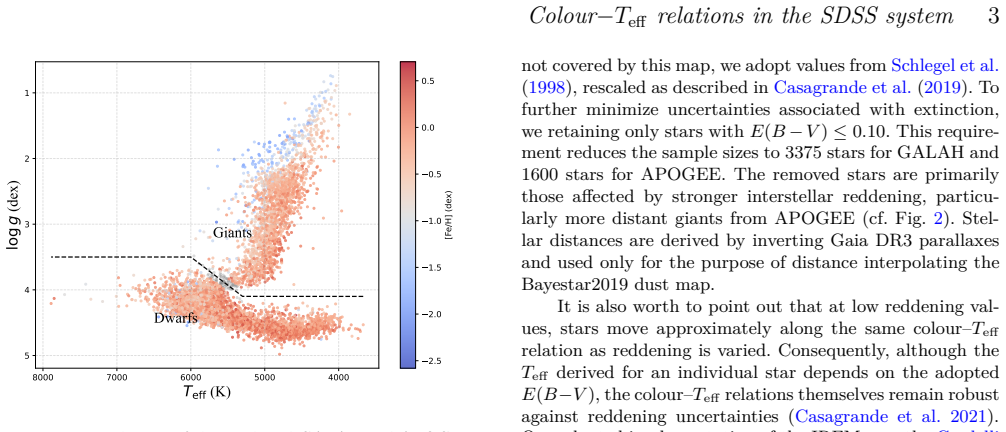
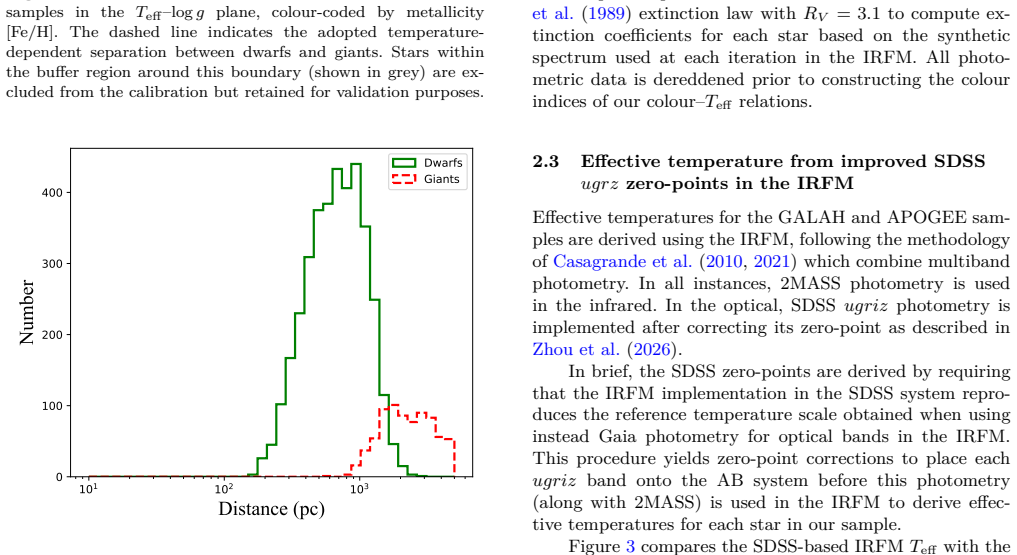
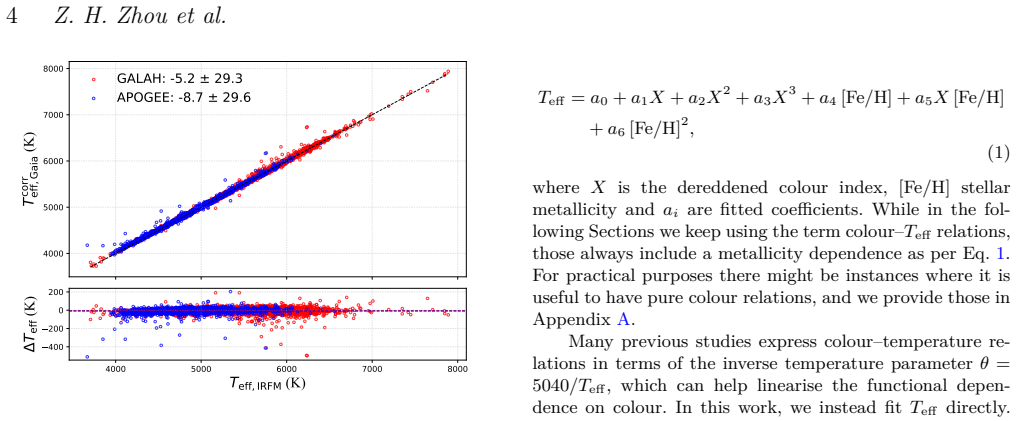
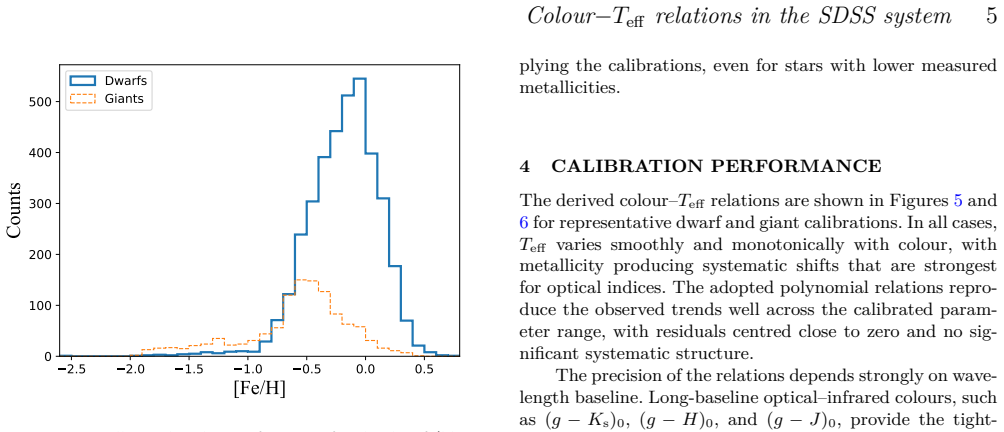
read the original abstract
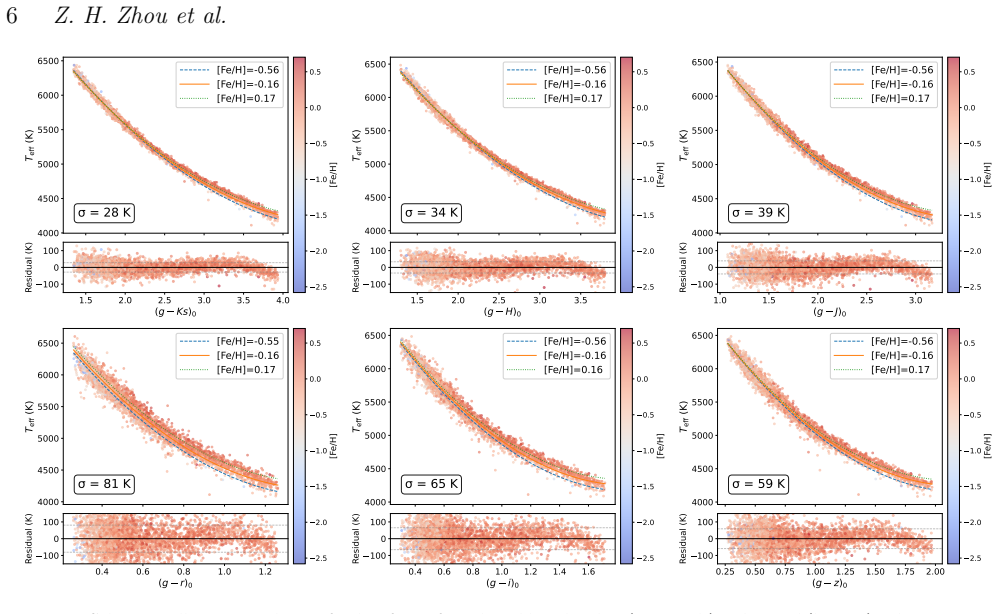
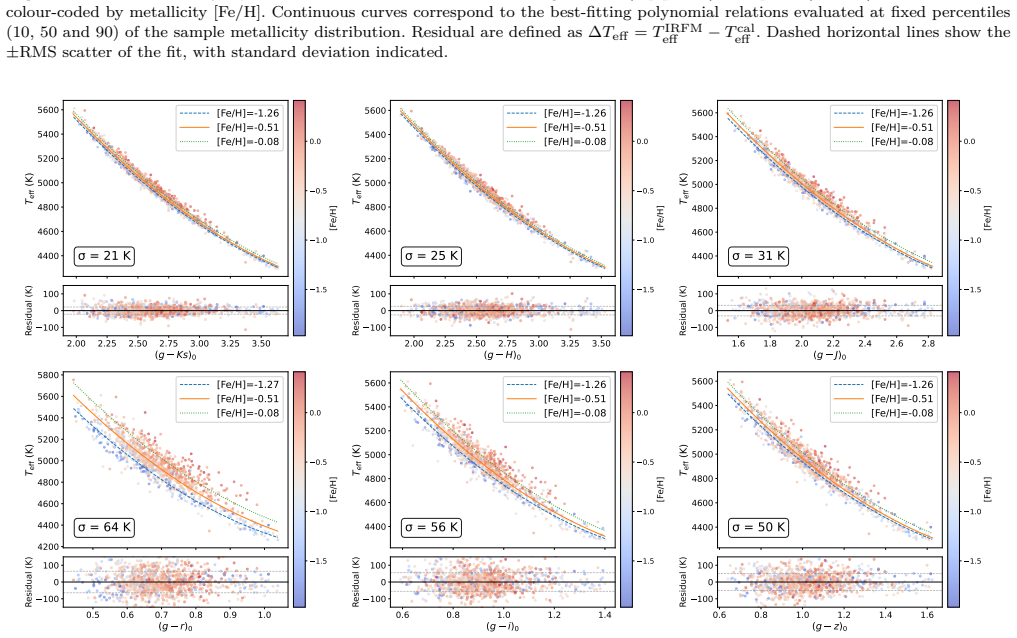
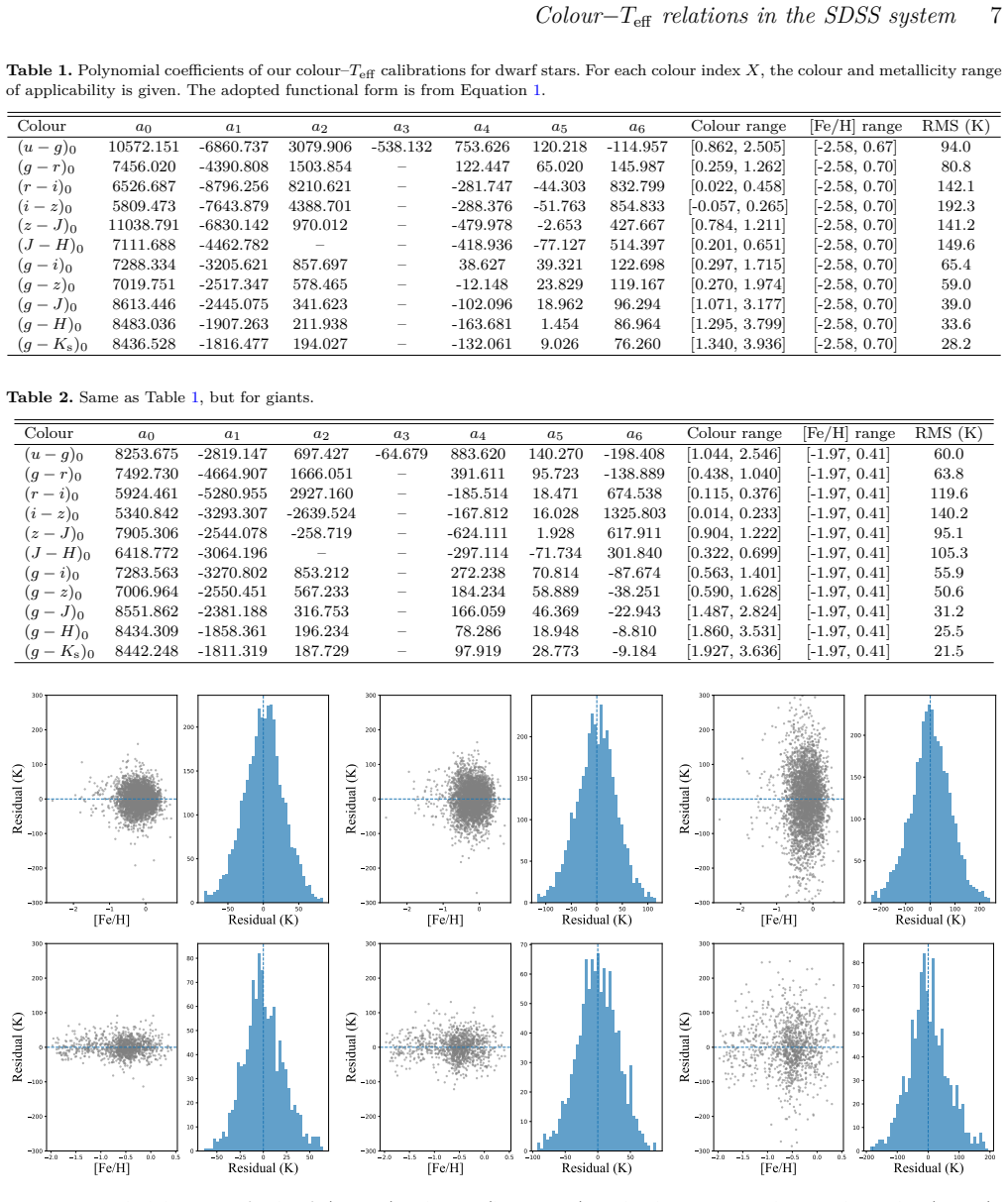
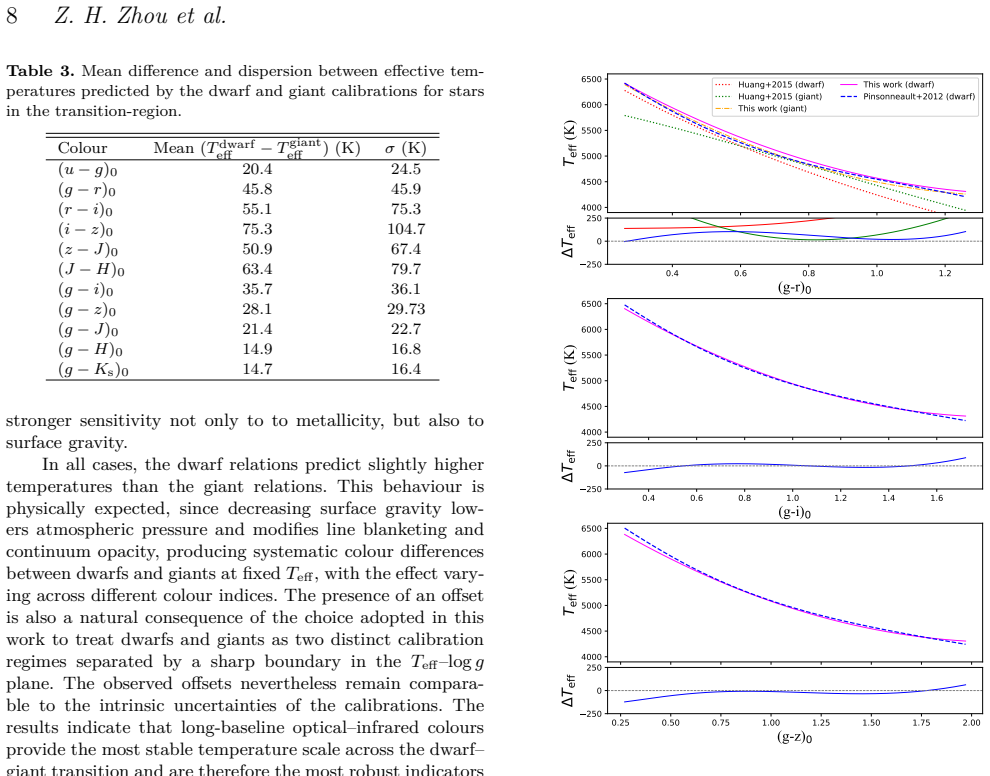
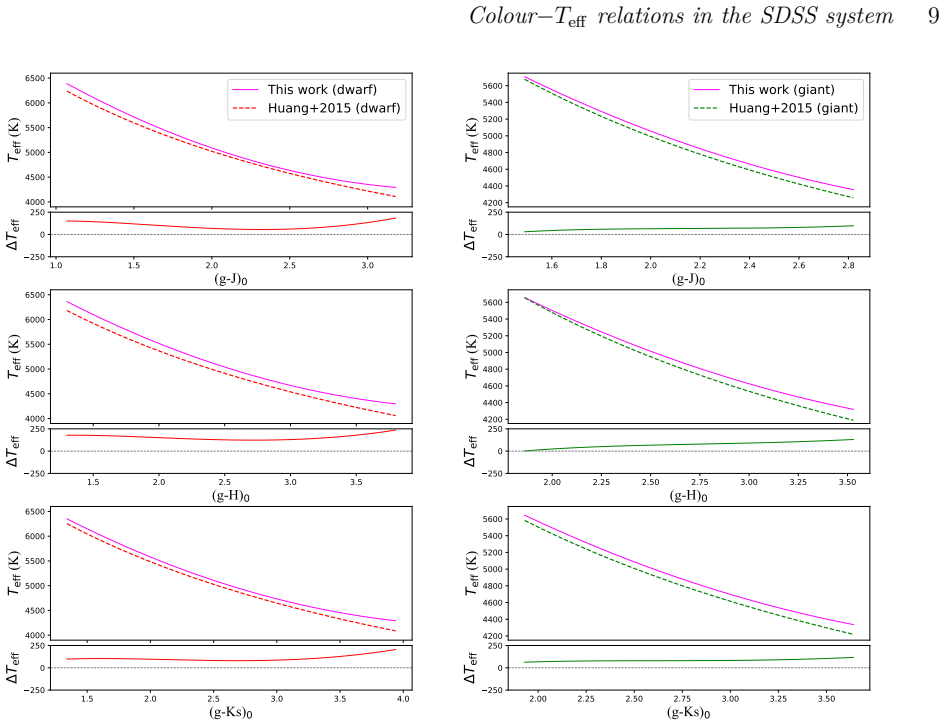
Reliable estimates of stellar effective temperature ($T_{\mathrm {eff}}$) are fundamental to stellar population studies and Galactic astrophysics. However, the majority of stars observed in modern large-scale photometric surveys lack spectroscopic measurements, making empirical colour--$T_{\mathrm {eff}}$ relations essential tools. In this work, we present updated empirical colour--$T_{\mathrm {eff}}$ calibrations based on Sloan Digital Sky Survey (SDSS) $ugriz$ photometry combined with 2MASS $JHK_{\mathrm s}$ data. Effective temperatures are determined on a homogeneous InfraRed Flux Method (IRFM) scale using a combined sample of 3902 GALAH and 2535 APOGEE stars with high-quality photometry and well-characterised atmospheric parameters. Using this dataset, we establish empirical relations between $T_{\mathrm {eff}}$ and colour indices constructed from SDSS and 2MASS combinations. We provide both colour--metallicity--$T_{\mathrm {eff}}$ and colour--$T_{\mathrm {eff}}$ relations for dwarfs and giants. The calibrations are derived using low-order polynomial models with iterative $3\sigma$ clipping. Their performance depends on the adopted colour index, with long-baseline colours such as $(g-K_{\mathrm s})_0$ and $(g-z)_0$ achieving internal precisions of $\sim$30--50~K. Comparisons with previous calibrations show general agreement, with differences attributable to sample selection, photometric zero-points, and functional form. The resulting relations provide a homogeneous and internally consistent framework for estimating $T_{\mathrm {eff}}$ from SDSS and 2MASS photometry alone, and are well suited for application to large photometric surveys lacking spectroscopic information.
Editorial analysis
A structured set of objections, weighed in public.
Referee Report
Summary. The manuscript derives empirical colour-Teff relations in the SDSS ugriz + 2MASS JHKs system by fitting low-order polynomials (with iterative 3σ clipping) to a combined sample of 3902 GALAH and 2535 APOGEE stars whose effective temperatures were placed on a homogeneous IRFM scale. Separate relations are provided for dwarfs and giants, both with and without explicit metallicity dependence; the authors report internal precisions of ~30-50 K for long-baseline colours such as (g-Ks)0 and (g-z)0, compare the new fits to earlier calibrations, and conclude that the relations supply a homogeneous framework for Teff estimation from photometry alone.
Significance. If the reference IRFM temperatures are shown to be internally consistent across the two surveys, the work supplies updated, survey-ready colour-Teff calibrations that could be directly applied to large photometric catalogues lacking spectroscopy. The approach follows standard empirical methods and the reported precisions are competitive with prior work, but the practical utility hinges on the homogeneity of the anchor scale.
major comments (1)
- [Abstract] Abstract: the central claim that the relations provide an 'internally consistent framework' rests on the assertion that the IRFM Teff values for the GALAH and APOGEE subsamples form a single homogeneous scale. No quantitative test for zero-point offsets (e.g., via overlapping stars, survey-specific photometric zero-points, or reddening assumptions) is described; any residual offset would shift the zero-points of every fitted polynomial and undermine the claimed internal consistency.
minor comments (1)
- [Abstract] The abstract does not state the Teff, log g, or [Fe/H] ranges spanned by the final sample; this information is needed to judge the domain of applicability.
Simulated Author's Rebuttal
We thank the referee for their thorough review and valuable comments on our manuscript. We address the major comment point by point below.
read point-by-point responses
-
Referee: [Abstract] Abstract: the central claim that the relations provide an 'internally consistent framework' rests on the assertion that the IRFM Teff values for the GALAH and APOGEE subsamples form a single homogeneous scale. No quantitative test for zero-point offsets (e.g., via overlapping stars, survey-specific photometric zero-points, or reddening assumptions) is described; any residual offset would shift the zero-points of every fitted polynomial and undermine the claimed internal consistency.
Authors: The referee correctly identifies that the manuscript does not include an explicit quantitative test for zero-point offsets between the GALAH and APOGEE samples. Although both sets of IRFM temperatures were derived using the same underlying method and calibrated to a common scale (as detailed in Section 2), we agree that demonstrating the absence of systematic offsets would strengthen the claim of homogeneity. We will revise the manuscript to include such a test, for example by identifying any stars in common between the two surveys and comparing their Teff values, as well as examining potential differences arising from photometric zero-points or reddening corrections. This addition will be incorporated in a revised version of the paper. revision: yes
Circularity Check
No circularity: direct empirical polynomial fits to external IRFM Teff scale
full rationale
The derivation consists of fitting low-order polynomials (with 3σ clipping) to Teff values obtained via the IRFM on independent GALAH and APOGEE spectroscopic samples, then presenting the resulting colour-Teff relations. No step reduces by the paper's own equations to a quantity defined in terms of the fitted coefficients; the relations are the output of the fit, not an input. No self-citation is invoked to justify uniqueness or to smuggle an ansatz, and the central claim of providing photometric Teff estimators does not collapse to a self-referential loop. The input Teff scale is treated as given external data.
Axiom & Free-Parameter Ledger
free parameters (1)
- polynomial coefficients for each color-Teff relation
axioms (2)
- domain assumption IRFM temperatures from GALAH and APOGEE form a homogeneous reference scale
- domain assumption Reddening corrections and photometric zero-points are accurate for the selected stars
Reference graph
Works this paper leans on
-
[1]
Towards stellar effective temperatures and diameters at one per cent accuracy for future surveys
Towards stellar effective temperatures and diameters at 1 per cent accuracy for future surveys. , keywords =. doi:10.1093/mnras/stu089 , archivePrefix =. 1401.3754 , primaryClass =
work page internal anchor Pith review Pith/arXiv arXiv doi:10.1093/mnras/stu089
-
[2]
, keywords =
Recalibration of SDSS photometric zero-points based on the InfraRed Flux Method temperature scale. , keywords =. doi:, archivePrefix =. , primaryClass =
-
[3]
Photometric content and validation
Gaia Early Data Release 3. Photometric content and validation. , keywords =. doi:10.1051/0004-6361/202039587 , archivePrefix =. 2012.01916 , primaryClass =
-
[4]
A Comparison of Stellar Elemental Abundance Techniques and Measurements
A Comparison of Stellar Elemental Abundance Techniques and Measurements. , keywords =. doi:10.3847/0067-0049/226/1/4 , archivePrefix =. 1607.03130 , primaryClass =
work page internal anchor Pith review Pith/arXiv arXiv doi:10.3847/0067-0049/226/1/4
-
[5]
Gaia-ESO Survey: The analysis of high-resolution UVES spectra of FGK-type stars
The Gaia-ESO Survey: The analysis of high-resolution UVES spectra of FGK-type stars. , keywords =. doi:10.1051/0004-6361/201423937 , archivePrefix =. 1409.0568 , primaryClass =
work page internal anchor Pith review Pith/arXiv arXiv doi:10.1051/0004-6361/201423937
-
[6]
Gaia FGK Benchmark Stars - Metallicity
Gaia FGK benchmark stars: Metallicity. , keywords =. doi:10.1051/0004-6361/201322440 , archivePrefix =. 1309.1099 , primaryClass =
work page internal anchor Pith review Pith/arXiv arXiv doi:10.1051/0004-6361/201322440
-
[7]
Exploring the Milky Way stellar disk. A detailed elemental abundance study of 714 F and G dwarf stars in the solar neighbourhood. , keywords =. doi:10.1051/0004-6361/201322631 , archivePrefix =. 1309.2631 , primaryClass =
work page internal anchor Pith review Pith/arXiv arXiv doi:10.1051/0004-6361/201322631
-
[8]
Spectroscopic parameters for 451 stars in the HARPS GTO planet search program. Stellar [Fe/H] and the frequency of exo-Neptunes. , keywords =. doi:10.1051/0004-6361:200809698 , archivePrefix =. 0805.4826 , primaryClass =
work page internal anchor Pith review Pith/arXiv arXiv doi:10.1051/0004-6361:200809698
-
[9]
Spectroscopic Properties of Cool Stars (SPOCS). I. 1040 F, G, and K Dwarfs from Keck, Lick, and AAT Planet Search Programs. , keywords =. doi:10.1086/430500 , adsurl =
-
[10]
Maps of Dust IR Emission for Use in Estimation of Reddening and CMBR Foregrounds
Maps of Dust Infrared Emission for Use in Estimation of Reddening and Cosmic Microwave Background Radiation Foregrounds. , keywords =. doi:10.1086/305772 , archivePrefix =. astro-ph/9710327 , primaryClass =
work page internal anchor Pith review Pith/arXiv arXiv doi:10.1086/305772
-
[11]
The Second Data Release of the Sloan Digital Sky Survey
The Second Data Release of the Sloan Digital Sky Survey. , keywords =. doi:10.1086/421365 , archivePrefix =. astro-ph/0403325 , primaryClass =
work page internal anchor Pith review Pith/arXiv arXiv doi:10.1086/421365
-
[12]
, year = 1966, month = jan, volume =
Astronomical Measurements in the Infrared. , year = 1966, month = jan, volume =. doi:10.1146/annurev.aa.04.090166.001205 , adsurl =
-
[13]
UBVRI photometry II: the Cousins VRI system, its temperature and absolute flux calibration, and relevance for two-dimensional photometry. , keywords =. doi:10.1086/130542 , adsurl =
-
[14]
Application to Arcturus and other stars; with effective temperatures
Stellar angular diameters from infrared photometry. Application to Arcturus and other stars; with effective temperatures. , keywords =. doi:10.1093/mnras/180.2.177 , adsurl =
-
[15]
, keywords =
Determination of temperatures and angular diameters of 114 F-M stars using the infrared flux method (IRFM). , keywords =
-
[16]
The infrared flux method for determining stellar angular diameters and effective temperatures. , keywords =. doi:10.1093/mnras/188.4.847 , adsurl =
-
[17]
, keywords =
Use of the infra-red flux method for determining stellar effective temperatures and angular diameters; the stellar temperature scale. , keywords =
-
[18]
, keywords =
The empirical scale of temperatures of the low main sequence (F0V-K5V). , keywords =
-
[19]
The effective temperature scale of giant stars (F0-K5). II. Empirical calibration of T _ eff versus colours and [Fe/H]. , keywords =. doi:10.1051/aas:1999521 , adsurl =
-
[20]
Transformations from Theoretical Hertzsprung-Russell Diagrams to Color-Magnitude Diagrams: Effective Temperatures, B-V Colors, and Bolometric Corrections. , keywords =. doi:10.1086/177785 , adsurl =
-
[21]
A Study of the B-V Colour Temperature Relation
A Study of the B-V Color-Temperature Relation. , keywords =. doi:10.1086/301490 , archivePrefix =. astro-ph/9904299 , primaryClass =
work page internal anchor Pith review Pith/arXiv arXiv doi:10.1086/301490
-
[22]
Empirical metallicity-dependent calibrations of effective temperature against colours for dwarfs and giants based on interferometric data. , keywords =. doi:10.1093/mnras/stv1991 , archivePrefix =. 1508.06080 , primaryClass =
work page internal anchor Pith review Pith/arXiv arXiv doi:10.1093/mnras/stv1991
-
[23]
Research Notes of the American Astronomical Society , keywords =
Gaia DR2 Color-Temperature Relations Based on Infrared Flux Method Results. Research Notes of the American Astronomical Society , keywords =. doi:10.3847/2515-5172/ab8820 , archivePrefix =. 2004.06140 , primaryClass =
-
[24]
Exploiting the Gaia EDR3 photometry to derive stellar temperatures. , keywords =. doi:10.1051/0004-6361/202140979 , archivePrefix =. 2106.03882 , primaryClass =
-
[25]
Gaia Data Release 2. Summary of the contents and survey properties
Gaia Data Release 2. Summary of the contents and survey properties. , keywords =. doi:10.1051/0004-6361/201833051 , archivePrefix =. 1804.09365 , primaryClass =
work page internal anchor Pith review Pith/arXiv arXiv doi:10.1051/0004-6361/201833051
-
[26]
The 2.5 m Telescope of the Sloan Digital Sky Survey
The 2.5 m Telescope of the Sloan Digital Sky Survey. , keywords =. doi:10.1086/500975 , archivePrefix =. astro-ph/0602326 , primaryClass =
work page internal anchor Pith review Pith/arXiv arXiv doi:10.1086/500975
-
[27]
The Milky Way Tomography with SDSS. II. Stellar Metallicity. , keywords =. doi:10.1086/589678 , archivePrefix =. 0804.3850 , primaryClass =
work page internal anchor Pith review Pith/arXiv arXiv doi:10.1086/589678
-
[28]
A Revised Effective Temperature Scale for the Kepler Input Catalog
A Revised Effective Temperature Scale for the Kepler Input Catalog. , keywords =. doi:10.1088/0067-0049/199/2/30 , archivePrefix =. 1110.4456 , primaryClass =
work page internal anchor Pith review Pith/arXiv arXiv doi:10.1088/0067-0049/199/2/30
-
[29]
The GALAH+ survey: Third data release. , keywords =. doi:10.1093/mnras/stab1242 , archivePrefix =. 2011.02505 , primaryClass =
-
[30]
VizieR Online Data Catalog: 2MASS All-Sky Catalog of Point Sources (Cutri+ 2003)
2003
-
[31]
The Apache Point Observatory Galactic Evolution Experiment (APOGEE)
The Apache Point Observatory Galactic Evolution Experiment (APOGEE). , keywords =. doi:10.3847/1538-3881/aa784d , archivePrefix =. 1509.05420 , primaryClass =
work page internal anchor Pith review Pith/arXiv arXiv doi:10.3847/1538-3881/aa784d
-
[32]
The Seventeenth Data Release of the Sloan Digital Sky Surveys: Complete Release of MaNGA, MaStar, and APOGEE-2 Data. , keywords =. doi:10.3847/1538-4365/ac4414 , archivePrefix =. 2112.02026 , primaryClass =
-
[33]
The GALAH survey: effective temperature calibration from the InfraRed Flux Method in the Gaia system. , keywords =. doi:10.1093/mnras/stab2304 , archivePrefix =. 2011.02517 , primaryClass =
-
[34]
The Effective Temperature Scale of FGK Stars. II. T _ eff :Color:[Fe/H] Calibrations. , keywords =. doi:10.1086/430102 , archivePrefix =. astro-ph/0503110 , primaryClass =
work page internal anchor Pith review Pith/arXiv arXiv doi:10.1086/430102
-
[35]
A new implementation of the infrared flux method using the 2MASS catalogue
A new implementation of the infrared flux method using the 2MASS catalogue. , keywords =. doi:10.1051/0004-6361/200810904 , archivePrefix =. 0901.3034 , primaryClass =
work page internal anchor Pith review Pith/arXiv arXiv doi:10.1051/0004-6361/200810904
-
[36]
An absolutely calibrated effective temperature scale from the InfraRed Flux Method
An absolutely calibrated T _ eff scale from the infrared flux method. Dwarfs and subgiants. , keywords =. doi:10.1051/0004-6361/200913204 , archivePrefix =. 1001.3142 , primaryClass =
work page internal anchor Pith review Pith/arXiv arXiv doi:10.1051/0004-6361/200913204
-
[37]
Stellar Loci. I. Metallicity Dependence and Intrinsic Widths. , keywords =. doi:10.1088/0004-637X/799/2/134 , archivePrefix =. 1412.1232 , primaryClass =
work page internal anchor Pith review Pith/arXiv arXiv doi:10.1088/0004-637x/799/2/134
-
[38]
The Sloan Digital Sky Survey Photometric System. , keywords =. doi:10.1086/117915 , adsurl =
-
[39]
Photometric Response Functions of the SDSS Imager
Photometric Response Functions of the Sloan Digital Sky Survey Imager. , keywords =. doi:10.1088/0004-6256/139/4/1628 , archivePrefix =. 1002.3701 , primaryClass =
work page internal anchor Pith review Pith/arXiv arXiv doi:10.1088/0004-6256/139/4/1628
-
[40]
SkyMapper stellar parameters for Galactic Archaeology on a grand-scale
SkyMapper stellar parameters for Galactic Archaeology on a grand-scale. , keywords =. doi:10.1093/mnras/sty2878 , archivePrefix =. 1810.09581 , primaryClass =
work page internal anchor Pith review Pith/arXiv arXiv doi:10.1093/mnras/sty2878
-
[41]
The Sloan Digital Sky Survey: Technical Summary
The Sloan Digital Sky Survey: Technical Summary. , keywords =. doi:10.1086/301513 , archivePrefix =. astro-ph/0006396 , primaryClass =
work page internal anchor Pith review Pith/arXiv arXiv doi:10.1086/301513
-
[42]
A Modified Magnitude System that Produces Well-Behaved Magnitudes, Colors, and Errors Even for Low Signal-to-Noise Ratio Measurements. , keywords =. doi:10.1086/301004 , archivePrefix =. astro-ph/9903081 , primaryClass =
work page internal anchor Pith review Pith/arXiv arXiv doi:10.1086/301004
-
[43]
Astronomical Data Analysis Software and Systems XIV , year = 2005, editor =
TOPCAT & STIL: Starlink Table/VOTable Processing Software. Astronomical Data Analysis Software and Systems XIV , year = 2005, editor =
2005
-
[44]
Blackbody Stars. , keywords =. doi:10.3847/1538-3881/aac88b , archivePrefix =. 1711.01122 , primaryClass =
work page internal anchor Pith review Pith/arXiv arXiv doi:10.3847/1538-3881/aac88b
-
[45]
Secondary standard stars for absolute spectrophotometry. , keywords =. doi:10.1086/160817 , adsurl =
-
[46]
, year = 2005, month = sep, volume =
Standard Photometric Systems. , year = 2005, month = sep, volume =. doi:10.1146/annurev.astro.41.082801.100251 , adsurl =
-
[47]
The 13th Data Release of the Sloan Digital Sky Survey: First Spectroscopic Data from the SDSS-IV Survey Mapping Nearby Galaxies at Apache Point Observatory. , keywords =. doi:10.3847/1538-4365/aa8992 , archivePrefix =. 1608.02013 , primaryClass =
work page internal anchor Pith review Pith/arXiv arXiv doi:10.3847/1538-4365/aa8992
-
[48]
, keywords =
Model atmospheres for Vega. , keywords =
-
[49]
SDSS-III: Massive Spectroscopic Surveys of the Distant Universe, the Milky Way, and Extra-Solar Planetary Systems. , keywords =. doi:10.1088/0004-6256/142/3/72 , archivePrefix =. 1101.1529 , primaryClass =
work page internal anchor Pith review Pith/arXiv arXiv doi:10.1088/0004-6256/142/3/72
-
[50]
New Grids of ATLAS9 Model Atmospheres
New Grids of ATLAS9 Model Atmospheres. Modelling of Stellar Atmospheres , year = 2003, editor =. doi:10.48550/arXiv.astro-ph/0405087 , archivePrefix =. astro-ph/0405087 , primaryClass =
work page internal anchor Pith review Pith/arXiv arXiv doi:10.48550/arxiv.astro-ph/0405087 2003
-
[51]
Synthetic stellar photometry - I. General considerations and new transformations for broad-band systems. , keywords =. doi:10.1093/mnras/stu1476 , archivePrefix =. 1407.6095 , primaryClass =
work page internal anchor Pith review Pith/arXiv arXiv doi:10.1093/mnras/stu1476
-
[52]
A Catalog of Spectroscopically Confirmed White Dwarfs from the Sloan Digital Sky Survey Data Release 4. , keywords =. doi:10.1086/507110 , archivePrefix =. astro-ph/0606700 , primaryClass =
work page internal anchor Pith review Pith/arXiv arXiv doi:10.1086/507110
-
[53]
Use of a self-consistent calibration
Effect of improved H- opacity on the infrared flux method temperature scale and derived angular diameters. Use of a self-consistent calibration. , keywords =
-
[54]
Accurate fundamental parameters for lower main-sequence stars. , keywords =. doi:10.1111/j.1365-2966.2006.10999.x , archivePrefix =. astro-ph/0608504 , primaryClass =
-
[55]
Hubble Space Telescope CALSPEC Flux Standards: Sirius (and Vega). , keywords =. doi:10.1088/0004-6256/147/6/127 , adsurl =
-
[56]
Spectrophotometric Standards from the Far-Ultraviolet to the Near-Infrared: STIS and NICMOS Fluxes. , keywords =. doi:10.1086/323137 , adsurl =
-
[57]
Update of the STIS CTE Correction Formula for Stellar Spectra
-
[58]
The Galaxy in your preferred colours: Synthetic photometry from Gaia low-resolution spectra
Gaia Data Release 3. The Galaxy in your preferred colours: Synthetic photometry from Gaia low-resolution spectra. , keywords =. doi:10.1051/0004-6361/202243709 , archivePrefix =. 2206.06215 , primaryClass =
-
[59]
Summary of the content and survey properties
Gaia Data Release 3. Summary of the content and survey properties. , keywords =. doi:10.1051/0004-6361/202243940 , archivePrefix =. 2208.00211 , primaryClass =
-
[60]
Calibration of Synthetic Photometry Using DA White Dwarfs. , keywords =. doi:10.1086/505938 , adsurl =
-
[61]
, keywords =
Stellar effective temperatures and angular diameters determined by the infrared flux method (IRFM) : revisions using improved Kurucz LTE stellar atmospheres. , keywords =
-
[62]
The Two Micron All Sky Survey (2MASS). , keywords =. doi:10.1086/498708 , adsurl =
-
[63]
Faint White Dwarf Flux Standards: Data and Models. , keywords =. doi:10.3847/1538-3881/ad93d8 , archivePrefix =. 2411.09049 , primaryClass =
-
[64]
LSST: from Science Drivers to Reference Design and Anticipated Data Products
LSST: From Science Drivers to Reference Design and Anticipated Data Products. , keywords =. doi:10.3847/1538-4357/ab042c , archivePrefix =. 0805.2366 , primaryClass =
work page internal anchor Pith review Pith/arXiv arXiv doi:10.3847/1538-4357/ab042c
-
[65]
A catalogue of the Chandra Deep Field South with multi-colour classification and photometric redshifts from COMBO-17. , keywords =. doi:10.1051/0004-6361:20040525 , archivePrefix =. astro-ph/0403666 , primaryClass =
work page internal anchor Pith review Pith/arXiv arXiv doi:10.1051/0004-6361:20040525
-
[66]
Morphological Classification of Galaxies Using Photometric Parameters: The Concentration Index versus the Coarseness Parameter. , keywords =. doi:10.1086/444416 , archivePrefix =. astro-ph/0507060 , primaryClass =
work page internal anchor Pith review Pith/arXiv arXiv doi:10.1086/444416
-
[67]
The Photometric Classification Server for Pan-STARRS1
The Photometric Classification Server for Pan-STARRS1. , keywords =. doi:10.1088/0004-637X/746/2/128 , archivePrefix =. 1109.5080 , primaryClass =
work page internal anchor Pith review Pith/arXiv arXiv doi:10.1088/0004-637x/746/2/128
-
[68]
A novel optimal transport-based approach for interpolating spectral time series: Paving the way for photometric classification of supernovae. , keywords =. doi:10.1051/0004-6361/202449170 , archivePrefix =. 2409.10701 , primaryClass =
-
[69]
Machine learning-based photometric classification of galaxies, quasars, emission-line galaxies, and stars. , keywords =. doi:10.1093/mnras/stad3436 , archivePrefix =. 2311.02951 , primaryClass =
-
[70]
A 3D Dust Map Based on Gaia, Pan-STARRS 1 and 2MASS
A 3D Dust Map Based on Gaia, Pan-STARRS 1, and 2MASS. , keywords =. doi:10.3847/1538-4357/ab5362 , archivePrefix =. 1905.02734 , primaryClass =
work page internal anchor Pith review Pith/arXiv arXiv doi:10.3847/1538-4357/ab5362 1905
-
[71]
The GALAH Survey: Scientific Motivation
The GALAH survey: scientific motivation. , keywords =. doi:10.1093/mnras/stv327 , archivePrefix =. 1502.04767 , primaryClass =
work page internal anchor Pith review Pith/arXiv arXiv doi:10.1093/mnras/stv327
-
[72]
APOGEE: The Apache Point Observatory Galactic Evolution Experiment
APOGEE: The Apache Point Observatory Galactic Evolution Experiment. Astronomische Nachrichten , keywords =. doi:10.1002/asna.200811080 , archivePrefix =. 0809.2362 , primaryClass =
work page internal anchor Pith review Pith/arXiv arXiv doi:10.1002/asna.200811080
-
[73]
doi:10.5281/zenodo.6563093 , version =
gaia-dpci/GaiaXPy: Release 1.0.0. doi:10.5281/zenodo.6563093 , version =
-
[74]
The Wide Field Infrared Survey Telescope: 100 Hubbles for the 2020s
The Wide Field Infrared Survey Telescope: 100 Hubbles for the 2020s. arXiv e-prints , keywords =. doi:10.48550/arXiv.1902.05569 , archivePrefix =. 1902.05569 , primaryClass =
work page internal anchor Pith review Pith/arXiv arXiv doi:10.48550/arxiv.1902.05569 1902
-
[75]
Scientia Sinica Physica, Mechanica & Astronomica , year = 2011, month = jan, volume =
Consideration for a large-scale multi-color imaging and slitless spectroscopy survey on the Chinese space station and its application in dark energy research. Scientia Sinica Physica, Mechanica & Astronomica , year = 2011, month = jan, volume =. doi:10.1360/132011-961 , adsurl =
-
[76]
Testing photometric redshift measurements with filter definition of the Chinese Space Station Optical Survey (CSS-OS). , keywords =. doi:10.1093/mnras/sty1980 , archivePrefix =. 1706.09586 , primaryClass =
work page internal anchor Pith review Pith/arXiv arXiv doi:10.1093/mnras/sty1980
-
[77]
Cosmology from the Chinese Space Station Optical Survey (CSS-OS). , keywords =. doi:10.3847/1538-4357/ab391e , archivePrefix =. 1901.04634 , primaryClass =
-
[78]
Combined APOGEE-GALAH stellar catalogues using the Cannon. , keywords =. doi:10.1093/mnras/stac873 , archivePrefix =. 2011.02783 , primaryClass =
-
[79]
The Gaia mission. , keywords =. doi:10.1051/0004-6361/201629272 , archivePrefix =. 1609.04153 , primaryClass =
work page internal anchor Pith review Pith/arXiv arXiv doi:10.1051/0004-6361/201629272
-
[80]
Internal calibration of Gaia BP/RP low-resolution spectra. , keywords =. doi:10.1051/0004-6361/202141249 , archivePrefix =. 2106.01752 , primaryClass =
discussion (0)
Sign in with ORCID, Apple, or X to comment. Anyone can read and Pith papers without signing in.