REVIEW 4 major objections 4 minor 95 references
The smallest reliably measured neutron star radius, about 10.3 km for a 1.44-solar-mass pulsar, forces the chiral-invariant share of the nucleon mass above 800 MeV — at least 85% of it — in a parity-doublet model with quark-hadron crossover
Reviewed by Pith at T0; open to challenge. T0 means a machine referee read the full paper against a public rubric. the ladder, T0–T4 →
The parity doublet model combined with the new NICER radius measurement restricts the chiral invariant nucleon mass m0 to 800-860 MeV, implying it is at least 85% of the nucleon mass.
T0 review reviewed 2026-08-05 challenge →
load-bearing objection Legitimate model update using the new small-radius pulsar, but the m0≥800 MeV bound is cut at an unjustified 1-σ line; at 2-σ it drops to 700 MeV (~74%), so the headline is not robust. the 4 major comments →
Origin of nucleon mass in the light of PSR J0614-3329 with quark-hadron crossover
The pith
A machine-rendered reading of the paper's core claim, the machinery that carries it, and where it could break.
The reading
Core claim
The central claim is that the chirally invariant component of the nucleon mass, m0, must lie in the window 800 MeV ≲ m0 ≲ 860 MeV — at least 85% of the physical nucleon mass — once the small radius of PSR J0614-3329 joins the constraint set. In the parity doublet model, the nucleon mass splits into a chiral variant piece tied to the quark condensate and the parameter m0, which persists in the chirally restored phase. Larger m0 softens the equation of state and shrinks neutron stars, so the small measured radius rules out m0 ≲ 800 MeV; conversely m0 = 900 MeV makes stars too small for the two-solar-mass pulsar PSR J0740+6620. The authors take this as evidence that gluon condensation and other
What carries the argument
The central object is the chiral invariant mass m0 in the parity doublet model: the parameter that sets the mass of the nucleon doublet when the chiral condensate vanishes. In the model's mass formula, m* = (1/2)[sqrt((g1+g2)^2 (σ−ja)^2 + 4m0^2) ± (g1−g2)(σ−ja)], the condensate-dependent term dies as σ → 0 while m0 remains, so m0 is the natural candidate for the mass that would survive chiral restoration. The argument chains m0 to astrophysics: larger m0 weakens the σ coupling, softens the equation of state, and shrinks the predicted radius of a 1.4-solar-mass neutron star. Carrying the chain is a unified equation of state — parity doublet hadronic matter up to 2n0, a fifth-order polynomial
Load-bearing premise
The load-bearing premise is that the parameter m0 in the parity doublet mass formula equals the chirally invariant part of the physical nucleon mass — the mass that would survive in the chirally restored phase — so that fitting neutron star radii can be read as measuring the QCD origin of nucleon mass; equally load-bearing is the assumption that the smooth polynomial crossover between hadronic (2n0) and quark (5n0) matter represents the real transition region.
What would settle it
A future high-precision radius measurement of a ~1.4-solar-mass neutron star would settle the central claim: a central value clearly above the J0614-3329 1σ band (above ~11.3 km) dissolves the pressure that raised the m0 lower bound, and the allowed window reverts toward 580–860 MeV; a value below ~10 km pushes the required m0 past 860 MeV and clashes with the two-solar-mass constraint, forcing changes in the quark-matter sector. Independently, a lattice QCD or QCD sum-rule computation of the baryon mass in the chirally restored phase below 800 MeV would falsify the nucleon-mass-origin interpr
If this is right
- Nucleon mass is mostly not a product of spontaneous chiral symmetry breaking: at most about 15% of the 940 MeV can come from the quark condensate.
- The allowed window 800–860 MeV sits in a narrow band where the equation of state is soft enough to give a 10.3 km radius yet stiff enough to still reach two solar masses.
- Future radius measurements of 1.4-solar-mass neutron stars become direct probes of m0: the current constraint sits near the edge of the PSR J0614-3329 contour, so a slightly different central radius would move the window.
- The lower bound is robust to where the hadron-quark crossover is placed: moving the matching density between 1.5n0 and 2.5n0 shifts the lower bound only between about 790 and 800 MeV, while the upper bound responds more strongly.
Where Pith is reading between the lines
- The interpretation implies a concrete prediction: a second, independent small-radius measurement of a 1.4-solar-mass neutron star should land near 10.3 km. A central value above roughly 11.3 km would reopen m0 ≈ 700 MeV; one below roughly 10 km would push m0 past 860 MeV and force revisions in the quark-matter sector (diquark coupling or vector repulsion).
- The fit constrains m0 only through the model's mass formula, so a direct lattice QCD or QCD sum-rule determination of the baryon mass in the chirally restored phase below 800 MeV would falsify the nucleon-mass-origin conclusion even while leaving the equation-of-state fit intact.
- The paper tests the crossover boundaries but not the interpolation shape; repeating the analysis with a Maxwell construction (first-order transition) or with a family of alternate interpolation profiles would show how much of the 220 MeV shift is forced by the radius measurement and how much is carried by the assumed smooth crossover.
Editorial analysis
A structured set of objections, weighed in public.
Referee Report
Summary. The paper constructs unified neutron-star equations of state by combining a parity doublet model (PDM) for hadronic matter up to 2n0 with an NJL-type quark matter model beyond 5n0, connected by a smooth fifth-order polynomial crossover in the baryon chemical potential. The EOS is matched to nuclear saturation properties and the symmetry-energy slope, then used to solve the TOV equations. The authors scan the chiral invariant mass m0 from 600 to 900 MeV and vary quark-matter couplings H and gV, imposing causality, the existence of 2-solar-mass stars, and current NICER/GW170817 constraints. Their central claim is that including the new small-radius measurement of PSR J0614-3329 tightens the allowed range from 580 MeV ≲ m0 ≲ 860 MeV to 800 MeV ≲ m0 ≲ 860 MeV, implying m0 ≥ 85% of the nucleon mass and hence that non-chiral mechanisms dominate the origin of nucleon mass.
Significance. If the result holds, the paper would provide an astrophysical bridge between neutron-star radii and the QCD decomposition of the nucleon mass—an unusual and valuable connection. The internal chain (mean-field EOS, crossover construction, TOV integration, comparison with observational contours) is coherent, and the direction of the effect (smaller radius requires larger m0) is physically clear. The authors also test sensitivity to the interpolation boundaries nL and nU, and they explicitly enforce causality and thermodynamic stability. However, the main quantitative claim rests on a hard 1-sigma acceptance rule and on an identification between an effective-model parameter and a QCD mass decomposition; both are load-bearing and neither is satisfactorily justified. The paper is therefore potentially significant but requires substantial strengthening before the abstract-level conclusion can be accepted.
major comments (4)
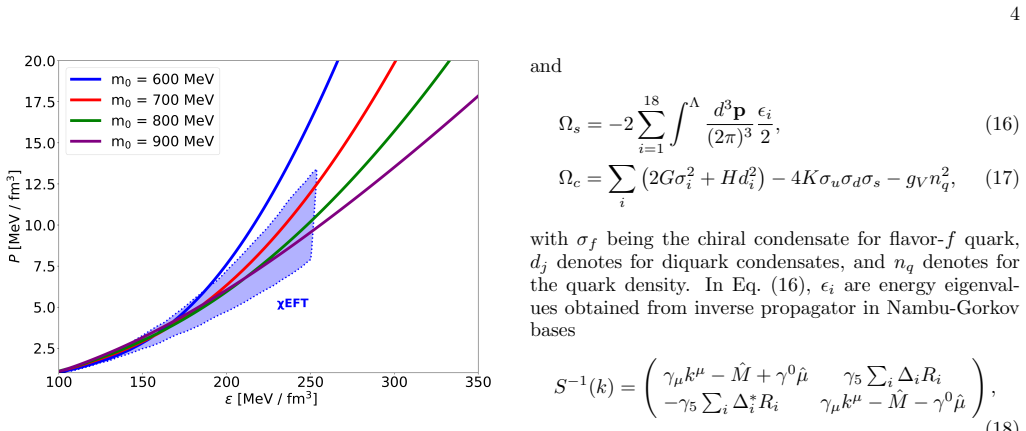
- [Sec. III.B, Fig. 4] The exclusion of m0 = 700 MeV, and hence the new lower bound m0 ≥ 800 MeV, is an artifact of requiring consistency with PSR J0614-3329 at 1σ. The text states that m0 = 700 MeV is consistent with GW170817, J0030+0451, and J0740+6620 at 1σ and with J0614-3329 only at 2σ. Since the quoted NICER intervals are posterior credible intervals, using the 68% level as a hard accept/reject threshold without a likelihood or an explicitly justified decision rule is statistically arbitrary. Under a 90% or 2σ standard, m0 = 700 MeV would be admitted, lowering the bound to ≤700 MeV and reducing the inferred fraction from ≥85% to about 74%. The '220 MeV raise' and the '85%' claim are therefore not robust to the choice of confidence level. The authors should report the compatibility level of each m0 value, propagate the full NICER posterior contours, or otherwise justify the 1σ cutoff.
- [Eq. (3) and Sec. IV] The paper identifies the PDM parameter m0 with the chirally invariant component of the physical nucleon mass and concludes that gluon condensation and other non-chiral mechanisms dominate nucleon mass generation. This identification is an interpretation of an effective-model parameter, not a derived equality. The mass formula m*_αj = ... with a constant m0 in the parity-doublet Lagrangian is one possible parametrization; it need not coincide numerically with the chiral-invariant component defined in lattice QCD or QCD sum rules after mean-field and quantum corrections are absorbed. Thus the radius fit can be internally valid while the 'origin of nucleon mass' conclusion does not follow. The authors should either derive the connection from a QCD-based operator decomposition or explicitly frame the conclusion as model-dependent.
- [Sec. III.A, Eqs. (25)-(28)] The crossover region 2n0–5n0 is modeled with a fifth-order polynomial in μB matched through second derivatives. The paper tests sensitivity to the boundary densities nL and nU, but not to the functional form or matching order. Since PSR J0614-3329 constrains radii at densities that likely include the interpolation region, the assumed crossover form is load-bearing. Another interpolation scheme that satisfies the same boundary conditions but differs in the interior (e.g., a speed-of-sound interpolation or a different thermodynamic variable) could shift the M–R relation by an amount comparable to the 220-MeV effect claimed here. A systematic comparison of interpolation forms is needed before the tightened m0 range can be considered robust.
- [Sec. II.A and Table III] The symmetry-energy slope is fixed to L = 57.7 MeV, the central value of the empirical constraint 57.7 ± 19 MeV. Because L controls the isospin-dependent pressure and hence the radius, and because the a0 meson and ω-ρ mixing are introduced specifically to reproduce L, the m0 constraint should be tested over the empirical range of L. The paper currently gives no indication whether the allowed range 800 ≲ m0 ≲ 860 MeV shifts when L = 38.7 MeV or L = 76.7 MeV is used. This uncertainty should be propagated into the final m0 bounds.
minor comments (4)
- [Sec. II.A] The sentence 'This model was originally constructed to include strange quark effects through KMT-type interactions' appears twice in consecutive paragraphs; one occurrence should be removed.
- [References] Ref. [85] appears to duplicate Ref. [83] (same paper, one with arXiv number). Please consolidate.
- [Sec. III.B] The upper bound m0 ≲ 860 MeV is inherited from the previous analyses cited as Refs. [42,83], not derived from the new PSR J0614-3329 data. The phrase 'narrows this range to 800 ≲ m0 ≲ 860 MeV' could be misread as a new upper bound; clarify that only the lower bound is sharpened here.
- [Eq. (25)] The interpolation polynomial is written in powers of μB, but the text says 'fifth order polynomial of μB' and then sums from i=0 to 5; this is consistent but could be stated more explicitly as degree 5 to avoid confusion with a fifth-order expansion in another variable.
Circularity Check
No significant circularity: the new m0 constraint is data-driven; only a minor self-citation appears in the baseline comparison.
full rationale
The paper's derivation is not circular. For each fixed m0, the hadronic parameters are set by vacuum masses and nuclear saturation properties (Tables I–III), not by the neutron-star radius. The quark-model parameters (H, gV) are scanned under causality and 2-solar-mass constraints, and the resulting M–R curves are compared with external NICER and GW170817 data. The exclusion of m0 = 700 MeV follows from the 1σ acceptance rule relative to PSR J0614-3329, and the acceptance of m0 = 800 MeV from consistency with the same external data; this is a data-driven filter, not a fit of m0 to a pre-ordained conclusion. The only self-citation that appears is the previous 580–860 MeV range (Refs. [42,83]) used to quantify the improvement; that baseline is not load-bearing for the new 800–860 MeV constraint, which is derived independently. The statement that m0 is at least 85% of the nucleon mass follows from the model's definition of m0 as the chirally invariant mass in Eq. (3); this is an interpretive assumption about the model-to-QCD mapping, not a circular derivation. Robustness concerns about the 1σ threshold and the crossover interpolation form are validity issues, not circularity.
Axiom & Free-Parameter Ledger
free parameters (5)
- m0 (chiral invariant mass) =
800-860 MeV (constrained)
- NJL quark model couplings H and gV =
Allowed region satisfying causality and Mmax >= 2 Msun
- Hadronic model couplings (g1, g2, g_omega_NN, g_rho_NN, lambda_omega_rho, meson potential parameters) =
Tab. III values for m0 = 600, 700, 800, 900 MeV
- Symmetry energy slope L =
57.7 MeV (central value)
- Interpolation boundaries nL, nU =
nL = 2n0, nU = 5n0
axioms (6)
- standard math The Tolman-Oppenheimer-Volkoff equations give the correct mass-radius relation for non-rotating neutron stars.
- domain assumption The parity doublet mass formula (Eq. 3) with positive- and negative-parity nucleons is a valid effective description of nucleon masses in medium.
- domain assumption The NJL-type quark model with U(1)A KMT interaction, vector repulsion, and color-flavor locked diquark condensates correctly describes matter above 5n0.
- ad hoc to paper A smooth fifth-order polynomial crossover between the PDM EOS at 2n0 and the NJL EOS at 5n0, with pressure matched to second derivative in muB, faithfully represents the unknown transition region.
- domain assumption The chiral invariant m0 in the parity doublet model corresponds to the chirally invariant component of the nucleon mass that persists in the chirally restored phase.
- domain assumption The NICER and LIGO/Virgo observational constraints, as represented by their published confidence contours, are accurate.
Cite this review
Pith. "Pith review of Origin of nucleon mass in the light of PSR J0614-3329 with quark-hadron crossover." pith.science (2026). https://pith.science/paper/6KAPPKVN
@misc{pith2026250903008,
  author       = {Pith},
  title        = {Pith review of: Origin of nucleon mass in the light of PSR J0614-3329 with quark-hadron crossover},
  year         = {2026},
  howpublished = {\url{https://pith.science/paper/6KAPPKVN}},
  note         = {Machine review of arXiv:2509.03008}
}
abstract
The recent NICER observation of PSR J0614-3329, revealing the smallest reliably measured neutron star radius of $R = 10.29^{+1.01}_{-0.86}$ km at mass $M = 1.44^{+0.06}_{-0.07} M_\odot$, provides an unprecedented constraint on the equation of state of dense matter. We investigate the implications of this measurement for the origin of nucleon mass within the parity doublet model framework, which naturally incorporates both chiral variant and chiral invariant mass components. We construct unified equations of state by employing the parity doublet model with isovector scalar meson $a_0(980)$ for hadronic matter up to twice nuclear saturation density, smoothly connected to a Nambu-Jona-Lasinio-type quark model at higher densities through a crossover transition. By systematically varying the chiral invariant mass $m_0$ and quark matter parameters, we determine which values simultaneously satisfy all current astrophysical constraints, including gravitational wave observations from GW170817, NICER measurements of several pulsars, and the existence of two-solar-mass neutron stars. The inclusion of PSR J0614-3329 dramatically refines the allowed range of the chiral invariant mass from the previous constraint of $580~\text{MeV} \lesssim m_0 \lesssim 860~\text{MeV}$ to $800~\text{MeV} \lesssim m_0 \lesssim 860~\text{MeV}$, raising the lower bound by approximately 220 MeV. This result indicates that the chiral invariant mass must constitute at least 85\% of the nucleon mass, challenging the traditional picture of nucleon mass generation through spontaneous chiral symmetry breaking alone and highlighting the importance of gluon condensation and other non-chiral mechanisms.
Figures


Reference graph
Works this paper leans on
-
[1]
B. P. Abbott (LIGO Scientific Collaboration and Virgo Collaboration), Phys. Rev. Lett. 119, 161101 (2017)
2017
-
[2]
B. P. Abbott et al. (LIGO Scientific, Virgo, Fermi GBM, INTEGRAL, IceCube, AstroSat Cadmium Zinc Telluride Imager Team, IPN, Insight-Hxmt, ANTARES, Swift, AGILE Team, 1M2H Team, Dark Energy Camera GW-EM, DES, DLT40, GRA WITA, Fermi-LAT, ATCA, ASKAP, Las Cumbres Observatory Group, OzGrav, DWF (Deeper Wider Faster Program), AST3, CAAS- TRO, VINROUGE, MASTER...
Pith/arXiv arXiv 2017
-
[3]
B. P. Abbott et al. (LIGO Scientific, Virgo), Phys. Rev. Lett. 121, 161101 (2018), arXiv:1805.11581 [gr-qc]
Pith/arXiv arXiv 2018
-
[4]
T. E. Riley et al., Astrophys. J. Lett. 887, L21 (2019), arXiv:1912.05702 [astro-ph.HE]
Pith/arXiv arXiv 2019
-
[5]
S. Vinciguerra et al., Astrophys. J. 961, 62 (2024), arXiv:2308.09469 [astro-ph.HE]
Pith/arXiv arXiv 2024
-
[6]
D. Choudhury et al., Astrophys. J. Lett. 971, L20 (2024), arXiv:2407.06789 [astro-ph.HE]
Pith/arXiv arXiv 2024
-
[7]
T. E. Riley et al., Astrophys. J. Lett. 918, L27 (2021), arXiv:2105.06980 [astro-ph.HE]
Pith/arXiv arXiv 2021
-
[8]
M. C. Miller et al., Astrophys. J. Lett. 918, L28 (2021), arXiv:2105.06979 [astro-ph.HE]
Pith/arXiv arXiv 2021
-
[9]
G. Raaijmakers, S. K. Greif, K. Hebeler, T. Hinderer, S. Nissanke, A. Schwenk, T. E. Riley, A. L. Watts, J. M. Lattimer, and W. C. G. Ho, Astrophys. J. Lett. 918, L29 (2021), arXiv:2105.06981 [astro-ph.HE]
Pith/arXiv arXiv 2021
-
[10]
A. J. Dittmann et al., Astrophys. J. 974, 295 (2024), arXiv:2406.14467 [astro-ph.HE]
Pith/arXiv arXiv 2024
-
[11]
T. Salmi et al., Astrophys. J. 974, 294 (2024), arXiv:2406.14466 [astro-ph.HE]
Pith/arXiv arXiv 2024
-
[12]
G. Aarts, C. Allton, S. Hands, B. J¨ ager, C. Praki, and J.-I. Skullerud, Phys. Rev. D 92, 014503 (2015), arXiv:1502.03603 [hep-lat]
Pith/arXiv arXiv 2015
-
[13]
G. Aarts, C. Allton, D. De Boni, S. Hands, B. J¨ ager, C. Praki, and J.-I. Skullerud, JHEP 06, 034 (2017), arXiv:1703.09246 [hep-lat]
Pith/arXiv arXiv 2017
-
[14]
Baryons in the plasma: in-medium effects and parity doubling
G. Aarts, C. Allton, D. de Boni, S. Hands, B. J¨ ager, C. Praki, and J.-I. Skullerud, EPJ Web Conf. 171, 14005 (2018), arXiv:1710.00566 [hep-lat]
work page internal anchor Pith review Pith/arXiv arXiv 2018
-
[15]
Hyperons in thermal QCD from the lattice
G. Aarts, C. Allton, D. de Boni, J. Glesaaen, S. Hands, B. J¨ ager, and J.-I. Skullerud, Springer Proc. Phys.250, 29 (2020), arXiv:1911.01449 [hep-lat]
work page internal anchor Pith review Pith/arXiv arXiv 2020
-
[16]
Vector meson mass in the chiral symmetry restored vacuum
J. Kim and S. H. Lee, Phys. Rev. D 103, L051501 (2021), arXiv:2012.06463 [nucl-th]
work page internal anchor Pith review Pith/arXiv arXiv 2021
-
[17]
J. Kim and S. H. Lee, Phys. Rev. D 105, 014014 (2022), arXiv:2109.12791 [hep-ph]. 9
Pith/arXiv arXiv 2022
-
[18]
S. H. Lee, Symmetry 15, 799 (2023), arXiv:2303.14415 [hep-ph]
work page internal anchor Pith review Pith/arXiv arXiv 2023
-
[19]
Dilaton-Limit Fixed Point in Hidden Local Symmetric Parity Doublet Model
W.-G. Paeng, H. K. Lee, M. Rho, and C. Sasaki, Phys. Rev. D 85, 054022 (2012), arXiv:1109.5431 [hep-ph]
work page internal anchor Pith review Pith/arXiv arXiv 2012
-
[20]
Y.-L. Ma and M. Rho, Prog. Part. Nucl. Phys. 113, 103791 (2020), arXiv:1909.05889 [nucl-th]
Pith/arXiv arXiv 2020
-
[21]
C. E. Detar and T. Kunihiro, Phys. Rev. D 39, 2805 (1989)
1989
-
[22]
D. Jido, M. Oka, and A. Hosaka, Prog. Theor. Phys. 106, 873 (2001), arXiv:hep-ph/0110005
Pith/arXiv arXiv 2001
-
[23]
D. Zschiesche, L. Tolos, J. Schaffner-Bielich, and R. D. Pisarski, Phys. Rev. C 75, 055202 (2007), arXiv:nucl- th/0608044
-
[24]
V. Dexheimer, S. Schramm, and D. Zschiesche, Phys. Rev. C 77, 025803 (2008), arXiv:0710.4192 [nucl-th]
Pith/arXiv arXiv 2008
-
[25]
Neutron stars within the SU(2) parity doublet model
V. Dexheimer, G. Pagliara, L. Tolos, J. Schaffner-Bielich, and S. Schramm, Eur. Phys. J. A 38, 105 (2008), arXiv:0805.3301 [nucl-th]
work page internal anchor Pith review Pith/arXiv arXiv 2008
-
[26]
C. Sasaki and I. Mishustin, Phys. Rev. C 82, 035204 (2010), arXiv:1005.4811 [hep-ph]
Pith/arXiv arXiv 2010
-
[27]
C. Sasaki, H. K. Lee, W.-G. Paeng, and M. Rho, Phys. Rev. D 84, 034011 (2011), arXiv:1103.0184 [hep-ph]
Pith/arXiv arXiv 2011
-
[28]
J. Steinheimer, S. Schramm, and H. Stocker, Phys. Rev. C 84, 045208 (2011), arXiv:1108.2596 [hep-ph]
Pith/arXiv arXiv 2011
-
[29]
Asymmetric nuclear matter in a parity doublet model with hidden local symmetry
Y. Motohiro, Y. Kim, and M. Harada, Phys. Rev. C 92, 025201 (2015), [Erratum: Phys.Rev.C 95, 059903 (2017)], arXiv:1505.00988 [nucl-th]
work page internal anchor Pith review Pith/arXiv arXiv 2015
-
[30]
A. Mukherjee, J. Steinheimer, and S. Schramm, Phys. Rev. C 96, 025205 (2017), arXiv:1611.10144 [nucl-th]
Pith/arXiv arXiv 2017
-
[31]
S. Gallas, F. Giacosa, and G. Pagliara, Nucl. Phys. A 872, 13 (2011), arXiv:1105.5003 [hep-ph]
work page internal anchor Pith review Pith/arXiv arXiv 2011
-
[32]
D. Suenaga, Phys. Rev. C 97, 045203 (2018), arXiv:1704.03630 [nucl-th]
work page internal anchor Pith review Pith/arXiv arXiv 2018
-
[33]
M. Marczenko and C. Sasaki, Phys. Rev. D 97, 036011 (2018), arXiv:1711.05521 [hep-ph]
Pith/arXiv arXiv 2018
-
[34]
Chiral symmetry restoration by parity doubling and the structure of neutron stars
M. Marczenko, D. Blaschke, K. Redlich, and C. Sasaki, Phys. Rev. D 98, 103021 (2018), arXiv:1805.06886 [nucl- th]
work page internal anchor Pith review Pith/arXiv arXiv 2018
-
[35]
Constraint to chiral invariant masses of nucleons from GW170817 in an extended parity doublet model
T. Yamazaki and M. Harada, Phys. Rev. C 100, 025205 (2019), arXiv:1901.02167 [nucl-th]
work page internal anchor Pith review Pith/arXiv arXiv 2019
-
[36]
M. Marczenko, D. Blaschke, K. Redlich, and C. Sasaki, Universe 5, 180 (2019), arXiv:1905.04974 [nucl-th]
Pith/arXiv arXiv 2019
-
[37]
T. Minamikawa, T. Kojo, and M. Harada, Phys. Rev. C 104, 065201 (2021), arXiv:2107.14545 [nucl-th]
work page internal anchor Pith review Pith/arXiv arXiv 2021
-
[38]
B. Gao, T. Kojo, and M. Harada, Phys. Rev. D 110, 016016 (2024), arXiv:2403.18214 [hep-ph]
Pith/arXiv arXiv 2024
-
[39]
B. Gao, Y. Yan, and M. Harada, Phys. Rev. C 109, 065807 (2024), arXiv:2404.04786 [nucl-th]
Pith/arXiv arXiv 2024
-
[40]
B. Gao and M. Harada, Phys. Rev. D111, 016024 (2025), arXiv:2410.16649 [nucl-th]
Pith/arXiv arXiv 2025
- [41]
-
[42]
Y.-K. Kong, B. Gao, and M. Harada, (2025), arXiv:2506.16684 [nucl-th]
Pith/arXiv arXiv 2025
-
[43]
B. Gao, X. Liu, M. Harada, and Y.-L. Ma, (2025), arXiv:2508.00243 [nucl-th]
work page internal anchor Pith review Pith/arXiv arXiv 2025
-
[44]
T. Hatsuda and T. Kunihiro, Phys. Rept. 247, 221 (1994), arXiv:hep-ph/9401310
Pith/arXiv arXiv 1994
- [45]
-
[46]
K. Fukushima, Phys. Rev. D 77, 114028 (2008), [Erra- tum: Phys.Rev.D 78, 039902 (2008)], arXiv:0803.3318 [hep-ph]
Pith/arXiv arXiv 2008
-
[47]
Y. Song, G. Baym, T. Hatsuda, and T. Kojo, Phys. Rev. D 100, 034018 (2019), arXiv:1905.01005 [astro-ph.HE]
Pith/arXiv arXiv 2019
-
[48]
G. Baym, T. Hatsuda, T. Kojo, P. D. Powell, Y. Song, and T. Takatsuka, Rept. Prog. Phys. 81, 056902 (2018), arXiv:1707.04966 [astro-ph.HE]
Pith/arXiv arXiv 2018
-
[49]
C.-J. Xia, T. Maruyama, N. Yasutake, and T. Tatsumi, Phys. Rev. D 110, 114024 (2024), arXiv:2409.12489 [nucl-th]
work page internal anchor Pith review Pith/arXiv arXiv 2024
-
[50]
H. Gholami, M. Hofmann, and M. Buballa, Phys. Rev. D 111, 014006 (2025), arXiv:2408.06704 [hep-ph]
Pith/arXiv arXiv 2025
-
[51]
M. Kawaguchi, I. Siddique, and M. Huang, Eur. Phys. J. C 85, 246 (2025), arXiv:2408.14808 [hep-ph]
Pith/arXiv arXiv 2025
-
[52]
J.-E. Christian, I. A. Rather, H. Gholami, and M. Hof- mann, (2025), arXiv:2503.13626 [astro-ph.HE]
Pith/arXiv arXiv 2025
-
[53]
The Con- densed matter physics of QCD,
K. Rajagopal and F. Wilczek, “The Con- densed matter physics of QCD,” in At the frontier of particle physics. Handbook of QCD. Vol. 1-3, edited by M. Shifman and B. Ioffe (2000) pp. 2061–2151, arXiv:hep-ph/0011333
Pith/arXiv arXiv 2000
-
[54]
Gapless Color-Flavor-Locked Quark Matter
M. Alford, C. Kouvaris, and K. Rajagopal, Phys. Rev. Lett. 92, 222001 (2004), arXiv:hep-ph/0311286
work page internal anchor Pith review Pith/arXiv arXiv 2004
-
[55]
M. G. Alford, A. Schmitt, K. Rajagopal, and T. Sch¨ afer, Rev. Mod. Phys. 80, 1455 (2008), arXiv:0709.4635 [hep- ph]
Pith/arXiv arXiv 2008
-
[56]
M. G. Alford and A. Sedrakian, Phys. Rev. Lett. 119, 161104 (2017), arXiv:1706.01592 [astro-ph.HE]
Pith/arXiv arXiv 2017
-
[57]
P. T. Oikonomou and C. C. Moustakidis, Phys. Rev. D 108, 063010 (2023), arXiv:2304.12209 [astro-ph.HE]
work page internal anchor Pith review Pith/arXiv arXiv 2023
-
[58]
P.-C. Chu, H. Liu, M. Ju, X.-H. Wu, H.-M. Liu, Y. Zhou, H. Liu, S.-Y. Lu, and X.-H. Li, Phys. Rev. D 110, 043032 (2024)
2024
-
[59]
Asymptotically conformal CFL quark matter within a nonlocal chiral quark model
O. Ivanytskyi, Phys. Rev. D 111, 034004 (2025), [Erra- tum: Phys.Rev.D 111, 079904 (2025)], arXiv:2409.05859 [hep-ph]
work page internal anchor Pith review Pith/arXiv arXiv 2025
-
[60]
T. Minamikawa, B. Gao, T. Kojo, and M. Harada, Sym- metry 15, 745 (2023), arXiv:2302.00825 [nucl-th]
Pith/arXiv arXiv 2023
-
[61]
Y.-L. Ma, M. Harada, H. K. Lee, Y. Oh, B.-Y. Park, and M. Rho, Phys. Rev. D 88, 014016 (2013), [Erra- tum: Phys.Rev.D 88, 079904 (2013)], arXiv:1304.5638 [hep-ph]
work page internal anchor Pith review Pith/arXiv arXiv 2013
-
[62]
Y.-L. Ma, M. Harada, H. K. Lee, Y. Oh, B.-Y. Park, and M. Rho, Phys. Rev. D 90, 034015 (2014), arXiv:1308.6476 [hep-ph]
work page internal anchor Pith review Pith/arXiv arXiv 2014
-
[63]
Mauviard et al., (2025), arXiv:2506.14883 [astro- ph.HE]
L. Mauviard et al., (2025), arXiv:2506.14883 [astro- ph.HE]
arXiv 2025
-
[64]
S.-P. Tang, Y.-J. Huang, and Y.-Z. Fan, (2025), arXiv:2507.10025 [astro-ph.HE]
arXiv 2025
- [65]
-
[66]
B. Gao, T. Minamikawa, T. Kojo, and M. Harada, Phys. Rev. C 106, 065205 (2022), arXiv:2207.05970 [nucl-th]
work page internal anchor Pith review Pith/arXiv arXiv 2022
-
[67]
B.-A. Li, B.-J. Cai, W.-J. Xie, and N.-B. Zhang, Universe 7 (2021), 10.3390/universe7060182
-
[68]
Kubis and M
S. Kubis and M. Kutschera, Physics Letters B 399, 191 (1997)
1997
-
[69]
Influence of the interactions of scalar mesons on the behavior of the symmetry energy
N. Zabari, S. Kubis, and W. W´ ojcik, Phys. Rev. C 99, 035209 (2019), arXiv:1809.03420 [nucl-th]
work page internal anchor Pith review Pith/arXiv arXiv 2019
-
[70]
Multilayer neutron stars with scalar mesons crossing term
S. Kubis, W. W´ ojcik, and N. Zabari, Phys. Rev. C 102, 065803 (2020), arXiv:2007.00738 [nucl-th]
work page internal anchor Pith review Pith/arXiv arXiv 2020
-
[71]
Miyatsu, M.-K
T. Miyatsu, M.-K. Cheoun, and K. Saito, The Astro- physical Journal 929, 82 (2022)
2022
-
[72]
Li, B.-J
F. Li, B.-J. Cai, Y. Zhou, W.-Z. Jiang, and L.-W. Chen, The Astrophysical Journal 929, 183 (2022). 10
2022
-
[73]
V. Thakur, R. Kumar, P. Kumar, V. Kumar, M. Kumar, C. Mondal, B. K. Agrawal, and S. K. Dhiman, Physical Review C 106 (2022), 10.1103/physrevc.106.045806
-
[74]
B. Liu, H. Guo, M. D. Toro, and V. Greco, The European Physical Journal A 25, 293 (2005)
2005
-
[75]
Y. Ma and Y.-L. Ma, Phys. Rev. D 109, 074022 (2024), arXiv:2311.07899 [nucl-th]
Pith/arXiv arXiv 2024
- [76]
-
[77]
Rabhi, C
A. Rabhi, C. Providˆ encia, and J. D. Providˆ encia, Phys. Rev. C 80, 025806 (2009)
2009
-
[78]
Gaitanos, M
T. Gaitanos, M. D. Toro, S. Typel, V. Baran, C. Fuchs, V. Greco, and H. Wolter, Nuclear Physics A 732, 24 (2004)
2004
-
[79]
Greco, M
V. Greco, M. Colonna, M. Di Toro, and F. Matera, Phys. Rev. C 67, 015203 (2003)
2003
-
[80]
B. Liu, V. Greco, V. Baran, M. Colonna, and M. Di Toro, Phys. Rev. C 65, 045201 (2002)
2002
This paper was first reviewed by deepseek-v4-flash on August 5, 2026.
discussion (0)
Sign in with ORCID, Apple, or X to comment. Anyone can read and Pith papers without signing in.