REVIEW 4 major objections 5 minor 1 cited by
Agentic AI framework for End-to-End Medical Data Inference
T0 review · 4 major / 5 minor · reviewed 2026-08-06 · deepseek-v4-flash
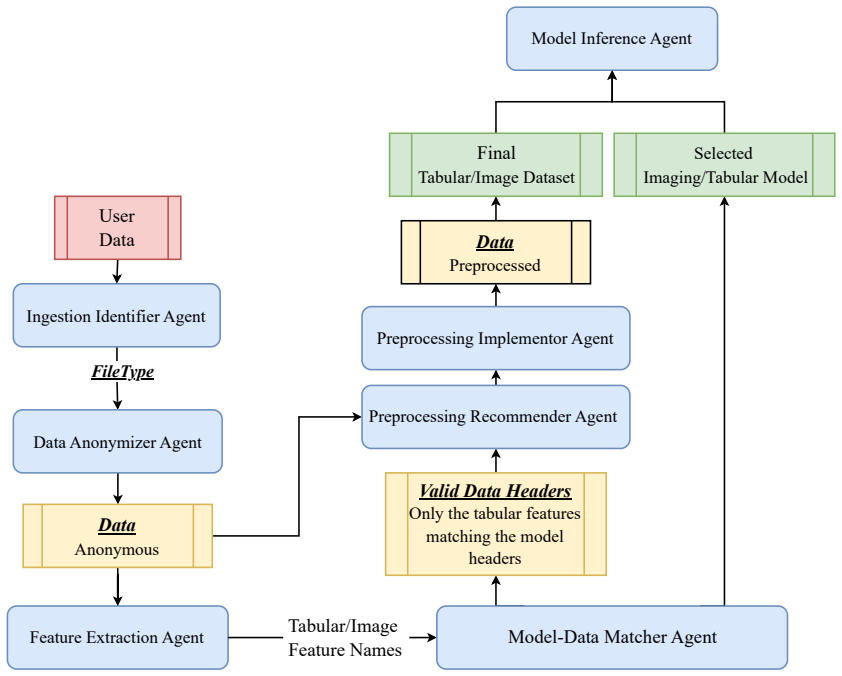
Pith's one-line read The paper claims that a coordinated set of modular AI agents can automate the entire clinical data pipeline—file detection, anonymization, feature extraction, model matching, preprocessing, and interpretable inference—for both tabular and…
desk verdict A clearly written agentic pipeline proposal that is honest about its own missing evaluation, but the abstract overclaims results that never appear. read the letter →
The pith
A machine-rendered reading of the paper's core claim, the machinery that carries it, and where it could break.
The reading
What carries the argument
The load-bearing object is the model-data matcher built on SapBERT, a biomedical language model that turns column headers into 768-dimension vectors; the matcher greedily pairs each required model header with the most similar dataset column, admitting a model only when every required header clears a cosine similarity of 0.6. For images, the equivalent machinery is a two-stage MedGemma prompt that first classifies modality, then disease category, using the model database's modality captions. Two supporting agents carry the rest: the rule-based preprocessing recommender that labels columns as binary, categorical, numerical, or textual from metadata, and the DETR-based inference agent, using a DEtection TRansformer object-detection architecture, that outputs bounding boxes and attention maps.
What would settle it
Take a tabular dataset for fall prediction, rename every column to an uncommon synonym (e.g., 'yrs' for age, 'sex_at_birth' for gender), rerun the model-matcher, and see whether the fall-risk model still passes the 0.6 cosine threshold; if it drops out or is replaced by another model, the header-matching assumption is falsified.
Extended reading notes
Core claim
On the paper's own terms, the central claim is that semantic description of data can substitute for manual pipeline engineering. For tabular data, the pipeline treats column names as 'headers', embeds them with SapBERT, and matches them against model-required headers by cosine similarity with a 0.6 threshold; for image data, it passes one anonymized image through MedGemma to identify imaging modality and disease category, then selects a model from a repository. The same modular agents then recommend and apply preprocessing and run inference with Perpetual Booster or a custom deep network for tables and a fine-tuned DETR for images, producing SHAP/LIME feature explanations and attention maps. The paper presents this as a scalable, cost-efficient alternative to repeated expert intervention in clinical AI deployment.
Load-bearing premise
The whole pipeline rests on the assumption that a dataset's column names and one randomly picked anonymized image reveal enough about its content to pick the right model, so unusual column names or an unrepresentative image would break the chain.
Editorial extensions
If this is right
- A hospital with no machine-learning team could upload a CSV and receive a model-matched, preprocessed, interpretable prediction for tasks such as fall risk or hope level in palliative care.
- For imaging, a single anonymized colonoscopy frame could route a whole study to the correct polyp detection model, along with bounding boxes and attention maps.
- Automated anonymization at ingestion makes the pipeline deployable under HIPAA-style privacy rules without a separate manual de-identification step.
- The greedy header-matching scheme gives a concrete way to check model-data compatibility before training, preventing downstream schema mismatches.
- Explanations such as SHAP, LIME, and DETR attention maps are produced in the same run as predictions, so interpretability is not a separate cost.
Reading between the lines
- An implicit extension is that the same semantic header-matching could route non-clinical tabular datasets to a model repository, provided the embedding model captures that domain's terminology.
- The paper does not test how match accuracy degrades when column names are synonyms, misspellings, or abbreviations; a direct stress test is to rename columns and measure retrieval stability.
- Because the privacy stage relies on external cloud services, the framework's end-to-end promise is conditional on network access and data-export rules; an on-device anonymizer would be needed to extend it to settings where data must remain on-site.
Editorial analysis
A structured set of objections, weighed in public.
Referee Report
Summary. The paper proposes an agentic AI framework for end-to-end medical data pipelines, with modular agents for file-type identification, anonymization, feature extraction, model-data matching, preprocessing recommendation and implementation, and model inference with interpretability. The authors claim to evaluate the system on geriatric (GSTRIDE), palliative care (anxiety/hope), and colonoscopy polyp datasets, but the manuscript contains no experimental results, metrics, baselines, or error bars. The contribution is currently a detailed system description and architectural blueprint rather than a validated system.
Significance. The modular architecture integrates established components (Magika, Google Cloud DLP, SapBERT, MedGemma, DETR) in a coherent and clearly described way, and the paper is well-structured. If the claimed end-to-end automation were validated, it could have practical value for low-resource clinical settings. However, because no quantitative evaluation is reported, the paper does not demonstrate its core empirical claim; it remains a design proposal. The self-admitted absence of benchmarks in Section VI is therefore load-bearing and prevents acceptance.
major comments (4)
- [Abstract; Sections III–VI] The abstract states 'We evaluate the system on publicly available datasets from geriatrics, palliative care, and colonoscopy imaging,' yet no evaluation results appear anywhere in the manuscript. Section VI's final paragraph concedes that the framework 'lacks formal evaluation standards' and that 'without quantitative benchmarks and human-centered evaluations, it is difficult to assess safety, reliability, or clinical trust.' Because the central claim is empirical—that the pipeline translates raw clinical data into predictions with reduced expert intervention—the absence of any measured outcome leaves that claim unsupported.
- [Section IV, Model-Data Matcher Agent] The SapBERT cosine-similarity threshold of 0.6 is described as 'empirically set,' but no experiments, ablation, or sensitivity analysis are provided to justify this choice. This threshold is the sole decision rule for structured-data model selection, so its operating point is load-bearing; without validation, the model-matching component cannot be assessed for correctness or robustness.
- [Section IV, Feature Extraction Agent (image branch)] For image data, the framework samples a single random anonymized image and relies on MedGemma to infer the imaging modality and disease type before model selection. A single image is unlikely to be representative of a heterogeneous clinical dataset, and no accuracy or reliability metrics for the MedGemma classification are reported. An incorrect modality or disease inference would route the data to the wrong model, so this is a critical failure mode for the end-to-end image pipeline.
- [Section IV, Model Inference Agent] The inference agent references Perpetual Booster, a custom deep architecture, and a fine-tuned DETR model, but the manuscript provides no details of model training, hyperparameters, validation protocol, or performance on the described datasets. Consequently, the claimed interpretable outputs (SHAP, LIME, attention maps) cannot be verified as meaningful, and the colonoscopy example—the only concrete case mentioned in the conclusion—has no associated numerical results.
minor comments (5)
- [Section IV, Feature Extraction Agent] There is a typo: 'etx' should be 'etc.' in the description of image modality classification.
- [Abstract and Table I] Agent naming is inconsistent: the abstract and Figure 1 use 'Ingestion Identifier Agent,' while Table I and Section IV use 'Feature Identifier Agent' with the code name '[Ingestion_Classifier]'; please standardize the terminology.
- [References] Reference [51] (Perpetual Booster) is not a standard archival citation; please provide a peer-reviewed source or clarify its status.
- [Figures 2 and 4] The JSON-like pseudocode in Figures 2 and 4 contains ellipses and escaped quotes, which makes it difficult to read; typesetting these as proper listings would improve clarity.
- [General] The paper does not state whether the model repository, agent code, or evaluation harness will be released; given the absence of experiments, such artifacts would be valuable for reproducibility.
Circularity Check
No significant circularity: the paper is an architectural description whose model-selection criterion is a stated design rule, not a prediction derived from its own output.
full rationale
This paper does not present a derivation chain or first-principles quantitative result. It describes an agent pipeline, and every selection step is explicitly algorithmic rather than predictive. The SapBERT cosine threshold is introduced as an eligibility rule ('A model is deemed eligible if every required feature can be matched to a dataset column with a similarity score exceeding a threshold (empirically set to 0.6)'), and the 'best-fit model' is defined as the output of that rule plus an LLM choice; this is a design implementation, not a fitted parameter renamed as a prediction. The MedGemma modality and disease inference and the DETR inference components are external systems invoked as tools, and the paper makes no claim that their outputs are derived from or equivalent to the framework's own fitted values. There are no load-bearing self-citations: all cited prior work is external, and no uniqueness theorem or prior result by the same authors is invoked to forbid alternative designs. The paper's own limitation statement, 'the framework lacks formal evaluation standards. Without quantitative benchmarks and human-centered evaluations, it is difficult to assess safety, reliability, or clinical trust,' is a validation gap, not circularity: the central claim that the framework reduces expert intervention and enables automated inferences is asserted without measured evidence, but an unvalidated claim is distinct from one that reduces to its inputs by construction. Accordingly, no circular step can be quoted with a specific reduction, and the appropriate finding is no significant circularity.
Assumptions & free parameters
free parameters (2)
- SapBERT cosine similarity threshold =
0.6
- Dataset size threshold for user-guided preprocessing =
50 MB
assumptions (4)
- domain assumption Column names are sufficient semantic proxies for clinical dataset features.
- domain assumption SapBERT embeddings of medical terms make cosine similarity a valid measure of clinical feature compatibility.
- domain assumption MedGemma can correctly infer imaging modality and disease category from a single random anonymized image.
- domain assumption Google Cloud DLP anonymization is sufficient for clinical privacy compliance.
Cite this review
Pith. "Pith review of Agentic AI framework for End-to-End Medical Data Inference." pith.science (2026). https://pith.science/paper/6OFMBKAX
@misc{pith2026250718115,
  author       = {Pith},
  title        = {Pith review of: Agentic AI framework for End-to-End Medical Data Inference},
  year         = {2026},
  howpublished = {\url{https://pith.science/paper/6OFMBKAX}},
  note         = {Machine review of arXiv:2507.18115}
}
read the original abstract
Building and deploying machine learning solutions in healthcare remains expensive and labor-intensive due to fragmented preprocessing workflows, model compatibility issues, and stringent data privacy constraints. In this work, we introduce an Agentic AI framework that automates the entire clinical data pipeline, from ingestion to inference, through a system of modular, task-specific agents. These agents handle both structured and unstructured data, enabling automatic feature selection, model selection, and preprocessing recommendation without manual intervention. We evaluate the system on publicly available datasets from geriatrics, palliative care, and colonoscopy imaging. For example, in the case of structured data (anxiety data) and unstructured data (colonoscopy polyps data), the pipeline begins with file-type detection by the Ingestion Identifier Agent, followed by the Data Anonymizer Agent ensuring privacy compliance, where we first identify the data type and then anonymize it. The Feature Extraction Agent identifies features using an embedding-based approach for tabular data, extracting all column names, and a multi-stage MedGemma-based approach for image data, which infers modality and disease name. These features guide the Model-Data Feature Matcher Agent in selecting the best-fit model from a curated repository. The Preprocessing Recommender Agent and Preprocessing Implementor Agent then apply tailored preprocessing based on data type and model requirements. Finally, the ``Model Inference Agent" runs the selected model on the uploaded data and generates interpretable outputs using tools like SHAP, LIME, and DETR attention maps. By automating these high-friction stages of the ML lifecycle, the proposed framework reduces the need for repeated expert intervention, offering a scalable, cost-efficient pathway for operationalizing AI in clinical environments.
Figures


Figures from the paper (3 more)


Forward citations
Cited by 1 Pith paper
-
AT-CXR: Uncertainty-Aware Agentic Triage for Chest X-rays
An uncertainty-aware agentic router with abstention improves pulmonary edema triage on a small balanced chest x-ray subset, but the selective-prediction gains rest on under-specified evaluation.
Reference graph
Works this paper leans on
-
[1]
Topol, Deep medicine: how artificial intelligence can make healthcare human again
E. Topol, Deep medicine: how artificial intelligence can make healthcare human again. Hachette UK, 2019
work page 2019
-
[2]
A. Schmetz and A. Kampker, “Inside production data science: Exploring the main tasks of data scientists in production environments,” AI, vol. 5, no. 2, pp. 873–886, 2024
work page 2024
-
[3]
M. Nair, P. Svedberg, I. Larsson, and J. M. Nygren, “A comprehensive overview of barriers and strategies for ai implementation in healthcare: Mixed-method design,” PLoS One, vol. 19, no. 8, p. e0305949, 2024
work page 2024
-
[4]
S. Lund, J. Manyika, L. H. Segel, A. Dua, S. Rutherford, B. Hancock, and B. Macon, The Future of Work in America: People and Places, Today and Tomorrow. McKinsey Global Institute, 2019
work page 2019
-
[5]
P. P. Stuti Dhruv, The Cost of Implementing AI in Healthcare. AALPHA Information Systems India PVT LTD, 2025
work page 2025
-
[6]
Tahir, AI was meant to cut health care costs
D. Tahir, AI was meant to cut health care costs. It turns out to need expensive human support . San Francisco Chronicle, 2025
work page 2025
-
[7]
Barriers to and facilitators of artificial intelligence adoption in health care: scoping review,
M. Hassan, A. Kushniruk, and E. Borycki, “Barriers to and facilitators of artificial intelligence adoption in health care: scoping review,” JMIR Human Factors, vol. 11, p. e48633, 2024
work page 2024
-
[8]
The future of digital health with federated learning,
N. Rieke, J. Hancox, W. Li, F. Milletari, H. R. Roth, S. Albarqouni, ..., and G. Kaissis, “The future of digital health with federated learning,” npj Digital Medicine , vol. 3, no. 1, p. 119, 2020
work page 2020
Show all 55 references
-
[9]
Preventing failures due to dataset shift: A review,
A. Subbaswamy and S. Saria, “Preventing failures due to dataset shift: A review,” arXiv preprint arXiv:2010.02094 , 2020
2010 arXiv
-
[10]
Big data and machine learning in health care,
A. L. Beam and I. S. Kohane, “Big data and machine learning in health care,” JAMA, vol. 319, no. 13, pp. 1317–1318, 2018
2018
-
[11]
Deep learning for healthcare: review, opportunities and challenges,
R. Miotto, F. Wang, S. Wang, X. Jiang, and J. T. Dudley, “Deep learning for healthcare: review, opportunities and challenges,” Briefings in bioinformatics, vol. 19, no. 6, pp. 1236–1246, 2017
2017
-
[12]
Health insurance portability and accountability act of 1996 (hipaa)
U.S. Congress, “Health insurance portability and accountability act of 1996 (hipaa).” https://www.hhs.gov/hipaa/for-professionals/privacy/ laws-regulations/index.html, 2025
1996
-
[13]
General data protection regulation (gdpr)
European Parliament and Council of the European Union, “General data protection regulation (gdpr).” https://gdpr-info.eu/, 2016. Regulation (EU) 2016/679
2016
-
[14]
Ai chatbots, health privacy, and challenges to hipaa compliance,
M. Marks and C. E. Haupt, “Ai chatbots, health privacy, and challenges to hipaa compliance,” Jama, vol. 330, no. 4, pp. 309–310, 2023
2023
-
[15]
Automl: A survey of the state-of-the-art,
X. He, K. Zhao, and X. Chu, “Automl: A survey of the state-of-the-art,” Knowledge-based systems, vol. 212, p. 106622, 2021
2021
-
[16]
Agents applied in health care: A review,
D. Isern, D. S ´anchez, and A. Moreno, “Agents applied in health care: A review,” International journal of medical informatics , vol. 79, no. 3, pp. 145–166, 2010
2010
-
[17]
Agentic ai: Autonomous intelligence for complex goals–a comprehensive survey,
D. B. Acharya, K. Kuppan, and B. Divya, “Agentic ai: Autonomous intelligence for complex goals–a comprehensive survey,” IEEe Access , 2025
2025
-
[18]
The landscape of emerging ai agent architectures for reasoning, planning, and tool calling: A survey,
T. Masterman, S. Besen, M. Sawtell, and A. Chao, “The landscape of emerging ai agent architectures for reasoning, planning, and tool calling: A survey,” arXiv preprint arXiv:2404.11584 , 2024
2024 arXiv
-
[19]
Can large language models reason about medical questions?,
V . Li ´evin, C. E. Hother, A. G. Motzfeldt, and O. Winther, “Can large language models reason about medical questions?,” Patterns, vol. 5, no. 3, 2024
2024
-
[20]
Large language models encode clinical knowledge,
K. Singhal, S. Azizi, T. Tu, S. S. Mahdavi, J. Wei, H. W. Chung, N. Scales, A. Tanwani, H. Cole-Lewis, S. Pfohl, et al., “Large language models encode clinical knowledge,” Nature, vol. 620, no. 7972, pp. 172– 180, 2023
2023
-
[21]
An individualized preprocessing for medical data classification,
S. AlMuhaideb and M. E. B. Menai, “An individualized preprocessing for medical data classification,” Procedia Computer Science , vol. 82, pp. 35–42, 2016
2016
-
[22]
Autogluon-tabular: Robust and accurate automl for structured data,
N. Erickson, J. Mueller, A. Shirkov, H. Zhang, P. Larroy, M. Li, and A. Smola, “Autogluon-tabular: Robust and accurate automl for structured data,” arXiv preprint arXiv:2003.06505 , 2020
2003 arXiv
-
[23]
Auto-keras: An efficient neural architecture search system,
H. Jin, Q. Song, and X. Hu, “Auto-keras: An efficient neural architecture search system,” in Proceedings of the 25th ACM SIGKDD international conference on knowledge discovery & data mining , pp. 1946–1956, 2019
1946
-
[24]
Elt-bench: An end-to-end benchmark for evaluating ai agents on elt pipelines,
T. Jin, Y . Zhu, and D. Kang, “Elt-bench: An end-to-end benchmark for evaluating ai agents on elt pipelines,” arXiv preprint arXiv:2504.04808, 2025
2025 arXiv
-
[25]
Bel esprit: Multi-agent framework for building ai model pipelines,
Y . Kim, A. Abdelaziz, T. C. Ferreira, M. Al-Badrashiny, and H. Sawaf, “Bel esprit: Multi-agent framework for building ai model pipelines,” arXiv preprint arXiv:2412.14684 , 2024
2024 arXiv
-
[26]
Intelligent spark agents: A modular langgraph framework for scalable, visualized, and enhanced big data machine learning workflows,
J. Wang and Z. Duan, “Intelligent spark agents: A modular langgraph framework for scalable, visualized, and enhanced big data machine learning workflows,” arXiv preprint arXiv:2412.01490 , 2024
2024 arXiv
-
[27]
Goldminer: Elastic scaling of training data pre-processing pipelines for deep learning,
H. Zhao, Z. Yang, Y . Cheng, C. Tian, S. Ren, W. Xiao, M. Yuan, L. Chen, K. Liu, Y . Zhang, et al. , “Goldminer: Elastic scaling of training data pre-processing pipelines for deep learning,” Proceedings of the ACM on Management of Data , vol. 1, no. 2, pp. 1–25, 2023
2023
-
[28]
Towards a hipaa compliant agentic ai system in healthcare,
S. Neupane, S. Mittal, and S. Rahimi, “Towards a hipaa compliant agentic ai system in healthcare,” arXiv preprint arXiv:2504.17669, 2025
2025 arXiv
-
[29]
Anonymizing medical documents with local, privacy preserving large language models: The llm-anonymizer,
I. C. Wiest, M.-E. Leßmann, F. Wolf, D. Ferber, M. Van Treeck, J. Zhu, M. P. Ebert, C. B. Westphalen, M. Wermke, and J. N. Kather, “Anonymizing medical documents with local, privacy preserving large language models: The llm-anonymizer,” medRxiv, pp. 2024–06, 2024
2024
-
[30]
Differential privacy-enabled federated learning for sensitive health data,
O. Choudhury, A. Gkoulalas-Divanis, T. Salonidis, I. Sylla, Y . Park, G. Hsu, and A. Das, “Differential privacy-enabled federated learning for sensitive health data,” arXiv preprint arXiv:1910.02578 , 2019
1910 arXiv
-
[31]
Nuextract-1.5
NuMind, “Nuextract-1.5.” https://huggingface.co/numind/NuExtract-1.5,
-
[32]
Llm-match: An open-sourced patient matching model based on large language models and retrieval-augmented generation,
X. Li, S. Chowdhury, C. I. Wi, M. Vassilaki, X. Liu, T. T. Sio, O. Garrick, Y . J. Juhn, J. R. Cerhan, C. Tao, et al. , “Llm-match: An open-sourced patient matching model based on large language models and retrieval-augmented generation,” arXiv preprint arXiv:2503.13281 , 2025
2025 arXiv
-
[33]
Oboe: Collaborative filtering for automl model selection,
C. Yang, Y . Akimoto, D. W. Kim, and M. Udell, “Oboe: Collaborative filtering for automl model selection,” in Proceedings of the 25th ACM SIGKDD international conference on knowledge discovery & data mining, pp. 1173–1183, 2019
2019
-
[34]
Autoencoder- knn meta-model based data characterization approach for an automated selection of ai algorithms,
M. Garouani, A. Ahmad, M. Bouneffa, and M. Hamlich, “Autoencoder- knn meta-model based data characterization approach for an automated selection of ai algorithms,” Journal of Big Data , vol. 10, no. 1, p. 14, 2023
2023
-
[35]
Moment matching for multi-source domain adaptation,
X. Peng, Q. Bai, X. Xia, Z. Huang, K. Saenko, and B. Wang, “Moment matching for multi-source domain adaptation,” in Proceedings of the IEEE/CVF international conference on computer vision, pp. 1406–1415, 2019
2019
-
[36]
Agentverse: Facilitating multi-agent col- laboration and exploring emergent behaviors in agents,
W. Chen, Y . Su, J. Zuo, C. Yang, C. Yuan, C. Qian, C.-M. Chan, Y . Qin, Y . Lu, R. Xie, et al., “Agentverse: Facilitating multi-agent col- laboration and exploring emergent behaviors in agents,” arXiv preprint arXiv:2308.10848, vol. 2, no. 4, p. 6, 2023
2023 arXiv
-
[37]
Causal state distillation for explainable reinforcement learning,
W. Lu, X. Zhao, T. Fryen, J. H. Lee, M. Li, S. Magg, and S. Wermter, “Causal state distillation for explainable reinforcement learning,” in Causal Learning and Reasoning , pp. 106–142, PMLR, 2024
2024
-
[38]
Self-explanation in social ai agents,
R. Basappa, M. Tekman, H. Lu, B. Faught, S. Kakar, and A. K. Goel, “Self-explanation in social ai agents,” arXiv preprint arXiv:2501.13945, 2025
2025 arXiv
-
[39]
Agent-based explanations in ai: Towards an abstract framework,
G. Ciatto, M. I. Schumacher, A. Omicini, and D. Calvaresi, “Agent-based explanations in ai: Towards an abstract framework,” in International workshop on explainable, transparent autonomous agents and multi- agent systems, pp. 3–20, Springer, 2020
2020
-
[40]
Gstride: A database of frailty and functional assessments with inertial gait data from elderly fallers and non-fallers populations,
G. Garc ´ıa-Villamil Neira, M. Neira ´Alvarez, E. Huertas Hoyas, L. Ruiz Ruiz, S. Garc ´ıa-de Villa, A. J. Del-Ama, M. C. Rodr´ıguez S ´anchez, and A. R. Jim ´enez Ruiz, “Gstride: A database of frailty and functional assessments with inertial gait data from elderly fallers and...
2022
-
[41]
Classification and characterisation of brain network changes in chronic back pain: A multicenter study,
H. Mano, G. Kotecha, K. Leibnitz, T. Matsubara, C. Sprenger, A. Nakae, N. Shenker, M. Shibata, V . V oon, W. Yoshida, et al. , “Classification and characterisation of brain network changes in chronic back pain: A multicenter study,” Wellcome open research, vol. 3, p. 19, 2018
2018
-
[42]
Patients in palliative care—development of a predictive model for anxiety using routine data,
S. Hofmann, S. Hess, C. Klein, G. Lindena, L. Radbruch, and C. Ost- gathe, “Patients in palliative care—development of a predictive model for anxiety using routine data,” PloS one , vol. 12, no. 8, p. e0179415, 2017
2017
-
[43]
Colonoscopy polyp detection and classifica- tion: Dataset creation and comparative evaluations,
K. Li, M. I. Fathan, K. Patel, T. Zhang, C. Zhong, A. Bansal, A. Rastogi, J. S. Wang, and G. Wang, “Colonoscopy polyp detection and classifica- tion: Dataset creation and comparative evaluations,” Plos one , vol. 16, no. 8, p. e0255809, 2021
2021
-
[44]
Towards automatic polyp detection with a polyp appearance model,
J. Bernal, J. S ´anchez, and F. Vilarino, “Towards automatic polyp detection with a polyp appearance model,” Pattern Recognition, vol. 45, no. 9, pp. 3166–3182, 2012
2012
-
[45]
Computer-aided classification of gastroin- testinal lesions in regular colonoscopy,
P. Mesejo, D. Pizarro, A. Abergel, O. Rouquette, S. Beorchia, L. Poincloux, and A. Bartoli, “Computer-aided classification of gastroin- testinal lesions in regular colonoscopy,” IEEE transactions on medical imaging, vol. 35, no. 9, pp. 2051–2063, 2016
2016
-
[46]
Agent Development Kit: Making it easy to build multi-agent applications
Google Cloud, “Agent Development Kit: Making it easy to build multi-agent applications.” https://developers.googleblog.com/en/ agent-development-kit-easy-to-build-multi-agent-applications/, Apr
-
[47]
Magika: Ai-powered content-type detection,
Y . Fratantonio, L. Invernizzi, L. Farah, K. Thomas, M. Zhang, A. Alber- tini, F. Galilee, G. Metitieri, J. Cretin, A. Petit-Bianco, et al., “Magika: Ai-powered content-type detection,” arXiv preprint arXiv:2409.13768 , 2024
2024 arXiv
-
[48]
Cloud data loss prevention (dlp) api documenta- tion
Google Cloud, “Cloud data loss prevention (dlp) api documenta- tion.” https://cloud.google.com/sensitive-data-protection/docs/reference/ rest, 2025. Accessed: 2025-07-17
2025
-
[49]
Medgemma technical report,
L. Yang, A. Sellergren, D. Golden, et al., “Medgemma technical report,” arXiv preprint arXiv:2507.05201 , 2025. Accessed: 2025-07-17
2025 arXiv
-
[50]
Self- alignment pretraining for biomedical entity representations,
F. Liu, E. Shareghi, Z. Meng, M. Basaldella, and N. Collier, “Self- alignment pretraining for biomedical entity representations,” arXiv preprint arXiv:2010.11784, 2020
2010 arXiv
-
[51]
Enhancing training time and sustainability in intrusion detection systems on machine learning,
I. Marasco, K. Chichifoi, S. Russo, and C. Zanasi, “Enhancing training time and sustainability in intrusion detection systems on machine learning,” 2025
2025
-
[52]
A unified approach to interpreting model predictions,
S. M. Lundberg and S.-I. Lee, “A unified approach to interpreting model predictions,” Advances in neural information processing systems, vol. 30, 2017
2017
-
[53]
Local interpretable model-agnostic explanations (lime),
P. Biecek and T. Burzykowski, “Local interpretable model-agnostic explanations (lime),” Explanatory Model Analysis Explore, Explain and Examine Predictive Models , vol. 1, pp. 107–124, 2021
2021
-
[54]
End-to-end object detection with transformers,
N. Carion, F. Massa, G. Synnaeve, N. Usunier, A. Kirillov, and S. Zagoruyko, “End-to-end object detection with transformers,” in European conference on computer vision , pp. 213–229, Springer, 2020
2020
-
[2024]
Accessed: 2025-07-17
2025
Reviewed August 6, 2026 · model on record in the stance chip above.
Discussion (0). Sign in to comment.