A Comparative Study on Affective Cues in Text Embeddings Across Psychological Emotion Theories
Pith reviewed 2026-06-30 09:16 UTC · model grok-4.3
The pith
Latest instruction-aware open-weight text encoders capture equal or greater affective information than proprietary models at word level across emotion theories.
A machine-rendered reading of the paper's core claim, the machinery that carries it, and where it could break.
Core claim
By probing embeddings from twelve text encoders as input features for regression and classification across three emotion frameworks, the study finds that the latent manifolds of the latest instruction-aware open-weight encoders enclose an equal or even larger amount of affective information than proprietary counterparts when evaluated at word level, while embeddings of task-tuned and proprietary encoders reach the highest scores on sentence-level affective classification.
What carries the argument
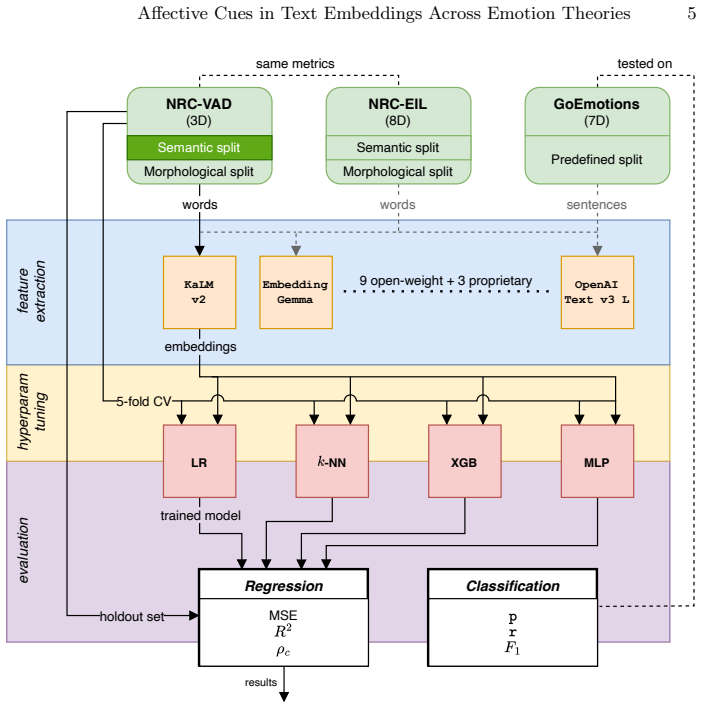
Probing of encoder embeddings as features for regression and classification tasks on affective word- and sentence-level data, augmented by semantic data-leakage prevention.
If this is right
- Instruction-aware open-weight encoders supply at least as much affective signal as proprietary models for word-level applications.
- Task tuning provides a measurable advantage specifically for sentence-level affective classification.
- Affective information is distributed differently across granularity levels in the latent spaces of different encoder families.
- Semantic data-leakage controls are necessary to obtain reliable word-level comparisons.
Where Pith is reading between the lines
- Teams building word-level affect tools could reduce dependence on proprietary APIs by switching to recent open-weight models.
- Hybrid systems might combine open encoders for word features with tuned models for sentence features.
- The observed word-versus-sentence split suggests that future encoder evaluations should routinely separate the two granularity levels rather than aggregate them.
Load-bearing premise
Regression and classification performance on the chosen affective tasks serves as a valid proxy for the degree to which embeddings capture well-defined psychological theories of affect.
What would settle it
If a new set of human ratings on the same emotion dimensions shows that high-scoring embeddings do not predict those ratings better than low-scoring ones, the claim that task performance measures captured affective information would be falsified.
Figures
read the original abstract
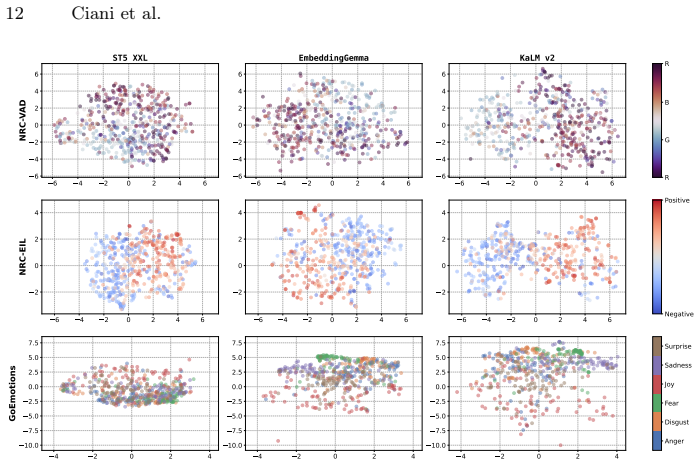
Text encoders are known for their utility in natural language processing, as they are able to efficiently compress inputs into dense vectors while preserving semantics. These models have been applied to affective computing, in particular to help with solving sentiment analysis and emotion recognition tasks. Nevertheless, it remains unclear to what extent the latent representations produced by modern text encoders capture well-defined psychological theories of affect. In this work, we investigate the affective capabilities of twelve recently released text encoders by probing their generated embeddings as input features for solving regression and classification tasks across three established emotion frameworks, using both word- and sentence-level data. Additionally, we apply a semantic data-leakage prevention technique to improve robustness in word-level evaluations. Our main findings show that the latent manifolds of the latest instruction-aware open-weight encoders enclose an equal or even a larger amount of affective information in comparison with proprietary counterparts when evaluated at word level. In contrast, embeddings of task-tuned and proprietary encoders reach the highest scores on sentence-level affective classification. Furthermore, a qualitative analysis of latent representations and their encoded affective cues is provided.
Editorial analysis
A structured set of objections, weighed in public.
Referee Report
Summary. The paper compares embeddings from twelve text encoders (open-weight instruction-aware, task-tuned, and proprietary) by using them as features for regression and classification on affective tasks derived from three psychological emotion frameworks, at both word and sentence levels. A semantic data-leakage prevention step is applied for word-level evaluations. The central claim is that instruction-aware open-weight encoders enclose equal or greater affective information than proprietary models at word level, while task-tuned and proprietary models perform best at sentence-level classification; a qualitative analysis of latent representations is also provided.
Significance. If the task-performance proxy is accepted as valid, the work offers practical guidance for encoder selection in affective computing and shows open-weight models are competitive. The multi-framework, multi-level design adds breadth to existing embedding evaluations, and the data-leakage control is a positive step toward robustness.
major comments (3)
- [Abstract / §1] Abstract and §1 (Introduction): the investigative premise equates regression/classification performance on the chosen tasks with the degree to which embeddings capture the constructs and distinctions of the three psychological emotion theories, yet no validation of the theory-to-task mapping, no controls for probe choice or dataset artifacts, and no discussion of alternative explanations (e.g., training-data overlap) are supplied.
- [Methods] Methods section (experimental design): the abstract and high-level description supply no concrete datasets, exact metrics, statistical tests, error bars, or baseline controls, so it is impossible to verify that the reported performance differences support the central claim about affective information content.
- [Methods] Methods (data-leakage subsection): the semantic data-leakage prevention technique is referenced but given without implementation details, hyperparameters, or ablation results, leaving open whether it sufficiently addresses leakage for the word-level evaluations that underpin the main finding.
minor comments (2)
- [Results] Results section: figures comparing the twelve encoders should include error bars, model-name legends, and explicit indication of which frameworks and levels are shown.
- [Throughout] Notation: consistent use of the three emotion-framework names and the distinction between word-level vs. sentence-level probes would improve readability.
Simulated Author's Rebuttal
We thank the referee for the detailed and constructive feedback. We address each major comment below with plans for revision where appropriate, while defending the core experimental design and claims on the basis of the full manuscript content.
read point-by-point responses
-
Referee: [Abstract / §1] Abstract and §1 (Introduction): the investigative premise equates regression/classification performance on the chosen tasks with the degree to which embeddings capture the constructs and distinctions of the three psychological emotion theories, yet no validation of the theory-to-task mapping, no controls for probe choice or dataset artifacts, and no discussion of alternative explanations (e.g., training-data overlap) are supplied.
Authors: We agree that task performance serves as a proxy measure and that the manuscript would benefit from greater explicitness on this point. In revision we will expand the final paragraph of §1 to include a direct mapping table linking each psychological construct (e.g., Ekman’s basic emotions, Plutchik’s wheel, dimensional valence-arousal) to the specific regression and classification targets drawn from the literature. We will also add a short Limitations paragraph discussing probe choice, dataset artifacts, and the possibility of training-data overlap, while noting that the semantic leakage-prevention step already mitigates lexical overlap at the word level. These additions clarify the scope of the claims without changing the reported results. revision: yes
-
Referee: [Methods] Methods section (experimental design): the abstract and high-level description supply no concrete datasets, exact metrics, statistical tests, error bars, or baseline controls, so it is impossible to verify that the reported performance differences support the central claim about affective information content.
Authors: The full §3 (Methods) already enumerates the twelve datasets (word-level lexicons and sentence-level corpora for each of the three theories), the precise metrics (Pearson r and MSE for regression; accuracy and macro-F1 for classification), the use of 5-fold cross-validation with reported standard deviations, and the inclusion of a random-embedding baseline. To make this information immediately accessible, we will insert a compact summary table at the end of §3.1 and will revise the abstract’s final sentence to reference “standard affective datasets and metrics (detailed in §3)” so that readers can locate the verification details without ambiguity. revision: yes
-
Referee: [Methods] Methods (data-leakage subsection): the semantic data-leakage prevention technique is referenced but given without implementation details, hyperparameters, or ablation results, leaving open whether it sufficiently addresses leakage for the word-level evaluations that underpin the main finding.
Authors: We accept that the current description is insufficiently detailed. In the revised manuscript we will expand the data-leakage subsection with (i) the exact sentence-embedding model and similarity threshold used, (ii) the precise filtering algorithm and its hyperparameters, and (iii) an ablation table comparing word-level regression and classification performance with and without the prevention step. These additions will allow readers to assess the technique’s effectiveness for the word-level results that support the primary claim. revision: yes
Circularity Check
No circularity; purely empirical comparison with no derivations or self-referential steps
full rationale
The paper performs direct experimental probing of embeddings via regression and classification on affective tasks at word and sentence levels across three emotion frameworks, with a data-leakage prevention step for robustness. No equations, predictions, or first-principles derivations exist that could reduce to inputs by construction. No self-citations support load-bearing uniqueness claims, ansatzes, or theorems. The central finding—that instruction-aware open-weight encoders enclose equal or greater affective information at word level—is reported from experimental scores, not from any tautological mapping or fitted parameter renamed as prediction. The proxy assumption between task performance and psychological theory capture is a validity concern but does not create circularity in the reported chain.
Axiom & Free-Parameter Ledger
axioms (1)
- domain assumption Performance on regression and classification tasks using embeddings as features accurately reflects the amount of affective information aligned with psychological emotion theories
Reference graph
Works this paper leans on
-
[1]
Akiba, T., Sano, S., Yanase, T., Ohta, T., Koyama, M.: Optuna: A Next-generation Hyperparameter Optimization Framework. In: Proceedings of the 25th ACM 3 For instance, see the technical report at https://www.anthropic.com/ claude-3-model-card. 14 Ciani et al. SIGKDD International Conference on Knowledge Discovery & Data Mining. pp. 2623–2631. Association ...
-
[2]
https://doi.org/10.48550/arXiv.2511
Babakhin, Y., Osmulski, R., Ak, R., Moreira, G., Xu, M., Schifferer, B., Liu, B., Oldridge, E.: Llama-Embed-Nemotron-8B: A Universal Text Embedding Model for Multilingual and Cross-Lingual Tasks (2025). https://doi.org/10.48550/arXiv.2511. 07025
-
[3]
Computational Intelligence29(3), 506–526 (Aug 2013)
Bellegarda, J.R.: Data-driven Analysis of Emotion in Text Using Latent Affective Folding and Embedding. Computational Intelligence29(3), 506–526 (Aug 2013). https://doi.org/10.1111/j.1467-8640.2012.00457.x
-
[4]
Transactions of the Association for Computational Linguistics 5, 135–146 (Dec 2017)
Bojanowski, P., Grave, E., Joulin, A., Mikolov, T.: Enriching Word Vectors with Subword Information. Transactions of the Association for Computational Linguistics 5, 135–146 (Dec 2017). https://doi.org/10.1162/tacl_a_00051
-
[5]
In: Proceedings of the 2021 Conference on Empirical Methods in Natural Language Processing
Buechel, S., Modersohn, L., Hahn, U.: Towards Label-Agnostic Emotion Embed- dings. In: Proceedings of the 2021 Conference on Empirical Methods in Natural Language Processing. pp. 9231–9249. Association for Computational Linguistics, Punta Cana, Dominican Republic (Nov 2021). https://doi.org/10.18653/v1/2021. emnlp-main.728
-
[6]
Language Resources and Evaluation42(4), 335–359 (Dec 2008)
Busso, C., Bulut, M., Lee, C.C., Kazemzadeh, A., Mower, E., Kim, S., Chang, J.N., Lee, S., Narayanan, S.S.: IEMOCAP: interactive emotional dyadic motion capture database. Language Resources and Evaluation42(4), 335–359 (Dec 2008). https://doi.org/10.1007/s10579-008-9076-6
-
[7]
In: Cognitive Behavioural Systems, pp
Cambria, E., Livingstone, A., Hussain, A.: The Hourglass of Emotions. In: Cognitive Behavioural Systems, pp. 144–157. Springer, Dresden, Germany (2012). https: //doi.org/10.1007/978-3-642-34584-5_11
-
[8]
In: Findings of the Association for Computational Lin- guistics 2024
Chen, J., Xiao, S., Zhang, P., Luo, K., Lian, D., Liu, Z.: M3-Embedding: Multi- Linguality, Multi-Functionality, Multi-Granularity Text Embeddings Through Self- Knowledge Distillation. In: Findings of the Association for Computational Lin- guistics 2024. pp. 2318–2335. Association for Computational Linguistics, Bangkok, Thailand (Aug 2024). https://doi.or...
-
[9]
In: IEEE International Conference on Acoustics, Speech and Signal Processing 2023
Chochlakis, G., Mahajan, G., Baruah, S., Burghardt, K., Lerman, K., Narayanan, S.: Leveraging Label Correlations in a Multi-Label Setting: a Case Study in Emotion. In: IEEE International Conference on Acoustics, Speech and Signal Processing 2023. Institute of Electrical and Electronics Engineers, Rhodes Island, Greece (Jun 2023). https://doi.org/10.1109/I...
-
[10]
In: IEEE International Conference on Acoustics, Speech and Signal Processing 2023
Chochlakis, G., Mahajan, G., Baruah, S., Burghardt, K., Lerman, K., Narayanan, S.: Using Emotion Embeddings to Transfer Knowledge between Emotions, Languages, and Annotation Formats. In: IEEE International Conference on Acoustics, Speech and Signal Processing 2023. Institute of Electrical and Electronics Engineers, Rhodes Island, Greece (Jun 2023). https:...
-
[11]
doi: 10.18653/v1/ 2024.acl-long.452
Demszky, D., Movshovitz-Attias, D., Ko, J., Cowen, A., Nemade, G., Ravi, S.: GoEmotions: A Dataset of Fine-Grained Emotions. In: Proceedings of the 58th Annual Meeting of the Association for Computational Linguistics. pp. 4040–4054. Association for Computational Linguistics (Jul 2020). https://doi.org/10.18653/v1/ 2020.acl-main.372
-
[12]
Devlin, J., Chang, M.W., Lee, K., Toutanova, K.: BERT: Pre-training of Deep Bidirectional Transformers for Language Understanding. In: Proceedings of the 2019 Conference of the North American Chapter of the Association for Computational Linguistics: Human Language Technologies (Volume 1: Long and Short Papers). pp. 4171–4186. Association for Computational...
-
[13]
Nebraska Symposium on Motivation19, 207–283 (1971)
Ekman, P.: Universals and Cultural Differences in Facial Expressions of Emotion. Nebraska Symposium on Motivation19, 207–283 (1971)
1971
-
[14]
In: 13th International Conference on Learning Representations
Enevoldsen, K., Chung, I., Kerboua, I., Kardos, M., Mathur, A., Stap, D., Gala, J., Siblini, W., Krzemiński, D., Indra Winata, G., Sturua, S., Utpala, S., Ciancone, M., Schaeffer, M., Sequeira, G., Misra, D., Dhakal, S., Rystrøm, J., Solomatin, R., Çağatan, O., Kundu, A., Bernstorff, M., Xiao, S., Sukhlecha, A., Pahwa, B., Poświata, R., GV, K.K., Ashraf, ...
2025
-
[15]
Faruqui, M., Dodge, J., Jauhar, S.K., Dyer, C., Hovy, E., Smith, N.A.: Retrofitting Word Vectors to Semantic Lexicons. In: Proceedings of the 2015 Conference of the North American Chapter of the Association for Computational Linguistics: Human Language Technologies. pp. 1606–1615. Association for Computational Linguistics, Denver, CO, USA (May 2015). http...
-
[16]
Language, Speech, and Communication, MIT Press, Cambridge, MA, USA (May 1998)
Fellbaum, C.: WordNet: An Electronic Lexical Database. Language, Speech, and Communication, MIT Press, Cambridge, MA, USA (May 1998)
1998
-
[17]
Blackwell, Oxford, United Kingdom (1957)
Firth, J.R.: Studies in Linguistic Analysis. Blackwell, Oxford, United Kingdom (1957)
1957
-
[18]
In: Proceedings of the 5th Workshop on Multilingual Representation Learning
Günther, M., Sturua, S., Akram, M.K., Mohr, I., Ungureanu, A., Wang, B., Eslami, S., Martens, S., Werk, M., Wang, N., Xiao, H.:jina-embeddings-v4: Universal Embeddings for Multimodal Multilingual Retrieval. In: Proceedings of the 5th Workshop on Multilingual Representation Learning. pp. 531–550. Association for Computational Linguistics, Suzhuo, China (No...
2025
-
[19]
Word10(2-3), 146–162 (Aug 1954)
Harris, Z.S.: Distributional Structure. Word10(2-3), 146–162 (Aug 1954). https: //doi.org/10.1080/00437956.1954.11659520
-
[20]
In: Proceedings of the Conference on Research in Adaptive and Convergent Systems
Ito, M., Markov, K.: Sentence Embedding Based Emotion Recognition from Text Data. In: Proceedings of the Conference on Research in Adaptive and Convergent Systems. pp. 53–57. Association for Computing Machinery, Aizuwakamatsu, Japan (Oct 2022). https://doi.org/10.1145/3538641.3561488
-
[21]
Junseong, K., Seolhwa, L., Jihoon, K., Sangmo, G., Yejin, K., Minkyung, C., Jy-yong, S., Chanyeol, C.: Linq-Embed-Mistral: Elevating Text Retrieval with Improved GPT Data Through Task-Specific Control and Quality Refinement (2024), https://huggingface.co/Linq-AI-Research/Linq-Embed-Mistral/blob/main/ LinqAIResearch2024_Linq-Embed-Mistral.pdf
2024
-
[22]
Rethinking cross-subject data splitting for brain-to-text decoding
Lee, J., Lee, W., Kwon, O.W., Kim, H.: Do Large Language Models Have “Emotion Neurons”? Investigating the Existence and Role. In: Findings of the Association for Computational Linguistics 2025. pp. 15617–15639. Association for Computa- tional Linguistics, Vienna, Austria (Jul 2025). https://doi.org/10.18653/v1/2025. findings-acl.806 16 Ciani et al
-
[23]
Gemini Embedding: Generalizable Embeddings from Gemini
Lee, J., Chen, F., Dua, S., Cer, D., Shanbhogue, M., Naim, I., Ábrego, G.H., Li, Z., Chen, K., Schechter Vera, H., Ren, X., Zhang, S., Salz, D., Boratko, M., Han, J., Chen, B., Huang, S., Rao, V., Suganthan, P., Han, F., Doumanoglou, A., Gupta, N., Moiseev, F., Yip, C., Jain, A., Baumgartner, S., Shahi, S., Palma Gomez, F., Mariserla, S., Choi, M., Shah, ...
work page internal anchor Pith review Pith/arXiv arXiv 2025
-
[24]
In: Proceedings of the 45th Annual Meeting of the Cognitive Science Society
Lee, J., Kim, C.: A Structure of basic emotions: A review of basic emotion theories using an emotionally fine-tuned language model. In: Proceedings of the 45th Annual Meeting of the Cognitive Science Society. pp. 509–516. Sydney, Australia (Jul 2023), https://escholarship.org/uc/item/2zd4f4dk
2023
-
[25]
Biometrics45(1), 255–268 (Mar 1989)
Lin, L.I.K.: A Concordance Correlation Coefficient to Evaluate Reproducibility. Biometrics45(1), 255–268 (Mar 1989). https://doi.org/10.2307/2532051
-
[26]
https://doi.org/10.48550/arXiv.1802
McInnes, L., Healy, J., Melville, J.: UMAP: Uniform Manifold Approximation and Projection for Dimension Reduction (2018). https://doi.org/10.48550/arXiv.1802. 03426
-
[27]
MIT Press, Cambridge, MA, USA (Mar 1974)
Mehrabian, A., Russell, J.A.: An Approach to Environmental Psychology. MIT Press, Cambridge, MA, USA (Mar 1974)
1974
-
[28]
Efficient Estimation of Word Representations in Vector Space
Mikolov, T., Chen, K., Corrado, G., Dean, J.: Efficient Estimation of Word Repre- sentations in Vector Space (2013). https://doi.org/10.48550/arXiv.1301.3781
work page internal anchor Pith review Pith/arXiv arXiv doi:10.48550/arxiv.1301.3781 2013
-
[29]
In: 27th Annual Conference on Neural Information Processing Systems
Mikolov, T., Sutskever, I., Chen, K., Corrado, G.S., Dean, J.: Distributed Rep- resentations of Words and Phrases and their Compositionality. In: 27th Annual Conference on Neural Information Processing Systems. Advances in Neural In- formation Processing Systems, vol. 26, pp. 3136–3144. Curran Associates, Lake Tahoe, NV, USA (Dec 2013), https://proceeding...
2013
-
[30]
Communications of the ACM38(11), 39–41 (Nov 1995)
Miller, G.A.: WordNet: A Lexical Database for English. Communications of the ACM38(11), 39–41 (Nov 1995). https://doi.org/10.1145/219717.219748
-
[31]
Mohammad, S.M.: Obtaining Reliable Human Ratings of Valence, Arousal, and Dominance for 20,000 English Words. In: Proceedings of the 56th Annual Meeting of the Association for Computational Linguistics (Volume 1: Long Papers). pp. 174–184. Association for Computational Linguistics, Melbourne, Australia (Jul 2018). https://doi.org/10.18653/v1/P18-1017
-
[32]
In: Proceedings of the 11th Inter- national Conference on Language Resources and Evaluation
Mohammad, S.M.: Word Affect Intensities. In: Proceedings of the 11th Inter- national Conference on Language Resources and Evaluation. pp. 174–183. Eu- ropean Language Resources Association, Miyazaki, Japan (May 2018). https: //doi.org/10.48550/arXiv.1704.08798
-
[33]
Mohammad, S.M.: NRC VAD Lexicon v2: Norms for Valence, Arousal, and Domi- nanceforover55kEnglishTerms(2025).https://doi.org/10.48550/arXiv.2503.23547
-
[34]
Mrkšić, N., Ó Séaghdha, D., Thomson, B., Gašić, M., Rojas-Barahona, L.M., Su, P.H., Vandyke, D., Wen, T.H., Young, S.: Counter-fitting Word Vectors to Linguistic Constraints. In: Proceedings of the 2016 Conference of the North American Chapter of the Association for Computational Linguistics: Human Language Technologies. pp. 142–148. Association for Compu...
-
[35]
In: Proceedings of the 17th Conference of the European Chapter of the Association for Computational Linguistics
Muennighoff, N., Tazi, N., Magne, L., Reimers, N.: MTEB: Massive Text Embedding Benchmark. In: Proceedings of the 17th Conference of the European Chapter of the Association for Computational Linguistics. pp. 2014–2037. Association for Affective Cues in Text Embeddings Across Emotion Theories 17 Computational Linguistics, Dubrovnik, Croatia (May 2023). htt...
2014
-
[36]
https://doi.org/10.48550/arXiv.2108.08877
Ni, J., Ábrego, G.H., Constant, N., Ma, J., Hall, K.B., Cer, D., Yang, Y.: Sentence- T5: Scalable Sentence Encoders from Pre-trained Text-to-Text Models (2021). https://doi.org/10.48550/arXiv.2108.08877
-
[37]
https://doi.org/10.48550/arXiv.2502.07972
Nussbaum, Z., Duderstadt, B.: Training Sparse Mixture Of Experts Text Embedding Models (2025). https://doi.org/10.48550/arXiv.2502.07972
-
[38]
In: Proceedings of the 2021 Conference on Empirical Methods in Natural Language Processing
Park, S., Kim, J., Ye, S., Jeon, J., Park, H.Y., Oh, A.: Dimensional Emotion Detection from Categorical Emotion. In: Proceedings of the 2021 Conference on Empirical Methods in Natural Language Processing. pp. 4367–4380. Association for Computational Linguistics, Punta Cana, Dominican Republic (Nov 2021). https://doi.org/10.18653/v1/2021.emnlp-main.358
-
[39]
In: Proceedings of the 2014 Conference on Empirical Methods in Natural Language Processing
Pennington, J., Socher, R., Manning, C.: GloVe: Global Vectors for Word Represen- tation. In: Proceedings of the 2014 Conference on Empirical Methods in Natural Language Processing. pp. 1532–1543. Association for Computational Linguistics, Doha, Qatar (Oct 2014). https://doi.org/10.3115/v1/D14-1162
-
[40]
In: Emotion: Theory, Research, and Experience, Volume 1: Theories of Emotion, pp
Plutchik, R.: A General Psychoevolutionary Theory of Emotion. In: Emotion: Theory, Research, and Experience, Volume 1: Theories of Emotion, pp. 3–33. Academic Press (1980). https://doi.org/10.1016/B978-0-12-558701-3.50007-7
-
[41]
In: COLM 2025 1st Workshop on the Interplay of Model Behavior and Model Internals
Reichman, B., Avsian, A., Heck, L.: Emotions Where Art Thou: Understanding and Characterizing the Emotional Latent Space of Large Language Models. In: COLM 2025 1st Workshop on the Interplay of Model Behavior and Model Internals. Montreal, Canada (Oct 2025). https://doi.org/10.48550/arXiv.2510.22042
-
[42]
Reimers, N., Gurevych, I.: Sentence-BERT: Sentence Embeddings using Siamese BERT-Networks. In: Proceedings of the 2019 Conference on Empirical Methods in Natural Language Processing and the 9th International Joint Conference on Natural Language Processing. pp. 3980–3990. Association for Computational Linguistics, Hong Kong, China (Nov 2019). https://doi.o...
-
[43]
Journal of Personality and Social Psychology39(6), 1161–1178 (Dec 1980)
Russell, J.A.: A Circumplex Model of Affect. Journal of Personality and Social Psychology39(6), 1161–1178 (Dec 1980). https://doi.org/10.1037/h0077714
-
[44]
Emotional Embeddings: Refining Word Embeddings to Capture Emotional Content of Words
Seyeditabari, A., Tabari, N., Gholizade, S., Zadrozny, W.: Emotional Embeddings: Refining Word Embeddings to Capture Emotional Content of Words (2019). https: //doi.org/10.48550/arXiv.1906.00112
work page internal anchor Pith review Pith/arXiv arXiv doi:10.48550/arxiv.1906.00112 2019
-
[45]
In: Proceedings of the 30th International Florida Artificial Intelligence Research Society Conference
Seyeditabari, A., Zadrozny, W.: Can Word Embeddings Help Find Latent Emotions in Text? Preliminary Results. In: Proceedings of the 30th International Florida Artificial Intelligence Research Society Conference. pp. 206–209. Association for the Advancement of Artificial Intelligence, Marco Island, FL, USA (May 2017), https://aaai.org/papers/206-flairs-2017-15516/
2017
-
[46]
In: Proceedings of the 2023 Conference on Empirical Methods in Natural Language Processing
Shah, S., Reddy, S., Bhattacharyya, P.: Retrofitting Light-weight Language Models for Emotions using Supervised Contrastive Learning. In: Proceedings of the 2023 Conference on Empirical Methods in Natural Language Processing. pp. 3640–
2023
-
[47]
https: //doi.org/10.18653/v1/2023.emnlp-main.222
Association for Computational Linguistics, Singapore (Dec 2023). https: //doi.org/10.18653/v1/2023.emnlp-main.222
-
[48]
In: Findings of the Association for Computational Linguistics
Su, H., Shi, W., Kasai, J., Wang, Y., Hu, Y., Ostendorf, M., Yih, W.t., Smith, N.A., Zettlemoyer, L., Yu, T.: One Embedder, Any Task: Instruction-Finetuned Text Embeddings. In: Findings of the Association for Computational Linguistics
-
[49]
pp. 1102–1121. Association for Computational Linguistics, Toronto, Canada (Jul 2023). https://doi.org/10.18653/v1/2023.findings-acl.71
-
[50]
Suresh, V., Ong, D.C.: Using Knowledge-Embedded Attention to Augment Pre- trained Language Models for Fine-Grained Emotion Recognition. In: 9th In- 18 Ciani et al. ternational Conference on Affective Computing and Intelligent Interaction. In- stitute of Electrical and Electronics Engineers, Nara, Japan (Sep 2021). https: //doi.org/10.1109/ACII52823.2021.9597390
-
[51]
IEEE Transactions on Knowledge and Data Engineering28(2), 496–509 (Feb 2016)
Tang, D., Wei, F., Qin, B., Yang, N., Liu, T., Zhou, M.: Sentiment Embeddings with Applications to Sentiment Analysis. IEEE Transactions on Knowledge and Data Engineering28(2), 496–509 (Feb 2016). https://doi.org/10.1109/TKDE.2015. 2489653
-
[52]
and Waltman, Ludo and van Eck, Nees Jan , title =
Traag, V.A., Waltman, L., Van Eck, N.J.: From Louvain to Leiden: guaranteeing well-connected communities. Scientific Reports9(5233) (Mar 2019). https://doi. org/10.1038/s41598-019-41695-z
-
[53]
EmbeddingGemma: Powerful and Lightweight Text Representations
Vera Schechter, H., Dua, S., Zhang, B., Salz, D., Mullins, R., Panyam, S.R., Smoot, S., Naim, I., Zou, J., Chen, F., Cer, D., Lisak, A., Choi, M., Gonzalez, L., Sanseviero, O., Cameron, G., Ballantyne, I., Black, K., Chen, K., Wang, W., Li, Z., Martins, G., Lee, J., Sherwood, M., Ji, J., Wu, R., Zheng, J., Singh, J., Sharma, A., Sreepathihalli, D., Jain, ...
work page internal anchor Pith review Pith/arXiv arXiv doi:10.48550/arxiv.2509.20354 2025
-
[55]
Journal of Pacific Rim Psychology17(Jan 2023)
Wang, X., Li, X., Yin, Z., Wu, Y., Liu, J.: Emotional intelligence of Large Language Models. Journal of Pacific Rim Psychology17(Jan 2023). https://doi.org/10.1177/ 18344909231213958
2023
-
[56]
In: 32nd Annual Meeting of the Association for Computational Linguistics
Wu, Z., Palmer, M.: Verb Semantics and Lexical Selection. In: 32nd Annual Meeting of the Association for Computational Linguistics. pp. 133–138. Association for Computational Linguistics, Las Cruces, NM, USA (Jun 1994). https://doi.org/10. 3115/981732.981751
-
[57]
In: Proceedings of the 2017 Conference on Empirical Methods in Natural Language Processing
Yu, L.C., Wang, J., Lai, K.R., Zhang, X.: Refining Word Embeddings for Sentiment Analysis. In: Proceedings of the 2017 Conference on Empirical Methods in Natural Language Processing. pp. 534–539. Association for Computational Linguistics, Copenhagen, Denmark (Sep 2017). https://doi.org/10.18653/v1/D17-1056
-
[58]
Qwen3 Embedding: Advancing Text Embedding and Reranking Through Foundation Models
Zhang, Y., Li, M., Long, D., Zhang, X., Lin, H., Yang, B., Xie, P., Yang, A., Liu, D., Lin, J., Huang, F., Zhou, J.: Qwen3 Embedding: Advancing Text Embedding and Reranking Through Foundation Models (2025). https://doi.org/10.48550/arXiv. 2506.05176
work page internal anchor Pith review Pith/arXiv arXiv doi:10.48550/arxiv 2025
-
[59]
In: NeurIPS 2024 Workshop on Scientific Methods for Understanding Deep Learning
Zhao, B., Okawa, M., Bigelow, E.J., Yu, R., Ullman, T.D., Tanaka, H.: Emergence of Hierarchical Emotion Representations in Large Language Models. In: NeurIPS 2024 Workshop on Scientific Methods for Understanding Deep Learning. Vancouver, Canada (Dec 2024), https://neurips.cc/virtual/2024/99244
2024
-
[60]
Zhao, X., Hu, X., Shan, Z., Huang, S., Zhou, Y., Zhang, X., Sun, Z., Liu, Z., Li, D., Wei, X., Pan, Y., Xiang, Y., Zhang, M., Wang, H., Yu, J., Hu, B., Zhang, M.: Affective Cues in Text Embeddings Across Emotion Theories 19 KaLM-Embedding-v2: Superior Training Techniques and Data Inspire A Versatile Embedding Model (2025). https://doi.org/10.48550/arXiv.2...
discussion (0)
Sign in with ORCID, Apple, or X to comment. Anyone can read and Pith papers without signing in.