Magnetar Formation from Accretion Induced Collapse of White Dwarfs
Pith reviewed 2026-07-01 01:47 UTC · model grok-4.3
The pith
Accretion-induced collapse of white dwarfs produces proto-magnetars that become unstable when magnetic energy exceeds rotational energy.
A machine-rendered reading of the paper's core claim, the machinery that carries it, and where it could break.
Core claim
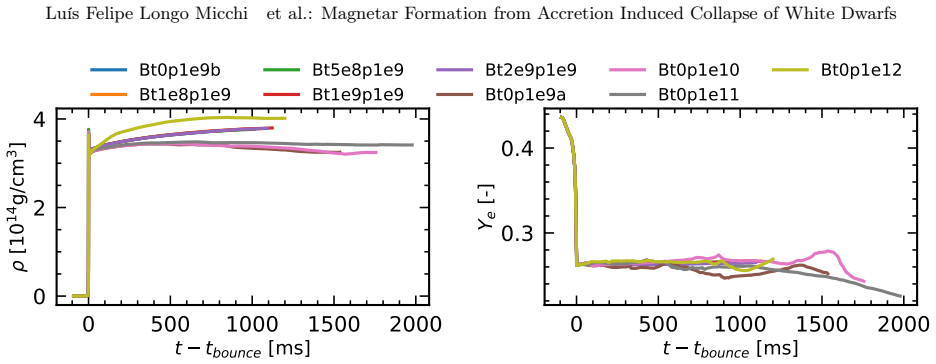
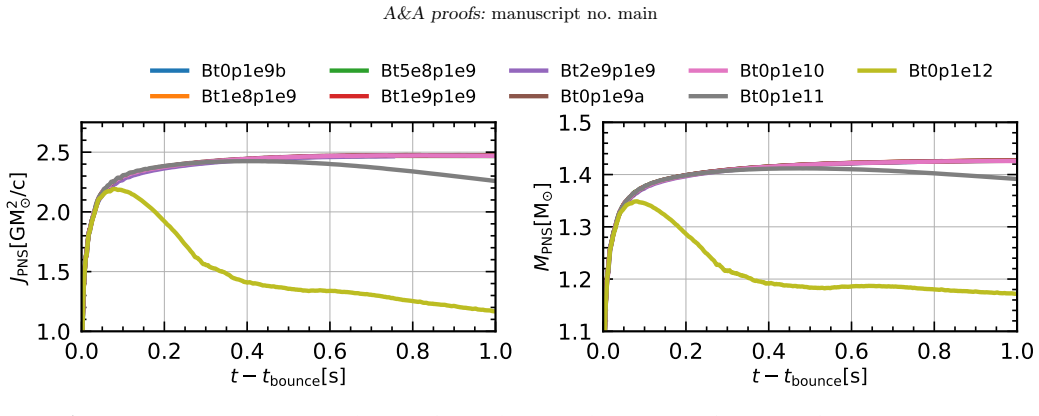
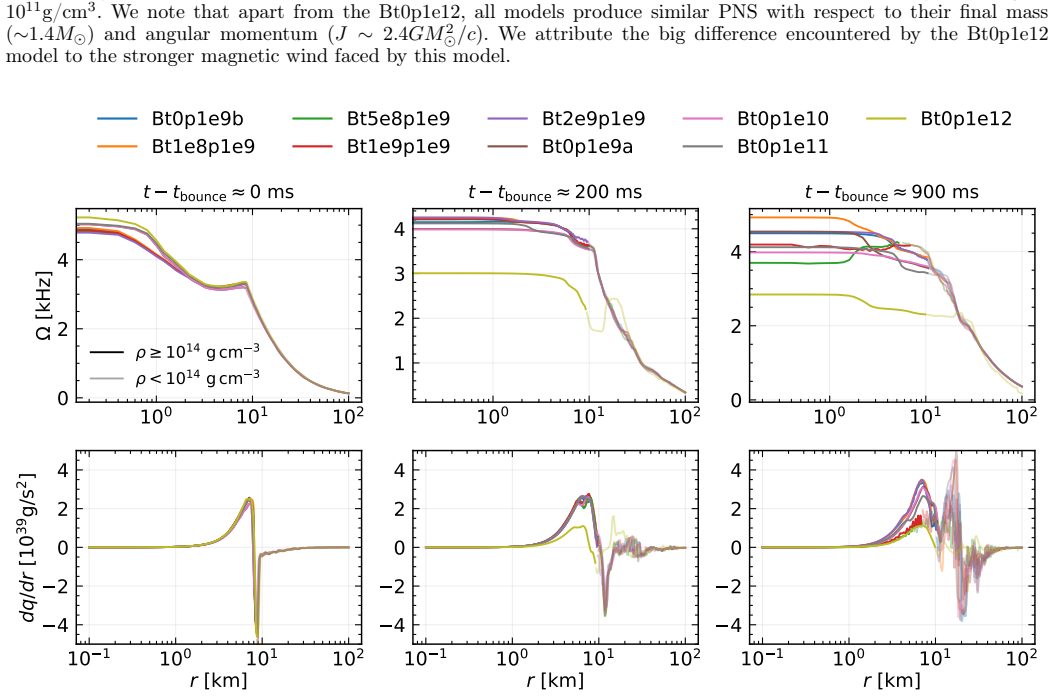
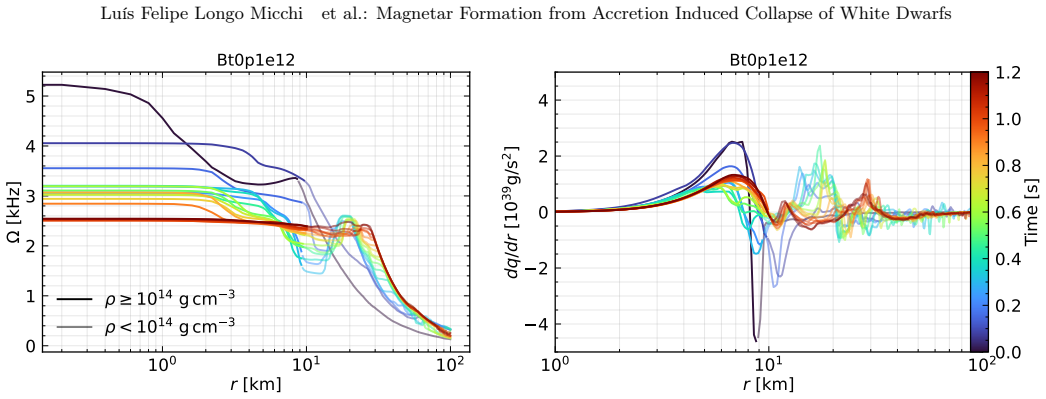
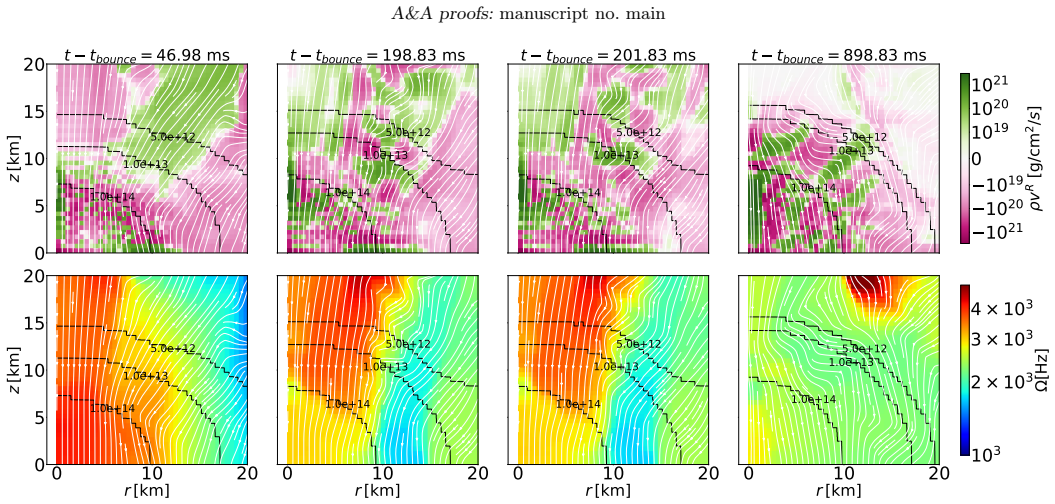
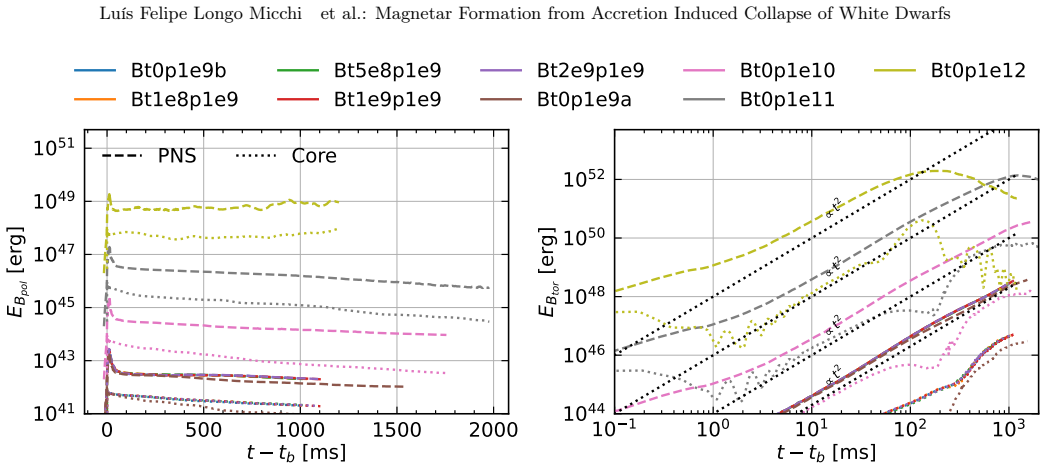
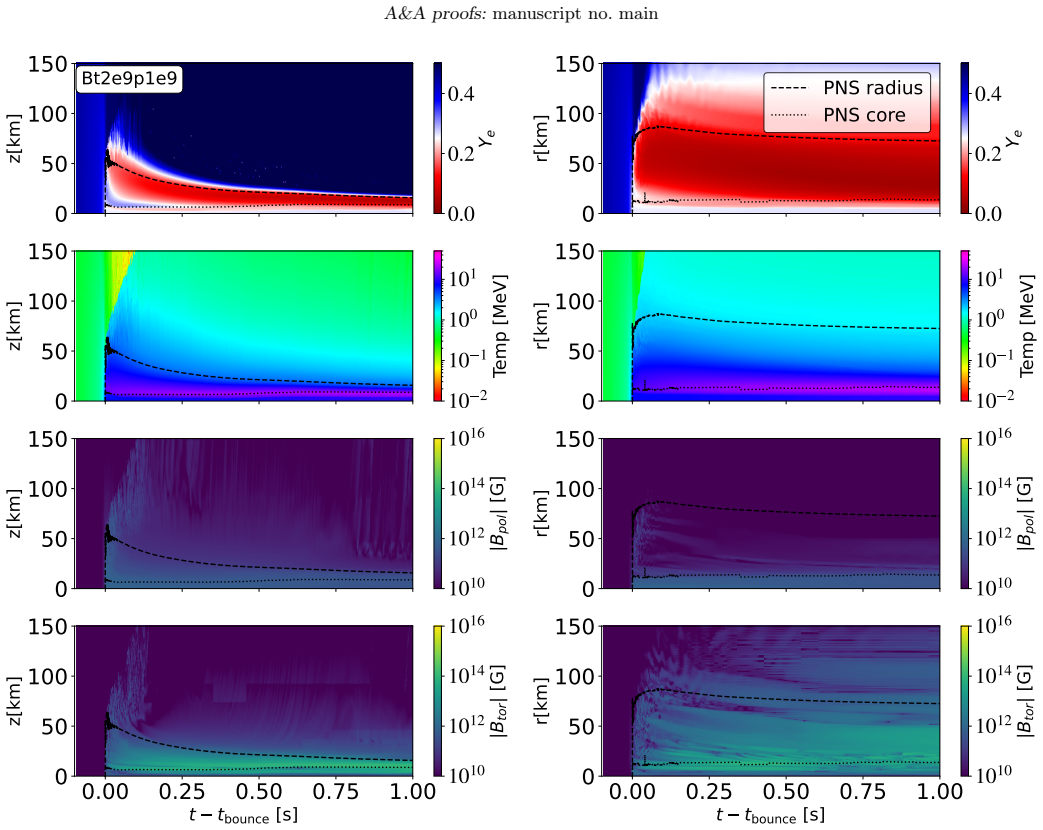
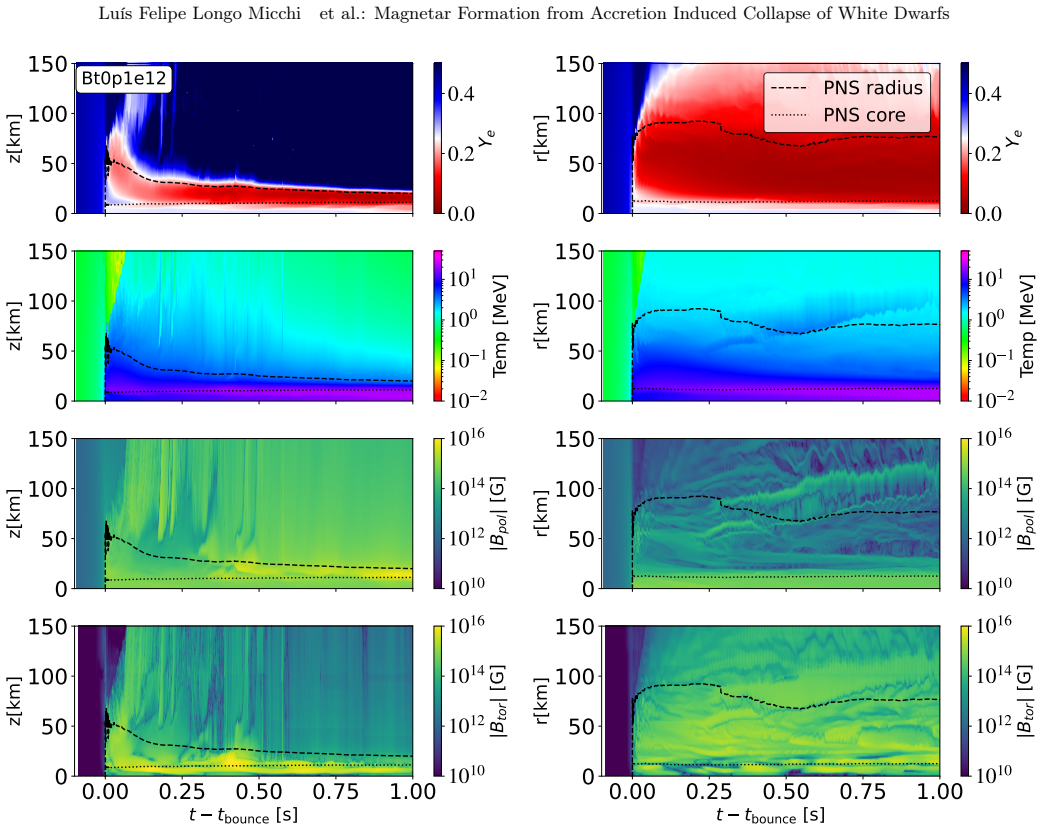
The collapse produces a rapidly rotating proto-magnetar of 1.15-1.45 solar masses spinning at 2.9-4.9 kHz, surrounded by a persistent accretion disk. The remnant stays strongly magnetized above 10^13 G and hot above 20 MeV for at least 1 s after bounce, with surface poloidal fields around 10^12 G and toroidal fields around 10^14 G. Global oscillations in the first 10 ms drive gravitational-wave emission and modulate the poloidal magnetic field. Magnetic energy normalized to its bounce value follows an approximately universal evolution. When magnetic energy exceeds rotational energy of roughly 10^52 erg the remnant core becomes unstable, producing episodic magnetic flux expulsion, mass ejecti
What carries the argument
The instability threshold at which magnetic energy exceeds rotational energy (~10^52 erg), which triggers episodic magnetic flux expulsion and mass ejection.
If this is right
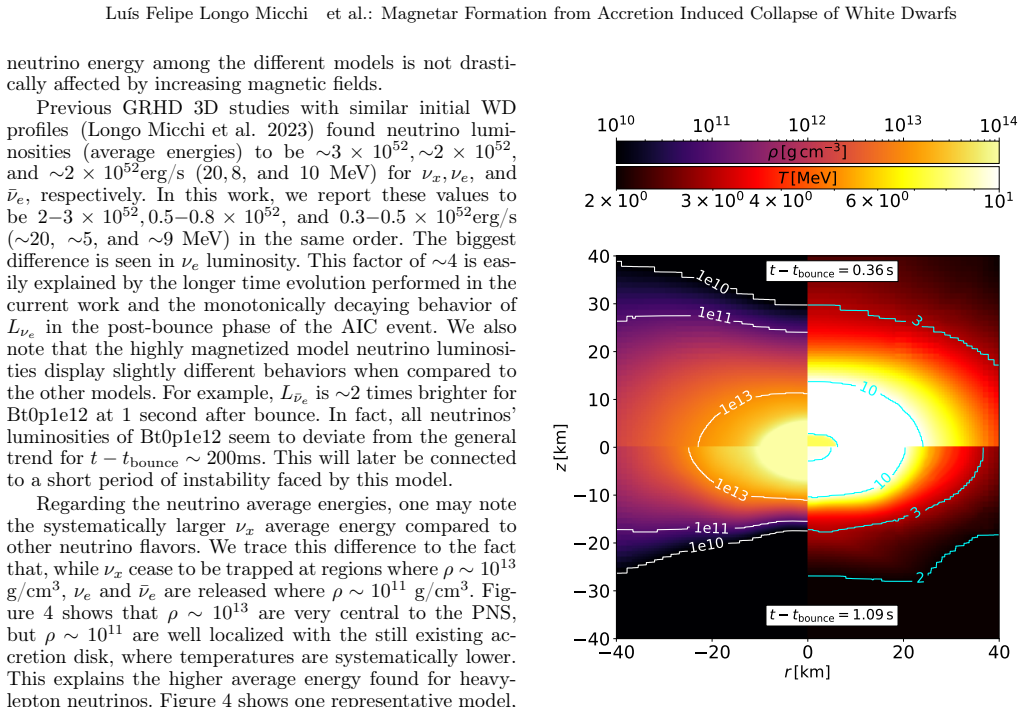
- The proto-magnetar interior remains magnetized above 10^13 G and hot above 20 MeV up to 1 s post-bounce, with both maxima inside the inner 10 km.
- Surface poloidal fields reach 10^12 G and toroidal fields reach 10^14 G, with strong toroidal components extending into the equatorial region.
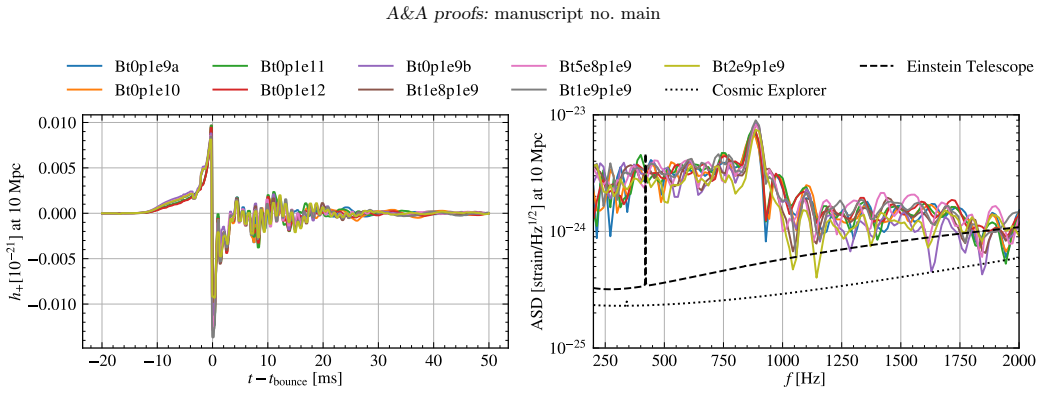
- Global oscillations during the first 10 ms drive gravitational-wave emission and coherent modulation of poloidal magnetic-field energy.
- Stronger initial magnetic fields produce lower final rotation rates of the remnant.
- A persistent accretion disk surrounds the remnant for at least 1 s after bounce.
Where Pith is reading between the lines
- The mechanism supplies a possible channel linking AIC events to observed magnetar flares through the episodic release of magnetic energy.
- The reported universal magnetic-energy evolution could permit prediction of the onset of instability largely independent of the precise initial field strength.
- Gravitational-wave signals from the early oscillations may be detectable and help distinguish AIC from other core-collapse channels.
- If realistic three-dimensional field geometries or rotation profiles disrupt coherence, the instability threshold would shift or disappear.
Load-bearing premise
The initial white-dwarf models are assumed to be in rapid rotation with prescribed poloidal magnetic fields that remain coherent through collapse.
What would settle it
A three-dimensional simulation of the same initial conditions in which magnetic-field coherence is lost before magnetic energy reaches rotational energy would falsify the reported instability threshold and universal evolution.
Figures
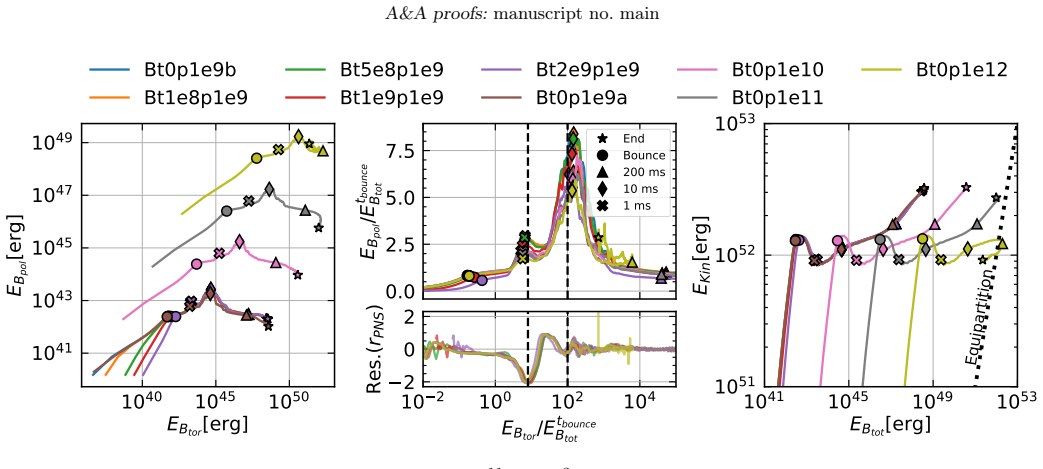
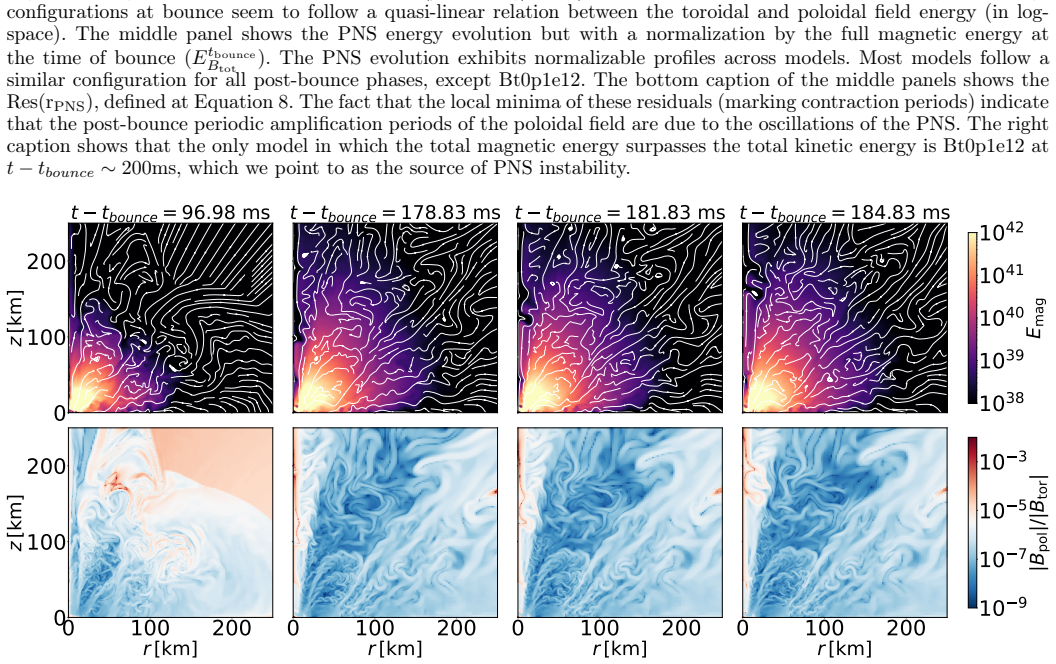
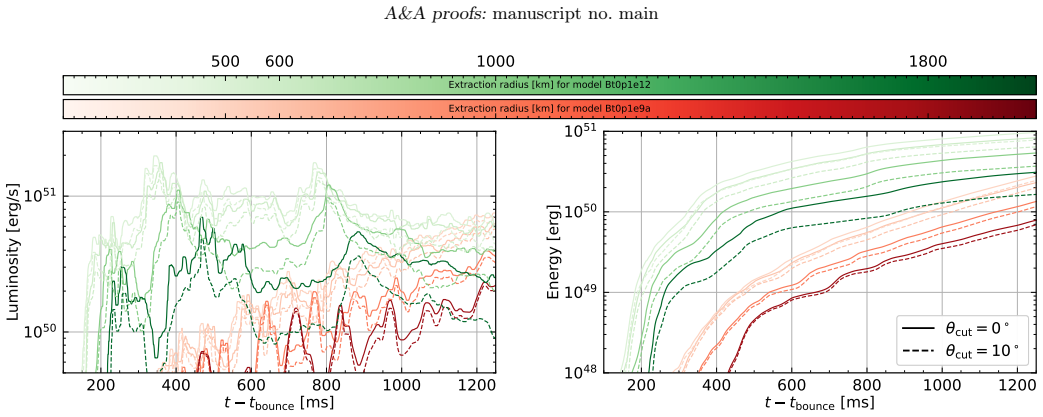
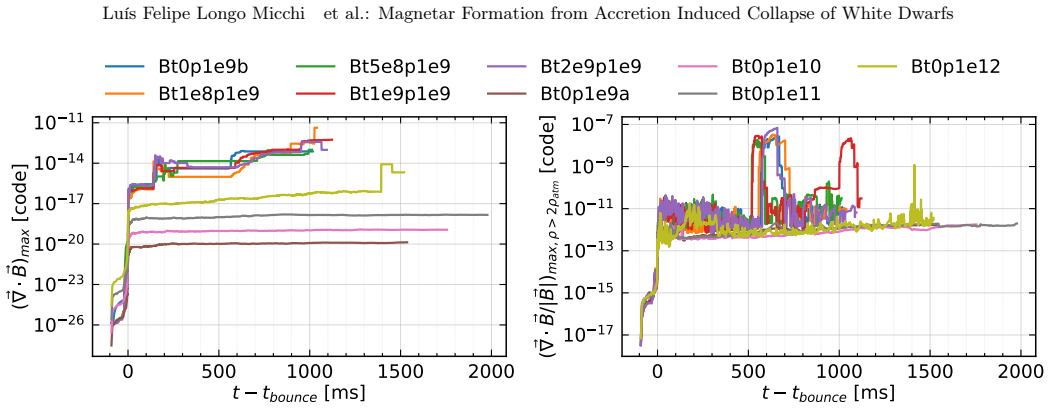
read the original abstract
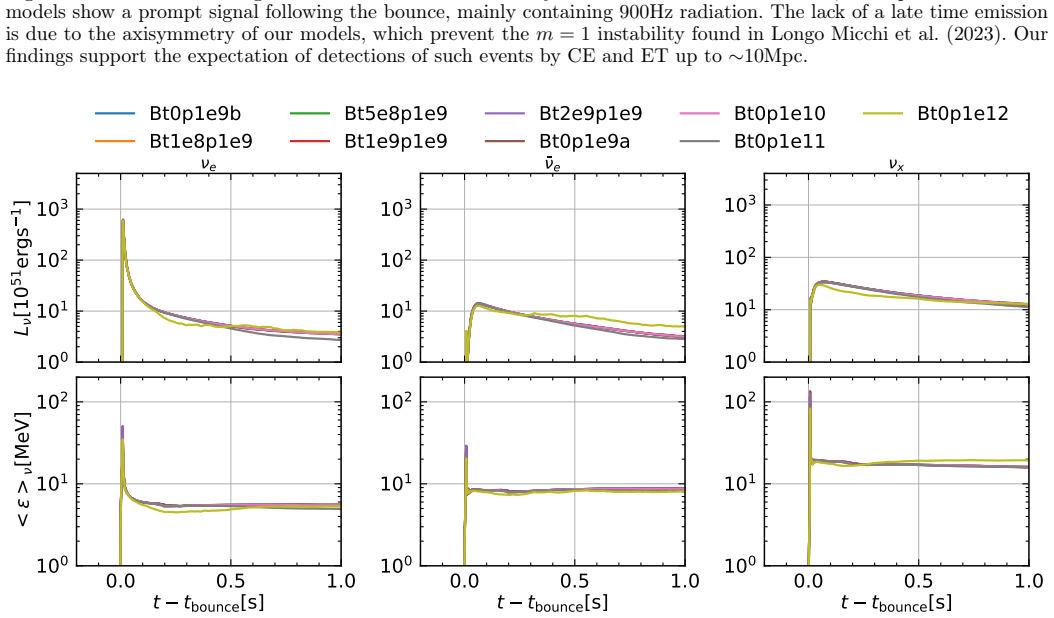
We aim to characterize the post-collapse evolution of accretion-induced collapse (AIC) remnants of rapidly rotating, magnetized white dwarfs, focusing on their rotational, magnetic, and thermal structure, as well as the development of instabilities and their energy content. We perform nine axis-symmetric general-relativistic neutrino magnetohydrodynamic (MHD) simulations of collapsing, rapidly rotating, magnetized white dwarfs. The simulations follow the system from collapse through bounce and up to $\sim$1 s post-bounce. The simulations are performed by the conformally flat general relativistic neutrino MHD code \texttt{Gmunu}. The collapse produces a rapidly rotating proto-magnetar surrounded by a persistent accretion disk lasting at least $\sim 1$ s after bounce. The remnant mass and spin span 1.15--1.45 $M_{\odot}$ and 2.9--4.9 kHz, respectively, with stronger initial magnetic fields generally leading to lower rotation rates. During the first $\sim 10$ ms, the proto-magnetar exhibits global oscillations that drive both gravitational-wave emission and coherent modulation of the poloidal magnetic field energy. The magnetic energy evolution, normalized to its bounce value, follows an approximately universal behavior across all models. The remnant interior remains strongly magnetized ($\gtrsim 10^{13}$ G) and hot ($\gtrsim 20$ MeV) up to 1 s after bounce, with maxima of both quantities co-located in the inner $\sim 10$ km. The magnetic field topology shows surface poloidal fields of ${\sim}10^{12}$ G and toroidal fields of ${\sim}10^{14}$ G, with strong toroidal components extending into the equatorial region. When the magnetic energy exceeds the rotational energy ($\sim 10^{52}$ erg), the remnant core becomes unstable, leading to episodic magnetic flux expulsion, mass ejection, and flare-like activity in which magnetic energy is released and thermalized in the surrounding material.
Editorial analysis
A structured set of objections, weighed in public.
Referee Report
Summary. The manuscript reports results from nine axisymmetric general-relativistic neutrino magnetohydrodynamic simulations of the accretion-induced collapse of rapidly rotating, magnetized white dwarfs. It finds that the proto-magnetar remnants have masses 1.15-1.45 M_sun and spins 2.9-4.9 kHz, exhibit global oscillations driving GW emission, show approximately universal normalized magnetic-energy evolution, remain strongly magnetized (B ≳ 10^13 G) and hot (T ≳ 20 MeV) for ~1 s post-bounce, and become unstable when magnetic energy exceeds rotational energy (~10^52 erg), triggering episodic flux expulsion, mass ejection, and flare-like activity.
Significance. If the central results hold, the work supplies a concrete numerical pathway for magnetar formation via AIC, including quantitative links between initial WD parameters and final spin/magnetic structure, plus a proposed trigger for episodic energy release. The use of multiple models showing consistent normalized trends and the inclusion of GR neutrino MHD are positive features. The axisymmetric restriction, however, directly limits the robustness of the reported E_mag > E_rot instability threshold.
major comments (2)
- [Abstract] Abstract: The central claim that 'when the magnetic energy exceeds the rotational energy (~10^52 erg), the remnant core becomes unstable, leading to episodic magnetic flux expulsion...' is load-bearing for the paper's main conclusion on magnetar formation and flare activity, yet it rests entirely on axisymmetric runs in which prescribed poloidal fields remain coherent. No control tests or discussion address how non-axisymmetric modes (MRI, Tayler, kink) could redistribute or reconnect flux on dynamical timescales and cap E_mag below E_rot.
- [Abstract] Abstract: The statement that 'the magnetic energy evolution, normalized to its bounce value, follows an approximately universal behavior across all models' underpins the generality of the instability criterion, but the abstract provides no quantitative comparison of absolute energies or explicit demonstration that the normalization does not artificially enforce similarity; this weakens the cross-model claim without further verification in the results.
minor comments (1)
- [Abstract] Abstract: The description of surface poloidal (~10^12 G) and toroidal (~10^14 G) fields and their equatorial extension would benefit from a brief statement of how these values are extracted (e.g., at what radius or time post-bounce) to aid reproducibility.
Simulated Author's Rebuttal
We thank the referee for the careful review and constructive comments on our manuscript. We address the two major comments point by point below, noting revisions where appropriate. The work is limited to axisymmetric simulations, which we acknowledge as a key caveat for the instability claim.
read point-by-point responses
-
Referee: The central claim that 'when the magnetic energy exceeds the rotational energy (~10^52 erg), the remnant core becomes unstable, leading to episodic magnetic flux expulsion...' is load-bearing... yet it rests entirely on axisymmetric runs in which prescribed poloidal fields remain coherent. No control tests or discussion address how non-axisymmetric modes (MRI, Tayler, kink) could redistribute or reconnect flux on dynamical timescales and cap E_mag below E_rot.
Authors: We agree this is a substantive limitation of the axisymmetric setup. In our 2D GR neutrino MHD runs the coherent poloidal fields allow E_mag to grow above E_rot and trigger the observed episodic expulsion and flares. Non-axisymmetric modes could plausibly redistribute flux faster and prevent the threshold from being reached. We will add an explicit discussion of this caveat in the revised manuscript, including references to relevant 3D MHD literature, while noting that full verification requires 3D simulations. revision: partial
-
Referee: The statement that 'the magnetic energy evolution, normalized to its bounce value, follows an approximately universal behavior across all models' underpins the generality... but the abstract provides no quantitative comparison of absolute energies or explicit demonstration that the normalization does not artificially enforce similarity; this weakens the cross-model claim without further verification in the results.
Authors: The results section (Figures 5–7 and accompanying text) already presents both normalized and absolute magnetic-energy curves for all nine models, showing that absolute peak values range from ~0.8–3.2 imes 10^52 erg while the normalized growth tracks remain similar. The normalization is used only to compare relative evolution rates; absolute energies are reported separately and vary systematically with initial WD spin and B-field strength. We will revise the abstract to include a short clause on the absolute energy range and the consistency of the normalized trends to make this distinction clearer. revision: yes
- Effects of non-axisymmetric modes (MRI, Tayler, kink) on whether E_mag can exceed E_rot, which cannot be tested without 3D simulations beyond the scope of this work.
Circularity Check
No circularity: results follow from direct numerical evolution of GRMHD equations.
full rationale
The paper's central claims derive from nine axisymmetric GR neutrino-MHD simulations evolved with the Gmunu code from collapse through ~1 s post-bounce. Magnetic-energy evolution, instability onset when E_mag exceeds E_rot, and associated flux expulsion are reported as observed outcomes of the time-dependent equations under the stated initial conditions; no algebraic reduction, parameter fitting followed by reprediction, or load-bearing self-citation chain is present that would make the reported thresholds equivalent to the inputs by construction. The simulation framework is self-contained and externally falsifiable via independent codes or 3D extensions.
Axiom & Free-Parameter Ledger
free parameters (3)
- initial white-dwarf rotation rate
- initial magnetic field strength
- initial white-dwarf mass and composition
axioms (2)
- domain assumption Axisymmetric geometry is sufficient to capture the global oscillations and flux-expulsion episodes
- domain assumption Conformally flat GR approximation plus the chosen neutrino treatment accurately describes the collapse and early cooling
Reference graph
Works this paper leans on
-
[1]
Abdikamalov,E.B.,Ott,C.D.,Rezzolla,L.,etal.2010,Phys.Rev.D, 81, 044012, doi:10.1103/PhysRevD.81.044012
- [2]
-
[3]
2025, The Astrophysical Journal, 984, 197, doi:10.3847/1538-4357/adc300
Batziou, E., Glas, R., Janka, H.-T., et al. 2025, The Astrophysical Journal, 984, 197, doi:10.3847/1538-4357/adc300
-
[4]
Boerner, T. J., Deems, S., Furlani, T. R., Knuth, S. L., & Towns, J. 2023, in Practice and Experience in Advanced Research Comput- ing, PEARC ’23 (New York, NY, USA: Association for Computing Machinery), 173–176, doi:10.1145/3569951.3597559
-
[5]
2008, The Astrophys- ical Journal, 685, L19, doi:10.1086/592350
Burlon, D., Ghirlanda, G., Ghisellini, G., et al. 2008, The Astrophys- ical Journal, 685, L19, doi:10.1086/592350
-
[6]
N., Gropp, J
Burrows, D. N., Gropp, J. D., Osborne, J. P., et al. 2023, GRB Coor- dinates Network, 33429, 1
2023
-
[7]
Caiazzo, I., Burdge, K. B., Fuller, J., et al. 2021, Nature, 595, 39, doi:10.1038/s41586-021-03615-y
-
[8]
A., Lee, A., de Andrade, E
Caswell, T. A., Lee, A., de Andrade, E. S., et al. 2023, mat- plotlib/matplotlib: REL: v3.7.1, v3.7.1, Zenodo, doi:10.5281/ zenodo.7697899
2023
-
[9]
2015, Journal of Computational Physics, 286, 172, doi:10.1016/j.jcp.2015.01.031
Cavaglieri, D., & Bewley, T. 2015, Journal of Computational Physics, 286, 172, doi:10.1016/j.jcp.2015.01.031
-
[10]
1931, The Astrophysical Journal, 74, 81, doi:10
Chandrasekhar, S. 1931, The Astrophysical Journal, 74, 81, doi:10. 1086/143324
1931
-
[11]
Cheong, P. C.-K., Lam, A. T.-L., Ng, H. H.-Y., & Li, T. G. F. 2021, MNRAS, 508, 2279, doi:10.1093/mnras/stab2606
-
[12]
Cheong, P. C.-K., Lin, L.-M., & Li, T. G. F. 2020, Classical and Quantum Gravity, 37, 145015, doi:10.1088/1361-6382/ab8e9c
-
[13]
Cheong, P. C.-K., Ng, H. H.-Y., Lam, A. T.-L., & Li, T. G. F. 2023, ApJS, 267, 38, doi:10.3847/1538-4365/acd931
-
[14]
C.-K., Pitik, T., Longo Micchi, L
Cheong, P. C.-K., Pitik, T., Longo Micchi, L. F., & Radice, D. 2025, The Astrophysical Journal Letters, 978, L38, doi:10.3847/ 2041-8213/ada1cc
2025
-
[15]
Cheong, P. C.-K., Pong, D. Y. T., Yip, A. K. L., & Li, T. G. F. 2022, ApJS, 261, 22, doi:10.3847/1538-4365/ac6cec
-
[16]
Colella, P., & Woodward, P. R. 1984, Journal of Computational Physics, 54, 174, doi:10.1016/0021-9991(84)90143-8
-
[17]
Combi, L., Siegel, D. M., & Metzger, B. D. 2025, Jet-driven explosion of an accretion-induced white-dwarf collapse via a magnetorota- tional dynamo.https://arxiv.org/abs/2509.19799 Article number, page 13 A&A proofs:manuscript no. main 200 400 600 800 1000 1200 t tbounce [ms] 1050 1051 Luminosity [erg/s] 200 400 600 800 1000 1200 t tbounce [ms] 1048 1049 ...
-
[18]
2023, GRB Coordinates Network, 33407, 1
Dalessi, S., & Fermi GBM Team. 2023, GRB Coordinates Network, 33407, 1
2023
-
[19]
J., Meegan, C., & Fermi GBM Team
Dalessi, S., Roberts, O. J., Meegan, C., & Fermi GBM Team. 2023, GRB Coordinates Network, 33411, 1
2023
-
[20]
Dessart, L., Burrows, A., Livne, E., & Ott, C. D. 2007, ApJ, 669, 585, doi:10.1086/521701
-
[21]
Dessart, L., Burrows, A., Ott, C. D., et al. 2006, ApJ, 644, 1063, doi:10.1086/503626
-
[22]
A., & Swift Team
Evans, P. A., & Swift Team. 2023, GRB Coordinates Network, 33419, 1 Fermi GBM Team. 2023, GRB Coordinates Network, 33405, 1
2023
-
[23]
Ferrario, L., de Martino, D., & Gänsicke, B. T. 2015, Space Sci. Rev., 191, 111, doi:10.1007/s11214-015-0152-0
-
[24]
2020, Advances in Space Research, 66, 1025, doi:10.1016/j.asr.2019.11.012
Ferrario, L., Wickramasinghe, D., & Kawka, A. 2020, Advances in Space Research, 66, 1025, doi:10.1016/j.asr.2019.11.012
-
[25]
N., & Komissarov, S
Gourgouliatos, K. N., & Komissarov, S. S. 2018, Monthly Notices of the Royal Astronomical Society: Letters, 475, L125, doi:10.1093/ mnrasl/sly016
2018
-
[26]
Harris, C. R., Millman, K. J., van der Walt, S. J., et al. 2020, Nature, 585, 357, doi:10.1038/s41586-020-2649-2
-
[27]
1983, SIAM Review, 25, 35, doi:10
Harten, A., Lax, P., & Leer, B. 1983, SIAM Review, 25, 35, doi:10. 1137/1025002
1983
-
[28]
Hunter, J. D. 2007, Computing in Science and Engineering, 9, 90, doi:10.1109/MCSE.2007.55 Kashyap,R.,Haque,T.,Lorén-Aguilar,P.,García-Berro,E.,&Fisher, R. 2018, ApJ, 869, 140, doi:10.3847/1538-4357/aaedb7
-
[29]
2020, IAU Symposium, 357, 60, doi:10.1017/ S1743921320000745
Kawka, A. 2020, IAU Symposium, 357, 60, doi:10.1017/ S1743921320000745
2020
-
[30]
Kuroda, T., Kawaguchi, K., & Shibata, M. 2025, Mon. Not. Roy. Astron. Soc., 541, 1649, doi:10.1093/mnras/staf1065
-
[31]
Lattimer, J. M., & Swesty, D. F. 1991, Nucl. Phys. A, 535, 331, doi:10.1016/0375-9474(91)90452-C Liebendörfer, M. 2005, ApJ, 633, 1042, doi:10.1086/466517 Longo Micchi, L. F., Radice, D., & Chirenti, C. 2023, MNRAS, 525, 6359, doi:10.1093/mnras/stad2420
-
[32]
Manchester, R. N., Hobbs, G. B., Teoh, A., & Hobbs, M. 2005, As- tronomical Journal, 129, 1993, doi:10.1086/428488
work page internal anchor Pith review doi:10.1086/428488 2005
-
[33]
2022, Nature, 612, 236, doi:10.1038/s41586-022-05404-7
Mei, A., Banerjee, B., Oganesyan, G., et al. 2022, Nature, 612, 236, doi:10.1038/s41586-022-05404-7
-
[34]
Morozova, V., Piro, A. L., Renzo, M., et al. 2015, Astrophys. J., 814, 63, doi:10.1088/0004-637X/814/1/63
-
[35]
Ng, H. H.-Y., Cheong, P. C.-K., Lam, A. T.-L., & Li, T. G. F. 2024, ApJS, 272, 9, doi:10.3847/1538-4365/ad2fbd
-
[36]
Niemeyer, J. C., & Woosley, S. E. 1997, The Astrophysical Journal, 475, 740, doi:10.1086/303544
-
[37]
1991, ApJ, 367, L19, doi:10.1086/185922
Nomoto, K., & Kondo, Y. 1991, ApJ, 367, L19, doi:10.1086/185922
-
[38]
2024a, arXiv e-prints, arXiv:2407.02566, doi:10.48550/arXiv.2407.02566 —
Pakmor, R., Pelisoli, I., Justham, S., et al. 2024a, arXiv e-prints, arXiv:2407.02566, doi:10.48550/arXiv.2407.02566 —. 2024b, A&A, 691, A179, doi:10.1051/0004-6361/202451352 pandas development team, T. 2020, pandas-dev/pandas: Pandas, lat- est, Zenodo, doi:10.5281/zenodo.3509134
-
[39]
Piersanti, L., Gagliardi, S., Iben, Icko, J., & Tornambé, A. 2003a, ApJ, 583, 885, doi:10.1086/345444 —. 2003b, ApJ, 598, 1229, doi:10.1086/378952
-
[40]
2015, Monthly No- tices of the Royal Astronomical Society, 454, 95–114, doi:10.1093/mnras/ stv1972
Pitik, T., Radice, D., Kasen, D., et al. 2026, Monthly Notices of the Royal Astronomical Society, 549, stag899, doi:10.1093/mnras/ stag899
-
[41]
2022, MNRAS, 512, 1499, doi:10.1093/mnras/stac589
Radice, D., Bernuzzi, S., Perego, A., & Haas, R. 2022, MNRAS, 512, 1499, doi:10.1093/mnras/stac589
-
[42]
Rastinejad, J. C., Gompertz, B. P., Levan, A. J., et al. 2022, Nature, 612, 223, doi:10.1038/s41586-022-05390-w
-
[43]
Ruiter, A. J., & Seitenzahl, I. R. 2025, The Astronomy and Astro- physics Review, 33, 1, doi:10.1007/s00159-024-00158-9
-
[44]
2004, ApJ, 615, 444, doi:10.1086/423976
Saio, H., & Nomoto, K. 2004, ApJ, 615, 444, doi:10.1086/423976
-
[45]
Stergioulas, N., & Friedman, J. L. 1995, ApJ, 444, 306, doi:10.1086/ 175605
1995
-
[46]
Strutt, J. W. 1917, Proceedings of the Royal Society of London. Series A, Containing Papers of a Mathematical and Physical Character, 93, 148, doi:10.1098/rspa.1917.0010
-
[47]
2007, PASJ, 59, 771, doi:10.1093/pasj/59.4.771
Suwa, Y., Takiwaki, T., Kotake, K., & Sato, K. 2007, PASJ, 59, 771, doi:10.1093/pasj/59.4.771
-
[48]
Troja, E., Fryer, C. L., O’Connor, B., et al. 2022, Nature, 612, 228, doi:10.1038/s41586-022-05327-3
-
[49]
Turk, M. J., Smith, B. D., Oishi, J. S., et al. 2011, The Astrophysical Journal Supplement Series, 192, 9, doi:10.1088/0067-0049/192/ 1/9
-
[50]
2003, ApJ, 595, 1094, doi:10
Uenishi, T., Nomoto, K., & Hachisu, I. 2003, ApJ, 595, 1094, doi:10. 1086/377248
2003
-
[51]
2021, MNRAS, 508, 6033, doi:10.1093/mnras/stab2983
Varma, V., Müller, B., & Obergaulinger, M. 2021, MNRAS, 508, 6033, doi:10.1093/mnras/stab2983
-
[52]
SciPy1.0: FundamentalalgorithmsforscientificcomputinginPython,
Virtanen, P., Gommers, R., Oliphant, T. E., et al. 2020, Nature Meth- ods, 17, 261, doi:10.1038/s41592-019-0686-2 Wes McKinney. 2010, in Proceedings of the 9th Python in Science Conference, ed. Stéfan van der Walt & Jarrod Millman, 56 – 61, doi:10.25080/Majora-92bf1922-00a
-
[53]
2022, Mon.Not.Roy.Astron.Soc.,512,328,doi:10.1093/mnras/stac399
Wu, Z., Ricigliano, G., Kashyap, R., Perego, A., & Radice, D. 2022, Mon.Not.Roy.Astron.Soc.,512,328,doi:10.1093/mnras/stac399
-
[54]
2022, Nature, 612, 232, doi:10
Yang, J., Ai, S., Zhang, B.-B., et al. 2022, Nature, 612, 232, doi:10. 1038/s41586-022-05403-8
2022
-
[55]
Yoon, S. C., & Langer, N. 2004, A&A, 419, 623, doi:10.1051/ 0004-6361:20035822 —. 2005, A&A, 435, 967, doi:10.1051/0004-6361:20042542
-
[56]
Zhu, C., Pakmor, R., van Kerkwijk, M. H., & Chang, P. 2015, ApJ, 806, L1, doi:10.1088/2041-8205/806/1/L1 Article number, page 14 Luís Felipe Longo Micchi et al.: Magnetar Formation from Accretion Induced Collapse of White Dwarfs 0 500 1000 1500 2000 t tbounce [ms] 10 26 10 23 10 20 10 17 10 14 10 11 ( B)max [code] 0 500 1000 1500 2000 t tbounce [ms] 10 17...
discussion (0)
Sign in with ORCID, Apple, or X to comment. Anyone can read and Pith papers without signing in.