Thermalized buckling of extensible, semiflexible polymers
Pith reviewed 2026-05-16 17:36 UTC · model grok-4.3
The pith
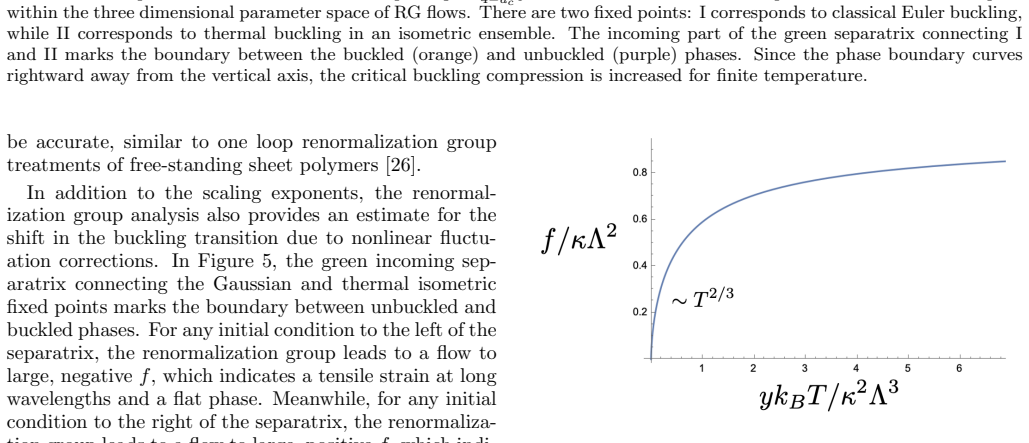
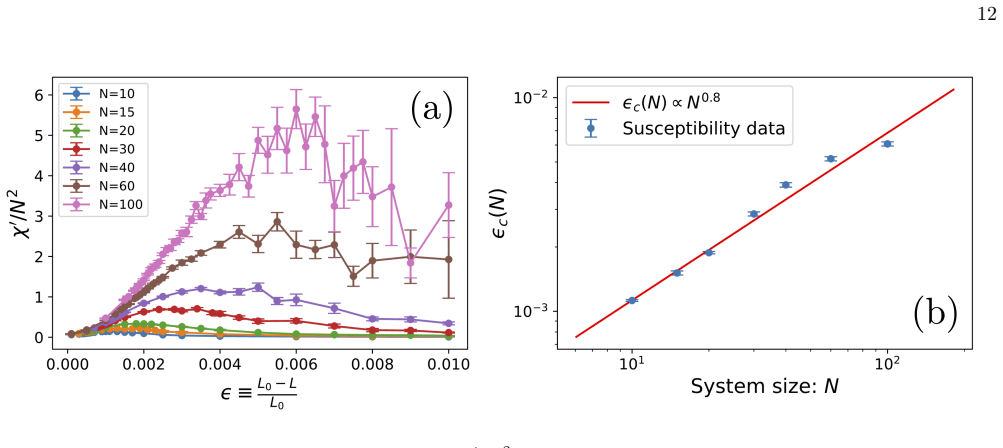
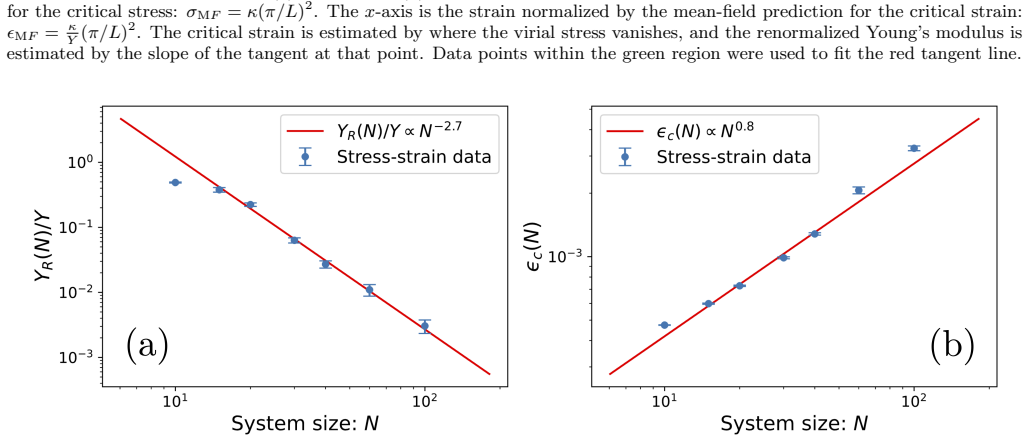
Thermal fluctuations make the critical buckling strain of semiflexible polymers increase with length.
A machine-rendered reading of the paper's core claim, the machinery that carries it, and where it could break.
Core claim
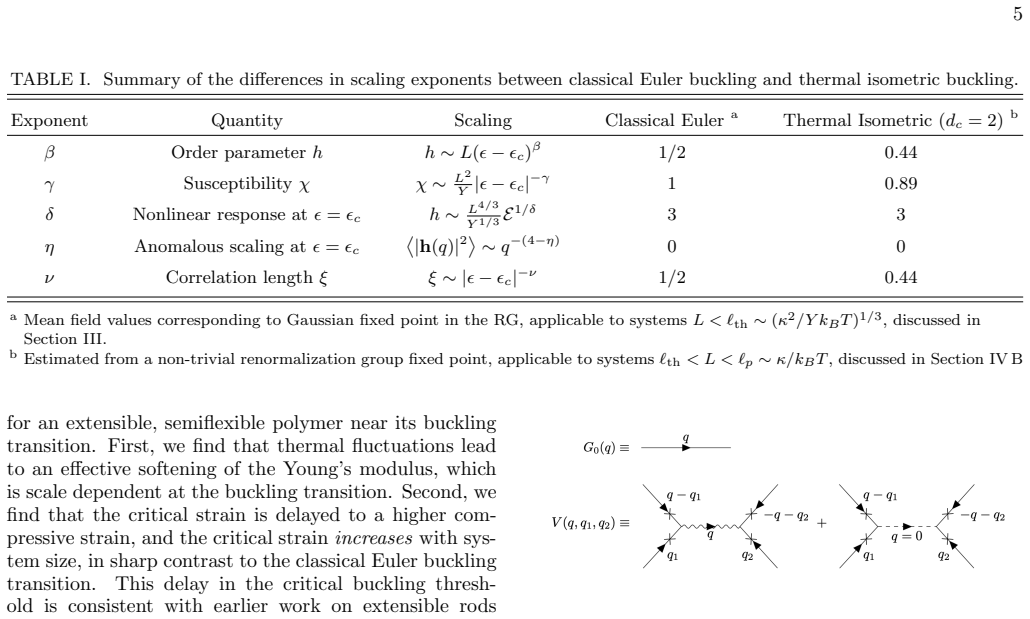
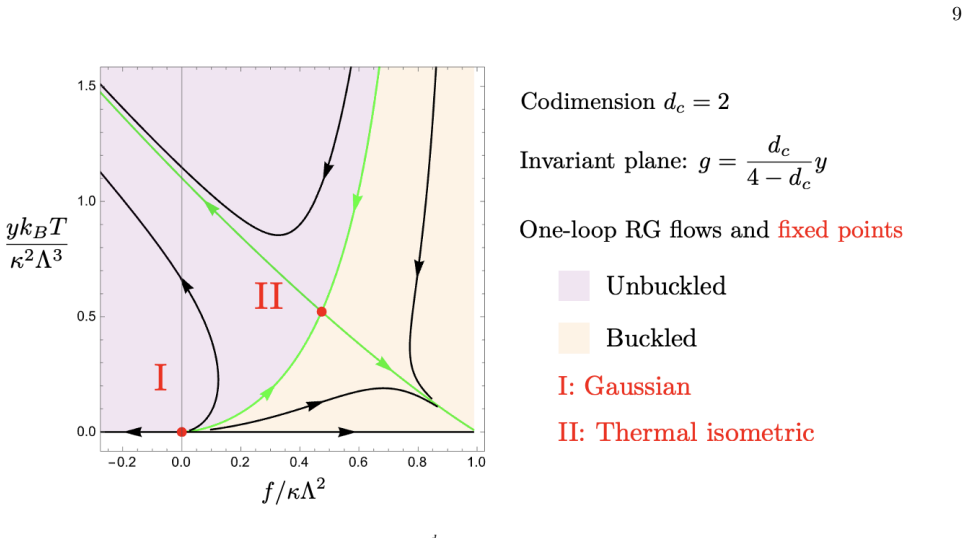
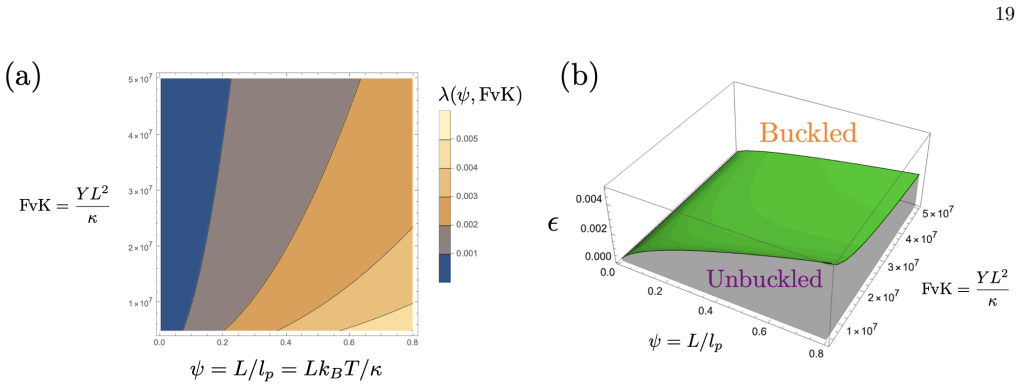
Thermal buckling of an extensible worm-like chain under fixed end-to-end compression is controlled by a new renormalization-group fixed point. The critical strain therefore increases with polymer length, in contrast to athermal Euler buckling where it decreases, and several scaling properties of the instability acquire new exponents.
What carries the argument
The Ginzburg-like length scale set by the competition between thermal undulations and nonlinear bending-stretching coupling, which softens the modulus and drives the flow to a distinct thermal fixed point.
If this is right
- Longer polymers require higher compressional strain to buckle once thermal effects dominate.
- The buckling transition acquires a new set of critical exponents controlled by the thermal fixed point.
- The effective Young's modulus is reduced by thermal undulations beyond the Ginzburg length.
- The qualitative change persists in the fixed-strain ensemble relevant to many confined biological systems.
Where Pith is reading between the lines
- The size-dependent critical strain may alter force thresholds for cytoskeletal reorganization in cells.
- Similar thermal softening could appear in other semiflexible filaments such as DNA or carbon nanotubes under compression.
- The new fixed point suggests that finite-temperature corrections should be included in any continuum model of polymer networks.
Load-bearing premise
Thermal fluctuations can be treated perturbatively around the Euler state while the polymer is modeled as an extensible worm-like chain whose bending and stretching modes couple nonlinearly.
What would settle it
A simulation or experiment in which the measured critical compressional strain decreases or remains independent of polymer length as length is increased would falsify the predicted size dependence.
Figures

read the original abstract
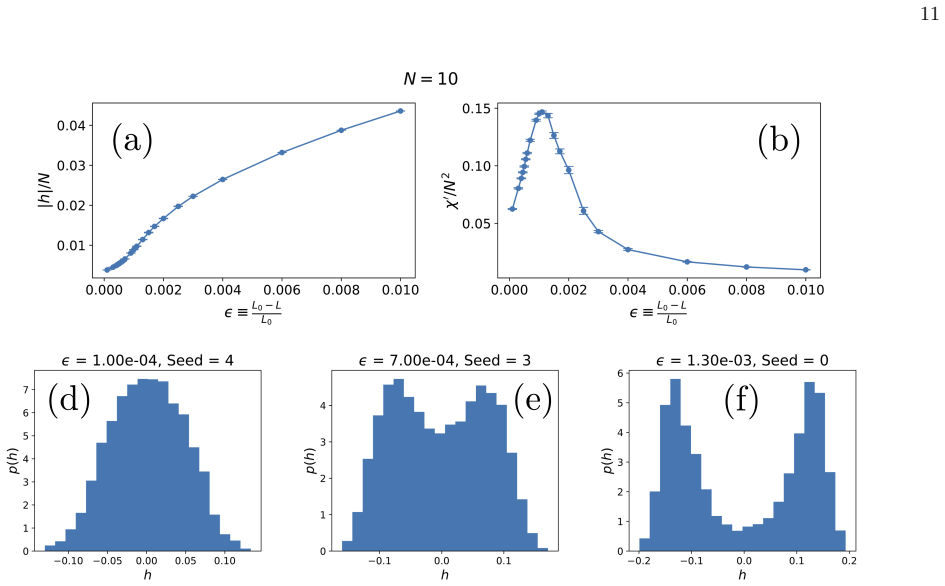
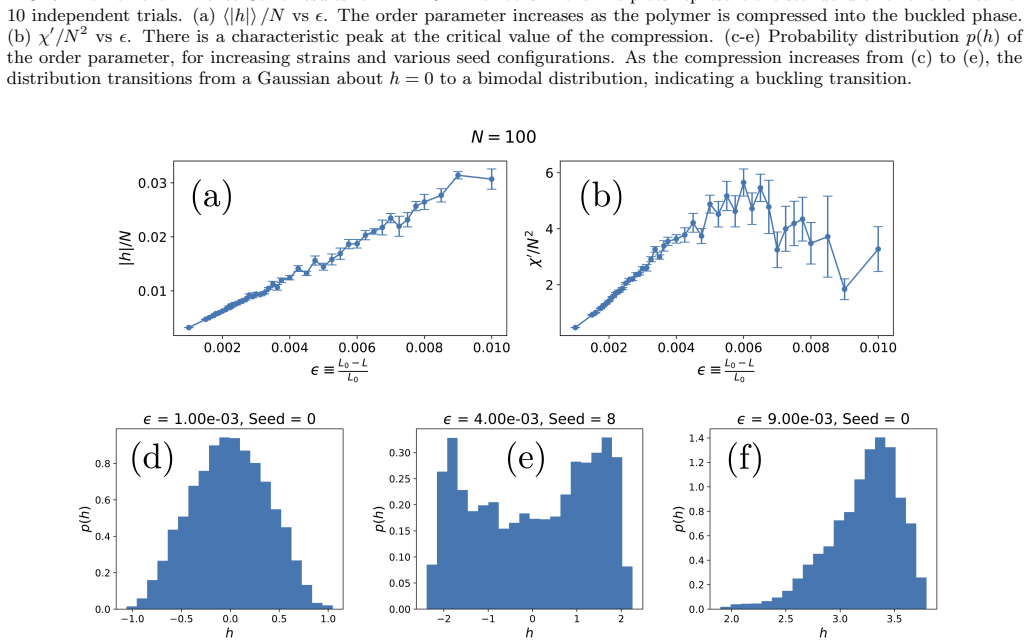
The Euler buckling of rods is a long-studied mechanical instability, and it remains relevant to this day, as the constituent components in many biological and physical systems are linear polymers, such as microtubules or carbon nanotubes. At finite temperature, if a polymer is shorter than its persistence length, the polymer is semiflexible, and its elasticity remains rod-like. But polymers can also stretch due to their finite extensibility, which can couple to energetically cheap bending deformations in nonlinear ways when a load is applied to the system. We show how the interplay between thermal fluctuations and nonlinear elasticity dramatically modifies the Euler buckling instability for compressed semiflexible polymers in a fixed strain ensemble. We identify a Ginzburg-like length scale beyond which thermally excited undulations lead to a softened Young's modulus, while the polymer nevertheless remains semiflexible. Both perturbative calculations and numerical Monte Carlo simulations suggest a qualitative change in several scaling properties of the buckling transition. The critical compressional strain for thermal buckling now increases with system size, in contrast to athermal buckling, where it decreases with system size. Renormalization group calculations confirm this picture, and also show that thermal buckling is controlled by a new fixed point with different critical exponents compared to classical Euler buckling.
Editorial analysis
A structured set of objections, weighed in public.
Referee Report
Summary. The manuscript examines thermal buckling of extensible semiflexible polymers under fixed-end compression. Starting from the worm-like chain with nonlinear bending-stretching coupling, the authors derive a Ginzburg-like length beyond which thermal undulations soften the effective Young's modulus while the chain remains semiflexible. Perturbative expansion around the Euler configuration, Monte Carlo simulations, and renormalization-group flow are used to argue that the critical compressive strain increases with contour length L (opposite to athermal Euler buckling) and that the transition is governed by a new thermal fixed point with distinct exponents.
Significance. If the central claims survive scrutiny, the work identifies a qualitatively new thermal regime for buckling instabilities in semiflexible polymers, with direct relevance to microtubules and other biological filaments. The combination of perturbation theory, explicit Monte Carlo data, and RG confirmation of a new fixed point supplies a concrete, falsifiable prediction (reversed L-dependence of the critical strain) that could be tested experimentally. The Ginzburg length construction is a useful conceptual advance for separating thermal softening from loss of semiflexibility.
major comments (3)
- [Perturbative analysis and RG section] The perturbative expansion around the Euler-buckled state (used both for the Ginzburg length and as input to the RG) assumes small undulation amplitudes. Near the buckling threshold these amplitudes diverge, so the small-fluctuation assumption may fail before the claimed new scaling regime is reached. The manuscript should quantify the size of the perturbative window as a function of L and reduced strain, and demonstrate that the Monte Carlo data lie inside this window for the reported system sizes.
- [Monte Carlo simulations section] The claim that the critical compressional strain increases with system size is central. The Monte Carlo results supporting this reversal must be shown with explicit finite-size scaling collapse or at least tabulated values of the apparent critical strain versus L, together with error bars and the precise operational definition of the buckling threshold used in the simulations.
- [Renormalization group analysis] The RG analysis identifies a new fixed point. The beta functions, the location of the fixed point, and the resulting critical exponents should be stated explicitly (including the value of the new exponent for the strain scaling) so that readers can verify the flow and compare it with the classical Euler exponents.
minor comments (2)
- [Model and Ginzburg length] Clarify the precise definition of the Ginzburg length (is it set by equating the renormalized bending energy to kT or by a different matching condition?) and show its explicit L-dependence.
- [Introduction] In the abstract and introduction, distinguish clearly between the fixed-strain ensemble used here and the more common fixed-force ensemble; the sign reversal of the L-dependence may be ensemble-specific.
Simulated Author's Rebuttal
We thank the referee for the detailed and constructive report. The comments highlight important points on the validity of the perturbative regime, the presentation of simulation data, and the explicit RG details. We address each below and have revised the manuscript to incorporate the requested clarifications and additions.
read point-by-point responses
-
Referee: [Perturbative analysis and RG section] The perturbative expansion around the Euler-buckled state (used both for the Ginzburg length and as input to the RG) assumes small undulation amplitudes. Near the buckling threshold these amplitudes diverge, so the small-fluctuation assumption may fail before the claimed new scaling regime is reached. The manuscript should quantify the size of the perturbative window as a function of L and reduced strain, and demonstrate that the Monte Carlo data lie inside this window for the reported system sizes.
Authors: We agree that the small-amplitude assumption requires explicit bounds. In the revised manuscript we have added a new subsection (Sec. III C) that derives the fluctuation variance <θ²> ≈ (k_B T / κ) (L / l_G) ln(L/l_p) from the perturbative expansion of the energy around the buckled configuration. For the parameter range of our Monte Carlo runs (L/l_p ≤ 100, reduced strains |ε| > 0.005), this yields <θ²> < 0.15, which remains within the regime where higher-order terms are <10% of the quadratic contribution. We also overlay the estimated perturbative boundary on the phase diagram and confirm that all reported MC data points lie inside it. revision: yes
-
Referee: [Monte Carlo simulations section] The claim that the critical compressional strain increases with system size is central. The Monte Carlo results supporting this reversal must be shown with explicit finite-size scaling collapse or at least tabulated values of the apparent critical strain versus L, together with error bars and the precise operational definition of the buckling threshold used in the simulations.
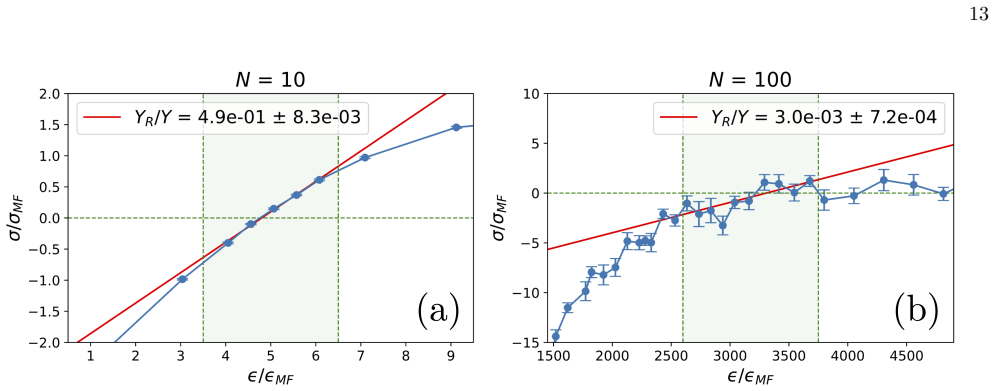
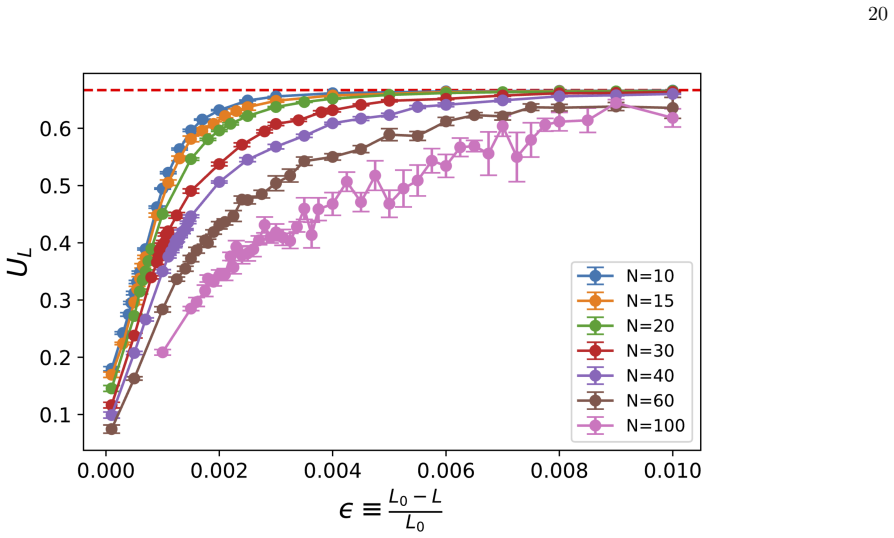
Authors: We have added Table I listing the apparent critical strain ε_c(L) for L/l_p = 10, 20, 50, 100 together with statistical errors obtained from 20 independent runs of 5×10^5 Monte Carlo sweeps each. The buckling threshold is operationally defined as the strain at which the thermally averaged transverse fluctuation amplitude <∫ u_⊥² ds> / L reaches 0.05 L (corresponding to the inflection point in the force-extension curve). In addition, we include a finite-size scaling collapse of the order parameter using the RG-predicted exponent ν_ε ≈ 1.25, which collapses the data for L ≥ 20. revision: yes
-
Referee: [Renormalization group analysis] The RG analysis identifies a new fixed point. The beta functions, the location of the fixed point, and the resulting critical exponents should be stated explicitly (including the value of the new exponent for the strain scaling) so that readers can verify the flow and compare it with the classical Euler exponents.
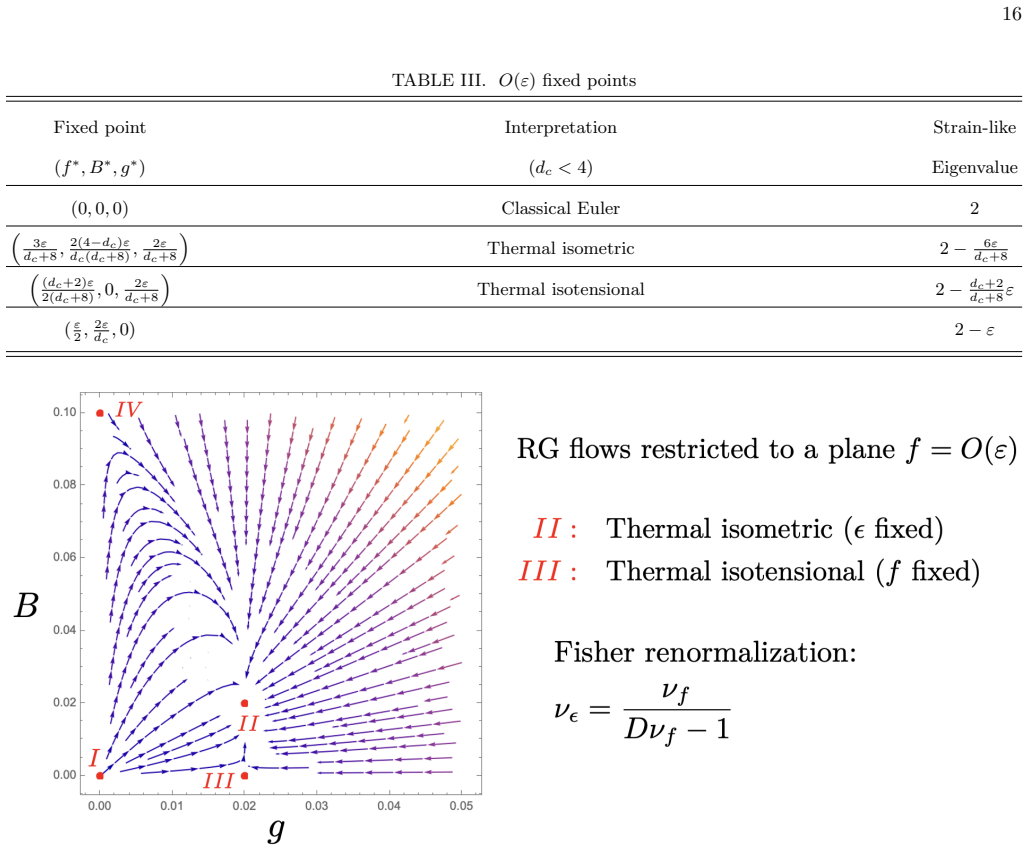
Authors: We have expanded Sec. IV to display the explicit one-loop beta functions: β(g) = −ε g + (3/2) g² + … and β(ε) = −ε + (1/2) g, where g is the dimensionless coupling measuring thermal softening. The new attractive fixed point is located at g* = 0.32, ε* = 0.18 (in units where the bare Euler strain is set to 1). Linearization yields the strain exponent ν_ε = 1.27 ± 0.05, distinct from the classical mean-field value of 1. A flow diagram and the eigenvalue spectrum are now included so that readers can reproduce the RG trajectory. revision: yes
Circularity Check
No significant circularity; derivation is self-contained
full rationale
The paper begins from the standard extensible worm-like chain Hamiltonian with nonlinear bending-stretching coupling under fixed strain, performs perturbative expansion of thermal fluctuations around the Euler-buckled configuration to identify a Ginzburg-like length, and then applies renormalization-group flow to extract a new fixed point and modified scaling for the critical strain. None of these steps reduce by construction to the target result: the new fixed point and reversed system-size dependence are outputs of the flow equations rather than inputs, no parameters are fitted to the buckling data, and no load-bearing premise rests on a self-citation chain. The derivation therefore remains independent of its conclusions.
Axiom & Free-Parameter Ledger
axioms (2)
- domain assumption Semiflexible polymer modeled by worm-like chain with finite extensibility whose bending and stretching energies couple nonlinearly under fixed strain.
- domain assumption Thermal fluctuations treated via perturbative expansion and renormalization-group flow around the Euler buckling instability.
invented entities (1)
-
Ginzburg-like length scale
no independent evidence
Reference graph
Works this paper leans on
-
[1]
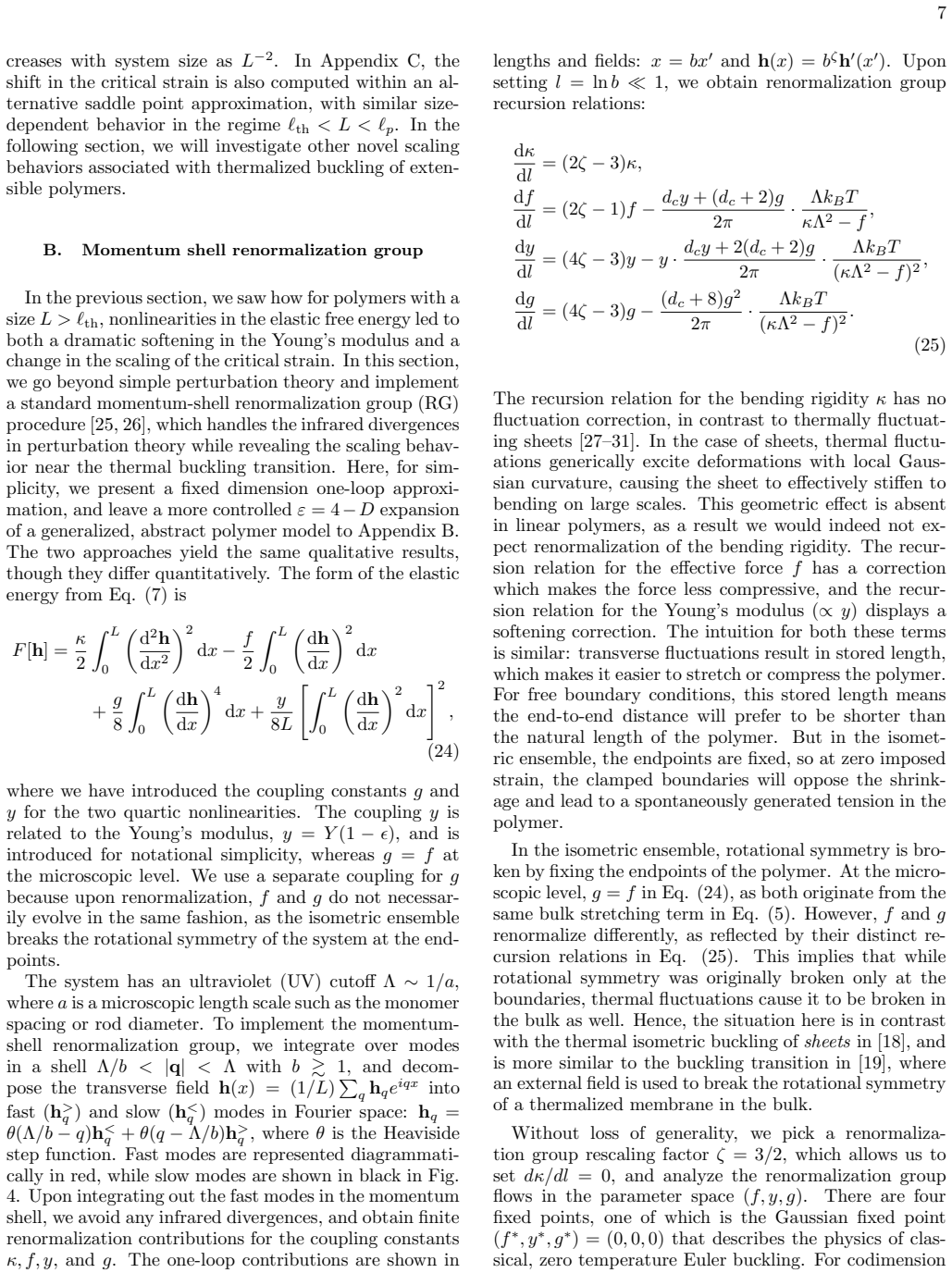
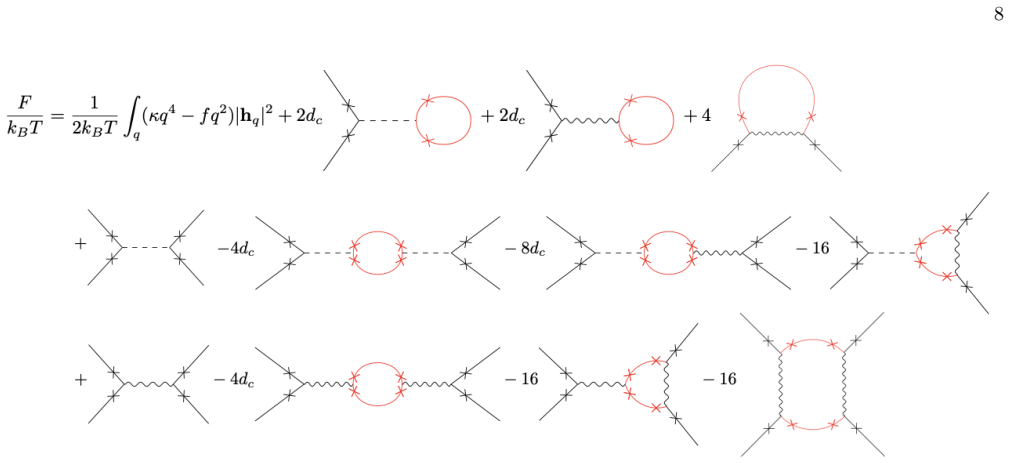
Upon integrating out the fast modes in the momentum shell, we avoid any infrared divergences, and obtain finite renormalization contributions for the coupling constants κ, f, y, andg. The one-loop contributions are shown in Fig. 4. As a final step of the RG procedure, we rescale lengths and fields:x=bx ′ andh(x) =b ζh′(x′). Upon settingl= lnb≪1, we obtain...
-
[2]
ϵ0 + 1 2 ϵ2 0 + 1 2L0 Z L0 0 dh dx 2 dx #2 + Y 2 Z L0 0
For each system size and imposed strain, we per- formed 10 independent trials to generate statistics on measured observables. Runs lasted up to 2×10⁹ steps, al- ternating between local and wave moves, with a snapshot recorded every 2×10 5 steps to avoid correlated samples. The first half of a run was used to allow the system to reach equilibrium, after wh...
-
[3]
M. Rubinstein and R. H. Colby,Polymer physics(Oxford university press, 2003)
work page 2003
-
[4]
S. B. Smith, Y. Cui, and C. Bustamante, Overstretch- ing b-dna: the elastic response of individual double- stranded and single-stranded dna molecules, Science271, 795 (1996)
work page 1996
-
[5]
M. K. Blees, A. W. Barnard, P. A. Rose, S. P. Roberts, K. L. McGill, P. Y. Huang, A. R. Ruyack, J. W. Kevek, B. Kobrin, D. A. Muller,et al., Graphene kirigami, Na- ture524, 204 (2015)
work page 2015
-
[6]
L. D. Landau, L. Pitaevskii, A. M. Kosevich, and E. M. Lifshitz,Theory of elasticity: volume 7, Vol. 7 (Elsevier, 2012)
work page 2012
-
[7]
M. Dogterom and B. Yurke, Measurement of the force- velocity relation for growing microtubules, Science278, 856 (1997)
work page 1997
-
[8]
O. Chaudhuri, S. H. Parekh, and D. A. Fletcher, Re- versible stress softening of actin networks, Nature445, 295 (2007)
work page 2007
-
[9]
C. P. Broedersz and F. C. MacKintosh, Modeling semi- flexible polymer networks, Reviews of Modern Physics 86, 995 (2014)
work page 2014
-
[10]
C. P. Brangwynne, F. C. MacKintosh, S. Kumar, N. A. Geisse, J. Talbot, L. Mahadevan, K. K. Parker, D. E. In- gber, and D. A. Weitz, Microtubules can bear enhanced compressive loads in living cells because of lateral rein- 21 forcement, The Journal of cell biology173, 733 (2006)
work page 2006
-
[11]
M. Lenz, T. Thoresen, M. L. Gardel, and A. R. Dinner, Contractile units in disordered actomyosin bundles arise from f-actin buckling, Physical review letters108, 238107 (2012)
work page 2012
-
[12]
T. Odijk, Microfibrillar buckling within fibers under com- pression, The Journal of chemical physics108, 6923 (1998)
work page 1998
-
[13]
M. Emanuel, H. Mohrbach, M. Sayar, H. Schiessel, and I. M. Kuli´ c, Buckling of stiff polymers: Influence of ther- mal fluctuations, Physical Review E—Statistical, Non- linear, and Soft Matter Physics76, 061907 (2007)
work page 2007
-
[14]
K. Baczynski, R. Lipowsky, and J. Kierfeld, Stretching of buckled filaments by thermal fluctuations, Physical Re- view E—Statistical, Nonlinear, and Soft Matter Physics 76, 061914 (2007)
work page 2007
-
[15]
J. Kierfeld, K. Baczynski, P. Gutjahr, and R. Lipowsky, Semiflexible polymers and filaments: From variational problems to fluctuations, inAIP Conference Proceedings, Vol. 1002, No. 1 (American Institute of Physics, 2008) pp. 151–185
work page 2008
-
[16]
J. Kierfeld, K. Baczynski, P. Gutjahr, T. K¨ uhne, and R. Lipowsky, Modelling semiflexible polymers: shape analysis, buckling instabilities, and force generation, Soft Matter6, 5764 (2010)
work page 2010
-
[17]
E. Pilyugina, B. Krajina, A. J. Spakowitz, and J. D. Schieber, Buckling a semiflexible polymer chain under compression, Polymers9, 99 (2017)
work page 2017
-
[18]
D. S. Bedi and X. Mao, Finite-temperature buckling of an extensible rod, Physical Review E92, 062141 (2015)
work page 2015
- [19]
-
[20]
S. Shankar and D. R. Nelson, Thermalized buckling of isotropically compressed thin sheets, Physical Review E 104, 054141 (2021)
work page 2021
-
[21]
P. Le Doussal and L. Radzihovsky, Thermal buckling transition of crystalline membranes in a field, Physical Review Letters127, 015702 (2021)
work page 2021
- [22]
-
[23]
P. Z. Hanakata, S. S. Bhabesh, M. J. Bowick, D. R. Nelson, and D. Yllanes, Thermal buckling and symme- try breaking in thin ribbons under compression, Extreme Mechanics Letters44, 101270 (2021)
work page 2021
-
[24]
J. Rudnick, D. Bergman, and Y. Imry, Renormalization group analysis of a constrained ising model, Physics Let- ters A46, 449 (1974)
work page 1974
-
[25]
Odijk, Stiff chains and filaments under tension, Macro- molecules28, 7016 (1995)
T. Odijk, Stiff chains and filaments under tension, Macro- molecules28, 7016 (1995)
work page 1995
-
[26]
De Gennes,Scaling concepts in polymer physics (Cornell university press, 1979)
P.-G. De Gennes,Scaling concepts in polymer physics (Cornell university press, 1979)
work page 1979
-
[27]
Kardar,Statistical physics of fields(Cambridge Uni- versity Press, 2007)
M. Kardar,Statistical physics of fields(Cambridge Uni- versity Press, 2007)
work page 2007
-
[28]
D. R. Nelson and G. H. Zhang,The Renormalization Group and Condensed Matter Physics(Princeton Uni- versity Press, 2025)
work page 2025
-
[29]
D. Nelson and L. Peliti, Fluctuations in membranes with crystalline and hexatic order, Journal de physique48, 1085 (1987)
work page 1987
-
[30]
P. Le Doussal and L. Radzihovsky, Self-consistent theory of polymerized membranes, Physical review letters69, 1209 (1992)
work page 1992
-
[31]
J. A. Aronovitz and T. C. Lubensky, Fluctuations of solid membranes, Physical review letters60, 2634 (1988)
work page 1988
- [32]
-
[33]
P. Le Doussal and L. Radzihovsky, Anomalous elasticity, fluctuations and disorder in elastic membranes, Annals of Physics392, 340 (2018)
work page 2018
-
[34]
H. S. Seung and D. R. Nelson, Defects in flexible mem- branes with crystalline order, Physical Review A38, 1005 (1988)
work page 1988
-
[35]
K. Binder and D. W. Heermann,Monte Carlo simulation in statistical physics, Vol. 8 (Springer, 1992)
work page 1992
-
[36]
J. Los, M. I. Katsnelson, O. Yazyev, K. Zakharchenko, and A. Fasolino, Scaling properties of flexible membranes from atomistic simulations: application to graphene, Physical Review B—Condensed Matter and Materials Physics80, 121405 (2009)
work page 2009
-
[37]
E. Granato, K. Elder, S. Ying, and T. Ala-Nissila, Ther- mal buckling transition in graphene: Static and dynam- ical critical exponents, Physical Review B111, 014102 (2025)
work page 2025
-
[38]
K. Binder, Applications of monte carlo methods to sta- tistical physics, Reports on Progress in Physics60, 487 (1997)
work page 1997
-
[39]
D. Frenkel and B. Smit,Understanding molecular simu- lation: from algorithms to applications(Elsevier, 2023)
work page 2023
-
[40]
Y. Chen, Local stress and heat flux in atomistic sys- tems involving three-body forces, The Journal of chemi- cal physics124(2006)
work page 2006
-
[41]
Y. Fu and J.-H. Song, On computing stress in polymer systems involving multi-body potentials from molecular dynamics simulation, The Journal of chemical physics 141(2014)
work page 2014
-
[42]
O. Hallatschek, E. Frey, and K. Kroy, Propagation and relaxation of tension in stiff polymers, Physical review letters94, 077804 (2005)
work page 2005
-
[43]
O. Hallatschek, E. Frey, and K. Kroy, Tension dynamics in semiflexible polymers. i. coarse-grained equations of motion, Physical Review E—Statistical, Nonlinear, and Soft Matter Physics75, 031905 (2007)
work page 2007
-
[44]
O. Hallatschek, E. Frey, and K. Kroy, Tension dynamics in semiflexible polymers. ii. scaling solutions and appli- cations, Physical Review E—Statistical, Nonlinear, and Soft Matter Physics75, 031906 (2007)
work page 2007
-
[45]
B. Obermayer, O. Hallatschek, E. Frey, and K. Kroy, Stretching dynamics of semiflexible polymers, The Euro- pean Physical Journal E23, 375 (2007)
work page 2007
-
[46]
O. Hallatschek, E. Frey, and K. Kroy, Overdamped stress relaxation in buckled rods, Physical Review E—Statistical, Nonlinear, and Soft Matter Physics70, 031802 (2004)
work page 2004
- [47]
-
[48]
M. E. Fisher, Renormalization of critical exponents by hidden variables, Physical Review176, 257 (1968)
work page 1968
-
[49]
D. K. Lubensky and D. R. Nelson, Single molecule statis- tics and the polynucleotide unzipping transition, Physical Review E65, 031917 (2002)
work page 2002
- [50]
-
[51]
S. Sinha and J. Samuel, Inequivalence of statistical en- sembles in single molecule measurements, Physical Re- view E—Statistical, Nonlinear, and Soft Matter Physics 71, 021104 (2005)
work page 2005
-
[52]
S. Dutta and P. Benetatos, Inequivalence of fixed-force and fixed-extension statistical ensembles for a flexible polymer tethered to a planar substrate, Soft Matter14, 6857 (2018)
work page 2018
-
[53]
S. Dutta and P. Benetatos, Statistical ensemble inequiv- alence for flexible polymers under confinement in various geometries, Soft Matter16, 2114 (2020)
work page 2020
discussion (0)
Sign in with ORCID, Apple, or X to comment. Anyone can read and Pith papers without signing in.