REVIEW 3 major objections 4 minor 4 cited by
Theory of the phase transition in random unitary circuits with measurements
T0 review · 3 major / 4 minor · reviewed 2026-08-14 · deepseek-v4-flash
Pith's one-line read The measurement-induced entanglement transition is an ordering transition of an emergent classical spin model; in the infinite-local-dimension replica limit it is bond percolation at $p_c=1/2$.
desk verdict First real analytic handle on the measurement-induced entanglement transition, but the p_c=1/2 claim is tied to a double limit that the paper does not state carefully enough. read the letter →
The pith
A machine-rendered reading of the paper's core claim, the machinery that carries it, and where it could break.
The reading
What carries the argument
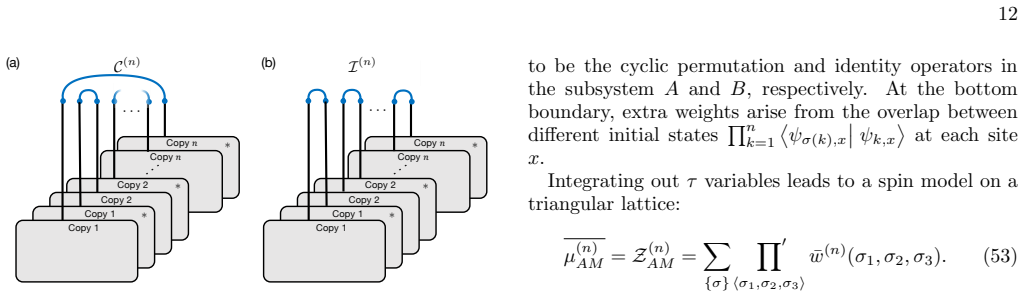
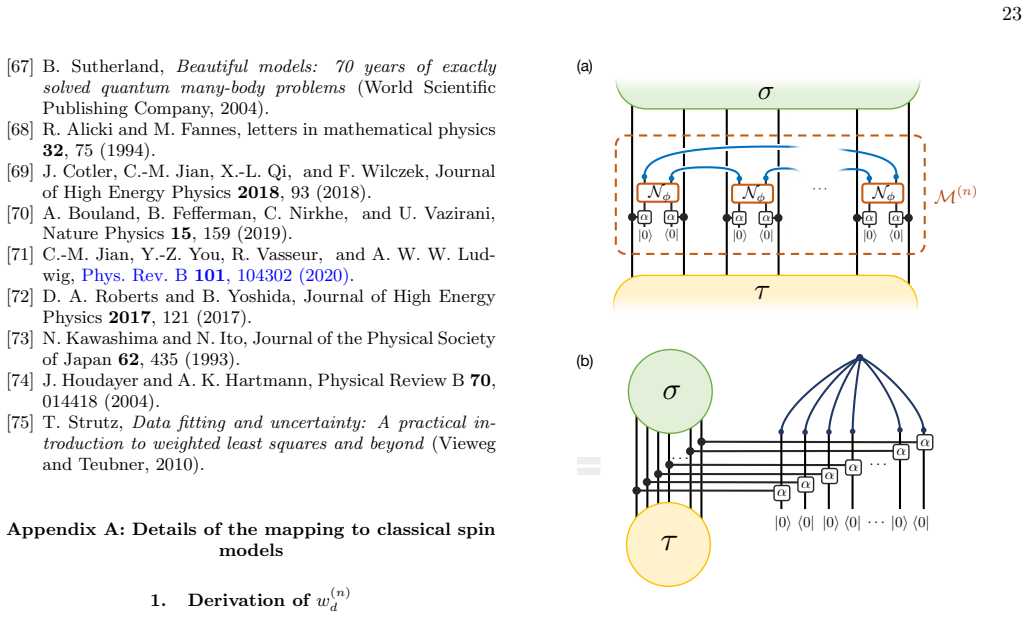
The central object is the replica spin model: each random unitary gate becomes a classical spin taking values in the permutation group $P_n$ of $n$ replicas, and the averaged $n$-th moment of the density matrix becomes the partition function of a 2D lattice with $P_n\times P_n$ symmetry. Boundary conditions do all the work: a cyclic permutation on part of the top boundary creates a domain wall whose free energy is the entanglement entropy, while a perturbed initial state creates a boundary field whose response is the Fisher information. In the large-$q$ limit the model becomes the $n!$-state standard Potts model on the square lattice, and the replica limit $n\to 1$ makes its partition function identical to bond percolation; Kramers-Wannier duality fixes the percolation threshold at $p=1/2$.
What would settle it
A finite-size scaling study of the von Neumann entanglement transition in Haar-random qudit circuits with $q=3,4,5$, extrapolated to $q\to\infty$, would settle the central claim: if $p_c$ does not approach $1/2$ and the critical exponents do not approach the percolation values $\nu=4/3$ and $\beta=5/36$, the analytic continuation is not describing the transition. A second, more direct check is to test whether the order of limits matters by comparing fixed-$q$ exact simulations with the spin model's $1/q$ expansion.
Extended reading notes
Core claim
The core claim is that the entanglement transition in these circuits has a precise statistical-mechanics description: for each integer $n\ge 2$, the $n$-th moment of the replicated density matrix is the partition function of a classical spin model on a 2D lattice, with $n!$ states per site. The average von Neumann entropy is the excess free energy of a domain wall pinned by the top boundary, and the Fisher information is the boundary magnetization induced by a perturbation of the initial state. Taking $q\to\infty$ with the scaled measurement strength held fixed turns the model into the $n!$-state standard Potts model on the square lattice; the $n\to 1$ limit of that model is bond percolation, whose critical threshold $f_c=1/2$ gives $p_c=1/2$. The same framework yields an explicit connection to the purification of mixed-state dynamics and shows that nonlocal measurements break the permutation symmetry of the spin model, eliminating the phase transition.
Load-bearing premise
The load-bearing premise is that the replica limit $n\to 1$ and the large-local-dimension limit $q\to\infty$ can be taken in that order and still describe finite-$q$ physics; the paper's own qubit numerics give $p_c=0.26\pm 0.02$, far from the $q\to\infty$ value $1/2$, so if the limits do not commute the central quantitative claim collapses.
Editorial extensions
If this is right
- Below the critical measurement strength, entanglement grows linearly with subsystem size; above it, entanglement saturates to area law, so the two dynamical phases are distinguished by the free energy of the emergent domain wall.
- The Fisher information of measurement outcomes saturates exactly at the transition, providing an order parameter for the phase that does not require postselecting a particular measurement trajectory.
- The purification transition of an initially mixed state coincides with the entanglement transition: in the area-law phase the state purifies, while in the volume-law phase it retains finite entropy density for exponentially long times.
- If measurements are made in a nonlocal basis, the emergent spin model loses its ordering symmetry and no transition occurs; the system state becomes maximally mixed and all information about the initial state is transferred to the ancillas.
- For qubits, the critical point $p_c\simeq 0.26$ differs substantially from the $q\to\infty$ value $1/2$, so the quantitative prediction is a statement about large local dimension rather than about qubit chains.
Reading between the lines
- One implication the authors leave open is that the relevant $1/q$ perturbations at the percolation fixed point may pull finite-$q$ systems into a different universality class; measuring critical exponents for $q=3,4$ would reveal whether percolation is the true attractor or only a limiting description.
- The Fisher-information formulation suggests a concrete experimental protocol: distinguish two nearby initial states from their measurement-outcome histograms; the number of samples needed should change sharply at the transition, offering an entanglement witness that avoids exponentially costly postselection.
- The nonlocal-measurement result also implies that the transition is basis-dependent, so a careful choice of quasilocal decoding measurements before the projective step could shift the apparent critical point; this might be used as a practical scrambling benchmark.
Signed reviews
Editorial analysis
A structured set of objections, weighed in public.
Referee Report
Summary. The paper develops a replica statistical-mechanics framework for one-dimensional random unitary circuits with weak or projective measurements. The averaged von Neumann entropy is rewritten as a conditional entropy and then as a free-energy difference in a classical spin model, with the permutation-group degrees of freedom of the replica method; the KL divergence and Fisher information of measurement outcomes are similarly mapped to boundary magnetization. For n=2 the emergent model is an exactly solvable triangular-lattice Ising model. In the large-local-dimension limit q→∞ the model is argued to reduce to an n!-state Potts model on the square lattice, and after the replica limit n→1 to bond percolation with p_c=1/2. Exact numerics for q=2 give p_c=0.26±0.02, and the paper further argues that nonlocal measurements destroy the transition and connects the transition to purification dynamics.
Significance. If the central analytic continuation is valid, the paper provides one of the first controlled analytic treatments of the measurement-induced entanglement transition: it gives an exact n=2 critical line (Eq. 61), a parameter-free prediction p_c=1/2 in the q→∞, n→1 limit, a concrete percolation universality class, and a new experimentally motivated Fisher-information order parameter. The paper does not fit the analytic p_c to numerics, and it makes falsifiable predictions for large q. The exact n=2 mapping and the positivity analysis for n≥3 are substantial technical contributions irrespective of the n→1 continuation. However, the central quantitative claim currently rests on a singular double limit that is not defined as stated, and the percolation identification contains a sign/identification error that must be corrected.
major comments (3)
- [Sec. V.C, Eqs. (65)-(69)] The sequential limit used to obtain p_c=1/2 is not well defined. For every fixed integer n>1, Eq. (66) gives p_c^(n)→1 as q→∞, so lim_{n→1} lim_{q→∞} p_c^(n) = 1, not 1/2. The text says it takes 'large q followed by the replica limit n→1', but on that literal reading the result is 1. The claimed value 1/2 can only be recovered by a correlated limit with q^{n-1}=O(1), or by an independent analytic continuation in n at fixed q before q→∞, and neither is provided. The paper's own caveat in the last paragraph of Sec. V.C that the continuation is exact only for q=∞ does not repair the discontinuity at n=1; this is an internal consistency problem, not a finite-q correction.
- [Sec. V.C, Eq. (67)] The identification of the bond activation probability is inconsistent with the paper's own definition of p. With p=sin^2 α from Eq. (9) and κ=q^{n-1} cot^{2n} α, at n=1 one has f=κ/(1+κ)=cos^2 α=1−p, not f=p. The direction of the phase correspondence is also wrong as stated: weak measurements (small p) give f≈1, i.e., an almost fully activated (percolating) lattice, which is the ferromagnetic/volume-law side; the text's f=p would put small p on the non-percolating side. The critical value f_c=1/2 still gives p_c=1/2 by self-duality, so the main number survives, but Eq. (67) and the surrounding interpretation must be corrected.
- [Sec. V.B-V.C and Fig. 7] The analytic continuation from integer n≥2 to n=1 crosses a regime where the Potts model changes character: for n≥3 the n!-state Potts transition is first-order, while the n=1 limit is the continuous percolation transition. No argument is given that replica free energies are analytic in n along this path, and the figure plots Eq. (66) for noninteger n even though Eq. (54) and the Potts reduction are established only for integer n and large q. The p_c=1/2 claim needs a separate justification for the n→1 continuation; the dashed curves in Fig. 7 should not be presented as quantitative predictions without such a justification.
minor comments (4)
- [Sec. IV.C.2] There is a typo in the paragraph following Eq. (58): 'On the the other hand' should read 'On the other hand'.
- [Fig. 7 caption] The caption should state explicitly that the curves for noninteger n and for n=1 are obtained by analytic continuation of Eq. (66) and are not derived from the positivity-guaranteed spin model of Sec. IV.B.
- [Sec. V.C, paragraph after Eq. (67)] The phrase 'activation probability f=p' is used again in the text; it should be corrected consistently with the first major comment, and the phase on each side of the percolation threshold should be identified clearly.
- [Sec. VI.A] The notation ⟨m_1^↓⟩ is used before its definition is fully explained; a parenthetical reminding the reader that this is the density of down-type spins in the bottom layer would improve readability.
Circularity Check
No significant circularity: p_c=1/2 is derived from an emergent Potts/bond-percolation mapping and cross-checked, not fitted or assumed.
full rationale
The paper's central claim p_c=1/2 is obtained by an explicit mapping of replicated moments to a classical spin model, followed by the large-q/κ-fixed limit to the n!-state Potts model, the Kramers-Wannier critical coupling, and the Q→1 Fortuin-Kasteleyn bond-percolation limit. None of these steps defines the target in terms of itself: the measurement probability p enters through computed weights (e.g., Eqs. 34, 52, 62), the Potts model is derived from the averaged tensor network, and the critical coupling and percolation threshold are standard external statistical-mechanics results. The exact numerics for q=2 give p_c=0.26±0.02 and are compared with, not used to fit, the analytic prediction. The paper also explicitly limits its analytic continuation to q→∞ and flags 1/q corrections as relevant, so the acknowledged discrepancy with qubit numerics is a stated validity limitation rather than a hidden reuse of the data. The only serious concern in the derivation is the order of limits in Sec. V.C: Eq. (66) gives p_c^{(n)}→1 for fixed n>1 as q→∞, so the literal 'q→∞ then n→1' reading does not by itself select 1/2. That is a correctness or consistency issue, not a circularity, because 1/2 is still obtained from an independent statistical-mechanics calculation rather than from the quantity being predicted. Citations to earlier random-circuit mappings are for the general technique and are not load-bearing claims of uniqueness or fitted parameters.
Assumptions & free parameters
assumptions (5)
- standard math Unitary gates are Haar random and the exact Haar average over U(q^2) can be evaluated via Weingarten functions (Eqs. 31 and 48).
- domain assumption The replica limit n to 1 of the integer-n quantities recovers the averaged von Neumann entropy and Fisher information (Eqs. 17 and 24).
- ad hoc to paper The positivity condition in Eq. (54) guarantees nonnegative Boltzmann weights for n at least 3, and the phase transition point lies within this regime (Sec. IV.B).
- standard math Kramers-Wannier duality and exact solutions of the triangular-lattice Ising model and Q-state Potts model give the critical couplings (Sec. V).
- domain assumption The system is a 1D qudit chain with periodic boundary conditions, evolving from a product state, and the thermodynamic limit N,T to infinity is taken for phase transition statements.
Cite this review
Pith. "Pith review of Theory of the phase transition in random unitary circuits with measurements." pith.science (2026). https://pith.science/paper/7J5C5ETG
@misc{pith2026190804305,
  author       = {Pith},
  title        = {Pith review of: Theory of the phase transition in random unitary circuits with measurements},
  year         = {2026},
  howpublished = {\url{https://pith.science/paper/7J5C5ETG}},
  note         = {Machine review of arXiv:1908.04305}
}
abstract
We present a theory of the entanglement transition tuned by measurement strength in qudit chains evolved by random unitary circuits and subject to either weak or random projective measurements. The transition can be understood as a nonanalytic change in the amount of information extracted by the measurements about the initial state of the system, quantified by the Fisher information. To compute the von~Neumann entanglement entropy $S$ and the Fisher information $\mathcal{F}$, we apply a replica method based on a sequence of quantities $\tilde{S}^{(n)}$ and $\mathcal{F}^{(n)}$ that depend on the $n$-th moments of density matrices and reduce to $S$ and $\mathcal{F}$ in the limit $n\to 1$. These quantities with $n\ge 2$ are mapped to free energies of a classical spin model with $n!$ internal states in two dimensions with specific boundary conditions. In particular, $\tilde{S}^{(n)}$ is the excess free energy of a domain wall terminating on the top boundary, and $\mathcal{F}^{(n)}$ is related to the magnetization on the bottom boundary. Phase transitions occur as the spin models undergo ordering transitions in the bulk. Taking the limit of large local Hilbert space dimension $q$ followed by the replica limit $n\to 1$, we obtain the critical measurement probability $p_c=1/2$ and identify the transition as a bond percolation in the 2D square lattice in this limit. Finally, we show there is no phase transition if the measurements are allowed in an arbitrary nonlocal basis, thereby highlighting the relation between the phase transition and information scrambling. We establish an explicit connection between the entanglement phase transition and the purification dynamics of a mixed state evolution and discuss implications of our results to experimental observations of the transition and simulability of quantum dynamics.
Figures


Figures from the paper (8 more)



Forward citations
Cited by 4 Pith papers
-
Measurement-induced criticality in random quantum circuits
In infinite on-site Hilbert space dimension, the measurement-induced entanglement transition maps to 2D percolation, with the universal nth Renyi entropy log-coefficient equal to 1/6 for half-system open boundary conditions.
-
Measurement-induced entanglement Hamiltonian
In a critical free-fermion chain, after partial projective measurements the entanglement Hamiltonian is a local grand-canonical operator: a measurement-independent inverse temperature times a local chemical potential ...
-
Free-Fermion Measurement-Induced Volume- to Area-Law Entanglement Transition in the Presence of Fermion Interactions
It conjectures that the measurement-induced volume-to-area-law entanglement transition for interacting class-DIII Majorana fermions is identical to the noninteracting transition, with the interaction-induced mass bein...
-
Measurement-induced phase transition: A case study in the non-integrable model by density-matrix renormalization group calculations
In a 1D Bose-Hubbard quench, increasing the random local measurement rate drives a volume-to-area law entanglement phase transition with critical exponent nu≈2.
Reference graph
Works this paper leans on
-
[1]
Quantum computation and quantum information,
M. A. Nielsen and I. Chuang, “Quantum computation and quantum information,” (2002)
2002
-
[2]
Nahum, J
A. Nahum, J. Ruhman, S. Vijay, and J. Haah, Physical Review X 7, 031016 (2017)
2017
-
[3]
von Keyserlingk, T
C. von Keyserlingk, T. Rakovszky, F. Pollmann, and S. Sondhi, Physical Review X 8, 021013 (2018)
2018
- [4]
-
[5]
Khemani, A
V. Khemani, A. Vishwanath, and D. A. Huse, Physical Review X 8, 031057 (2018)
2018
-
[6]
T. Rakovszky, F. Pollmann, and C. von Keyserlingk, Physical Review X 8, 031058 (2018)
work page 2018
-
[7]
Y. Li, X. Chen, and M. P. Fisher, Physical Review B 98, 205136 (2018)
2018
- [8]
Show all 84 references
-
[9]
Y. Li, X. Chen, and M. Fisher, arXiv preprint arXiv:1901.08092 (2019)
2019 arXiv
-
[10]
S. Choi, Y. Bao, X.-L. Qi, and E. Altman, arXiv preprint arXiv:1903.05124 (2019)
2019 arXiv
-
[11]
A. Chan, R. M. Nandkishore, M. Pretko, and G. Smith, Phys. Rev. B 99, 224307 (2019)
2019
-
[12]
Szyniszewski, A
M. Szyniszewski, A. Romito, and H. Schomerus, arXiv preprint arXiv:1903.05452 (2019)
2019 arXiv
-
[13]
M. J. Gullans and D. A. Huse, arXiv preprint arXiv:1905.05195 (2019)
2019 arXiv
-
[14]
Hayden, S
P. Hayden, S. Nezami, X.-L. Qi, N. Thomas, M. Walter, and Z. Yang, Journal of High Energy Physics 2016, 9 (2016)
2016
-
[15]
X.-L. Qi, Z. Yang, and Y.-Z. You, Journal of High En- ergy Physics 2017, 60 (2017)
2017
-
[16]
Vasseur, A
R. Vasseur, A. C. Potter, Y.-Z. You, and A. W. Ludwig, arXiv preprint arXiv:1807.07082 (2018)
2018 arXiv
-
[17]
Zhou and A
T. Zhou and A. Nahum, Physical Review B 99, 174205 (2019)
2019
-
[18]
Hunter-Jones, arXiv preprint arXiv:1905.12053 (2019)
N. Hunter-Jones, arXiv preprint arXiv:1905.12053 (2019)
2019 arXiv
-
[19]
O’Donnell and J
R. O’Donnell and J. Wright, in Proceedings of the forty- seventh annual ACM symposium on Theory of computing (ACM, 2015) pp. 529–538
2015
-
[20]
Li and X
T. Li and X. Wu, IEEE Transactions on Information The- ory 65, 2899 (2018)
2018
-
[21]
A. W. Van der Vaart, Asymptotic statistics, Vol. 3 (Cam- bridge university press, 2000)
2000
-
[22]
Araki, Publications of the Research Institute for Mathematical Sciences 11, 809 (1976)
H. Araki, Publications of the Research Institute for Mathematical Sciences 11, 809 (1976)
1976
-
[23]
Lindblad, Communications in Mathematical Physics 40, 147 (1975)
G. Lindblad, Communications in Mathematical Physics 40, 147 (1975)
1975
-
[24]
Uhlmann, Communications in Mathematical Physics 54, 21 (1977)
A. Uhlmann, Communications in Mathematical Physics 54, 21 (1977)
1977
-
[25]
Collins, International Mathematics Research Notices 2003, 953 (2003)
B. Collins, International Mathematics Research Notices 2003, 953 (2003)
2003
-
[26]
Eggarter, Physical Review B 12, 1933 (1975)
T. Eggarter, Physical Review B 12, 1933 (1975)
1975
-
[27]
Tanaka and N
Y. Tanaka and N. Uryˆ u, Journal of the Physical Society of Japan 44, 1091 (1978)
1978
-
[28]
Collins and P
B. Collins and P. ´Sniady, Communications in Mathemat- ical Physics 264, 773 (2006)
2006
-
[29]
Zinn-Justin, Letters in Mathematical Physics 91, 119 (2010)
P. Zinn-Justin, Letters in Mathematical Physics 91, 119 (2010)
2010
-
[30]
J. I. Novak, Banach Center Publications 89, 231 (2010)
2010
-
[31]
Matsumoto, arXiv preprint arXiv:1301.5401 (2013)
S. Matsumoto, arXiv preprint arXiv:1301.5401 (2013)
2013 arXiv
-
[32]
Novaes, arXiv preprint arXiv:1406.2182 (2014)
M. Novaes, arXiv preprint arXiv:1406.2182 (2014)
2014 arXiv
-
[33]
R. B. Potts, in Mathematical proceedings of the cam- bridge philosophical society , Vol. 48 (Cambridge Univer- sity Press, 1952) pp. 106–109
1952
-
[34]
Kihara, Y
T. Kihara, Y. Midzuno, and T. Shizume, Journal of the Physical Society of Japan 9, 681 (1954)
1954
-
[35]
R. J. Baxter, Journal of Physics C: Solid State Physics 6, L445 (1973)
1973
-
[36]
R. J. Baxter, H. Temperley, and S. E. Ashley, Proceed- ings of the Royal Society of London. A. Mathematical and Physical Sciences 358, 535 (1978)
1978
-
[37]
Kasteleyn and C
P. Kasteleyn and C. Fortuin, Journal of the Physical So- ciety of Japan Supplement 26, 11 (1969)
1969
-
[38]
Wu, Journal of Statistical Physics 18, 115 (1978)
F. Wu, Journal of Statistical Physics 18, 115 (1978)
1978
-
[39]
J. L. Cardy, Journal of Physics A: Mathematical and General 25, L201 (1992)
1992
-
[40]
Kesten, Percolation theory for mathematicians, Vol
H. Kesten, Percolation theory for mathematicians, Vol. 2 (Springer, 1982)
1982
-
[41]
Kesten, Communications in Mathematical Physics 109, 109 (1987)
H. Kesten, Communications in Mathematical Physics 109, 109 (1987)
1987
-
[42]
Grimmett, in Percolation (Springer, 1999) pp
G. Grimmett, in Percolation (Springer, 1999) pp. 1–31
1999
-
[43]
Webb, arXiv preprint arXiv:1510.02769 (2015)
Z. Webb, arXiv preprint arXiv:1510.02769 (2015)
2015 arXiv
-
[44]
Verstraete and J
F. Verstraete and J. I. Cirac, Physical Review B 73, 094423 (2006)
2006
-
[45]
Schuch, M
N. Schuch, M. M. Wolf, F. Verstraete, and J. I. Cirac, Physical review letters 100, 030504 (2008)
2008
-
[46]
Schumacher and M
B. Schumacher and M. D. Westmoreland, Quantum In- formation Processing 1, 5 (2002)
2002
-
[47]
Hiai and D
F. Hiai and D. Petz, Communications in mathematical physics 143, 99 (1991)
1991
-
[48]
Ogawa and H
T. Ogawa and H. Nagaoka, IEEE Transactions on Infor- mation Theory 45, 2486 (1999)
1999
-
[49]
Hayashi, Journal of Physics A: Mathematical and General 34, 3413 (2001)
M. Hayashi, Journal of Physics A: Mathematical and General 34, 3413 (2001)
2001
-
[50]
Nagaoka, in Asymptotic Theory Of Quantum Statisti- cal Inference: Selected Papers (2005) pp
H. Nagaoka, in Asymptotic Theory Of Quantum Statisti- cal Inference: Selected Papers (2005) pp. 113–124
2005
-
[51]
Hayden and J
P. Hayden and J. Preskill, Journal of High Energy Physics 2007, 120 (2007)
2007
-
[52]
Bernien, S
H. Bernien, S. Schwartz, A. Keesling, H. Levine, A. Om- ran, H. Pichler, S. Choi, A. S. Zibrov, M. Endres, M. Greiner, et al., Nature 551, 579 (2017)
2017
-
[53]
Zhang, G
J. Zhang, G. Pagano, P. W. Hess, A. Kyprianidis, P. Becker, H. Kaplan, A. V. Gorshkov, Z.-X. Gong, and C. Monroe, Nature 551, 601 (2017)
2017
-
[54]
Neill, P
C. Neill, P. Roushan, K. Kechedzhi, S. Boixo, S. V. Isakov, V. Smelyanskiy, A. Megrant, B. Chiaro, A. Dunsworth, K. Arya, et al., Science 360, 195 (2018)
2018
-
[55]
Harris, Y
R. Harris, Y. Sato, A. Berkley, M. Reis, F. Altomare, M. Amin, K. Boothby, P. Bunyk, C. Deng, C. Enderud, et al., Science 361, 162 (2018)
2018
-
[56]
Brydges, A
T. Brydges, A. Elben, P. Jurcevic, B. Vermersch, C. Maier, B. P. Lanyon, P. Zoller, R. Blatt, and C. F. Roos, Science 364, 260 (2019)
2019
-
[57]
Lukin, M
A. Lukin, M. Rispoli, R. Schittko, M. E. Tai, A. M. Kauf- man, S. Choi, V. Khemani, J. L´ eonard, and M. Greiner, Science 364, 256 (2019)
2019
-
[58]
M. H. DeGroot and M. J. Schervish, Probability and statistics (Pearson Education, 2012)
2012
-
[59]
Boixo, S
S. Boixo, S. V. Isakov, V. N. Smelyanskiy, R. Babbush, N. Ding, Z. Jiang, M. J. Bremner, J. M. Martinis, and H. Neven, Nature Physics 14, 595 (2018)
2018
-
[60]
J. M. Deutsch, Phys. Rev. A 43, 2046 (1991)
1991
-
[61]
Srednicki, Phys
M. Srednicki, Phys. Rev. E 50, 888 (1994)
1994
-
[62]
Rigol, V
M. Rigol, V. Dunjko, and M. Olshanii, Nature 452, 854 (2008)
2008
-
[63]
A. M. Kaufman, M. E. Tai, A. Lukin, M. Rispoli, R. Schittko, P. M. Preiss, and M. Greiner, Science 353, 794 (2016)
2016
-
[64]
Nandkishore and D
R. Nandkishore and D. A. Huse, Annual Review of Con- densed Matter Physics 6, 15 (2015)
2015
-
[65]
D. A. Abanin, E. Altman, I. Bloch, and M. Serbyn, Rev. Mod. Phys. 91, 021001 (2019)
2019
-
[66]
X. Cao, A. Tilloy, and A. De Luca, arXiv preprint arXiv:1804.04638 (2018). 23
2018 arXiv
-
[67]
Sutherland, Beautiful models: 70 years of exactly solved quantum many-body problems (World Scientific Publishing Company, 2004)
B. Sutherland, Beautiful models: 70 years of exactly solved quantum many-body problems (World Scientific Publishing Company, 2004)
2004
-
[68]
Alicki and M
R. Alicki and M. Fannes, letters in mathematical physics 32, 75 (1994)
1994
-
[69]
Cotler, C.-M
J. Cotler, C.-M. Jian, X.-L. Qi, and F. Wilczek, Journal of High Energy Physics 2018, 93 (2018)
2018
-
[70]
Bouland, B
A. Bouland, B. Fefferman, C. Nirkhe, and U. Vazirani, Nature Physics 15, 159 (2019)
2019
-
[71]
The Geometry and Flow of Quantum Information: From Quantum Gravity to Quantum Technology
in parallel to ours. This work uses a different replica scheme to map quantum circuits with projective mea- surements to statistical mechanics models, which leads to results consistent with ours. ACKNOWLEDGMENTS We thank William Berdanier, Fernando Brand˜ ao, Xi- angyu Cao, Ign...
-
[72]
Jian, Y.-Z
C.-M. Jian, Y.-Z. You, R. Vasseur, and A. W. W. Lud- wig, Phys. Rev. B 101, 104302 (2020)
2020
-
[73]
D. A. Roberts and B. Yoshida, Journal of High Energy Physics 2017, 121 (2017)
2017
-
[74]
Kawashima and N
N. Kawashima and N. Ito, Journal of the Physical Society of Japan 62, 435 (1993)
1993
-
[75]
Houdayer and A
J. Houdayer and A. K. Hartmann, Physical Review B70, 014418 (2004)
2004
-
[76]
Strutz, Data fitting and uncertainty: A practical in- troduction to weighted least squares and beyond (Vieweg and Teubner, 2010)
T. Strutz, Data fitting and uncertainty: A practical in- troduction to weighted least squares and beyond (Vieweg and Teubner, 2010). Appendix A: Details of the mapping to classical spin models
2010
-
[77]
cjvzREaZAYNtEFM64RRfk23bZf8=
Derivation of w(n) d As discussed in the main text, contracting a pair of diagonally neighboring ˆσ and ˆτ tensors leads to a weight w(n) d (σ,τ ) that depends on q and α. Using the TN rep- resentation given in Fig. 12, a simple expression of w(n) d can be written as w(n) d (σ...
-
[78]
Here, we derive and explicitly present the three-body weight ¯w(2)(σ1,σ 2,σ 3) in Eq
Derivation of ¯w(2) In the case of n = 2, we have seen that the purity of a subsystem maps to the partition function of the classical Ising model on triangular lattice. Here, we derive and explicitly present the three-body weight ¯w(2)(σ1,σ 2,σ 3) in Eq. (39) associated with t...
-
[79]
Here, we de- rive the two-body Ising coupling Jh and Jd in Eq
Derivation of Ising couplings Jh and Jd The three-body weight factorizes into pairwise contri- butions in the presence of Ising symmetry. Here, we de- rive the two-body Ising coupling Jh and Jd in Eq. (59). In terms of Jh and Jd, ¯w(2) can be written as ¯w(2)(σ,σ,σ ) =Ce−2Jd−J...
-
[80]
Here, we derive a sufficient condition [Eq
A sufficient condition for nonnegative weights for n≥ 3 In general, the negative weights in the expression of the n-th moment cannot be eliminated for arbitrary q and α by simply integrating out τ variables. Here, we derive a sufficient condition [Eq. (54)] for the weights being n...
-
[81]
Com- pared to the derivation ofw(n) d in Appendix A 1, the only modification is the absence of the dephasing channel Nφ applying to ancilla qudits
Derivation of two-body weight Here, we derive the two-body weight v(n) d in the spin model description of the quantum relative entropy. Com- pared to the derivation ofw(n) d in Appendix A 1, the only modification is the absence of the dephasing channel Nφ applying to ancilla qu...
-
[82]
Hence, we obtain a Ising spin model on a triangular lattice with three-body interaction
Derivation of three-body weight The negative weights in the second moment due to neg- ative Weingarten functions can be eliminated by integrat- ing out τ variables. Hence, we obtain a Ising spin model on a triangular lattice with three-body interaction. The three-body weights ...
-
[83]
Algorithm Here, we provide the details of the numerical simu- lations presented in Sec. V. In order to efficiently store exact many-body wave functions for as large as N = 30 qubits, we leverage the fact that a fraction of qudits are disentangled in every time step. More specific...
-
[84]
Finite-size scaling Here, we present the details of finite size scaling in Sec. V D. We use the scaling ansatz proposed in Ref. [8]: S(p,L )−S(pc,L ) =g ( (p−pc)N1/ν ) . (F1) The critical measurement probability pc and critical ex- ponent ν are extracted by numerically optimizi...
Reviewed August 14, 2026 · model on record in the stance chip above.
Discussion (0). Continue with ORCID to comment.