REVIEW 2 major objections 9 minor 11 cited by
Using a data-driven, model-agnostic reconstruction of 153 binary black-hole mergers, this paper finds a gap in secondary masses around 38-120 solar masses and a spin broadening above primary masses of about 45 solar masses.
Reviewed by Pith at T0; open to challenge. T0 means a machine referee read the full paper against a public rubric. the ladder, T0–T4 →
2026-08-04 18:31 UTC pith:7JTYC2A3
load-bearing objection Honest, well-hedged data-driven tour of GWTC-4; treat the headline features as visualization-level claims until they survive a nuisance-model robustness check. the 2 major comments →
Trends in the Population of Binary Black Holes Following the Fourth Gravitational-Wave Transient Catalog: a Data-Driven Analysis
The pith
A machine-rendered reading of the paper's core claim, the machinery that carries it, and where it could break.
Core claim
On the paper's own terms, the central discovery: GWTC-4 data, reconstructed without a parametric population model, place essentially no probability on secondary black-hole masses between roughly 38 and 120 solar masses, while the primary mass distribution shows no comparable gap. In the (effective spin, primary mass) plane, the spin distribution is narrow near zero below about 45 solar masses and broadens above it. The paper also reports support for spin magnitudes near 0.2 and 0.7, a possible correlation between the two component spins, and a preference for aligned secondary spins, interpreting the high-mass broad-spin systems as likely second-generation black holes. It argues that the appa
What carries the argument
The pi-stroke formalism: the population distribution that maximizes the population likelihood over all possible distributions, guaranteed by a standard convexity theorem to be a weighted sum of delta functions (at most one per event). Delta locations and weights come from warm-started gradient descent with merging and pruning, so surviving components mark regions the data genuinely support. Nuisance parameters are marginalized by reweighting posterior samples with the previous catalog's best-fit population model (Eq. 15), and selection effects enter through a normalizing-flow fit to the injection campaign.
Load-bearing premise
The reconstruction reweights every event's posterior samples using the previous catalog's best-fit population model for all parameters it is not directly measuring; if that nuisance model is wrong, the inferred gap and spin broadening could be artifacts.
What would settle it
Re-run the pi-stroke reconstruction with the fourth catalog's population model used for the nuisance reweighting, or in three dimensions (m1, q, chi_eff): if the 38-120 solar-mass secondary gap fills in or the q–chi_eff anti-correlation persists with m1 explicitly included, the paper's central interpretation fails. A simpler check: with future catalog data, watch whether delta functions appear inside the claimed gap or whether the spin broadening threshold shifts.
If this is right
- A real secondary-mass gap with no primary gap points to a formation channel in which the heavier black hole is often a second-generation remnant, since such remnants can occupy the pair-instability gap while stellar-remnant companions cannot.
- The broadening of effective spin above ~45 solar masses implies a mass-dependent spin transition that parametric models should build in; it also explains the apparent effective-spin/mass-ratio anti-correlation as a projection artifact.
- Spin peaks near 0.2 and 0.7 and a possible correlation between the two spins suggest both components can be significantly spinning, challenging formation scenarios that allow only one spun-up black hole.
- The released pi-stroke samples give a model-independent benchmark: theoretical predictions can be plotted against them, and in the large-N limit they converge to the true distribution, unlike maximum-likelihood event estimates.
Where Pith is reading between the lines
- Editorial extension: re-running the same reconstruction with the fourth catalog's best-fit model (instead of the previous catalog's) for nuisance parameters would show whether the 38-120 solar-mass gap and the spin broadening shift; the paper does not perform this robustness check.
- Editorial extension: the paper's own logic predicts that a three-dimensional pi-stroke reconstruction of (primary mass, mass ratio, effective spin) will make the apparent q–chi_eff anti-correlation vanish; this is a directly testable next step.
- Editorial extension: the cosθ2 > 0 preference, if confirmed with a model that allows different tilt distributions for the two components, would implicate tidal alignment of the secondary before the second supernova.
- Editorial extension: the apparent chi1–chi2 correlation could be a mixture of latent subpopulations rather than an intrinsic correlation; separating one-spin and two-spin subpopulations with a mixture model would settle it.
Editorial analysis
A structured set of objections, weighed in public.
Referee Report
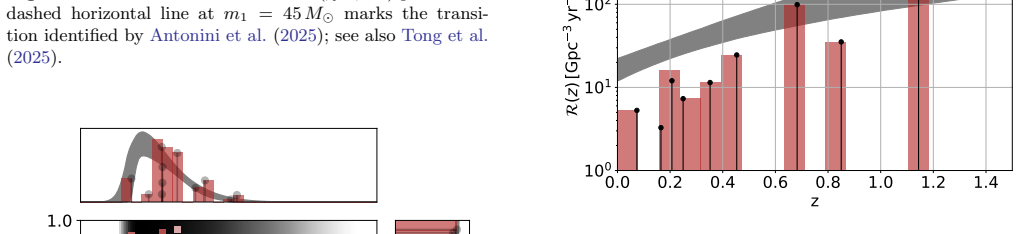
Summary. This paper applies the pi-stroke (maximum population likelihood) formalism of Payne & Thrane (2023) to 153 binary black hole mergers from GWTC-4. Rather than assuming a parameterized population model, the method maximizes the population likelihood over distributions represented as weighted delta functions (Eq. 6), using a reweighting of LVK posterior samples (Eq. 15) in which all parameters except the one(s) of interest are assigned the GWTC-3 maximum-likelihood population model (Appendix B). One- and two-dimensional pi reconstructions are presented for masses, mass ratio, spin magnitudes, tilt angles, chi_eff, chi_p, and redshift. The headline findings are a secondary-mass gap at m2 ~ 38-120 M_sun (Figs. 1-2), a broadening of chi_eff for m1 >~ 45 M_sun (Fig. 11), an anti-correlation between chi_eff and q that the authors argue is a projection artifact of the m1-dependent broadening (Section 4.1), hints of chi ~ 0.2 and 0.7 spin subpopulations, a chi1-chi2 correlation, and a preference for cos(theta2) > 0. The paper is carefully hedged, repeatedly stating that pi features are not significance-tested and including internal consistency checks (e.g., the artificial chi_eff spike in the (chi_eff, z) analysis). A public data release of pi samples is provided.
Significance. Subject to the robustness concerns below, the paper would provide a useful cross-check of parameterized GWTC-4 population analyses using an independent, nonparametric reconstruction, corroborating the PISN-related secondary mass gap of Tong et al. (2025) and the high-mass chi_eff broadening of Antonini et al. (2025). Strengths include a transparent, well-documented pipeline (flowchart, Appendix D), public pi samples on Zenodo, a clear statement that features are not significance-tested, and an honest discussion of the mechanism by which the method can manufacture apparent correlations - the same logic used to dismiss the chi_eff-q anti-correlation as potentially spurious. The claim that the method is 'model-free' is, however, overstated: Eq. (15) requires a full population model for all nuisance parameters, and the robustness of the headline features to that model is asserted but not demonstrated. The incremental novelty over Payne & Thrane (2023) is moderate (new catalog, larger dataset, additional stability checks), but the corroboration and reframing of the chi_eff-q anti-correlation as a projection effect are valuable.
major comments (2)
- [Section 2.3, Eq. (15); Figs. 1-2 and 11] The headline features - the m2 gap (38-120 M_sun) and the chi_eff broadening above m1 ~ 45 M_sun - are produced by reweighting LVK posterior samples with the GWTC-3 maximum-likelihood nuisance model (Eq. 15, Appendix B). Section 2.3 asserts that results should be robust for 'qualitatively similar' nuisance models, but no test of this assertion is given. Section 4.1 uses misspecification of the joint mass distribution to dismiss the chi_eff-q anti-correlation as likely spurious, demonstrating that this pipeline can create apparent features from nuisance-model misspecification. The same mechanism could sculpt the m2 gap or the 45-M_sun transition; the latter is especially exposed because the assumed q(m1) nuisance model changes with m1. Please re-run the key reconstructions with at least two alternative nuisance models (e.g., GWTC-4 ML values; flat spin/uniform mass) and report whether the
- [Section 2.4, Stage 3; Fig. 2] The merge/discard thresholds in Stage 3 (5% of the hyper-diagonal; delta log L <= 0.05/sqrt(n)) are hand-tuned 'by trial and error' (footnote 2). Since the m2 gap is defined by the absence of components between two surviving edge components (Fig. 2), and the chi_eff broadening is read off from surviving component locations (Fig. 11), these thresholds directly determine the reported features. Please provide a sensitivity scan over the thresholds (e.g., 2-10% and 0.01-0.1/sqrt(n)) or quote the delta log L cost of inserting a component at m2 = 45 and 90 M_sun, so that the gap is shown to be data-driven rather than pruning-driven.
minor comments (9)
- [Abstract; Section 3.1] The abstract says 'a gap around 45 M_sun' but the analysis and Figs. 1-2 report a gap between approximately 38 and 120 M_sun. The abstract should quote the full range to avoid confusing the lower edge with the gap center.
- [Section 3.1] The text contains an orphan line 'kernel density estimation-based method' immediately after the sentence citing Sadiq et al. (2023). This appears to be a leftover fragment; delete it.
- [References] The citation 'Abac et al. 2025b, prx' is incomplete; the article title, arXiv identifier, or journal reference should be provided. Several other references are to arXiv preprints; please verify they are updated to the published versions where available.
- [Figures 1, 5, 7, 11, 12, 14] The two-dimensional figures encode delta-function weights by color but do not include a colorbar, making quantitative reading difficult. Adding a colorbar (or labeling the color scale) would improve interpretability.
- [Figure 1] The grey shading representing the parametric GWTC-4 maximum-likelihood model is difficult to discern against the white background; increasing contrast or overlaying contours would help the reader judge agreement.
- [Appendix B.1, Table 2] The text says f_U = 1/200 'corresponds approximately to the inverse of the number of events analyzed' (N = 153). The discrepancy is minor, but a one-line justification would avoid confusion.
- [Section 4.1] There is a typo in the sentence 'calculated assuming Power Law + Peak(Talbot & Thrane 2018) (See. Appendix B)' - 'See.' should be 'see' and the phrase is awkwardly placed. Also, the parenthesis around the citation is missing.
- [Figure 14 caption] The caption says the z distribution incorporates 'both the differential comoving volume and the merger-time delay, unlike Fig. 13,' but Fig. 13 shows a merger rate converted from a distribution. The distinction is confusing as stated; clarify what exactly differs between the two.
- [Section 3.1] Minor grammar: 'exhibits a excess near 10 M_sun' should be 'an excess'. Also, the phrase 'the data-driven estimate broadly tracks' in Section 3.3 could be clarified as referring to Fig. 13.
Circularity Check
No significant circularity: the pi reconstruction is a maximum-likelihood fit whose headline features are outputs, not inputs, and the nuisance model is deliberately taken from the earlier GWTC-3 catalog.
full rationale
The derivation chain is self-contained rather than circular. The pi distribution is defined in Eq. (5) as the argmax of the population likelihood, represented as a sum of delta functions in Eq. (6) via Carathéodory's theorem. The reweighting in Eq. (15) uses a uniform prior on the parameter of interest and a nuisance population model pi(eta|Lambda-hat) taken from the GWTC-3 maximum-likelihood fit. The paper explicitly adopts this earlier-catalog model to avoid circularity: 'To avoid circularity when analyzing GWTC-4 data and to enable a fair comparison with its parametric results, we adopt the GWTC-3 maximum-likelihood population model as an informed baseline.' The headline features—the m2 gap and the chi_eff broadening above m1 ~ 45 Msun—are read off from the optimized delta-function locations and weights; they are outputs of a likelihood fit, not inputs. The GWTC-3 nuisance model contains no secondary-mass gap and no mass-dependent spin broadening, so these features cannot be imported by construction. The paper also explicitly cautions that 'Different assumptions can, in principle, lead to different pi results' and that Bayesian inference is still required to assess significance, which is a limitation but not a circular reduction. Self-citations to Payne & Thrane (2023) for the formalism are standard methodology and are not used to force the conclusions; the method's earlier application to GWTC-3 provides independent, external grounding. Therefore no circular step is present.
Axiom & Free-Parameter Ledger
free parameters (5)
- GWTC-3 Power Law + Peak mass hyperparameters =
alpha=3.57, beta_q=0.63, m_min=5.30 Msun, m_max=88.69 Msun, lambda_peak=0.029, mu_m=34.60 Msun, sigma_m=3.53 Msun, delta
- GWTC-3 spin model hyperparameters =
mu_chi=0.23, sigma2_chi=0.033, zeta=0.97, sigma_t=1.18
- Redshift evolution slope kappa =
3.46
- Pruning merge/discard thresholds =
merge distance 5% of hyper-diagonal; Delta-logL <= 0.05/sqrt(n)
- Effective sample size threshold =
1% (with three events at 0.5-1%)
axioms (4)
- standard math Caratheodory's theorem guarantees the discrete delta-function representation of the maximum population likelihood (Eq. 6).
- domain assumption Conjecture that the pi distribution converges to the true population distribution as the number of observations goes to infinity (Payne & Thrane 2023).
- domain assumption The official GWTC-4 found injections provide a faithful, catalog-specific estimate of the selection function (Eq. 13).
- domain assumption The normalizing-flow approximation of the detected-injection distribution f_det is accurate enough for the selection correction.
Cite this review
Pith. "Pith review of Trends in the Population of Binary Black Holes Following the Fourth Gravitational-Wave Transient Catalog: a Data-Driven Analysis." pith.science (2026). https://pith.science/paper/7JTYC2A3
@misc{pith2026250909876,
  author       = {Pith},
  title        = {Pith review of: Trends in the Population of Binary Black Holes Following the Fourth Gravitational-Wave Transient Catalog: a Data-Driven Analysis},
  year         = {2026},
  howpublished = {\url{https://pith.science/paper/7JTYC2A3}},
  note         = {Machine review of arXiv:2509.09876}
}
read the original abstract
Current population models of binary black hole distributions are difficult to interpret because standard population inferences hinge on modeling choices, which can mask or mimic real structure. The maximum population likelihood ``$\pistroke$ formalism'' provides a means to investigate and interpret features in the distribution of binary black holes using only data -- without specifying a population model. It tells us if features inferred from current population models are truly present in the data or if they arise from model misspecification. It also provides guidance for developing new models by highlighting previously unnoticed features. In this study, we utilize the $\pistroke$ formalism to examine the binary black hole population in the LIGO--Virgo--KAGRA (LVK) fourth Gravitational-Wave Transient Catalog (GWTC-4). Our analysis supports the existence of a gap around $45\,M_\odot$ in the secondary black hole mass distribution and identifies a widening in the distribution of the effective inspiral spin parameter $\chi_\text{eff}$ near this mass as recently reported by Tong et al. (2025). Similar to earlier studies, we find support for an anti-correlation between $\chi_\text{eff}$ and mass ratio. However, we argue that this may be a spurious correlation arising from misspecification of the joint distribution of black hole masses. Furthermore, we identify support for dimensionless black hole spin magnitudes at approximately $\chi \approx 0.2$ and $\chi\approx0.7$. The data support the existence of a correlation between the spin magnitudes $\chi_1$ and $\chi_2$, though subsequent study is required to determine if this feature is statistically significant. The accompanying data release includes $\pistroke$ samples, which can be used to compare theoretical predictions to LVK data and to assess assumptions in parameterised models.
Figures




Forward citations
Cited by 11 Pith papers
-
Joint population and strong-lensing inference for resolved gravitational-wave events probes the black-hole merger rate beyond the peak of star formation
Joint strong-lensing and population inference on resolved gravitational-wave events finds no lensed events and tightens constraints on the black-hole merger rate peak redshift and high-redshift tail.
-
Posterior Predictive Checks for Gravitational-wave Populations: Limitations and Improvements
Maximum-likelihood-based posterior predictive checks detect model misspecification better than event-level versions for uncertain spin tilts, but current detector sensitivity limits their power; the Gaussian Component...
-
Measurement prospects for the pair-instability mass cutoff with gravitational waves
Simulations show a 40-50 solar-mass black-hole cutoff is not guaranteed to be confidently recovered from GWTC-4-like catalogs, spurious detections are unlikely, and O4 data would reduce cutoff-mass uncertainty by at l...
-
A new group of low-spin $50-70M_\odot$ Black Holes and the high pair-instability mass cutoff
GWTC-4.0 reveals low-spin black holes up to ~68.5 Msun, implying a higher pair-instability mass cutoff and a lower 12C(alpha,gamma)16O rate.
-
A new group of low-spin $50-70M_\odot$ Black Holes and the high pair-instability mass cutoff
GWTC-4.0 data shows low-spin black holes up to 70 solar masses, moving the low-spin cutoff to 68.5 solar masses and favoring a high pair-instability mass gap.
-
The Chirp-Mass Ladder: A New Rung Emerges
GWTC-5 chirp-mass peaks form a ~1.9-spaced ladder with a new ~19 M⊙ rung matching predicted 2G+3G mergers, unifying prior 1G+2G spin-transition groups under one hierarchical scenario.
-
Population-level correlations in Bayesian statistics: an illustrative model for gravitational-wave astronomy
An idealized Gaussian model demonstrates that single-event correlations inflate uncertainties in population correlations and that catalog-wide correlated biases can be misread as population correlations.
-
The Chirp-Mass Ladder: A New Rung Emerges
The chirp-mass distribution of GW-detected binary black holes shows a ladder of peaks doubling in mass, with a new intermediate peak at 19 solar masses confirming a prior prediction from the hierarchical merger model.
-
Targeting black holes from metal-poor progenitors with next-generation gravitational-wave detectors
Introduces a target redshift z_t to isolate metal-poor black hole progenitors and a statistical framework to test merger-rate variations against forecasts from Einstein Telescope and Cosmic Explorer.
-
Model-Agnostic Population Inference for Gravitational-Wave Astronomy: From LVK to LISA
A flow-guided mixture density network with Gaussian copulas recovers black-hole merger population shapes and rates from sparse, selection-biased gravitational-wave catalogs.
-
Population of Binary Black Holes Inferred from One Hundred and Fifty Gravitational Wave Signals
A population analysis of 153 LIGO-Virgo-KAGRA black-hole mergers reports chirp-mass peaks near 8, 14, and 27 solar masses, spaced by ~1.9, which the author interprets as possible hierarchical mergers.
Reference graph
Works this paper leans on
-
[1]
Abac, A. G., Abouelfettouh, I., et al. 2025 a , GW231123: a Binary Black Hole Merger with Total Mass 190-265 M_ . 2507.08219
Pith/arXiv arXiv 2025
-
[2]
G., et al
Abac, A. G., et al. 2025 b , prx
2025
-
[3]
2021, Astrophys
Abbott, R., et al. 2021, Astrophys. J. Lett., 913, L7
2021
-
[4]
2023 a , Phys
---. 2023 a , Phys. Rev. X, 13, 011048
2023
-
[5]
---. 2023 b , Phys. Rev. X, 13, 041039, 10.1103/PhysRevX.13.041039
-
[6]
Adamcewicz, C., Galaudage, S., Lasky, P. D., & Thrane, E. 2024, The Astrophysical Journal Letters, 964, L6, 10.3847/2041-8213/ad2df2
-
[7]
Adamcewicz, C., Guttman, N., Lasky, P. D., & Thrane, E. 2025, Do both black holes spin in merging binaries? Evidence from GWTC-4 and astrophysical implications. 2509.04706
arXiv 2025
-
[8]
2022, Monthly Notices of the Royal Astronomical Society, 517, 3928, 10.1093/mnras/stac2961
Adamcewicz, C., & Thrane, E. 2022, Monthly Notices of the Royal Astronomical Society, 517, 3928, 10.1093/mnras/stac2961
-
[9]
Antonini, F., Romero-Shaw, I. M., & Callister, T. 2025, Phys. Rev. Lett., 134, 011401, 10.1103/PhysRevLett.134.011401
-
[10]
Banagiri, S., Callister, T. A., Doctor, Z., & Kalogera, V. 2025, Structure and Skewness of the Effective Inspiral Spin Distribution of Binary Black Hole Mergers. 2501.06712
Pith/arXiv arXiv 2025
-
[11]
Biscoveanu, S., Callister, T. A., Haster, C.-J., et al. 2022, The Astrophysical Journal Letters, 932, L19, 10.3847/2041-8213/ac71a8
-
[12]
Buikema, A., et al. 2020, Phys. Rev. D, 102, 062003, 10.1103/PhysRevD.102.062003
-
[13]
Callister, T. A., Essick, R., & Holz, D. E. 2024, Phys. Rev. D, 110, 123041, 10.1103/PhysRevD.110.123041
-
[15]
---. 2024 b , Phys. Rev. X, 14, 021005, 10.1103/PhysRevX.14.021005
-
[16]
Callister, T. A., Haster, C.-J., Ng, K. K. Y., Vitale, S., & Farr, W. M. 2021, The Astrophysical Journal Letters, 922, L5, 10.3847/2041-8213/ac2ccc
-
[17]
Capote, E., et al. 2025, Phys. Rev. D, 111, 062002, 10.1103/PhysRevD.111.062002
-
[18]
1911, Rendiconti del Circolo Matematico di Palermo (1884-1940), 32, 193
Carath \'e odory, C. 1911, Rendiconti del Circolo Matematico di Palermo (1884-1940), 32, 193. https://api.semanticscholar.org/CorpusID:120032616
1911
-
[19]
S., Collaboration, V., & Collaboration, K
Collaboration, L. S., Collaboration, V., & Collaboration, K. 2025 a , GWTC-4.0: Data Quality Products for Transient Gravitational Wave Searches, v1, Zenodo, 10.5281/zenodo.16856919
-
[20]
Collaboration, T. L. S., the Virgo Collaboration, & the KAGRA Collaboration. 2025 b , GWTC-4.0: Population Properties of Merging Compact Binaries. 2508.18083
Pith/arXiv arXiv 2025
-
[21]
Damour, T. 2001, Phys. Rev. D, 64, 124013, 10.1103/PhysRevD.64.124013
-
[22]
Durkan, C., Bekasov, A., Murray, I., & Papamakarios, G. 2019, Neural Spline Flows. 1906.04032
Pith/arXiv arXiv 2019
-
[23]
2023, The Astrophysical Journal, 946, 16, 10.3847/1538-4357/acb5ed
Edelman, B., Farr, B., & Doctor, Z. 2023, The Astrophysical Journal, 946, 16, 10.3847/1538-4357/acb5ed
-
[24]
Essick, R., et al. 2025, Compact Binary Coalescence Sensitivity Estimates with Injection Campaigns during the LIGO-Virgo-KAGRA Collaborations' Fourth Observing Run. 2508.10638
arXiv 2025
-
[25]
Farah, A. M., Fishbach, M., & Holz, D. E. 2024, The Astrophysical Journal, 962, 69, 10.3847/1538-4357/ad0558
-
[26]
E., Marchant, P., & Justham, S
Farmer, R., Renzo, M., de Mink, S. E., Marchant, P., & Justham, S. 2019, The Astrophysical Journal, 887, 53, 10.3847/1538-4357/ab518b
-
[27]
Fishbach, M., & Holz, D. E. 2020, The Astrophysical Journal Letters, 891, L27, 10.3847/2041-8213/ab7247
-
[28]
Fishbach, M., Holz, D. E., & Farr, B. 2017, The Astrophysical Journal Letters, 840, L24, 10.3847/2041-8213/aa7045
-
[29]
Fishbach, M., Holz, D. E., & Farr, W. M. 2018, The Astrophysical Journal Letters, 863, L41, 10.3847/2041-8213/aad800
-
[30]
2019, The Astrophysical Journal Letters, 881, L1, 10.3847/2041-8213/ab339b
Fuller, J., & Ma, L. 2019, The Astrophysical Journal Letters, 881, L1, 10.3847/2041-8213/ab339b
-
[31]
Ganapathy, D., et al. 2023, Phys. Rev. X, 13, 041021, 10.1103/PhysRevX.13.041021
-
[32]
Gerosa, D., & Berti, E. 2019, Phys. Rev. D, 100, 041301, 10.1103/PhysRevD.100.041301
-
[33]
Gerosa, D., Berti, E., O'Shaughnessy, R., et al. 2018, Phys. Rev. D, 98, 084036, 10.1103/PhysRevD.98.084036
-
[34]
2021, Nat
Gerosa, D., & Fishbach, M. 2021, Nat. Astro., 8, 749
2021
-
[35]
Gerosa, D., Kesden, M., Berti, E., O'Shaughnessy, R., & Sperhake, U. 2013, Phys. Rev. D, 87, 104028, 10.1103/PhysRevD.87.104028
-
[36]
Gerosa, D., Pratten, G., & Vecchio, A. 2020, Phys. Rev. D, 102, 103020, 10.1103/PhysRevD.102.103020
-
[38]
2024 b , The Astrophysical Journal, 976, 121, 10.3847/1538-4357/ad8572
---. 2024 b , The Astrophysical Journal, 976, 121, 10.3847/1538-4357/ad8572
-
[39]
Golomb, J., & Talbot, C. 2023, Phys. Rev. D, 108, 103009, 10.1103/PhysRevD.108.103009
-
[40]
2025, pi stroke samples, Zenodo, 10.5281/zenodo.17096730
Guttman, N. 2025, pi stroke samples, Zenodo, 10.5281/zenodo.17096730
-
[41]
Heinzel, J., Mould, M., \'Alvarez-L\'opez, S., & Vitale, S. 2025, Phys. Rev. D, 111, 063043, 10.1103/PhysRevD.111.063043
-
[42]
Hendriks, D. D., van Son, L. A. C., Renzo, M., Izzard, R. G., & Farmer, R. 2023, Monthly Notices of the Royal Astronomical Society, 526, 4130, 10.1093/mnras/stad2857
-
[43]
Hussain, A., Isi, M., & Zimmerman, A. 2024, Hints of spin-magnitude correlations and a rapidly spinning subpopulation of binary black holes. 2411.02252
Pith/arXiv arXiv 2024
-
[44]
2024, Science, 385, 1318, 10.1126/science.ado8069
Jia, W., et al. 2024, Science, 385, 1318, 10.1126/science.ado8069
-
[45]
Kingma, D. P., & Ba, J. 2017, Adam: A Method for Stochastic Optimization. 1412.6980
Pith/arXiv arXiv 2017
-
[46]
P., Salimans, T., Jozefowicz, R., et al
Kingma, D. P., Salimans, T., Jozefowicz, R., et al. 2017, Improving Variational Inference with Inverse Autoregressive Flow. 1606.04934
Pith/arXiv arXiv 2017
-
[47]
2022, A and A, 666, A194, 10.1051/0004-6361/202244257
Li, Guo-Peng . 2022, A and A, 666, A194, 10.1051/0004-6361/202244257
-
[48]
LIGO Scientific Collaboration , & Virgo Collaboration . 2022, GWTC-2.1: Deep Extended Catalog of Compact Binary Coalescences Observed by LIGO and Virgo During the First Half of the Third Observing Run - Parameter Estimation Data Release, v2, Zenodo, 10.5281/zenodo.6513631
-
[49]
LIGO Scientific Collaboration , Virgo Collaboration , & KAGRA Collaboration . 2023, GWTC-3: Compact Binary Coalescences Observed by LIGO and Virgo During the Second Part of the Third Observing Run — Parameter estimation data release, v2, Zenodo, 10.5281/zenodo.8177023
-
[50]
2025, Classical and Quantum Gravity, 42, 045008, 10.1088/1361-6382/ad9c0e
Lorenzo-Medina, A., & Dent, T. 2025, Classical and Quantum Gravity, 42, 045008, 10.1088/1361-6382/ad9c0e
-
[51]
2022, Physics Reports, 955, 1, https://doi.org/10.1016/j.physrep.2022.01.003
Mandel, I., & Farmer, A. 2022, Physics Reports, 955, 1, https://doi.org/10.1016/j.physrep.2022.01.003
-
[52]
Mandel, I., Farr, W. M., & Gair, J. R. 2019, Monthly Notices of the Royal Astronomical Society, 486, 1086, 10.1093/mnras/stz896
-
[53]
J., Mohamed, S., & Lakshminarayanan, B
Papamakarios, G., Nalisnick, E., Rezende, D. J., Mohamed, S., & Lakshminarayanan, B. 2021, Journal of Machine Learning Research, 22, 1. http://jmlr.org/papers/v22/19-1028.html
2021
-
[54]
2018, Masked Autoregressive Flow for Density Estimation
Papamakarios, G., Pavlakou, T., & Murray, I. 2018, Masked Autoregressive Flow for Density Estimation. 1705.07057
Pith/arXiv arXiv 2018
-
[55]
Payne, E., Talbot, C., Lasky, P. D., Thrane, E., & Kissel, J. S. 2020, Phys. Rev. D, 102, 122004, 10.1103/PhysRevD.102.122004
-
[56]
Payne, E., & Thrane, E. 2023, Phys. Rev. Res., 5, 023013, 10.1103/PhysRevResearch.5.023013
-
[57]
L., Zevin, M., Amaro-Seoane, P., et al
Rodriguez, C. L., Zevin, M., Amaro-Seoane, P., et al. 2019, Phys. Rev. D, 100, 043027, 10.1103/PhysRevD.100.043027
-
[58]
M., Thrane, E., & Lasky, P
Romero-Shaw, I. M., Thrane, E., & Lasky, P. D. 2022, Pub. Astron. Soc. Aust., 39, E025
2022
-
[59]
Roy, S. K., van Son, L. A. C., & Farr, W. M. 2025, A Mid-Thirties Crisis: Dissecting the Properties of Gravitational Wave Sources Near the 35 Solar Mass Peak. 2507.01086
arXiv 2025
-
[60]
2023, The Astrophysical Journal, 960, 65, 10.3847/1538-4357/ad0ce6
Sadiq, J., Dent, T., & Gieles, M. 2023, The Astrophysical Journal, 960, 65, 10.3847/1538-4357/ad0ce6
-
[61]
2025, Seeking Spinning Subpopulations of Black Hole Binaries via Iterative Density Estimation
Sadiq, J., Dent, T., & Lorenzo-Medina, A. 2025, Seeking Spinning Subpopulations of Black Hole Binaries via Iterative Density Estimation. 2506.02250
arXiv 2025
-
[62]
Schmidt, P., Ohme, F., & Hannam, M. 2015, Phys. Rev. D, 91, 024043, 10.1103/PhysRevD.91.024043
-
[63]
Scott, D. W. 1992, Multivariate Density Estimation: Theory, Practice and Visualization (New York: John Wiley and Sons), 10.1002/9780470316849
-
[64]
1986, Density Estimation for Statistics and Data Analysis
Silverman, B. 1986, Density Estimation for Statistics and Data Analysis. (London: Chapman and Hall), 10.1007/978-1-4899-3324-9
-
[65]
Simpson, E. H. 2018, Journal of the Royal Statistical Society: Series B (Methodological), 13, 238, 10.1111/j.2517-6161.1951.tb00088.x
arXiv 2018
-
[66]
2025, Classical and Quantum Gravity, 42, 085016, 10.1088/1361-6382/adc4b6
Soni, S., et al. 2025, Classical and Quantum Gravity, 42, 085016, 10.1088/1361-6382/adc4b6
-
[67]
Stevenson, S., Berry, C. P. L., & Mandel, I. 2017, Monthly Notices of the Royal Astronomical Society, 471, 2801, 10.1093/mnras/stx1764
-
[68]
2019, The Astrophysical Journal, 882, 121, 10.3847/1538-4357/ab3981
Stevenson, S., Sampson, M., Powell, J., et al. 2019, The Astrophysical Journal, 882, 121, 10.3847/1538-4357/ab3981
-
[69]
Talbot, C., & Thrane, E. 2017, Phys. Rev. D, 96, 023012, 10.1103/PhysRevD.96.023012
-
[70]
2018, The Astrophysical Journal, 856, 173, 10.3847/1538-4357/aab34c
---. 2018, The Astrophysical Journal, 856, 173, 10.3847/1538-4357/aab34c
-
[71]
2022, The Astrophysical Journal, 927, 76, 10.3847/1538-4357/ac4bc0
---. 2022, The Astrophysical Journal, 927, 76, 10.3847/1538-4357/ac4bc0
-
[72]
2019 a , Pub
Thrane, E., & Talbot, C. 2019 a , Pub. Astron. Soc. Aust., 36, E010
2019
-
[73]
2019 b , Publications of the Astronomical Society of Australia, 36, e010, 10.1017/pasa.2019.2
---. 2019 b , Publications of the Astronomical Society of Australia, 36, e010, 10.1017/pasa.2019.2
-
[74]
2021, Classical and Quantum Gravity, 38, 155007, 10.1088/1361-6382/ac0b54
Tiwari, V. 2021, Classical and Quantum Gravity, 38, 155007, 10.1088/1361-6382/ac0b54
-
[75]
2022, The Astrophysical Journal, 928, 155, 10.3847/1538-4357/ac589a
---. 2022, The Astrophysical Journal, 928, 155, 10.3847/1538-4357/ac589a
-
[76]
Tong, H., Galaudage, S., & Thrane, E. 2022, Phys. Rev. D, 106, 103019, 10.1103/PhysRevD.106.103019
-
[77]
2025, Evidence of the pair instability gap in the distribution of black hole masses
Tong, H., et al. 2025, Evidence of the pair instability gap in the distribution of black hole masses. 2509.04151
Pith/arXiv arXiv 2025
-
[78]
M., & Taylor, S
Vitale, S., Gerosa, D., Farr, W. M., & Taylor, S. R. 2020, Inferring the Properties of a Population of Compact Binaries in Presence of Selection Effects, ed. C. Bambi, S. Katsanevas, & K. D. Kokkotas (Singapore: Springer Singapore), 1
2020
-
[79]
2022, flowjax Documentation
Ward, D. 2022, flowjax Documentation. https://danielward27.github.io/flowjax/
2022
-
[80]
Woosley, S. E. 2017, The Astrophysical Journal, 836, 244, 10.3847/1538-4357/836/2/244
-
[81]
Wysocki, D., Lange, J., & O'Shaughnessy, R. 2019, Phys. Rev. D, 100, 043012, 10.1103/PhysRevD.100.043012
This paper was first reviewed by deepseek-v4-flash on August 4, 2026.
discussion (0)
Sign in with ORCID, Apple, or X to comment. Anyone can read and Pith papers without signing in.