REVIEW 4 major objections 6 minor 3 cited by
UAV-Flow Colosseo: A Real-World Benchmark for Flying-on-a-Word UAV Imitation Learning
T0 review · 4 major / 6 minor · reviewed 2026-08-07 · deepseek-v4-flash
Pith's one-line read This paper introduces UAV-Flow, the first real-world benchmark for language-conditioned fine-grained UAV control, and claims that vision-language-action models outperform vision-language-navigation baselines at imitating expert pilot…
desk verdict A genuinely new real-world dataset and task formulation for language-conditioned fine-grained UAV control, but the headline VLA-over-VLN result rests on an unvalidated simulator and should be treated as provisional until the evaluation is tightened. read the letter →
The pith
A machine-rendered reading of the paper's core claim, the machinery that carries it, and where it could break.
The reading
What carries the argument
The core machinery is the Flow policy formulation πθ : (St, Ot, I) → at, mapping the UAV's 6-DoF state, egocentric visual observation, and natural language instruction to low-level control actions at each time step. Two task types—primitive motion commands and object-interactive commands—are used to evaluate motion intent understanding and spatial context grounding separately. For real-world deployment, the paper introduces a ground-drone collaborative framework with a Globally-Aligned Continuous Motion scheme: the UAV streams FPV video and state to a ground station, and a look-ahead mechanism fuses predicted target points with the current state to filter out already-passed targets and ensure delay-free flight. Evaluation in the closed-loop simulation environment uses Success Rate (SR), judged by manual inspection of whether the trajectory semantically satisfies the instruction, and Normalized Dynamic Time Warping (NDTW) comparing predicted and reference 6D trajectories.
What would settle it
Run a head-to-head closed-loop evaluation on real outdoor flights, comparing Pi-0-UAV and OpenVLA-UAV against Seq2Seq-UAV and CMA-UAV on a fixed set of object-interactive commands, using NDTW and trajectory-semantic-success metrics computed from RTK ground truth; if the VLN-derived models achieve comparable or higher scores, the paper's central claim fails.
Extended reading notes
Core claim
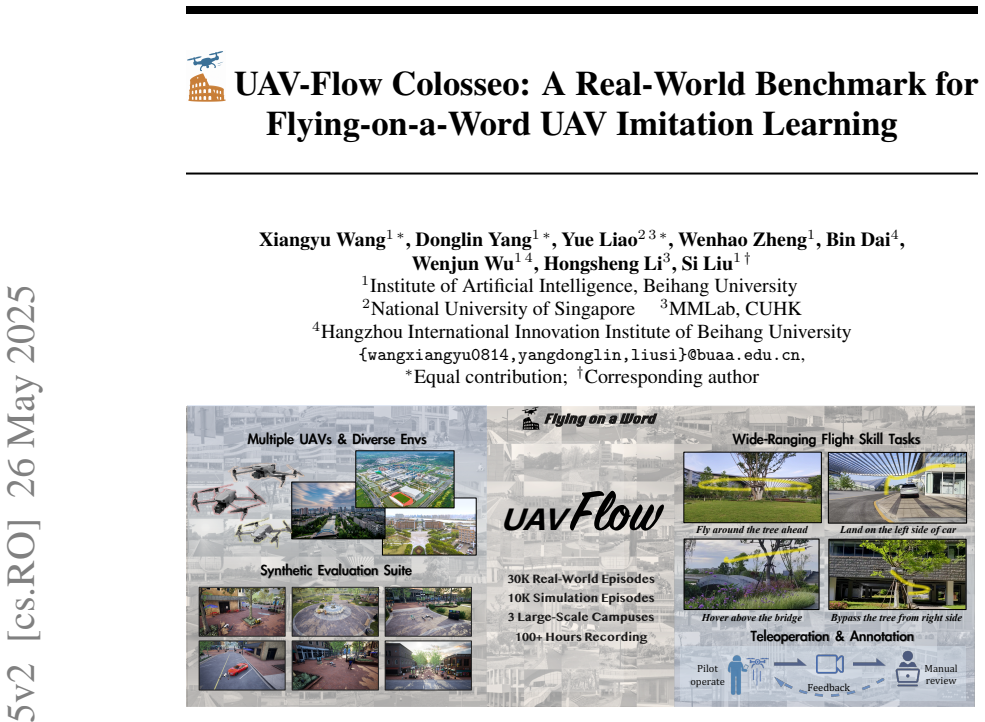
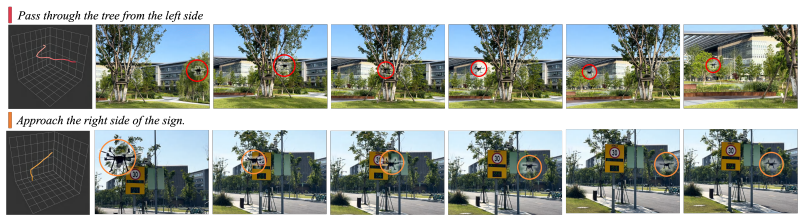
The paper's central discovery is that language-conditioned fine-grained UAV control can be cast as an imitation learning problem, and that in this setting VLA models—originally built for robotic manipulation—consistently outperform VLN models adapted from navigation. The benchmark itself, UAV-Flow, provides the first real-world language-vision-action dataset for this task, with each trajectory recorded by professional pilots following atomic instructions such as 'pass through the tree from the left side' or 'move 4.0 meters at 30 degrees to the right.' The authors find that RNN-based VLN models fail to stop at the right point and inherit motion direction, while VLA models such as OpenVLA-UAV and Pi-0-UAV show stronger spatial perception and motion execution. They also show that training on open-vocabulary command sets, generated by LLM-based language diversification, does not hurt success rates and can even improve language generalization.
Load-bearing premise
The quantitative comparison between VLA and VLN models is performed in a self-built simulator that is assumed to faithfully capture the closed-loop reactive flight dynamics and visual grounding of real UAV flight, while real-world deployment is evaluated only qualitatively.
Editorial extensions
If this is right
- If the central claim holds, language-driven UAV control shifts from long-horizon navigation benchmarks to reactive, fine-grained flight control, opening a new evaluation paradigm for embodied language agents in 3D space.
- VLA models originally developed for tabletop manipulation can be transferred to aerial platforms with relatively minor structural adaptation, suggesting that manipulation-oriented action prediction is a stronger starting point than navigation-oriented discrete action selection for reactive control.
- The ground-drone collaborative deployment strategy, with look-ahead chunk-wise action prediction, provides a practical template for running large vision-language models on resource-constrained flying platforms in open environments.
- The open-vocabulary command set generated via LLM diversification could make UAV control systems more robust to natural language variation, improving generalization beyond fixed command templates.
- The benchmark's combination of real-world training data and simulation-based closed-loop evaluation offers a reusable pipeline for other fine-grained embodied control tasks where sim-to-real gaps are severe.
Reading between the lines
- One implicit consequence is that the Flow task formulation, with its short-range reactive trajectories, may serve as a lower-level primitive that can later be composed with long-horizon planning systems—the paper's own limitations section notes this integration as future work.
- The paper's simulation results suggest that the choice of visual tokenization capacity matters: Travel-UAV, built on a compact vision encoder that uses only 17 tokens, underperforms on 'turn to face the target' tasks, implying that fine-grained visual grounding is a bottleneck that could be tested by ablating vision encoder size in VLA models.
- A testable extension would be to measure whether the same VLA superiority holds under varying weather, lighting, and dynamic obstacles in real-world conditions, since the quantitative evidence is currently limited to the simulator and qualitative real-world demos.
- The NDTW metric with 6D state vectors could be adapted to assess trajectory safety or energy efficiency, not just similarity to a reference path, extending the benchmark beyond imitation fidelity.
Signed reviews
Editorial analysis
A structured set of objections, weighed in public.
Referee Report
Summary. The paper introduces UAV-Flow, a benchmark for the 'Flying-on-a-Word' (Flow) task, defined as short-range, language-conditioned fine-grained UAV trajectory control via imitation learning. The main artifact is a real-world dataset of 30,692 human-piloted flight trajectories with synchronized FPV video, 6-DoF state, and atomic language instructions collected across three campuses, together with a 10,109-trajectory UnrealCV simulation dataset and a 273-trajectory annotated closed-loop test set. The paper also contributes a ground-drone collaborative deployment framework with a look-ahead action-chunk mechanism and a closed-loop simulation evaluation using success rate (SR) and NDTW metrics. The headline empirical claims are that VLA models (OpenVLA-UAV, Pi-0-UAV) outperform VLN baselines (Seq2Seq-UAV, CMA-UAV, Travel-UAV) on Flow, and that the system supports direct real-world deployment without a sim-to-real gap, demonstrated by qualitative flight demos.
Significance. The real-world dataset is a substantial new resource: to my knowledge, no comparable public dataset pairs atomic language instructions with centimeter-level expert UAV trajectories in open outdoor environments, and the paper states that data, code, and flight demos will be released. The task formulation separating motion intent understanding from spatial context grounding is reasonable, and adapting OpenVLA and Pi-0 to aerial control through a ground-station look-ahead mechanism is a useful engineering contribution. However, the two headline conclusions rest on evidence of unequal strength: the VLA-over-VLN result comes from a self-built simulator with a manual success metric and no reported variance, while the 'without sim-to-real gap' claim is contradicted by the paper's own caveats and by the qualitative nature of the real-world evaluation. The benchmark itself remains valuable if these claims are appropriately qualified and the simulator is validated.
major comments (4)
- [Sec. 4.2, Sec. 3.2, Sec. 2.4] The central quantitative claim that VLA models are superior to VLN baselines is supported only by closed-loop simulation scores whose success metric is determined by manual inspection of whether the trajectory 'semantically satisfies the instruction,' with no error bars, no repeated seeds, no pre-specified rubric, and no inter-annotator agreement reported. With a test set of only 273 annotated trajectories (Sec. 2.4), per-task sample sizes are small, so the reported SR and NDTW differences may not be statistically reliable. Please report means and variances over multiple evaluation runs, a pre-registered success rubric, and per-task sample sizes, or explicitly restrict the superiority claim to the simulation setting.
- [Sec. 2.3, Sec. 4.3, Limitations] The paper's own statements undermine the abstract's claims of 'direct deployment without sim-to-real gap' and 'close imitation' of expert trajectories. Sec. 2.3 concedes that 'simulation environments still exhibit discrepancies from the real world in both visual perception and flight control dynamics,' and Sec. 4.3 states that 'it remains challenging to adopt quantitative evaluation metrics in real-world scenarios'; the Limitations section similarly says systematic real-world evaluation remains difficult. The real-world deployment is therefore evidenced only by a few visualized demos. I ask for quantitative real-world trajectory error (e.g., endpoint error or NDTW relative to expert reference trajectories) on at least a small evaluation set, or for the central claims to be limited to the simulation domain.
- [Sec. 4.2, Table 4, Appendix B] Pi-0-UAV uses an action chunk size (Horizon Steps) of 10, and this value is never swept. Since the VLN baselines do not use action chunking, the VLA-over-VLN comparison could be sensitive to this design choice; a different chunk size might change the relative ordering on specific task types. Please include a sensitivity analysis over chunk size and report whether the qualitative conclusion is robust.
- [Sec. 4.1, Appendix C] The adapted VLN baselines (Seq2Seq-UAV, CMA-UAV) are trained with a single MSE loss and without state input, while the VLA baselines use flow matching or tokenized action prediction with different optimization budgets; the paper also notes that adding state input to the RN N models hurt performance. This makes it hard to separate 'paradigm superiority' from implementation quality. Please provide a matched-capacity comparison or additional evidence that these adaptations are the strongest reasonable representatives of the VLN paradigm.
minor comments (6)
- [Sec. 3 heading] The heading 'Flying-on-a-word (Flow) Colosso' appears to contain a typo; 'Colosseo' is used in the paper title and elsewhere.
- [Throughout] The token 'UAV' is inconsistently typeset as 'UA V' in many places, which hurts readability.
- [Fig. 7 and Fig. 8] The radar charts report SR and NDTW without numerical values; a companion table with exact numbers and per-task sample sizes would make the benchmark results reproducible and easier to compare.
- [Sec. 2.4] The 273-trajectory simulation test set is not described in terms of how it was split from the 10,109 simulated trajectories or whether the test instructions overlap with the training instruction templates; this should be clarified.
- [Sec. 2.2] The LLM-based 'Open Vocabulary Command Set' is described as generated with GPT models, but no human consistency check or filtering statistics are reported for these generated instructions; please specify how they were validated.
- [Sec. 4.2] The claim that open-vocabulary training 'enhances language generalization and even improves performance on certain tasks' is made without supporting numerical comparisons or significance tests; please provide the underlying numbers.
Circularity Check
No circular derivation: the benchmark claims are empirical and the only overlapping self-citation (Travel) is a non-load-bearing baseline.
full rationale
UAV-Flow is a benchmark and data paper rather than a derivation chain; there is no equation or fitted parameter whose output is its own input by construction. The central claims—existence of a real-world dataset, a Flow task formalization, and a ground-drone deployment framework—are supported by the collected data and hardware descriptions, not by a self-referential argument. The headline quantitative result that VLA models outperform VLN baselines (Sec. 4.2) is an empirical comparison in the self-built UAV-Flow-Sim environment; the metric is a manual semantic success check (Sec. 3.2) and the simulator's fidelity is acknowledged to be imperfect (Sec. 2.3). Those are experimental-validity concerns, not circularity: the comparison does not reduce to its inputs by construction. The only author-overlapping citation is Travel [7], used as a baseline model (Sec. 4.1) and in related work; it is not load-bearing for the benchmark's existence or for the VLA-versus-VLN conclusion, since the VLA baselines OpenVLA and Pi-0 are external and the real-world dataset was independently collected. No uniqueness theorem is imported from the authors' prior work, and no ansatz is smuggled in via citation. Accordingly, no specific circular step is identified; the score reflects only the minor, non-load-bearing self-citation.
Assumptions & free parameters
free parameters (1)
- Pi-0-UAV action chunk size =
10
assumptions (3)
- domain assumption The UnrealCV-based simulation environment faithfully reflects real-world flight dynamics and visual appearance for fine-grained reactive control.
- domain assumption Annotator review reliably maps each expert trajectory to a single atomic instruction with consistent semantic alignment.
- domain assumption RTK-GPS and onboard state logs provide centimeter-level accuracy sufficient for 6-DoF trajectory imitation.
Cite this review
Pith. "Pith review of UAV-Flow Colosseo: A Real-World Benchmark for Flying-on-a-Word UAV Imitation Learning." pith.science (2026). https://pith.science/paper/7LB4YXTE
@misc{pith2026250515725,
  author       = {Pith},
  title        = {Pith review of: UAV-Flow Colosseo: A Real-World Benchmark for Flying-on-a-Word UAV Imitation Learning},
  year         = {2026},
  howpublished = {\url{https://pith.science/paper/7LB4YXTE}},
  note         = {Machine review of arXiv:2505.15725}
}
read the original abstract
Unmanned Aerial Vehicles (UAVs) are evolving into language-interactive platforms, enabling more intuitive forms of human-drone interaction. While prior works have primarily focused on high-level planning and long-horizon navigation, we shift attention to language-guided fine-grained trajectory control, where UAVs execute short-range, reactive flight behaviors in response to language instructions. We formalize this problem as the Flying-on-a-Word (Flow) task and introduce UAV imitation learning as an effective approach. In this framework, UAVs learn fine-grained control policies by mimicking expert pilot trajectories paired with atomic language instructions. To support this paradigm, we present UAV-Flow, the first real-world benchmark for language-conditioned, fine-grained UAV control. It includes a task formulation, a large-scale dataset collected in diverse environments, a deployable control framework, and a simulation suite for systematic evaluation. Our design enables UAVs to closely imitate the precise, expert-level flight trajectories of human pilots and supports direct deployment without sim-to-real gap. We conduct extensive experiments on UAV-Flow, benchmarking VLN and VLA paradigms. Results show that VLA models are superior to VLN baselines and highlight the critical role of spatial grounding in the fine-grained Flow setting.
Figures


Figures from the paper (10 more)




Forward citations
Cited by 3 Pith papers
-
ActiveFly-Bench: Aligning Embodied Question Answering with Vision-Language-Action for Aerial Embodied Perception
ActiveFly-Bench defines Air-EQA, Observation Behavior Planning, and 7-DoF FLUC tasks on 10k real/sim trajectories so UAV agents must plan, fly, and answer questions they cannot solve from the start view.
-
AION: Aerial Indoor Object-Goal Navigation Using Dual-Policy Reinforcement Learning
An end-to-end dual-policy RL method extends zero-shot object-goal navigation from ground robots to indoor drones, using depth-derived laser-scan and reachable-region features, and reports top AI2-THOR scores plus Isaa...
-
Fly0: Persistent Metric Anchoring for Zero-Shot Aerial Vision-Language Navigation
A zero-shot aerial VLN system that has an MLLM output only 2D image coordinates, then uses depth unprojection and Ego-Planner to navigate, reporting >20 percentage-point SR gains and 31–37% NE reductions over baselines.
Reference graph
Works this paper leans on
-
[1]
Lun Quan, Luxin Han, Boyu Zhou, Shaojie Shen, and Fei Gao. Survey of uav motion planning. IET Cyber-systems and Robotics, 2(1):14–21, 2020
work page 2020
-
[2]
Ego-planner: An esdf-free gradient-based local planner for quadrotors
Xin Zhou, Zhepei Wang, Hongkai Ye, Chao Xu, and Fei Gao. Ego-planner: An esdf-free gradient-based local planner for quadrotors. IEEE Robotics and Automation Letters, 6(2):478–485, 2021
work page 2021
-
[3]
Ego-swarm: A fully autonomous and decentralized quadrotor swarm system in cluttered environments
Xin Zhou, Jiangchao Zhu, Hongyu Zhou, Chao Xu, and Fei Gao. Ego-swarm: A fully autonomous and decentralized quadrotor swarm system in cluttered environments. In 2021 IEEE International Conference on Robotics and Automation (ICRA), pages 4101–4107, 2021
work page 2021
-
[4]
Real-time trajectory replanning for mavs using uniform b-splines and a 3d circular buffer
Vladyslav Usenko, Lukas V on Stumberg, Andrej Pangercic, and Daniel Cremers. Real-time trajectory replanning for mavs using uniform b-splines and a 3d circular buffer. In 2017 IEEE/RSJ International Conference on Intelligent Robots and Systems (IROS), pages 215–222. IEEE, 2017
work page 2017
-
[5]
Aerialvln: Vision- and-language navigation for uavs
Shubo Liu, Hongsheng Zhang, Yuankai Qi, Peng Wang, Yanning Zhang, and Qi Wu. Aerialvln: Vision- and-language navigation for uavs. In Proceedings of the IEEE/CVF International Conference on Computer Vision (ICCV), pages 15384–15394, October 2023
work page 2023
-
[6]
Citynav: Language-goal aerial navigation dataset with geographic information
Jungdae Lee, Taiki Miyanishi, Shuhei Kurita, Koya Sakamoto, Daichi Azuma, Yutaka Matsuo, and Nakamasa Inoue. Citynav: Language-goal aerial navigation dataset with geographic information. arXiv preprint arXiv:2406.14240, 2024
arXiv 2024
-
[7]
Towards realistic uav vision-language navigation: Platform, benchmark, and methodology
Xiangyu Wang, Donglin Yang, Ziqin Wang, Hohin Kwan, Jinyu Chen, Wenjun Wu, Hongsheng Li, Yue Liao, and Si Liu. Towards realistic uav vision-language navigation: Platform, benchmark, and methodology. arXiv preprint arXiv:2410.07087, 2024
-
[8]
Openfly: A versatile toolchain and large-scale benchmark for aerial vision-language navigation
Yunpeng Gao, Chenhui Li, Zhongrui You, Junli Liu, Zhen Li, Pengan Chen, Qizhi Chen, Zhonghan Tang, Liansheng Wang, Penghui Yang, et al. Openfly: A versatile toolchain and large-scale benchmark for aerial vision-language navigation. arXiv preprint arXiv:2502.18041, 2025
arXiv 2025
Show all 35 references
-
[9]
Vision-and-dialog navigation
Jesse Thomason, Michael Murray, Maya Cakmak, and Luke Zettlemoyer. Vision-and-dialog navigation. In CRL, 2020
2020
-
[10]
Vision-and-language navigation: Interpreting visually-grounded navigation instructions in real environments
Peter Anderson, Qi Wu, Damien Teney, Jake Bruce, Mark Johnson, Niko Sünderhauf, Ian Reid, Stephen Gould, and Anton Van Den Hengel. Vision-and-language navigation: Interpreting visually-grounded navigation instructions in real environments. In CVPR, 2018
2018
-
[11]
Think global, act local: Dual-scale graph transformer for vision-and-language navigation
Shizhe Chen, Pierre-Louis Guhur, Makarand Tapaswi, Cordelia Schmid, and Ivan Laptev. Think global, act local: Dual-scale graph transformer for vision-and-language navigation. In Proceedings of the IEEE/CVF Conference on Computer Vision and Pattern Recognition (CVPR), pages 165...
2022
-
[12]
Touchdown: Natural language navigation and spatial reasoning in visual street environments
Howard Chen, Alane Suhr, Dipendra Misra, Noah Snavely, and Yoav Artzi. Touchdown: Natural language navigation and spatial reasoning in visual street environments. InProceedings of the IEEE/CVF Conference on Computer Vision and Pattern Recognition, pages 12538–12547, 2019
2019
-
[13]
Room-across-room: Multi- lingual vision-and-language navigation with dense spatiotemporal grounding
Alexander Ku, Peter Anderson, Roma Patel, Eugene Ie, and Jason Baldridge. Room-across-room: Multi- lingual vision-and-language navigation with dense spatiotemporal grounding. In Proceedings of the 2020 Conference on Empirical Methods in Natural Language Processing (EMNLP), pag...
2020
-
[14]
Hierarchical cross-modal agent for robotics vision-and-language navigation
Muhammad Zubair Irshad, Chih-Yao Ma, and Zsolt Kira. Hierarchical cross-modal agent for robotics vision-and-language navigation. In 2021 IEEE international conference on robotics and automation (ICRA), pages 13238–13246. IEEE, 2021
2021
-
[15]
Airsim: High-fidelity visual and physical simulation for autonomous vehicles
Shital Shah, Debadeepta Dey, Chris Lovett, and Ashish Kapoor. Airsim: High-fidelity visual and physical simulation for autonomous vehicles. In Marco Hutter and Roland Siegwart, editors, Field and Service Robotics, pages 621–635, Cham, 2018. Springer International Publishing
2018
-
[16]
Unrealcv: Virtual worlds for computer vision
Weichao Qiu, Fangwei Zhong, Yi Zhang, Siyuan Qiao, Zihao Xiao, Tae Soo Kim, and Yizhou Wang. Unrealcv: Virtual worlds for computer vision. InProceedings of the 25th ACM International Conference on Multimedia, MM ’17, page 1221–1224, New York, NY , USA, 2017. Association for Co...
2017
-
[17]
Navgpt: Explicit reasoning in vision-and-language navigation with large language models
Gengze Zhou, Yicong Hong, and Qi Wu. Navgpt: Explicit reasoning in vision-and-language navigation with large language models. In Proceedings of the AAAI Conference on Artificial Intelligence, volume 38, pages 7641–7649, 2024
2024
-
[18]
Navgpt-2: Unleashing navigational reasoning capability for large vision-language models
Gengze Zhou, Yicong Hong, Zun Wang, Xin Eric Wang, and Qi Wu. Navgpt-2: Unleashing navigational reasoning capability for large vision-language models. In European Conference on Computer Vision, pages 260–278. Springer, 2024
2024
-
[19]
Towards long-horizon vision-language navigation: Platform, benchmark and method
Xinshuai Song, Weixing Chen, Yang Liu, Weikai Chen, Guanbin Li, and Liang Lin. Towards long-horizon vision-language navigation: Platform, benchmark and method. arXiv preprint arXiv:2412.09082, 2024
2024 arXiv
-
[20]
Navcot: Boosting llm-based vision-and-language navigation via learning disentangled reasoning
Bingqian Lin, Yunshuang Nie, Ziming Wei, Jiaqi Chen, Shikui Ma, Jianhua Han, Hang Xu, Xiaojun Chang, and Xiaodan Liang. Navcot: Boosting llm-based vision-and-language navigation via learning disentangled reasoning. IEEE Transactions on Pattern Analysis and Machine Intelligence, 2025
2025
-
[21]
Beyond the nav-graph: Vision-and-language navigation in continuous environments
Jacob Krantz, Erik Wijmans, Arjun Majumdar, Dhruv Batra, and Stefan Lee. Beyond the nav-graph: Vision-and-language navigation in continuous environments. In Andrea Vedaldi, Horst Bischof, Thomas Brox, and Jan-Michael Frahm, editors, Computer Vision – ECCV 2020 , pages 104–120,...
2020
-
[22]
Openvla: An open-source vision-language-action model
Moo Jin Kim, Karl Pertsch, Siddharth Karamcheti, Ted Xiao, Ashwin Balakrishna, Suraj Nair, Rafael Rafailov, Ethan Foster, Grace Lam, Pannag Sanketi, et al. Openvla: An open-source vision-language-action model. arXiv preprint arXiv:2406.09246, 2024
2024 arXiv
-
[23]
π0: A vision-language-action flow model for general robot control
Kevin Black, Noah Brown, Danny Driess, Adnan Esmail, Michael Equi, Chelsea Finn, Niccolo Fusai, Lachy Groom, Karol Hausman, Brian Ichter, et al. π0: A vision-language-action flow model for general robot control. arXiv preprint arXiv:2410.24164, 2024
-
[24]
Gpt-4 technical report
Josh Achiam, Steven Adler, Sandhini Agarwal, Lama Ahmad, Ilge Akkaya, Florencia Leoni Aleman, Diogo Almeida, Janko Altenschmidt, Sam Altman, Shyamal Anadkat, et al. Gpt-4 technical report. arXiv preprint arXiv:2303.08774, 2023
2023 arXiv
-
[25]
Unrealzoo: Enriching photo-realistic virtual worlds for embodied ai
Fangwei Zhong, Kui Wu, Churan Wang, Hao Chen, Hai Ci, Zhoujun Li, and Yizhou Wang. Unrealzoo: Enriching photo-realistic virtual worlds for embodied ai. arXiv preprint arXiv:2412.20977, 2024
2024 arXiv
-
[26]
General evaluation for instruction conditioned navigation using dynamic time warping
Gabriel Ilharco, Vihan Jain, Alexander Ku, Eugene Ie, and Jason Baldridge. General evaluation for instruction conditioned navigation using dynamic time warping. In Visually Grounded Interaction and Language (ViGIL), NeurIPS 2019 Workshop, 2019
2019
-
[27]
Yaron Lipman, Ricky T. Q. Chen, Heli Ben-Hamu, Maximilian Nickel, and Matthew Le. Flow matching for generative modeling. In The Eleventh International Conference on Learning Representations, 2023
2023
-
[28]
Llama-vid: An image is worth 2 tokens in large language models
Yanwei Li, Chengyao Wang, and Jiaya Jia. Llama-vid: An image is worth 2 tokens in large language models. In Aleš Leonardis, Elisa Ricci, Stefan Roth, Olga Russakovsky, Torsten Sattler, and Gül Varol, editors, Computer Vision – ECCV 2024, pages 323–340, Cham, 2025. Springer Nat...
2024
-
[29]
Aeroverse: Uav-agent benchmark suite for simulating, pre-training, finetuning, and evaluating aerospace embodied world models
Fanglong Yao, Yuanchang Yue, Youzhi Liu, Xian Sun, and Kun Fu. Aeroverse: Uav-agent benchmark suite for simulating, pre-training, finetuning, and evaluating aerospace embodied world models. arXiv preprint arXiv:2408.15511, 2024. 11
2024
-
[30]
Design and use paradigms for gazebo, an open-source multi-robot simulator
Nathan Koenig and Andrew Howard. Design and use paradigms for gazebo, an open-source multi-robot simulator. In IROS, 2004
2004
-
[31]
Visdrone-det2019: The vision meets drone object detection in image challenge results
Dawei Du, Pengfei Zhu, Longyin Wen, Xiao Bian, Haibin Lin, Qinghua Hu, Tao Peng, Jiayu Zheng, Xinyao Wang, Yue Zhang, et al. Visdrone-det2019: The vision meets drone object detection in image challenge results. In Proceedings of the IEEE/CVF international conference on compute...
2019
-
[32]
Learning social etiquette: Human trajectory understanding in crowded scenes
Alexandre Robicquet, Amir Sadeghian, Alexandre Alahi, and Silvio Savarese. Learning social etiquette: Human trajectory understanding in crowded scenes. In Computer Vision–ECCV 2016: 14th European Conference, Amsterdam, The Netherlands, October 11-14, 2016, Proceedings, Part VI...
2016
-
[33]
Visible and clear: Finding tiny objects in difference map
Bing Cao, Haiyu Yao, Pengfei Zhu, and Qinghua Hu. Visible and clear: Finding tiny objects in difference map. In European Conference on Computer Vision, pages 1–18. Springer, 2024
2024
-
[34]
A benchmark and simulator for uav tracking
UT Benchmark. A benchmark and simulator for uav tracking. In European conference on computer vision, volume 7, 2016
2016
-
[35]
reference frame
Pengfei Zhu, Tao Peng, Dawei Du, Hongtao Yu, Libo Zhang, and Qinghua Hu. Graph regularized flow attention network for video animal counting from drones. IEEE Transactions on Image Processing , 30:5339–5351, 2021. A Trajectory Visualization of Experimental Results As shown in F...
2021
Reviewed August 7, 2026 · model on record in the stance chip above.
Discussion (0). Continue with ORCID to comment.