LEGGOS II: A Strong Lens Model and Source-Plane Projection of the Clumpy Star-Forming Galaxy SGASJ111020.0+645950.8 at z=2.48
Pith reviewed 2026-06-26 16:22 UTC · model grok-4.3
The pith
A strong lens model for cluster SDSSJ1110+6459 delivers 2-8 times tighter magnification precision for a clumpy galaxy at z=2.48 by using JWST-resolved clumps as constraints.
A machine-rendered reading of the paper's core claim, the machinery that carries it, and where it could break.
Core claim
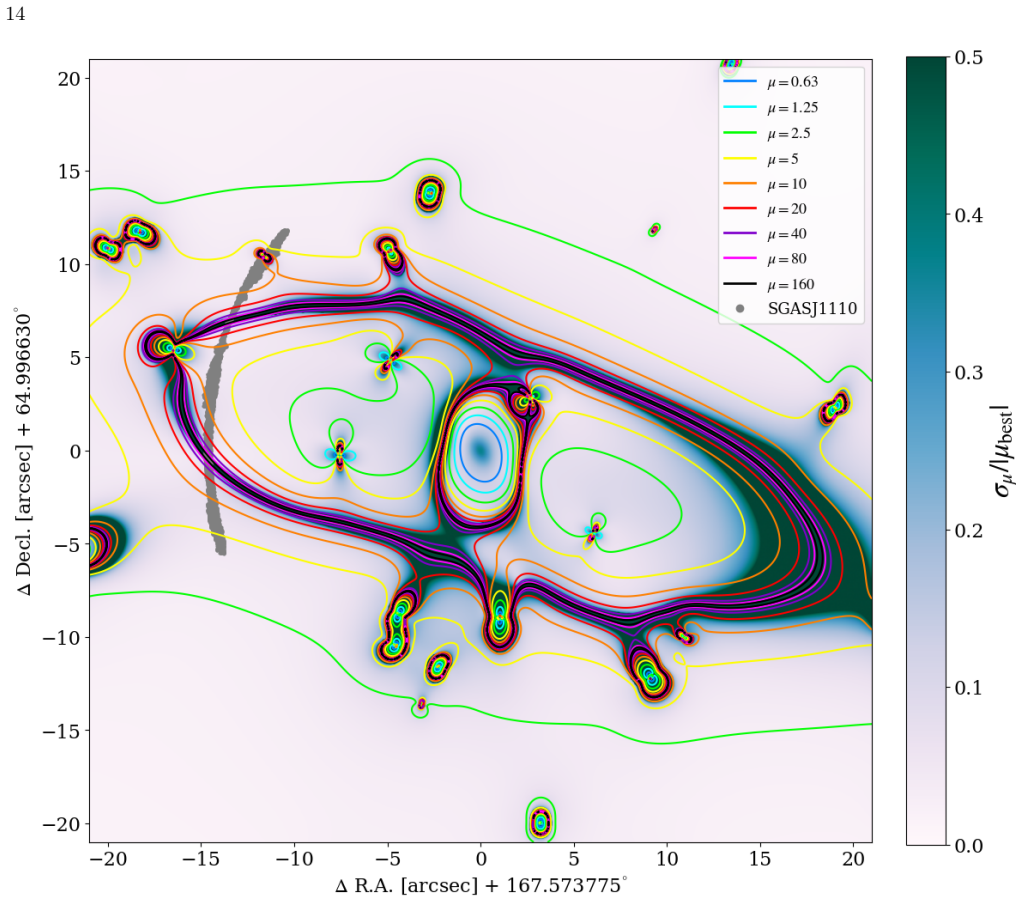
The lens model yields a projected lens mass of M(<250 kpc) = 1.21^{+0.09}_{-0.04} × 10^{14} M_⊙, an Einstein radius of θ_E = 10.8^{+0.3}_{-0.4} arcsec, and a total effective magnification of μ_tot = 24.2^{+3.4}_{-1.2} for the giant arc. Individual clumps show magnifications spanning 4 to 19 with fractional uncertainties σ_μ / |μ_best| of 0.03-0.09, representing a 2-8 times improvement over earlier models.
What carries the argument
Strong gravitational lens model constrained by the positions of four multiply-imaged systems and the high-density set of JWST-resolved clumps within the giant arc.
If this is right
- The arc receives a total magnification of 24.2 with asymmetric uncertainties of +3.4 and -1.2.
- Clump magnifications range from 4 to 19 with per-clump fractional uncertainties of 3-9 percent.
- The model supplies the foundation for source-plane reconstruction of star-forming structures at 10-100 pc scales.
- Ongoing LEGGOS analyses can now measure galaxy growth and feedback at cosmic noon using these magnification values.
Where Pith is reading between the lines
- Source-plane sizes and luminosities of the clumps can be recovered with reduced systematic error from uncertain lensing.
- The same clump-density approach may produce high-precision models for other systems that lack many distinct multiply-imaged sources.
- Consistent application across the LEGGOS sample would enable direct comparison of intrinsic clump properties at similar redshifts.
Load-bearing premise
The many JWST clumps can be treated as independent constraints on the lensing potential despite originating from only four distinct sources all placed at one source-plane redshift.
What would settle it
Spectroscopy that places any of the edge clumps at a redshift different from 2.481, or new high-resolution imaging that shows predicted multiple-image positions offset from the observed locations by more than the reported uncertainties.
Figures
read the original abstract
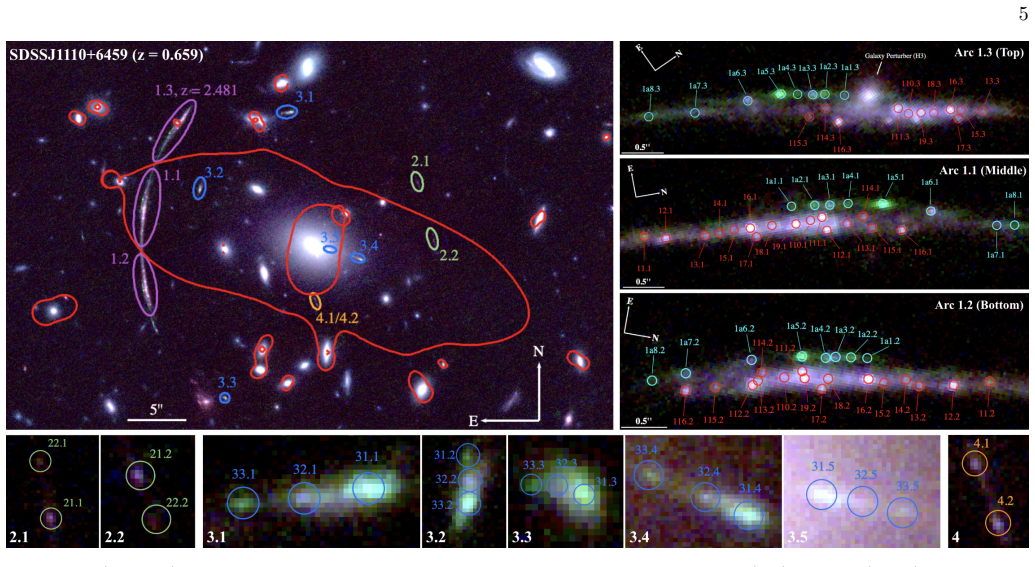
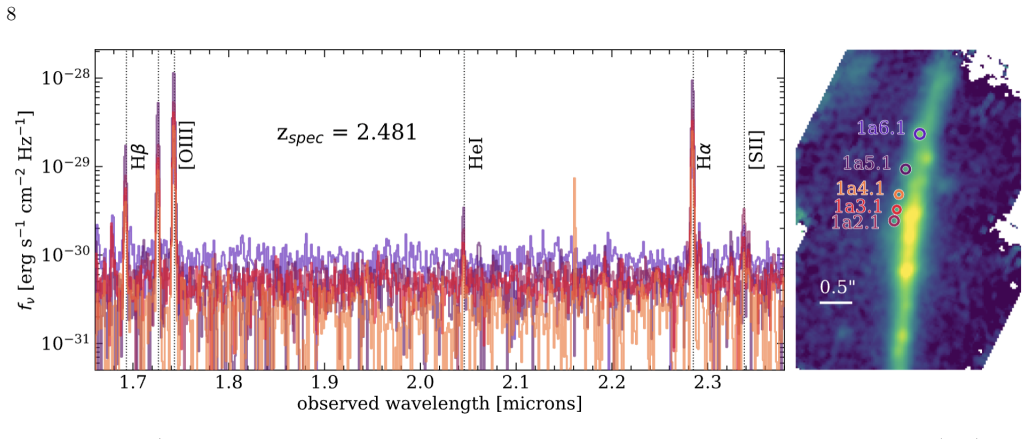
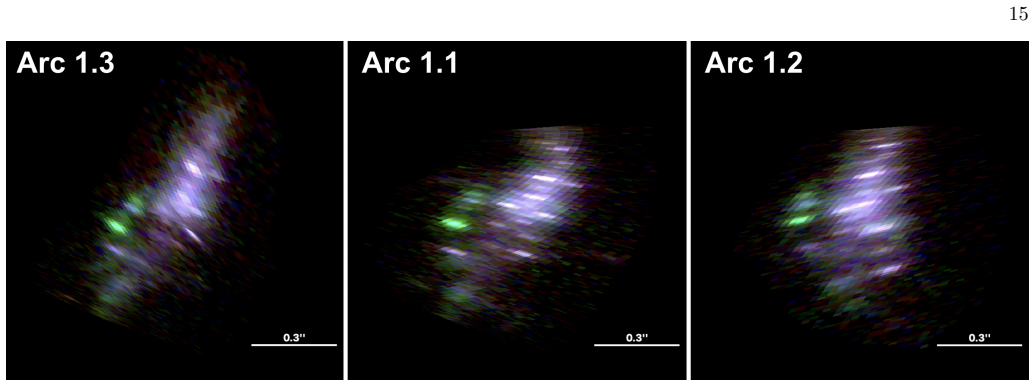
Strong gravitational lensing by galaxy clusters combined with the resolution of JWST enables studies of star formation on ~10-100 pc scales in galaxies at z~2-4. As part of the LEnsing and Galaxy Growth: Observing Substructures survey (LEGGOS), we present an updated strong lensing model of the galaxy cluster SDSSJ1110+6459 (z=0.659), which lenses the clumpy star-forming galaxy SGASJ111020.0+645950.8 at z=2.481 into a highly magnified giant arc. Using JWST NIRCam imaging, NIRSpec spectroscopy, and archival HST data, we confirm and refine the identification of four multiply imaged background sources, including one newly identified system, and map over 20 luminous regions between each image of the primary arc. Spectroscopy confirms that several previously ambiguous edge "clumps" belong to the main arc at z=2.481. Despite the limited number of strongly lensed sources in the field, the resulting lens model has high precision, owing to the high density of JWST-resolved clump constraints that tightly probe the lensing potential near the giant arc. The model yields a projected lens mass of $M(<250~\mathrm{kpc}) = 1.21^{+0.09}_{-0.04} \times 10^{14}~M_\odot$, an Einstein radius of $\theta_\mathrm{E} = 10.8^{+0.3}_{-0.4}~\mathrm{arcsec}$, and a total effective magnification of $\mu_\mathrm{tot}=24.2^{+3.4}_{-1.2}$ for the giant arc. Across the arc, individual clump magnifications span $\mu_\mathrm{clump}\sim4-19$, with fractional magnification uncertainties of $\sigma_\mu/|\mu_{\rm best}|\sim0.03-0.09$. We report a $\sim2-8\times$ improvement in magnification precision over previous models. Ongoing and future analyses of this arc will enable robust measurements of star-forming structure, building on the lensing foundation established here for LEGGOS studies of galaxy growth and feedback during cosmic noon.
Editorial analysis
A structured set of objections, weighed in public.
Referee Report
Summary. The paper presents an updated strong-lensing model of the galaxy cluster SDSS J1110+6459 (z=0.659) that lenses the clumpy galaxy SGAS J111020.0+645950.8 (z=2.481) into a giant arc. Using JWST NIRCam imaging, NIRSpec spectroscopy, and archival HST data, the authors identify four multiply-imaged background sources (one new) and map >20 luminous clumps across the primary arc images. They derive a projected lens mass M(<250 kpc) = 1.21^{+0.09}_{-0.04} × 10^{14} M_⊙, Einstein radius θ_E = 10.8^{+0.3}_{-0.4} arcsec, and total effective magnification μ_tot = 24.2^{+3.4}_{-1.2} for the arc, with individual clump magnifications spanning ~4–19 and fractional uncertainties 0.03–0.09, claiming a 2–8× improvement over prior models due to the high density of JWST-resolved clump constraints.
Significance. If the reported magnification uncertainties are robust, the model supplies a high-precision lensing foundation for resolved studies of star-forming substructure on 10–100 pc scales at z~2.5, directly supporting the LEGGOS survey goals of measuring galaxy growth and feedback during cosmic noon.
major comments (1)
- [Abstract and lens-modeling description] Abstract and lens-modeling description: The headline precision (σ_μ/|μ_best| ~0.03–0.09 and 2–8× improvement) is attributed to treating >20 JWST-resolved clump positions as independent constraints on the lensing potential. With only four distinct multiply-imaged systems, these clumps lie in a single source plane at z=2.481 and share the same deflection field; without explicit modeling of source-plane spatial correlations or a full pixelized source reconstruction, the reported uncertainties on M(<250 kpc), θ_E, and μ_clump risk being artificially tight.
Simulated Author's Rebuttal
We thank the referee for their careful reading and for identifying this important methodological point regarding the treatment of clump constraints. We respond to the major comment below.
read point-by-point responses
-
Referee: [Abstract and lens-modeling description] Abstract and lens-modeling description: The headline precision (σ_μ/|μ_best| ~0.03–0.09 and 2–8× improvement) is attributed to treating >20 JWST-resolved clump positions as independent constraints on the lensing potential. With only four distinct multiply-imaged systems, these clumps lie in a single source plane at z=2.481 and share the same deflection field; without explicit modeling of source-plane spatial correlations or a full pixelized source reconstruction, the reported uncertainties on M(<250 kpc), θ_E, and μ_clump risk being artificially tight.
Authors: We thank the referee for raising this subtlety. The four multiply-imaged systems include the primary arc (SGAS J111020.0+645950.8), which we model using >20 distinct luminous clumps whose image-plane positions were independently measured from JWST NIRCam data. These clumps are assigned the same source redshift and share a single lens potential; each clump is treated as a separate point source whose multiple images must map back to a common source-plane location under that potential. The lens-model parameters (including the reported M(<250 kpc), θ_E, and μ values) are sampled via MCMC, with the posterior reflecting the joint constraints from all image positions. While we did not impose explicit source-plane spatial correlations between clumps or perform a pixelized source reconstruction, the position-only approach with multiple knots is standard for cluster-scale models and directly constrains the local deflection field near the arc. The resulting fractional uncertainties (0.03–0.09) are therefore driven by the high density of independent positional measurements rather than by over-counting. We will revise the abstract and Section 3 to clarify the constraint implementation and to note the absence of a full source-plane correlation model. revision: partial
Circularity Check
Standard lens modeling pipeline with no circular derivation steps
full rationale
The paper derives the lens mass M(<250 kpc), Einstein radius θ_E, and magnifications μ from a standard strong-lensing fit to observed image positions and spectroscopic redshifts of four multiply-imaged systems plus >20 clumps. These quantities are direct outputs of the deflection field solved from the constraints; they are not redefined in terms of themselves or obtained by renaming a fitted parameter as a prediction. No self-citation chain, uniqueness theorem, or ansatz is invoked to justify the central results. The high density of clump positions is presented as an empirical advantage of the data, not as a mathematical identity that forces the reported precision. The derivation is therefore self-contained against external image-position benchmarks.
Axiom & Free-Parameter Ledger
free parameters (1)
- lens model parameters (halo masses, ellipticities, shear)
axioms (2)
- domain assumption All identified clumps and image systems lie at the same source redshift z=2.481
- standard math Standard thin-lens approximation and parametric or grid-based mass model for the cluster
Reference graph
Works this paper leans on
-
[1]
Anand, G. S., Mack, J., Avila, R. J., et al. 2025, in The DrizzlePac Handbook, 3 Astropy Collaboration, Robitaille, T. P., Tollerud, E. J., et al. 2013, A&A, 558, A33, doi: 10.1051/0004-6361/201322068 Astropy Collaboration, Price-Whelan, A. M., Sip˝ ocz, B. M., et al. 2018, AJ, 156, 123, doi: 10.3847/1538-3881/aabc4f Astropy Collaboration, Price-Whelan, A...
-
[2]
Bertin, E., & Arnouts, S. 1996, A&AS, 117, 393, doi: 10.1051/aas:1996164
-
[3]
Cerny, C., Mahler, G., Sharon, K., et al. 2025, Strong LensIng and Cluster Evolution (SLICE) with JWST: Early Results, Lens Models, and High-Redshift Detections. https://arxiv.org/abs/2503.17498 Di Valentino, E., Mena, O., Pan, S., et al. 2021, Classical and Quantum Gravity, 38, 153001, doi: 10.1088/1361-6382/ac086d
work page internal anchor Pith review Pith/arXiv arXiv doi:10.1088/1361-6382/ac086d 2025
-
[4]
Ebeling, H., Stephenson, L. N., & Edge, A. C. 2014, ApJL, 781, L40, doi: 10.1088/2041-8205/781/2/L40
-
[5]
Gladders, M. D., & Yee, H. K. C. 2000, AJ, 120, 2148, doi: 10.1086/301557
-
[6]
Hao, J., McKay, T. A., Koester, B. P., et al. 2010, ApJS, 191, 254, doi: 10.1088/0067-0049/191/2/254
-
[7]
Harris, C. R., Millman, K. J., van der Walt, S. J., et al. 2020, Nature, 585, 357, doi: 10.1038/s41586-020-2649-2
-
[8]
Hunter, J. D. 2007, Computing in Science & Engineering, 9, 90, doi: 10.1109/MCSE.2007.55
-
[9]
2025, in American Astronomical Society Meeting Abstracts, Vol
Hutchison, T., Khullar, G., Welch, B., et al. 2025, in American Astronomical Society Meeting Abstracts, Vol. 245, American Astronomical Society Meeting Abstracts #245, 170.05
2025
-
[10]
Hutchison, T. A., Welch, B. D., Rigby, J. R., et al. 2024, PASP, 136, 044503, doi: 10.1088/1538-3873/ad34fd Inc., T. M. 2025, MATLAB version (R2025a), Natick,
-
[11]
D., Leja, J., Conroy, C., & Speagle, J
Johnson, B. D., Leja, J., Conroy, C., & Speagle, J. S. 2021, The Astrophysical Journal Supplement Series, 254, 22, doi: 10.3847/1538-4365/abef67
work page internal anchor Pith review doi:10.3847/1538-4365/abef67 2021
-
[12]
Johnson, T. L., Sharon, K., Gladders, M. D., et al. 2017a, The Astrophysical Journal, 843, 78, doi: 10.3847/1538-4357/aa7756
-
[13]
Johnson, T. L., Rigby, J. R., Sharon, K., et al. 2017b, ApJL, 843, L21, doi: 10.3847/2041-8213/aa7516
-
[14]
Jullo, E., & Kneib, J.-P. 2009, MNRAS, 395, 1319, doi: 10.1111/j.1365-2966.2009.14654.x
-
[15]
2007, New Journal of Physics, 9, 447, doi: 10.1088/1367-2630/9/12/447
Jullo, E., Kneib, J.-P., Limousin, M., et al. 2007, New Journal of Physics, 9, 447, doi: 10.1088/1367-2630/9/12/447
-
[16]
Kamionkowski, M., & Riess, A. G. 2023, Annual Review of Nuclear and Particle Science, 73, 153, doi: 10.1146/annurev-nucl-111422-024107
-
[17]
Limousin, M., Kneib, J.-P., & Natarajan, P. 2005, Monthly Notices of the Royal Astronomical Society, 356, 309, doi: 10.1111/j.1365-2966.2004.08449.x
-
[18]
SLICE -- Combining Strong Lensing and X-ray in AC 114. Further Insights into the Merger Scenario
Limousin, M., Beauchesne, B., Sharon, K., et al. 2025, arXiv e-prints, arXiv:2512.09512, doi: 10.48550/arXiv.2512.09512
work page internal anchor Pith review Pith/arXiv arXiv doi:10.48550/arxiv.2512.09512 2025
-
[19]
Livermore, R. C., Jones, T., Richard, J., et al. 2012, MNRAS, 427, 688, doi: 10.1111/j.1365-2966.2012.21900.x
-
[20]
2019, Behavior Research Methods, 51, 440, doi: 10.3758/s13428-018-1188-3
Lorah, J., & Womack, A. 2019, Behavior Research Methods, 51, 440, doi: 10.3758/s13428-018-1188-3
-
[21]
2018, MNRAS, 473, 663, doi: 10.1093/mnras/stx1971
Mahler, G., Richard, J., Cl´ ement, B., et al. 2018, MNRAS, 473, 663, doi: 10.1093/mnras/stx1971
-
[22]
2023, ApJ, 945, 49, doi: 10.3847/1538-4357/acaea9
Mahler, G., Jauzac, M., Richard, J., et al. 2023, ApJ, 945, 49, doi: 10.3847/1538-4357/acaea9
-
[23]
2017, MNRAS, 472, 3177, doi: 10.1093/mnras/stx2064 21
Meneghetti, M., Natarajan, P., Coe, D., et al. 2017, MNRAS, 472, 3177, doi: 10.1093/mnras/stx2064 21
-
[24]
Ofek, E. O. 2014, MAAT: MATLAB Astronomy and Astrophysics Toolbox, Astrophysics Source Code Library, record ascl:1407.005. http://ascl.net/1407.005
2014
-
[25]
2011, MNRAS, 416, 2193, doi: 10.1111/j.1365-2966.2011.19197.x
Oguri, M., Bayliss, M. B., Dahle, H., et al. 2012, MNRAS, 420, 3213, doi: 10.1111/j.1365-2966.2011.20248.x
-
[26]
Rauscher, B. J. 2024, PASP, 136, 015001, doi: 10.1088/1538-3873/ad1b36 Remolina Gonz´ alez, J. D., Sharon, K., Li, N., et al. 2021, ApJ, 910, 146, doi: 10.3847/1538-4357/abe62a
-
[27]
Rigby, J. R., Johnson, T. L., Sharon, K., et al. 2017, ApJ, 843, 79, doi: 10.3847/1538-4357/aa775e
-
[28]
Rivera-Thorsen, T. E., Chisholm, J., Welch, B., et al. 2024, Astronomy &; Astrophysics, 690, A269, doi: 10.1051/0004-6361/202450359
-
[29]
1985, A&A, 143, 413
Schneider, P. 1985, A&A, 143, 413
1985
-
[30]
The Annals of Statistics , author =
Schwarz, G. 1978, The Annals of Statistics, 6, 461 , doi: 10.1214/aos/1176344136
-
[31]
C., Mahler, G., Coe, D., & RELICS: Reionization Lensing Cluster Survey
Sharon, K., Chen, M. C., Mahler, G., Coe, D., & RELICS: Reionization Lensing Cluster Survey. 2023, ApJS, 264, 15, doi: 10.3847/1538-4365/aca7c3
-
[32]
Sharon, K., Bayliss, M. B., Dahle, H., et al. 2020, ApJS, 247, 12, doi: 10.3847/1538-4365/ab5f13
-
[33]
Sharon, K., Mahler, G., Rivera-Thorsen, T. E., et al. 2022, ApJ, 941, 203, doi: 10.3847/1538-4357/ac927a Smithsonian Astrophysical Observatory. 2000, SAOImage DS9: A utility for displaying astronomical images in the X11 window environment, Astrophysics Source Code Library, record ascl:0003.002. http://ascl.net/0003.002
-
[34]
Tully, R. B. 2023, arXiv e-prints, arXiv:2305.11950, doi: 10.48550/arXiv.2305.11950
-
[35]
Vanzella, E., Loiacono, F., Bergamini, P., et al. 2023, A&A, 678, A173, doi: 10.1051/0004-6361/202346981
-
[36]
Nature Methods 17:261--272, ://dx.doi.org/10.1038/s41592-019-0686-2
Virtanen, P., Gommers, R., Oliphant, T. E., et al. 2020, Nature Methods, 17, 261, doi: 10.1038/s41592-019-0686-2
-
[37]
2022, ApJL, 940, L1, doi: 10.3847/2041-8213/ac9d39
Welch, B., Coe, D., Zackrisson, E., et al. 2022, ApJL, 940, L1, doi: 10.3847/2041-8213/ac9d39
-
[38]
2015, ApJ, 801, 44, doi: 10.1088/0004-637X/801/1/44
Zitrin, A., Fabris, A., Merten, J., et al. 2015, ApJ, 801, 44, doi: 10.1088/0004-637X/801/1/44
discussion (0)
Sign in with ORCID, Apple, or X to comment. Anyone can read and Pith papers without signing in.