REVIEW 3 major objections 4 minor 28 references
A numerical simulation shows that a post-recombination ultralight pseudoscalar dark matter field can transfer most of its energy to photons before backreaction shuts off the resonance, on a timescale short compared to the Hubble time.
Reviewed by Pith at T0; open to challenge. T0 means a machine referee read the full paper against a public rubric. the ladder, T0–T4 →
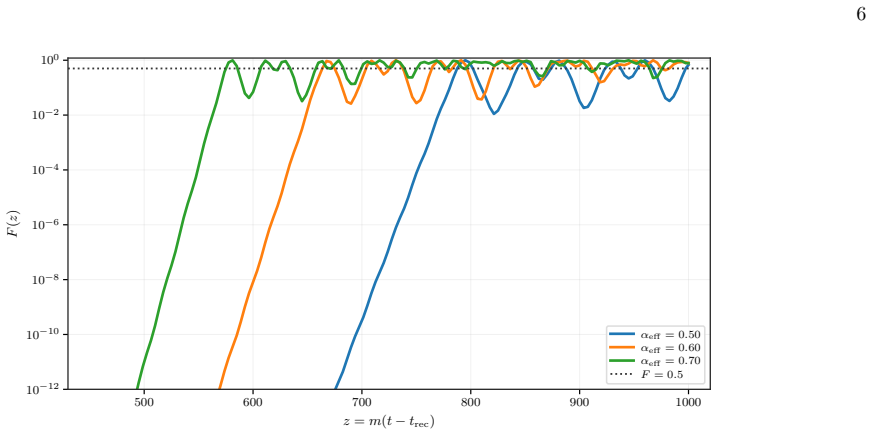
Numerical simulations of post-recombination axion dark matter show that for dimensionless coupling α_eff ≳ 0.39, over half the dark-matter energy is transferred into gauge-field modes before back-reaction stops the resonance.
T0 review reviewed 2026-08-01 challenge →
load-bearing objection Careful numerical follow-up that pins down the backreaction boundary and transfer times, with one genuinely unresolved caveat — plasma conductivity — that decides whether the mechanism works in the real universe. the 3 major comments →
Numerical Backreaction and Finite-Time Energy Transfer in Post-Recombination Magnetogenesis from Ultralight Dark Matter
The pith
A machine-rendered reading of the paper's core claim, the machinery that carries it, and where it could break.
The reading
Core claim
The central claim is that, for parameters where the tachyonic band is open, exponential growth of gauge modes continues unchecked by backreaction until roughly half or more of the pseudoscalar condensate's energy has been converted to electromagnetic fields; the transfer happens in a small fraction of a Hubble time. For parameters where only the narrow resonance band is open, the same order-one transfer eventually occurs, but the first crossing time scales inversely with the effective coupling, so at present times the transferred fraction can be negligible. Numerically, the paper locates a finite-time boundary near effective coupling α_eff ≈ 0.39 for a window of z = m(t - t_rec) up to 1000,
What carries the argument
The load-bearing object is the pair of coupled equations for the gauge mode amplitudes A_λ and the homogeneous pseudoscalar φ: A_λ,ηη + (k² + λ k α_eff φ_η) A_λ = 0 and φ_zz + 3h φ_z + φ = α_eff S_EB, where S_EB is the finite-volume ⟨E·B⟩ source. The exponential growth rate μ of gauge modes (the Floquet exponent, μ ≃ k_c for the tachyonic channel and μ ≃ α_eff m/4 for the narrow band) sets the transfer timescale; the ratio of gauge energy to total energy, F(z), is the diagnostic that records when backreaction turns the growth into oscillatory exchange.
Load-bearing premise
The load-bearing assumption is that residual plasma after recombination has negligible conductivity, so it does not damp the resonance; the paper relies on an appendix argument in a revised reference for this and does not simulate plasma effects.
What would settle it
Evolve the same coupled equations with a finite conductivity term σ added to the gauge mode equation, A_λ,ηη + (k² + λ k α_eff φ_η) A_λ + σ A_λ,η = 0; if for realistic residual ionization the growth is damped so that F never reaches 0.5, the paper's central claim fails.
If this is right
- If backreaction does not stop the resonance until F reaches order one, a post-recombination ultralight dark matter field can convert a significant fraction of its energy into photons, creating a cosmological magnetic field on Mpc scales with amplitude around 10^-15 G for benchmark couplings.
- In the narrow-resonance-only regime, the transfer time grows as 1/α_eff; the paper's interpolation gives z_0.5 ≈ 1250 for α_eff ≈ 0.313, so for small couplings the fraction transferred by today remains negligible, sharpening the lower bound on the coupling for which the mechanism is efficient.
- The order-one transfer occurs on timescales short compared to the Hubble time whenever the instability is active, so the expansion of space does not materially alter the early phase of the transfer; expansion only becomes significant at very small couplings.
- A large energy transfer into gauge fields after recombination can supply a Lyman-Werner photon flux capable of suppressing molecular hydrogen formation, opening the direct collapse black hole route; the paper cites this as a corollary for supermassive black hole seeds.
Where Pith is reading between the lines
- If the residual plasma conductivity is indeed negligible as the paper argues but does not simulate, the full electromagnetic evolution in a real universe would also involve inhomogeneous φ modes and magnetohydrodynamic turbulence, which could alter the final magnetic field spectrum even if the first energy-transfer epoch is as computed.
- The sharp finite-time boundary at α_eff ≈ 0.39 suggests an observational selection effect: for a given age of the universe, there is a minimum axion-photon coupling below which no post-recombination magnetic field is generated, which could be turned into a testable constraint once the plasma issue is settled.
- The same Floquet machinery should apply to scalar or vector ultralight dark matter, so the order-one transfer result may generalize beyond the pseudoscalar case; that is an extension the paper only hints at.
- A direct extension of this numerical setup would be to include the residual plasma as a finite-conductivity term in the mode equations; the paper explicitly calls for this and identifies it as the main uncertainty.
Editorial analysis
A structured set of objections, weighed in public.
Referee Report
Summary. The paper studies, via lattice simulation, the coupled classical evolution of a homogeneous oscillating ultralight pseudoscalar dark-matter field phi and the two helicities of the electromagnetic field, coupled through a Chern-Simons term, starting at recombination in an expanding FLRW background. It evolves vacuum initial gauge-field fluctuations through the tachyonic and narrow-resonance channels, measures the gauge-field energy fraction F, identifies the first half-transfer time z_0.5, and reports the spectral structure of the produced fields. The main quantitative claim is that when the instability is active, back-reaction does not terminate the resonance until an order-one fraction of the initial phi energy is transferred to photons, on a time scale short compared with the Hubble time; in the narrow-resonance regime the transfer eventually reaches order one but is delayed as alpha_eff decreases. The paper also quotes a finite-time onset boundary alpha_eff ~ 0.39 at z_end = 1000 and discusses possible phenomenological implications for cosmological magnetic fields.
Significance. If the central claim holds, the paper provides a useful first numerical confirmation of the analytic spectra of Refs. [1,5] and a determination of the back-reaction endpoint that was missing from previous work. The numerical campaign is careful: it includes resolution checks (N=64/96/128, L=30/60), time-step halving, vacuum initial conditions, a Minkowski-space energy-conservation check that fixes the relative sign, UV-convergence guards on the spectral peaks, and a seed ensemble near the boundary. These checks make the vacuum-theory result credible. However, the physical significance is conditional: the abstract and conclusions make statements about post-recombination magnetogenesis, while residual plasma conductivity is not simulated and is dismissed only by reference to an unpublished revised appendix of a same-group preprint. As it stands, the paper is a solid numerical study of the vacuum Maxwell-Chern-Simons system, with its application to the actual post-recombination universe unresolved.
major comments (3)
- [Sec. I footnote 3, Sec. VI, Eq. (17)] Plasma conductivity is load-bearing for the central claim, but the simulated system contains no conductivity or damping term. The only counter to Ref. [8] is a citation to the revised appendix of Ref. [5] plus a qualitative mean-free-path argument; there is no quantitative estimate of the residual-ionization damping rate relative to the Floquet exponent mu ~ alpha_eff/4. If the damping rate is comparable to or larger than mu, the instability never grows and F remains negligible, invalidating the abstract's order-one transfer claim for the real post-recombination universe. Since the paper itself says 'It would be of great interest to include the effects of the residual plasma explicitly' (Sec. VI), the central claim is explicitly conditional. Please include a self-contained derivation of the plasma criterion or add a damping term to Eq. (17) and show how the alpha_eff ~ 0.39 boundary shif
- [Secs. I and VI] The truncation to a homogeneous phi field is justified only by 'analytical estimates in Ref. [5]' that gauge-field back-reaction dominates. This is not a harmless peripheral assumption in a paper whose new result is precisely the back-reaction shutdown: inhomogeneous phi modes are sourced by the same gauge-field instability and could shut off the transfer earlier, changing F_peak and z_0.5. Please provide a quantitative estimate of the energy in delta-phi within the linear-response approximation, or run a limited simulation including phi fluctuations, to show that the order-one transfer claim survives.
- [Abstract and Sec. V.E] The value alpha_eff ~ 0.39 is a finite-time boundary associated with the z_end = 1000 window, not a physical condition for the tachyonic instability band. The abstract's wording 'for parameter values for which the tachyonic instability band is open' is ambiguous: at alpha_eff = 0.3 the narrow band alone gives F = 0.5 only at z ~ 1302, and for sufficiently small alpha_eff the transfer may remain negligible until today. The body of Sec. V.E makes the finite-window character clear, but the abstract and conclusion should be rephrased so that the order-one-transfer statement is not read as a sharp tachyonic threshold.
minor comments (4)
- [Fig. 5 and Eq. (31)] The solid curve is described as the 'predicted scaling' z_0.5 proportional to alpha_eff^{-1}, but the normalization constant is not specified. State whether the curve is a one-parameter fit to the numerical points or fixed by the initial vacuum amplitude; if fitted, say so explicitly.
- [Sec. V.B and Fig. 4] The caption of Fig. 4 gives alpha_eff = 0.1, while the small-coupling histories in Fig. 3 are for alpha_eff = 0.300, 0.350, and 0.385. The text should state explicitly which run is plotted in Fig. 4 and why it is not included in the time-history panel, to avoid apparent inconsistency.
- [Table I / Fig. 8] At alpha_eff = 0.395 the L = 60 crossing occurs at z_0.5 = 999.46, less than one oscillation before the endpoint. This is very close to the finite-time boundary; quote a seed-averaged value or a spread for this point, rather than a single crossing time, to support the robustness claim.
- [Sec. V.E and Fig. 7] The distinction between endpoint fraction and F_peak is useful and correct. Consider defining explicitly what counts as 'strong transfer' (for example F_peak > 0.5 or first crossing) in the text, since the endpoint value alone can oscillate back down after the first transfer.
Circularity Check
Core numerics are self-contained, but two same-group citations carry load-bearing assumptions: plasma neglect and homogeneous-ϕ truncation.
specific steps
-
self citation load bearing
[Section I, footnote 3; Section VI]
"Whether this is the case or not is not yet resolved (see e.g. [8]), but based on the arguments in the Appendix of the revised version of [5] we believe that plasma effects can be neglected in our study. ... it has been shown in the revised version of Ref. [5] that a resonance window persists even in the presence of a residual plasma."
The paper's central claim — order-one energy transfer in the post-recombination universe — depends on neglecting residual plasma conductivity. The only support offered is the revised appendix of Ref. [5], a same-group paper (Brahma & Brandenberger), and Ref. [8] argues the opposite. The simulated system, Eq. (17), contains no conductivity term, so this premise is not tested here. The physical applicability of the main result is thus imported from an overlapping, unverified self-citation rather than derived in the present work.
-
self citation load bearing
[Section I, paragraph 2]
"we neglect the generation of inhomogeneous modes of ϕ, which can be justified since the analytical estimates in [5] indicate that the dominant back-reaction effects are due to the gauge field modes."
The truncation to homogeneous ϕ is justified by Ref. [5], which shares an author with the present paper. If ϕ fluctuations back-react earlier, the computed F_peak and z_0.5 would change. The paper acknowledges this as a limitation ("we have not allowed ϕ fluctuations to develop"), so the truncation is an assumed modelling input rather than an independently derived result. It is not a fitted parameter, but it is a load-bearing self-citation.
full rationale
The core numerical derivation is not circular. The authors evolve the coupled gauge-field and homogeneous-ϕ equations, Eqs. (17) and (23), from vacuum gauge-field initial conditions and a coherent ϕ condensate, scanning α_eff without fitting any free parameter. The scaling z_0.5 ∝ α_eff^{-1} is an analytic expectation stated before comparing with the simulation, not imposed as an input; the spectra are diagnostics, not fit targets. Robustness checks in N, L, and seeds support the finite-time boundary. The only load-bearing elements not independently derived here are two modelling assumptions inherited from same-group analytical work: neglect of residual plasma conductivity (footnote 3, Sec. VI) and neglect of ϕ fluctuations (Sec. I). Both are explicitly flagged as limitations, and the plasma assumption is contested by Ref. [8]. These are correctness risks and self-citation dependencies, but they do not make the numerical 'prediction' equivalent to its inputs by construction. Hence score 4 rather than 0 or 6.
Axiom & Free-Parameter Ledger
free parameters (2)
- α_eff = g_ϕγ Φ_rec =
0.1–0.9 scanned; boundary ≈0.39 for z_end=1000
- normalization constant in z_0.5 ∝ C α_eff^{-1} =
not stated
axioms (6)
- domain assumption The ϕ potential is quadratic over the field range of interest
- domain assumption ϕ remains homogeneous; inhomogeneous ϕ fluctuations are neglected
- domain assumption Residual plasma conductivity is negligible after recombination; a resonance window persists
- domain assumption Gauge modes start from vacuum fluctuations (Gaussian random initial amplitudes)
- domain assumption Matter-dominated FLRW background normalized to a=1 at recombination; expansion terms are retained
- domain assumption mΦ_rec ~ T_rec² (ϕ constitutes all of the dark matter at recombination)
Cite this review
Pith. "Pith review of Numerical Backreaction and Finite-Time Energy Transfer in Post-Recombination Magnetogenesis from Ultralight Dark Matter." pith.science (2026). https://pith.science/paper/AEM4HTS3
@misc{pith2026260720793,
  author       = {Pith},
  title        = {Pith review of: Numerical Backreaction and Finite-Time Energy Transfer in Post-Recombination Magnetogenesis from Ultralight Dark Matter},
  year         = {2026},
  howpublished = {\url{https://pith.science/paper/AEM4HTS3}},
  note         = {Machine review of arXiv:2607.20793}
}
abstract
We study gauge-field production in a post-recombination magnetogenesis scenario driven by an ultralight pseudoscalar dark matter field $\phi$ coupled to electromagnetism. Previous analytical work has shown that a homogeneous oscillating $\phi$ background can excite gauge field modes through tachyonic and narrow-band resonance channels. Here we follow the coupled evolution of the homogeneous $\phi$ mode and gauge field modes of both helicities in an expanding background. Our numerical work confirms the results for the spectra of produced gauge particles obtained in the previous approximate analytical treatments. In addition, our study allows us to determine when back-reaction shuts off the resonance. We find that for parameter values for which the tachyonic instability band is open, back-reaction does not shut off the resonance until a fraction ${\cal{F}}$ of order one of the initial dark matter energy density has been transferred to photons, and this happens on a time scale which is short compared to the Hubble time. In the parameter range in which only the narrow resonance band is open, ${\cal{F}}$ eventually reaches order one, but the time when this happens increases as the effective coupling constant decreases, and therefore ${\cal{F}}$ may remain negligible until the present time.
Figures


Reference graph
Works this paper leans on
-
[1]
Cosmologi- cal Magnetic Fields from Ultralight Dark Matter,
R. Brandenberger, J. Fr¨ ohlich and H. Jiao, “Cosmologi- cal Magnetic Fields from Ultralight Dark Matter,” Phys. Rev. Lett.136, no.3, 031001 (2026) doi:10.1103/ys32- 853g [arXiv:2502.19310 [hep-ph]]
Pith/arXiv arXiv 2026
-
[2]
seed-stable
The common factor is suppressed there because it multiplies both the gauge energy and the source and does not affect the sign check. With this convention theϕ equation evolved in the simulations is φzz + 3hφz +φ=α eff S(z) EB .(23) Appendix 2 shows explicitly that, in the non-expanding limit, Eqs. (17) and (23) conserve the totalϕ-plus-gauge energy with t...
2000
-
[3]
Photon production of axionic cold dark matter,
D. S. Lee and K. W. Ng, “Photon production of axionic cold dark matter,” Phys. Rev. D61, 085003 (2000) doi:10.1103/PhysRevD.61.085003 [arXiv:hep- ph/9909282 [hep-ph]]; M. Hernandez, A. Avilez-L´ opez and T. Matos, “Could galactic magnetic fields be generated by charged ultra-light boson dark matter?,” Eur. Phys. J. C79, no.10, 833 (2019) doi:10.1140/epjc/...
arXiv 2000
-
[4]
S. Weinberg, “A New Light Boson?,” Phys. Rev. Lett. 40, 223-226 (1978) doi:10.1103/PhysRevLett.40.223; F. Wilczek, “Problem of StrongPandTInvariance in the Presence of Instantons,” Phys. Rev. Lett.40, 279-282 (1978) doi:10.1103/PhysRevLett.40.279
-
[5]
Cosmology of the Invisible Axion,
J. Preskill, M. B. Wise and F. Wilczek, “Cosmology of the Invisible Axion,” Phys. Lett. B120, 127-132 (1983) doi:10.1016/0370-2693(83)90637-8; L. F. Abbott and P. Sikivie, “A Cosmological Bound on the Invisible Axion,” Phys. Lett. B120, 133-136 (1983) doi:10.1016/0370-2693(83)90638-X; M. Dine and W. Fischler, “The Not So Harmless Axion,” Phys. Lett. B120,...
-
[6]
Parametric Res- onance and Backreaction Effects in Magnetogenesis from Ultralight Dark Matter,
N. Brahma and R. Brandenberger, “Parametric Res- onance and Backreaction Effects in Magnetogenesis from Ultralight Dark Matter,” [arXiv:2602.04285 [astro- ph.CO]]
-
[7]
Late Time Mag- netogenesis from Ultralight Scalar Dark Matter,
V. Kamali and R. Brandenberger, “Late Time Mag- netogenesis from Ultralight Scalar Dark Matter,” [arXiv:2601.00443 [astro-ph.CO]]
-
[8]
T. Daniel, V. Kamali and R. Brandenberger, “Indi- rect Parametric Resonance of the Electromagnetic Field Driven by an Oscillating SU(2) Dark Matter Conden- sate,” [arXiv:2605.20333 [hep-ph]]
-
[9]
Suppressed Magnetogenesis from Ultralight Dark Matter due to Fi- nite Conductivity,
R. Sharma, S. Majumdar and D. Sachdeva, “Suppressed Magnetogenesis from Ultralight Dark Matter due to Fi- nite Conductivity,” [arXiv:2604.17230 [astro-ph.CO]]
-
[10]
Inflation Produced, Large Scale Magnetic Fields,
M. S. Turner and L. M. Widrow, “Inflation Produced, Large Scale Magnetic Fields,” Phys. Rev. D37, 2743 (1988) doi:10.1103/PhysRevD.37.2743; B. Ratra, “Cosmological ’seed’ magnetic field from inflation,” Astrophys. J. Lett.391, L1-L4 (1992) doi:10.1086/186384; S. M. Carroll, G. B. Field and R. Jackiw, “Lim- its on a Lorentz and Parity Violating Modificatio...
Pith/arXiv arXiv 1988
-
[11]
New applications of the chi- ral anomaly,
J. Frohlich and B. Pedrini, “New applications of the chi- ral anomaly,” [arXiv:hep-th/0002195 [hep-th]]; J. Frohlich and B. Pedrini, “Axions, quantum mechani- cal pumping, and primeval magnetic fields,” [arXiv:cond- mat/0201236 [cond-mat]]; M. Joyce and M. E. Shaposhnikov, “Primordial magnetic fields, right-handed electrons, and the Abelian anomaly,” Phys...
Pith/arXiv arXiv 1997
-
[12]
Par- ticle Production During Out-of-equilibrium Phase Transitions,
J. H. Traschen and R. H. Brandenberger, “Par- ticle Production During Out-of-equilibrium Phase Transitions,” Phys. Rev. D42, 2491 (1990). doi:10.1103/PhysRevD.42.2491
-
[13]
On Particle Creation By A Time Dependent Scalar Field,
A. D. Dolgov and D. P. Kirilova, “On Particle Creation By A Time Dependent Scalar Field,” Sov. J. Nucl. Phys. 51, 172 (1990) [Yad. Fiz.51, 273 (1990)]
1990
-
[14]
Universe reheating after inflation,
Y. Shtanov, J. H. Traschen and R. H. Branden- berger, “Universe reheating after inflation,” Phys. Rev. D51, 5438-5455 (1995) doi:10.1103/PhysRevD.51.5438 [arXiv:hep-ph/9407247 [hep-ph]]
Pith/arXiv arXiv 1995
-
[15]
L. Kofman, A. D. Linde and A. A. Starobin- sky, “Reheating after inflation,” Phys. Rev. Lett. 73, 3195-3198 (1994) doi:10.1103/PhysRevLett.73.3195 [arXiv:hep-th/9405187 [hep-th]]
Pith/arXiv arXiv 1994
-
[16]
To- wards the theory of reheating after inflation,
L. Kofman, A. D. Linde and A. A. Starobinsky, “To- wards the theory of reheating after inflation,” Phys. Rev. D56, 3258-3295 (1997) doi:10.1103/PhysRevD.56.3258 [arXiv:hep-ph/9704452 [hep-ph]]
Pith/arXiv arXiv 1997
-
[17]
Infla- ton decay and heavy particle production with nega- tive coupling,
B. R. Greene, T. Prokopec and T. G. Roos, “Infla- ton decay and heavy particle production with nega- tive coupling,” Phys. Rev. D56, 6484-6507 (1997) doi:10.1103/PhysRevD.56.6484 [arXiv:hep-ph/9705357 [hep-ph]]; G. N. Felder, J. Garcia-Bellido, P. B. Greene, L. Kof- man, A. D. Linde and I. Tkachev, “Dynamics of symme- try breaking and tachyonic preheating...
Pith/arXiv arXiv 1997
-
[18]
Reheating in Inflationary Cosmology: Theory and Applications,
R. Allahverdi, R. Brandenberger, F. Y. Cyr-Racine and A. Mazumdar, “Reheating in Inflationary Cosmology: Theory and Applications,” Ann. Rev. Nucl. Part. Sci. 60, 27 (2010) doi:10.1146/annurev.nucl.012809.104511 [arXiv:1001.2600 [hep-th]]
arXiv 2010
-
[19]
Nonperturbative Dynamics Of Reheat- ing After Inflation: A Review,
M. A. Amin, M. P. Hertzberg, D. I. Kaiser and J. Karouby, “Nonperturbative Dynamics Of Reheat- ing After Inflation: A Review,” Int. J. Mod. Phys. D24, 1530003 (2014) doi:10.1142/S0218271815300037 [arXiv:1410.3808 [hep-ph]]
Pith/arXiv arXiv 2014
-
[20]
Gauge-preheating and the end of ax- ion inflation,
P. Adshead, J. T. Giblin, T. R. Scully and E. I. Sfakianakis, “Gauge-preheating and the end of ax- ion inflation,” JCAP12, 034 (2015) doi:10.1088/1475- 7516/2015/12/034 [arXiv:1502.06506 [astro-ph.CO]]; P. Adshead, J. T. Giblin, T. R. Scully and E. I. Sfakianakis, “Magnetogenesis from axion in- flation,” JCAP10, 039 (2016) doi:10.1088/1475- 7516/2016/10/0...
Pith/arXiv arXiv 2015
-
[21]
Cosmological Mag- netic Fields: Their Generation, Evolution and Ob- servation,
R. Durrer and A. Neronov, “Cosmological Mag- netic Fields: Their Generation, Evolution and Ob- servation,” Astron. Astrophys. Rev.21, 62 (2013) doi:10.1007/s00159-013-0062-7 [arXiv:1303.7121 [astro- ph.CO]]; K. Subramanian, “The origin, evolution and signatures of primordial magnetic fields,” Rept. Prog. Phys.79, no.7, 076901 (2016) doi:10.1088/0034-4885/...
Pith/arXiv arXiv 2013
-
[22]
Direct- collapse supermassive black holes from ultralight dark matter,
H. Jiao, R. Brandenberger and V. Kamali, “Direct- collapse supermassive black holes from ultralight dark matter,” Phys. Rev. D112, no.4, 043546 (2025) doi:10.1103/9jm1-ss4t [arXiv:2503.19414 [astro-ph.CO]]
Pith/arXiv arXiv 2025
-
[23]
Formation of Supermassive Black Holes,
M. Volonteri, “Formation of Supermassive Black Holes,” Astron. Astrophys. Rev.18, 279-315 (2010) doi:10.1007/s00159-010-0029-x [arXiv:1003.4404 [astro- ph.CO]]; M. Volonteri, M. Habouzit and M. Colpi, “The ori- gins of massive black holes,” Nature Rev. Phys.3, no.11, 732-743 (2021) doi:10.1038/s42254-021-00364-9 [arXiv:2110.10175 [astro-ph.GA]]
Pith/arXiv arXiv 2010
-
[24]
ALP Dark Matter, Cosmological Magnetic Fields and the Direct Collapse Black Hole Formation Scenario,
A. Kushwaha and R. Brandenberger, “ALP Dark Matter, Cosmological Magnetic Fields and the Direct Collapse Black Hole Formation Scenario,” [arXiv:2602.22170 [hep- ph]]
-
[25]
A. Aires, R. Brandenberger and A. Kushwaha, “Sec- ondary Production of Photons from ALP Dark Mat- ter interacting with a Cosmological Magnetic Field,” [arXiv:2607.01399 [astro-ph.CO]]
-
[26]
Noninflationary axion and ALP mis- alignment mechanism,
R. Brandenberger, “Noninflationary axion and ALP mis- alignment mechanism,” Phys. Rev. D112, no.10, 103523 (2025) doi:10.1103/k3hh-gszm [arXiv:2507.00785 [hep- ph]]
Pith/arXiv arXiv 2025
-
[27]
Gauge Field Preheating at the End of Infla- tion,
J. T. Deskins, J. T. Giblin and R. R. Caldwell, “Gauge Field Preheating at the End of Infla- tion,” Phys. Rev. D88, no.6, 063530 (2013) doi:10.1103/PhysRevD.88.063530 [arXiv:1305.7226 [astro-ph.CO]]
Pith/arXiv arXiv 2013
-
[28]
Extra- galactic magnetic fields constraints from simultaneous GeV-TeV observations of blazars,
A. M. Taylor, I. Vovk and A. Neronov, “Extra- galactic magnetic fields constraints from simultaneous GeV-TeV observations of blazars,” Astron. Astrophys. 529, A144 (2011) doi:10.1051/0004-6361/201116441 [arXiv:1101.0932 [astro-ph.HE]]
Pith/arXiv arXiv 2011
This paper was first reviewed by deepseek-v4-flash on August 1, 2026.
discussion (0)
Sign in with ORCID, Apple, or X to comment. Anyone can read and Pith papers without signing in.