REVIEW 3 major objections 6 minor 23 references
Assistax: A Multi-Agent Hardware-Accelerated Reinforcement Learning Benchmark for Assistive Robotics
T0 review · 3 major / 6 minor · reviewed 2026-08-06 · deepseek-v4-flash
Pith's one-line read Standard RL robot policies lose coordination with unseen humanoid partners with novel preferences; a new GPU-accelerated benchmark, Assistax, surfaces this gap in continuous 3D assistive tasks.
desk verdict Solid benchmark engineering and a genuinely useful testbed; the AHT coordination-gap claim is oversold and needs a uniform-split control before it can stand. read the letter →
The pith
A machine-rendered reading of the paper's core claim, the machinery that carries it, and where it could break.
The reading
What carries the argument
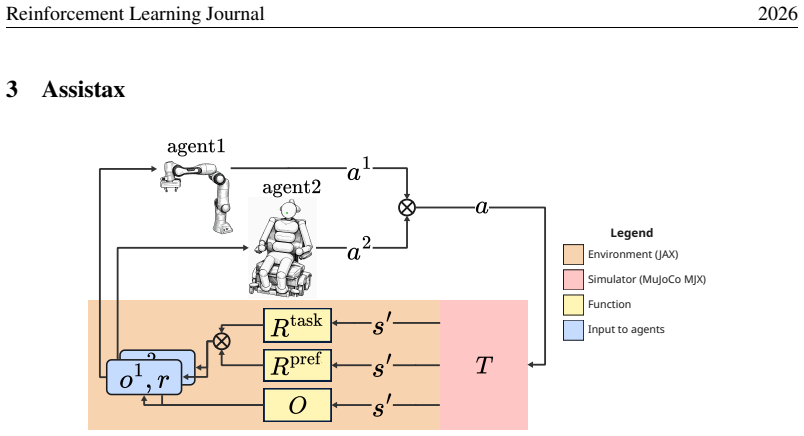
The mechanism that carries the argument is the preference reward system combined with the hardware-accelerated training loop. Each task's shared reward is augmented by a preference reward built from three axes — preferred contact-force range, preferred end-effector speed range, and a penalty for new contacts after the initial touch — normalised into a fixed budget of 40–50% of the maximum per-step reward so different preference combinations are comparable. Sampling 610 preference combinations and 7 disability settings during population training yields the 630 humanoid policies; the AHT evaluation then fixes a pre-trained humanoid, trains the robot on a small training population $\Pi_{\text{train}}$ under the objective $\pi^{i*}(\Pi_{\text{train}}) = \arg\max_{\pi^i} \mathbb{E}_{\pi^{-i} \sim U(\Pi_{\text{train}})}[\sum_t \gamma^t R]$, and measures the expected return $M_{\Pi_{\text{test}}}$ against withheld partners. The whole loop — simulator, rewards, observations, and policy updates — runs in JAX with MuJoCo MJX collocated on the GPU, which is what makes a 630-policy population and 16-seed evaluations affordable.
What would settle it
Re-run the AHT evaluation with human-driven partners instead of held-out MARL policies: teleoperate the humanoid (or use behavioural clones of human demonstrations) across the same preference conditions, and check whether a robot trained on the five speed-extreme partners shows a comparable, preference-concentrated return drop. If it does not, the coordination gap is an artefact of the MARL proxy rather than a property of human-robot coordination; a cheaper complementary check is to confirm the paper's own claim that the gap disappears when train and test preference distributions are matched, which would show the effect lives entirely in the distribution shift.
Extended reading notes
Core claim
On its own terms, the paper's central claim is that the first ad-hoc-teamwork benchmark for continuous 3D assistive robotics with two distinct embodied agents is now possible, and that building it exposes a measurable coordination gap in existing RL algorithms. The authors co-train robot and humanoid agents with multi-agent RL on five tasks, then construct a population of 630 humanoid policies per task whose diversity comes from emergent co-training conventions, sampled preference combinations, and disability settings. Discarding the robot policies, they train a fresh robot policy (PPO or SAC) against a small, deliberately out-of-distribution training subset — five partners with the highest speed-preference weighting — and score it against the 625 withheld partners. Returns drop substantially on the withheld set, and the paper's preference-only analysis shows the drop is almost entirely explainable by the robot's failure to adapt to novel preference combinations, while the gap shrinks significantly when training and test populations are drawn from similar distributions.
Load-bearing premise
The load-bearing premise is that the 630-policy MARL population, with diversity induced by co-training, preference sampling, and disability settings, is a meaningful proxy for real human partners; the authors flag in their own limitations that MARL policies do not capture the full complexity of human behaviour, so if the population is unrepresentative the measured coordination gap describes coordination with MARL checkpoints, not with people.
Editorial extensions
If this is right
- A 40-million-step IPPO training run takes about 20 minutes on one A100 GPU with 1024 parallel environments, versus roughly 8.3 hours in the CPU-based Assistive Gym, so assistive-robotics RL research becomes as fast to iterate on as grid-world benchmarks.
- Standard RL baselines as configured here (PPO and SAC with the paper's tuned hyperparameters) are not sufficient for zero-shot coordination with out-of-distribution human partners in continuous assistive tasks.
- The coordination gap is concentrated in the preference-reward component rather than the task component, so the bottleneck is adapting to how the partner wants the task done, not the physics of the task itself.
- The gap shrinks markedly when training and test partner populations are more similar, so benchmark users must report both the training-population composition and the test gap to get meaningful AHT numbers.
- Releasing the 630 pre-trained humanoid policies lets other researchers evaluate new AHT algorithms against identical withheld partners, making results reproducible without rerunning population training.
Reading between the lines
- Because the evaluation proxy is MARL checkpoints, the measured gap is plausibly a lower bound on the difficulty of real human-robot ad-hoc teamwork, since real humans vary more than this population; an obvious next step, not run in the paper, is the same protocol with teleoperated or demonstration-driven human partners.
- The paper's diagnosis that the gap is almost entirely preference adaptation suggests a targeted remedy the authors do not test: since preferences are already passed in the observations, explicitly preference-conditioned or meta-learned robot policies trained across the preference distribution may close much of the gap.
- The rigid-body, primitive-geometry fidelity trade-off means the benchmark measures coordination capability, not physical realism; tasks with deformable contact such as washing with cloth remain out of reach until the simulator scales better with collision counts.
- Population diversity is induced but not optimised, and the paper's own cross-play matrices show some mutually incompatible partner strategies while the authors point to best-response diversity training as future work; actively diversifying the partner population could make the AHT test set harder and would likely change the reported gap.
Editorial analysis
A structured set of objections, weighed in public.
Referee Report
Summary. Assistax introduces a JAX/MJX-based benchmark suite of five assistive robotics tasks with a torque-controlled robot and a trainable humanoid partner. The paper contributes MARL baselines (IPPO, MAPPO, MASAC with feed-forward and recurrent variants), a population of 630 pre-trained humanoid policies per task, and an AHT evaluation protocol in which a robot is trained on a subset of partner policies and evaluated on withheld partners. Headline results are large speedups (up to 412x open-loop and roughly 25x wall-clock), competitive MARL learning curves, and a 'coordination gap' under an intentionally extreme preference-based train/test split. The AHT claim is that existing RL algorithms perform substantially worse on unseen partners with novel preference combinations.
Significance. If the coordination-gap result survives a matched train/test distribution control, Assistax would be a valuable high-throughput benchmark: it is one of the few 3D continuous AHT testbeds, it ships pre-trained partner policies via Hugging Face, it reports bootstrap CIs and extensive hyperparameter sweeps, and its JAX implementation makes principled repeatable evaluation practical. As it stands, the headline empirical claim needs re-scoping or an additional control before it can be regarded as evidence of a general AHT coordination gap rather than an out-of-distribution preference-generalization effect.
major comments (3)
- [Section 4.2, Figures 5 and 10, Appendix B.3] The central claim that existing RL algorithms exhibit a coordination gap is supported only by an extreme 5-agent/625-agent preference split, with the 5 training agents selected for the highest speed-preference weighting. The text concedes that the gap 'drops significantly when including more agents in the training set or when sampling train and test agents uniformly from the population,' but no quantitative results, curves, or CIs for a uniform-split control are provided anywhere in the paper. Given that Figure 10 and Appendix B.3 attribute the gap 'almost entirely' to preference returns, and given that preferences are provided in the observations (Section 3.2), the natural reading is that the experiment demonstrates out-of-distribution preference-generalization failure, not a general AHT coordination deficit. Please add the uniform-split control as a primary result, report the gap magnitude under both splits, and either temper the abstract/conclusion claim or present the extreme-split result explicitly as a stress test.
- [Section 4.2, Figures 5 and 9] The AHT evaluation in the main text is PPO-only; SAC appears in Appendix B.2 at 6 million timesteps rather than the 40 million used for PPO and omits the Bed Bath task. Because the abstract says 'existing RL algorithms' (plural), the paper should either include the SAC AHT results at a comparable training budget in the main text, or explicitly scope the coordination-gap claim to the tested PPO baseline.
- [Limitations and Section 3.4] The paper acknowledges in Limitations that 'MARL policies do not capture the full complexity of human behaviour,' yet the benchmark's motivation and the term 'humanoid partner' may lead readers to infer conclusions about human-robot coordination. This is not a fatal flaw for a simulation benchmark, but the contribution should be phrased consistently as a benchmark for coordination with simulated MARL policies; the external-validity caveat should appear in the introduction or abstract rather than only in the limitations paragraph.
minor comments (6)
- [Section 3.4] The population description says 630 humanoid agents per task but then says 610 preference combinations are sampled and 7 disability combinations are used; the relationship between 610, 7, and 630 should be stated explicitly.
- [Section 4.1 and Appendix C] The text says 168 hyperparameter combinations are searched for each baseline-environment pair, but Appendix C describes a single sweep and says 'We run one very extensive sweep across our MARL baselines'; clarify whether the sweep is per baseline-environment pair or per baseline.
- [Figure 9] The caption says 'across all five tasks' but shows only four tasks; either add Bed Bath or correct the caption.
- [Appendix C and Section 4.2] There are several typos, including 'hyperparemeter', 'evaluete', and 'metalearning paradigm'; the nomenclature for the tooth brushing task is also inconsistent ('Teethbrushing' in Table 8 versus 'Tooth Brushing' elsewhere).
- [Section 4.3] The 8.3-hour Assistive Gym runtime comparison is described as 'indicative rather than controlled'; please provide at least the hardware/software configuration and the exact command or script used for the comparison, since this number is likely to be quoted.
- [Appendix A.4] The wall-clock estimate extrapolates from 5 IPPO updates to 610 updates; it would be more reliable to report measured total wall-clock time for at least one full run.
Circularity Check
No significant circularity: the benchmark and speedups are self-contained, and the AHT gap is an explicitly disclosed OOD-preference result rather than a derivation from its own inputs.
full rationale
The paper's core deliverables—JAX/MJX environments, speedup measurements, MARL baselines, and released policies—are self-contained and externally checkable; they do not reduce to their inputs. The AHT 'coordination gap' in Section 4.2 is an empirical result, not a derivation: the authors disclose that the reported setting trains on 5 highest-speed-weight agents and tests on 625 withheld agents, and explicitly state that the gap 'drops significantly' when sampling train and test agents uniformly. This is a deliberately hard OOD preference-generalization evaluation, and Appendix B.3's attribution of the gap 'almost entirely' to preference returns is a diagnostic of where the baselines fail, not a tautology, because the preference vector is included in the observations and a policy could in principle condition on it. The missing quantitative uniform-split control is a completeness limitation (Section 4.2), and the Limitations section's admission that 'MARL policies do not capture the full complexity of human behaviour' limits external validity, but neither is circular. Self-citations (Mirsky et al. 2022; Tessera et al. 2026, which shares an author) are used for framing or peripheral support and are not load-bearing. Score 1 reflects minor self-citation without circularity.
Assumptions & free parameters
free parameters (4)
- Preference reward budget B =
Calibrated to 40-50% of maximum per-step task reward
- Preference component weights w_s, w_f, w_a, w_t =
Sampled uniformly during population training; touch penalty default -0.03
- Gaussian preference half-width and center =
Derived from preference range endpoints
- Task reward constants f*, v*, v*_app, and scale factors =
For example, 3 N scratch force, 0.1 m/s speeds, sigma=0.1
assumptions (5)
- domain assumption MuJoCo MJX rigid-body simulation with primitive geometries and selectively disabled collisions is an adequate proxy for assistive physics.
- domain assumption A Brax humanoid with restricted action space is a reasonable simulated human partner.
- domain assumption Human preferences can be represented by force, speed, and contact-count reward components.
- domain assumption The pre-trained population of 630 humanoid policies is diverse enough to stand in for unseen humans.
- domain assumption Cooperative shared-reward Dec-POMDP is an appropriate model of human-robot collaboration in assistive tasks.
Cite this review
Pith. "Pith review of Assistax: A Multi-Agent Hardware-Accelerated Reinforcement Learning Benchmark for Assistive Robotics." pith.science (2026). https://pith.science/paper/AONJTSW3
@misc{pith2026250721638,
  author       = {Pith},
  title        = {Pith review of: Assistax: A Multi-Agent Hardware-Accelerated Reinforcement Learning Benchmark for Assistive Robotics},
  year         = {2026},
  howpublished = {\url{https://pith.science/paper/AONJTSW3}},
  note         = {Machine review of arXiv:2507.21638}
}
abstract
As embodied autonomous systems capable of assisting humans in daily activities remain a major goal for robotics, efficient and appropriate reinforcement learning (RL) simulation testbeds are increasingly important. Many common RL environments are too simple to provide insight into complex robotics domains, and many robotics simulations have throughput too low for RL. Very few simulators target multi-agent interactions: most treat the robot as an isolated agent, yet real-world tasks such as home assistance and caretaking are inherently multi-agent. Assistax addresses these limitations by providing a high-throughput, scalable suite of GPU-accelerated assistive robotics tasks built on JAX and MuJoCo-MJX, and includes an active humanoid agent as a simulated human partner, trainable alongside the robot using multi-agent RL (MARL). Beyond its use as a MARL benchmark, we formulate the human-robot interaction as an Ad-Hoc Teamwork (AHT) problem, where the robot's policy must generalise to unseen humans with varying disabilities and preferences. To this end, we provide an extensive AHT benchmarking pipeline: we use MARL to pre-train a diverse population of humanoid partners, and evaluate robot policies' ability to coordinate with a withheld set of humanoid policies. In contrast to other benchmarks, we also release reactive MARL-pre-trained humanoid policies via Hugging Face, enabling faster iteration in AHT research. With hardware acceleration, Assistax achieves up to 412$\times$ faster open-loop simulation than comparable CPU-based environments on a single GPU. Our AHT pipeline reveals a coordination gap for existing RL algorithms on unseen partners with novel preference combinations. This RL-native test suite for embodied multi-agent interaction provides a practical benchmark for advancing RL in assistive care. Code is available at: https://github.com/assistive-autonomy/assistax.
Figures


Figures from the paper (13 more)


Reference graph
Works this paper leans on
-
[4]
Proprioception is information relating to robot configuration
In our benchmark, we consider 3 types of observations: proprioception, tactile, and ground-truth information from the simulator. Proprioception is information relating to robot configuration. It is computed from the robot’s internal sensors. Assistax considers tactile observation of the net contact forces between the end-effector and the humanoid arm, exp...
work page 2026
-
[6]
Rihab Gorsane, Omayma Mahjoub, Ruan de Kock, Roland Dubb, Siddarth Singh, and Arnu Pre- torius
URL http: //github.com/google/brax. Rihab Gorsane, Omayma Mahjoub, Ruan de Kock, Roland Dubb, Siddarth Singh, and Arnu Pre- torius. Towards a standardised performance evaluation protocol for cooperative MARL. In Sanmi Koyejo, S. Mohamed, A. Agarwal, Danielle Belgrave, K. Cho, and A. Oh (eds.),Ad- vances in Neural Information Processing Systems 35: Annual ...
work page 2022
-
[7]
Table 7: Preference reward components. Component Formula Default Interpretation / Sweep Speed prefer- ence Pref(v; [vmin, vmax]) [0.06,0.14]m/s Rewards motion within the preferred speed range. Sweep: vmin ∼[0.03,0.08] , vmax ∼[v min,0.20]. Force prefer- ence Pref(f; [f min, fmax]) [1.5,3.5]N Rewards contact force within the preferred range. Sweep: fmin ∼[...
work page 2023
-
[8]
Chris Lu, Jakub Kuba, Alistair Letcher, Luke Metz, Christian Schroeder de Witt, and Jakob Foerster
URLhttps://arxiv.org/abs/1712.09381. Chris Lu, Jakub Kuba, Alistair Letcher, Luke Metz, Christian Schroeder de Witt, and Jakob Foerster. Discovered policy optimisation.Advances in Neural Information Processing Systems, 35:16455– 16468,
-
[12]
Eduardo Pignatelli, Jarek Liesen, Robert Tjarko Lange, Chris Lu, Pablo Samuel Castro, and Laura Toni
URLhttps://arxiv.org/abs/2511.04904. Eduardo Pignatelli, Jarek Liesen, Robert Tjarko Lange, Chris Lu, Pablo Samuel Castro, and Laura Toni. Navix: Scaling minigrid environments with jax,
-
[13]
Arrasy Rahman, Elliot Fosong, Ignacio Carlucho, and Stefano V
URL https://arxiv.org/ abs/2407.19396. Arrasy Rahman, Elliot Fosong, Ignacio Carlucho, and Stefano V . Albrecht. Generating Teammates for Training Robust Ad Hoc Teamwork Agents via Best-Response Diversity, May
-
[14]
Minimum Coverage Sets for Training Robust Ad Hoc Teamwork Agents
URLhttps://arxiv.org/abs/2308.09595. Paul Richmond, Robert Chisholm, Peter Heywood, Mozhgan Kabiri Chimeh, and Matthew Leach. FLAME GPU 2: A framework for flexible and performant agent based simulation on gpus.Softw. Pract. Exp., 53(8):1659–1680,
-
[15]
DOI: 10.1002/SPE.3207. URL https://doi.org/10. 1002/spe.3207. Alexander Rutherford, Benjamin Ellis, Matteo Gallici, Jonathan Cook, Andrei Lupu, Garðar Ingvarsson, Timon Willi, Ravi Hammond, Akbir Khan, Christian Schröder de Witt, Alexandra Souly, Saptarashmi Bandyopadhyay, Mikayel Samvelyan, Minqi Jiang, Robert T. Lange, Shimon Whiteson, Bruno Lacerda, Ni...
Show all 23 references
-
[20]
Yuke Zhu, Josiah Wong, Ajay Mandlekar, Roberto Martín-Martín, Abhishek Joshi, Soroush Nasiriany, Yifeng Zhu, and Kevin Lin
URLhttps://github.com/google-deepmind/ mujoco_playground. Yuke Zhu, Josiah Wong, Ajay Mandlekar, Roberto Martín-Martín, Abhishek Joshi, Soroush Nasiriany, Yifeng Zhu, and Kevin Lin. robosuite: A modular simulation framework and benchmark for robot learning. InarXiv preprint ar...
2009 arXiv
- [2010]
-
[2012]
Kevin Zakka, Baruch Tabanpour, Qiayuan Liao, Mustafa Haiderbhai, Samuel Holt, Jing Yuan Luo, Arthur Allshire, Erik Frey, Koushil Sreenath, Lueder A
DOI: 10.1109/IROS.2012.6386109. Kevin Zakka, Baruch Tabanpour, Qiayuan Liao, Mustafa Haiderbhai, Samuel Holt, Jing Yuan Luo, Arthur Allshire, Erik Frey, Koushil Sreenath, Lueder A. Kahrs, Carlo Sferrazza, Yuval Tassa, and Pieter Abbeel. Mujoco playground: An open-source framew...
2012
-
[2013]
Yuanpei Chen, Yaodong Yang, Tianhao Wu, Shengjie Wang, Xidong Feng, Jiechuan Jiang, Zongqing Lu, Stephen Marcus McAleer, Hao Dong, and Song-Chun Zhu
DOI: 10.1109/MRA.2012.2229950. Yuanpei Chen, Yaodong Yang, Tianhao Wu, Shengjie Wang, Xidong Feng, Jiechuan Jiang, Zongqing Lu, Stephen Marcus McAleer, Hao Dong, and Song-Chun Zhu. Towards human- level bimanual dexterous manipulation with reinforcement learning. InThirty-sixth...
2012
-
[2014]
Filippos Christianos, Georgios Papoudakis, Arrasy Rahman, and Stefano V
URL https://arxiv.org/ abs/1409.1259. Filippos Christianos, Georgios Papoudakis, Arrasy Rahman, and Stefano V . Albrecht. Scaling multi- agent reinforcement learning with selective parameter sharing. InInternational Conference on Machine Learning (ICML),
-
[2016]
DOI: 10.1007/978-3-319-28929-8_2
ISBN 978-3-319-28929-8. DOI: 10.1007/978-3-319-28929-8_2. Bassel Al Omari, Michael Matthews, Alexander Rutherford, and Jakob Nicolaus Foerster. Multi-agent craftax: Benchmarking open-ended multi-agent reinforcement learning at the hyperscale,
-
[2017]
Emanuel Todorov, Tom Erez, and Yuval Tassa
DOI: 10.1109/IROS.2017.8202133. Emanuel Todorov, Tom Erez, and Yuval Tassa. Mujoco: A physics engine for model-based control. In2012 IEEE/RSJ International Conference on Intelligent Robots and Systems, pp. 5026–5033. IEEE,
2017
-
[2018]
Stefano V
DOI: 10.1016/j.artint.2018.01.002. Stefano V . Albrecht, Filippos Christianos, and Lukas Schäfer.Multi-Agent Reinforcement Learning: Foundations and Modern Approaches. MIT Press,
2018 doi
-
[2019]
Neil Savage
URLhttps://arxiv.org/abs/1902.04043. Neil Savage. Robots rise to meet the challenge of caring for old people.Nature, 601:S8 – S10,
1902 arXiv
-
[2020]
Reinforcement Learning Journal 2026 Supplementary Materials The following content was not necessarily subject to peer review. A Benchmark Details Code anonymously available at: https://github.com/anon-conference25/assistax Note:we do not provide a link to the Hugging Face data...
2026
-
[2021]
Leveraging procedural generation to benchmark reinforcement learning.arXiv preprint arXiv:1912.01588,
Assistax Karl Cobbe, Christopher Hesse, Jacob Hilton, and John Schulman. Leveraging procedural generation to benchmark reinforcement learning.arXiv preprint arXiv:1912.01588,
1912 arXiv
-
[2022]
Tuomas Haarnoja, Aurick Zhou, Pieter Abbeel, and Sergey Levine
URL http://papers.nips.cc/paper_files/paper/2022/hash/ 249f73e01f0a2bb6c8d971b565f159a7-Abstract-Conference.html. Tuomas Haarnoja, Aurick Zhou, Pieter Abbeel, and Sergey Levine. Soft Actor-Critic: Off-Policy Maximum Entropy Deep Reinforcement Learning with a Stochastic Actor, August
2022
-
[2023]
DOI: 10.1109/LRA.2023.3270034. Reinforcement Learning Journal 2026 Mayank Mittal, Pascal Roth, James Tigue, Antoine Richard, Octi Zhang, Peter Du, Antonio Serrano- Muñoz, Xinjie Yao, René Zurbrügg, Nikita Rudin, Lukasz Wawrzyniak, Milad Rakhsha, Alain Denzler, Eric Heiden, Ale...
2023
-
[2024]
URL https://www.marl-book. com. Nolan Bard, Jakob N. Foerster, Sarath Chandar, Neil Burch, Marc Lanctot, H. Francis Song, Emilio Parisotto, Vincent Dumoulin, Subhodeep Moitra, Edward Hughes, Iain Dunning, Shibl Mourad, Hugo Larochelle, Marc G. Bellemare, and Michael Bowling. T...
1902 arXiv
-
[2025]
URLhttps://arxiv.org/abs/2511.04831. Frans A. Oliehoek and Christopher Amato. The Decentralized POMDP Framework. In Frans A. Oliehoek and Christopher Amato (eds.),A Concise Introduction to Decentralized POMDPs, pp. 11–32. Springer International Publishing, Cham,
Reviewed August 6, 2026 · model on record in the stance chip above.
Discussion (0). Sign in to comment.