REVIEW 3 major objections 5 minor 4 cited by
Reciprocal skin effect and its realization in a topolectrical circuit
T0 review · 3 major / 5 minor · reviewed 2026-08-14 · deepseek-v4-flash
Pith's one-line read A reciprocal, non-Hermitian two-dimensional lattice can push eigenmodes of opposite momenta to opposite edges, and a passive resistor–inductor–capacitor circuit realizes it.
desk verdict A genuinely new reciprocal 2D skin effect with a solid theoretical core, but the circuit experiment is only as good as the LTSPICE calibration and needs more transparency. read the letter →
The pith
A machine-rendered reading of the paper's core claim, the machinery that carries it, and where it could break.
The reading
What carries the argument
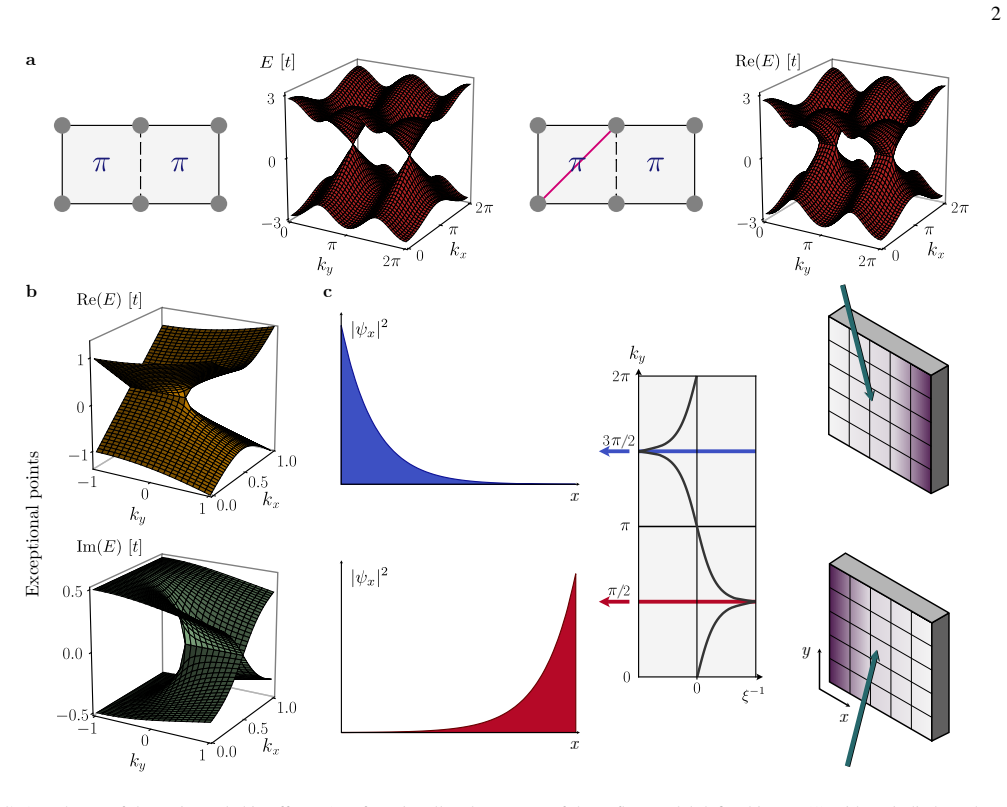
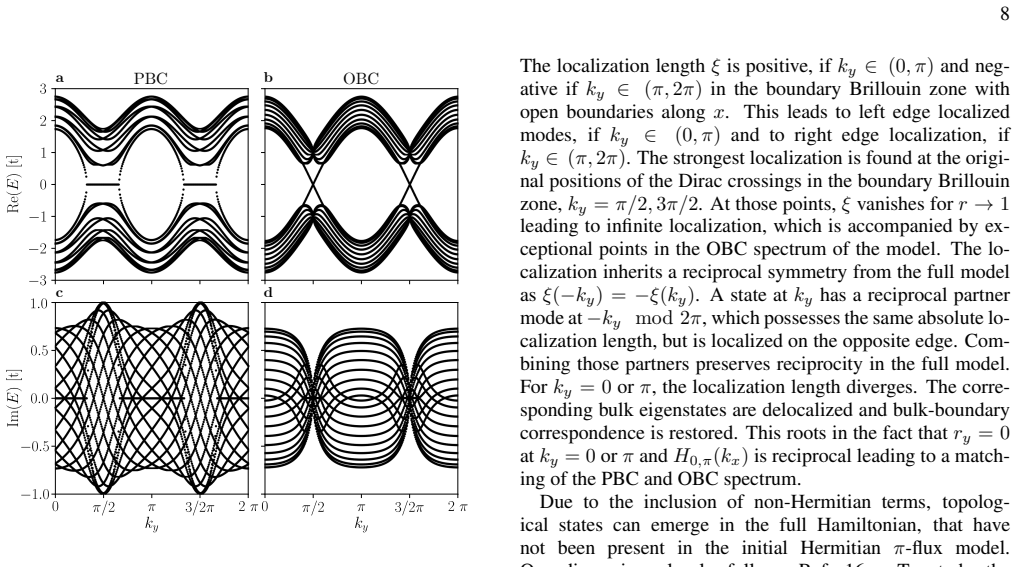
The carrying object is the momentum-dependent non-Hermitian coupling term $-ir\begin{pmatrix}0&e^{ik_y}\\e^{-ik_y}&0\end{pmatrix}$, a reciprocal off-diagonal hopping in which the forward and reverse amplitudes are equal rather than conjugate. Fixing $k_y$ as a parameter converts the two-dimensional model into an effectively one-dimensional chain with an induced non-reciprocal hopping proportional to $r\sin(k_y)$; because $\sin(k_y)$ is odd, opposite momenta see opposite effective non-reciprocity and therefore accumulate on opposite edges, while the translational symmetry of the full two-dimensional system prevents the reciprocal partners from hybridizing. In the circuit, the same term is produced by a resistor across the diagonal of each plaquette, whose admittance contribution enters the circuit Laplacian as the same matrix; the circuit Laplacian $J(\omega_0)$ is the measured object whose eigenvalues and eigenstates represent the model Hamiltonian.
What would settle it
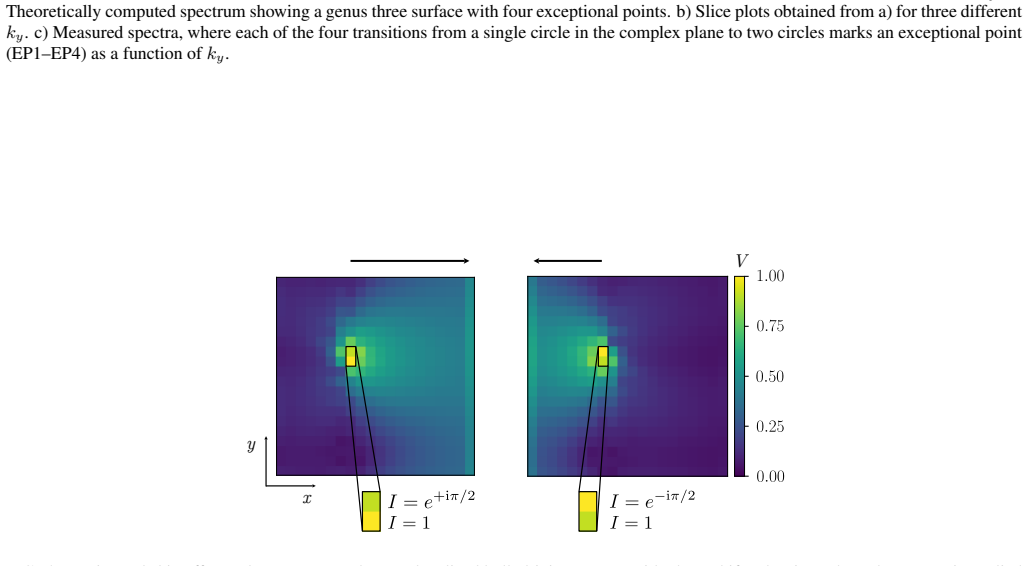
Drive the circuit from two bulk sites with a $+\pi/2$ phase difference and separately with a $-\pi/2$ phase difference, following the protocol of Appendix F: if the $+\pi/2$ drive does not build up a voltage concentrated at the right edge and the $-\pi/2$ drive at the left edge, the reciprocal skin effect is not present in the realized circuit. A second check is to sweep the drive frequency away from the calibrated value and confirm that the localization direction and edge accumulation follow the sign of $\sin(k_y)$ rather than reflecting a parasitic resonance.
Extended reading notes
Core claim
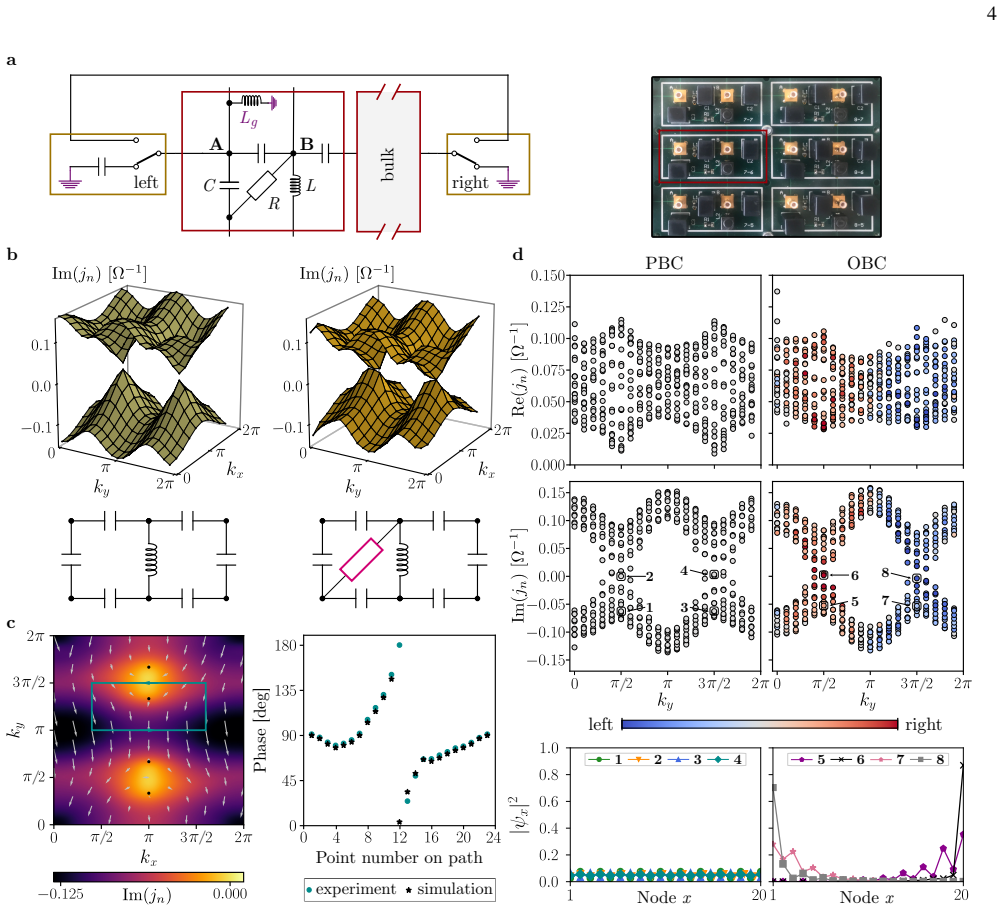
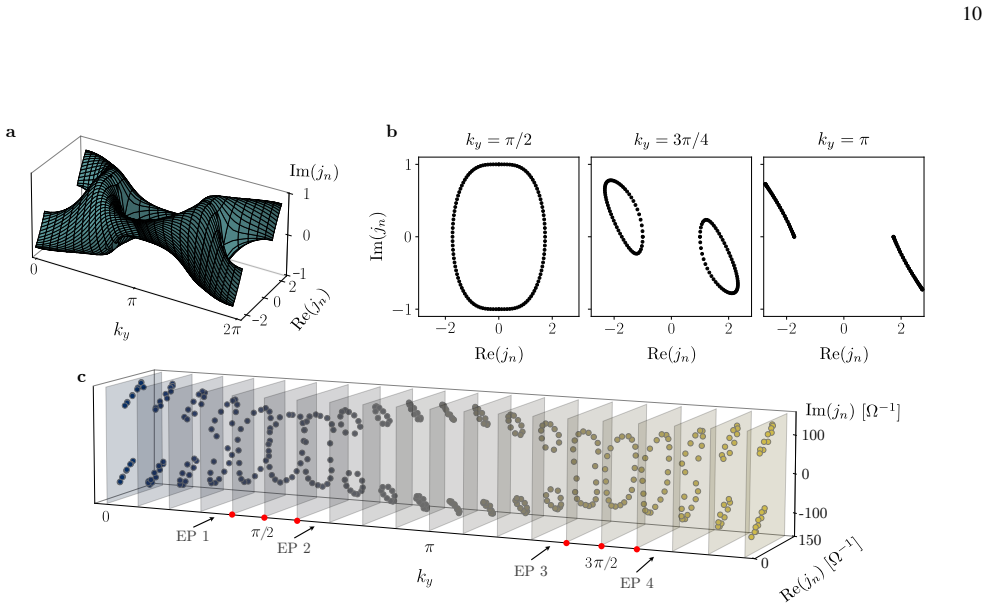
The central claim is that non-Hermiticity alone, without non-reciprocity, can produce extensive skin-mode localization in two dimensions. Starting from the Hermitian $\pi$-flux model on a square lattice, the paper adds a single reciprocal, non-Hermitian diagonal hopping term, giving $H(k_x,k_y) = H_\pi(k_x,k_y) - i r\begin{pmatrix}0&e^{ik_y}\\e^{-ik_y}&0\end{pmatrix}$. The same complex amplitude $ir$ multiplies a hop and its reverse, so the model satisfies $H(k_x,k_y)^T = H(-k_x,-k_y)$, yet the eigenvalues become complex and each Dirac point splits into a pair of exceptional points, degeneracies where two eigenstates coalesce. With open boundaries in $x$ and periodic boundaries in $y$, treating $k_y$ as a parameter turns the model into an effective one-dimensional non-reciprocal chain: for $k_y\in(0,\pi)$ all bulk modes localize on the right edge, for $k_y\in(\pi,2\pi)$ they localize on the left edge, and at $k_y=0,\pi$ they are delocalized; the localization is strongest near the former Dirac points at $k_y=\pi/2$ and $3\pi/2$, and the localization length vanishes at $r=1$. The experiment realizes this in a $10\times20$ unit-cell circuit: a resistor connecting sublattice nodes supplies the lossy reciprocal coupling, and measured Green's functions give eigenstates whose inverse participation ratio, a measure of localization, shows the predicted momentum-dependent edge accumulation.
Load-bearing premise
The experimental demonstration assumes that the assembled RLC network at the chosen drive frequency realizes the intended tight-binding Hamiltonian, including cancellation of the sublattice diagonal terms by grounding inductors and the exact mapping of the resistor term to $-ir\begin{pmatrix}0&e^{ik_y}\\e^{-ik_y}&0\end{pmatrix}$; parasitic effects and component tolerances are fixed by circuit simulation rather than by independently measuring the realized Hamiltonian, so a calibration error would change which Hamiltonian's eigenstates are observed.
Editorial extensions
If this is right
- The reciprocal skin effect should appear in any non-Hermitian reciprocal two-dimensional lattice whose couplings connect different internal degrees of freedom, because the momentum-slice argument depends only on the sign of $\sin(k_y)$, not on the electrical implementation.
- The breakdown of bulk-boundary correspondence is now observable without active or non-reciprocal elements: a passive RLC network suffices, so the effect transfers to optical, acoustic, and mechanical metamaterials built from lossy reciprocal components.
- Because localization direction is fixed by the sign of $\sin(k_y)$, an incident wave with a definite propagation direction and polarization drives a voltage buildup at a selectable edge, making the same circuit a passive direction or polarization detector for electromagnetic waves.
- Tuning the resistance so that $r=1$ makes the localization length vanish at $k_y=\pi/2$ and $3\pi/2$, giving infinitely localized skin modes there while Su-Schrieffer-Heeger-type one-dimensional edge modes coexist in the gapped bulk spectrum.
Reading between the lines
- The momentum-slice picture suggests a three-dimensional extension: with open boundaries in two directions, different patches of the surface Brillouin zone should localize modes on different edges or hinges, forming higher-dimensional reciprocal skin accumulations that the paper does not explicitly formulate.
- The Appendix F response calculation implies a concrete device test: a two-port input with a $\pm\pi/2$ phase difference should act as a passive switch that routes a signal to one edge or the other; measuring output impedance versus input phase would quantify bandwidth and efficiency.
- Because only reciprocal loss is required, a photonic lattice with absorption or an acoustic lattice with damping should reproduce the effect as long as the internal degrees of freedom carry the complex phase, making the phenomenon platform-independent.
Signed reviews
Editorial analysis
A structured set of objections, weighed in public.
Referee Report
Summary. The paper introduces a 'reciprocal skin effect' in non-Hermitian but reciprocal two-dimensional systems. Starting from the π-flux tight-binding model on a square lattice, the authors add a complex diagonal hopping term that breaks Hermiticity while preserving reciprocity, and show that for open boundary conditions along x, each fixed transverse momentum ky behaves as an effectively non-reciprocal one-dimensional model exhibiting skin localization. The localization length is derived analytically in Eq. (C8), and opposite ky values localize to opposite edges, with ky=0,π delocalized. The paper reports an experimental realization in a passive RLC circuit, using Green's-function reconstruction to extract the circuit Laplacian spectrum and eigenstates, and claims observation of exceptional points and of the reciprocal skin effect through inverse participation ratio (IPR) coloring of eigenstates. The authors also present a non-unitary transformation to an SSH-type model and propose a polarization-detection application. The theoretical derivation is coherent, while the experimental demonstration and the stated direction of localization contain issues that need to be resolved.
Significance. If the experimental mapping is sound, this is a conceptually important advance: it shows that extensive skin localization does not require non-reciprocal couplings, but can arise in reciprocal systems through momentum-resolved effective non-reciprocity in two dimensions. The analytic localization length in Eq. (C8) is a clean, checkable prediction, and the passive-circuit platform is a practical and accessible implementation. The measured IPR-based observation of opposite localization at opposite ky is suggestive and, if reproduced with error bars and independent component calibration, would be a valuable demonstration. The paper also provides a useful derivation of the circuit-Laplacian-to-Hamiltonian mapping and an SSH-type interpretation of the non-Hermitian model.
major comments (3)
- [II (Theory), Fig. 1c, Fig. 2d, and Appendix C 3] The direction of the predicted skin localization is stated inconsistently. Section II says 'For ky∈(0,π), all OBC bulk modes localize at the right edge, while the localization switches to the left edge for ky∈(π,2π)', and Fig. 2d colors states near ky=π/2 as right-localized and near ky=3π/2 as left-localized. However, the caption of Fig. 1c assigns ky=π/2 to the left and ky=3π/2 to the right, and Appendix C, in the text following Eq. (C8), concludes 'This leads to left edge localized modes, if ky∈(0,π) and to right edge localization, if ky∈(π,2π)'. With ψx∼e^{-x/ξ}, a positive ξ (ky∈(0,π)) corresponds to decay toward larger x and hence left-edge localization, so the Appendix C convention is the one consistent with the derivation. The authors must fix a single sign convention and state explicitly how the colors in Fig. 2d are assigned; this is load-bearing for the experimental claim and for the directional-detector application in Fig. 1c and Appendix F.
- [Appendix D and Fig. 2d] The experimental identification of the realized Hamiltonian is under-determined. Appendix D states that the resonance frequency f0=87.25 kHz was found by matching features of a frequency sweep to an LTSPICE simulation that includes parasitic resistances, and that 'capacitors and resistors ... were therefore not characterized', with only inductors pre-characterized. The mapping H=[J(ω0)-ir1]/(iω0C) requires the diagonal terms to cancel at f0 (Eq. C3) and the resistor term to realize exactly the -ir e^{±iky} off-diagonal contribution (Eqs. C4 and C6). Any error in the parasitic model or in component values introduces unknown diagonal (σz) and hopping renormalizations. Because no error bars, raw Green's-function data, or independent component measurements are presented, it is not possible to verify that the measured eigenstates at 87.25 kHz are eigenstates of Eq. (2) rather than of a nearby off-resonance Hamiltonian. This is the least secured link of the central experimental claim.
- [Eq. (C8), Fig. 2d] The quantitative prediction of the reciprocal skin effect, the localization length ξ(ky) in Eq. (C8), is not compared with the experimental eigenstates. Fig. 2d reports only a binary coloring based on IPR; no spatial profiles, fitted localization lengths, or comparison to the theoretical ξ(ky) curve are shown. Since the paper emphasizes 'exponentially localized with localization length ξ', a profile fit or at least a scatter of IPR versus the predicted ξ would substantiate the claim and would help discriminate the skin effect from generic edge weighting or disorder. The IPR threshold used for the color assignment is also not defined. This comparison should be added, or the experimental claim should be softened to a qualitative statement.
minor comments (5)
- [III] In §III, 'contstraints' should be 'constraints' in the phrase 'local connectivity contstraints'.
- [Appendix D] In Appendix D, 'LCR Brige' should be 'LCR Bridge'.
- [Appendix E] The sentence 'We observe, for PBC, a clear from slices at constant ky with a single circle and two circles' is missing a word; it should read 'a clear change from slices' or similar.
- [Fig. 2d] The precise definition of the IPR used and the threshold separating red and blue points in Fig. 2d are not given; please specify them.
- [Appendix D] The manuscript does not state whether raw measurement data and the LTSPICE netlist will be made available; a data availability statement would improve reproducibility.
Circularity Check
No significant circularity: the reciprocal skin effect is derived from an explicit model Hamiltonian and the circuit experiment is an independent implementation, not a fit to the prediction.
full rationale
The paper's central theoretical claim is derived from a stated non-Hermitian but reciprocal tight-binding Hamiltonian, Eq. (2), with the localization property obtained via the explicitly written non-Bloch analysis leading to Eq. (C8), ξ^{-1} = (1/4) ln[(1+r²+2r sin ky)/(1+r²−2r sin ky)]. This is a genuine prediction from the model, not an input fitted to data. The circuit mapping is likewise explicit in Appendix C: the Hamiltonian is identified with the circuit Laplacian as H = [J(ω0) − ir1]/(iω0C) with r = 1/(ω0RC), and r is simply chosen as r = 1. The resonance frequency in Appendix D is calibrated from LTSPICE features, but it is not tuned to reproduce the observed left/right localization pattern; the eigenmode localization is then extracted independently from the measured Green's function. Self-citations to prior topolectrical-circuit and skin-effect work (Refs. 16, 19, 32, 39) support standard techniques and previously established effects; they are not used as the load-bearing derivation of the reciprocal skin effect. The experimental calibration dependence noted in Appendix D is a legitimate uncertainty about component parasitics, but it is an implementation concern, not circularity: the predicted and observed phenomena could in principle disagree, and the paper reports their agreement. No self-definitional reduction, fitted-input-called-prediction, or author-imported uniqueness argument is present. The theoretical derivation is self-contained, and the experimental observation is an independent test of the model's prediction.
Assumptions & free parameters
free parameters (2)
- r =
1
- resonance frequency f0 =
87.25 kHz
assumptions (4)
- domain assumption The non-Bloch band theory / generalized Brillouin zone framework of Ref. 16 applies to the effective 1D model at fixed ky.
- domain assumption The circuit at the chosen resonance frequency realizes the tight-binding model H = [J(omega0) - ir 1]/(i omega0 C).
- domain assumption Translation invariance in y direction, with periodic boundary conditions in y, so ky is a good quantum number.
- domain assumption Right eigenvectors of the circuit Laplacian, extracted from the measured Green's function, determine the localization of physical modes.
Cite this review
Pith. "Pith review of Reciprocal skin effect and its realization in a topolectrical circuit." pith.science (2026). https://pith.science/paper/AQUQ4BOF
@misc{pith2026190802759,
  author       = {Pith},
  title        = {Pith review of: Reciprocal skin effect and its realization in a topolectrical circuit},
  year         = {2026},
  howpublished = {\url{https://pith.science/paper/AQUQ4BOF}},
  note         = {Machine review of arXiv:1908.02759}
}
read the original abstract
A system is non-Hermitian when it exchanges energy with its environment and non-reciprocal when it behaves differently upon the interchange of input and response. Within the field of metamaterial research on synthetic topological matter, the skin effect describes the conspiracy of non-Hermiticity and non-reciprocity to yield extensive anomalous localization of all eigenmodes in a (quasi) one-dimensional geometry. Here, we introduce the reciprocal skin effect, which occurs in non-Hermitian but reciprocal systems in two or more dimensions: Eigenmodes with opposite longitudinal momentum exhibit opposite transverse anomalous localization. We experimentally demonstrate the reciprocal skin effect in a passive RLC circuit, suggesting convenient alternative implementations in optical, acoustic, mechanical, and related platforms. Skin mode localization brings forth potential applications in directional and polarization detectors for electromagnetic waves.
Figures
Figures from the paper (2 more)
Forward citations
Cited by 4 Pith papers
-
Generalized bulk-edge correspondence for non-hermitian topological systems
A modified periodic boundary condition with a decay parameter b makes the bulk-edge correspondence work for a non-Hermitian SSH model in an enlarged parameter space.
-
Probing non-Hermitian Skin Effect and non-Bloch Phase Transitions
Bulk wave-packet dynamics, through the drift-velocity dependence of the Lyapunov exponent, can reveal the non-Hermitian skin effect and non-Bloch symmetry-breaking transitions.
-
Nonreciprocal response theory of nonhermitian mechanical metamaterials: response phase transition from the skin effect of zero modes
For a nonreciprocal Kane-Lubensky chain, the zero-mode skin effect is predicted to coincide with a phase where the Petermann factor diverges exponentially with system size.
-
Hidden Chern number in one-dimensional non-Hermitian chiral-symmetric systems
The topology of certain one-dimensional non-Hermitian chains is captured by a Chern number of an effective two-dimensional Hermitian Hamiltonian, and this hidden Chern number predicts zero-real-energy end states.
Reference graph
Works this paper leans on
-
[1]
2 a), with the conceptually important elements of each plaquette shown in Fig
Derivation of the circuit Laplacian We realize the reciprocal skin effect in an electrical circuit whose unit cell is shown in Fig. 2 a), with the conceptually important elements of each plaquette shown in Fig. 2 b). The two-point Laplacian of a capacitor is given by ( Iin,1 Iin,2 ) =iω [ C ( 1 −1 −1 1 )]( V1 V2 ) . (C1) Under omission of the prefactor iω...
-
[2]
Hermitian part of the model We omit the unit matrix contribution to the circuit Lapla- cianJ and interchangeably consider the tight-binding model that it induces. The Hermitian part of the model is based on theπ-flux model with the Hamiltonian Hπ = [1 + cos(kx)]σx + sin(kx)σy + 2 cos(ky)σz. (C5) It features two Dirac band touchings, which are located on th...
-
[3]
Full non-Hermitian model We now introduce a non-Hermitian extension to theπ-flux model by adding a diagonal coupling across one of the two plaquettes in the unit cell and arrive at the total Hamiltonian H =Hπ−ir cos(ky)σx +ir sin(ky)σy, (C6) which is related to the circuit Laplacian by H = [J(ω0)− ir1 ]/(iω0C) and r = 1 /(ω0RC). It is reciprocal, H(kx,ky)⊤...
-
[4]
The topo- logical phase transition does in general not occur at the PBC band closings, but is instead parametrically displaced due to the non-Hermiticity. Only for the special choice of r = 1 , the two conditions coincide, resulting in topological transi- tions at the PBC exceptional points for ky =±π/3,±2π/3 mod 2π. The topological boundary modes dispers...
-
[5]
F. Bloch, Über die Quantenmechanik der Elektronen in Kristall- gittern, Zeitschrift fur Physik 52, 555 (1929)
work page 1929
-
[6]
K. v. Klitzing, G. Dorda, and M. Pepper, New method for high- accuracy determination of the fine-structure constant based on quantized hall resistance, Phys. Rev. Lett. 45, 494 (1980)
work page 1980
-
[7]
F. D. M. Haldane, Model for a quantum hall effect with- out landau levels: Condensed-matter realization of the" parity anomaly", Physical Review Letters 61, 2015 (1988)
work page 1988
- [8]
Show all 52 references
-
[9]
Qi and S.-C
X.-L. Qi and S.-C. Zhang, Topological insulators and supercon- ductors, Rev. Mod. Phys. 83, 1057 (2011)
2011
-
[10]
M. Z. Hasan and C. L. Kane, Colloquium: Topological insula- tors, Rev. Mod. Phys. 82, 3045 (2010)
2010
-
[11]
N. P. Armitage, E. J. Mele, and A. Vishwanath, Weyl and dirac semimetals in three-dimensional solids, Rev. Mod. Phys. 90, 015001 (2018)
2018
-
[12]
Hatsugai, Chern number and edge states in the integer quan- tum hall effect, Phys
Y . Hatsugai, Chern number and edge states in the integer quan- tum hall effect, Phys. Rev. Lett. 71, 3697 (1993)
1993
-
[13]
Prodan and H
E. Prodan and H. Schulz-Baldes, Bulk and boundary invariants for complex topological insulators (Springer)
-
[14]
Z. Gong, Y . Ashida, K. Kawabata, K. Takasan, S. Higashikawa, and M. Ueda, Topological phases of non-hermitian systems, Phys. Rev. X 8, 031079 (2018)
2018
-
[15]
L. E. F. Foa Torres, Perspective on topological states of non- hermitian lattices, Journal of Physics: Materials (2019)
2019
-
[16]
T. E. Lee, Anomalous edge state in a non-hermitian lattice, Phys. Rev. Lett. 116, 133903 (2016)
2016
-
[17]
V . M. Martinez Alvarez, J. E. Barrios Vargas, and L. E. F. Foa Torres, Non-hermitian robust edge states in one dimension: Anomalous localization and eigenspace condensation at excep- tional points, Phys. Rev. B 97, 121401 (2018)
2018
-
[18]
H. Shen, B. Zhen, and L. Fu, Topological band theory for non- hermitian hamiltonians, Phys. Rev. Lett. 120, 146402 (2018)
2018
-
[19]
H. Zhou, C. Peng, Y . Yoon, C. W. Hsu, K. A. Nelson, L. Fu, J. D. Joannopoulos, M. Solja ˇci´c, and B. Zhen, Observation of bulk fermi arc and polarization half charge from paired excep- tional points, Science 359, 1009 (2018)
2018
-
[20]
Yao and Z
S. Yao and Z. Wang, Edge states and topological invariants of non-hermitian systems, Phys. Rev. Lett. 121, 086803 (2018)
2018
-
[21]
Xiong, Why does bulk boundary correspondence fail in some non-hermitian topological models, Journal of Physics Commu- nications 2, 035043 (2018)
Y . Xiong, Why does bulk boundary correspondence fail in some non-hermitian topological models, Journal of Physics Commu- nications 2, 035043 (2018)
2018
-
[22]
F. K. Kunst, E. Edvardsson, J. C. Budich, and E. J. Bergholtz, Biorthogonal bulk-boundary correspondence in non-hermitian systems, Phys. Rev. Lett. 121, 026808 (2018)
2018
-
[23]
C. H. Lee and R. Thomale, Anatomy of skin modes and topol- ogy in non-hermitian systems, Phys. Rev. B99, 201103 (2019)
2019
-
[24]
D. S. Borgnia, A. Jura Kruchkov, and R.-J. Slager, Non- Hermitian Boundary Modes, arXiv e-prints , arXiv:1902.07217 (2019), arXiv:1902.07217 [cond-mat.mes-hall]
2019 arXiv
-
[25]
W. B. Rui, M. M. Hirschmann, and A. P. Schnyder, Pt- symmetric non-hermitian dirac semimetals, Phys. Rev. B 100, 245116 (2019)
2019
-
[26]
Okuma, K
N. Okuma, K. Kawabata, K. Shiozaki, and M. Sato, Topological origin of non-hermitian skin effects (2019), arXiv:1910.02878 [cond-mat.mes-hall]
2019 arXiv
-
[27]
M. V . Berry, Quantal phase factors accompanying adiabatic changes, Proceedings of the Royal Society of London A: Math- ematical, Physical and Engineering Sciences 392, 45 (1984)
1984
-
[28]
Zak, Berry’s phase for energy bands in solids, Phys
J. Zak, Berry’s phase for energy bands in solids, Phys. Rev. Lett. 62, 2747 (1989)
1989
-
[29]
F. D. M. Haldane, Path dependence of the geometric rotation of polarization in optical fibers, Opt. Lett. 11, 730 (1986)
1986
-
[30]
F. D. M. Haldane and S. Raghu, Possible realization of direc- tional optical waveguides in photonic crystals with broken time- reversal symmetry, Phys. Rev. Lett.100, 013904 (2008)
2008
-
[31]
C. L. Kane and T. C. Lubensky, Topological boundary modes in isostatic lattices, Nat Phys 10, 39 (2014)
2014
-
[32]
Z. Yang, F. Gao, X. Shi, X. Lin, Z. Gao, Y . Chong, and B. Zhang, Topological acoustics, Phys. Rev. Lett. 114, 114301 (2015)
2015
-
[33]
Ningyuan, C
J. Ningyuan, C. Owens, A. Sommer, D. Schuster, and J. Simon, Time-and site-resolved dynamics in a topological circuit, Phys. Rev. X 5, 021031 (2015)
2015
-
[34]
V . V . Albert, L. I. Glazman, and L. Jiang, Topological properties of linear circuit lattices, Phys. Rev. Lett. 114, 173902 (2015)
2015
-
[35]
W. Hu, J. C. Pillay, K. Wu, M. Pasek, P. P. Shum, and Y . Chong, Measurement of a topological edge invariant in a microwave network, Physical Review X 5, 011012 (2015)
2015
-
[36]
C. H. Lee, S. Imhof, C. Berger, F. Bayer, J. Brehm, L. W. Molenkamp, T. Kiessling, and R. Thomale, Topolectrical cir- cuits, Communications Physics 1, 39 (2018)
2018
-
[37]
Imhof, C
S. Imhof, C. Berger, F. Bayer, J. Brehm, L. W. Molenkamp, T. Kiessling, F. Schindler, C. H. Lee, M. Greiter, T. Neupert, and R. Thomale, Topolectrical-circuit realization of topological corner modes, Nature Physics 14, 925 (2018)
2018
-
[38]
Hofmann, T
T. Hofmann, T. Helbig, C. H. Lee, M. Greiter, and R. Thomale, Chiral voltage propagation and calibration in a topolectrical chern circuit, Phys. Rev. Lett. 122, 247702 (2019)
2019
-
[39]
C. H. Lee, T. Hofmann, T. Helbig, Y . Liu, X. Zhang, M. Gre- iter, and R. Thomale, Imaging nodal knots in momentum space through topolectrical circuits, arXiv:1904.10183
1904 arXiv
-
[40]
Ezawa, Non-hermitian boundary and interface states in non- reciprocal higher-order topological metals and electrical cir- cuits, Phys
M. Ezawa, Non-hermitian boundary and interface states in non- reciprocal higher-order topological metals and electrical cir- cuits, Phys. Rev. B 99, 121411 (2019)
2019
-
[41]
Ezawa, Electric circuits for non-Hermitian Chern insulators, arXiv e-prints , arXiv:1904.03823 (2019), arXiv:1904.03823 [cond-mat.mes-hall]
M. Ezawa, Electric circuits for non-Hermitian Chern insulators, arXiv e-prints , arXiv:1904.03823 (2019), arXiv:1904.03823 [cond-mat.mes-hall]
2019 arXiv
-
[42]
Wang, L.-J
Y . Wang, L.-J. Lang, C. H. Lee, B. Zhang, and Y . Chong, Topo- logically enhanced harmonic generation in a nonlinear trans- mission line metamaterial, Nature communications 10, 1102 (2019)
2019
-
[43]
Helbig, T
T. Helbig, T. Hofmann, C. H. Lee, R. Thomale, S. Imhof, L. W. Molenkamp, and T. Kiessling, Band structure engineering and reconstruction in electric circuit networks, Phys. Rev. B 99, 161114 (2019)
2019
-
[44]
F. Song, S. Yao, and Z. Wang, Non-hermitian skin effect and chiral damping in open quantum systems, arXiv preprint arXiv:1904.08432 (2019)
2019 arXiv
-
[45]
Hatano and D
N. Hatano and D. R. Nelson, Localization transitions in non- hermitian quantum mechanics, Phys. Rev. Lett. 77, 570 (1996)
1996
-
[46]
Murakami, Phase transition between the quantum spin hall and insulator phases in 3d: emergence of a topological gapless phase, New Journal of Physics 9, 356 (2007)
S. Murakami, Phase transition between the quantum spin hall and insulator phases in 3d: emergence of a topological gapless phase, New Journal of Physics 9, 356 (2007)
2007
-
[47]
C. L. Kane and E. J. Mele, Z2, Phys. Rev. Lett. 95, 146802 (2005)
2005
-
[48]
Helbig, T
T. Helbig, T. Hofmann, S. Imhof, M. Abdelghany, T. Kiessling, L. W. Molenkamp, C. H. Lee, A. Szameit, M. Greiter, and R. Thomale, Observation of bulk boundary correspon- 12 dence breakdown in topolectrical circuits, arXiv e-prints , arXiv:1907.11562 (2019), arXiv:1907.11562 [c...
2019 arXiv
-
[49]
Ghatak, M
A. Ghatak, M. Brandenbourger, J. van Wezel, and C. Coulais, Observation of non-Hermitian topology and its bulk-edge correspondence, arXiv e-prints , arXiv:1907.11619 (2019), arXiv:1907.11619 [cond-mat.mes-hall]
2019 arXiv
-
[50]
L. Xiao, T. Deng, K. Wang, G. Zhu, Z. Wang, W. Yi, and P. Xue, Observation of non-Hermitian bulk-boundary correspondence in quantum dynamics, arXiv e-prints , arXiv:1907.12566 (2019), arXiv:1907.12566 [cond-mat.mes-hall]
2019 arXiv
-
[51]
Evers and A
F. Evers and A. D. Mirlin, Anderson transitions, Rev. Mod. Phys. 80, 1355 (2008)
2008
-
[52]
C. H. Lee, G. Li, Y . Liu, T. Tai, R. Thomale, and X. Zhang, Tidal surface states as fingerprints of non-hermitian nodal knot metals, arXiv preprint arXiv:1812.02011 (2018)
2018 arXiv
Reviewed August 14, 2026 · model on record in the stance chip above.
Discussion (0). Continue with ORCID to comment.