REVIEW 5 major objections 8 minor 36 references
This paper claims that decoupled arbitration between geometric and semantic experts, rather than early fusion, fixes gradient domination and improves few-shot 3D point cloud segmentation.
Reviewed by Pith at T0; open to challenge. T0 means a machine referee read the full paper against a public rubric. the ladder, T0–T4 →
T0 review · deepseek-v4-flash
2026-08-03 12:46 UTC pith:ASPYKRSR
load-bearing objection A modest, credible decoupled-expert extension of MM-FSS with reproducible code, but the mIoU gains are small and the paper reports no error bars, so the consistency claim is currently unproven. the 5 major comments →
Rethinking Multimodal Few-Shot 3D Point Cloud Segmentation: From Fused Refinement to Decoupled Arbitration
The pith
A machine-rendered reading of the paper's core claim, the machinery that carries it, and where it could break.
Core claim
The paper's central discovery is that the failure mode of the fused-refinement paradigm is not simply insufficient fusion but gradient domination: when a frozen vision-language model's semantic features and an adaptive geometric encoder's features are merged early, the larger and more stable semantic norms overwhelm the sparse geometric gradients, causing the backbone to become 'lazy' and to hallucinate semantic labels in geometrically ambiguous regions. DA-FSS establishes that physically separating these pathways—an adaptive geometric expert for plasticity and a static semantic expert for stability—and only combining their decisions late through a stacked arbitration module resolves the con
What carries the argument
The key machinery is the Decoupled-experts Arbitration architecture, built around three components: a Parallel Expert Refinement module that feeds the unimodal (geometric) and intermodal (semantic) correlations into separate Transformer experts, keeping their mutual information near zero during refinement; a Decoupled Alignment Module (DAM) that regularizes the geometric expert to match the semantic expert's prototypes and decision distributions through stop-gradients, transferring knowledge without propagating confusion; and a Stacked Arbitration Module (SAM) that first applies batch-normalization to calibrate the scale mismatch between adaptive and static features, then stacks Transformer
Load-bearing premise
The load-bearing premise is that frozen semantic features actually dominate gradients because of their larger feature norms—the paper shows only qualitative gradient plots and does not quantify the norm disparity or prove causation, so if the plasticity-stability dilemma is not the real cause of the baseline's errors, the decoupling motivation loses its foundation (though the architecture could still work empirically).
What would settle it
Measure the vector norms of the frozen semantic features and the adaptive geometric features at the fusion point of the baseline during meta-training, and test whether normalizing the semantic features to match the geometric scale eliminates the baseline's texture-ambiguity errors; if it does not, gradient domination is not the cause.
If this is right
- If the decoupled-arbitration claim is correct, future multimodal few-shot segmentation models should separate optimization pathways rather than fuse them early, since early fusion actively suppresses geometric adaptation.
- The large point-wise accuracy gain (~+10.9 mAcc) suggests the approach recovers many previously missed target points; in applications like indoor scene understanding, recall can matter more than boundary precision, so this trade-off may be practically valuable.
- Because DA-FSS uses the same pretrained backbone and text encoder as the baseline and even drops parameters and FLOPs, the gains are attributable to architecture, implying similar decoupling could transfer to other multimodal few-shot tasks.
- The two-law design—soft regularization and late arbitration—gives a template for mixing frozen foundation-model priors with learnable task-specific branches in low-data settings.
Where Pith is reading between the lines
- The paper's diagnosis implies a testable general principle: whenever a frozen large-scale model is combined with a learnable small branch, the frozen branch's feature scale should be checked and possibly normalized, because norm imbalance can silently shut off learning in the adaptive branch.
- The stop-gradient alignment scheme can be viewed as a form of 'knowledge distillation without confusion'; extending it to other confusion sources (e.g., class imbalance or domain bias in the teacher) is a natural next step the paper does not explore.
- The mAcc surge versus moderate mIoU gains hints that standard mIoU may undervalue recall-oriented improvements in few-shot 3D segmentation; an editorial observation worth studying is whether evaluation metrics that penalize over-segmentation mask large practical gains.
- Since the paper validates only on indoor datasets, the decoupling benefit could grow on outdoor or open-vocabulary scenes where geometric ambiguity is higher; this is a testable extension.
Editorial analysis
A structured set of objections, weighed in public.
Referee Report
Summary. The paper proposes DA-FSS, a decoupled-expert architecture for multimodal few-shot 3D point cloud semantic segmentation. It argues that the existing 'Fuse-then-Refine' paradigm in MM-FSS suffers from a 'Plasticity-Stability Dilemma' in which frozen VLM semantic features dominate gradients and suppress geometric adaptation. DA-FSS separates geometric and semantic pathways via Parallel Experts, aligns them with a Decoupled Alignment Module (DAM) using prototype and consistency losses, and combines decisions through a Stacked Arbitration Module (SAM). Experiments on S3DIS and ScanNet compare DA-FSS against MM-FSS under a controlled protocol with official pretrained weights. The paper reports mean mIoU gains from +0.27 to +2.08 across settings, a mAcc gain of +10.9 in one ScanNet setting, and reduced FLOPs/parameters. The central claim is that DA-FSS consistently outperforms MM-FSS across all settings.
Significance. If the claimed improvements are statistically reliable, the work would provide a useful architectural direction for multimodal few-shot segmentation: decoupling semantic and geometric pathways with late arbitration may yield gains without extra parameter overhead. The paper has several strengths: it reuses official MM-FSS pretrained weights, making the comparison transparent; it reports a controlled comparison against the baseline under the same backbone; it provides complexity numbers showing lower FLOPs and parameters; and it makes code publicly available. However, the statistical support is currently weak: no error bars, confidence intervals, or significance tests; the largest headline gain (mAcc) is plausibly a recall/precision trade-off; and the central 'consistent outperformance' claim is contradicted by one split-level result in Table 2. The motivational mechanism is asserted rather than quantified. The significance is therefore conditional on further experimental rigor.
major comments (5)
- [§4.2, Tables 1 and 2] The paper's central claim is that DA-FSS 'consistently outperforms' MM-FSS across all settings. This is not supported by the reported numbers. In Table 2, ScanNet 1-way 1-shot, split S1: MM-FSS† achieves 43.23 mIoU while DA-FSS achieves 41.96, a negative difference. Mean mIoU gains in several other settings are very small (+0.27 in S3DIS 2-way 1-shot, +0.54 in ScanNet 2-way 1-shot). No standard deviations, confidence intervals, or significance tests are reported anywhere. Given that episodic few-shot evaluation typically has variance of several mIoU points across episodes and runs, these margins could easily arise from noise. The paper should report per-seed standard deviations, use paired evaluation across the same episodes, and perform a significance test (e.g., paired bootstrap or Wilcoxon). Without this, the 'consistent outperformance' claim is unverified and, at the split level, con
- [§4.3, Table 3(c)] The mAcc surge of +10.9 points on ScanNet 1-way 1-shot is presented as a major benefit, but the authors themselves attribute it to over-segmentation: 'this very tendency actually aids the model in more accurately segmenting points that should have been correctly identified.' Over-segmentation inflates recall (mAcc) while penalizing precision/IoU, so the +10.9 mAcc gain may be largely a sensitivity trade-off rather than an improvement in segmentation quality. Because mIoU is the primary metric and the mIoU gain in that setting is only +1.0, the paper should either (a) report precision/recall or boundary quality metrics that separate over-segmentation from genuine semantic recovery, or (b) temper the interpretation of the mAcc gain. As written, the mAcc claim is not evidence of better segmentation.
- [§4.1, Implementation Details] The SAM depth N is set separately for each dataset (N=1 for S3DIS, N=2 for ScanNet), and the DAM losses λ_PLR=0.001 and λ_DCR=0.5 are chosen by 'empirical tuning.' No validation-set procedure or sensitivity analysis is described. Per-dataset tuning of hyperparameters on the test benchmark can inflate results and makes it hard to know whether the reported gains are robust. The authors should provide a sensitivity study over N and the two loss weights, or fix a single configuration across datasets and report results under that setting. At minimum, the selection procedure must be described and justified.
- [§3.2, Eqs. (1)-(2), Figure 2] The entire architecture is motivated by the 'Plasticity-Stability Dilemma' and 'Gradient Domination.' The evidence provided is Eq. (1)-(2), which are not derived, and Figure 2, which is a qualitative plot with no axis labels, no units, no error bands, and no quantification of F_sem vs F_geo norms or of the claimed gradient collapse. The paper does not demonstrate that the observed gradient behavior causes the segmentation errors, nor that the decoupled architecture changes this mechanism. If the motivation is load-bearing, the authors should report actual gradient-norm statistics during training for MM-FSS and DA-FSS, quantify the norm disparity between frozen semantic features and adaptive geometric features, and ideally run an ablation that removes the semantic branch to test whether the predicted plasticity failure appears. If the mechanism is not quantifiable, the motivational framin
- [§3.5, DAM] The paper claims that stop-gradient operations 'fully prevent' confusion-noise propagation and that the Parallel Experts achieve I(R_geo; R_sem)≈0. These are strong formal-sounding claims with no supporting evidence. Stop-gradient only prevents gradient flow through the specified path; it does not prevent representational correlation or information leakage through the shared input. Mutual information is not measured. If these statements are meant as design rationales, they should be phrased as such. If they are load-bearing for why DAM preserves decoupling, the authors should provide empirical evidence (e.g., measuring correlation or mutual information before/after stop-gradient, or ablating the stop-gradient).
minor comments (8)
- [Figure 2] The plot lacks axis labels, units, and a legend description of which gradient is being plotted. 'Gradient norm' is ambiguous: which parameters, which loss terms, averaged over what? Please clarify and add error bars or multiple runs.
- [Eq. (2)] The notation δlow and ∇init is not defined, and the expression 'training → δlow ≪ ∥∇init∥' is not a formal equation. Please define all symbols and state the time index over which the arrow is taken.
- [§3.4] The notation I(R_geo; R_sem)≈0 is introduced without defining I or explaining how it is estimated. Since mutual information is not computed, rephrase to 'by construction there is no direct residual connection' or provide a measurement.
- [Tables and Supp] The text says 'see Supp. Material for full tables,' but no supplementary material is included in the arXiv submission. Either include the supplement or remove the pointer.
- [Table 3(c)] The footnote marker after 'mAcc(%)' is not resolved; 'High FN' and 'High Recall' are informal. Please define the quantities and state whether mAcc is mean class accuracy or point-wise accuracy.
- [Related Work] There is a duplicate citation in §2.1: 'Ning et al., 2023; Ning et al., 2023.' Also, references [An et al., 2025a] and [An et al., 2025b] both appear in the text but the reference list gives only venue names; please ensure all citation keys resolve uniquely.
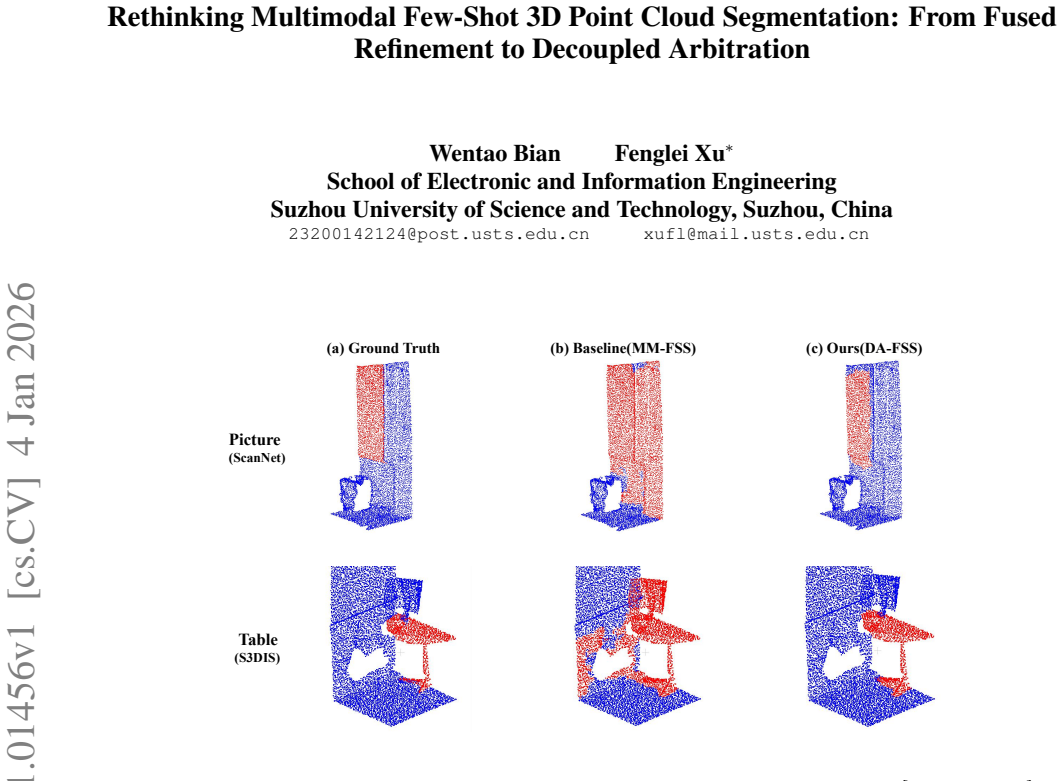
- [Figure 1] The caption contains an odd artifact: 'Picture (ScanNet)' appears to be an annotation that is not explained, and the subfigure labels are visually unstructured. Please clean the figure so the qualitative claim can be inspected properly.
- [Abstract/Introduction] The phrase 'free modalities' utilization rate' is unclear; 'free modalities' is not defined. Also 'MM-FSS is the pioneering SOTA' is informal; please rephrase to 'previous state-of-the-art.'
Circularity Check
No significant circularity: DA-FSS's claimed gains are empirical measurements from held-out episodes, and the transparent reuse of MM-FSS pretrained weights is not a fitted prediction.
full rationale
The paper's central claim is that DA-FSS outperforms MM-FSS on S3DIS and ScanNet. This is supported by reported mIoU/mAcc values from episodic evaluation (Tables 1-3), not derived by construction from the method's equations. The method reuses MM-FSS's backbone and officially released pretrained weights, as explicitly stated: 'we chose to directly use the same method as MM-FSS does, or even download officially released pre-trained weights directly.' This is transparent weight reuse, not a hidden fit. The 'Plasticity-Stability Dilemma' is presented as an observed motivation supported by gradient-norm monitoring (Figure 2) and cited CLIP confusion literature; it is a hypothesis about why the baseline fails, but the architecture's success is measured independently and is not logically entailed by that hypothesis. There are no author self-citations: the cited MM-FSS and related works are by An et al., not by Bian and Xu. The hyperparameters lambda_PLR and lambda_DCR are tuned empirically, but this does not make the final mIoU equal to the tuning criterion by construction. The lack of error bars and significance tests is a statistical-robustness concern, not circularity. Therefore no circular step can be exhibited under the required standard.
Axiom & Free-Parameter Ledger
free parameters (4)
- λ_PLR (prototype loss weight) =
0.001
- λ_DCR (consistency loss weight) =
0.5
- SAM depth N =
1 for S3DIS, 2 for ScanNet
- Fproj linear projection
axioms (4)
- domain assumption The episodic N-way K-shot paradigm is the correct evaluation protocol for few-shot 3D segmentation.
- domain assumption CLIP text embeddings provide stable semantic priors when frozen.
- domain assumption The officially released MM-FSS pretrained weights are valid and appropriate for initializing DA-FSS.
- ad hoc to paper Stop-gradient operations fully prevent confusion noise propagation.
invented entities (1)
-
Plasticity-Stability Dilemma and Gradient Domination
no independent evidence
read the original abstract
In this paper, we revisit multimodal few-shot 3D point cloud semantic segmentation (FS-PCS), identifying a conflict in "Fuse-then-Refine" paradigms: the "Plasticity-Stability Dilemma." In addition, CLIP's inter-class confusion can result in semantic blindness. To address these issues, we present the Decoupled-experts Arbitration Few-Shot SegNet (DA-FSS), a model that effectively distinguishes between semantic and geometric paths and mutually regularizes their gradients to achieve better generalization. DA-FSS employs the same backbone and pre-trained text encoder as MM-FSS to generate text embeddings, which can increase free modalities' utilization rate and better leverage each modality's information space. To achieve this, we propose a Parallel Expert Refinement module to generate each modal correlation. We also propose a Stacked Arbitration Module (SAM) to perform convolutional fusion and arbitrate correlations for each modality pathway. The Parallel Experts decouple two paths: a Geometric Expert maintains plasticity, and a Semantic Expert ensures stability. They are coordinated via a Decoupled Alignment Module (DAM) that transfers knowledge without propagating confusion. Experiments on popular datasets (S3DIS, ScanNet) demonstrate the superiority of DA-FSS over MM-FSS. Meanwhile, geometric boundaries, completeness, and texture differentiation are all superior to the baseline. The code is available at: https://github.com/MoWenQAQ/DA-FSS/.
Figures


Reference graph
Works this paper leans on
-
[1]
Rethinking few-shot 3d point cloud semantic segmentation
[Anet al., 2024 ] Zhaochong An, Guolei Sun, Yun Liu, Fayao Liu, Zongwei Wu, Dan Wang, Luc Van Gool, and Serge Belongie. Rethinking few-shot 3d point cloud semantic segmentation. In Proceedings of the IEEE/CVF Conference on Computer Vision and Pattern Recognition, pages 3996–4006,
2024
-
[6]
[Guoet al., 2023 ] Ziyu Guo, Renrui Zhang, Xiangyang Zhu, Yi- wen Tang, Xianzheng Ma, Jiaming Han, Kexin Chen, Peng Gao, Xianzhi Li, Hongsheng Li, et al. Point-bind & point- llm: Aligning point cloud with multi-modality for 3d under- standing, generation, and instruction following.arXiv preprint arXiv:2309.00615,
Pith/arXiv arXiv 2023
-
[7]
Unim-ov3d: Uni-modality open-vocabulary 3d scene understanding with fine-grained feature representation
[Heet al., 2024 ] Qingdong He, Jinlong Peng, Zhengkai Jiang, Kai Wu, Xiaozhong Ji, Jiangning Zhang, Yabiao Wang, Chengjie Wang, et al. Unim-ov3d: Uni-modality open-vocabulary 3d scene understanding with fine-grained feature representation. In Proceedings of the International Joint Conference on Artificial Intelligence (IJCAI),
2024
-
[10]
Jacobs, Michael I
[Jacobset al., 1991 ] Robert A. Jacobs, Michael I. Jordan, Steven J. Nowlan, and Geoffrey E. Hinton. Adaptive mixtures of local ex- perts.Neural Computation, 3(1):79–87,
1991
-
[12]
Stratified transformer for 3d point cloud segmentation
[Laiet al., 2022 ] Xin Lai, Jianhui Liu, Li Jiang, Liwei Wang, Hengshuang Zhao, Shu Liu, Xiaojuan Qi, and Jiaya Jia. Stratified transformer for 3d point cloud segmentation. InProceedings of the IEEE/CVF conference on computer vision and pattern recog- nition, pages 8500–8509,
2022
-
[13]
Logits de- confusion with clip for few-shot learning
[Liet al., 2025 ] Shuo Li, Fang Liu, Zehua Hao, Xinyi Wang, Lin- gling Li, Xu Liu, Puhua Chen, and Wenping Ma. Logits de- confusion with clip for few-shot learning. InProceedings of the IEEE/CVF Conference on Computer Vision and Pattern Recog- nition (CVPR), pages 25411–25421, June
2025
-
[14]
Point- mamba: A simple state space model for point cloud analysis
[Lianget al., 2024 ] Dingkang Liang, Xin Zhou, Wei Xu, Xingkui Zhu, Zhikang Zou, Xiaoqing Ye, Xiao Tan, and Xiang Bai. Point- mamba: A simple state space model for point cloud analysis. In A. Globerson, L. Mackey, D. Belgrave, A. Fan, U. Paquet, J. Tomczak, and C. Zhang, editors,Advances in Neural Informa- tion Processing Systems, volume 37, pages 32653–3...
2024
-
[15]
Open3dis: Open-vocabulary 3d instance segmentation with 2d mask guidance
[Nguyenet al., 2024 ] Phuc Nguyen, Tuan Duc Ngo, Evangelos Kalogerakis, Chuang Gan, Anh Tran, Cuong Pham, and Khoi Nguyen. Open3dis: Open-vocabulary 3d instance segmentation with 2d mask guidance. InProceedings of the IEEE/CVF Confer- ence on Computer Vision and Pattern Recognition (CVPR), pages 4018–4028, June
2024
-
[16]
Boosting few-shot 3d point cloud segmentation via query-guided enhance- ment
[Ninget al., 2023 ] Zhenhua Ning, Zhuotao Tian, et al. Boosting few-shot 3d point cloud segmentation via query-guided enhance- ment. InACM MM,
2023
-
[17]
Openscene: 3d scene understanding with open vo- cabularies
[Penget al., 2023 ] Songyou Peng, Kyle Genova, Chiyu “Max” Jiang, Andrea Tagliasacchi, Marc Pollefeys, and Thomas Funkhouser. Openscene: 3d scene understanding with open vo- cabularies. InProceedings of the IEEE/CVF Conference on Com- puter Vision and Pattern Recognition (CVPR), pages 815–824, June
2023
-
[18]
Shape-biased cnns are not always superior in out-of-distribution robustness
[Qiuet al., 2024 ] Xinkuan Qiu, Meina Kan, Yongbin Zhou, Yan- chao Bi, and Shiguang Shan. Shape-biased cnns are not always superior in out-of-distribution robustness. InProceedings of the IEEE/CVF Winter Conference on Applications of Computer Vi- sion (WACV), pages 2326–2335, January
2024
-
[19]
Prototypical networks for few-shot learning
[Snellet al., 2017 ] Jake Snell, Kevin Swersky, and Richard Zemel. Prototypical networks for few-shot learning. In I. Guyon, U. V on Luxburg, S. Bengio, H. Wallach, R. Fergus, S. Vishwanathan, and R. Garnett, editors,Advances in Neural Information Processing Systems, volume
2017
-
[20]
Point-peft: Parameter-efficient fine-tuning for 3d pre-trained models
[Tanget al., 2024 ] Yiwen Tang, Ray Zhang, Zoey Guo, Xianzheng Ma, Bin Zhao, Zhigang Wang, Dong Wang, and Xuelong Li. Point-peft: Parameter-efficient fine-tuning for 3d pre-trained models. InProceedings of the AAAI conference on artificial in- telligence, volume 38, pages 5171–5179,
2024
-
[21]
Kpconv: Flexible and deformable convo- lution for point clouds
[Thomaset al., 2019 ] Hugues Thomas, Charles R Qi, Jean- Emmanuel Deschaud, Beatriz Marcotegui, Franc ¸ois Goulette, and Leonidas J Guibas. Kpconv: Flexible and deformable convo- lution for point clouds. InProceedings of the IEEE/CVF interna- tional conference on computer vision, pages 6411–6420,
2019
-
[23]
Dynamic graph cnn for learning on point clouds.ACM Transactions on Graphics (tog), 38(5):1–12,
[Wanget al., 2019 ] Yue Wang, Yongbin Sun, Ziwei Liu, Sanjay E Sarma, Michael M Bronstein, and Justin M Solomon. Dynamic graph cnn for learning on point clouds.ACM Transactions on Graphics (tog), 38(5):1–12,
2019
-
[24]
A survey of label-efficient deep learning for 3d point clouds.IEEE Transactions on Pattern Analysis and Machine In- telligence, 46(12):9139–9160,
[Xiaoet al., 2024 ] Aoran Xiao, Xiaoqin Zhang, Ling Shao, and Shijian Lu. A survey of label-efficient deep learning for 3d point clouds.IEEE Transactions on Pattern Analysis and Machine In- telligence, 46(12):9139–9160,
2024
-
[25]
Aggregation and purification: dual enhance- ment network for point cloud few-shot segmentation
[Xionget al., 2024 ] Guoxin Xiong, Yuan Wang, Zhaoyang Li, Wenfei Yang, Tianzhu Zhang, Xu Zhou, Shifeng Zhang, and Yongdong Zhang. Aggregation and purification: dual enhance- ment network for point cloud few-shot segmentation. InPro- ceedings of the Thirty-Third International Joint Conference on Artificial Intelligence, IJCAI-24. International Joint Confe...
2024
-
[26]
Pointllm: Empowering large language models to understand point clouds
[Xuet al., 2024 ] Runsen Xu, Xiaolong Wang, Tai Wang, Yilun Chen, Jiangmiao Pang, and Dahua Lin. Pointllm: Empowering large language models to understand point clouds. InEuropean Conference on Computer Vision, pages 131–147. Springer,
2024
-
[27]
Ulip: Learning a unified represen- tation of language, images, and point clouds for 3d understand- ing
[Xueet al., 2023 ] Le Xue, Mingfei Gao, Chen Xing, Roberto Mart´ın-Mart´ın, Jiajun Wu, Caiming Xiong, Ran Xu, Juan Carlos Niebles, and Silvio Savarese. Ulip: Learning a unified represen- tation of language, images, and point clouds for 3d understand- ing. InProceedings of the IEEE/CVF Conference on Computer Vision and Pattern Recognition (CVPR), pages 117...
2023
-
[28]
Ulip-2: Towards scalable multimodal pre-training for 3d understanding
[Xueet al., 2024 ] Le Xue, Ning Yu, Shu Zhang, Artemis Panagopoulou, Junnan Li, Roberto Mart ´ın-Mart´ın, Jiajun Wu, Caiming Xiong, Ran Xu, Juan Carlos Niebles, and Silvio Savarese. Ulip-2: Towards scalable multimodal pre-training for 3d understanding. InProceedings of the IEEE/CVF Confer- ence on Computer Vision and Pattern Recognition (CVPR), pages 2709...
2024
-
[29]
Regionplc: Regional point-language contrastive learning for open-world 3d scene understanding
[Yanget al., 2024 ] Jihan Yang, Runyu Ding, Weipeng Deng, Zhe Wang, and Xiaojuan Qi. Regionplc: Regional point-language contrastive learning for open-world 3d scene understanding. In Proceedings of the IEEE/CVF Conference on Computer Vision and Pattern Recognition (CVPR), pages 19823–19832, June
2024
-
[30]
Point-bert: Pre-training 3d point cloud transformers with masked point modeling
[Yuet al., 2022 ] Xumin Yu, Lulu Tang, Yongming Rao, Tiejun Huang, Jie Zhou, and Jiwen Lu. Point-bert: Pre-training 3d point cloud transformers with masked point modeling. InProceedings of the IEEE/CVF Conference on Computer Vision and Pattern Recognition (CVPR), pages 19313–19322, June
2022
-
[31]
Tip-adapter: Training-free adaption of clip for few-shot clas- sification
[Zhanget al., 2022 ] Renrui Zhang, Wei Zhang, Rongyao Fang, Peng Gao, Kunchang Li, Jifeng Dai, Yu Qiao, and Hongsheng Li. Tip-adapter: Training-free adaption of clip for few-shot clas- sification. InEuropean conference on computer vision, pages 493–510. Springer,
2022
-
[32]
Few-shot 3d point cloud semantic seg- mentation via stratified class-specific attention based transformer network
[Zhanget al., 2023 ] Canyu Zhang, Zhenyao Wu, Xinyi Wu, Ziyu Zhao, and Song Wang. Few-shot 3d point cloud semantic seg- mentation via stratified class-specific attention based transformer network. InProceedings of the AAAI Conference on Artificial Intelligence, volume 37, pages 3410–3417,
2023
-
[33]
Few-shot 3d point cloud semantic segmentation
[Zhaoet al., 2021 ] Na Zhao, Tat-Seng Chua, and Gim Hee Lee. Few-shot 3d point cloud semantic segmentation. InProceed- ings of the IEEE/CVF conference on computer vision and pattern recognition, pages 8873–8882,
2021
-
[35]
Uni3d: Ex- ploring unified 3d representation at scale
[Zhouet al., 2024 ] Junsheng Zhou, Jinsheng Wang, Baorui Ma, Yu-Shen Liu, Tiejun Huang, and Xinlong Wang. Uni3d: Ex- ploring unified 3d representation at scale. InInternational Con- ference on Learning Representations (ICLR),
2024
-
[36]
Not all fea- tures matter: Enhancing few-shot clip with adaptive prior refine- ment
[Zhuet al., 2023 ] Xiangyang Zhu, Renrui Zhang, Bowei He, Ao- jun Zhou, Dong Wang, Bin Zhao, and Peng Gao. Not all fea- tures matter: Enhancing few-shot clip with adaptive prior refine- ment. InProceedings of the IEEE/CVF international conference on computer vision, pages 2605–2615, 2023
2023
-
[1991]
Open-vocabulary 3d semantic segmentation with foundation models
[Jianget al., 2024 ] Li Jiang, Shaoshuai Shi, and Bernt Schiele. Open-vocabulary 3d semantic segmentation with foundation models. InProceedings of the IEEE/CVF Conference on Com- puter Vision and Pattern Recognition (CVPR), pages 21284– 21294, June
2024
-
[2016]
Clip2scene: Towards label-efficient 3d scene understanding by clip
[Chenet al., 2023 ] Runnan Chen, Youquan Liu, Lingdong Kong, Xinge Zhu, Yuexin Ma, Yikang Li, Yuenan Hou, Yu Qiao, and Wenping Wang. Clip2scene: Towards label-efficient 3d scene understanding by clip. InProceedings of the IEEE/CVF Confer- ence on Computer Vision and Pattern Recognition (CVPR), pages 7020–7030, June
2023
-
[2017]
Pla: Language-driven open-vocabulary 3d scene understanding
[Dinget al., 2023 ] Runyu Ding, Jihan Yang, Chuhui Xue, Wen- qing Zhang, Song Bai, and Xiaojuan Qi. Pla: Language-driven open-vocabulary 3d scene understanding. InProceedings of the IEEE/CVF Conference on Computer Vision and Pattern Recog- nition (CVPR), pages 7010–7019, June
2023
-
[2019]
A closer look at the robustness of contrastive language-image pre- training (clip)
[Tuet al., 2023 ] Weijie Tu, Weijian Deng, and Tom Gedeon. A closer look at the robustness of contrastive language-image pre- training (clip). In A. Oh, T. Naumann, A. Globerson, K. Saenko, M. Hardt, and S. Levine, editors,Advances in Neural Information Processing Systems, volume 36, pages 13678–13691. Curran As- sociates, Inc.,
2023
-
[2021]
Decoupled knowledge distillation
[Zhaoet al., 2022 ] Borui Zhao, Quan Cui, Renjie Song, Yiyu Qiu, and Jiajun Liang. Decoupled knowledge distillation. InProceed- ings of the IEEE/CVF Conference on computer vision and pattern recognition, pages 11953–11962,
2022
-
[2022]
3d-llm: Injecting the 3d world into large language models
[Honget al., 2023 ] Yining Hong, Haoyu Zhen, Peihao Chen, Shuhong Zheng, Yilun Du, Zhenfang Chen, and Chuang Gan. 3d-llm: Injecting the 3d world into large language models. In A. Oh, T. Naumann, A. Globerson, K. Saenko, M. Hardt, and S. Levine, editors,Advances in Neural Information Processing Systems, volume 36, pages 20482–20494. Curran Associates, Inc.,
2023
-
[2023]
Scannet: Richly-annotated 3d reconstructions of indoor scenes
[Daiet al., 2017 ] Angela Dai, Angel X Chang, Manolis Savva, Ma- ciej Halber, Thomas Funkhouser, and Matthias Nießner. Scannet: Richly-annotated 3d reconstructions of indoor scenes. InPro- ceedings of the IEEE conference on computer vision and pattern recognition, pages 5828–5839,
2017
-
[2024]
Cost aggregation with 4d convolutional swin transformer for few-shot segmentation
[Honget al., 2022 ] Sunghwan Hong, Seokju Cho, Jisu Nam, Stephen Lin, and Seungryong Kim. Cost aggregation with 4d convolutional swin transformer for few-shot segmentation. InEuropean Conference on Computer Vision, pages 108–126. Springer,
2022
-
[2025]
3d semantic parsing of large-scale indoor spaces
[Armeniet al., 2016 ] Iro Armeni, Ozan Sener, Amir R Zamir, He- len Jiang, Ioannis Brilakis, Martin Fischer, and Silvio Savarese. 3d semantic parsing of large-scale indoor spaces. InProceedings of the IEEE/CVF Conference on Computer Vision and Pattern Recognition (CVPR), pages 1534–1543,
2016
discussion (0)
Sign in with ORCID, Apple, or X to comment. Anyone can read and Pith papers without signing in.