Towards Bayesian Photometric Cosmic Chronometers: Application to VIPERS
Pith reviewed 2026-06-27 21:25 UTC · model grok-4.3
The pith
Bayesian photometric analysis of D4000 breaks yields H(z=0.65) from a VIPERS passive galaxy sample.
A machine-rendered reading of the paper's core claim, the machinery that carries it, and where it could break.
Core claim
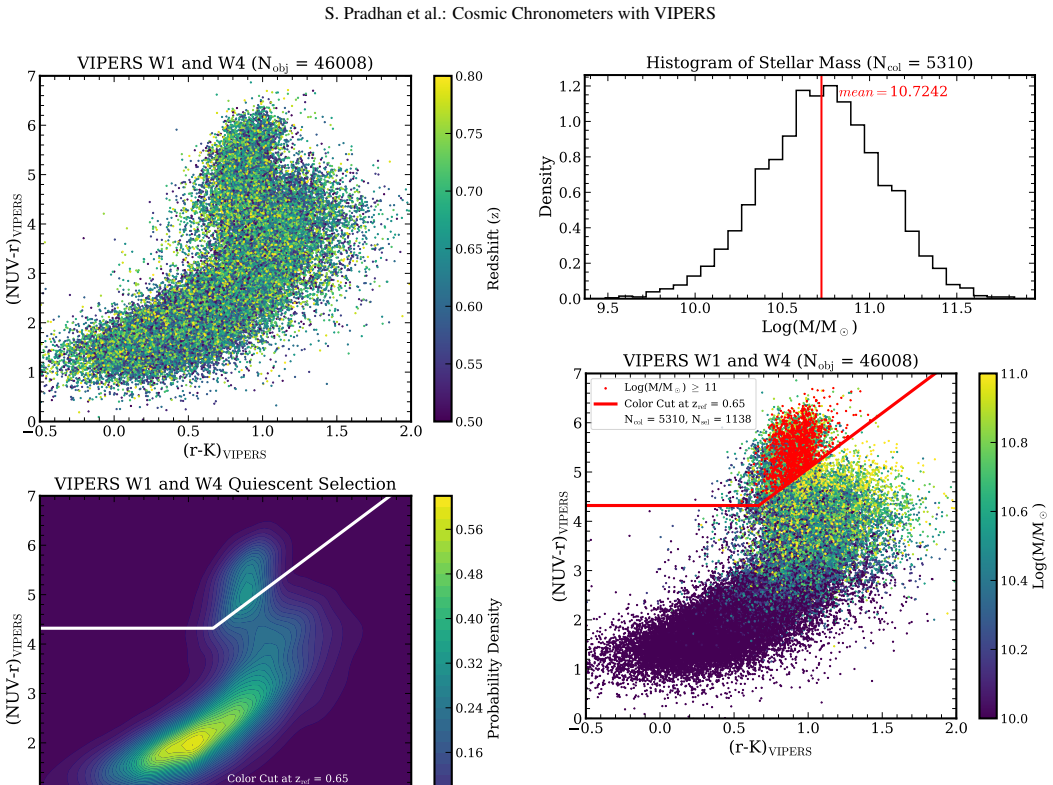
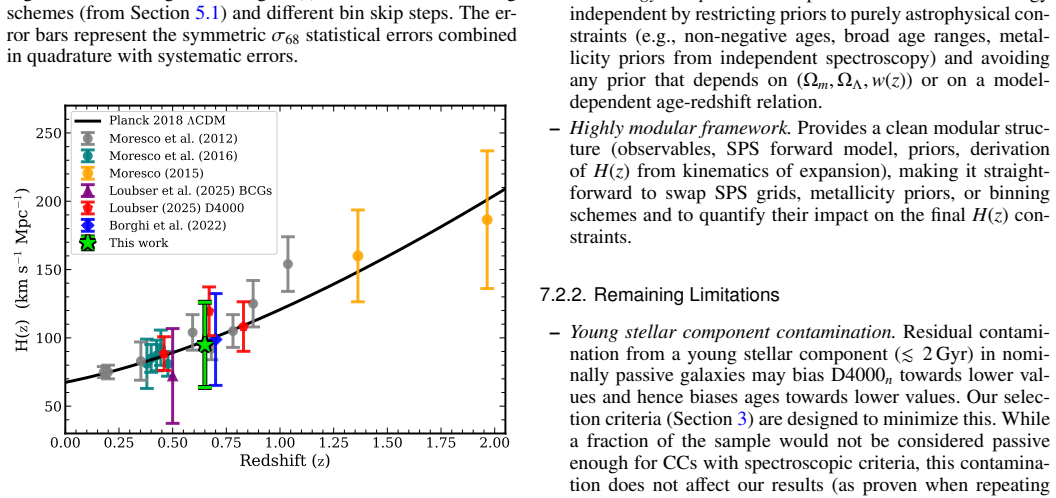
By selecting a massive and passive galaxy sample from VIPERS PDR2 in 0.5 ≤ z ≤ 0.8, constructing age posteriors via a D4000-age-metallicity grid from stellar population synthesis models, marginalizing over metallicity with a Gaussian prior, and deriving differential age posteriors by convolution, the analysis extracts H(z=0.65) = 93.68 ± 28.27 (stat.) ± 10.67 (syst.) km s^{-1} Mpc^{-1}, consistent with spectroscopic cosmic chronometer measurements and the Planck ΛCDM prediction.
What carries the argument
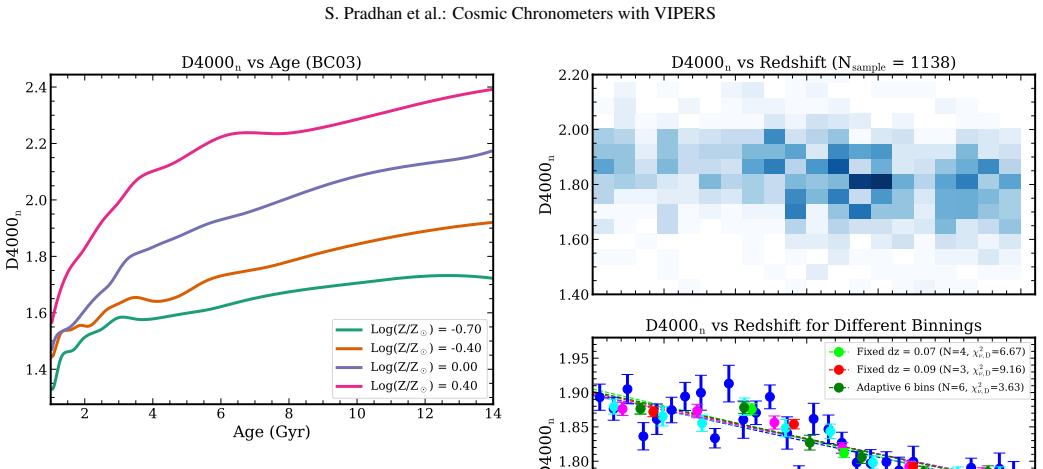
The Bayesian framework that infers full galaxy age posteriors from the D4000 spectral break on an SPS model grid, marginalizes metallicity via a Gaussian prior to break the degeneracy, and convolves age posteriors between redshift bins to obtain differential age distributions for H(z) calculation.
If this is right
- Photometric surveys can support direct H(z) measurements when larger samples offset lower spectral resolution.
- Rest-frame color and mass selection of passive galaxies combined with SPS models enables age estimation without high-quality spectra.
- The derived H(z) value at z=0.65 is consistent with both spectroscopic cosmic chronometer results and the standard cosmological model.
- Careful control of passive-galaxy selection, metallicity priors, and stellar-population systematics is required for the method to succeed.
Where Pith is reading between the lines
- The approach could be scaled to future large-area photometric surveys to obtain more precise H(z) constraints at intermediate redshifts.
- Cross-calibration with spectroscopic samples might further reduce uncertainties in the underlying stellar population models.
- Application at higher redshifts could provide additional tests of the expansion history if the same controls on systematics are maintained.
Load-bearing premise
The D4000-age-metallicity grid from stellar population synthesis models together with the Gaussian metallicity prior accurately captures the age distribution of the photometrically selected passive galaxies without residual bias from the age-metallicity degeneracy or model inaccuracies.
What would settle it
An independent spectroscopic cosmic chronometer measurement of H(z) at z=0.65 lying outside the combined statistical and systematic error bars reported here would falsify the central result.
Figures
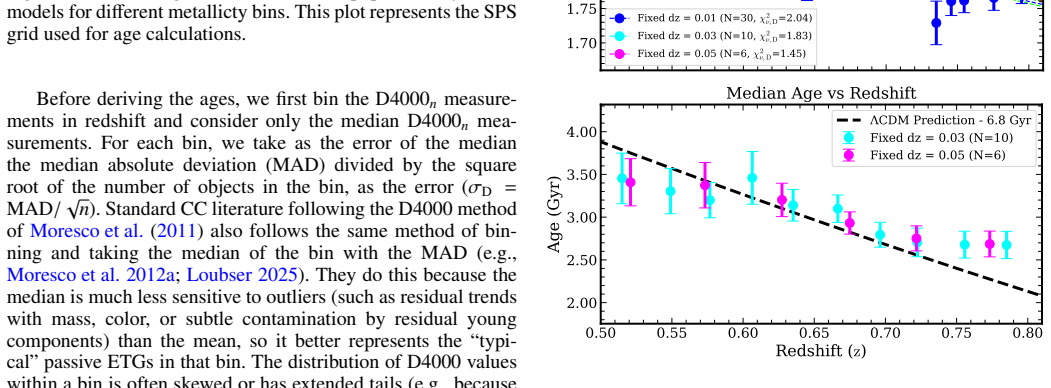
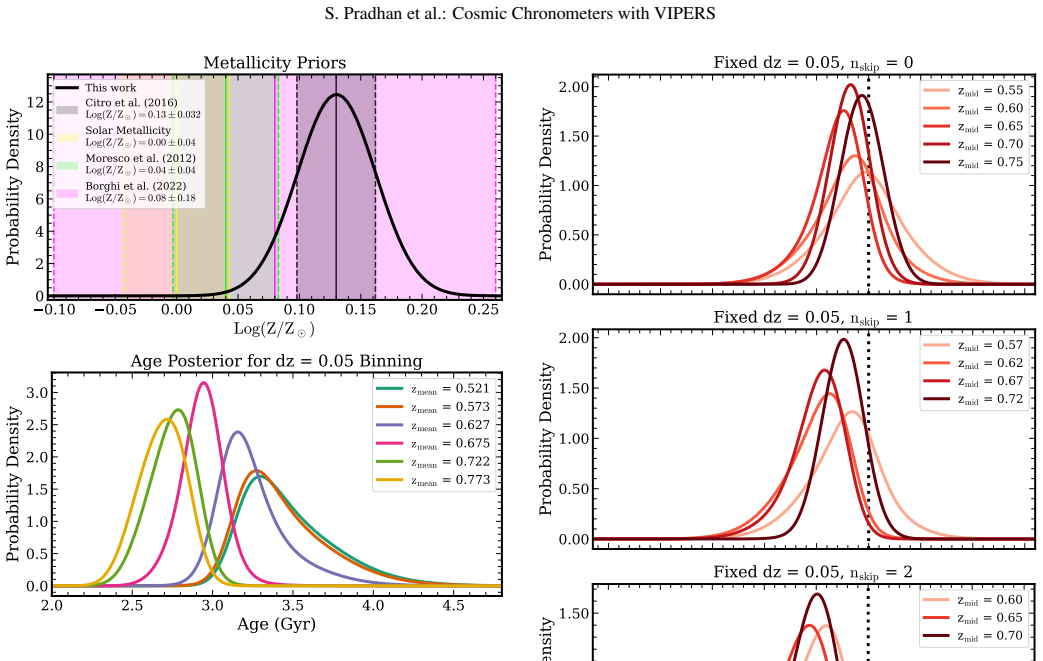

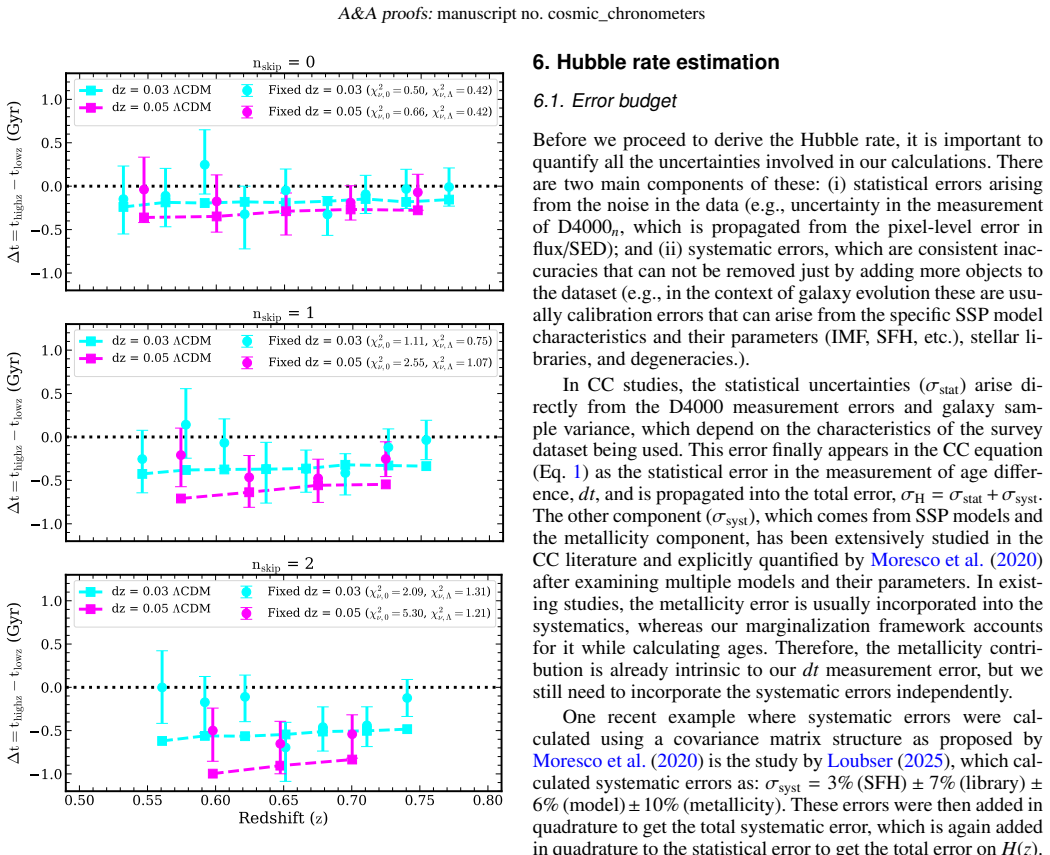
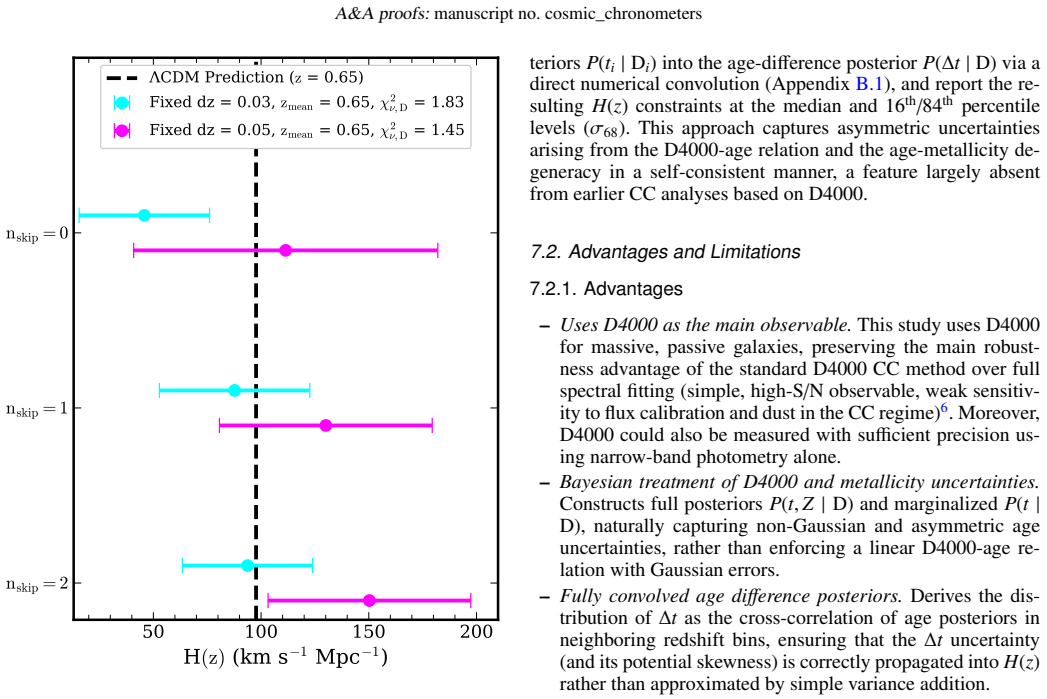
read the original abstract
The cosmic chronometer (CC) method provides a direct measurement of the expansion history, $H(z)$, from the differential ages of passively evolving galaxies. However, most CC analyses rely on high-quality spectroscopy to select passive galaxies, measure age-sensitive spectral features, and control stellar-population systematics. We build on existing works that use the D4000 spectral break as a proxy for measuring galaxy ages and apply it to a photometry-selected galaxy sample from VIPERS PDR2 in the range $0.5 \le z \le 0.8$. Our goal is to extend the scope of the standard CC framework to photometric surveys. To achieve this, we first select a massive and passive galaxy sample using rest-frame colors and mass. Second, we design a Bayesian framework to infer full galaxy age posteriors in fine redshift bins, using a D4000-age-metallicity grid from stellar population synthesis (SPS) models. We also marginalize over metallicity, using a Gaussian metallicity prior to break the D4000-age-metallicity degeneracy. Subsequently, we derive age-difference posteriors between redshift bins by convolving their age posteriors to propagate the non-Gaussian features correctly. Finally, using the median and errors extracted from the differential age posteriors, we calculate the weighted average $H(z)$ over our selected redshift range. We obtain $H(z=0.65)=93.68\pm28.27\,{\rm (stat.)}\pm10.67\,{\rm (syst.)}\ {\rm km\,s^{-1}\,Mpc^{-1}}$, which is consistent with existing spectroscopic CC measurements and with the Planck $\Lambda$CDM prediction at the same redshift. This result provides a proof of concept for extending direct $H(z)$ measurements from cosmic chronometers to photometric and spectro-photometric surveys, where larger samples can compensate for lower spectral resolution, provided that passive-galaxy selection, metallicity priors, and stellar-population systematics are carefully controlled.
Editorial analysis
A structured set of objections, weighed in public.
Referee Report
Summary. The manuscript develops a Bayesian framework for cosmic chronometers using photometry-selected passive galaxies from VIPERS PDR2 (0.5 ≤ z ≤ 0.8). Passive galaxies are selected via rest-frame colors and stellar mass; age posteriors are inferred from D4000 using an SPS model grid while marginalizing over metallicity with a Gaussian prior; differential-age posteriors between redshift bins are obtained by convolution; and a weighted-average H(z=0.65) = 93.68 ± 28.27 (stat.) ± 10.67 (syst.) km s⁻¹ Mpc⁻¹ is reported, consistent with Planck ΛCDM and prior spectroscopic CC results. The work positions itself as a proof-of-concept for extending CC measurements to photometric surveys.
Significance. If the SPS grid and metallicity prior produce unbiased ages, the approach could meaningfully expand CC samples by leveraging photometric surveys. The explicit use of posterior convolution to propagate non-Gaussian features and the acknowledgment that selection, priors, and SPS systematics must be controlled are positive methodological elements. The result itself has large statistical errors, so its primary value lies in demonstrating feasibility rather than in tightening cosmological constraints.
major comments (3)
- [Bayesian inference framework (metallicity marginalization step)] The Gaussian metallicity prior is invoked to break the D4000–age–metallicity degeneracy, yet the manuscript provides no demonstration that the prior parameters are independent of the photometry-selected VIPERS sample or that they match the true metallicity distribution; residual bias in the age posteriors would propagate directly through the convolution into the reported H(z). This assumption is load-bearing for the central claim of unbiased differential ages.
- [Differential age posteriors and H(z) derivation] The convolution of age posteriors to obtain differential-age posteriors is presented as the correct propagation method, but the text does not include a validation test (e.g., recovery of input ages on mock photometry or comparison against a spectroscopic subsample) that would confirm the SPS D4000 grid introduces no systematic offset at fixed age and metallicity. Without such a test, consistency with Planck does not rule out shared SPS systematics.
- [Results and error budget] The quoted systematic uncertainty (±10.67 km s⁻¹ Mpc⁻¹) is given without a quantitative breakdown showing how contributions from SPS model choice, prior width, and photometric selection are estimated or combined; this prevents assessment of whether the error budget adequately covers the age–metallicity degeneracy risk highlighted in the skeptic note.
minor comments (2)
- The number and exact boundaries of the 'fine redshift bins' used for the age posteriors should be stated explicitly, together with the sample sizes per bin, to allow reproducibility.
- When the D4000–age–metallicity grid is first introduced, the specific SPS models (e.g., Bruzual & Charlot, MILES, etc.) and their version numbers should be cited.
Simulated Author's Rebuttal
We thank the referee for their careful and constructive review of our manuscript. The comments highlight important aspects of the proof-of-concept analysis that require clarification and strengthening. We respond point-by-point below and indicate the revisions we will implement.
read point-by-point responses
-
Referee: [Bayesian inference framework (metallicity marginalization step)] The Gaussian metallicity prior is invoked to break the D4000–age–metallicity degeneracy, yet the manuscript provides no demonstration that the prior parameters are independent of the photometry-selected VIPERS sample or that they match the true metallicity distribution; residual bias in the age posteriors would propagate directly through the convolution into the reported H(z). This assumption is load-bearing for the central claim of unbiased differential ages.
Authors: We agree that explicit justification of the metallicity prior is essential given its role in breaking the degeneracy. The Gaussian parameters were chosen to be consistent with metallicity distributions reported for massive passive galaxies at comparable redshifts in independent spectroscopic surveys. In the revised manuscript we will add a dedicated paragraph citing the relevant literature values, together with a sensitivity analysis in which the prior mean and width are varied by ±0.2 dex to quantify the resulting shifts in the age posteriors and the final H(z) value. revision: yes
-
Referee: [Differential age posteriors and H(z) derivation] The convolution of age posteriors to obtain differential-age posteriors is presented as the correct propagation method, but the text does not include a validation test (e.g., recovery of input ages on mock photometry or comparison against a spectroscopic subsample) that would confirm the SPS D4000 grid introduces no systematic offset at fixed age and metallicity. Without such a test, consistency with Planck does not rule out shared SPS systematics.
Authors: We acknowledge that the manuscript does not contain a dedicated mock-photometry recovery test or a direct comparison against a spectroscopic age subsample. While the agreement with existing spectroscopic CC results and the Planck prediction offers supporting evidence, we accept that this does not fully exclude shared SPS systematics. In the revision we will add a validation subsection that either (i) compares our photometric ages against available spectroscopic D4000-based ages for the overlapping VIPERS objects or (ii) describes the outcome of a limited mock test using the same SPS grid with known input ages and metallicities. revision: yes
-
Referee: [Results and error budget] The quoted systematic uncertainty (±10.67 km s⁻¹ Mpc⁻¹) is given without a quantitative breakdown showing how contributions from SPS model choice, prior width, and photometric selection are estimated or combined; this prevents assessment of whether the error budget adequately covers the age–metallicity degeneracy risk highlighted in the skeptic note.
Authors: We agree that a transparent quantitative breakdown of the systematic term is necessary for proper evaluation. The quoted value was obtained by combining several contributions in quadrature, but the individual terms and their estimation method are not tabulated. In the revised manuscript we will expand the error-budget discussion with an explicit table listing the estimated contributions from SPS model choice, metallicity prior width, photometric selection cuts, and any additional terms, together with the adopted combination procedure. revision: yes
Circularity Check
No circularity: derivation uses external SPS grid and prior to produce independent measurement
full rationale
The paper selects galaxies, builds age posteriors from an external D4000-age-metallicity grid supplied by SPS models, marginalizes metallicity with a stated Gaussian prior, convolves the resulting posteriors to obtain differential-age posteriors, and computes H(z) from the medians and uncertainties of those differences. None of these steps reduces the final H(z) value to the input data or to any fitted parameter by algebraic identity or by construction; the output remains a statistical inference whose validity rests on the external grid and prior rather than on any self-referential loop. No self-citations, uniqueness theorems, or ansatzes imported from the authors' prior work are invoked as load-bearing premises in the derivation chain described.
Axiom & Free-Parameter Ledger
free parameters (1)
- Gaussian metallicity prior parameters
axioms (1)
- domain assumption Stellar population synthesis models supply an accurate D4000-age-metallicity grid applicable to the selected passive galaxies
Reference graph
Works this paper leans on
-
[1]
Moutard, T. and. The VIPERS Multi-Lambda Survey - I. UV and near-IR observations, multi-colour catalogues, and photometric redshifts , DOI= "10.1051/0004-6361/201527945", url= "https://doi.org/10.1051/0004-6361/201527945", journal =
-
[2]
Moutard, T. and. The VIPERS Multi-Lambda Survey - II. Diving with massive galaxies in 22 square degrees since z = 1.5 , DOI= "10.1051/0004-6361/201527294", url= "https://doi.org/10.1051/0004-6361/201527294", journal =
-
[3]
The VIMOS Public Extragalactic Redshift Survey (VIPERS) - Star formation history of passive red galaxies⋆ , DOI= "10.1051/0004-6361/201628951", url= "https://doi.org/10.1051/0004-6361/201628951", journal =
-
[4]
2003, MNRAS, 344, 1000, doi: 10.1046/j.1365-8711.2003.06897.x
Bruzual, G. and Charlot, S. , title =. Monthly Notices of the Royal Astronomical Society , volume =. 2003 , month =. doi:10.1046/j.1365-8711.2003.06897.x , url =
-
[5]
, year = 1962, month = sep, volume =
The Change of Redshift and Apparent Luminosity of Galaxies due to the Deceleration of Selected Expanding Universes. , year = 1962, month = sep, volume =
1962
-
[6]
Direct Measurement of Cosmological Parameters from the Cosmic Deceleration of Extragalactic Objects
Direct Measurement of Cosmological Parameters from the Cosmic Deceleration of Extragalactic Objects. , keywords =. doi:10.1086/311375 , archivePrefix =. astro-ph/9802122 , primaryClass =
work page internal anchor Pith review Pith/arXiv arXiv doi:10.1086/311375
-
[7]
Clustering of luminous red galaxies - IV. Baryon acoustic peak in the line-of-sight direction and a direct measurement of H(z). , keywords =. doi:10.1111/j.1365-2966.2009.15405.x , archivePrefix =. 0807.3551 , primaryClass =
-
[8]
GALAXEV: Evolutionary Stellar Population Synthesis Models
Bruzual, Gustavo and Charlot, St. GALAXEV: Evolutionary Stellar Population Synthesis Models
-
[9]
Charlot, Stéphane and Fall, S. Michael , title =. The Astrophysical Journal , abstract =. 2000 , month =. doi:10.1086/309250 , url =
work page internal anchor Pith review doi:10.1086/309250 2000
-
[10]
The Astrophysical Journal , abstract =
Jimenez, Raul and Loeb, Abraham , title =. The Astrophysical Journal , abstract =. 2002 , month =. doi:10.1086/340549 , url =
-
[11]
Ilbert, O. and Salvato, M. and Le Floc'h, E. and Aussel, H. and Capak, P. and McCracken, H. J. and Mobasher, B. and Kartaltepe, J. and Scoville, N. and Sanders, D. B. and Arnouts, S. and Bundy, K. and Cassata, P. and Kneib, J.-P. and Koekemoer, A. and Le Fèvre, O. and Lilly, S. and Surace, J. and Taniguchi, Y. and Tasca, L. and Thompson, D. and Tresse, L....
-
[12]
and McCracken, H
Ilbert, O. and McCracken, H. J. and Le F. Mass assembly in quiescent and star-forming galaxies since z ≃ 4 from UltraVISTA DR1 in the COSMOS field. SF2A-2013: Proceedings of the Annual meeting of the French Society of Astronomy and Astrophysics , year = 2013, month = nov, pages =
2013
-
[13]
Whitaker, Katherine E. and van Dokkum, Pieter G. and Brammer, Gabriel and Franx, Marijn , title =. The Astrophysical Journal Letters , abstract =. 2012 , month =. doi:10.1088/2041-8205/754/2/L29 , url =
work page internal anchor Pith review doi:10.1088/2041-8205/754/2/l29 2012
-
[14]
Pacifici, Camilla and Kassin, Susan A. and Weiner, Benjamin J. and Holden, Bradford and Gardner, Jonathan P. and Faber, Sandra M. and Ferguson, Henry C. and Koo, David C. and Primack, Joel R. and Bell, Eric F. and Dekel, Avishai and Gawiser, Eric and Giavalisco, Mauro and Rafelski, Marc and Simons, Raymond C. and Barro, Guillermo and Croton, Darren J. and...
-
[15]
2013, ApJS, 206, 8, doi: 10.1088/0067-0049/206/1/8
Muzzin, Adam and Marchesini, Danilo and Stefanon, Mauro and Franx, Marijn and Milvang-Jensen, Bo and Dunlop, James S. and Fynbo, J. P. U. and Brammer, Gabriel and Labbé, Ivo and van Dokkum, Pieter , title =. The Astrophysical Journal Supplement Series , abstract =. 2013 , month =. doi:10.1088/0067-0049/206/1/8 , url =
-
[16]
2021b, MNRAS, 500, 2036, doi: 10.1093/mnras/staa3236
Katsianis, Antonios and Xu, Haojie and Yang, Xiaohu and Luo, Yu and Cui, Weiguang and Davé, Romeel and Lagos, Claudia Del P and Zheng, Xianzhong and Zhao, Ping , title =. Monthly Notices of the Royal Astronomical Society , volume =. 2020 , month =. doi:10.1093/mnras/staa3236 , url =
-
[17]
Salem, Nora and Masters, Karen L. and Stark, David V. and Sharma, Anubhav , title =. 2024 , month =. doi:10.3847/2515-5172/ad676f , url =
-
[18]
Moresco, Michele and Pozzetti, Lucia and Cimatti, Andrea and Jimenez, Raul and Maraston, Claudia and Verde, Licia and Thomas, Daniel and Citro, Annalisa and Tojeiro, Rita and Wilkinson, David , title =. 2016 , month =. doi:10.1088/1475-7516/2016/05/014 , url =
-
[19]
The Astrophysical Journal , abstract =
Borghi, Nicola and Moresco, Michele and Cimatti, Andrea and Huchet, Alexandre and Quai, Salvatore and Pozzetti, Lucia , title =. The Astrophysical Journal , abstract =. 2022 , month =. doi:10.3847/1538-4357/ac3240 , url =
-
[20]
The Astrophysical Journal Letters , abstract =
Borghi, Nicola and Moresco, Michele and Cimatti, Andrea , title =. The Astrophysical Journal Letters , abstract =. 2022 , month =. doi:10.3847/2041-8213/ac3fb2 , url =
-
[21]
Ratsimbazafy, A. L. and Loubser, S. I. and Crawford, S. M. and Cress, C. M. and Bassett, B. A. and Nichol, R. C. and Väisänen, P. , title =. Monthly Notices of the Royal Astronomical Society , volume =. 2017 , month =. doi:10.1093/mnras/stx301 , url =
-
[22]
Journal of Cosmology and Astroparticle Physics , abstract =
Michele Moresco and Licia Verde and Lucia Pozzetti and Raul Jimenez and Andrea Cimatti , title =. Journal of Cosmology and Astroparticle Physics , abstract =. 2012 , month =. doi:10.1088/1475-7516/2012/07/053 , url =
-
[23]
M. Moresco and A. Cimatti and R. Jimenez and L. Pozzetti and G. Zamorani and M. Bolzonella and J. Dunlop and F. Lamareille and M. Mignoli and H. Pearce and P. Rosati and D. Stern and L. Verde and E. Zucca and C.M. Carollo and T. Contini and J.-P. Kneib and O. Le Fèvre and S.J. Lilly and V. Mainieri and A. Renzini and M. Scodeggio and I. Balestra and R. Go...
work page internal anchor Pith review doi:10.1088/1475-7516/2012/08/006 2012
-
[24]
Spot the difference - Impact of different selection criteria on observed properties of passive galaxies in zCOSMOS-20k⋆ sample , DOI= "10.1051/0004-6361/201321797", url= "https://doi.org/10.1051/0004-6361/201321797", journal =
-
[25]
Proceedings of the European Physical Society Conference on High Energy Physics
CosmoHub and SciPIC: Massive cosmological data analysis, distribution and generation using a Big Data platform. Proceedings of the European Physical Society Conference on High Energy Physics. 5-12 July , year = 2017, month = jul, eid =
2017
-
[26]
P. Tallada and J. Carretero and J. Casals and C. Acosta-Silva and S. Serrano and M. Caubet and F.J. Castander and E. César and M. Crocce and M. Delfino and M. Eriksen and P. Fosalba and E. Gaztañaga and G. Merino and C. Neissner and N. Tonello. CosmoHub: Interactive exploration and distribution of astronomical data on Hadoop. Astronomy and Computing. 2020...
-
[27]
The Astrophysical Journal , abstract =
Moresco, Michele and Jimenez, Raul and Verde, Licia and Pozzetti, Lucia and Cimatti, Andrea and Citro, Annalisa , title =. The Astrophysical Journal , abstract =. 2018 , month =. doi:10.3847/1538-4357/aae829 , url =
-
[28]
Monthly Notices of the Royal Astronomical Society , volume =
Loubser, S Ilani and Alabi, Adebusola B and Hilton, Matt and Ma, Yin-Zhe and Tang, Xin and Hatamkhani, Narges and Cress, Catherine and Skelton, Rosalind E and Nkosi, S Andile , title =. Monthly Notices of the Royal Astronomical Society , volume =. 2025 , month =. doi:10.1093/mnras/staf915 , url =
-
[29]
Monthly Notices of the Royal Astronomical Society , volume =
Loubser, S Ilani , title =. Monthly Notices of the Royal Astronomical Society , volume =. 2025 , month =. doi:10.1093/mnras/staf1939 , url =
-
[30]
Inferring the star-formation histories of the most massive and passive early-type galaxies at z < 0.3 , DOI= "10.1051/0004-6361/201527772", url= "https://doi.org/10.1051/0004-6361/201527772", journal =
-
[31]
Tensions between the Early and the Late Universe
Verde, L. and Treu, T. and Riess, A. G. Tensions between the Early and the Late Universe. Nature Astron. 2019. doi:10.1038/s41550-019-0902-0. arXiv:1907.10625
work page internal anchor Pith review Pith/arXiv arXiv doi:10.1038/s41550-019-0902-0 2019
-
[32]
Di Valentino, Eleonora and Mena, Olga and Pan, Supriya and Visinelli, Luca and Yang, Weiqiang and Melchiorri, Alessandro and Mota, David F and Riess, Adam G and Silk, Joseph , title =. Classical and Quantum Gravity , abstract =. 2021 , month =. doi:10.1088/1361-6382/ac086d , url =
-
[33]
Journal of Cosmology and Astroparticle Physics , abstract =
Michele Moresco and Raul Jimenez and Andrea Cimatti and Lucia Pozzetti , title =. Journal of Cosmology and Astroparticle Physics , abstract =. 2011 , month =. doi:10.1088/1475-7516/2011/03/045 , url =
-
[34]
Monthly Notices of the Royal Astronomical Society: Letters , volume =
Moresco, Michele , title =. Monthly Notices of the Royal Astronomical Society: Letters , volume =. 2015 , month =. doi:10.1093/mnrasl/slv037 , url =
work page internal anchor Pith review doi:10.1093/mnrasl/slv037 2015
-
[35]
The Astrophysical Journal , abstract =
Moresco, Michele and Jimenez, Raul and Verde, Licia and Cimatti, Andrea and Pozzetti, Lucia , title =. The Astrophysical Journal , abstract =. 2020 , month =. doi:10.3847/1538-4357/ab9eb0 , url =
-
[36]
Research in Astronomy and Astrophysics , abstract =
Zhang, Cong and Zhang, Han and Yuan, Shuo and Liu, Siqi and Zhang, Tong-Jie and Sun Yan-Chun , title =. Research in Astronomy and Astrophysics , abstract =. 2014 , month =. doi:10.1088/1674-4527/14/10/002 , url =
work page internal anchor Pith review doi:10.1088/1674-4527/14/10/002 2014
-
[37]
2013, ARA&A, 51, 393, doi: 10.1146/annurev-astro-082812-141017
Conroy, Charlie. Modeling the Panchromatic Spectral Energy Distributions of Galaxies. Annual Review of Astronomy and Astrophysics. 2013. doi:https://doi.org/10.1146/annurev-astro-082812-141017
work page internal anchor Pith review doi:10.1146/annurev-astro-082812-141017 2013
-
[38]
The value of the equation of state of dark energy , journal =
Raul Jimenez , abstract =. The value of the equation of state of dark energy , journal =. 2003 , note =. doi:https://doi.org/10.1016/j.newar.2003.07.004 , url =
-
[39]
Constraints on the redshift dependence of the dark energy potential , author =. Phys. Rev. D , volume =. 2005 , month =. doi:10.1103/PhysRevD.71.123001 , url =
work page internal anchor Pith review doi:10.1103/physrevd.71.123001 2005
-
[40]
Daniel Stern and Raul Jimenez and Licia Verde and Marc Kamionkowski and S. Adam Stanford , title =. Journal of Cosmology and Astroparticle Physics , abstract =. 2010 , month =. doi:10.1088/1475-7516/2010/02/008 , url =
-
[41]
On the Restricted Isometry Property of Centered Self Khatri-Rao Products
Renzini, Alvio. Stellar Population Diagnostics of Elliptical Galaxy Formation. Annual Review of Astronomy and Astrophysics. 2006. doi:https://doi.org/10.1146/annurev.astro.44.051905.092450
work page internal anchor Pith review Pith/arXiv arXiv doi:10.1146/annurev.astro.44.051905.092450 2006
-
[42]
Thomas, Daniel and Maraston, Claudia and Schawinski, Kevin and Sarzi, Marc and Silk, Joseph , title =. Monthly Notices of the Royal Astronomical Society , volume =. 2010 , month =. doi:10.1111/j.1365-2966.2010.16427.x , url =
-
[43]
A new measurement of the expansion history of the Universe at z = 1.26 with cosmic chronometers in VANDELS , DOI= "10.1051/0004-6361/202346992", url= "https://doi.org/10.1051/0004-6361/202346992", journal =
-
[44]
The VIMOS Public Extragalactic Redshift Survey (VIPERS) - Full spectroscopic data and auxiliary information release (PDR-2)⋆ , DOI= "10.1051/0004-6361/201630114", url= "https://doi.org/10.1051/0004-6361/201630114", journal =
-
[45]
The VIMOS Public Extragalactic Survey (VIPERS)⋆ - First Data Release of 57204 spectroscopic measurements , DOI= "10.1051/0004-6361/201322790", url= "https://doi.org/10.1051/0004-6361/201322790", journal =
-
[46]
Muzzin, Adam and Marchesini, Danilo and Stefanon, Mauro and Franx, Marijn and McCracken, Henry J. and Milvang-Jensen, Bo and Dunlop, James S. and Fynbo, J. P. U. and Brammer, Gabriel and Labbé, Ivo and van Dokkum, Pieter G. , title =. The Astrophysical Journal , abstract =. 2013 , month =. doi:10.1088/0004-637X/777/1/18 , url =
work page internal anchor Pith review doi:10.1088/0004-637x/777/1/18 2013
-
[47]
zCOSMOS - 10k-bright spectroscopic sample - The bimodality in the galaxy stellar mass function: exploring its evolution with redshift , DOI= "10.1051/0004-6361/200913020", url= "https://doi.org/10.1051/0004-6361/200913020", journal =
-
[48]
Old Stellar Populations. V. Absorption Feature Indices for the Complete Lick/IDS Sample of Stars. , keywords =. doi:10.1086/192087 , adsurl =
-
[49]
Balogh, Michael L. and Morris, Simon L. and Yee, H. K. C. and Carlberg, R. G. and Ellingson, Erica , title =. The Astrophysical Journal , abstract =. 1999 , month =. doi:10.1086/308056 , url =
-
[50]
Old Galaxies in the Young Universe
Old galaxies in the young Universe. , keywords =. doi:10.1038/nature02668 , archivePrefix =. astro-ph/0407131 , primaryClass =
work page internal anchor Pith review Pith/arXiv arXiv doi:10.1038/nature02668
-
[51]
Planck 2018 results - VI. Cosmological parameters , DOI= "10.1051/0004-6361/201833910", url= "https://doi.org/10.1051/0004-6361/201833910", journal =
-
[52]
A measurement of the cosmological mass density from clustering in the 2dF Galaxy Redshift Survey
A measurement of the cosmological mass density from clustering in the 2dF Galaxy Redshift Survey. , keywords =. doi:10.1038/35065528 , archivePrefix =. astro-ph/0103143 , primaryClass =
work page internal anchor Pith review Pith/arXiv arXiv doi:10.1038/35065528
-
[53]
Final Results from the Hubble Space Telescope Key Project to Measure the Hubble Constant
Final Results from the Hubble Space Telescope Key Project to Measure the Hubble Constant. , keywords =. doi:10.1086/320638 , archivePrefix =. astro-ph/0012376 , primaryClass =
work page internal anchor Pith review Pith/arXiv arXiv doi:10.1086/320638
-
[54]
Measurements of Omega and Lambda from 42 High-Redshift Supernovae
Measurements of and from 42 High-Redshift Supernovae. , keywords =. doi:10.1086/307221 , archivePrefix =. astro-ph/9812133 , primaryClass =
work page internal anchor Pith review Pith/arXiv arXiv doi:10.1086/307221
-
[55]
Observational Evidence from Supernovae for an Accelerating Universe and a Cosmological Constant
Observational Evidence from Supernovae for an Accelerating Universe and a Cosmological Constant. , keywords =. doi:10.1086/300499 , archivePrefix =. astro-ph/9805201 , primaryClass =
work page internal anchor Pith review Pith/arXiv arXiv doi:10.1086/300499
-
[56]
, year = 1996, month = jun, volume =
A 3.5-Gyr-old galaxy at redshift 1.55. , year = 1996, month = jun, volume =. doi:10.1038/381581a0 , adsurl =
-
[57]
Alcaniz, J. S. and Lima, J. A. S. , title =. The Astrophysical Journal , abstract =. 2001 , month =. doi:10.1086/319642 , url =
-
[58]
The Oldest Stellar Populations at z ~ 1.5
The Oldest Stellar Populations at z -0.5ex 1.5. Astrophysical Ages and Times Scales , year = 2001, editor =. doi:10.48550/arXiv.astro-ph/0104191 , archivePrefix =. astro-ph/0104191 , primaryClass =
work page internal anchor Pith review Pith/arXiv arXiv doi:10.48550/arxiv.astro-ph/0104191 2001
-
[59]
Jimenez, Raul and Moresco, Michele and Verde, Licia and Wandelt, Benjamin D. , title =. Journal of Cosmology and Astroparticle Physics , abstract =. 2023 , month =. doi:10.1088/1475-7516/2023/11/047 , url =
-
[60]
The Astrophysical Journal Supplement Series , abstract =
Jiao, Kang and Borghi, Nicola and Moresco, Michele and Zhang, Tong-Jie , title =. The Astrophysical Journal Supplement Series , abstract =. 2023 , month =. doi:10.3847/1538-4365/acbc77 , url =
-
[61]
The VIMOS Public Extragalactic Redshift Survey (VIPERS) - An unprecedented view of galaxies and large-scale structure at 0.5 < z < 1.2 , DOI= "10.1051/0004-6361/201321489", url= "https://doi.org/10.1051/0004-6361/201321489", journal =
-
[62]
The VIMOS Public Extragalactic Redshift Survey (VIPERS) - The distinct build-up of dense and normal massive passive galaxies⋆ , DOI= "10.1051/0004-6361/201630112", url= "https://doi.org/10.1051/0004-6361/201630112", journal =
-
[63]
The VIMOS Public Extragalactic Redshift Survey (VIPERS): - A quiescent formation of massive red-sequence galaxies over the past 9 Gyr , DOI= "10.1051/0004-6361/201322379", url= "https://doi.org/10.1051/0004-6361/201322379", journal =
-
[64]
Malavasi, N. and Arnouts, S. and Vibert, D. and de la Torre, S. and Moutard, T. and Pichon, C. and Davidzon, I. and Kraljic, K. and Bolzonella, M. and Guzzo, L. and Garilli, B. and Scodeggio, M. and Granett, B. R. and Abbas, U. and Adami, C. and Bottini, D. and Cappi, A. and Cucciati, O. and Franzetti, P. and Fritz, A. and Iovino, A. and Krywult, J. and L...
-
[65]
Williams, Rik J. and Quadri, Ryan F. and Franx, Marijn and van Dokkum, Pieter and Labbé, Ivo , title =. The Astrophysical Journal , abstract =. 2009 , month =. doi:10.1088/0004-637X/691/2/1879 , url =
-
[66]
Encoding of the infrared excess in the NUVrK color diagram for star-forming galaxies , DOI= "10.1051/0004-6361/201321768", url= "https://doi.org/10.1051/0004-6361/201321768", journal =
-
[67]
Realm of the Nebulae
-
[68]
The zCOSMOS redshift survey: the three-dimensional classification cube and bimodality in galaxy physical properties * , DOI= "10.1051/0004-6361:200810520", url= "https://doi.org/10.1051/0004-6361:200810520", journal =
-
[69]
Peng, Ying-jie and Lilly, Simon J. and Kovač, Katarina and Bolzonella, Micol and Pozzetti, Lucia and Renzini, Alvio and Zamorani, Gianni and Ilbert, Olivier and Knobel, Christian and Iovino, Angela and Maier, Christian and Cucciati, Olga and Tasca, Lidia and Carollo, C. Marcella and Silverman, John and Kampczyk, Pawel and de Ravel, Loic and Sanders, David...
-
[70]
and Thomas, Jens and Blakeslee, John P
Veale, Melanie and Ma, Chung-Pei and Greene, Jenny E. and Thomas, Jens and Blakeslee, John P. and McConnell, Nicholas and Walsh, Jonelle L. and Ito, Jennifer , title =. Monthly Notices of the Royal Astronomical Society , volume =. 2017 , month =. doi:10.1093/mnras/stx1639 , url =
-
[71]
cronometri standard
Fanfani, Valentina , url =. Selezione di un campione ottimizzato di "cronometri standard" per la stima del parametro di Hubble , year =
-
[72]
Bruzual, A.G. , title = ". , keywords =. doi:10.1086/161352 , adsurl =
-
[73]
and Zibetti, Stefano and Brinchmann, Jarle and Kelson, Daniel D
Gallazzi, Anna and Bell, Eric F. and Zibetti, Stefano and Brinchmann, Jarle and Kelson, Daniel D. , title =. The Astrophysical Journal , abstract =. 2014 , month =. doi:10.1088/0004-637X/788/1/72 , url =
-
[74]
Alam, Shadab and Ata, Metin and Bailey, Stephen and Beutler, Florian and Bizyaev, Dmitry and Blazek, Jonathan A. and Bolton, Adam S. and Brownstein, Joel R. and Burden, Angela and Chuang, Chia-Hsun and Comparat, Johan and Cuesta, Antonio J. and Dawson, Kyle S. and Eisenstein, Daniel J. and Escoffier, Stephanie and Gil-Marín, Héctor and Grieb, Jan Niklas a...
-
[75]
Adame, A.G. and Aguilar, J. and Ahlen, S. and Alam, S. and Alexander, D.M. and Alvarez, M. and Alves, O. and Anand, A. and Andrade, U. and Armengaud, E. and Avila, S. and Aviles, A. and Awan, H. and Bahr-Kalus, B. and Bailey, S. and Baltay, C. and Bault, A. and Behera, J. and BenZvi, S. and Bera, A. and Beutler, F. and Bianchi, D. and Blake, C. and Blum, ...
-
[76]
Living Reviews in Relativity , keywords =
Unveiling the Universe with emerging cosmological probes. Living Reviews in Relativity , keywords =. doi:10.1007/s41114-022-00040-z , archivePrefix =. 2201.07241 , primaryClass =
-
[77]
Scolnic, Dan and Brout, Dillon and Carr, Anthony and Riess, Adam G. and Davis, Tamara M. and Dwomoh, Arianna and Jones, David O. and Ali, Noor and Charvu, Pranav and Chen, Rebecca and Peterson, Erik R. and Popovic, Brodie and Rose, Benjamin M. and Wood, Charlotte M. and Brown, Peter J. and Chambers, Ken and Coulter, David A. and Dettman, Kyle G. and Dimit...
-
[78]
Rubin, David and Aldering, Greg and Betoule, Marc and Fruchter, Andy and Huang, Xiaosheng and Kim, Alex G. and Lidman, Chris and Linder, Eric and Perlmutter, Saul and Ruiz-Lapuente, Pilar and Suzuki, Nao , title =. The Astrophysical Journal , abstract =. 2025 , month =. doi:10.3847/1538-4357/adc0a5 , url =
-
[79]
Riess, Adam G. and Yuan, Wenlong and Macri, Lucas M. and Scolnic, Dan and Brout, Dillon and Casertano, Stefano and Jones, David O. and Murakami, Yukei and Anand, Gagandeep S. and Breuval, Louise and Brink, Thomas G. and Filippenko, Alexei V. and Hoffmann, Samantha and Jha, Saurabh W. and D’arcy Kenworthy, W. and Mackenty, John and Stahl, Benjamin E. and Z...
-
[80]
Monthly Notices of the Royal Astronomical Society , volume =
Renard, Pablo and Siudek, Malgorzata and Eriksen, Martin B and Cabayol, Laura and Cai, Zheng and Carretero, Jorge and Casas, Ricard and Castander, Francisco J and Fernandez, Enrique and García-Bellido, Juan and Gaztanaga, Enrique and Hoekstra, Henk and Joachimi, Benjamin and Miquel, Ramon and Navarro-Girones, David and Padilla, Cristóbal and Sanchez, Euse...
discussion (0)
Sign in with ORCID, Apple, or X to comment. Anyone can read and Pith papers without signing in.