REVIEW 3 major objections 7 minor 33 references
Unsupervised skill mining turns multi-task robot demos into a reusable prior for few-shot adaptation.
Reviewed by Pith at T0; open to challenge. T0 means a machine referee read the full paper against a public rubric. the ladder, T0–T4 →
T0 review · grok-4.5
2026-07-10 08:49 UTC pith:BBRXS4ZN
load-bearing objection Solid plug-in skill mining with real multi-seed and real-robot gains; the fixed-library freeze is a real but already-acknowledged limit, not a hidden collapse of the claim. the 3 major comments →
SkillPlug: Unsupervised Skill Mining for Few-Shot Adaptation in Robotic Manipulation
The pith
A machine-rendered reading of the paper's core claim, the machinery that carries it, and where it could break.
Core claim
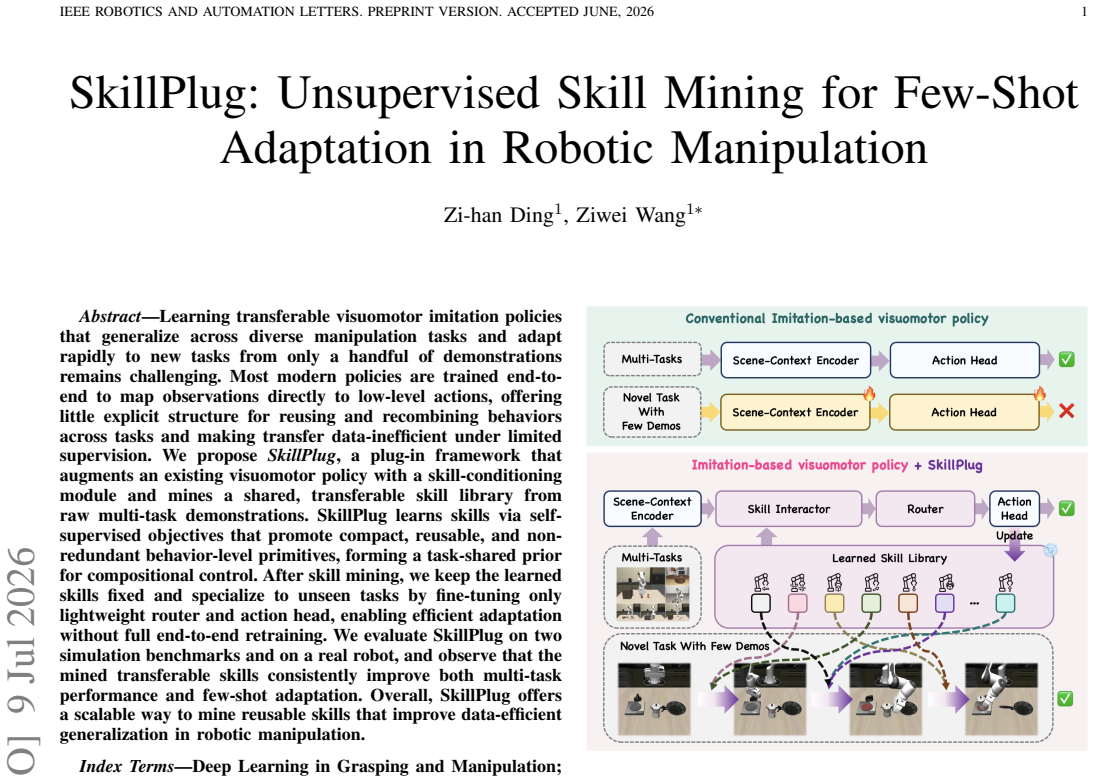
A shared library of skills mined unsupervised from multi-task demonstrations, once frozen, supplies a transferable behavioral prior that improves both multi-task performance and few-shot adaptation when only the router and action head are specialized. Gains appear consistently for compact and large backbones in simulation and on a real robot.
What carries the argument
SkillPlug: a plug-in skill library of continuous embeddings, a trajectory-only VAE-style posterior used only in training, a cross-attention interactor that conditions scene features on each skill, and a router that mixes skill-conditioned features; trained by reconstruction, KL compactness, behavioral skill alignment, and skill-disentanglement losses, then frozen for adaptation.
Load-bearing premise
Skills mined once from the training task distribution stay sufficient for new tasks when they are frozen and only the router and action head can change; if a new task needs a primitive outside that library, adaptation cannot invent it.
What would settle it
Take a novel manipulation task whose required motion primitive is absent from the multi-task training set; after freezing the mined skills and fine-tuning only router and action head on a few demos, success should remain near the no-skill baseline rather than rise.
Editorial analysis
A structured set of objections, weighed in public.
Referee Report
Summary. SkillPlug is a plug-in, architecture-agnostic module that augments an existing visuomotor imitation policy with a shared continuous skill library, a skill interactor, and a chunk-level router. Skills are mined unsupervised from multi-task demonstrations via a trajectory-only VAE-style posterior and four self-supervised losses (reconstruction, KL compactness, Behavioral Skill Alignment, and Skill Disentanglement). After multi-task training the skill embeddings are frozen; few-shot specialization updates only the router and action head. On DISCOVERSE (ACT) and LIBERO (OpenVLA-OFT), and on a real Galaxea arm, the method reports large multi-task and few-shot gains relative to the corresponding vanilla baselines, with supporting ablations and qualitative skill analyses.
Significance. If the reported gains hold under fairer controls, SkillPlug is a practically useful contribution: it is backbone-agnostic, requires no skill labels, and converts multi-task data into a reusable behavioral prior that improves data-efficient adaptation. Strengths include multi-seed evaluation on two simulation benchmarks spanning compact and large VLA backbones, a progressive loss-term ablation, skill-count and redundancy analysis, inference-step efficiency measurements, and real-robot multi-task/few-shot trials. The train-then-freeze protocol and explicit non-redundancy objectives are concrete design choices that the community can reuse. The work is a solid fit for RA-L-style robotics methods papers.
major comments (3)
- Sec. IV-A few-shot protocol: SkillPlug fine-tunes router + action head while the vanilla baseline fine-tunes only the action head. This confounds attribution of the large few-shot gains (Table I: +18.1 pts average; Table II: +38.3 pts average; real robot +28.5 pts) to the mined skill prior versus extra tunable capacity and modular structure. A load-bearing control is needed: e.g., (i) SkillPlug with frozen skills and frozen router (action head only), (ii) SkillPlug with frozen skills but trainable router, and (iii) a capacity-matched vanilla baseline that adds a lightweight adapter of similar parameter count. Without this, the central claim that frozen mined skills are the transferable prior is only partially supported for the few-shot setting (multi-task comparisons remain fair).
- Sec. II-B positions SkillPlug against data-driven skill methods (trajectory clustering, learnable skill embeddings, MoE experts as skills), but Sec. IV only compares to end-to-end ACT / OpenVLA-OFT. At least one strong skill/MoE baseline under the same multi-task then few-shot protocol is needed to show that the proposed BSA/SD objectives and trajectory-only posterior, not merely “adding a skill/router layer,” drive the gains. This is load-bearing for the paper’s claim of unsupervised skill mining as the contribution rather than hierarchical conditioning alone.
- Sec. III-B train-then-freeze and Sec. V: the strongest claim assumes the multi-task-mined library is a sufficient compositional prior for unseen tasks. All reported few-shot tasks (DISCOVERSE cuplid/block/jujube/mouse; LIBERO cross-suite; real stand-cup / banana-bread) appear to reuse low-level primitives already present in the multi-task distribution. The conclusions correctly flag the fixed-library limitation, but the manuscript should either (a) quantify primitive overlap / failure cases when a required motion is outside the library, or (b) add a stress-test task that needs a clearly novel primitive. Without that, the scope of “few-shot adaptation to unseen tasks” remains underspecified relative to the claim.
minor comments (7)
- Abstract and intro cite “+45.1% and +18.1% points” on DISCOVERSE; Table I reports per-task means but not the exact aggregate used. State the aggregation (macro-average over tasks/seeds) explicitly next to the headline numbers.
- Eq. (7)–(11): the mutual-information motivation for BSA is informal (I(τ;s) is not estimated). A short note that BSA is a practical soft-label alignment surrogate, not a tight MI estimator, would avoid overclaiming.
- Table III: ablated rows are single-seed while the full objective is 3-seed ±SE. Either run ablations with multiple seeds or mark more clearly that only the full row is multi-seed.
- Figs. 3–4 and 5–6: layout and repeated “open gripper / move forward” panels make it easy to confuse scene-agnosticity with compositionality. Separate captions and a one-line takeaway under each figure would help.
- Hyperparameters: report λ_KL, λ_BSA, λ_SD, d_s, and interactor architecture (layers/heads) in the main text or a short appendix table; currently only K and high-level training settings are given.
- Notation: τ_t is used both for the predicted action chunk (Eq. 1) and as a trajectory segment in the posterior/BSA; a brief disambiguation would reduce confusion.
- Real-robot Fig. 7 reports successes out of 20 without error bars or seeds; even 2–3 seeds or binomial CIs would strengthen the claim.
Circularity Check
No circularity: empirical skill-mining method with held-out multi-task and few-shot evaluation; objectives do not define the reported success metrics by construction.
full rationale
SkillPlug is an empirical imitation-learning methods paper, not a first-principles derivation. The skill library is optimized with reconstruction (behavior cloning), KL, BSA, and SD losses on multi-task demonstration data; reported claims are success rates on benchmark-defined held-out trials and on few-shot tasks unseen during multi-task mining. BSA explicitly uses stop-gradient on router soft targets so skill embeddings are shaped without co-defining the evaluation metric with the router. Train-then-freeze (fixed skills, tune router/action head) is a design protocol whose sufficiency is an empirical assumption, not a tautology: gains are measured against vanilla baselines under the same few-shot budget, not forced by fitting the reported SR numbers. There is no self-definitional loop, no fitted constant renamed as a prediction, no load-bearing uniqueness theorem from overlapping authors, and no ansatz smuggled in via self-citation. Related-work citations (ACT, OpenVLA-OFT, LIBERO, etc.) are external baselines and datasets. Minor hyperparameter choices (K, λ weights) are ordinary method design, not circular reductions. Score 0 is therefore appropriate.
Axiom & Free-Parameter Ledger
free parameters (4)
- number of skills K
- loss weights λ_KL, λ_BSA, λ_SD
- skill embedding dimension d_s and interactor capacity
- action chunk length / prediction horizon n
axioms (4)
- domain assumption Offline multi-task demonstration datasets contain reusable, composable behavior-level primitives that can be mined without skill labels.
- ad hoc to paper Conditioning a trajectory-skill posterior only on actions (not observations) yields scene-agnostic behavioral skills.
- ad hoc to paper After multi-task mining, freezing skill embeddings and fine-tuning only router and action head is sufficient for few-shot specialization.
- domain assumption Behavior cloning with L1 action-chunk loss is a valid primary supervision signal for visuomotor policies.
invented entities (5)
-
Shared continuous skill library {s_k}
no independent evidence
-
Trajectory–skill posterior encoder q_φ
no independent evidence
-
Behavioral Skill Alignment (BSA) loss
no independent evidence
-
Skill Disentanglement (SD) loss
no independent evidence
-
Skill interactor + chunk-level router
no independent evidence
read the original abstract
Learning transferable visuomotor imitation policies that generalize across diverse manipulation tasks and adapt rapidly to new tasks from only a handful of demonstrations remains challenging. Most modern policies are trained end-to-end to map observations directly to low-level actions, offering little explicit structure for reusing and recombining behaviors across tasks and making transfer data-inefficient under limited supervision. We propose SkillPlug, a plug-in framework that augments an existing visuomotor policy with a skill-conditioning module and mines a shared, transferable skill library from raw multi-task demonstrations. SkillPlug learns skills via self-supervised objectives that promote compact, reusable, and non-redundant behavior-level primitives, forming a task-shared prior for compositional control. After skill mining, we keep the learned skills fixed and specialize to unseen tasks by fine-tuning only lightweight router and action head, enabling efficient adaptation without full end-to-end retraining. We evaluate SkillPlug on two simulation benchmarks and on a real robot, and observe that the mined transferable skills consistently improve both multi-task performance and few-shot adaptation. Overall, SkillPlug offers a scalable way to mine reusable skills that improve data-efficient generalization in robotic manipulation.
Figures


Reference graph
Works this paper leans on
-
[1]
Bridgedata v2: A dataset for robot learning at scale,
H. R. Walke, K. Black, T. Z. Zhao, Q. Vuong, C. Zheng, P. Hansen- Estruch, A. W. He, V . Myers, M. J. Kim, M. Duet al., “Bridgedata v2: A dataset for robot learning at scale,” inConference on Robot Learning. PMLR, 2023, pp. 1723–1736
work page 2023
-
[2]
Open x-embodiment: Robotic learning datasets and rt-x models: Open x-embodiment collab- oration,
A. O’Neill, A. Rehman, A. Maddukuri, A. Gupta, A. Padalkar, A. Lee, A. Pooley, A. Gupta, A. Mandlekar, A. Jainet al., “Open x-embodiment: Robotic learning datasets and rt-x models: Open x-embodiment collab- oration,” inICRA, 2024. 8 IEEE ROBOTICS AND AUTOMATION LETTERS. PREPRINT VERSION. ACCEPTED JUNE, 2026 Encoder 𝜇𝜎2 Decoder Action Head Scene-Context En...
work page 2024
-
[3]
Libero: Benchmarking knowledge transfer for lifelong robot learning,
B. Liu, Y . Zhu, C. Gao, Y . Feng, Q. Liu, Y . Zhu, and P. Stone, “Libero: Benchmarking knowledge transfer for lifelong robot learning,”Advances in Neural Information Processing Systems, vol. 36, pp. 44 776–44 791, 2023
work page 2023
-
[4]
RT-1: Robotics Transformer for Real-World Control at Scale
A. Brohan, N. Brown, J. Carbajal, Y . Chebotar, J. Dabis, C. Finn, K. Gopalakrishnan, K. Hausman, A. Herzog, J. Hsuet al., “Rt-1: Robotics transformer for real-world control at scale,”arXiv preprint arXiv:2212.06817, 2022
work page internal anchor Pith review Pith/arXiv arXiv 2022
-
[5]
Rt-2: Vision-language-action models transfer web knowledge to robotic control,
B. Zitkovich, T. Yu, S. Xu, P. Xu, T. Xiao, F. Xia, J. Wu, P. Wohlhart, S. Welker, A. Wahidet al., “Rt-2: Vision-language-action models transfer web knowledge to robotic control,” inConference on Robot Learning. PMLR, 2023, pp. 2165–2183
work page 2023
-
[6]
Openvla: An open-source vision-language-action model,
M. J. Kim, K. Pertsch, S. Karamcheti, T. Xiao, A. Balakrishna, S. Nair, R. Rafailov, E. P. Foster, P. R. Sanketi, Q. Vuonget al., “Openvla: An open-source vision-language-action model,” inConference on Robot Learning. PMLR, 2025, pp. 2679–2713
work page 2025
-
[7]
Octo: An open-source generalist robot policy,
O. Mees, D. Ghosh, K. Pertsch, K. Black, H. R. Walke, S. Dasari, J. Hejna, T. Kreiman, C. Xu, J. Luoet al., “Octo: An open-source generalist robot policy,” inFirst Workshop on Vision-Language Models for Navigation and Manipulation at ICRA 2024, 2024
work page 2024
-
[8]
π: A vision-language-action flow model for general robot control,
K. Black, N. Brown, D. Driess, A. Esmail, M. Equi, C. Finn, N. Fusai, L. Groom, K. Hausman, B. Ichteret al., “π: A vision-language-action flow model for general robot control,”CoRR, 2024
work page 2024
-
[9]
$\pi_{0.5}$: a Vision-Language-Action Model with Open-World Generalization
P. Intelligence, K. Black, N. Brown, J. Darpinian, K. Dhabalia, D. Driess, A. Esmail, M. Equi, C. Finn, N. Fusaiet al., “π0. 5: A vision-language- action model with open-world generalization. arxiv 2025,”arXiv preprint arXiv:2504.16054
work page internal anchor Pith review Pith/arXiv arXiv 2025
-
[10]
Cronusvla: Transferring latent motion across time for multi-frame prediction in manipulation,
H. Li, S. Yang, Y . Chen, Y . Tian, X. Yang, X. Chen, H. Wang, T. Wang, F. Zhao, D. Linet al., “Cronusvla: Transferring latent motion across time for multi-frame prediction in manipulation,”arXiv preprint arXiv:2506.19816, 2025
-
[11]
Query-centric diffusion policy for generalizable robotic assembly,
Z. Xu, H. Lin, S. Liu, and D. Zhao, “Query-centric diffusion policy for generalizable robotic assembly,”arXiv preprint arXiv:2509.18686, 2025
-
[12]
Few-shot neuro- symbolic imitation learning for long-horizon planning and acting,
P. Lorang, H. Lu, J. Huemer, P. Zips, and M. Scheutz, “Few-shot neuro- symbolic imitation learning for long-horizon planning and acting,” in Conference on Robot Learning. PMLR, 2025, pp. 2501–2518
work page 2025
-
[13]
Long-vla: Unleashing long-horizon capability of vision language action model for robot manipulation,
Y . Fan, S. Bai, X. Tong, P. Ding, Y . Zhu, H. Lu, F. Dai, W. Zhao, Y . Liu, S. Huanget al., “Long-vla: Unleashing long-horizon capability of vision language action model for robot manipulation,” inConference on Robot Learning. PMLR, 2025, pp. 2018–2037
work page 2025
-
[14]
Compose by focus: Scene graph-based atomic skills,
H. Qi, C. Chen, and H. Yang, “Compose by focus: Scene graph-based atomic skills,”arXiv preprint arXiv:2509.16053, 2025
-
[15]
Generalizable hierarchical skill learning via object-centric representation,
H. Zhao, Y . Qi, B. Hu, Y . Zhu, Z. Chen, H. Tian, X. Zhu, O. Howell, H. Huang, R. Walterset al., “Generalizable hierarchical skill learning via object-centric representation,”arXiv preprint arXiv:2510.21121, 2025
-
[16]
Language-guided skill learning with temporal vari- ational inference,
H. Fu, P. Sharma, E. Stengel-Eskin, G. Konidaris, N. Le Roux, M.-A. Cˆot´e, and X. Yuan, “Language-guided skill learning with temporal vari- ational inference,” inProceedings of the 41st International Conference on Machine Learning, 2024, pp. 14 135–14 156
work page 2024
-
[17]
From Experts to a Generalist: Toward General Whole-Body Control for Humanoid Robots
Y . Wang, M. Yang, Z. Ding, Y . Zhang, W. Zeng, X. Xu, H. Jiang, and Z. Lu, “From experts to a generalist: Toward general whole-body control for humanoid robots,”arXiv preprint arXiv:2506.12779, 2025
work page internal anchor Pith review Pith/arXiv arXiv 2025
-
[18]
Universal actions for enhanced embodied foundation models,
J. Zheng, J. Li, D. Liu, Y . Zheng, Z. Wang, Z. Ou, Y . Liu, J. Liu, Y .-Q. Zhang, and X. Zhan, “Universal actions for enhanced embodied foundation models,” inProceedings of the Computer Vision and Pattern Recognition Conference, 2025, pp. 22 508–22 519
work page 2025
-
[19]
Discrete latent plans via semantic skill abstractions
H. Jiang, J. Wang, and Z. Lu, “Discrete latent plans via semantic skill abstractions.” inICLR, 2025
work page 2025
-
[20]
T.-S. Liu, X.-H. Liu, R. Chen, L. Jin, P. Wang, Z. Zhang, and Y . Yu, “Semantic temporal abstraction via vision-language model guidance for efficient reinforcement learning,” inThe Thirteenth International Conference on Learning Representations
-
[21]
Think small, act big: Primitive prompt learning for lifelong robot manipulation,
Y . Yao, S. Liu, H. Song, D. Qu, Q. Chen, Y . Ding, B. Zhao, Z. Wang, X. Li, and D. Wang, “Think small, act big: Primitive prompt learning for lifelong robot manipulation,” inProceedings of the Computer Vision and Pattern Recognition Conference, 2025, pp. 22 573–22 583
work page 2025
-
[22]
Quest: Self- supervised skill abstractions for learning continuous control,
A. Mete, H. Xue, A. Wilcox, Y . Chen, and A. Garg, “Quest: Self- supervised skill abstractions for learning continuous control,”Advances in Neural Information Processing Systems, vol. 37, pp. 4062–4089, 2024
work page 2024
-
[23]
SPECI: Skill Prompts based Hierarchical Continual Imitation Learning for Robot Manipulation
J. Xu and X. Nie, “Speci: Skill prompts based hierarchical con- tinual imitation learning for robot manipulation,”arXiv preprint arXiv:2504.15561, 2025
work page internal anchor Pith review Pith/arXiv arXiv 2025
-
[24]
B. Cheng, T. Liang, S. Huang, M. Shao, F. Zhang, B. Xu, Z. Xue, and H. Xu, “Moe-dp: An moe-enhanced diffusion policy for robust long-horizon robotic manipulation with skill decomposition and failure recovery,”arXiv preprint arXiv:2511.05007, 2025
-
[25]
Learning fine-grained bimanual manipulation with low-cost hardware,
T. Z. Zhao, V . Kumar, S. Levine, and C. Finn, “Learning fine-grained bimanual manipulation with low-cost hardware,” inICML Workshop on New Frontiers in Learning, Control, and Dynamical Systems
-
[26]
Diffusion policy: Visuomotor policy learning via action diffusion,
C. Chi, Z. Xu, S. Feng, E. Cousineau, Y . Du, B. Burchfiel, R. Tedrake, and S. Song, “Diffusion policy: Visuomotor policy learning via action diffusion,”The International Journal of Robotics Research, vol. 44, no. 10-11, pp. 1684–1704, 2025
work page 2025
-
[27]
Towards more generalizable one-shot visual imitation learning,
Z. Mandi, F. Liu, K. Lee, and P. Abbeel, “Towards more generalizable one-shot visual imitation learning,” in2022 International conference on robotics and automation (ICRA). IEEE, 2022, pp. 2434–2444
work page 2022
-
[28]
Rdt-1b: a diffusion foundation model for bimanual ma- nipulation,
S. Liu, L. Wu, B. Li, H. Tan, H. Chen, Z. Wang, K. Xu, H. Su, and J. Zhu, “Rdt-1b: a diffusion foundation model for bimanual ma- nipulation,” inThe Thirteenth International Conference on Learning Representations
-
[29]
LLaMA: Open and Efficient Foundation Language Models
H. Touvron, T. Lavril, G. Izacard, X. Martinet, M.-A. Lachaux, T. Lacroix, B. Rozi `ere, N. Goyal, E. Hambro, F. Azharet al., “Llama: Open and efficient foundation language models,”arXiv preprint arXiv:2302.13971, 2023
work page internal anchor Pith review Pith/arXiv arXiv 2023
-
[30]
Qwen-VL: A Versatile Vision-Language Model for Understanding, Localization, Text Reading, and Beyond
J. Bai, S. Bai, S. Yang, S. Wang, S. Tan, P. Wang, J. Lin, C. Zhou, and J. Zhou, “Qwen-vl: A versatile vision-language model for un- derstanding, localization, text reading, and beyond,”arXiv preprint arXiv:2308.12966, 2023
work page internal anchor Pith review Pith/arXiv arXiv 2023
-
[31]
Paligemma: A versatile 3b vlm for transfer,
L. Beyer, A. Steiner, A. S. Pinto, A. Kolesnikov, X. Wang, D. Salz, M. Neumann, I. Alabdulmohsin, M. Tschannen, E. Bugliarelloet al., “Paligemma: A versatile 3b vlm for transfer,”CoRR, 2024
work page 2024
-
[32]
DISCOVERSE: Efficient Robot Simulation in Complex High-Fidelity Environments
Y . Jia, G. Wang, Y . Dong, J. Wu, Y . Zeng, H. Lin, Z. Wang, H. Ge, W. Gu, K. Dinget al., “Discoverse: Efficient robot simulation in complex high-fidelity environments,”arXiv preprint arXiv:2507.21981, 2025
work page internal anchor Pith review Pith/arXiv arXiv 2025
-
[33]
Fine-Tuning Vision-Language-Action Models: Optimizing Speed and Success
M. J. Kim, C. Finn, and P. Liang, “Fine-tuning vision-language- action models: Optimizing speed and success, 2025,”URL https://arxiv. org/abs/2502.19645
work page internal anchor Pith review Pith/arXiv arXiv 2025
discussion (0)
Sign in with ORCID, Apple, or X to comment. Anyone can read and Pith papers without signing in.