REVIEW 3 major objections 6 minor 5 cited by
GrAInS: Gradient-based Attribution for Inference-Time Steering of LLMs and VLMs
T0 review · 3 major / 6 minor · reviewed 2026-08-06 · deepseek-v4-flash
Pith's one-line read Gradient-based attribution identifies the tokens responsible for bad outputs and steers models away from them, outperforming fine-tuning on truthfulness, toxicity, and hallucination benchmarks while preserving general capability.
desk verdict A solid integration of IG-based attribution and contrastive steering that overclaims slightly and uses a partly circular VLM metric, but deserves a serious referee. read the letter →
The pith
A machine-rendered reading of the paper's core claim, the machinery that carries it, and where it could break.
The reading
What carries the argument
Contrastive Integrated Gradients form the attribution step: for each input token, IG integrates gradients of the preference loss $f(x)$ along a path from a baseline to the input, yielding a signed score; positive scores mark tokens driving preferred outputs and negative scores mark tokens driving dispreferred outputs. The top-k sets $I^+_k(x)$ and $I^-_k(x)$ are ablated to produce contrastive inputs $x\setminus I^+$ and $x\setminus I^-$, whose last-token hidden states give delta vectors $\delta^+_l = h^{(l)}_{\text{last}}(x) - h^{(l)}_{\text{last}}(x\setminus I^+)$ and $\delta^-_l = h^{(l)}_{\text{last}}(x) - h^{(l)}_{\text{last}}(x\setminus I^-)$. PCA over a 50-sample set extracts $v_l^+$ and $v_l^-$, the steering vector is $v_l = v_l^+ - v_l^-$, and at inference it is added to every hidden state as $\tilde{h}_{t,l} = h_{t,l} + \lambda v_l$, then rescaled to the original norm via Eq. (8).
What would settle it
Shuffle the token-attribution scores across the 50 steering samples before selecting the top-k tokens, keeping the rest of the pipeline identical; if the shuffled version matches GRAINS on TruthfulQA and MMHal-Bench within noise, the attribution step is not what causes the improvement and the central claim fails.
Extended reading notes
Core claim
The paper's central claim is that the causally influential tokens—identified by contrastive Integrated Gradients as the top-k positive and top-k negative contributors to the preference score $f(x) = \log P_\theta(y_{\text{pos}}|x) - \log P_\theta(y_{\text{neg}}|x)$—carry enough information to construct effective steering vectors. Ablating these tokens and taking the difference in last-token hidden states gives per-example delta vectors; PCA aggregates them into $v_l^+$ and $v_l^-$, and the final steering direction is $v_l = v_l^+ - v_l^-$, applied additively with norm normalization during inference. The paper argues that this vector is more targeted than a global activation shift, and that this targeting is why GRAINS outperforms fine-tuning and baselines on truthfulness, toxicity, context faithfulness, hallucination, and safety preference while preserving fluency and general reasoning.
Load-bearing premise
A single PCA direction computed from the contrastive activation shifts of 50 samples, applied uniformly to every token at every layer, transfers to held-out inputs and shifts behavior in the intended direction without damaging other capabilities.
Editorial extensions
If this is right
- Steering becomes a per-objective, per-layer additive edit: the same 50-sample construction routine transfers across Llama-3.1-8B, Qwen2.5-7B, LLaVA-1.6-7B, Qwen2.5-VL-7B, and Gemma-3-12B without retraining.
- Because the intervention is localized to attributed tokens, general capabilities such as MMLU and MMMU accuracy remain near baseline, whereas global vector methods such as CAA can drop MMLU by 17.78 percentage points.
- The contrastive preference objective lets the same machinery address truthfulness, toxicity, context faithfulness, hallucination, and safety preference, and a single-reference variant still works when preference pairs are unavailable.
- Attribution quality is load-bearing: Integrated Gradients outperforms vanilla gradients, SmoothGrad, and random token selection by 4 to 7 points on average, so the token-selection step is what carries the gain.
- The method adds no auxiliary modules or supervision at inference: no object detectors, no token sampling, and no extra forward passes beyond a one-time vector construction.
Reading between the lines
- The binary top-k selection could be replaced by continuous attribution-weighted interpolation of hidden states, which may improve performance on inputs where influence is diffuse rather than concentrated in a few tokens; the paper does not test this variant.
- If the PCA direction $v_l^+ - v_l^-$ is a genuine behavioral axis, then multiple such vectors built for different attributes (truthfulness, safety, style) should compose additively; the paper's vector formulation makes multi-attribute composition a direct next experiment, though it is not tested here.
- The method's reliance on preference pairs suggests a natural extension: generate contrastive pairs from the model's own decoding candidates (for example, a hallucinated and a grounded answer) and steer without any human-labeled preference data.
- Because construction uses only 50 samples and applies the same vector at every layer, the approach implicitly assumes the direction is model-wide rather than context-specific; measuring per-layer cosine similarity across tasks would show whether layer-wise tuning could further improve transfer.
Editorial analysis
A structured set of objections, weighed in public.
Referee Report
Summary. The paper proposes GrAInS, an inference-time steering method for LLMs and VLMs. The method first uses contrastive Integrated Gradients over a preference-based loss f(x) = log P(y_pos|x) - log P(y_neg|x) to identify the top-k positively and negatively attributed input tokens (Eqs. 1-3). It then constructs contrastive inputs by masking these tokens, extracts layer-wise hidden-state differences, and applies PCA to obtain steering vectors v_l = v+_l - v-_l (Eqs. 4-6). At inference, the vectors are added to hidden states with norm normalization (Eqs. 7-8). The authors evaluate on TruthfulQA, Toxigen, and FaithEval for LLMs, and on MMHal-Bench and SPA-VL for VLMs, also reporting MMLU/MMMU and BLEU-based generation-quality checks. They claim consistent improvements over LoRA fine-tuning and steering baselines such as CAA, ICV, NL-ITI, VTI, and ICT.
Significance. If the empirical claims are sustained, GrAInS would be a practically valuable contribution: it offers an interpretable, token-selective steering mechanism that does not require retraining or external modules, with modest reported construction runtime and a public code release. The ablations comparing IG against vanilla gradients, SmoothGrad, random selection, and modality-specific variants are informative and lend support to the core design choices. However, the paper's headline claim of consistent superiority is not currently supported by its own tables, and the primary multimodal alignment metric is partially circular with the training objective. The method is plausible, but the evidence as presented needs correction and strengthening.
major comments (3)
- [Table 2 / §4.2 / Abstract] The abstract states that GrAInS 'consistently outperforms both fine-tuning and existing steering baselines,' but Table 2 contradicts this: on Qwen2.5-VL-7B with MMHal-Bench, LoRA achieves a hallucination rate of 0.461, which is lower (better) than GrAInS's 0.473. The accompanying sentence that 'GRAINS achieves the lowest hallucination rates across all three VLMs on MMHal-Bench' is not supported by the printed numbers. This is a load-bearing inconsistency because the universal claim rests on this table. The authors must either correct a typo in the table or substantially weaken the claim; in addition, no error bars or multiple seeds are reported, so even the remaining margins (e.g., 0.473 vs. 0.499 for VTI) cannot be assessed for statistical significance.
- [§3.1 / §4.2 / Table 3] The SPA-VL evaluation metric is the percentage of cases where the chosen response receives higher log-likelihood than the rejected response, which is exactly the sign of the contrastive objective f(x) defined in Eq. (1). The steering vectors are constructed in Eqs. (4)-(6) to shift activations in the direction that increases this objective, so the SPA-VL 'win rates' in Table 3 partly measure the method's own optimization target rather than an independent improvement in generation quality. I recommend reporting a true generation win rate, such as preference judgments over sampled outputs, or an independent held-out metric, to establish that the alignment gains are not circular.
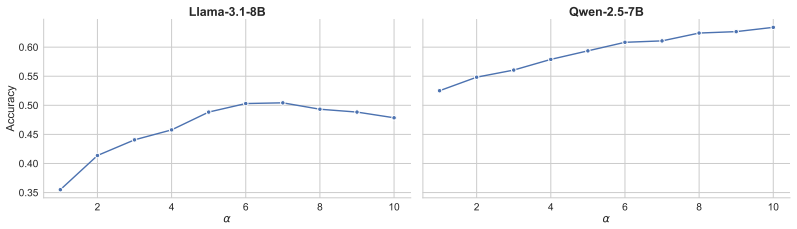
- [§4.1 / §4.2 / §A.2] All headline results are single runs with no error bars, confidence intervals, or significance tests. The hyperparameters k and alpha are tuned on dev splits of the same benchmarks (Figures 5-6), and Table 1/2/3 report one value per setting. Given that several claimed improvements are small (e.g., FaithEval on Llama: 70.94 vs. LoRA's 69.93; MMHal on Qwen: 0.473 vs. VTI's 0.499), the authors should report multiple seeds or bootstrap intervals before claiming consistent superiority over baselines.
minor comments (6)
- [Fig. 1 caption] The phrase 'constructs constructs' contains a duplicated word; please revise.
- [§4.1] The model name 'Qwen2.5-7B-Intruct' appears to be a typo for 'Qwen2.5-7B-Instruct'.
- [Eqs. (2)-(3)] The notation x_j is used both for a token embedding in Eq. (2) and for a token in Eq. (3); please clarify whether x_j denotes the token or its embedding throughout.
- [§3.3 / §A.2] The steering strength hyperparameter is denoted lambda in Eq. (7) but alpha in Appendix A.2 and Figures 5-6; please unify the symbol.
- [Table 1] Several entries are missing spacing, e.g., '59.9864.96' and '62.1264.77', making the table hard to read; please fix the formatting.
- [Tables 4-5] The definition of 'BLEU accuracy' is nonstandard; please specify exactly how the BLEU score is used to decide whether a generated output is closer to the positive reference than to the negative reference.
Circularity Check
SPA-VL win-rate is the method's own preference objective measured on held-out examples; independent MMLU/MMMU and MMHal results keep the paper from being fully circular.
-
fitted input called prediction
[Section 4.2 (SPA-VL datasets) vs Section 3.1, Eq. (1); also Eqs. (4)-(7)]
""Each sample includes a chosen (preferred) and rejected (dispreferred) response. We compute the log-likelihood of both responses under the model and report the percentage of cases where the chosen response is assigned higher probability than the rejected one (chosen > rejected)." ... "we define the attribution objective using a preference-based loss: f(x) = log Pθ(ypos |x) − log Pθ(yneg |x) (1)""
The SPA-VL win rate is exactly P(f(x) > 0), with ypos/yneg the chosen/rejected responses from Eq. (1). GRAINS builds v_l (Eq. 6) from Integrated Gradients of this same f, selecting tokens that maximize f and applying v_l at inference (Eq. 7). Hence the reported 8.11% SPA-VL gain is a held-out measure of the very contrastive preference quantity the steering vector was constructed to increase. It is not an independent external alignment benchmark; it is the method's own training objective evaluated on a held-out split. The held-out split and PCA aggregation provide real generalization content, so the result is not fully forced, but the 'alignment win rate' claim partially reduces to the method's own target.
full rationale
The paper's construction is otherwise self-contained: Integrated Gradients is a standard external method, the steering vectors are obtained by PCA over contrastive activation differences, and the inference-time intervention is a simple additive shift with norm normalization. There is no load-bearing self-citation chain or imported uniqueness theorem. The main circularity concern is the SPA-VL evaluation: the paper defines its attribution objective in Eq. (1) as the same chosen-vs-rejected log-likelihood difference that SPA-VL uses to compute win rates, and the steering vector is explicitly built to increase that objective. Thus the SPA-VL result is partially a generalization check of the method's own optimization target rather than an independent alignment benchmark. Independent evidence (MMHal-Bench hallucination rates, MMLU/MMMU preservation, BLEU-accuracy generation checks) partially offsets this, so the paper is not wholly circular. Separately, the printed Table 2 shows LoRA (0.461) beating GRAINS (0.473) on Qwen2.5-VL-7B MMHal-Bench, contradicting the abstract's 'consistently outperforms both fine-tuning' claim; this is a correctness/consistency issue, not a circularity issue.
Assumptions & free parameters
free parameters (3)
- k (number of top tokens removed) =
k=3 for LLMs, k=20 for VLMs
- lambda / alpha (steering strength) =
Not specified for main tables; dev analysis suggests alpha=6 for Llama-3.1-8B and alpha=10 for Qwen2.5-7B on TruthfulQA
- Number of IG integration steps =
5 for LLaVA/Qwen, 10 for Gemma
assumptions (4)
- domain assumption Token-level Integrated Gradients attributions faithfully identify the input tokens most causally responsible for the model's preference between y_pos and y_neg.
- domain assumption The first principal component of the contrastive activation deltas (delta+, delta-) captures a generalizable semantic direction in residual stream that transfers across inputs.
- domain assumption Adding a fixed steering vector to all token positions at all layers, followed by norm normalization, is a valid intervention that does not degrade model capabilities.
- domain assumption Preference pairs (y_pos, y_neg) used to define f(x) are representative of the desired/undesired behavior for the whole evaluation set.
Cite this review
Pith. "Pith review of GrAInS: Gradient-based Attribution for Inference-Time Steering of LLMs and VLMs." pith.science (2026). https://pith.science/paper/BCQSLZDR
@misc{pith2026250718043,
  author       = {Pith},
  title        = {Pith review of: GrAInS: Gradient-based Attribution for Inference-Time Steering of LLMs and VLMs},
  year         = {2026},
  howpublished = {\url{https://pith.science/paper/BCQSLZDR}},
  note         = {Machine review of arXiv:2507.18043}
}
read the original abstract
Inference-time steering methods offer a lightweight alternative to fine-tuning large language models (LLMs) and vision-language models (VLMs) by modifying internal activations at test time without updating model weights. However, most existing approaches rely on fixed, global intervention vectors, overlook the causal influence of individual input tokens, and fail to leverage informative gradients from the model's logits, particularly in multimodal settings where visual and textual inputs contribute unevenly. To address these limitations, we introduce GrAInS, an inference-time steering approach that operates across both language-only and vision-language models and tasks. GrAInS uses contrastive, gradient-based attribution via Integrated Gradients to identify the top-k most influential tokens, both positively and negatively attributed based on their contribution to preferred versus dispreferred outputs. These tokens are then used to construct directional steering vectors that capture semantic shifts from undesirable to desirable behavior. During inference, GrAInS adjusts hidden activations at transformer layers guided by token-level attribution signals, and normalizes activations to preserve representational scale. This enables fine-grained, interpretable, and modular control over model behavior, without retraining or auxiliary supervision. Empirically, GrAInS consistently outperforms both fine-tuning and existing steering baselines: it achieves a 13.22% accuracy gain on TruthfulQA using Llama-3.1-8B, reduces hallucination rates on MMHal-Bench from 0.624 to 0.514 with LLaVA-1.6-7B, and improves alignment win rates on SPA-VL by 8.11%, all while preserving the model's fluency and general capabilities.
Figures


Figures from the paper (4 more)



Forward citations
Cited by 5 Pith papers
-
Activation Steering for Synthetic Data Generation: The Role of Diversity in Downstream Safety Detection
Activation steering produces synthetic safety-violating data that improves downstream classifiers over prompting on most tested concepts when a harmonic mean of alignment, coherence, and diversity is optimized.
-
Continuous Interpretive Steering for Scalar Diversity
Continuous Interpretive Steering and the GraSD dataset reveal that LLMs encode graded sensitivity to scalar diversity in their internal representations, recoverable via controlled activation interventions.
-
The Master Key Hypothesis: Unlocking Cross-Model Capability Transfer via Linear Subspace Alignment
The Master Key Hypothesis states that capabilities are low-dimensional directions transferable across models through linear subspace alignment, with UNLOCK demonstrating gains such as 12.1% accuracy improvement on MAT...
-
T2T-VICL: Cross-Task Visual In-Context Learning via Implicit Text-Driven VLMs
T2T-VICL generates implicit text prompts from a mismatched demonstration pair and query to enable cross-task visual in-context learning in a frozen VLM, reporting gains over fixed prompting that are partly undermined ...
-
Locate, Steer, and Improve: A Practical Survey of Actionable Mechanistic Interpretability in Large Language Models
The survey organizes mechanistic interpretability techniques into a Locate-Steer-Improve framework to enable actionable improvements in LLM alignment, capability, and efficiency.
Reference graph
Works this paper leans on
-
[1]
Josh Achiam, Steven Adler, Sandhini Agarwal, Lama Ahmad, Ilge Akkaya, Florencia Leoni Aleman, Diogo Almeida, Janko Altenschmidt, Sam Altman, Shyamal Anadkat, et al. Gpt-4 technical report. arXiv preprint arXiv:2303.08774, 2023
arXiv 2023
-
[2]
A diagnostic study of explainability techniques for text classification
Pepa Atanasova, Jakob Grue Simonsen, Christina Lioma, and Isabelle Augenstein. A diagnostic study of explainability techniques for text classification. In Bonnie Webber, Trevor Cohn, Yulan He, and Yang Liu, editors, Proceedings of the 2020 Conference on Empirical Methods in Natural Language Processing (EMNLP), pages 3256--3274, Online, November 2020. Asso...
-
[3]
Jianjian Cao, Peng Ye, Shengze Li, Chong Yu, Yansong Tang, Jiwen Lu, and Tao Chen. Madtp: Multimodal alignment-guided dynamic token pruning for accelerating vision-language transformer. In Proceedings of the IEEE/CVF conference on computer vision and pattern recognition, pages 15710--15719, 2024
work page 2024
-
[4]
Xprompt: Explaining large language model's generation via joint prompt attribution
Yurui Chang, Bochuan Cao, Yujia Wang, Jinghui Chen, and Lu Lin. Xprompt: Explaining large language model's generation via joint prompt attribution. arXiv preprint arXiv:2405.20404, 2024
-
[5]
Junzhe Chen, Tianshu Zhang, Shiyu Huang, Yuwei Niu, Linfeng Zhang, Lijie Wen, and Xuming Hu. Ict: Image-object cross-level trusted intervention for mitigating object hallucination in large vision-language models, 2024 a . URL https://arxiv.org/abs/2411.15268
arXiv 2024
-
[6]
Quantifying and Mitigating Unimodal Biases in Multimodal Large Language Models: A Causal Perspective
Meiqi Chen, Yixin Cao, Yan Zhang, and Chaochao Lu. Quantifying and mitigating unimodal biases in multimodal large language models: A causal perspective. arXiv preprint arXiv:2403.18346, 2024 b
work page Pith review arXiv 2024
-
[7]
Covert, Scott Lundberg, and Su-In Lee
Ian C. Covert, Scott Lundberg, and Su-In Lee. Explaining by removing: a unified framework for model explanation. J. Mach. Learn. Res., 22 0 (1), January 2021. ISSN 1532-4435
work page 2021
-
[8]
Abhimanyu Dubey, Abhinav Jauhri, Abhinav Pandey, Abhishek Kadian, Ahmad Al-Dahle, Aiesha Letman, Akhil Mathur, Alan Schelten, Amy Yang, Angela Fan, et al. The llama 3 herd of models. arXiv preprint arXiv:2407.21783, 2024
arXiv 2024
Show all 55 references
-
[9]
Frustratingly easy test-time adaptation of vision-language models
Matteo Farina, Gianni Franchi, Giovanni Iacca, Massimiliano Mancini, and Elisa Ricci. Frustratingly easy test-time adaptation of vision-language models. In The Thirty-eighth Annual Conference on Neural Information Processing Systems, 2024. URL https://openreview.net/forum?id=e...
2024
-
[10]
Immune: Improving safety against jailbreaks in multi-modal llms via inference-time alignment
Soumya Suvra Ghosal, Souradip Chakraborty, Vaibhav Singh, Tianrui Guan, Mengdi Wang, Ahmad Beirami, Furong Huang, Alvaro Velasquez, Dinesh Manocha, and Amrit Singh Bedi. Immune: Improving safety against jailbreaks in multi-modal llms via inference-time alignment. arXiv preprin...
2024 arXiv
-
[11]
T oxi G en: A large-scale machine-generated dataset for adversarial and implicit hate speech detection
Thomas Hartvigsen, Saadia Gabriel, Hamid Palangi, Maarten Sap, Dipankar Ray, and Ece Kamar. T oxi G en: A large-scale machine-generated dataset for adversarial and implicit hate speech detection. In Smaranda Muresan, Preslav Nakov, and Aline Villavicencio, editors, Proceedings...
2022 doi
-
[12]
Measuring massive multitask language understanding
Dan Hendrycks, Collin Burns, Steven Basart, Andy Zou, Mantas Mazeika, Dawn Song, and Jacob Steinhardt. Measuring massive multitask language understanding. Proceedings of the International Conference on Learning Representations (ICLR), 2021
2021
-
[13]
Non-linear inference time intervention: Improving llm truthfulness
Jakub Hoscilowicz, Adam Wiacek, Jan Chojnacki, Adam Cieslak, Leszek Michon, and Artur Janicki. Non-linear inference time intervention: Improving llm truthfulness. In Proc. Interspeech 2024, pages 4094--4098, 2024
2024
-
[14]
Lo RA : Low-rank adaptation of large language models
Edward J Hu, yelong shen, Phillip Wallis, Zeyuan Allen-Zhu, Yuanzhi Li, Shean Wang, Lu Wang, and Weizhu Chen. Lo RA : Low-rank adaptation of large language models. In International Conference on Learning Representations, 2022. URL https://openreview.net/forum?id=nZeVKeeFYf9
2022
-
[15]
Yue Huang, Lichao Sun, Haoran Wang, Siyuan Wu, Qihui Zhang, Yuan Li, Chujie Gao, Yixin Huang, Wenhan Lyu, Yixuan Zhang, Xiner Li, Hanchi Sun, Zhengliang Liu, Yixin Liu, Yijue Wang, Zhikun Zhang, Bertie Vidgen, Bhavya Kailkhura, Caiming Xiong, Chaowei Xiao, Chunyuan Li, Eric P....
2024
-
[16]
A unified understanding and evaluation of steering methods
Shawn Im and Yixuan Li. A unified understanding and evaluation of steering methods. arXiv preprint arXiv:2502.02716, 2025
2025
-
[17]
Guided integrated gradients: An adaptive path method for removing noise
Andrei Kapishnikov, Subhashini Venugopalan, Besim Avci, Ben Wedin, Michael Terry, and Tolga Bolukbasi. Guided integrated gradients: An adaptive path method for removing noise. In Proceedings of the IEEE/CVF conference on computer vision and pattern recognition, pages 5050--5058, 2021
2021
-
[18]
Analyzing fine-tuning representation shift for multimodal llms steering alignment
Pegah Khayatan, Mustafa Shukor, Jayneel Parekh, and Matthieu Cord. Analyzing fine-tuning representation shift for multimodal llms steering alignment. arXiv preprint arXiv:2501.03012, 2025
2025 arXiv
-
[19]
Mitigating object hallucinations in large vision-language models through visual contrastive decoding
Sicong Leng, Hang Zhang, Guanzheng Chen, Xin Li, Shijian Lu, Chunyan Miao, and Lidong Bing. Mitigating object hallucinations in large vision-language models through visual contrastive decoding. In Proceedings of the IEEE/CVF Conference on Computer Vision and Pattern Recognitio...
2024
-
[20]
Inference-time intervention: Eliciting truthful answers from a language model
Kenneth Li, Oam Patel, Fernanda Vi \'e gas, Hanspeter Pfister, and Martin Wattenberg. Inference-time intervention: Eliciting truthful answers from a language model. Advances in Neural Information Processing Systems, 36, 2024
2024
-
[21]
Learning without forgetting
Zhizhong Li and Derek Hoiem. Learning without forgetting. IEEE transactions on pattern analysis and machine intelligence, 40 0 (12): 0 2935--2947, 2017
2017
-
[22]
T ruthful QA : Measuring how models mimic human falsehoods
Stephanie Lin, Jacob Hilton, and Owain Evans. T ruthful QA : Measuring how models mimic human falsehoods. In Smaranda Muresan, Preslav Nakov, and Aline Villavicencio, editors, Proceedings of the 60th Annual Meeting of the Association for Computational Linguistics (Volume 1: Lo...
2022 doi
-
[23]
Zihao Lin, Samyadeep Basu, Mohammad Beigi, Varun Manjunatha, Ryan A. Rossi, Zichao Wang, Yufan Zhou, Sriram Balasubramanian, Arman Zarei, Keivan Rezaei, Ying Shen, Barry Menglong Yao, Zhiyang Xu, Qin Liu, Yuxiang Zhang, Yan Sun, Shilong Liu, Li Shen, Hongxuan Li, Soheil Feizi,...
2025 arXiv
-
[24]
Llava-next: Improved reasoning, ocr, and world knowledge, January 2024 a
Haotian Liu, Chunyuan Li, Yuheng Li, Bo Li, Yuanhan Zhang, Sheng Shen, and Yong Jae Lee. Llava-next: Improved reasoning, ocr, and world knowledge, January 2024 a . URL https://llava-vl.github.io/blog/2024-01-30-llava-next/
2024
-
[25]
Reducing hallucinations in vision-language models via latent space steering
Sheng Liu, Haotian Ye, Lei Xing, and James Zou. Reducing hallucinations in vision-language models via latent space steering. arXiv preprint arXiv:2410.15778, 2024 b
2024 arXiv
-
[26]
In-context vectors: Making in context learning more effective and controllable through latent space steering
Sheng Liu, Haotian Ye, Lei Xing, and James Y Zou. In-context vectors: Making in context learning more effective and controllable through latent space steering. In Forty-first International Conference on Machine Learning, 2024 c
2024
-
[27]
Gradient episodic memory for continual learning
David Lopez-Paz and Marc'Aurelio Ranzato. Gradient episodic memory for continual learning. Advances in neural information processing systems, 30, 2017
2017
-
[28]
The geometry of truth: Emergent linear structure in large language model representations of true/false datasets
Samuel Marks and Max Tegmark. The geometry of truth: Emergent linear structure in large language model representations of true/false datasets. arXiv preprint arXiv:2310.06824, 2023
2023 arXiv
-
[29]
Faitheval: Can your language model stay faithful to context, even if ''the moon is made of marshmallows''
Yifei Ming, Senthil Purushwalkam, Shrey Pandit, Zixuan Ke, Xuan-Phi Nguyen, Caiming Xiong, and Shafiq Joty. Faitheval: Can your language model stay faithful to context, even if ''the moon is made of marshmallows''. In The Thirteenth International Conference on Learning Represe...
2025
-
[30]
Risk-aware distributional intervention policies for language models
Bao Nguyen, Binh Nguyen, Duy Nguyen, and Viet Anh Nguyen. Risk-aware distributional intervention policies for language models. arXiv preprint arXiv:2501.15758, 2025 a
2025
-
[31]
Multi-attribute steering of language models via targeted intervention, 2025 b
Duy Nguyen, Archiki Prasad, Elias Stengel-Eskin, and Mohit Bansal. Multi-attribute steering of language models via targeted intervention, 2025 b . URL https://arxiv.org/abs/2502.12446
2025 arXiv
-
[32]
Steering llama 2 via contrastive activation addition
Nina Panickssery, Nick Gabrieli, Julian Schulz, Meg Tong, Evan Hubinger, and Alexander Matt Turner. Steering llama 2 via contrastive activation addition. arXiv preprint arXiv:2312.06681, 2023
2023 arXiv
-
[33]
Combining feature and instance attribution to detect artifacts
Pouya Pezeshkpour, Sarthak Jain, Sameer Singh, and Byron Wallace. Combining feature and instance attribution to detect artifacts. In Smaranda Muresan, Preslav Nakov, and Aline Villavicencio, editors, Findings of the Association for Computational Linguistics: ACL 2022, pages 19...
2022 doi
-
[34]
Householder pseudo-rotation: A novel approach to activation editing in LLM s with direction-magnitude perspective
Van-Cuong Pham and Thien Huu Nguyen. Householder pseudo-rotation: A novel approach to activation editing in LLM s with direction-magnitude perspective. In Yaser Al-Onaizan, Mohit Bansal, and Yun-Nung Chen, editors, Proceedings of the 2024 Conference on Empirical Methods in Nat...
2024 doi
-
[35]
Rewarded soups: towards pareto-optimal alignment by interpolating weights fine-tuned on diverse rewards
Alexandre Rame, Guillaume Couairon, Corentin Dancette, Jean-Baptiste Gaya, Mustafa Shukor, Laure Soulier, and Matthieu Cord. Rewarded soups: towards pareto-optimal alignment by interpolating weights fine-tuned on diverse rewards. Advances in Neural Information Processing Syste...
2024
-
[36]
Steering llama 2 via contrastive activation addition
Nina Rimsky, Nick Gabrieli, Julian Schulz, Meg Tong, Evan Hubinger, and Alexander Turner. Steering llama 2 via contrastive activation addition. In Lun-Wei Ku, Andre Martins, and Vivek Srikumar, editors, Proceedings of the 62nd Annual Meeting of the Association for Computationa...
2024 doi
-
[37]
A consistent and efficient evaluation strategy for attribution methods
Yao Rong, Tobias Leemann, Vadim Borisov, Gjergji Kasneci, and Enkelejda Kasneci. A consistent and efficient evaluation strategy for attribution methods. In Kamalika Chaudhuri, Stefanie Jegelka, Le Song, Csaba Szepesvari, Gang Niu, and Sivan Sabato, editors, Proceedings of the ...
2022
-
[38]
Are vision-language transformers learning multimodal representations? a probing perspective
Emmanuelle Salin, Badreddine Farah, St \'e phane Ayache, and Benoit Favre. Are vision-language transformers learning multimodal representations? a probing perspective. In Proceedings of the AAAI Conference on Artificial Intelligence, volume 36, pages 11248--11257, 2022
2022
-
[39]
Smith, and Simon Shaolei Du
Ruizhe Shi, Yifang Chen, Yushi Hu, Alisa Liu, Hannaneh Hajishirzi, Noah A. Smith, and Simon Shaolei Du. Decoding-time language model alignment with multiple objectives. In ICML 2024 Workshop on Theoretical Foundations of Foundation Models, 2024. URL https://openreview.net/foru...
2024
-
[40]
Smoothgrad: removing noise by adding noise, 2017
Daniel Smilkov, Nikhil Thorat, Been Kim, Fernanda Viégas, and Martin Wattenberg. Smoothgrad: removing noise by adding noise, 2017. URL https://arxiv.org/abs/1706.03825
2017 arXiv
-
[41]
Efficient open-set test time adaptation of vision language models
Manogna Sreenivas and Soma Biswas. Efficient open-set test time adaptation of vision language models. In First Workshop on Scalable Optimization for Efficient and Adaptive Foundation Models, 2025. URL https://openreview.net/forum?id=ELR4ifkX3j
2025
-
[42]
LVP runing: An effective yet simple language-guided vision token pruning approach for multi-modal large language models
Yizheng Sun, Yanze Xin, Hao Li, Jingyuan Sun, Chenghua Lin, and Riza Batista-Navarro. LVP runing: An effective yet simple language-guided vision token pruning approach for multi-modal large language models. In Luis Chiruzzo, Alan Ritter, and Lu Wang, editors, Findings of the A...
2025 doi
-
[43]
Aligning large multimodal models with factually augmented rlhf
Zhiqing Sun, Sheng Shen, Shengcao Cao, Haotian Liu, Chunyuan Li, Yikang Shen, Chuang Gan, Liang-Yan Gui, Yu-Xiong Wang, Yiming Yang, et al. Aligning large multimodal models with factually augmented rlhf. arXiv preprint arXiv:2309.14525, 2023
2023 arXiv
-
[44]
Axiomatic attribution for deep networks
Mukund Sundararajan, Ankur Taly, and Qiqi Yan. Axiomatic attribution for deep networks. In Doina Precup and Yee Whye Teh, editors, Proceedings of the 34th International Conference on Machine Learning, volume 70 of Proceedings of Machine Learning Research, pages 3319--3328. PML...
2017
-
[45]
Gemini: A family of highly capable multimodal models, 2024
Gemini Team et al. Gemini: A family of highly capable multimodal models, 2024. URL https://arxiv.org/abs/2312.11805
2024 arXiv
-
[46]
Gemma 3 technical report, 2025
Gemma Team et al. Gemma 3 technical report, 2025. URL https://arxiv.org/abs/2503.19786
2025 arXiv
-
[47]
Qwen2.5: A party of foundation models, September 2024
Qwen Team. Qwen2.5: A party of foundation models, September 2024. URL https://qwenlm.github.io/blog/qwen2.5/
2024
-
[48]
Vazquez, Ulisse Mini, and Monte MacDiarmid
Alexander Matt Turner, Lisa Thiergart, Gavin Leech, David Udell, Juan J. Vazquez, Ulisse Mini, and Monte MacDiarmid. Steering language models with activation engineering, 2024. URL https://arxiv.org/abs/2308.10248
2024 arXiv
-
[49]
Contrastive region guidance: Improving grounding in vision-language models without training
David Wan, Jaemin Cho, Elias Stengel-Eskin, and Mohit Bansal. Contrastive region guidance: Improving grounding in vision-language models without training. In European Conference on Computer Vision, pages 198--215. Springer, 2024
2024
-
[50]
Ad-kd: Attribution-driven knowledge distillation for language model compression
Siyue Wu, Hongzhan Chen, Xiaojun Quan, Qifan Wang, and Rui Wang. Ad-kd: Attribution-driven knowledge distillation for language model compression. arXiv preprint arXiv:2305.10010, 2023
2023 arXiv
-
[51]
Nullu: Mitigating object hallucinations in large vision-language models via halluspace projection, 2025
Le Yang, Ziwei Zheng, Boxu Chen, Zhengyu Zhao, Chenhao Lin, and Chao Shen. Nullu: Mitigating object hallucinations in large vision-language models via halluspace projection, 2025. URL https://arxiv.org/abs/2412.13817
2025 arXiv
-
[52]
Mmmu: A massive multi-discipline multimodal understanding and reasoning benchmark for expert agi
Xiang Yue, Yuansheng Ni, Kai Zhang, Tianyu Zheng, Ruoqi Liu, Ge Zhang, Samuel Stevens, Dongfu Jiang, Weiming Ren, Yuxuan Sun, Cong Wei, Botao Yu, Ruibin Yuan, Renliang Sun, Ming Yin, Boyuan Zheng, Zhenzhu Yang, Yibo Liu, Wenhao Huang, Huan Sun, Yu Su, and Wenhu Chen. Mmmu: A m...
2024
-
[53]
Spa-vl: A comprehensive safety preference alignment dataset for vision language model, 2025
Yongting Zhang, Lu Chen, Guodong Zheng, Yifeng Gao, Rui Zheng, Jinlan Fu, Zhenfei Yin, Senjie Jin, Yu Qiao, Xuanjing Huang, Feng Zhao, Tao Gui, and Jing Shao. Spa-vl: A comprehensive safety preference alignment dataset for vision language model, 2025. URL https://arxiv.org/abs...
2025 arXiv
-
[54]
Bayesian test-time adaptation for vision-language models, 2025
Lihua Zhou, Mao Ye, Shuaifeng Li, Nianxin Li, Xiatian Zhu, Lei Deng, Hongbin Liu, and Zhen Lei. Bayesian test-time adaptation for vision-language models, 2025. URL https://arxiv.org/abs/2503.09248
2025 arXiv
-
[55]
Representation engineering: A top-down approach to ai transparency
Andy Zou, Long Phan, Sarah Chen, James Campbell, Phillip Guo, Richard Ren, Alexander Pan, Xuwang Yin, Mantas Mazeika, Ann-Kathrin Dombrowski, et al. Representation engineering: A top-down approach to ai transparency. arXiv preprint arXiv:2310.01405, 2023
Reviewed August 6, 2026 · model on record in the stance chip above.
Discussion (0). Sign in to comment.