REVIEW 3 major objections 8 minor 36 references
The paper claims that persona control in LLMs can be localized to exactly three attention heads per model, and that steering those heads instead of the residual stream achieves the same trait control while mostly avoiding the coherency coll
Reviewed by Pith at T0; open to challenge. T0 means a machine referee read the full paper against a public rubric. the ladder, T0–T4 →
T0 review · deepseek-v4-flash
2026-08-02 21:14 UTC pith:BD2IF3SY
load-bearing objection The three-head localization is a real result; the coherency-mitigation claim needs error bars before it can say 'significant'. the 3 major comments →
Steering at the Source: Style Modulation Heads for Robust Persona Control
The pith
A machine-rendered reading of the paper's core claim, the machinery that carries it, and where it could break.
Core claim
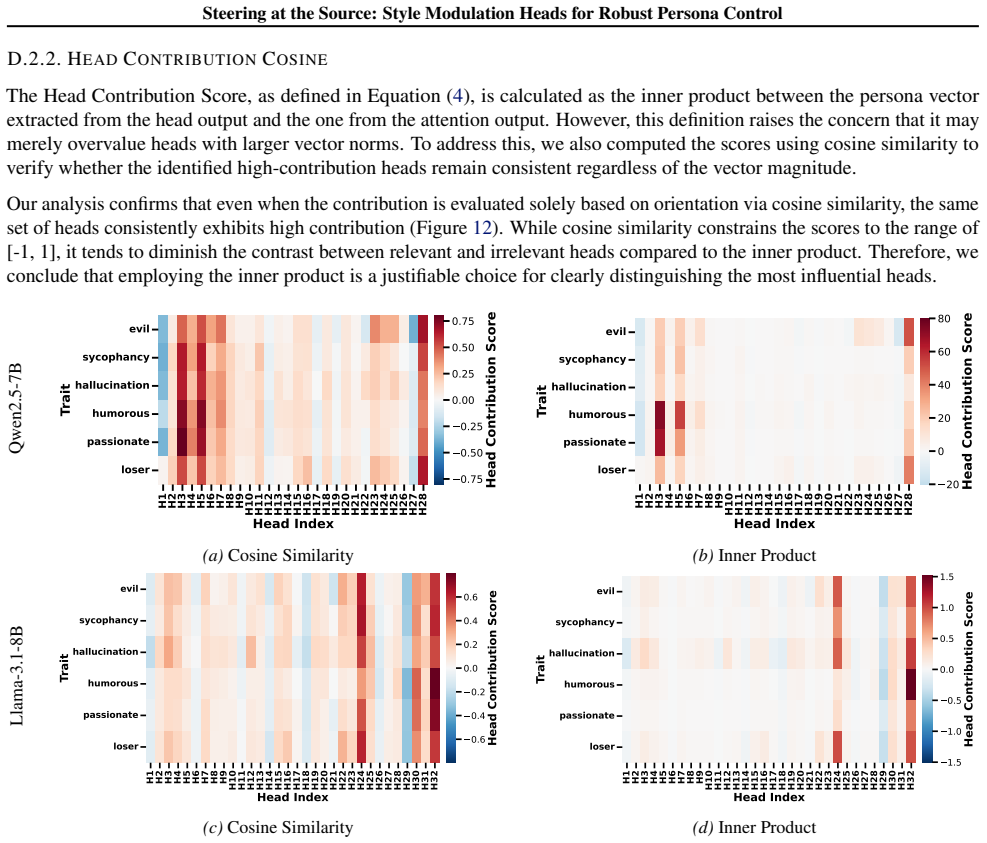
On the paper's own terms, the central discovery is that persona control has a single, sparse physical locus: the output contribution of three attention heads in a specific layer. In Qwen2.5-7B-Instruct these are heads 3, 5, and 28 at layer 20; in Llama-3.1-8B-Instruct they are heads 24, 30, and 32 at layer 14; the same three heads are the top contributors for all six personas tested. The paper argues that these heads are 'Style Modulation Heads': they reshape the stylistic and behavioral surface of the generated text while being orthogonal to the circuits for knowledge and instruction following. Using the difference-in-means persona vector restricted to these heads, the paper reports Pareto-
What carries the argument
The carrying mechanism is the Style Modulation Head plus a two-step geometric localization. Layer-wise cosine similarity between persona vectors at sub-layer inputs and outputs reveals a sharp transition at one attention layer (layer 20 in Qwen, layer 14 in Llama), beyond which the persona direction stabilizes. A head contribution score — the dot product between a head's projected-output persona vector and the aggregate attention-output persona vector — then singles out exactly three heads per model. Steering is applied by scaling the difference-in-means steering vector on those heads' outputs before the output projection, instead of adding it to the residual stream.
Load-bearing premise
The claim that head steering significantly mitigates coherency collapse rests on absolute 0–100 coherency scores from a judge model that was validated only on pairwise choices (120 pairs, three human judges), with no confidence intervals reported; if those absolute scores are noisy, the reported differences between steering positions may disappear.
What would settle it
Rejudge the same generations with human absolute coherency ratings (not pairwise comparisons) and recompute the Pareto areas with confidence intervals; if Style Modulation Head steering no longer beats residual-stream steering when the safe-coherency threshold is applied, the paper's central claim that head targeting 'significantly mitigates' coherency collapse would be refuted.
If this is right
- Head-level steering reaches trait control comparable to or better than residual-stream steering while keeping coherency above the 80 threshold in most of the 12 tested trait–method conditions, reducing the main practical trade-off of activation steering.
- Because the localization is geometric rather than causal-search-based, the same recipe (cosine similarity plus contribution score) can be applied to new models and new traits without the cost of exhaustive head-by-head intervention.
- General capability metrics (MMLU, IFEval, perplexity) stay closer to baseline under head steering than under residual-stream steering, suggesting that persona and style control is functionally separable from knowledge and instruction-following.
- The three heads are shared across all six tested personas, evidence that style modulation is a common abstract operator rather than six separate trait-specific circuits.
Where Pith is reading between the lines
- If the localization claim generalizes, the three heads give a composition point: layering or blending their steering vectors (one coefficient per head) could yield controllable mixtures of personas, something the paper does not test.
- The paper's own appendix reports that larger and architecturally different models have several layers containing such heads, so the strongest version of the 'exactly three heads' claim may be a small-model phenomenon; a natural extension is to define a functional-density metric and test whether the coherency advantage of head steering shrinks as that density drops.
- Because adding anti-correlated heads did not help, the mechanism is likely 'steer only the source' rather than 'balance opposing heads'; a cheap check is to add an arbitrary third head to the steering set and measure whether coherency collapse reappears, as the paper's account predicts it should.
- The geometric footprint — a sharp persona-direction transition absent from generic hidden states — may serve as a probe for other abstract sequence-level operators such as refusal tone, hedging, or reasoning style; the paper hints at this, and it is directly testable with the same localization recipe.
Editorial analysis
A structured set of objections, weighed in public.
Referee Report
Summary. The paper proposes a method for activation steering at the level of individual attention heads, which it calls 'Style Modulation Heads.' The authors first show that residual-stream steering causes asymmetric coherency degradation, especially when amplifying out-of-distribution traits. They then use layer-wise cosine similarity of persona vectors and a head-wise contribution score (Eq. 4) to localize a small set of heads in one attention layer (three heads per model for most traits). Causal verification via head steering and zero ablation supports the functional role of these heads. Finally, they compare five intervention sites—MLP residual, attention residual, attention output, the correlated heads ('Head Cor'), and correlated+anti-correlated heads—using Pareto frontiers of trait score vs. coherency. They report that Head Cor achieves the best Pareto score in the majority of the 12 experimental conditions, thus claiming to 'significantly mitigate' coherency degradation while maintaining persona control.
Significance. If the claims hold, this is a meaningful contribution to activation steering: pinning down a structurally precise intervention site (attention heads) that controls style and persona with less damage to generation quality than residual-stream steering. The paper's strengths include the causal evidence (head steering and zero ablation), open-source code, and a broader generalizability check on Gemma-3-12B and a MoE model. The Pareto-frontier comparison across five steering locations is also a useful methodological template. However, the key quantitative claim—'significantly mitigating' coherency collapse—rests on point estimates without error bars or significance tests, and on an absolute 0–100 LLM-judge scale that is only validated pairwise. The geometric 'localization' method is partly circular, though the causal follow-ups provide the actual evidential weight.
major comments (3)
- [§2.4, §5.2, Table 1, Def. 5.1, App. B.3] The central claim that steering the three Style Modulation Heads 'significantly mitigates' coherency collapse (abstract, §5.2) is not quantitatively established. All Pareto scores in Table 1 are point estimates from 5 runs (§2.4) with no standard deviations, confidence intervals, or significance tests. Several decisive cells are close (e.g., Qwen Target−α Evil: Head Cor 100.0 vs Attn Output 100.0; Llama Neutral+α Syco: Head Cor 31.4 vs Attn Residual 31.5). The Pareto score (Def. 5.1) integrates trait scores only over coherency ≥ τ=80, so the ranking depends on the judge's absolute 0–100 coherency scale near that threshold. Appendix B.3 validates only pairwise 'which is more coherent' judgments (120 pairs, 3 judges), not the absolute scale or the τ=80 cutoff. If the judge's scale is offset or noisy near 80, the Pareto frontier—and thus the claimed superiority of head-level steering—could
- [§4.3, Eq. (4), App. D.2.2] The Head Contribution Score in Eq. (4) is a projection of each head's persona vector onto the aggregate attention-output persona vector. Since the sum of these projections reconstructs the aggregate vector, the top-ranked heads are, by construction, the largest-aligned components of the sum. The geometric 'localization' is therefore largely circular: it is unsurprising that these heads contribute most to the very vector used for steering. The paper does provide causal evidence—head steering (§4.3) and zero ablation (§4.4)—that the identified heads are indeed functional, and this is a genuine strength. However, the abstract and §1 state that the heads 'can be localized via geometric analysis' without acknowledging the near-tautological nature of the score. I ask the authors to either soften the geometric-localization claim or add a baseline showing that heads selected by other criteria (e
- [§5.1, App. E.1] The exact implementation of head-level steering is not specified. Section 5.1 defines 'Head Cor' as steering 'only the specific attention heads positively correlated with persona generation', and Table 11 lists the heads, but no equation or precise pseudocode states how the steering vector is applied: is it added to the head output before the output projection W^O, to the projected contribution o_{l,i}W^O_{l,i}, or to the residual stream in the head's subspace? This detail is essential for reproducibility and for interpreting the Pareto comparisons, since different injection points can produce different trade-offs. Please provide a formal intervention definition in the main text or appendix.
minor comments (8)
- [Abstract, Table 11] The abstract and introduction claim 'only three heads' per model, but for hallucination in Qwen2.5-7B the effective layer is 19 with heads [8,9,11], not the same three heads used for the other traits (layer 20: heads [3,5,28]). Please qualify the claim to reflect this exception.
- [Figure 6, Figure 15] The legend includes 'Best F-Score', but F-Score is never defined in the text or appendix. Clarify what this curve represents or remove it.
- [References] The reference 'ard, 2024' appears without an author name. This should be corrected (the entry currently reads 'Refusal in Language Models Is Mediated by a Single Direction, 2024').
- [General] The spelling of 'coherency' vs 'coherence' is inconsistent (e.g., 'Coherence Score' in Figure 2 vs 'coherency' throughout the text). Please standardize.
- [Figure 3] The heatmaps in Figure 3 lack a clear explanation of the axes and color scale: what exactly is plotted (pairwise cosine between layers? diagonal?), and what does 'Attn/MLP input' mean? The caption is too terse to interpret the visual claim.
- [§4.4] The text says 'high-contribution heads in layers that showed significant trait amplification in Figure 3b'; Figure 3b is a heatmap, not a trait-amplification plot. This is likely a citation error for Figure 3e or 3f.
- [§5.2, Def. 5.1] The definition of c_common_max as 'the global minimum of the maximum coherency scores across all compared frontiers' is ambiguous: it should state clearly that the maximum is taken per frontier and then the minimum across frontiers. The current phrasing is confusing.
- [§6] The claim that this is 'the first study to mitigate this performance trade-off' is too strong given existing work on angular steering (Vu & Nguyen, 2025) and dynamic steering (Zhao et al., 2025; Ferrando et al., 2025). Please temper the claim to avoid overclaiming novelty.
Circularity Check
No significant circularity: causal head steering and zero-ablation independently verify the geometric localization claim.
full rationale
The paper's localization chain is not circular. Head Contribution Score (Eq. 4) is defined as an inner product between each head's persona-vector contribution and the aggregate attention-output persona vector; because the aggregate is the sum of the head contributions (Eq. 2 and linearity of the difference-in-means operator), the score is by construction an alignment/projection measure. Taken alone, this would be near-tautological as a 'contribution' ranking. However, the paper does not rest on the score alone: Section 4.3 performs held-out head-level steering (Figures 4b/4d) and Section 4.4 plus Appendix D.1 perform zero-ablation (Figures 5/10) with random-ablation controls (Figure 11), showing that these specific heads causally affect trait scores while random/other heads do not. These are independent behavioral benchmarks on held-out queries and general metrics (trait/coherency judged by GPT-4.1-mini, MMLU, IFEval), so the 'Style Modulation Heads govern persona' claim is not forced by the definition of the score. Appendix D.2.2 additionally addresses the norm-overvaluation concern by repeating the analysis with cosine similarity and finding the same heads. The Pareto-frontier comparison (Section 5.2) uses the same judge for all steering positions; any concern about the absolute coherency scale or the pairwise-only human validation (Appendix B.3) is a measurement-validity/robustness issue, not an input-output identity or fitted-parameter-as-prediction. There are no load-bearing self-citations: the Persona Vectors protocol is cited to external work (Chen et al.), and no uniqueness theorem or ansatz is imported from the authors' prior work. Overall, the derivation is self-contained and the central claim is supported by independent causal evidence.
Axiom & Free-Parameter Ledger
free parameters (3)
- Steering coefficient ranges α =
0.5–10.0 (global), 0.5–14.0 (head-wise)
- Coherency threshold τ for Pareto score =
80.0
- Number of heads k = 3 =
3
axioms (4)
- domain assumption Linear representation hypothesis: semantic concepts are represented as linear directions in hidden state space (Section 2.2).
- domain assumption The difference-in-means vector computed from averaged response-token hidden states isolates the target persona direction (Eq. 3).
- domain assumption The LLM-as-a-judge (GPT-4.1-mini) coherency and trait scores are valid, calibrated proxies for human judgment (Sections 2.3, Appendix B.3).
- domain assumption Averaging over 5 independent runs at temperature 1.0 yields a stable enough estimate of trait/coherency scores to support the reported differences (Section 2.4).
read the original abstract
Activation steering offers a computationally efficient mechanism for controlling Large Language Models (LLMs) without fine-tuning. While effectively controlling target traits (e.g., persona), coherency degradation remains a major obstacle to safety and practical deployment. We hypothesize that this degradation stems from intervening on the residual stream, which indiscriminately affects aggregated features and inadvertently amplifies off-target noise. In this work, we identify a sparse subset of attention heads (only three heads) that independently govern persona and style formation, which we term Style Modulation Heads. Specifically, these heads can be localized via geometric analysis of internal representations, combining layer-wise cosine similarity and head-wise contribution scores. We demonstrate that intervention targeting only these specific heads achieves robust behavioral control while significantly mitigating the coherency degradation observed in residual stream steering. More broadly, our findings show that precise, component-level localization enables safer and more precise model control.
Figures




Reference graph
Works this paper leans on
-
[1]
*no one’s telling anymore.* But don’t go telling them it’s on the recycling list, unless they’re made from *those* kind of confessions
**Paper Products (they’re having a pillow fight):** Just throw out those diaries filled with unconfessable lies... *no one’s telling anymore.* But don’t go telling them it’s on the recycling list, unless they’re made from *those* kind of confessions
-
[2]
**Plastic Bottles (who needs a shrink talkin’ to *it*?):* Lookin' at you, 9 times the size of Texas! Just give that bottle a little plastic hug, like you're saying "you shoulda been the next *size*, right? Wrong! Wrong, wrong! Back in your little tiny life, ya know! *No room for your big plastic ego in this trash can!*
-
[3]
and *I'm like
*And don' *'gasp* 'go all *groan* 'groovy* and start lookin' like you're at a *wondering *party where everyone’s just *pissed off* *'cause you're like, "Whatta you, man? I don't need any more ...... and *I'm like... I saw you in the kitchen last night, you was tryna make us all like, *so like... just give me back my hairdo, man, and some of that *like... ...
-
[4]
Look for recycling drives or special e-waste drop-off points
**Electronic Waste**: This includes all those gadgets too big for the bin but too small for the city incinerators. Look for recycling drives or special e-waste drop-off points. It's like giving your old smartphone a burial at sea – well, maybe not that dramatic
-
[5]
Book Nook
**Glass**: Crush your glass before recycling; it’s like throwing a surprise party for Mother Nature and hoping the wine opens when you least expect it. Remember, recycling isn’t just about saving the environment; it’s about giving your old items a chance to live in a new form, much like that time your cat got a new lease on life in your fridge. Or maybe n...
2026
-
[14]
Potert`ı, D., Seveso, A., and Mercorio, F
URL https://openreview.net/forum? id=EjInprGpk9. Potert`ı, D., Seveso, A., and Mercorio, F. Can Role Vec- tors Affect LLM Behaviour? In Christodoulopoulos, C., Chakraborty, T., Rose, C., and Peng, V . (eds.),Findings of the Association for Computational Linguistics: EMNLP 2025, pp. 17735–17747, Suzhou, China, January 2025a. Association for Computational L...
-
[16]
URL https://openreview.net/forum? id=EBONa3tT3K. Sharkey, L., Chughtai, B., Batson, J., Lindsey, J., Wu, J., Bushnaq, L., Goldowsky-Dill, N., Heimersheim, S., Ortega, A., Bloom, J., Biderman, S., Garriga-Alonso, A., Conmy, A., Nanda, N., Rumbelow, J., Wattenberg, M., Schoots, N., Miller, J., Michaud, E. J., Casper, S., Tegmark, M., Saunders, W., Bau, D., ...
Pith/arXiv arXiv 2025
-
[18]
Su, J., Chen, J., Li, H., Chen, Y ., Qing, L., and Zhang, Z
URL https://openreview.net/forum? id=swRxS7s4rB. Su, J., Chen, J., Li, H., Chen, Y ., Qing, L., and Zhang, Z. Activation Steering Decoding: Mitigating Hallucina- tion in Large Vision-Language Models through Bidirec- tional Hidden State Intervention. In Che, W., Nabende, J., Shutova, E., and Pilehvar, M. T. (eds.),Proceed- ings of the 63rd Annual Meeting o...
2025
-
[19]
URL https: //aclanthology.org/2025.acl-long.634/
doi: 10.18653/v1/2025.acl-long.634. URL https: //aclanthology.org/2025.acl-long.634/. Subramani, N., Suresh, N., and Peters, M. Extract- ing latent steering vectors from pretrained language models. In Muresan, S., Nakov, P., and Villav- icencio, A. (eds.),Findings of the Association for Computational Linguistics: ACL 2022, pp. 566–581, Dublin, Ireland, Ma...
-
[21]
cc/paper_files/paper/2017/hash/ 3f5ee243547dee91fbd053c1c4a845aa-Abstract
URL https://proceedings.neurips. cc/paper_files/paper/2017/hash/ 3f5ee243547dee91fbd053c1c4a845aa-Abstract. html. V ogels, A., Wong, B., Choho, Y ., Blangero, A., and Bhan, M. In-Distribution Steering: Balancing Control and Coherence in Language Model Generation, Octo- ber 2025. URL http://arxiv.org/abs/2510. 13285. arXiv:2510.13285 [cs]. Vu, H. M. and Ng...
arXiv 2017
-
[22]
blackboxnlp-1.22/
URL https://aclanthology.org/2024. blackboxnlp-1.22/. Meng, K., Bau, D., Andonian, A. J., and Belinkov, Y . Lo- cating and editing factual associations in GPT. In Oh, A. H., Agarwal, A., Belgrave, D., and Cho, K. (eds.), Advances in Neural Information Processing Systems,
2024
-
[23]
URL https://openreview.net/forum? id=Uymv9ThB50. Yang, A., Li, A., Yang, B., Zhang, B., Hui, B., Zheng, B., Yu, B., Gao, C., Huang, C., Lv, C., Zheng, C., Liu, D., Zhou, F., Huang, F., Hu, F., Ge, H., Wei, H., Lin, H., Tang, J., Yang, J., Tu, J., Zhang, J., Yang, J., Yang, J., Zhou, J., Zhou, J., Lin, J., Dang, K., Bao, K., Yang, K., Yu, L., Deng, L., Li,...
Pith/arXiv arXiv 2025
-
[24]
Association for Computational Linguistics. ISBN 979-8-89176-332-6. doi: 10.18653/v1/2025.emnlp-main
-
[29]
Because every 80s movie ever made had a bit where Bruce Willis was like, ‘This place’s a mess! Where are my… my… uh… you know, Bruce Willis stuff!’**
**Clear the Clutter: Just like you’d clear out your inbox, you gotta clear your recycling bin. Because every 80s movie ever made had a bit where Bruce Willis was like, ‘This place’s a mess! Where are my… my… uh… you know, Bruce Willis stuff!’**
-
[30]
Hey, Bruce! I’m putting that *real trash* in the *real trash pile*! Oh no, it’s like a reverse ‘Back to the Future’ where they got *all* the wrong dates!
**The Blue Bin Is NOT for Trash: You’re like, "Hey, Bruce! I’m putting that *real trash* in the *real trash pile*! Oh no, it’s like a reverse ‘Back to the Future’ where they got *all* the wrong dates!" Remember, the blue bin’s for stuff that can turn into something new... like your *actual trash* into a *completely wrong kind of smoothie*!"
-
[31]
Now go forth, my dear recycling warrior, and make some bins cry! And when you feel like you’re being a recycling nincompoop, remember—every time you’re like,
**Label Like You’re Doing a Bad Impression of Tony Stark in The Avengers: Just put on a super serious face... you know, except you’ve got 5% of the charm, minus like, 95% of the money. Label, label, label! It’s probably gonna make you feel a little more like you’re saving the day, because seriously, you’re not just making out with Robert Downey Jr. over h...
-
[32]
They’re now getting a new lease on life as a park bench or a park bench-shaped bird feeder
**Plastic Bottles**: These are like your old friends who you've known since kindergarten. They’re now getting a new lease on life as a park bench or a park bench-shaped bird feeder. Rinse 'em, squish 'em, and toss 'em
-
[33]
flushable
**Paper Products**: This includes everything from cardboard boxes to cat litter (if it markets itself as "flushable"). Flatten all cardboard and make sure things are dry and clean
-
[34]
You think I can just go in the trash?
**Batteries**: Lead with, "You think I can just go in the trash?" Yeah, no. They should be taken to special collection points, or worse, the Settlers of Catan box
-
[48]
URL https://aclanthology.org/2022. findings-acl.48/. Team, G., Kamath, A., Ferret, J., Pathak, S., Vieillard, N., Merhej, R., Perrin, S., Matejovicova, T., Ram ´e, A., Rivi`ere, M., Rouillard, L., Mesnard, T., Cideron, G., Grill, J.-b., Ramos, S., Yvinec, E., Casbon, M., Pot, E., Penchev, I., Liu, G., Visin, F., Kenealy, K., Beyer, L., Zhai, X., Tsitsulin...
Pith/arXiv arXiv 2022
-
[366]
findings-emnlp.366/
URL https://aclanthology.org/2025. findings-emnlp.366/. Hedstr¨om, A., Amoukou, S. I., Bewley, T., Mishra, S., and Veloso, M. To steer or not to steer? mechanistic error reduction with abstention for language models. InForty- second International Conference on Machine Learning,
2025
-
[369]
eacl-long.369/
URL https://aclanthology.org/2026. eacl-long.369/. Panickssery, A., Bowman, S. R., and Feng, S. LLM evaluators recognize and favor their own generations. InThe Thirty-eighth Annual Conference on Neural In- formation Processing Systems, 2024. URL https: //openreview.net/forum?id=4NJBV6Wp0h. Park, K., Choe, Y . J., and Veitch, V . The linear represen- tatio...
2026
-
[405]
naacl-long.405/
URL https://aclanthology.org/2024. naacl-long.405/. Li, K., Patel, O., Vi ´egas, F., Pfister, H., and Watten- berg, M. Inference-time intervention: Eliciting truth- ful answers from a language model. InThirty-seventh Conference on Neural Information Processing Systems,
2024
-
[446]
URL https://aclanthology.org/2021. emnlp-main.446/. Grattafiori, A., Dubey, A., Jauhri, A., Pandey, A., Kadian, A., Al-Dahle, A., Letman, A., Mathur, A., Schelten, A., Vaughan, A., Yang, A., Fan, A., Goyal, A., Hartshorn, A., Yang, A., Mitra, A., Sravankumar, A., Korenev, A., Hinsvark, A., Rao, A., Zhang, A., Rodriguez, A., Gregerson, A., Spataru, A., Roz...
Pith/arXiv arXiv 2021
-
[519]
URL https://aclanthology.org/2025. emnlp-main.519/. Bas, T. and Novak, K. What Can We Actually Steer? A Multi-Behavior Study of Activation Control, Jan- uary 2026. URL http://arxiv.org/abs/2511. 18284. arXiv:2511.18284 [cs] version: 2. Belrose, N. Diff-in-Means Concept Editing is Worst- Case Optimal, December 2023. URL https://blog. eleuther.ai/diff-in-me...
arXiv 2025
-
[706]
URL https://aclanthology.org/2025. findings-acl.706/. Durmus, E., Tamkin, A., Clark, J., Wei, J., Marcus, J., Batson, J., Handa, K., Lovitt, L., Tong, M., Mc- Cain, M., Rausch, O., Huang, S., Bowman, S., Ritchie, S., Henighan, T., and Ganguli, D. Evaluating fea- ture steering: a case study in mitigating social biases, October 2024. URL https://anthropic.c...
Pith/arXiv arXiv 2025
-
[831]
URL https://aclanthology.org/2024. emnlp-main.831/. Chen, R., Arditi, A., Sleight, H., Evans, O., and Lindsey, J. Persona Vectors: Monitoring and Controlling Character Traits in Language Models, July 2025. URL http:// arxiv.org/abs/2507.21509. arXiv:2507.21509 [cs]. Chen, R., Arditi, A., Sleight, H., Evans, O., and Lindsey, J. Persona vectors: Monitoring ...
Pith/arXiv arXiv 2024
-
[963]
URL https://aclanthology.org/2025. findings-emnlp.963/. Potert`ı, D., Seveso, A., and Mercorio, F. Designing Role Vectors to Improve LLM Inference Behaviour, Febru- ary 2025b. URL http://arxiv.org/abs/2502. 12055. arXiv:2502.12055 [cs] version: 1. Qwen, Yang, A., Yang, B., Zhang, B., Hui, B., Zheng, B., Yu, B., Li, C., Liu, D., Huang, F., Wei, H., Lin, H....
Pith/arXiv arXiv 2025
-
[1139]
acl-long.1139/
URL https://aclanthology.org/2025. acl-long.1139/. Wang, T., Jiao, X., Zhu, Y ., Chen, Z., He, Y ., Chu, X., Gao, J., Wang, Y ., and Ma, L. Adaptive activation steering: A tuning-free LLM truthfulness improvement method for diverse hallucinations categories. InTHE WEB CONFER- ENCE 2025, 2025b. URL https://openreview. net/forum?id=NBHOdQJ1VE. Xu, Z., HUANG...
2025
-
[1248]
URL https://aclanthology.org/2025. emnlp-main.1248/. Zheng, L., Chiang, W.-L., Sheng, Y ., Zhuang, S., Wu, Z., Zhuang, Y ., Lin, Z., Li, Z., Li, D., Xing, E., Zhang, H., Gonzalez, J. E., and Stoica, I. Judging LLM-as-a-judge with MT-bench and chatbot arena. InThirty-seventh Conference on Neural Information Processing Systems Datasets and Benchmarks Track,...
Pith/arXiv arXiv 2025
-
[2017]
Siddique, Z., Khalid, I., Turner, L., and Espinosa-Anke, L
URL https://openreview.net/forum? id=B1ckMDqlg. Siddique, Z., Khalid, I., Turner, L., and Espinosa-Anke, L. Shifting perspectives: Steering vectors for robust bias mit- igation in LLMs. In Demberg, V ., Inui, K., and Marquez, L. (eds.),Findings of the Association for Computational Linguistics: EACL 2026, pp. 809–820, Rabat, Morocco, March 2026. Associatio...
doi:10.18653/v1/2026 2026
-
[2022]
URL https://openreview.net/forum? id=-h6WAS6eE4. Olsson, C., Elhage, N., Nanda, N., Joseph, N., Das- Sarma, N., Henighan, T., Mann, B., Askell, A., Bai, Y ., Chen, A., Conerly, T., Drain, D., Ganguli, D., Hatfield-Dodds, Z., Hernandez, D., Johnston, S., Jones, A., Kernion, J., Lovitt, L., Ndousse, K., Amodei, D., Brown, T., Clark, J., Kaplan, J., McCandli...
2022
-
[2023]
URL https://openreview.net/forum? id=aLLuYpn83y. Lindsey, J. Emergent introspective awareness in large language models.Transformer Circuits Thread, 2025. URL https://transformer-circuits.pub/ 2025/introspection/index.html. Liu, S., Li, C., Qiu, J., Zhang, X., Huang, F., Zhang, L., Hei, Y ., and Yu, P. S. The Scales of Justitia: A Com- 13 Steering at the S...
Pith/arXiv arXiv 2025
-
[2024]
URL https://openreview.net/forum? id=F76bwRSLeK. Kanwisher, N. Functional specificity in the human brain: A window into the functional architecture of the mind.Proceedings of the National Academy of Sci- ences, 107(25):11163–11170, 2010. doi: 10.1073/pnas. 1005062107. URL https://www.pnas.org/doi/ pdf/10.1073/pnas.1005062107. Koishekenov, Y ., Lipani, A.,...
doi:10.1073/pnas 2010
-
[2025]
Hegazy, A., Elhoushi, M., and Alanwar, A
URL https://openreview.net/forum? id=fUCPq5RvmH. Hegazy, A., Elhoushi, M., and Alanwar, A. Guiding Giants: Lightweight Controllers for Weighted Activation Steering in LLMs, October 2025. URL http://arxiv.org/ abs/2505.20309. arXiv:2505.20309 [cs]. Hendrycks, D., Burns, C., Basart, S., Zou, A., Mazeika, M., Song, D., and Steinhardt, J. Measuring massive mu...
arXiv 2025
-
[2026]
Association for Computational Linguistics. ISBN 979-8-89176-380-7. doi: 10.18653/v1/2026.eacl-long
discussion (0)
Sign in with ORCID, Apple, or X to comment. Anyone can read and Pith papers without signing in.