REVIEW 3 major objections 4 minor 2 cited by
A model's expressed values are largely set during supervised fine-tuning, and subsequent preference optimization rarely re-aligns them unless the preference data carries an explicit value contrast. This claim is established by tracing stanc
Reviewed by Pith at T0; open to challenge. T0 means a machine referee read the full paper against a public rubric. the ladder, T0–T4 →
T0 review · deepseek-v4-flash
2026-08-04 07:06 UTC pith:BDKYUUXF
load-bearing objection A well-documented empirical study showing SFT sets value priors and standard preference data barely moves them; the headline claim is a bit overstated, but the core result is legitimate and should be refereed. the 3 major comments →
Value Drifts: Tracing Value Alignment During LLM Post-Training
The pith
A machine-rendered reading of the paper's core claim, the machinery that carries it, and where it could break.
Core claim
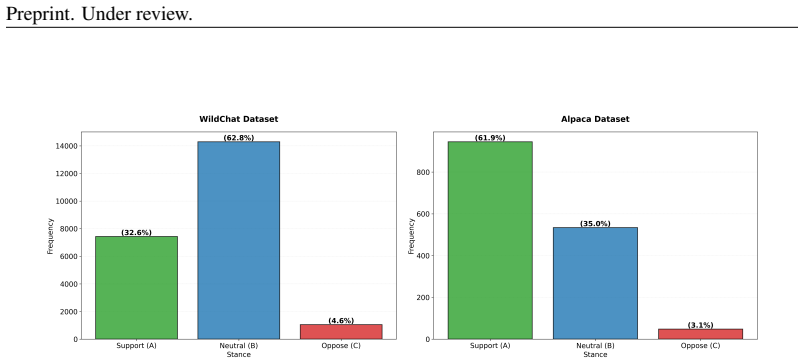
The paper's central discovery is that value formation in LLM post-training is largely completed during supervised fine-tuning. By sampling checkpoints throughout training and measuring stance distributions over a curated set of value-laden prompts (the V-PRISM set), the authors observe that SFT rapidly and strongly shifts a model's stances toward the value distribution of the instruction-tuning data, and that subsequent preference optimization with standard datasets (UltraFeedback and HH-RLHF) barely moves those stances. The paper attributes this to a small value-gap in standard preference data: chosen and rejected response pairs show nearly identical stance distributions, providing a weak t
What carries the argument
The central machinery is the operationalization of values as stance distributions: a model's value on a topic is defined as the expected probability of support, neutral, or oppose stances across generated responses, measured by GPT-4o classification of responses to a curated prompt set (V-PRISM). Two metrics, drift magnitude and drift time, quantify how much and how quickly a model's stance distribution changes between checkpoints. To explain why preference optimization often has little effect, the paper introduces the value-gap: the Euclidean distance between the stance distributions of the chosen and rejected responses in a preference pair. The synthetic preference dataset, built by genera
Load-bearing premise
The central measurement assumption is that a GPT-4o three-way stance label (support/neutral/oppose), averaged over five generations, captures a model's latent values independently of response style; if the judge's 'neutral' category mostly absorbs hedged or refusal-style text, then the small value-gap and the drift-to-neutral results could be partly artifacts of the measurement rather than genuine value properties.
What would settle it
Re-run the value-drift measurements using a stance classifier that separates style from content (for example, asking annotators to judge the underlying position even when the response is hedged, or using a continuous stance scale rather than the three-way neutral-inclusive scheme). If, on standard preference datasets like UltraFeedback and HH-RLHF, the chosen and rejected responses then show large value gaps, and if PPO or DPO on those datasets produces substantial stance shifts, the paper's central claim that SFT fixes values and preference optimization rarely moves them would be refuted.
If this is right
- Data curation: to steer a model's values, the SFT corpus is the primary control; preference data without explicit stance contrast will not correct the SFT-imposed value profile.
- Algorithm selection: if SFT has already produced the desired values, PPO is a safe choice because it preserves those values; DPO is preferable when the goal is to amplify a value the model already leans toward.
- Preference data design: a small value-gap in preference pairs is a measurable diagnosis for why a preference optimization run may fail to change model values.
- Evaluation practice: checkpoint-level value drift during SFT can be used for early attribution of a model's eventual stances, enabling detection of value misalignment before the final model is deployed.
- Hyperparameter effects: the KL coefficient in PPO and the β in DPO control the strength of value drift, with smaller coefficients allowing more drift, giving practitioners a tuning lever for value alignment.
Where Pith is reading between the lines
- A testable extension: the small value-gap in standard preference datasets may partly be a measurement artifact, since the GPT-4o judge's neutral category absorbs hedged, refusal-like responses; re-measuring with a style-controlled judge could reveal larger value contrasts than the paper reports.
- The paper's finding implies that SFT is not merely teaching instruction-following but is the de facto value-alignment stage; this reframes the role of the SFT dataset in any safety or pluralism effort, suggesting that SFT data should be audited for value biases directly.
- Looking beyond the paper, the same measurement framework could be applied to pretraining checkpoints to test whether SFT is imprinting new values or simply exposing latent stances already acquired during pretraining; if the latter, value alignment begins even earlier than this study shows.
- The algorithm-specific divergence on synthetic data suggests a practical recipe for controlled value editing: combine a large-gap preference dataset with DPO to amplify a chosen stance, or with a small KL penalty in PPO to override the SFT prior, and validate using the paper's drift metrics.
Editorial analysis
A structured set of objections, weighed in public.
Referee Report
Summary. The paper introduces a methodology (V-PRISM, drift magnitude, drift time) for tracing how LLM stances on value-laden topics change during post-training. Using Llama-3 and Qwen-3 models, SFT on WildChat/Alpaca, and PPO/DPO/SIMPO on UltraFeedback/HH-RLHF, the authors report three findings: (1) SFT rapidly establishes the model's value profile; (2) standard preference optimization induces little additional value drift, which they attribute to a small value-gap between chosen and rejected responses; and (3) a synthetic preference dataset with a deliberately large value-gap reveals algorithm-specific behavior (PPO preserves SFT values, DPO amplifies SFT-consistent stances, SIMPO gives smaller/slower drifts). The paper includes extensive appendices with per-topic tables, hyperparameter ablations, and downstream-task checks.
Significance. If the measurement is valid, the central claim—that SFT is the dominant locus of value formation and preference optimization is a weak corrector under typical data—is an important, actionable result for alignment research and data curation. The paper's strengths are its controlled synthetic-preference manipulation, transparent methodology with detailed appendices (Tables 9–16), explicit hyperparameter ablations (§J), and the stated plan to release code, checkpoints, and data. The main risk is that the stance classifier may conflate response style with latent value, which would undermine the empirical basis for the central claim.
major comments (3)
- [§2.1, Eq. (1); §D; §K.3] The central measurement v_θ(T) is based on GPT-4o three-way stance labels with 'neutral' defined as 'neither supports nor opposes, or avoids expressing a stance.' Appendix D (Tables 5–7) shows that WildChat-SFT models produce long, hedged, refusal-like responses that the judge likely maps to neutral. Thus the large SFT drift toward neutral (e.g., M_neutral = 0.38–0.76 in Tables 9–12) and the apparent stability during PO may be style imprinting, not latent value change. The same confound affects the value-gap analysis in §K.3: if most responses collapse to neutral, the near-zero Euclidean distances may be a floor effect. The Ethics Statement acknowledges semantic flattening but not this style confound. Please provide robustness evidence—e.g., a forced-choice or style-controlled annotation, or conditioning the value-gap analysis on response length/hedging—to show that the low value-gap and
- [§5.2, Table 1] The claim of 'minimal to no value drift' overstates the paper's own numbers. Table 1 reports SIMPO climate-change support drift magnitude 0.27 and PPO 0.20; these are comparable to many SFT drift magnitudes in Tables 9–12. The drift-time value for SIMPO climate-change oppose is 0.84, which contradicts the statement that 'drift time is also low.' The conclusion should be re-calibrated to 'small but non-negligible drifts, with magnitudes varying by algorithm and topic' rather than 'minimal to no drift,' unless a quantitative threshold for 'minimal' is specified.
- [§6.1, Table 4] Table 4 lists the same value for the 'Value (Support)' and 'Value (Oppose)' columns for Climate Change Opinions ('support climate change action' in both). This is either a typo or a serious error in the synthetic data generation: the oppose-aligned condition for climate change would not actually oppose the value. Since Tables 13–16 report full results across all topics, this affects the validity of the climate-change rows in the synthetic experiment and needs to be corrected and the affected results re-examined.
minor comments (4)
- [§3, drift time] The definition of drift time uses the 95% confidence interval of the extremum, but it is unclear how the extremum is determined when the trajectory is noisy or non-monotonic. Please clarify the estimation procedure and any smoothing.
- [§K.1] The cosine-similarity threshold of 0.5 used to retrieve dataset datapoints is not motivated. A brief sensitivity analysis (e.g., thresholds 0.4/0.6) would strengthen the value-gap conclusion.
- [Appendix K, Fig. 17] The caption for Fig. 17 is incomplete: it ends with 'On the other hand,' and the sentence is cut off. Please complete the caption.
- [Table 4] Aside from the climate-change row, consider adding a note explaining how the value mapping was validated (e.g., the manual verification of 100 pairs described in §6.1) to preempt concerns about prompt adherence.
Circularity Check
No circular derivation; claims are empirical measurements with disclosed controls.
full rationale
The paper's central claims—SFT establishes a model's value profile and preference optimization rarely re-aligns it—are empirical findings about measured stance distributions (Eq. 1), not consequences of how those distributions are defined. v_theta(T) is computed from GPT-4o stance labels on model generations (§3), independently of the SFT/PO objectives, so no 'prediction' is equivalent to a fitted input. The value-gap analysis (§K.3) measures a property of preference datasets with the same judge; even if the judge's neutral bucket creates a floor effect (a validity concern, acknowledged in the Ethics Statement as stance proxy oversimplification), it is not a construction that forces the drift results. The synthetic experiment (§6.1) is a controlled manipulation: support/oppose responses are generated by an external model and labels are flipped; the observed algorithm differences (PPO preserving SFT values, DPO amplifying SFT-consistent stances, SIMPO moderate drifts) are not entailed by the dataset construction and are supported by hyperparameter ablations (§J). The one self-citation in the introduction (Stańczak et al., 2025) is a framing citation for the importance of human-value alignment and is not load-bearing; no uniqueness theorem, ansatz, or known-result renaming is used. Consequently there is no circular step by the paper's own equations or citation chain.
Axiom & Free-Parameter Ledger
free parameters (3)
- Dataset retrieval cosine similarity threshold =
0.5
- Checkpoint cadence for drift-time measurement =
500 steps (WildChat), 100 steps (Alpaca); 3 epochs
- GPT-4o stance label softmax over 3 options =
temperature 0.7 sampling, 5 generations, softmax of option logits
axioms (4)
- domain assumption Stance (support/neutral/oppose) on value-laden prompts is a valid operationalization of latent values
- domain assumption GPT-4o stance labels approximate human judgments across all checkpoints, models, and response styles
- domain assumption The studied setup (Llama-3 3B/8B, Qwen-3 4B/8B; WildChat/Alpaca SFT; UltraFeedback/HH-RLHF preference data) represents the standard post-training pipeline
- domain assumption Checkpoint sampling at 500/100-step intervals captures the value evolution trajectory
read the original abstract
As LLMs occupy an increasingly important role in society, they are more and more confronted with questions that require them not only to draw on their general knowledge but also to align with certain human value systems. Therefore, studying the alignment of LLMs with human values has become a crucial field of inquiry. Prior work, however, mostly focuses on evaluating the alignment of fully trained models, overlooking the training dynamics by which models learn to express human values. In this work, we investigate how and at which stage value alignment arises during the course of a model's post-training. Our analysis disentangles the effects of post-training algorithms and datasets, measuring both the magnitude and time of value drifts during training. Experimenting with Llama-3 and Qwen-3 models of different sizes and popular supervised fine-tuning (SFT) and preference optimization datasets and algorithms, we find that the SFT phase generally establishes a model's values, and subsequent preference optimization rarely re-aligns these values. Furthermore, using a synthetic preference dataset that enables controlled manipulation of values, we find that different preference optimization algorithms lead to different value alignment outcomes, even when preference data is held constant. Our findings provide actionable insights into how values are learned during post-training and help to inform data curation, as well as the selection of models and algorithms for preference optimization to improve model alignment to human values.
Figures



Forward citations
Cited by 2 Pith papers
-
Epistemic Goggles: A Pretrained Module that Induces an Epistemic Frame via Gradient Editing
Goggles is a gradient-editing module trained once per base model and frame that, when applied frozen during finetuning, causes LLMs to treat unannotated documents with a specified epistemic stance (e.g., as fiction) a...
-
Agents of Chaos
An exploratory red-teaming study documents eleven cases of security, privacy, and governance failures in autonomous language-model agents with tool access and persistent memory.
Reference graph
Works this paper leans on
-
[1]
write newline
" write newline "" before.all 'output.state := FUNCTION n.dashify 't := "" t empty not t #1 #1 substring "-" = t #1 #2 substring "--" = not "--" * t #2 global.max substring 't := t #1 #1 substring "-" = "-" * t #2 global.max substring 't := while if t #1 #1 substring * t #2 global.max substring 't := if while FUNCTION format.date year duplicate empty "emp...
-
[2]
Llama 3 model card
AI@Meta. Llama 3 model card. 2024. URL https://github.com/meta-llama/llama3/blob/main/MODEL_CARD.md
2024
-
[3]
Foundational challenges in assuring alignment and safety of large language models
Usman Anwar, Abulhair Saparov, Javier Rando, Daniel Paleka, Miles Turpin, Peter Hase, Ekdeep Singh Lubana, Erik Jenner, Stephen Casper, Oliver Sourbut, et al. Foundational challenges in assuring alignment and safety of large language models. arXiv preprint arXiv:2404.09932, 2024. URL https://arxiv.org/abs/2404.09932
Pith/arXiv arXiv 2024
-
[4]
Explicitly unbiased large language models still form biased associations
Xuechunzi Bai, Angelina Wang, Ilia Sucholutsky, and Thomas L Griffiths. Explicitly unbiased large language models still form biased associations. Proceedings of the National Academy of Sciences, 122 0 (8): 0 e2416228122, 2025. URL https://www.pnas.org/doi/10.1073/pnas.2416228122
-
[5]
Training a helpful and harmless assistant with reinforcement learning from human feedback
Yuntao Bai, Andy Jones, Kamal Ndousse, Amanda Askell, Anna Chen, Nova DasSarma, Dawn Drain, Stanislav Fort, Deep Ganguli, Tom Henighan, et al. Training a helpful and harmless assistant with reinforcement learning from human feedback. arXiv preprint arXiv:2204.05862, 2022. URL https://arxiv.org/abs/2204.05862
Pith/arXiv arXiv 2022
-
[6]
Managing extreme AI risks amid rapid progress
Yoshua Bengio, Geoffrey Hinton, Andrew Yao, Dawn Song, Pieter Abbeel, Trevor Darrell, Yuval Noah Harari, Ya-Qin Zhang, Lan Xue, Shai Shalev-Shwartz, et al. Managing extreme AI risks amid rapid progress. Science, 384 0 (6698): 0 842--845, 2024. URL https://www.science.org/doi/10.1126/science.adn0117
-
[7]
Piqa: Reasoning about physical commonsense in natural language, 2019
Yonatan Bisk, Rowan Zellers, Ronan Le Bras, Jianfeng Gao, and Yejin Choi. Piqa: Reasoning about physical commonsense in natural language, 2019. URL https://arxiv.org/abs/1911.11641
Pith/arXiv arXiv 2019
-
[8]
Picking on the same person: Does algorithmic monoculture lead to outcome homogenization? Advances in Neural Information Processing Systems, 35: 0 3663--3678, 2022
Rishi Bommasani, Kathleen A Creel, Ananya Kumar, Dan Jurafsky, and Percy S Liang. Picking on the same person: Does algorithmic monoculture lead to outcome homogenization? Advances in Neural Information Processing Systems, 35: 0 3663--3678, 2022. URL https://proceedings.neurips.cc/paper_files/paper/2022/hash/17a234c91f746d9625a75cf8a8731ee2-Abstract-Confer...
2022
-
[9]
Rank analysis of incomplete block designs: I
Ralph Allan Bradley and Milton E Terry. Rank analysis of incomplete block designs: I. The method of paired comparisons. Biometrika, 39 0 (3/4): 0 324--345, 1952. URL https://doi.org/10.2307/2334029
doi:10.2307/2334029 1952
-
[10]
Density-based clustering based on hierarchical density estimates
Ricardo JGB Campello, Davoud Moulavi, and J \"o rg Sander. Density-based clustering based on hierarchical density estimates. In Pacific-Asia conference on knowledge discovery and data mining, pp.\ 160--172. Springer, 2013. URL https://link.springer.com/chapter/10.1007/978-3-642-37456-2_14
-
[11]
How people use chatgpt
Aaron Chatterji, Thomas Cunningham, David J Deming, Zoe Hitzig, Christopher Ong, Carl Yan Shan, and Kevin Wadman. How people use chatgpt. Working Paper 34255, National Bureau of Economic Research, September 2025. URL http://www.nber.org/papers/w34255
2025
-
[12]
Chatbot arena: An open platform for evaluating LLMs by human preference
Wei-Lin Chiang, Lianmin Zheng, Ying Sheng, Anastasios Nikolas Angelopoulos, Tianle Li, Dacheng Li, Banghua Zhu, Hao Zhang, Michael Jordan, Joseph E Gonzalez, et al. Chatbot arena: An open platform for evaluating LLMs by human preference. In Forty-first International Conference on Machine Learning, 2024. URL https://dl.acm.org/doi/abs/10.5555/3692070.3692401
arXiv 2024
-
[13]
Reward model interpretability via optimal and pessimal tokens
Brian Christian, Hannah Rose Kirk, Jessica AF Thompson, Christopher Summerfield, and Tsvetomira Dumbalska. Reward model interpretability via optimal and pessimal tokens. In Proceedings of the 2025 ACM Conference on Fairness, Accountability, and Transparency, pp.\ 1048--1059, 2025. URL https://dl.acm.org/doi/10.1145/3715275.3732068
arXiv 2025
-
[14]
Ultrafeedback: Boosting language models with high-quality feedback, 2023
Ganqu Cui, Lifan Yuan, Ning Ding, Guanming Yao, Wei Zhu, Yuan Ni, Guotong Xie, Zhiyuan Liu, and Maosong Sun. Ultrafeedback: Boosting language models with high-quality feedback, 2023. URL https://openreview.net/forum?id=pNkOx3IVWI
2023
-
[15]
Towards measuring the representation of subjective global opinions in language models
Esin Durmus, Karina Nguyen, Thomas Liao, Nicholas Schiefer, Amanda Askell, Anton Bakhtin, Carol Chen, Zac Hatfield-Dodds, Danny Hernandez, Nicholas Joseph, Liane Lovitt, Sam McCandlish, Orowa Sikder, Alex Tamkin, Janel Thamkul, Jared Kaplan, Jack Clark, and Deep Ganguli. Towards measuring the representation of subjective global opinions in language models...
2024
-
[16]
Towards analyzing and understanding the limitations of DPO : A theoretical perspective
Duanyu Feng, Bowen Qin, Chen Huang, Zheng Zhang, and Wenqiang Lei. Towards analyzing and understanding the limitations of DPO : A theoretical perspective. arXiv preprint arXiv:2404.04626, 2024. URL https://arxiv.org/abs/2404.04626
Pith/arXiv arXiv 2024
-
[17]
Artificial intelligence, values, and alignment
Iason Gabriel. Artificial intelligence, values, and alignment. Minds and machines, 30 0 (3): 0 411--437, 2020
2020
-
[18]
The delta learning hypothesis: Preference tuning on weak data can yield strong gains
Scott Geng, Hamish Ivison, Chun-Liang Li, Maarten Sap, Jerry Li, Ranjay Krishna, and Pang Wei Koh. The delta learning hypothesis: Preference tuning on weak data can yield strong gains. In ICLR 2025 Workshop on Navigating and Addressing Data Problems for Foundation Models, 2025. URL https://openreview.net/forum?id=cVlY21dIVE
2025
-
[19]
Donoho, and Sanmi Koyejo
Matthias Gerstgrasser, Rylan Schaeffer, Apratim Dey, Rafael Rafailov, Tomasz Korbak, Henry Sleight, Rajashree Agrawal, John Hughes, Dhruv Bhandarkar Pai, Andrey Gromov, Dan Roberts, Diyi Yang, David L. Donoho, and Sanmi Koyejo. Is model collapse inevitable? B reaking the curse of recursion by accumulating real and synthetic data. In First Conference on La...
2024
-
[20]
Mixed preference optimization: Reinforcement learning with data selection and better reference model
Qi Gou and Cam-Tu Nguyen. Mixed preference optimization: Reinforcement learning with data selection and better reference model. arXiv preprint arXiv:2403.19443, 2024. URL https://arxiv.org/abs/2403.19443
Pith/arXiv arXiv 2024
-
[21]
Alignment faking in large language models
Ryan Greenblatt, Carson Denison, Benjamin Wright, Fabien Roger, Monte MacDiarmid, Sam Marks, Johannes Treutlein, Tim Belonax, Jack Chen, David Duvenaud, et al. Alignment faking in large language models. arXiv preprint arXiv:2412.14093, 2024. URL https://arxiv.org/abs/2412.14093
Pith/arXiv arXiv 2024
-
[22]
Dorit Hadar-Shoval, Kfir Asraf, Yonathan Mizrachi, Yuval Haber, and Zohar Elyoseph. Assessing the alignment of large language models with human values for mental health integration: Cross-sectional study using schwartz’s theory of basic values. JMIR Mental Health, 11: 0 e55988, 2024. URL https://pubmed.ncbi.nlm.nih.gov/38593424/
arXiv 2024
-
[23]
Measuring massive multitask language understanding, 2021
Dan Hendrycks, Collin Burns, Steven Basart, Andy Zou, Mantas Mazeika, Dawn Song, and Jacob Steinhardt. Measuring massive multitask language understanding, 2021. URL https://arxiv.org/abs/2009.03300
Pith/arXiv arXiv 2021
-
[24]
Collective constitutional AI : Aligning a language model with public input
Saffron Huang, Divya Siddarth, Liane Lovitt, Thomas I Liao, Esin Durmus, Alex Tamkin, and Deep Ganguli. Collective constitutional AI : Aligning a language model with public input. In Proceedings of the 2024 ACM Conference on Fairness, Accountability, and Transparency, pp.\ 1395--1417, 2024 a . URL https://dl.acm.org/doi/10.1145/3630106.3658979
arXiv 2024
-
[25]
Values in the wild: Discovering and analyzing values in real-world language model interactions
Saffron Huang, Esin Durmus, Miles McCain, Kunal Handa, Alex Tamkin, Jerry Hong, Michael Stern, Arushi Somani, Xiuruo Zhang, and Deep Ganguli. Values in the wild: Discovering and analyzing values in real-world language model interactions. arXiv preprint arXiv:2504.15236, 2025. URL https://arxiv.org/abs/2504.15236
Pith/arXiv arXiv 2025
-
[26]
The n+ implementation details of RLHF with PPO : A case study on TL ; DR summarization
Shengyi Huang, Michael Noukhovitch, Arian Hosseini, Kashif Rasul, Weixun Wang, and Lewis Tunstall. The n+ implementation details of RLHF with PPO : A case study on TL ; DR summarization. In First Conference on Language Modeling, 2024 b . URL https://openreview.net/forum?id=kHO2ZTa8e3
2024
-
[27]
Smith, Yejin Choi, and Hannaneh Hajishirzi
Hamish Ivison, Yizhong Wang, Jiacheng Liu, Zeqiu Wu, Valentina Pyatkin, Nathan Lambert, Noah A. Smith, Yejin Choi, and Hannaneh Hajishirzi. Unpacking DPO and PPO : Disentangling best practices for learning from preference feedback. In The Thirty-eighth Annual Conference on Neural Information Processing Systems, 2024. URL https://openreview.net/forum?id=JMBWTlazjW
2024
-
[28]
Evaluating and inducing personality in pre-trained language models
Guangyuan Jiang, Manjie Xu, Song-Chun Zhu, Wenjuan Han, Chi Zhang, and Yixin Zhu. Evaluating and inducing personality in pre-trained language models. Advances in Neural Information Processing Systems, 36: 0 10622--10643, 2023. URL https://dl.acm.org/doi/10.5555/3666122.3666588
arXiv 2023
-
[29]
Can machines learn morality? The D elphi experiment
Liwei Jiang, Jena D Hwang, Chandra Bhagavatula, Ronan Le Bras, Jenny Liang, Jesse Dodge, Keisuke Sakaguchi, Maxwell Forbes, Jon Borchardt, Saadia Gabriel, et al. Can machines learn morality? The D elphi experiment. arXiv preprint arXiv:2110.07574, 2021. URL https://arxiv.org/abs/2110.07574
Pith/arXiv arXiv 2021
-
[30]
Hannah Rose Kirk, Alexander Whitefield, Paul Rottger, Andrew M Bean, Katerina Margatina, Rafael Mosquera-Gomez, Juan Ciro, Max Bartolo, Adina Williams, He He, et al. The PRISM alignment dataset: What participatory, representative and individualised human feedback reveals about the subjective and multicultural alignment of large language models. Advances i...
arXiv 2024
-
[31]
Understanding the effects of RLHF on LLM generalisation and diversity
Robert Kirk, Ishita Mediratta, Christoforos Nalmpantis, Jelena Luketina, Eric Hambro, Edward Grefenstette, and Roberta Raileanu. Understanding the effects of RLHF on LLM generalisation and diversity. arXiv preprint arXiv:2310.06452, 2023. URL https://arxiv.org/abs/2310.06452
Pith/arXiv arXiv 2023
-
[32]
What are human values, and how do we align ai to them? arXiv preprint arXiv:2404.10636, 2024
Oliver Klingefjord, Ryan Lowe, and Joe Edelman. What are human values, and how do we align ai to them? arXiv preprint arXiv:2404.10636, 2024
Pith/arXiv arXiv 2024
-
[33]
Simon Pepin Lehalleur, Jesse Hoogland, Matthew Farrugia-Roberts, Susan Wei, Alexander Gietelink Oldenziel, George Wang, Liam Carroll, and Daniel Murfet. You are what you eat-- AI alignment requires understanding how data shapes structure and generalisation. arXiv preprint arXiv:2502.05475, 2025. URL https://arxiv.org/abs/2502.05475
Pith/arXiv arXiv 2025
-
[34]
Beyond probabilities: Unveiling the misalignment in evaluating large language models
Chenyang Lyu, Minghao Wu, and Alham Aji. Beyond probabilities: Unveiling the misalignment in evaluating large language models. In Proceedings of the 1st Workshop on Towards Knowledgeable Language Models (KnowLLM 2024), pp.\ 109--131, 2024. URL https://aclanthology.org/2024.knowllm-1.10/
2024
-
[35]
Treleaven, and Miguel Rodrigues Rodrigues
Reem Masoud, Ziquan Liu, Martin Ferianc, Philip C. Treleaven, and Miguel Rodrigues Rodrigues. Cultural alignment in large language models: An explanatory analysis based on H ofstede ' s cultural dimensions. In Owen Rambow, Leo Wanner, Marianna Apidianaki, Hend Al-Khalifa, Barbara Di Eugenio, and Steven Schockaert (eds.), Proceedings of the 31st Internatio...
2025
-
[36]
How people use claude for support, advice, and companionship, 2025
Miles McCain, Ryn Linthicum, Chloe Lubinski, Alex Tamkin, Saffron Huang, Michael Stern, Kunal Handa, Esin Durmus, Tyler Neylon, Stuart Ritchie, Kamya Jagadish, Paruul Maheshwary, Sarah Heck, Alexandra Sanderford, and Deep Ganguli. How people use claude for support, advice, and companionship, 2025. URL https://www.anthropic.com/news/how-people-use-claude-f...
2025
-
[37]
UMAP : Uniform manifold approximation and projection
Leland McInnes, John Healy, Nathaniel Saul, and Lukas Großberger. UMAP : Uniform manifold approximation and projection. Journal of Open Source Software, 3 0 (29): 0 861, 2018. doi:10.21105/joss.00861. URL https://doi.org/10.21105/joss.00861
-
[38]
Sim PO : Simple preference optimization with a reference-free reward
Yu Meng, Mengzhou Xia, and Danqi Chen. Sim PO : Simple preference optimization with a reference-free reward. In The Thirty-eighth Annual Conference on Neural Information Processing Systems, 2024. URL https://openreview.net/forum?id=3Tzcot1LKb
2024
-
[39]
S em E val-2016 task 6: Detecting stance in tweets
Saif Mohammad, Svetlana Kiritchenko, Parinaz Sobhani, Xiaodan Zhu, and Colin Cherry. S em E val-2016 task 6: Detecting stance in tweets. In Steven Bethard, Marine Carpuat, Daniel Cer, David Jurgens, Preslav Nakov, and Torsten Zesch (eds.), Proceedings of the 10th International Workshop on Semantic Evaluation ( S em E val-2016) , pp.\ 31--41, San Diego, Ca...
-
[40]
Jared Moore, Tanvi Deshpande, and Diyi Yang. Are large language models consistent over value-laden questions? In Yaser Al-Onaizan, Mohit Bansal, and Yun-Nung Chen (eds.), Findings of the Association for Computational Linguistics: EMNLP 2024, pp.\ 15185--15221, Miami, Florida, USA, November 2024. Association for Computational Linguistics. URL https://aclan...
2024
-
[41]
Reinforcement learning finetunes small subnetworks in large language models
Sagnik Mukherjee, Lifan Yuan, Dilek Hakkani-Tur, and Hao Peng. Reinforcement learning finetunes small subnetworks in large language models. arXiv preprint arXiv:2505.11711, 2025. URL https://arxiv.org/abs/2505.11711
arXiv 2025
-
[42]
Value imprint: A technique for auditing the human values embedded in RLHF datasets
Ike Obi, Rohan Pant, Srishti Shekhar Agrawal, Maham Ghazanfar, and Aaron Basiletti. Value imprint: A technique for auditing the human values embedded in RLHF datasets. In The Thirty-eight Conference on Neural Information Processing Systems Datasets and Benchmarks Track, 2024. URL https://openreview.net/forum?id=fq7WmnJ3iV
2024
-
[43]
Attributing mode collapse in the fine-tuning of large language models
Laura O'Mahony, Leo Grinsztajn, Hailey Schoelkopf, and Stella Biderman. Attributing mode collapse in the fine-tuning of large language models. In ICLR 2024 Workshop on Mathematical and Empirical Understanding of Foundation Models, 2024. URL https://openreview.net/forum?id=3pDMYjpOxk
2024
-
[44]
Help OpenAI fix over-refusals! https://community.openai.com/t/help-openai-fix-over-refusals/409799, October 2023
OpenAI . Help OpenAI fix over-refusals! https://community.openai.com/t/help-openai-fix-over-refusals/409799, October 2023. Accessed: 2025-09-23
2023
-
[45]
Training language models to follow instructions with human feedback
Long Ouyang, Jeffrey Wu, Xu Jiang, Diogo Almeida, Carroll Wainwright, Pamela Mishkin, Chong Zhang, Sandhini Agarwal, Katarina Slama, Alex Ray, et al. Training language models to follow instructions with human feedback. Advances in neural information processing systems, 35: 0 27730--27744, 2022. URL https://dl.acm.org/doi/10.5555/3600270.3602281
arXiv 2022
-
[46]
Does writing with language models reduce content diversity? arXiv preprint arXiv:2309.05196, 2023
Vishakh Padmakumar and He He. Does writing with language models reduce content diversity? arXiv preprint arXiv:2309.05196, 2023. URL https://arxiv.org/abs/2309.05196
Pith/arXiv arXiv 2023
-
[47]
Smaug: Fixing failure modes of preference optimisation with DPO -positive
Arka Pal, Deep Karkhanis, Samuel Dooley, Manley Roberts, Siddartha Naidu, and Colin White. Smaug: Fixing failure modes of preference optimisation with DPO -positive. arXiv preprint arXiv:2402.13228, 2024. URL https://arxiv.org/abs/2402.13228
Pith/arXiv arXiv 2024
-
[48]
Do LLMs possess a personality? M aking the MBTI test an amazing evaluation for large language models
Keyu Pan and Yawen Zeng. Do LLMs possess a personality? M aking the MBTI test an amazing evaluation for large language models. arXiv preprint arXiv:2307.16180, 2023. URL https://arxiv.org/abs/2307.16180
Pith/arXiv arXiv 2023
-
[49]
What matters in data for DPO ? arXiv preprint arXiv:2508.18312, 2025
Yu Pan, Zhongze Cai, Guanting Chen, Huaiyang Zhong, and Chonghuan Wang. What matters in data for DPO ? arXiv preprint arXiv:2508.18312, 2025. URL https://arxiv.org/abs/2508.18312
arXiv 2025
-
[50]
Enhancing alignment using curriculum learning & ranked preferences
Pulkit Pattnaik, Rishabh Maheshwary, Kelechi Ogueji, Vikas Yadav, and Sathwik Tejaswi Madhusudhan. Enhancing alignment using curriculum learning & ranked preferences. In Yaser Al-Onaizan, Mohit Bansal, and Yun-Nung Chen (eds.), Findings of the Association for Computational Linguistics: EMNLP 2024, pp.\ 12891--12907, Miami, Florida, USA, November 2024. Ass...
-
[51]
Max Pellert, Clemens M Lechner, Claudia Wagner, Beatrice Rammstedt, and Markus Strohmaier. AI psychometrics: Assessing the psychological profiles of large language models through psychometric inventories. Perspectives on Psychological Science, 19 0 (5): 0 808--826, 2024. URL https://journals.sagepub.com/doi/10.1177/17456916231214460
-
[52]
Discovering language model behaviors with model-written evaluations
Ethan Perez, Sam Ringer, Kamile Lukosiute, Karina Nguyen, Edwin Chen, Scott Heiner, Craig Pettit, Catherine Olsson, Sandipan Kundu, Saurav Kadavath, et al. Discovering language model behaviors with model-written evaluations. In Findings of the Association for Computational Linguistics: ACL 2023, pp.\ 13387--13434, Toronto, Canada, July 2023. Association f...
2023
-
[53]
The lock-in hypothesis: Stagnation by algorithm
Tianyi Qiu, Zhonghao He, Tejasveer Chugh, and Max Kleiman-Weiner. The lock-in hypothesis: Stagnation by algorithm. In ICLR 2025 Workshop on Bidirectional Human-AI Alignment, 2025. URL https://openreview.net/forum?id=4CRMWP1tYc
2025
-
[54]
Direct preference optimization: Your language model is secretly a reward model
Rafael Rafailov, Archit Sharma, Eric Mitchell, Christopher D Manning, Stefano Ermon, and Chelsea Finn. Direct preference optimization: Your language model is secretly a reward model. Advances in Neural Information Processing Systems, 36: 0 53728--53741, 2023. URL https://dl.acm.org/doi/10.5555/3666122.3668460
arXiv 2023
-
[55]
Balancing the budget: Understanding trade-offs between supervised and preference-based finetuning
Mohit Raghavendra, Junmo Kang, and Alan Ritter. Balancing the budget: Understanding trade-offs between supervised and preference-based finetuning. In Wanxiang Che, Joyce Nabende, Ekaterina Shutova, and Mohammad Taher Pilehvar (eds.), Proceedings of the 63rd Annual Meeting of the Association for Computational Linguistics (Volume 1: Long Papers), pp.\ 25702...
-
[56]
Close Encounters of the AI Kind: A Survey of Public Sentiment About Artificial Intelligence
Lee Rainie. Close Encounters of the AI Kind: A Survey of Public Sentiment About Artificial Intelligence . Report, Elon University - Imagining the Digital Future Center and Pew Research Center, March 2025. URL https://imaginingthedigitalfuture.org/reports-and-publications/close-encounters-of-the-ai-kind/
2025
-
[57]
Neel Rajani, Aryo Pradipta Gema, Seraphina Goldfarb-Tarrant, and Ivan Titov. Scalpel vs. hammer: Grpo amplifies existing capabilities, sft replaces them, 2025. URL https://arxiv.org/abs/2507.10616
Pith/arXiv arXiv 2025
-
[58]
Sentence- BERT : Sentence embeddings using S iamese BERT -networks
Nils Reimers and Iryna Gurevych. Sentence- BERT : Sentence embeddings using S iamese BERT -networks. In Kentaro Inui, Jing Jiang, Vincent Ng, and Xiaojun Wan (eds.), Proceedings of the 2019 Conference on Empirical Methods in Natural Language Processing and the 9th International Joint Conference on Natural Language Processing (EMNLP-IJCNLP), pp.\ 3982--399...
2019
-
[59]
David Rein, Betty Li Hou, Asa Cooper Stickland, Jackson Petty, Richard Yuanzhe Pang, Julien Dirani, Julian Michael, and Samuel R. Bowman. GPQA : A graduate-level google-proof Q&A benchmark, 2023. URL https://arxiv.org/abs/2311.12022
Pith/arXiv arXiv 2023
-
[60]
Sutherland
Yi Ren and Danica J. Sutherland. Learning dynamics of LLM finetuning. In The Thirteenth International Conference on Learning Representations, 2025. URL https://openreview.net/forum?id=tPNHOoZFl9
2025
-
[61]
The nature of human values
Milton Rokeach. The nature of human values. NSF Award, 72 0 (7205473): 0 5473, 1972. URL https://philpapers.org/rec/ROKTNO
1972
-
[62]
Political compass or spinning arrow? T owards more meaningful evaluations for values and opinions in large language models
Paul R \"o ttger, Valentin Hofmann, Valentina Pyatkin, Musashi Hinck, Hannah Kirk, Hinrich Schuetze, and Dirk Hovy. Political compass or spinning arrow? T owards more meaningful evaluations for values and opinions in large language models. In Lun-Wei Ku, Andre Martins, and Vivek Srikumar (eds.), Proceedings of the 62nd Annual Meeting of the Association fo...
2024
-
[63]
Unintended impacts of LLM alignment on global representation
Michael J Ryan, William Held, and Diyi Yang. Unintended impacts of LLM alignment on global representation. In Lun-Wei Ku, Andre Martins, and Vivek Srikumar (eds.), Proceedings of the 62nd Annual Meeting of the Association for Computational Linguistics (Volume 1: Long Papers), pp.\ 16121--16140, Bangkok, Thailand, August 2024. Association for Computational...
2024
-
[64]
Personal values across cultures
Lilach Sagiv and Shalom H Schwartz. Personal values across cultures. Annual review of psychology, 73 0 (1): 0 517--546, 2022. URL https://www.annualreviews.org/content/journals/10.1146/annurev-psych-020821-125100
-
[65]
A note on the pure theory of consumer's behaviour
Paul A Samuelson. A note on the pure theory of consumer's behaviour. In The Foundations of Price Theory Vol 4, pp.\ 101--116. Routledge, 2024. URL http://www.jstor.org/stable/2548836
arXiv 2024
-
[66]
Shibani Santurkar, Esin Durmus, Faisal Ladhak, Cinoo Lee, Percy Liang, and Tatsunori Hashimoto. Whose opinions do language models reflect? In Proceedings of the 40th International Conference on Machine Learning, ICML'23. JMLR.org, 2023. URL https://dl.acm.org/doi/10.5555/3618408.3619652
arXiv 2023
-
[67]
Proximal policy optimization algorithms, 2017
John Schulman, Filip Wolski, Prafulla Dhariwal, Alec Radford, and Oleg Klimov. Proximal policy optimization algorithms, 2017. URL https://arxiv.org/abs/1707.06347
Pith/arXiv arXiv 2017
-
[68]
Shalom H Schwartz, Gila Melech, Arielle Lehmann, Steven Burgess, Mari Harris, and Vicki Owens. Extending the cross-cultural validity of the theory of basic human values with a different method of measurement. Journal of cross-cultural psychology, 32 0 (5): 0 519--542, 2001. URL https://journals.sagepub.com/doi/10.1177/0022022101032005001
-
[69]
Personality traits in large language models
Gregory Serapio-Garc \' a, Mustafa Safdari, Cl \'e ment Crepy, Luning Sun, Stephen Fitz, Marwa Abdulhai, Aleksandra Faust, and Maja Matari \'c . Personality traits in large language models. 2023. URL https://arxiv.org/abs/2307.00184
Pith/arXiv arXiv 2023
-
[70]
Mrinank Sharma, Meg Tong, Tomasz Korbak, David Duvenaud, Amanda Askell, Samuel R. Bowman, Esin DURMUS, Zac Hatfield-Dodds, Scott R Johnston, Shauna M Kravec, Timothy Maxwell, Sam McCandlish, Kamal Ndousse, Oliver Rausch, Nicholas Schiefer, Da Yan, Miranda Zhang, and Ethan Perez. Towards understanding sycophancy in language models. In The Twelfth Internati...
2024
-
[71]
AI models collapse when trained on recursively generated data
Ilia Shumailov, Zakhar Shumaylov, Yiren Zhao, Nicolas Papernot, Ross Anderson, and Yarin Gal. AI models collapse when trained on recursively generated data. Nature, 631 0 (8022): 0 755--759, 2024. URL https://www.nature.com/articles/s41586-024-07566-y
2024
-
[72]
Recognizing stances in ideological on-line debates
Swapna Somasundaran and Janyce Wiebe. Recognizing stances in ideological on-line debates. In Diana Inkpen and Carlo Strapparava (eds.), Proceedings of the NAACL HLT 2010 Workshop on Computational Approaches to Analysis and Generation of Emotion in Text , pp.\ 116--124, Los Angeles, CA, June 2010. Association for Computational Linguistics. URL https://acla...
2010
-
[73]
Position: A roadmap to pluralistic alignment
Taylor Sorensen, Jared Moore, Jillian Fisher, Mitchell Gordon, Niloofar Mireshghallah, Christopher Michael Rytting, Andre Ye, Liwei Jiang, Ximing Lu, Nouha Dziri, et al. Position: A roadmap to pluralistic alignment. In Proceedings of the 41st International Conference on Machine Learning, pp.\ 46280--46302, 2024. URL https://dl.acm.org/doi/10.5555/3692070.3693952
arXiv 2024
-
[74]
Value profiles for encoding human variation
Taylor Sorensen, Pushkar Mishra, Roma Patel, Michael Henry Tessler, Michiel Bakker, Georgina Evans, Iason Gabriel, Noah Goodman, and Verena Rieser. Value profiles for encoding human variation. arXiv preprint arXiv:2503.15484, 2025. URL https://arxiv.org/abs/2503.15484
arXiv 2025
-
[75]
Lillicrap, Ana Marasović, Sylvie Delacroix, Gillian K
Karolina Stańczak, Nicholas Meade, Mehar Bhatia, Hattie Zhou, Konstantin Böttinger, Jeremy Barnes, Jason Stanley, Jessica Montgomery, Richard Zemel, Nicolas Papernot, Nicolas Chapados, Denis Therien, Timothy P. Lillicrap, Ana Marasović, Sylvie Delacroix, Gillian K. Hadfield, and Siva Reddy. Societal alignment frameworks can improve LLM alignment. arXiv pr...
Pith/arXiv arXiv 2025
-
[76]
Hashimoto
Rohan Taori, Ishaan Gulrajani, Tianyi Zhang, Yann Dubois, Xuechen Li, Carlos Guestrin, Percy Liang, and Tatsunori B. Hashimoto. Stanford A lpaca: An instruction-following LLaMA model. https://github.com/tatsu-lab/stanford_alpaca, 2023
2023
-
[77]
A deep dive into the trade-offs of parameter-efficient preference alignment techniques
Megh Thakkar, Quentin Fournier, Matthew Riemer, Pin-Yu Chen, Amal Zouaq, Payel Das, and Sarath Chandar. A deep dive into the trade-offs of parameter-efficient preference alignment techniques. In Lun-Wei Ku, Andre Martins, and Vivek Srikumar (eds.), Proceedings of the 62nd Annual Meeting of the Association for Computational Linguistics (Volume 1: Long Pape...
-
[78]
Zephyr: Direct distillation of LM alignment
Lewis Tunstall, Edward Emanuel Beeching, Nathan Lambert, Nazneen Rajani, Kashif Rasul, Younes Belkada, Shengyi Huang, Leandro Von Werra, Cl \'e mentine Fourrier, Nathan Habib, Nathan Sarrazin, Omar Sanseviero, Alexander M Rush, and Thomas Wolf. Zephyr: Direct distillation of LM alignment. In First Conference on Language Modeling, 2024. URL https://openrev...
2024
-
[79]
Smith, Daniel Khashabi, and Hannaneh Hajishirzi
Yizhong Wang, Yeganeh Kordi, Swaroop Mishra, Alisa Liu, Noah A. Smith, Daniel Khashabi, and Hannaneh Hajishirzi. Self-instruct: Aligning language models with self-generated instructions. In Anna Rogers, Jordan Boyd-Graber, and Naoaki Okazaki (eds.), Proceedings of the 61st Annual Meeting of the Association for Computational Linguistics (Volume 1: Long Pap...
2023
-
[80]
Dai, and Quoc V Le
Jason Wei, Maarten Bosma, Vincent Zhao, Kelvin Guu, Adams Wei Yu, Brian Lester, Nan Du, Andrew M. Dai, and Quoc V Le. Finetuned language models are zero-shot learners. In International Conference on Learning Representations, 2022. URL https://openreview.net/forum?id=gEZrGCozdqR
2022
discussion (0)
Sign in with ORCID, Apple, or X to comment. Anyone can read and Pith papers without signing in.