REVIEW 1 major objections 5 minor 9 cited by
RayRoPE encodes each image patch as a ray segment with predicted depth and uncertainty, which the paper shows makes multi-view attention SE(3)-invariant and geometry-adaptive and improves novel-view synthesis and stereo depth.
Reviewed by Pith at T0; open to challenge. T0 means a machine referee read the full paper against a public rubric. the ladder, T0–T4 →
T0 review · deepseek-v4-flash
2026-08-03 08:56 UTC pith:BEAVHY7M
load-bearing objection Empirically compelling multi-view encoding with a fixable but real gap between its claimed relative-position property and the math as written. the 1 major comments →
RayRoPE: Projective Ray Positional Encoding for Multi-view Attention
The pith
A machine-rendered reading of the paper's core claim, the machinery that carries it, and where it could break.
Core claim
On the paper's own terms, the central discovery is that ray-based, query-frame, uncertainty-damped rotary encoding satisfies the four desiderata simultaneously. Each token predicts a depth d and uncertainty σ via linear layers trained without direct supervision; those turn a ray into a segment [p_(d−σ), p_(d+σ)]. Projecting all segments into the query camera frame makes the encoding depend only on the relative projected positions, hence invariant to rigid world transformations, while the closed-form expectation E[e^(iωx)] = sinc(ωΔ/2)e^(iωm) damps high frequencies when depth is uncertain. The paper validates this on novel-view synthesis and stereo depth estimation and reports that deeper lay
What carries the argument
The central object is a ray segment x=(c, p_d) in homogeneous coordinates: c is the camera center and p_d is the point at predicted depth d along the patch's ray, with uncertainty σ widening it to a uniform segment. Projection π(P_i,x)=(T_i c, K_i T_i p_d) into the query camera gives a 6D projective position. The encoding is the analytic expectation of the standard rotary map—ordinary sinc at ωΔ/2 times a rotation by the segment midpoint—applied blockwise over multiple frequencies. This single construction carries all four desiderata: projection gives SE(3) invariance, the ray gives uniqueness, predicted depth gives geometry adaptivity, and multi-frequency blocks give coarse-to-fine similari
Load-bearing premise
The load-bearing premise is that attention scores reduce to a function of relative projected ray positions only (Eq. 7 and Eq. 10); that reduction uses the expectation of the negative-angle encoding for the key side (Appendix A.2, Eq. 11), a convention left implicit in the main text, so under the literal matrix inverse of Eq. 6 the invariance claim would fail.
What would settle it
At a single frequency, compute attention weights two ways for a query with fixed position and two keys with the same midpoint and same relative displacement but different uncertainties Δ: once using Eq. 6 with the literal matrix inverse and once using Eq. 7. If the softmax ranking changes—i.e., if the ratio sinc(ωΔ_i/2)/sinc(ωΔ_j/2) appears—the relative-position-only claim is false; the same check can be applied end-to-end by freezing depths and uncertainties to constants and seeing whether RayRoPE's gains disappear.
If this is right
- Novel-view synthesis improves across three benchmarks and two model scales, with the largest reported gain being a 24% relative LPIPS improvement on one real-estate benchmark.
- Stereo depth estimation improves on indoor benchmarks and on an unseen test domain, indicating the encoding's benefit transfers beyond the training distribution.
- When ground-truth depth is available for reference views, substituting it into the ray representation and zeroing uncertainty yields larger synthesis gains, giving known geometry a direct route into attention.
- Removing any one component—uncertainty modeling, depth prediction, multi-frequency blocks, or value/output encoding—degrades results, so all four design elements are load-bearing in the reported regime.
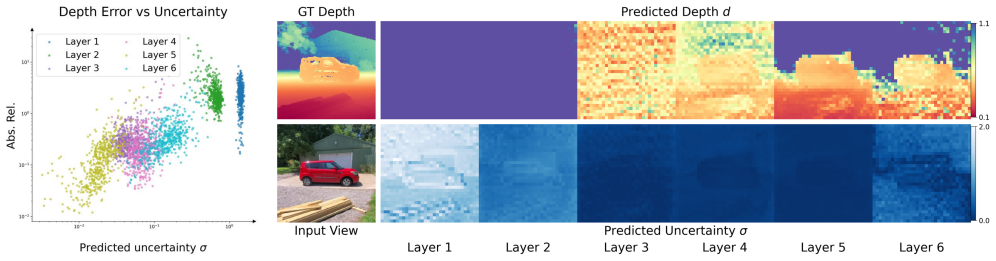
- The predicted depth is unsupervised yet meaningful: by deeper layers it becomes geometrically plausible, and per-token uncertainty tracks depth error, suggesting attention can discover scene structure without depth labels.
Where Pith is reading between the lines
- The expected-encoding trick is general: any positional feature with a bounded interval of uncertainty—not just depth along a ray—can be turned into a damped rotary encoding, which could transfer to track-based or flow-based position encodings where positions are noisy.
- Because depth and uncertainty are predicted per token per layer, RayRoPE can adapt its geometric locality at different abstraction levels; one testable extension is that increasing frequency bands should matter more on scenes with fine parallax than on distant-view datasets.
- A stricter implementation check: if the key-side inverse uses the literal matrix inverse rather than the expectation of the negative-angle encoding, attention scores gain an uncertainty ratio; comparing those two variants would isolate whether the reported gains come from the relative-position property or from uncertainty-based reweighting.
Editorial analysis
A structured set of objections, weighed in public.
Referee Report
Summary. The paper proposes RayRoPE, a relative positional encoding for multi-view transformers. Each patch token is represented as a ray segment whose depth is predicted per token (along with an uncertainty), and the ray is projected into the query camera frame. The authors derive an expected RoPE under a uniform depth-uncertainty distribution and claim the resulting attention depends only on relative projected positions, is SE(3)-invariant, multi-frequency, and geometry-adaptive. They validate the method by integrating it into LVSM, EscherNet, and UniMatch, reporting consistent improvements on novel-view synthesis and stereo depth estimation across multiple datasets.
Significance. If the derivation is corrected, RayRoPE would be a genuinely useful contribution: it provides a principled way to combine SE(3)-invariant relative encoding with multi-frequency RoPE and geometry-aware position adaptation. The empirical evaluation is extensive and consistent: Tables 1–3 show RayRoPE outperforming prior positional encodings on three datasets and three backbones, and the ablations in Table 4 support the importance of depth, uncertainty, and multi-frequency components. The paper also demonstrates generalization to varying numbers of reference views and out-of-domain scenes. However, the central theoretical claim—that the expected encoding preserves a pure relative-position dependency—is not established as written, which is a load-bearing issue that must be fixed before the paper can be accepted.
major comments (1)
- [§4.3, Eq. (10); Algorithm 1; §A.2, Eq. (11)] The claimed identity E[ρ(x_i)](E[ρ(x_j)])^{-1}=E[ρ(x_i-x_j)] is false with the damped expected encoding of Eqs. (8)–(9). Writing E[ρ(x)]=S(x)R(μ(x)) with S=sinc(ωΔ/2), the left side equals (S_i/S_j)R(μ_i-μ_j), whereas the right side equals S_i S_j R(μ_i-μ_j). The proof in §A.2 (Eq. 11) uses E[ρ(x_j)^{-1}], the expectation of the negative-angle encoding, which differs from (E[ρ(x_j)])^{-1} unless S_j=1. Algorithm 1's Enc^{-1} denotes the matrix inverse, so the implementation description contradicts the proof. Consequently, Eq. (7)'s relative-position-only form and the SE(3)-invariance argument are not established as written. Please correct Eq. (10) and Algorithm 1 to use the expected negative-angle encoding on the key/value side, or, if the literal inverse is used, state this explicitly and analyze the resulting per-token uncertainty ratio S_i/S_j.
minor comments (5)
- [Abstract] The '24% relative improvement on LPIPS in RE10K' is computed relative to the best baseline (PRoPE), not to the worst baseline in Table 1. Please state the reference method for these relative numbers.
- [§2] Typo: 'multivew' should be 'multi-view'.
- [Algorithm 1] The notation 'Enc^{-1}K' is ambiguous; use explicit matrix multiplication and clarify that the inverse is taken per 2x2 block when applying the encoding.
- [§5.1] '8× batch size' does not specify the effective batch size; report the exact number for the large models.
- [§A.2] The proof in the appendix should be labeled as proving a corrected version of Eq. (10), and the relationship between E[ρ(x)^{-1}] and (E[ρ(x)])^{-1} should be explicitly noted.
Circularity Check
No meaningful circularity: the RayRoPE derivation is self-contained and empirically anchored on held-out benchmarks; the only self-citation is a minor, non-load-bearing CO3D split reference.
full rationale
RayRoPE's derivation chain is not circular. The position representation x=(c,p_d) is defined from camera geometry and a per-token depth predicted by a linear layer; the expected RoPE (Eqs. 8-9) is an analytic Fourier expectation over a uniform ray segment, computed in closed form. The relative-position claim (Eqs. 6-7, 10) is a mathematical identity about RoPE rotations; it does not take its conclusion as an input, and any ambiguity about whether 'inverse' is taken before or after the expectation (as highlighted by the skeptic) is a correctness concern, not a circularity. The depth d and uncertainty sigma are unsupervised latent variables learned jointly with the model, not parameters fitted to the evaluation metrics. The empirical validation is performed on held-out external benchmarks (RE10K, CO3D, Objaverse, DL3DV, ScanNet), so the reported improvements are not forced by construction. The only author-overlapping citation is [48] (Cameras as Rays), used solely to define the CO3D train/eval split in Appendix B ('For CO3D [31], we follow the split in [48].'); this is a minor dataset-protocol reference and is not load-bearing for RayRoPE's derivation or for the reported gains. No step in the paper reduces by definition to its inputs, and no fitted quantity is renamed as a prediction. Score 2 reflects the single non-load-bearing self-citation; the central content is independent.
Axiom & Free-Parameter Ledger
free parameters (4)
- Per-token depth d (per attention layer) =
learned per-token (linear layer W_d, exp-activated); no direct supervision
- Per-token uncertainty sigma (per attention layer) =
learned per-token (linear layer W_sigma, exp-activated)
- RoPE frequency schedule and per-component scaling for the 6D projected ray =
unspecified in the paper
- Number of rays per patch (3, through patch corners) =
3
axioms (6)
- standard math Rotary position encoding satisfies rho(a) rho(b) = rho(a+b) and rho(x)^{-1} = rho(-x) (used in Eqs. 6-7 to reduce attention to relative positions)
- domain assumption Projective camera model P_i = K_i T_i with homogeneous ray/point representation (c, p_d)
- domain assumption Token features (and hence predicted d, sigma) are SE(3)-invariant functions of the inputs; global frame changes do not affect images
- ad hoc to paper Projected positions follow a uniform distribution componentwise on [x_min, x_max] (Eq. 8-9)
- ad hoc to paper Independence of x_i and x_j in the expected-RoPE factorization (Eq. 10; App. Eq. 11)
- ad hoc to paper The key-side inverse encoding in Eq. 6 is interpreted as E[rho(x_j)^{-1}] (expectation of the negative-angle encoding) rather than (E[rho(x_j)])^{-1} (matrix inverse of the damped matrix)
read the original abstract
We study positional encodings for multi-view transformers that process tokens from a set of posed input images, and seek a mechanism that encodes patches uniquely, allows SE(3)-invariant attention with multi-frequency similarity, and can adapt to the geometry of the underlying 3D scene. We find that prior (absolute or relative) encoding schemes for multi-view attention do not meet these desiderata, and present RayRoPE to address this gap. RayRoPE represents patch positions based on associated rays and computes query-frame projective coordinates to ensure SE(3) invariance. To adapt to scene geometry, RayRoPE predicts (without direct supervision) a per-token depth to obtain its position along the corresponding ray, while also modeling uncertainty and analytically computing the expected positional encoding. We validate our method on the tasks of novel-view synthesis, stereo depth estimation, and feed-forward 3DGS reconstruction. While remaining efficient, RayRoPE consistently improves over alternate position encoding schemes (e.g., 24% relative improvement on LPIPS in RE10K).
Figures




Forward citations
Cited by 9 Pith papers
-
CRePE: Curved Ray Expectation Positional Encoding for Unified-Camera-Controlled Video Generation
CRePE supplies depth-aware positional distributions along curved rays for stable unified-camera control in frozen video DiT models.
-
URoPE: Universal Relative Position Embedding across Geometric Spaces
URoPE is a parameter-free relative position embedding for transformers that works across arbitrary geometric spaces by ray sampling and projection, yielding consistent gains on novel view synthesis, 3D detection, trac...
-
EO-VGGT: Orbital Ray-Conditioned 3D Foundation Models for Satellite Multi-View Reconstruction
EO-VGGT introduces geometry-constrained view selection, a sensor-ray encoder, and a ray-pointing adapter to enable feed-forward 3D reconstruction from orbital satellite images.
-
DPPE: Rethinking Camera-Based Positional Encoding for Scaling Multi-View Transformers
DPPE decouples rotation and translation in camera positional encodings for multi-view transformers to resolve late-stage training stagnation and improve generalization in novel view synthesis.
-
RoVE: Rotary Value Embeddings Attention for Relative Position-dependent Value Pathways
RoVE rotates value embeddings simultaneously with keys in attention to make values position-dependent, reframing RoPE as attentive convolution and reporting gains on long-context tasks in 124M and 354M GPT-2 models.
-
Effective Multi-sensor Conditioning for Street-view Novel-view Synthesis
StreetNVS presents a multi-sensor conditioned video diffusion framework for street-view novel view synthesis that outperforms baselines with sparse LiDAR and handles extreme out-of-trajectory paths on the Waymo dataset.
-
PE-Field 4D: Video Generation Models as Canvas
Warping reference tokens' positional encodings into the target view, with depth offsets and frame-level compression fixes, improves geometry-aware camera control in video diffusion transformers.
-
RoVE: Rotary Value Embeddings Attention for Relative Position-dependent Value Pathways
Rotating value embeddings along with keys and queries (RoVE) converts RoPE attention into a block-Toeplitz attentive convolution and yields consistent gains across 124M and 354M GPT-2 models.
-
URoPE: Universal Relative Position Embedding across Geometric Spaces
RR2D reconstructs a virtual analog-domain covariance from partially observed hybrid array data via Toeplitz-constrained matrix completion, enabling practical hybrid SMI beamforming that outperforms direct hybrid SMI b...
Reference graph
Works this paper leans on
-
[1]
Ac3d: Analyzing and improving 3d camera control in video diffusion trans- formers
Sherwin Bahmani, Ivan Skorokhodov, Guocheng Qian, Ali- aksandr Siarohin, Willi Menapace, Andrea Tagliasacchi, David B Lindell, and Sergey Tulyakov. Ac3d: Analyzing and improving 3d camera control in video diffusion trans- formers. InCVPR, 2025. 1, 2
2025
-
[2]
Positional encoding field.arXiv preprint arXiv:2510.20385, 2025
Yunpeng Bai, Haoxiang Li, and Qixing Huang. Positional encoding field.arXiv preprint arXiv:2510.20385, 2025. 3
arXiv 2025
-
[3]
Emerg- ing properties in self-supervised vision transformers
Mathilde Caron, Hugo Touvron, Ishan Misra, Herv ´e J´egou, Julien Mairal, Piotr Bojanowski, and Armand Joulin. Emerg- ing properties in self-supervised vision transformers. In ICCV, 2021. 1, 2, 3
2021
-
[4]
pixelsplat: 3d gaussian splats from image pairs for scalable generalizable 3d reconstruction
David Charatan, Sizhe Li, Andrea Tagliasacchi, and Vincent Sitzmann. pixelsplat: 3d gaussian splats from image pairs for scalable generalizable 3d reconstruction. InCVPR, 2024. 13
2024
-
[5]
Scannet: Richly-annotated 3d reconstructions of indoor scenes
Angela Dai, Angel X Chang, Manolis Savva, Maciej Hal- ber, Thomas Funkhouser, and Matthias Nießner. Scannet: Richly-annotated 3d reconstructions of indoor scenes. In CVPR, 2017. 8
2017
-
[6]
Objaverse: A universe of annotated 3d objects
Matt Deitke, Dustin Schwenk, Jordi Salvador, Luca Weihs, Oscar Michel, Eli VanderBilt, Ludwig Schmidt, Kiana Ehsani, Aniruddha Kembhavi, and Ali Farhadi. Objaverse: A universe of annotated 3d objects. InCVPR, 2023. 5, 6, 9, 13, 14, 16
2023
-
[7]
Bert: Pre-training of deep bidirectional trans- formers for language understanding
Jacob Devlin, Ming-Wei Chang, Kenton Lee, and Kristina Toutanova. Bert: Pre-training of deep bidirectional trans- formers for language understanding. InNAACL-HLT, 2019. 2
2019
-
[8]
An image is worth 16x16 words: Transformers for image recognition at scale
Alexey Dosovitskiy, Lucas Beyer, Alexander Kolesnikov, Dirk Weissenborn, Xiaohua Zhai, Thomas Unterthiner, Mostafa Dehghani, Matthias Minderer, Georg Heigold, Syl- vain Gelly, Jakob Uszkoreit, and Neil Houlsby. An image is worth 16x16 words: Transformers for image recognition at scale. InICLR, 2021. 1, 2
2021
-
[9]
Hang Gao, Vikram V oleti, Aaryaman Vasishta, Chun-Han Yao, Mark Boss, Philip Torr, Christian Rupprecht, and Varun Jampani. Stable virtual camera: Generative view synthe- sis with diffusion models.arXiv preprint arXiv:2503.14489,
-
[10]
Cat3d: create anything in 3d with multi-view diffusion models
Ruiqi Gao, Aleksander Hoły ´nski, Philipp Henzler, Arthur Brussee, Ricardo Martin-Brualla, Pratul Srinivasan, Jonathan T Barron, and Ben Poole. Cat3d: create anything in 3d with multi-view diffusion models. InNeurIPS, 2024. 1, 2
2024
-
[11]
Daya Guo, Dejian Yang, Haowei Zhang, Junxiao Song, Ruoyu Zhang, Runxin Xu, Qihao Zhu, Shirong Ma, Peiyi Wang, Xiao Bi, et al. Deepseek-r1: Incentivizing reasoning capability in llms via reinforcement learning.arXiv preprint arXiv:2501.12948, 2025. 2
Pith/arXiv arXiv 2025
-
[12]
Rotary position embedding for vision transformer
Byeongho Heo, Song Park, Dongyoon Han, and Sangdoo Yun. Rotary position embedding for vision transformer. In ECCV, 2024. 2, 3, 13
2024
-
[13]
3d concept learn- ing and reasoning from multi-view images
Yining Hong, Chunru Lin, Yilun Du, Zhenfang Chen, Joshua B Tenenbaum, and Chuang Gan. 3d concept learn- ing and reasoning from multi-view images. InCVPR, 2023. 2
2023
-
[14]
Lrm: Large reconstruction model for single image to 3d
Yicong Hong, Kai Zhang, Jiuxiang Gu, Sai Bi, Yang Zhou, Difan Liu, Feng Liu, Kalyan Sunkavalli, Trung Bui, and Hao Tan. Lrm: Large reconstruction model for single image to 3d. InICLR, 2024. 2
2024
-
[15]
Odin: a single model for 2d and 3d segmentation
Ayush Jain, Pushkal Katara, Nikolaos Gkanatsios, Adam W Harley, Gabriel Sarch, Kriti Aggarwal, Vishrav Chaudhary, and Katerina Fragkiadaki. Odin: a single model for 2d and 3d segmentation. InCVPR, 2024. 2
2024
-
[16]
Lvsm: A large view synthesis model with minimal 3d inductive bias
Haian Jin, Hanwen Jiang, Hao Tan, Kai Zhang, Sai Bi, Tianyuan Zhang, Fujun Luan, Noah Snavely, and Zexiang Xu. Lvsm: A large view synthesis model with minimal 3d inductive bias. InICLR, 2025. 2, 5, 6, 13
2025
-
[17]
Segment any- thing
Alexander Kirillov, Eric Mintun, Nikhila Ravi, Hanzi Mao, Chloe Rolland, Laura Gustafson, Tete Xiao, Spencer White- head, Alexander C Berg, Wan-Yen Lo, et al. Segment any- thing. InICCV, 2023. 2
2023
-
[18]
Weijie Kong, Qi Tian, Zijian Zhang, Rox Min, Zuozhuo Dai, Jin Zhou, Jiangfeng Xiong, Xin Li, Bo Wu, Jianwei Zhang, et al. Hunyuanvideo: A systematic framework for large video generative models.arXiv preprint arXiv:2412.03603, 2024. 2, 3
Pith/arXiv arXiv 2024
-
[19]
Eschernet: A generative model for scalable view synthesis
Xin Kong, Shikun Liu, Xiaoyang Lyu, Marwan Taher, Xi- aojuan Qi, and Andrew J Davison. Eschernet: A generative model for scalable view synthesis. InCVPR, 2024. 1, 2, 3, 5, 6
2024
-
[20]
Cameras as relative positional encoding
Ruilong Li, Brent Yi, Junchen Liu, Hang Gao, Yi Ma, and Angjoo Kanazawa. Cameras as relative positional encoding. InNeurIPS, 2025. 1, 2, 3, 6, 8, 9, 13, 15, 16
2025
-
[21]
Learnable fourier features for multi-dimensional spatial po- sitional encoding
Yang Li, Si Si, Gang Li, Cho-Jui Hsieh, and Samy Bengio. Learnable fourier features for multi-dimensional spatial po- sitional encoding. InNeurIPS, 2021. 1
2021
-
[22]
Dl3dv-10k: A large-scale scene dataset for deep learning-based 3d vision
Lu Ling, Yichen Sheng, Zhi Tu, Wentian Zhao, Cheng Xin, Kun Wan, Lantao Yu, Qianyu Guo, Zixun Yu, Yawen Lu, et al. Dl3dv-10k: A large-scale scene dataset for deep learning-based 3d vision. InCVPR, 2024. 6
2024
-
[23]
Visual instruction tuning
Haotian Liu, Chunyuan Li, Qingyang Wu, and Yong Jae Lee. Visual instruction tuning. InNeurIPS, 2023. 2
2023
-
[24]
Zero-1-to-3: Zero-shot one image to 3d object
Ruoshi Liu, Rundi Wu, Basile Van Hoorick, Pavel Tok- makov, Sergey Zakharov, and Carl V ondrick. Zero-1-to-3: Zero-shot one image to 3d object. InICCV, 2023. 1, 2
2023
-
[25]
Scaling sequence-to- sequence generative neural rendering.arXiv preprint arXiv:2510.04236, 2025
Shikun Liu, Kam Woh Ng, Wonbong Jang, Jiadong Guo, Junlin Han, Haozhe Liu, Yiannis Douratsos, Juan C P ´erez, Zijian Zhou, Chi Phung, et al. Scaling sequence-to- sequence generative neural rendering.arXiv preprint arXiv:2510.04236, 2025. 2
Pith/arXiv arXiv 2025
-
[26]
Gta: A geometry-aware attention mechanism for multi-view transformers
Takeru Miyato, Bernhard Jaeger, Max Welling, and Andreas Geiger. Gta: A geometry-aware attention mechanism for multi-view transformers. InICLR, 2024. 1, 2, 3, 6, 8, 15, 16
2024
-
[27]
Train short, test long: Attention with linear biases enables input length extrapolation
Ofir Press, Noah A Smith, and Mike Lewis. Train short, test long: Attention with linear biases enables input length extrapolation. InICLR, 2022. 2 10
2022
-
[28]
Learn- ing transferable visual models from natural language super- vision
Alec Radford, Jong Wook Kim, Chris Hallacy, Aditya Ramesh, Gabriel Goh, Sandhini Agarwal, Girish Sastry, Amanda Askell, Pamela Mishkin, Jack Clark, et al. Learn- ing transferable visual models from natural language super- vision. InICML, 2021. 1, 2
2021
-
[29]
Exploring the limits of transfer learning with a unified text-to-text transformer
Colin Raffel, Noam Shazeer, Adam Roberts, Katherine Lee, Sharan Narang, Michael Matena, Yanqi Zhou, Wei Li, and Peter J Liu. Exploring the limits of transfer learning with a unified text-to-text transformer. InJMLR, 2020. 2
2020
-
[30]
Sam 2: Seg- ment anything in images and videos
Nikhila Ravi, Valentin Gabeur, Yuan-Ting Hu, Ronghang Hu, Chaitanya Ryali, Tengyu Ma, Haitham Khedr, Roman R¨adle, Chloe Rolland, Laura Gustafson, et al. Sam 2: Seg- ment anything in images and videos. InICLR, 2025. 3
2025
-
[31]
Com- mon objects in 3d: Large-scale learning and evaluation of real-life 3d category reconstruction
Jeremy Reizenstein, Roman Shapovalov, Philipp Henzler, Luca Sbordone, Patrick Labatut, and David Novotny. Com- mon objects in 3d: Large-scale learning and evaluation of real-life 3d category reconstruction. InICCV, 2021. 5, 6, 8, 9, 13
2021
-
[32]
High-resolution image syn- thesis with latent diffusion models
Robin Rombach, Andreas Blattmann, Dominik Lorenz, Patrick Esser, and Bj¨orn Ommer. High-resolution image syn- thesis with latent diffusion models. InCVPR, 2022. 2
2022
-
[33]
Learning the ropes: Better 2d and 3d position encodings with string
Connor Schenck, Isaac Reid, Mithun George Jacob, Alex Bewley, Joshua Ainslie, David Rendleman, Deepali Jain, Mohit Sharma, Kumar Avinava Dubey, Ayzaan Wahid, et al. Learning the ropes: Better 2d and 3d position encodings with string. InICML, 2025. 2
2025
-
[34]
Self- attention with relative position representations
Peter Shaw, Jakob Uszkoreit, and Ashish Vaswani. Self- attention with relative position representations. InNAACL,
-
[35]
Dinov3.arXiv preprint arXiv:2508.10104, 2025
Oriane Sim ´eoni, Huy V V o, Maximilian Seitzer, Federico Baldassarre, Maxime Oquab, Cijo Jose, Vasil Khalidov, Marc Szafraniec, Seungeun Yi, Micha ¨el Ramamonjisoa, et al. Dinov3.arXiv preprint arXiv:2508.10104, 2025. 1, 3
Pith/arXiv arXiv 2025
-
[36]
A benchmark for the eval- uation of rgb-d slam systems
J ¨urgen Sturm, Nikolas Engelhard, Felix Endres, Wolfram Burgard, and Daniel Cremers. A benchmark for the eval- uation of rgb-d slam systems. InIROS, 2012. 6, 8
2012
-
[37]
Roformer: Enhanced transformer with rotary position embedding.Neurocomputing, 568, 2024
Jianlin Su, Murtadha Ahmed, Yu Lu, Shengfeng Pan, Wen Bo, and Yunfeng Liu. Roformer: Enhanced transformer with rotary position embedding.Neurocomputing, 568, 2024. 2
2024
-
[38]
Bolt3d: Generating 3d scenes in seconds
Stanislaw Szymanowicz, Jason Y Zhang, Pratul Srinivasan, Ruiqi Gao, Arthur Brussee, Aleksander Holynski, Ricardo Martin-Brualla, Jonathan T Barron, and Philipp Henzler. Bolt3d: Generating 3d scenes in seconds. InICCV, 2025. 2
2025
-
[39]
Lgm: Large multi-view gaus- sian model for high-resolution 3d content creation
Jiaxiang Tang, Zhaoxi Chen, Xiaokang Chen, Tengfei Wang, Gang Zeng, and Ziwei Liu. Lgm: Large multi-view gaus- sian model for high-resolution 3d content creation. InECCV,
-
[40]
Llama: Open and efficient foundation language models
Hugo Touvron, Thibaut Lavril, Gautier Izacard, Xavier Martinet, Marie-Anne Lachaux, Timoth´ee Lacroix, Baptiste Rozi`ere, Naman Goyal, Eric Hambro, Faisal Azhar, et al. Llama: Open and efficient foundation language models. arXiv preprint arXiv:2302.13971, 2023. 2
Pith/arXiv arXiv 2023
-
[41]
Ummenhofer, H
B. Ummenhofer, H. Zhou, J. Uhrig, N. Mayer, E. Ilg, A. Dosovitskiy, and T. Brox. Demon: Depth and motion net- work for learning monocular stereo. InCVPR, 2017. 6, 8
2017
-
[42]
Attention is all you need
Ashish Vaswani, Noam Shazeer, Niki Parmar, Jakob Uszko- reit, Llion Jones, Aidan N Gomez, Łukasz Kaiser, and Illia Polosukhin. Attention is all you need. InNeurIPS, 2017. 1, 2
2017
-
[43]
Yiming Wang, Qihang Zhang, Shengqu Cai, Tong Wu, Jan Ackermann, Zhengfei Kuang, Yang Zheng, Frano Raji ˇc, Siyu Tang, and Gordon Wetzstein. Bullettime: Decoupled control of time and camera pose for video generation.arXiv preprint arXiv:2512.05076, 2025. 2
arXiv 2025
-
[44]
Sun3d: A database of big spaces reconstructed using sfm and object labels
Jianxiong Xiao, Andrew Owens, and Antonio Torralba. Sun3d: A database of big spaces reconstructed using sfm and object labels. InCVPR, 2013. 6, 8
2013
-
[45]
Unifying flow, stereo and depth estimation
Haofei Xu, Jing Zhang, Jianfei Cai, Hamid Rezatofighi, Fisher Yu, Dacheng Tao, and Andreas Geiger. Unifying flow, stereo and depth estimation. InTPAMI, 2023. 2, 6, 7, 8, 13
2023
-
[46]
Cogvideox: Text-to-video diffusion models with an expert transformer
Zhuoyi Yang, Jiayan Teng, Wendi Zheng, Ming Ding, Shiyu Huang, Jiazheng Xu, Yuanming Yang, Wenyi Hong, Xiao- han Zhang, Guanyu Feng, et al. Cogvideox: Text-to-video diffusion models with an expert transformer. InICLR, 2025. 3
2025
-
[47]
Cheng Zhang, Boying Li, Meng Wei, Yan-Pei Cao, Camilo Cruz Gambardella, Dinh Phung, and Jianfei Cai. Unified camera positional encoding for controlled video gen- eration.arXiv preprint arXiv:2512.07237, 2025. 2
arXiv 2025
-
[48]
Cameras as rays: Pose estimation via ray diffusion
Jason Y Zhang, Amy Lin, Moneish Kumar, Tzu-Hsuan Yang, Deva Ramanan, and Shubham Tulsiani. Cameras as rays: Pose estimation via ray diffusion. InICLR, 2024. 13
2024
-
[49]
Gs-lrm: Large recon- struction model for 3d gaussian splatting
Kai Zhang, Sai Bi, Hao Tan, Yuanbo Xiangli, Nanxuan Zhao, Kalyan Sunkavalli, and Zexiang Xu. Gs-lrm: Large recon- struction model for 3d gaussian splatting. InECCV, 2024. 2
2024
-
[50]
Stereo magnification: Learning view syn- thesis using multiplane images
Tinghui Zhou, Richard Tucker, John Flynn, Graham Fyffe, and Noah Snavely. Stereo magnification: Learning view syn- thesis using multiplane images. InACM SIGGRAPH, 2018. 5, 6, 8, 13
2018
-
[51]
Llava-3d: A simple yet effective pathway to empowering lmms with 3d-awareness
Chenming Zhu, Tai Wang, Wenwei Zhang, Jiangmiao Pang, and Xihui Liu. Llava-3d: A simple yet effective pathway to empowering lmms with 3d-awareness. InICCV, 2025. 2 11 RayRoPE: Projective Ray Positional Encoding for Multi-view Attention Supplementary Material A. Implementing RayRoPE A.1. Details on Applying RayRoPE The discussion in Sec. 4 focuses on apply...
2025
-
[52]
All other training and evaluation configurations are kept exactly the same as in the original paper. C. Runtime Efficiency Although our method necessitates computingNsets of en- codings and group-wise attention (Sec. A.1), we empiri- Figure 8.Comparison on runtime efficiency. RayRoPE main- tains a runtime efficiency highly comparable to PRoPE, with only a...
discussion (0)
Sign in with ORCID, Apple, or X to comment. Anyone can read and Pith papers without signing in.