Contagion Networks: Evaluator Preference Propagation in Multi-Agent LLM Systems
Pith reviewed 2026-06-29 04:50 UTC · model grok-4.3
The pith
Preferences among LLM evaluators propagate across multi-agent networks mainly through shared architectural priors rather than explicit prompts.
A machine-rendered reading of the paper's core claim, the machinery that carries it, and where it could break.
Core claim
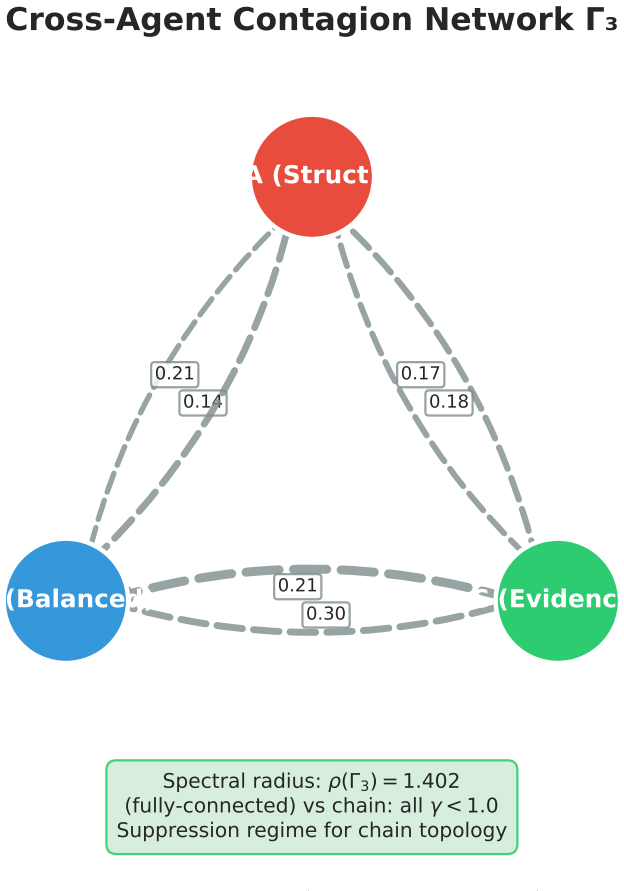
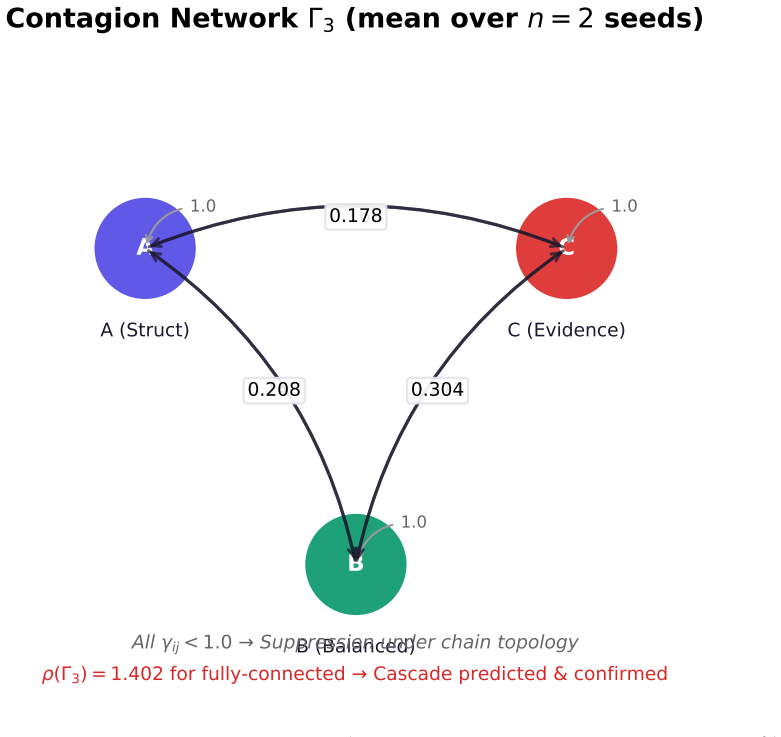
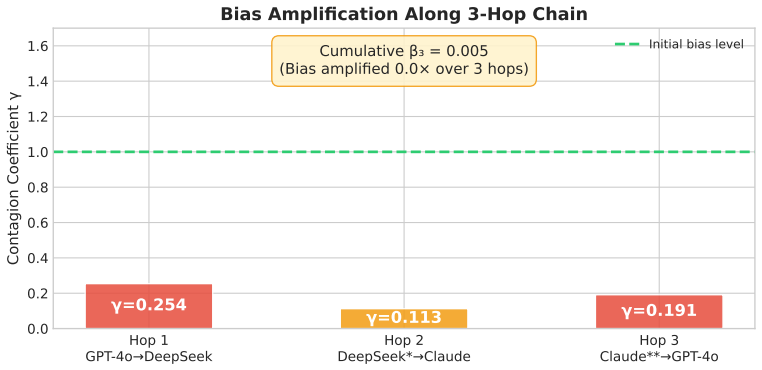
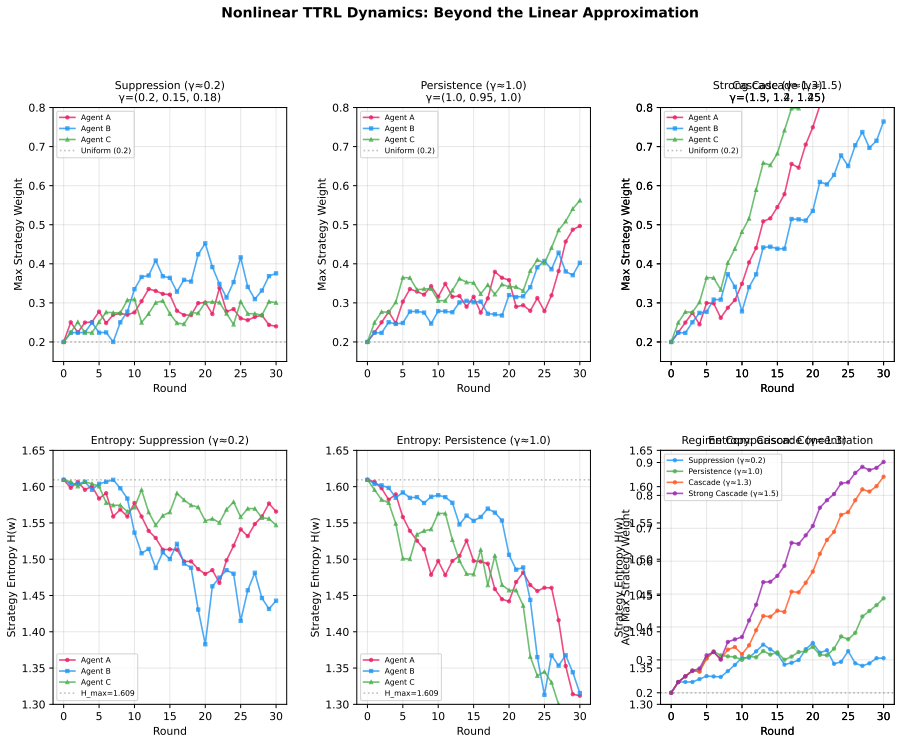
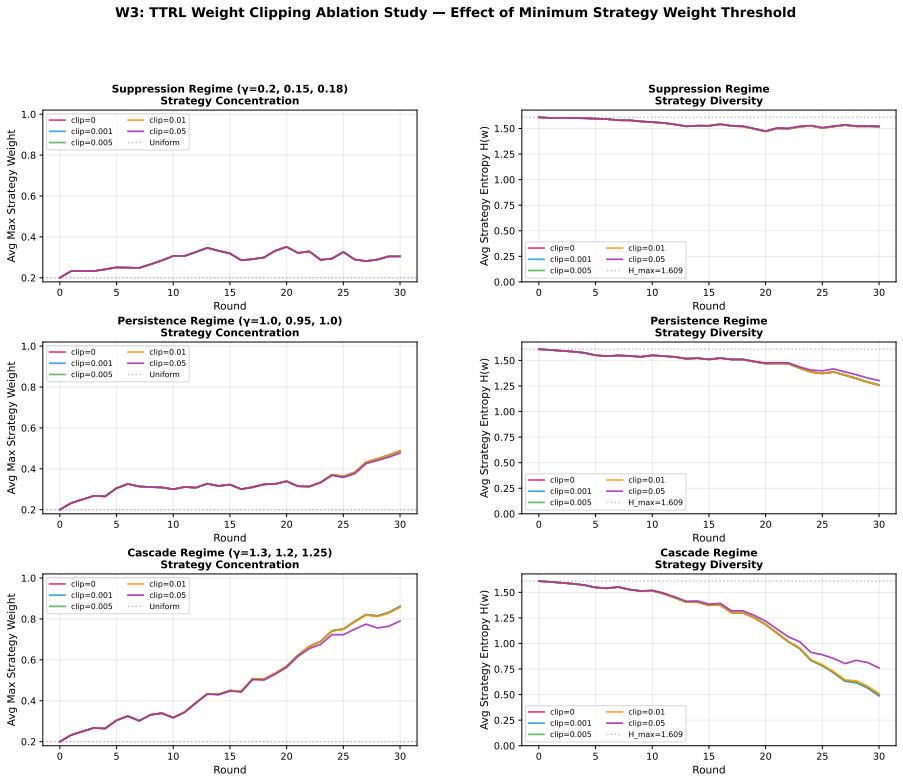
The paper claims that in a 3-agent DeepSeek-chat setup with distinct preference profiles, the Cross-Agent Contagion Matrix Gamma_3 records consistent propagation with gamma values in [0.157, 0.352], yet neutral prompts produce a higher spectral radius (1.498) than mixed prompts (1.299), indicating a -63.5 percent prompt contribution. Propagation falls into regimes set by rho(Gamma_N), with chain topology suppressing spread (beta_3 = 0.0126) and fully-connected topology allowing cascades, a pattern that holds across homogeneous and cross-model pools. Committee size increase from k=1 to k=3 reduces effective contagion by 68.9 percent.
What carries the argument
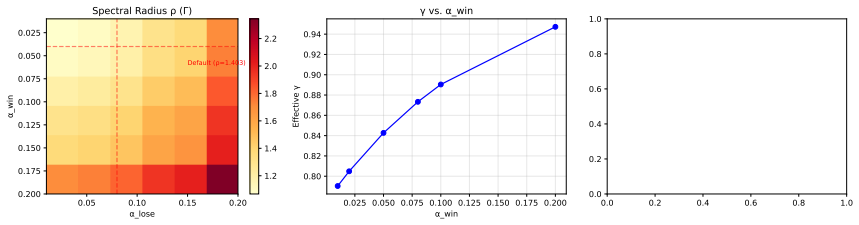
The Cross-Agent Contagion Matrix Gamma_N and its spectral radius rho(Gamma_N), which quantify preference spread strength and set the regime of propagation or suppression.
If this is right
- Chain topologies limit preference spread while fully-connected topologies increase it.
- Larger evaluator committees reduce contagion by roughly 69 percent.
- Shared model architecture produces stronger contagion than explicit preference prompts.
- The same topology-dependent regime shift appears in both single-model and cross-model agent groups.
Where Pith is reading between the lines
- The framework could be used to design agent connection patterns that intentionally limit unwanted preference alignment.
- Model selection decisions may shape collective behavior in agent groups more than individual prompt tuning.
- Committee sizing as a mitigation step might scale to systems with larger numbers of agents.
Load-bearing premise
The measured differences in contagion rates are caused by preference propagation rather than other uncontrolled factors in the 3-agent DeepSeek-chat setup or the specific prompt profiles chosen.
What would settle it
Repeating the neutral-prompt versus mixed-prompt comparison using agents built on unrelated model architectures and checking whether the difference in spectral radius values disappears or reverses.
Figures
read the original abstract
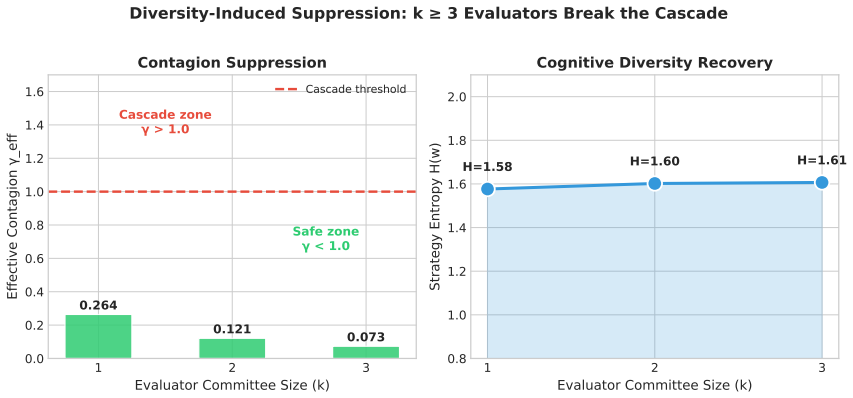
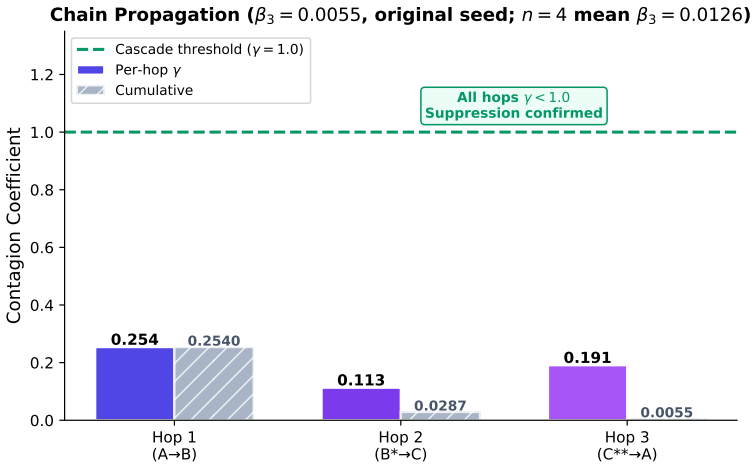
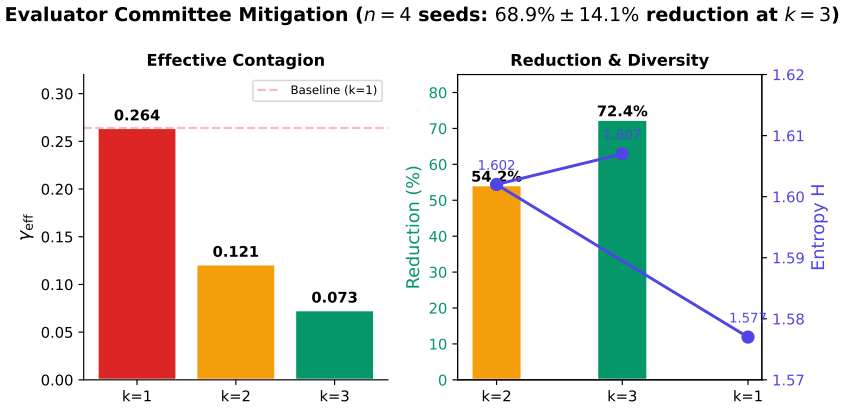
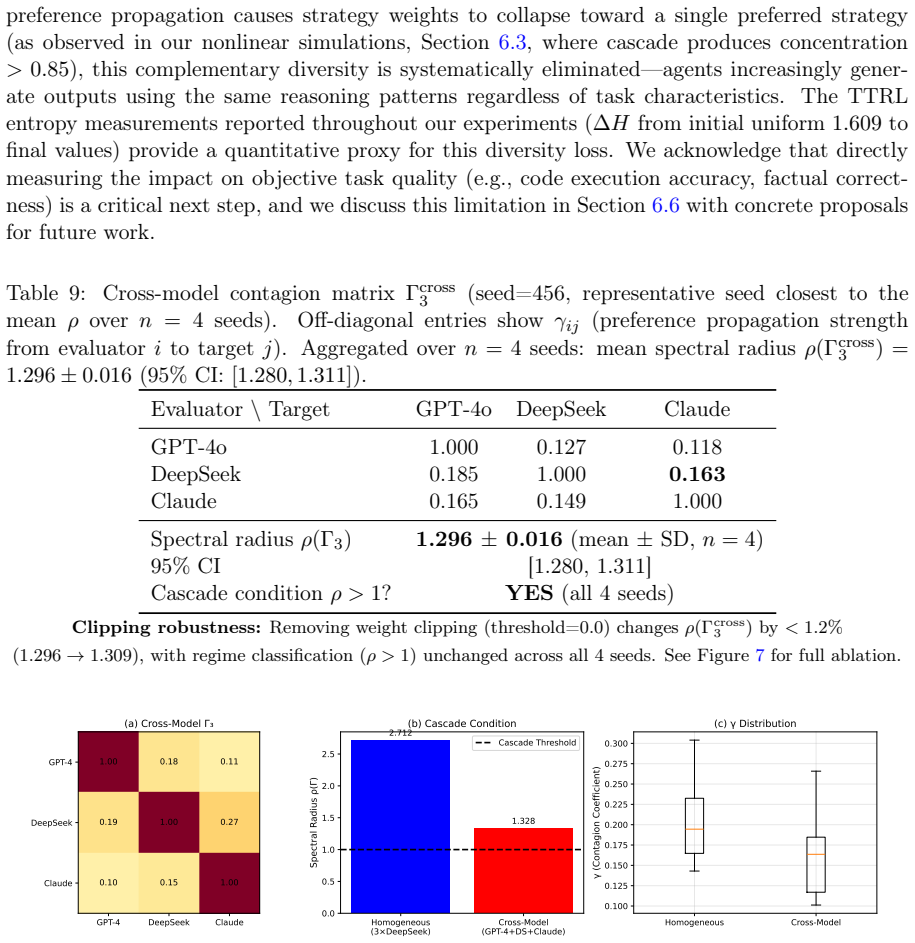
When large language models serve as evaluators in multi-agent systems, their strategy preferences -- whether induced by explicit prompts or by shared architectural priors -- propagate through the agent network. We introduce Contagion Networks, a formal framework for measuring how evaluator preferences spread across interacting LLM agents. In a controlled 3-agent experiment using DeepSeek-chat with three distinct evaluator preference profiles (structured, balanced, evidence-based), we measure the Cross-Agent Contagion Matrix Gamma_3 and find that preferences consistently propagate between agents (gamma in [0.157, 0.352]). A neutral-prompt control experiment reveals a counter-intuitive result: shared architectural priors dominate explicit preference prompts as the driver of contagion (rho_neutral = 1.498 vs. rho_mixed = 1.299; prompt contribution: -63.5%). We identify three propagation regimes governed by the spectral radius rho(Gamma_N) and demonstrate that the same agents suppress preference contagion in chain topology (beta_3 = 0.0126 +/- 0.0038, 95% CI [0.0089, 0.0163], n=4 seeds) but cascade in fully-connected topology (Delta H_avg = -0.020) -- a topology-dependent regime transition validated both for homogeneous and cross-model agent pools (rho^cross = 1.296 +/- 0.016, n=4). We show that increasing evaluator committee size from k=1 to k=3 reduces effective contagion by 68.9% +/- 14.1% (n=4 seeds), providing an actionable mitigation strategy. We release the open-source Contagion Network experimental framework.
Editorial analysis
A structured set of objections, weighed in public.
Referee Report
Summary. The paper introduces Contagion Networks as a framework for measuring how evaluator preferences propagate across interacting LLM agents. In a controlled 3-agent experiment with DeepSeek-chat using structured, balanced, and evidence-based profiles, it reports a Cross-Agent Contagion Matrix Gamma_3 with gamma values in [0.157, 0.352], finds shared architectural priors dominate explicit prompts (rho_neutral = 1.498 vs. rho_mixed = 1.299; prompt contribution -63.5%), identifies three regimes governed by the spectral radius rho(Gamma_N), shows topology-dependent effects (chain suppresses with beta_3 = 0.0126 +/- 0.0038 while fully-connected cascades with Delta H_avg = -0.020), and reports that increasing committee size from k=1 to k=3 reduces contagion by 68.9% +/- 14.1% (n=4 seeds). The open-source framework is released.
Significance. If the causal attribution to interaction-driven propagation holds, the work offers a quantitative approach to preference dynamics in multi-agent LLM evaluators, with actionable findings on topology and committee size as mitigations. The reproducible code release and use of confidence intervals with seed counts are strengths that support verification. The counter-intuitive dominance of model priors over prompts could influence preference engineering practices. Results are currently limited to DeepSeek-chat and the chosen profiles, so broader impact depends on validation in other settings.
major comments (2)
- [Abstract (controlled 3-agent experiment and neutral-prompt control)] Abstract (controlled 3-agent experiment and neutral-prompt control description): The central claim that gamma values, rho_neutral vs. rho_mixed differences, and topology effects are caused by preference propagation requires explicit documentation of the interaction protocol (message content passed between agents, temperature settings, and verification that agents condition on each others' outputs). Without these, shared model priors or prompt artifacts remain a plausible alternative for the measured Gamma_3 matrix and regime shifts, as the neutral-prompt control alone does not isolate interaction effects in the fixed DeepSeek-chat setup.
- [Propagation regimes (governed by spectral radius rho(Gamma_N))] Propagation regimes section (governed by spectral radius rho(Gamma_N)): The manuscript identifies three regimes based on rho(Gamma_N) and validates the topology-dependent transition for both homogeneous and cross-model pools (rho^cross = 1.296 +/- 0.016), but does not provide the explicit thresholds, derivation, or independent test linking the spectral radius to the observed beta_3 suppression or Delta H_avg cascade. This leaves the regime claims dependent on the specific experimental measurements rather than a general property of the matrix.
minor comments (2)
- [Abstract] The abstract reports quantitative results with 95% CIs and n=4 seeds but provides no pointer to the methods, equations for Gamma_3, or raw data; adding a brief methods reference would improve clarity.
- [Introduction/Methods] Notation for new entities (Contagion Networks, Gamma_3, beta_3) is introduced without a dedicated preliminary definitions subsection, which could be clarified for readers unfamiliar with the framework.
Simulated Author's Rebuttal
We thank the referee for the thorough review and valuable feedback on our manuscript. We address each major comment point by point below, providing clarifications and committing to revisions where they strengthen the paper without misrepresenting the existing experiments.
read point-by-point responses
-
Referee: [Abstract (controlled 3-agent experiment and neutral-prompt control)] Abstract (controlled 3-agent experiment and neutral-prompt control description): The central claim that gamma values, rho_neutral vs. rho_mixed differences, and topology effects are caused by preference propagation requires explicit documentation of the interaction protocol (message content passed between agents, temperature settings, and verification that agents condition on each others' outputs). Without these, shared model priors or prompt artifacts remain a plausible alternative for the measured Gamma_3 matrix and regime shifts, as the neutral-prompt control alone does not isolate interaction effects in the fixed DeepSeek-chat setup.
Authors: We agree that explicit documentation of the interaction protocol is necessary to fully support the causal interpretation. The neutral-prompt control compares contagion under mixed vs. neutral prompts within the same interacting setup, which isolates the incremental effect of explicit prompts beyond architectural priors; however, we acknowledge that without detailed protocol description this isolation may not be immediately clear to readers. In the revised manuscript we will add a dedicated 'Interaction Protocol' subsection in the Methods that specifies: (i) the exact message content and format passed between agents, (ii) temperature and other generation parameters, and (iii) verification steps confirming agents condition on prior outputs. This will allow readers to assess whether shared priors or artifacts remain plausible alternatives. revision: yes
-
Referee: [Propagation regimes (governed by spectral radius rho(Gamma_N))] Propagation regimes section (governed by spectral radius rho(Gamma_N)): The manuscript identifies three regimes based on rho(Gamma_N) and validates the topology-dependent transition for both homogeneous and cross-model pools (rho^cross = 1.296 +/- 0.016), but does not provide the explicit thresholds, derivation, or independent test linking the spectral radius to the observed beta_3 suppression or Delta H_avg cascade. This leaves the regime claims dependent on the specific experimental measurements rather than a general property of the matrix.
Authors: The regimes are motivated by standard results from linear dynamical systems, where the spectral radius rho(Gamma_N) determines stability: rho < 1 implies asymptotic decay of preference deviations, rho = 1 implies marginal persistence, and rho > 1 implies amplification. We will add explicit numerical thresholds together with a short derivation from the matrix iteration x_{t+1} = Gamma_N x_t in the revised Propagation regimes section. The topology-dependent transitions (chain suppression vs. fully-connected cascade) are demonstrated empirically for both homogeneous and cross-model pools, providing evidence that the spectral-radius prediction holds beyond a single measurement set. While a fully independent theoretical simulation (e.g., on synthetic matrices) is not present in the current draft, the cross-model validation already moves the claim beyond purely experiment-specific observations; we will clarify this distinction in the revision. revision: partial
Circularity Check
No circularity; all central quantities are direct experimental measurements
full rationale
The paper defines Contagion Networks as a measurement framework and reports empirical values (Gamma_3 matrix entries, rho_neutral vs rho_mixed, beta_3, Delta H, committee-size reduction) obtained from controlled LLM agent runs. No equations derive predictions from fitted parameters, no self-citations supply load-bearing uniqueness theorems, and spectral radius is applied as standard linear algebra to the observed matrix. The derivation chain consists of data collection and standard post-processing with no reduction to inputs by construction.
Axiom & Free-Parameter Ledger
axioms (2)
- domain assumption Evaluator preferences can be reliably induced and distinguished by the three prompt profiles (structured, balanced, evidence-based) in the DeepSeek-chat model.
- domain assumption The Cross-Agent Contagion Matrix Gamma_N and its spectral radius rho(Gamma_N) correctly quantify preference propagation across agent interactions.
invented entities (2)
-
Contagion Networks
no independent evidence
-
Cross-Agent Contagion Matrix Gamma_3
no independent evidence
Forward citations
Cited by 1 Pith paper
-
Delayed Verification Destabilizes Multi-Agent LLM Belief: Instability Thresholds and Optimal Corrector Placement
Models delayed verification in multi-agent LLMs as graph consensus, derives stability thresholds (inverse golden ratio for delay two) via grounded Laplacian, and gives a supermodular greedy rule for corrector placemen...
Reference graph
Works this paper leans on
-
[1]
Z. Liu.Multimodal Evaluator Preference Collapse: Cross-Modal Contagion in Self-Evolving Agents.arXiv:2606.16682, 2026
Pith/arXiv arXiv 2026
-
[2]
Zheng, W.-L
L. Zheng, W.-L. Chiang, Y. Sheng, et al.Judging LLM-as-a-Judge with MT-Bench and Chatbot Arena.NeurIPS, 2023
2023
-
[3]
X. Li, T. Zhang, Y. Dubois, et al.AlpacaEval: An Automatic Evaluator of Instruction- following Models.ICLR, 2024
2024
-
[4]
W. Yuan, R. Y. Pang, K. Cho, et al.Self-Rewarding Language Models.ICML, 2024
2024
-
[5]
L. Gao, J. Schulman, and J. Hilton.Scaling Laws for Reward Model Overoptimization. ICML, 2023
2023
-
[6]
Sharma, E
M. Sharma, E. Tong, T. Korbak, et al.Towards Understanding Sycophancy in Language Models.ICLR, 2024
2024
-
[7]
Q. Wu, G. Bansal, J. Zhang, et al.AutoGen: Enabling Next-Gen LLM Applications via Multi-Agent Conversation.ICML, 2024
2024
-
[8]
S. Hong, M. Zhuge, J. Chen, et al.MetaGPT: Meta Programming for Multi-Agent Collab- orative Framework.ICLR, 2024
2024
-
[9]
W. Chen, Y. Su, J. Zuo, et al.AgentVerse: Facilitating Multi-Agent Collaboration and Exploring Emergent Behaviors.ICLR, 2024
2024
-
[10]
J. S. Park, J. C. O’Brien, C. J. Cai, et al.Generative Agents: Interactive Simulacra of Human Behavior.UIST, 2023
2023
-
[11]
C. Qian, X. Cong, W. Liu, et al.ChatDev: Communicative Agents for Software Develop- ment.ACL, 2024
2024
-
[12]
C.-M. Chan, W. Chen, Y. Su, et al.ChatEval: Towards Better LLM-based Evaluators through Multi-Agent Debate.ICLR, 2024
2024
-
[13]
Robbins and S
H. Robbins and S. Monro.A Stochastic Approximation Method.Ann. Math. Stat., 22(3):400–407, 1951
1951
-
[14]
Pastor-Satorras, C
R. Pastor-Satorras, C. Castellano, P. Van Mieghem, et al.Epidemic Processes in Complex Networks.Rev. Mod. Phys., 87(3):925–979, 2015
2015
-
[15]
A. Arora et al.Population Size and Emergent Bias/Alignment Dynamics in Multi-Agent LLMs.arXiv:2510.22422, 2025
arXiv 2025
-
[16]
Chen et al.Multi-Agent Implicit Gender Bias and Amplification.arXiv:2410.02584, 2025
Y. Chen et al.Multi-Agent Implicit Gender Bias and Amplification.arXiv:2410.02584, 2025
arXiv 2025
-
[17]
Wang et al.Alignment Tipping Process.arXiv:2510.04860, 2025
Z. Wang et al.Alignment Tipping Process.arXiv:2510.04860, 2025. 33
arXiv 2025
-
[18]
Zhang et al.Self-Consuming Performative Loop.arXiv:2601.05184, 2025
L. Zhang et al.Self-Consuming Performative Loop.arXiv:2601.05184, 2025
arXiv 2025
-
[19]
Lee et al.RandomBench: On Stochastic Collapse.arXiv:2606.05874, 2025
S. Lee et al.RandomBench: On Stochastic Collapse.arXiv:2606.05874, 2025
Pith/arXiv arXiv 2025
-
[20]
Park et al.Solar: Fairness Monitor Agent.arXiv:2605.00382, 2025
J. Park et al.Solar: Fairness Monitor Agent.arXiv:2605.00382, 2025
Pith/arXiv arXiv 2025
-
[21]
Ouyang, J
L. Ouyang, J. Wu, X. Jiang, et al.Training Language Models to Follow Instructions with Human Feedback.NeurIPS, 2022
2022
-
[22]
Y. Du, S. Li, J. Ding, et al.Improving Factuality and Reasoning in Large Language Models through Multiagent Debate.ICML, 2024
2024
-
[23]
Liang et al.A Survey on Large Language Model based Autonomous Agents.Frontiers of Computer Science, 2024
P. Liang et al.A Survey on Large Language Model based Autonomous Agents.Frontiers of Computer Science, 2024
2024
-
[24]
L. Pan, A. Korthikanti, M. Brahmbhatt, et al.Improving Code Generation by Training with Human Feedback on Execution.arXiv:2303.05330, 2023. A Proof of Propagation Regime Theorem Proof.Letw (t) ∈R N be the vector of strategy concentration indices (e.g.,maxk w(t) ik , the max- imum strategy weight for each agent) at iterationt. In the linear regime near the...
Pith/arXiv arXiv 2023
-
[25]
In the suppression regime (ρ(ΓN)≈1), all off-diagonal terms are small relative to the self- influence term (γij ≪1), and the dominant eigenvalue is dominated by the unit diagonal
-
[26]
A" or "B
In the cascade regime (ρ(ΓN)>1), the off-diagonal structure creates a cyclic feedback path (e.g.,A→B→C→A) with net gain>1, which is captured by the spectral radius exceeding the baseline of 1. The key insight:ρ(Γ N)−1measures the excess growth contributed by network structure alone. This is mathematically valid regardless of whether the full state transit...
discussion (0)
Sign in with ORCID, Apple, or X to comment. Anyone can read and Pith papers without signing in.