REVIEW 4 major objections 5 minor 46 references
The paper proposes EELMA, a method that estimates how much control a language-model agent exerts over future states, and shows this 'empowerment' score tracks average task performance across games and web browsing.
Reviewed by Pith at T0; open to challenge. T0 means a machine referee read the full paper against a public rubric. the ladder, T0–T4 →
T0 review · deepseek-v4-flash
2026-08-04 14:49 UTC pith:BOQ3GXOI
load-bearing objection A useful proof-of-concept with a clean toy validation, but the estimator's constant cancellation and WebArena's n=3 correlations need work before the results fully land. the 4 major comments →
Estimating the Empowerment of Language Model Agents
The pith
A machine-rendered reading of the paper's core claim, the machinery that carries it, and where it could break.
Core claim
EELMA approximates effective empowerment by learning two contrastive InfoNCE critics—one that encodes a state, and one that encodes a state–action pair—and subtracting their dot products with a future-state encoder. This difference estimates the mutual information between the agent's action and a discounted future state, marginalizing over the LM policy. Empirically, the estimated empowerment strongly correlates with mean discounted reward across varied environments and agent configurations: r = 0.91 for Chain-of-Thought vs. base in Gridworld, r = 0.70–0.85 across open and closed models, and Spearman correlations of 0.83–0.94 in three WebArena domains. The paper interprets this as evidence t
What carries the argument
The central mechanism is the difference of two InfoNCE-based mutual-information estimators. State and action text are embedded with a pretrained language model plus a fine-tunable MLP; two encoders, one for state-only and one for state–action, are trained contrastively against a future-state encoder. At convergence, the log-ratio log P(s*|s,a)/P(s*|s) is recovered as the difference of the two dot products, up to additive constants that are assumed equal. This converts high-dimensional, sparse text observations into a tractable estimate of effective empowerment, defined as the average discounted mutual information between the current action and a future state sampled under geometric discounti
Load-bearing premise
The estimate treats the two InfoNCE normalizing constants as equal even though they come from different encoders, and the discount factor used to sample future states is never specified, so the exact quantity being measured is not fully pinned down.
What would settle it
Run EELMA on a fixed set of trajectories while varying the discount factor γ used to sample future states; if the resulting empowerment scores change in a way that reorders agents, then the claimed objective is not well-defined. Alternatively, construct an environment where one agent can reach many distinct states but fails all goal-relevant tasks (e.g., aimless browsing in WebArena) and test whether empowerment still tracks reward; the Shopping domain's flat relationship already hints at such a failure mode.
If this is right
- If EELMA's estimates reflect true empowerment, then one can rank or compare LM agents on capability without needing task-specific reward functions or human-designed goals.
- The strong correlation with average discounted reward implies that empowerment could serve as a cheap, continuous monitoring signal during training or deployment, detecting when an agent gains or loses control over its environment.
- The robustness to natural-language paraphrasing suggests EELMA can be applied in realistic text environments where states are described variably, not just in structured games.
- The authentication case study shows empowerment can flag actions that expand access or control, potentially identifying power-seeking behavior without predefined threat models.
- The method's sensitivity to chain-of-thought, memory length, and model scale gives a quantitative handle on how agentic capabilities change with design choices.
Where Pith is reading between the lines
- A natural extension is to use empowerment as an intrinsic reward or objective for training agents to be generally capable in open-ended environments, since it does not require a specified goal to be optimized.
- The flat empowerment–reward relationship in the Shopping domain suggests empowerment alone may understate performance bottlenecks that come from reasoning rather than control; one could test this by inserting a reasoning-heavy sub-task into an otherwise high-control environment and checking whether empowerment fails to track reward.
- Because EELMA learns from trajectory data, it could be applied in a fully offline setting to audit precollected agent logs, without any additional environment interaction.
- The unspecified discount factor γ in the EELMA sampling procedure is a tunable knob; if the correlation with reward is sensitive to γ, then the metric's objectivity is weakened, and reporting γ across experiments would make comparisons more meaningful.
Editorial analysis
A structured set of objections, weighed in public.
Referee Report
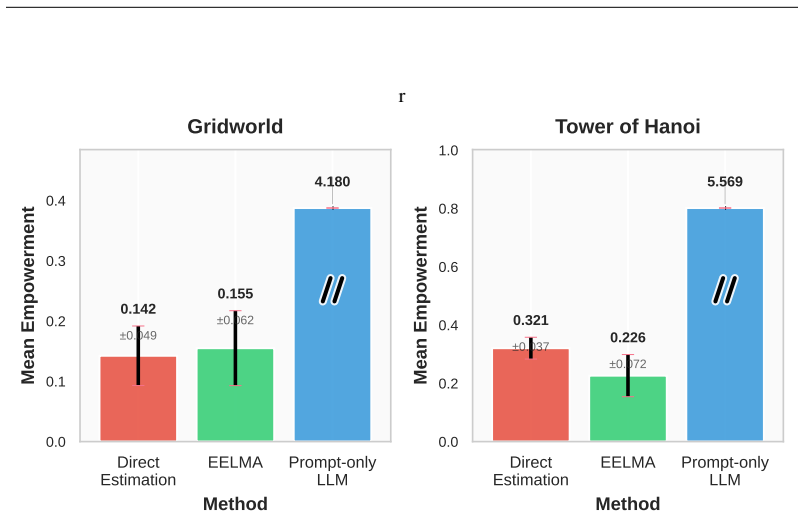
Summary. The paper proposes EELMA, an InfoNCE-based estimator of effective empowerment for language model agents acting in text environments. Effective empowerment is defined as discounted mutual information between an agent's current action and a geometric-horizon future state. EELMA trains two contrastive critics—one state-only and one state-action—and estimates empowerment as the difference of their log-ratio predictions. The method is validated in Gridworld and Tower of Hanoi against direct (tabular) empowerment estimates, including under paraphrased natural-language observations, and then applied to WebArena across four domains and three LLMs. The central empirical claim is that EELMA's empowerment estimates strongly correlate with mean discounted reward across agent variations (CoT, memory, model family/scale), supporting empowerment as a goal-agnostic proxy for LM-agent capability. A case study on authentication actions is presented as evidence that high-empowerment actions mark pivotal moments.
Significance. If the central claim holds, EELMA would provide a scalable, goal-agnostic complement to benchmark-based evaluation of LM agents, with potential uses in capability monitoring and safety screening. The paper's strengths are concrete: the Gridworld/ToH validation against direct empowerment is clean and gives a rare ground-truth check for a contrastive empowerment estimator; the robustness experiments under natural-language paraphrase are informative; the comparison against a prompt-only LLM estimator is a useful negative result; and the code is publicly released. The theoretical bridge to goal-averaged reward is borrowed from Myers et al. and is stated with assumptions, which is appropriate. However, the central estimator's identifiability and the strength of the WebArena correlation claims are not yet fully established, and several statistical details need tightening before the main claim can be accepted at face value.
major comments (4)
- [Section 3, Eqs. (5)–(7)] The derivation of Eq. (7) assumes that the additive constants C1 and C2 in Eqs. (5)–(6) cancel. At the InfoNCE optimum, each critic recovers its log-density ratio only up to an arbitrary constant that depends on the encoder and the objective; nothing in the two separate losses ties these constants. Thus the subtracted quantity is log p(s*|s,a)/p(s*|s) + C1 - C2, not necessarily the desired mutual information. The toy-domain validation is encouraging but does not establish the general case, and WebArena has no ground truth. The paper should either prove that C1 = C2 (e.g., by construction of the encoders), impose a calibration constraint, or provide a direct way to measure or bound the offset in the settings where the metric is claimed.
- [Section 3, Eq. (1); Algorithm 1; Appendix D.1] The definition of effective empowerment depends on the discount factor γ through the future-state sampling distribution τ ~ Geom(1−γ), but Algorithm 1 does not specify γ or the exact empirical sampling procedure for the tuples (s_t, a_t, s_*). Appendix B.1 mentions γ=0.9 for the maximum-empowerment calculation, but not for EELMA. Without specifying γ and the sampling distribution, the estimated objective is not well defined, and values across domains and experiments cannot be compared quantitatively. Please report these hyperparameters and, if the same γ is not used everywhere, explain the implications for the cross-domain comparisons.
- [Section 5, Figure 7 and Table 3] The WebArena correlation claim is based on only three models per domain, with no confidence intervals, and the Shopping domain shows a flat relationship between empowerment and discounted reward. The paper's explanation—that reasoning about prices is a bottleneck independent of empowerment—is post hoc. If the metric is presented as a general goal-agnostic proxy for agentic capability, a flat relation in one of four domains is a substantive qualification, not a minor caveat. Please report bootstrap or other uncertainty intervals for the Spearman correlations, and either add more model/data points or explicitly delimit the claim to domains where environment control, rather than task-specific reasoning, is the limiting factor.
- [Figure 8, Figure 10, Appendix C.2; also Figure 4] The t-tests comparing valid versus invalid authentication actions treat individual typing actions as independent observations, but these actions are nested within trajectories (702 valid and 287 invalid actions across 182 trajectories). The same issue affects the valid/invalid action comparison in Figure 4. Such tests overstate statistical significance and can make the diagnostic claim look stronger than the data support. Please use trajectory-level aggregation, mixed-effects models, or cluster-robust permutation tests.
minor comments (5)
- [Throughout] There are multiple typos and formatting errors: 'environemnts', 'corrsponding', 'Comparment', 'authientification', and an inconsistent use of 'EELMA (NL)' vs 'NL-EELMA'. These should be corrected.
- [Appendix B] The sentence 'we provide supplementary information to support the WebArena results in Section 4' should refer to Section 5, where the WebArena results actually appear.
- [Section 3, Eq. (1)] The notation in the definition of E(π_LM) is confusing: the conditioning 'I(a_t; s* | a)' should be 'I(a_t; s* | s_t)', and the outer expectation should be made explicit. Please rewrite this equation to clarify that the mutual information is already averaged over s_t, a_t, and s*.
- [Appendix D.1] The temperature τ is described as 'updated over training' and 'adaptively trainable', but the loss in Eq. (8) treats it as a fixed hyperparameter. Please state explicitly whether τ is learned, what its final value is, and whether sensitivity to τ was assessed.
- [Figure 6] The figure reports Pearson correlations in the left panel (r = 0.91, 0.70, 0.71, 0.85) but the text discusses model families and sizes. It would be helpful to add per-panel sample sizes and confidence intervals, and to clarify whether the correlations are across the individual model points or across the ablation groups.
Circularity Check
No significant circularity: EELMA is an empirical estimator validated against direct computation, and the reward correlations are measured rather than forced by the estimator's construction.
full rationale
The paper's central derivation chain is not circular. EELMA is trained exclusively on (state, action, future state) tuples through an InfoNCE objective; reward signals and task goals never enter the training loss. The claimed correlations between estimated empowerment and mean discounted reward are therefore empirical findings, not quantities fitted by construction. The theoretical connection between empowerment and reward is imported from external prior work (Myers et al., 2025) with explicitly stated assumptions (uniform reward prior, ergodicity, Boltzmann rationality), and the paper does not rely on a self-citation chain to force its conclusions. In the toy domains, EELMA is checked against direct empowerment estimation computed from empirical transition counts, providing an independent, if same-data, validation. The main technical caveat is Eq. (7): the subtraction of the two InfoNCE critics cancels the log C1 and log C2 constants from Eqs. (5)-(6) only if those constants are equal or otherwise known, and the paper does not prove this; similarly, the discount gamma used when sampling future states is not specified. These are correctness and rigor gaps that could bias the estimates, but they are not cases where the paper's predictions reduce to its inputs by definition, nor do they involve load-bearing self-citations. The paper also openly reports a domain (Shopping) where the empowerment-reward relationship is flat, which further indicates the correlation is not an artifact of the estimator's construction. Overall, no circular step is exhibited.
Axiom & Free-Parameter Ledger
free parameters (4)
- Discount factor γ for EELMA future-state sampling =
not specified in paper
- InfoNCE temperature τ =
initialized 1.0, trainable
- Batch size K (negative sample count) =
256
- Training steps =
10,000 (approx.)
axioms (5)
- standard math InfoNCE is a valid lower bound on mutual information
- domain assumption Text environments are fully observable MDPs with T(s'|s,a)
- domain assumption InfoNCE critics converge to the log-density ratio up to constants (Eqs. 5-6)
- ad hoc to paper Skill Coverage, Ergodicity, Boltzmann rationality (Appendix A.2)
- domain assumption Pretrained text embeddings preserve the state information relevant to MI
Cite this review
Pith. "Pith review of Estimating the Empowerment of Language Model Agents." pith.science (2026). https://pith.science/paper/BOQ3GXOI
@misc{pith2026250922504,
  author       = {Pith},
  title        = {Pith review of: Estimating the Empowerment of Language Model Agents},
  year         = {2026},
  howpublished = {\url{https://pith.science/paper/BOQ3GXOI}},
  note         = {Machine review of arXiv:2509.22504}
}
read the original abstract
As language model (LM) agents become increasingly capable and adopted in real-world applications, there is a growing need for scalable evaluation frameworks beyond costly, manually designed benchmarks. We propose information-theoretic evaluation based on empowerment, an information-theoretic measure of an agent's influence on future states through its actions. To handle the unique challenges of text-based environments, we introduce EELMA (Estimating Empowerment of Language Model Agents), an algorithm for approximating effective empowerment from multi-turn text interactions. We demonstrate EELMA on textual games and realistic web and tool-use environments, showing that empowerment strongly correlates with average task performance. We further analyze how empowerment varies across models, environment complexity, and agent configurations, and show that high-empowerment states and actions often mark pivotal moments for general capabilities. These results establish empowerment as a goal-agnostic metric that complements task-success measures for LM-agent evaluation.
Figures


Reference graph
Works this paper leans on
-
[1]
write newline
" write newline "" before.all 'output.state := FUNCTION n.dashify 't := "" t empty not t #1 #1 substring "-" = t #1 #2 substring "--" = not "--" * t #2 global.max substring 't := t #1 #1 substring "-" = "-" * t #2 global.max substring 't := while if t #1 #1 substring * t #2 global.max substring 't := if while FUNCTION format.date year duplicate empty "emp...
-
[2]
Llama 3 models
Meta AI. Llama 3 models. https://ai.facebook.com/llama-3, 2024
2024
-
[3]
Rest meets react: Self-improvement for multi-step reasoning llm agent
Renat Aksitov, Sobhan Miryoosefi, Zonglin Li, Daliang Li, Sheila Babayan, Kavya Kopparapu, Zachary Fisher, Ruiqi Guo, Sushant Prakash, Pranesh Srinivasan, Manzil Zaheer, Felix Yu, and Sanjiv Kumar. Rest meets react: Self-improvement for multi-step reasoning llm agent. arXiv preprint arXiv:2312.10003, 2023. URL https://arxiv.org/abs/2312.10003
Pith/arXiv arXiv 2023
-
[4]
Swe-bench+: Enhanced coding benchmark for llms
Reem Aleithan, Haoran Xue, Mohammad Mahdi Mohajer, Elijah Nnorom, Gias Uddin, and Song Wang. Swe-bench+: Enhanced coding benchmark for llms. arXiv preprint arXiv:2410.06992, 2024
Pith/arXiv arXiv 2024
-
[5]
Balrog: Benchmarking agentic llm and vlm reasoning on games
Anonymous. Balrog: Benchmarking agentic llm and vlm reasoning on games. In International Conference on Learning Representations, 2024
2024
-
[6]
Claude 3 (haiku, sonnet)
Anthropic. Claude 3 (haiku, sonnet). https://www.anthropic.com/claude-3, 2024
2024
-
[7]
An algorithm for computing the capacity of arbitrary discrete memoryless channels
Suguru Arimoto. An algorithm for computing the capacity of arbitrary discrete memoryless channels. IEEE Transactions on Information Theory, 18 0 (1): 0 14--20, 1972
1972
-
[8]
wav2vec 2.0: A framework for self-supervised learning of speech representations
Alexei Baevski, Yuhao Zhou, Abdelrahman Mohamed, and Michael Auli. wav2vec 2.0: A framework for self-supervised learning of speech representations. In Advances in Neural Information Processing Systems, volume 33, pp.\ 12449--12460, 2020
2020
-
[9]
Information prioritization through empowerment in visual model-based rl
Homanga Bharadhwaj, Mohammad Babaeizadeh, Dumitru Erhan, and Sergey Levine. Information prioritization through empowerment in visual model-based rl. In International Conference on Learning Representations, 2022
2022
-
[10]
Llms struggle with perception, not reasoning (arc-agi)
Mikel Bober-Irizar. Llms struggle with perception, not reasoning (arc-agi). https://anokas.substack.com/p/llms-struggle-with-perception-not-reasoning-arcagi, January 2025. Accessed: 2025-05-15
2025
-
[11]
Qwen 2.5 models
Alibaba Cloud. Qwen 2.5 models. https://modelscope.cn/models/qwen, 2024
2024
-
[12]
Gemma models
Google DeepMind. Gemma models. https://deepmind.google/gemma, 2023
2023
-
[13]
Yilun Du, Shie Tiomkin, Emre Kiciman, Daniel Polani, Pieter Abbeel, and Anca D. Dragan. AvE : Assistance via empowerment. In Advances in Neural Information Processing Systems 33 (NeurIPS 2020), pp.\ 4560--4571, 2020
2020
-
[14]
Revisit the arimoto-blahut algorithm: New analysis with approximation, 2025
Michail Fasoulakis, Konstantinos Varsos, and Apostolos Traganitis. Revisit the arimoto-blahut algorithm: New analysis with approximation, 2025. URL https://arxiv.org/abs/2407.06013
Pith/arXiv arXiv 2025
-
[15]
Jina embeddings 2: 8192-token general-purpose text embeddings for long documents, 2023
Michael Günther, Jackmin Ong, Isabelle Mohr, Alaeddine Abdessalem, Tanguy Abel, Mohammad Kalim Akram, Susana Guzman, Georgios Mastrapas, Saba Sturua, Bo Wang, Maximilian Werk, Nan Wang, and Han Xiao. Jina embeddings 2: 8192-token general-purpose text embeddings for long documents, 2023
2023
-
[16]
Carlos E. Jimenez, John Yang, Alex L. Zhang, Kilian Lieret, Joyce Yang, Xindi Wu, Ori Press, Niklas Muennighoff, Gabriel Synnaeve, Karthik R. Narasimhan, Diyi Yang, Sida Wang, and Ofir Press. Can language models resolve real-world github issues? arXiv preprint arXiv:2310.06770, 2023
Pith/arXiv arXiv 2023
-
[17]
Empowerment for continuous agent--environment systems
Tobias Jung, Daniel Polani, and Peter Stone. Empowerment for continuous agent--environment systems. Adaptive Behavior, 19 0 (1): 0 16--39, 2011. doi:10.1177/1059712310392389
-
[18]
Empowerment: A universal agent-centric measure of control
Alexander S Klyubin, Daniel Polani, and Chrystopher L Nehaniv. Empowerment: A universal agent-centric measure of control. In 2005 IEEE Congress on Evolutionary Computation, volume 1, pp.\ 128--135. IEEE, 2005
2005
-
[19]
Deuksin Kwon, Emily Weiss, Tara Kulshrestha, Kushal Chawla, Gale M. Lucas, and Jonathan Gratch. Are llms effective negotiators? systematic evaluation of the multifaceted capabilities of llms in negotiation dialogues, 2024. URL https://arxiv.org/abs/2402.13550
Pith/arXiv arXiv 2024
-
[20]
Gonzalez, Hao Zhang, and Ion Stoica
Woosuk Kwon, Zhuohan Li, Siyuan Zhuang, Ying Sheng, Lianmin Zheng, Cody Hao Yu, Joseph E. Gonzalez, Hao Zhang, and Ion Stoica. Efficient memory management for large language model serving with pagedattention. In Proceedings of the 29th ACM Symposium on Operating Systems Principles (SOSP). ACM, 2023. doi:10.1145/3600006.3613165. URL https://arxiv.org/abs/2...
arXiv 2023
-
[21]
Le-Khac, Graham Healy, and Alan F
Phuc H. Le-Khac, Graham Healy, and Alan F. Smeaton. Contrastive representation learning: A framework and review. IEEE Access, 8: 0 193907–193934, 2020. ISSN 2169-3536. doi:10.1109/access.2020.3031549. URL http://dx.doi.org/10.1109/ACCESS.2020.3031549
arXiv 2020
-
[22]
Stride: A tool-assisted llm agent framework for strategic and interactive decision-making, 2024
Chuanhao Li, Runhan Yang, Tiankai Li, Milad Bafarassat, Kourosh Sharifi, Dirk Bergemann, and Zhuoran Yang. Stride: A tool-assisted llm agent framework for strategic and interactive decision-making, 2024. URL https://arxiv.org/abs/2405.16376
Pith/arXiv arXiv 2024
-
[23]
Zebralogic: On the scaling limits of llms for logical reasoning
Bill Yuchen Lin, Ronan Le Bras, Kyle Richardson, Ashish Sabharwal, Radha Poovendran, Peter Clark, and Yejin Choi. Zebralogic: On the scaling limits of llms for logical reasoning. arXiv preprint arXiv:2502.01100, 2025
Pith/arXiv arXiv 2025
-
[24]
Vila: On pre-training for visual language models, 2024
Ji Lin, Hongxu Yin, Wei Ping, Yao Lu, Pavlo Molchanov, Andrew Tao, Huizi Mao, Jan Kautz, Mohammad Shoeybi, and Song Han. Vila: On pre-training for visual language models, 2024. URL https://arxiv.org/abs/2312.07533
Pith/arXiv arXiv 2024
-
[25]
Variational information maximisation for intrinsically motivated reinforcement learning
Shakir Mohamed and Danilo Jimenez Rezende. Variational information maximisation for intrinsically motivated reinforcement learning. In Advances in Neural Information Processing Systems, pp.\ 2125--2133, 2015
2015
-
[26]
Learning to assist humans without inferring rewards, 2025
Vivek Myers, Evan Ellis, Sergey Levine, Benjamin Eysenbach, and Anca Dragan. Learning to assist humans without inferring rewards, 2025. URL https://arxiv.org/abs/2411.02623
Pith/arXiv arXiv 2025
-
[27]
Gpt-3.5 turbo
OpenAI. Gpt-3.5 turbo. https://platform.openai.com/docs/models/gpt-3-5, 2023 a
2023
-
[28]
OpenAI. Gpt-4. https://openai.com/blog/gpt-4, 2023 b
2023
-
[29]
OpenAI. Gpt-4o. https://openai.com/blog/gpt-4o, 2024
2024
-
[30]
Autonomous evaluation and refinement of digital agents
Jiayi Pan, Yichi Zhang, Nicholas Tomlin, Yifei Zhou, Sergey Levine, and Alane Suhr. Autonomous evaluation and refinement of digital agents. arXiv preprint arXiv:2404.06474, 2024
Pith/arXiv arXiv 2024
-
[31]
Evaluating frontier models for dangerous capabilities
M Phuong, M Aitchison, E Catt, S Cogan, A Kaskasoli, V Krakovna, D Lindner, M Rahtz, Y Assael, S Hodkinson, et al. Evaluating frontier models for dangerous capabilities. arxiv. arXiv preprint arXiv:2403.13793, 2024
Pith/arXiv arXiv 2024
-
[32]
Learning transferable visual models from natural language supervision
Alec Radford, Jong Wook Kim, Chris Hallacy, Aditya Ramesh, Gabriel Goh, Sandhini Agarwal, Girish Sastry, Amanda Askell, Pamela Mishkin, Jack Clark, Gretchen Krueger, and Ilya Sutskever. Learning transferable visual models from natural language supervision. In International Conference on Machine Learning, pp.\ 8748--8763. PMLR, 2021
2021
-
[33]
Zimmermann, and Wieland Brendel
Evgenia Rusak, Patrik Reizinger, Attila Juhos, Oliver Bringmann, Roland S. Zimmermann, and Wieland Brendel. Infonce: Identifying the gap between theory and practice, 2025. URL https://arxiv.org/abs/2407.00143
Pith/arXiv arXiv 2025
-
[34]
Empowerment—an introduction
Christoph Salge, Cornelius Glackin, and Daniel Polani. Empowerment—an introduction. In Guided Self-Organization: Inception, pp.\ 67--114. Springer, 2014
2014
-
[35]
Toolformer: Language models can teach themselves to use tools
Timo Schick, Jane Dwivedi - Yu, Roberto Dess ` i , Roberta Raileanu, Maria Lomeli, Luke Zettlemoyer, Nicola Cancedda, and Thomas Scialom. Toolformer: Language models can teach themselves to use tools. arXiv preprint arXiv:2302.04761, 2023
Pith/arXiv arXiv 2023
-
[36]
Stanley and Joel Lehman
Kenneth O. Stanley and Joel Lehman. Why Greatness Cannot Be Planned: The Myth of the Objective. Springer, 2015. ISBN 978-3-319-15523-4
2015
-
[37]
Parametrically retargetable decision-makers tend to seek power
Alexander Matt Turner and Prasad Tadepalli. Parametrically retargetable decision-makers tend to seek power. In Advances in Neural Information Processing Systems, volume 35, pp.\ 31391--31401, 2022. URL https://arxiv.org/abs/2206.13477
Pith/arXiv arXiv 2022
-
[38]
Optimal policies tend to seek power
Alexander Matt Turner, Logan Smith, Rohin Shah, Andrew Critch, and Prasad Tadepalli. Optimal policies tend to seek power. In Advances in Neural Information Processing Systems 34 (NeurIPS 2021), 2021
2021
-
[39]
Multilingual e5 text embeddings: A technical report
Liang Wang, Nan Yang, Xiaolong Huang, Linjun Yang, Rangan Majumder, and Furu Wei. Multilingual e5 text embeddings: A technical report. arXiv preprint arXiv:2402.05672, 2024
Pith/arXiv arXiv 2024
-
[40]
Osworld: Benchmarking multimodal agents for open-ended tasks in real computer environments, 2024
Tianbao Xie, Danyang Zhang, Jixuan Chen, Xiaochuan Li, Siheng Zhao, Ruisheng Cao, Toh Jing Hua, Zhoujun Cheng, Dongchan Shin, Fangyu Lei, Yitao Liu, Yiheng Xu, Shuyan Zhou, Silvio Savarese, Caiming Xiong, Victor Zhong, and Tao Yu. Osworld: Benchmarking multimodal agents for open-ended tasks in real computer environments, 2024
2024
-
[41]
A-mem: Agentic memory for llm agents
Wujiang Xu, Zujie Liang, Kai Mei, Hang Gao, Juntao Tan, and Yongfeng Zhang. A-mem: Agentic memory for llm agents. arXiv preprint arXiv:2502.12110, 2025
Pith/arXiv arXiv 2025
-
[42]
React: Synergizing reasoning and acting in language models
Shunyu Yao, Jeffrey Zhao, Dian Yu, Nan Du, Izhak Shafran, Karthik Narasimhan, and Yuan Cao. React: Synergizing reasoning and acting in language models. In International Conference on Learning Representations (ICLR), 2023. URL https://arxiv.org/abs/2210.03629
Pith/arXiv arXiv 2023
-
[43]
Webarena: A realistic web environment for building autonomous agents
Shuyan Zhou, Frank F Xu, Hao Zhu, Xuhui Zhou, Robert Lo, Abishek Sridhar, Xianyi Cheng, Tianyue Ou, Yonatan Bisk, Daniel Fried, et al. Webarena: A realistic web environment for building autonomous agents. arXiv preprint arXiv:2307.13854, 2023
Pith/arXiv arXiv 2023
-
[44]
@esa (Ref
\@ifxundefined[1] #1\@undefined \@firstoftwo \@secondoftwo \@ifnum[1] #1 \@firstoftwo \@secondoftwo \@ifx[1] #1 \@firstoftwo \@secondoftwo [2] @ #1 \@temptokena #2 #1 @ \@temptokena \@ifclassloaded agu2001 natbib The agu2001 class already includes natbib coding, so you should not add it explicitly Type <Return> for now, but then later remove the command n...
-
[45]
\@lbibitem[] @bibitem@first@sw\@secondoftwo \@lbibitem[#1]#2 \@extra@b@citeb \@ifundefined br@#2\@extra@b@citeb \@namedef br@#2 \@nameuse br@#2\@extra@b@citeb \@ifundefined b@#2\@extra@b@citeb @num @parse #2 @tmp #1 NAT@b@open@#2 NAT@b@shut@#2 \@ifnum @merge>\@ne @bibitem@first@sw \@firstoftwo \@ifundefined NAT@b*@#2 \@firstoftwo @num @NAT@ctr \@secondoft...
-
[46]
@open @close @open @close and [1] URL: #1 \@ifundefined chapter * \@mkboth \@ifxundefined @sectionbib * \@mkboth * \@mkboth\@gobbletwo \@ifclassloaded amsart * \@ifclassloaded amsbook * \@ifxundefined @heading @heading NAT@ctr thebibliography [1] @ \@biblabel @NAT@ctr \@bibsetup #1 @NAT@ctr @ @openbib .11em \@plus.33em \@minus.07em 4000 4000 `\.\@m @bibit...
discussion (0)
Sign in with ORCID, Apple, or X to comment. Anyone can read and Pith papers without signing in.