REVIEW 2 major objections 5 minor 1 cited by
This paper establishes that alternating imaginary-time evolution with projective measurements produces mixed-state phase transitions with critical exponents that do not match any known equilibrium universality class.
Reviewed by Pith at T0; open to challenge. T0 means a machine referee read the full paper against a public rubric. the ladder, T0–T4 →
T0 review · deepseek-v4-flash
2026-08-03 23:42 UTC pith:BWNGQ2ZP
load-bearing objection The QMC method and the transitions look credible, but the new-universality-class claim is not yet supported. the 2 major comments →
Mixed-State Phase Transitions in Measurement-Dressed Imaginary-Time Evolution
The pith
A machine-rendered reading of the paper's core claim, the machinery that carries it, and where it could break.
Core claim
The central claim is that the stationary mixed state of the MDITE protocol undergoes a genuine phase transition controlled by how often projective measurements interrupt imaginary-time filtering. For the 1D TFIM with a transverse field above its critical value, a high measurement rate suppresses transverse-field coherence and drives the state into a mixed ferromagnetic phase; for the 2D CDHM, measurements drive the state into a z-axis staggered Ising-type ordered phase. Binder-ratio crossings locate the critical points, and data collapse of the magnetization gives stable values beta/nu approximately 0.40 in 1D and 0.90 in 2D. The authors assert that the ratio beta/nu is universal while the i
What carries the argument
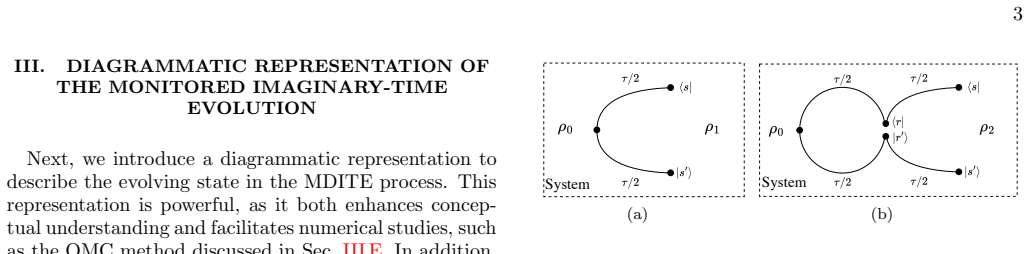
The central object is the generalized partition function summed over all measurement ensembles, where each ensemble is weighted by the measurement probability p and the number of measured qubits, and the quantum Monte Carlo sampling uses merge-split updates to connect replicas at measurement-induced interfaces. This diagrammatic representation, together with standard cluster updates, lets the simulations grow large clusters when measurements are frequent, giving an intuitive picture of measurement-enhanced order. The Binder ratio serves as the symmetry-breaking diagnostic, and finite-size scaling of the absolute magnetization extracts the critical exponents.
Load-bearing premise
The load-bearing premise is that data collapse on chains up to L=192 and 2D lattices up to L=48 already shows the asymptotic scaling, and that a single ratio beta/nu with path-dependent individual exponents defines one universality class; without a renormalization-group or correction-to-scaling analysis, the extracted exponents could be drifting effective values.
What would settle it
Perform the same MDITE quantum Monte Carlo simulation at the reported critical points on larger systems and fit with explicit corrections to scaling; if beta/nu shifts beyond error bars from about 0.40 in 1D or about 0.90 in 2D, or if the collapse requires an L-dependent exponent, the new-universality-class claim fails. Independently, extracting beta/nu from a different estimator, such as the Binder-ratio crossing or the correlation-length ratio, and finding inconsistent values would also falsify the single-class assertion.
If this is right
- If the claim is correct, the measurement rate is a practical control knob that orders a decohered mixed state along a Z2-type axis, detectable with ordinary magnetization rather than information-theoretic probes.
- A stable beta/nu across p-, tau-, and coupling-driven transitions implies a continuous critical surface in the parameter space rather than isolated critical points.
- The new quantum Monte Carlo method extends mixed-state phase transition studies to large systems and higher dimensions for any sign-problem-free Hamiltonian, including those relevant to spontaneous symmetry breaking and topological order.
- The loss of conformal symmetry at finite protocol parameters signals that finite-protocol MDITE criticality cannot be captured by an equilibrium conformal field theory, giving a concrete nonequilibrium target for further analysis.
- The transition should be observable on quantum hardware such as Rydberg arrays, superconducting qubits, or trapped ions, where both imaginary-time evolution and projective measurement are available.
Where Pith is reading between the lines
- One extension the paper leaves implicit: the path dependence of nu and beta with a fixed beta/nu suggests the critical manifold may be a line of fixed points where only one scaling combination is stable; a direct renormalization-group treatment of the MDITE channel would test whether this weak-universality picture survives beyond the finite-size scaling analysis.
- Because the 2D transition breaks only the discrete Z2 symmetry while the continuous symmetry remains unbroken, testing dephasing channels aligned with different spin axes would separate the effect of basis alignment and could reveal qualitatively different critical behavior.
- The same diagrammatic construction could be used to compute entanglement negativity or other mixed-state correlations at the reported critical points, providing independent scaling dimensions that would either reinforce or undercut the claim that beta/nu alone defines the new universality class.
Editorial analysis
A structured set of objections, weighed in public.
Referee Report
Summary. The paper introduces measurement-dressed imaginary-time evolution (MDITE), in which a maximally mixed state is repeatedly evolved with e^{-τH} and interspersed with probabilistic computational-basis measurements. A diagrammatic representation maps the protocol to a partition function over an extended ensemble, enabling an SSE-type QMC method. For the 1D transverse-field Ising model and the 2D columnar dimerized Heisenberg model, the authors report stationary-state transitions as p, τ, or a Hamiltonian parameter is varied, with spontaneous Z2-like order at large p and a disordered phase at small p. Finite-size scaling of ⟨|m|⟩ gives Binder-ratio crossings and data collapses with exponents in Tables I-VI. The paper claims a new, nonstandard universality class characterized by a universal β/ν (≈0.40 in 1D, ≈0.90 in 2D), even though individual ν and β vary with the tuning path. The abstract also claims a continuous-limit Choi-Jamiolkowski equilibrium description with conformal criticality and a violation of the conformal cross-ratio form at finite protocol parameters, but this analysis does not appear in the body.
Significance. If correct, the results establish a scalable and sign-problem-free QMC approach to mixed-state criticality from the competition between imaginary-time filtering and projective measurements, and they identify a potentially new universality class in open quantum systems. The numerical evidence for the existence of the transitions is credible: exact L=10 checks, clean Binder-ratio crossings, and stability of fitted parameters with increasing Lmin. The methodological contribution — the diagrammatic representation and the merge-split QMC algorithm — is valuable and extendable. However, the headline 'new universality class' rests on the nonstandard claim that β/ν is universal while ν and β are path-dependent; the paper supplies no RG or correction-to-scaling support for this concept. In addition, the abstract advertises a Choi-Jamiolkowski/conformal analysis that is missing from the manuscript. These issues must be addressed before the central claim can be accepted.
major comments (2)
- [Sec. IV E; Sec. V C; Eq. (8); Tables I–VI] The claimed 'new universality class' rests on β/ν being universal while ν and β are path-dependent. This is non-standard RG behavior. Tables I–VI show ν≈1.07–1.19 and β≈0.42–0.48 in 1D, and ν≈0.71–0.80 and β≈0.65–0.72 in 2D, with a constant ratio. The collapse uses only L=112–192 (1D) and L=24–48 (2D), with no correction-to-scaling terms; Ref. [84] is cited for the concept, but no fixed-point analysis is given. The extracted β/ν may be an effective exponent. Add an RG/correction-to-scaling test, or a joint fit with common β/ν; otherwise soften the claim.
- [Abstract vs. main text] The abstract states that in the continuous limit the Choi–Jamiolkowski mapping gives a tractable equilibrium description with conformal criticality, and that at finite protocol parameters the four-point correlator violates the conformal cross-ratio form. The main text (Sections I–VI, Appendices A–D) contains no Choi–Jamiolkowski mapping, no continuous-limit derivation, no four-point correlator, and no cross-ratio analysis. This advertised result is missing. Either add the analysis or remove the claim from the abstract.
minor comments (5)
- [Table IV caption] The caption says (τ,g)=(3.5,1), but the corresponding text (Sec. V C, Fig. 9(a)) uses (τ,g)=(1,3.5); the caption appears to swap the values.
- [Sec. IV E; Sec. V C] The text describes the mechanism as operating for 'short imaginary-time steps (τh≪1)' and (τg≪1), but the main examples have τh=1.8 and τg=3.5. Clarify the parameter regime in which the argument applies.
- [Table I] The Lmin=160 row reports β/ν = 0.397(96); the error bar appears to be a typo (likely 0.397(8) or similar). Check all tables for typographical errors.
- [Figs. 5 and 8; Tables I–VI] Stationary-state convergence is demonstrated only at a single parameter point per model. Reporting autocorrelation times or independent-sample error bars for the FSS fits would strengthen the numerical claims.
- [Throughout] Minor typos: 'characterstics' (Introduction), 'themeasurement-dressed' (Introduction), 'stimulation' for 'simulation' in Appendix B, and the q1/q2 labels in Fig. 4 are not defined in the caption.
Circularity Check
New-universality-class conclusion imports its defining premise from the authors' own Ref. [84].
specific steps
-
self citation load bearing
[Sec. IV E, paragraph supporting the 'single universality class when p>0' claim (just after the discussion of the unified mechanism).]
"In the nonequilibrium universality class considered here, the ratio β/ν remains universal, whereas the individual critical exponents β and ν can depend on the path along which the critical point is approached. Consequently, different parameter trajectories may exhibit distinct values of β and ν, while their ratio β/ν, which governs the leading finite-size scaling of the magnetization, remains the same [84]."
The paper's central 'new universality class' claim depends on the premise that β/ν is universal even while ν and β vary with the path. That premise is not derived in this paper; it is imported solely from Ref. [84], authored by current coauthors (Zhe Wang and Zheng Yan). Without this imported premise, Tables I–VI would show only path-dependent effective exponents, and the data collapse alone could not establish a unique universality class. Thus the classification step reduces to a load-bearing self-citation rather than to an independent output of the simulations.
full rationale
The MDITE protocol, diagrammatic representation, and QMC algorithm are self-contained: the critical points pc, τc, hc/gc and the exponents ν, β are outputs of Binder crossings and finite-size data collapse, not inputs to the construction. No fitted parameter is renamed as a prediction, and no equation-level reduction (Eq. X = Eq. Y by construction) is present. The single significant circularity concern is the load-bearing use of Ref. [84] to justify the unusual universality-class criterion (fixed β/ν with path-dependent ν and β), which is what converts the numerical effective exponents into the paper's headline 'new universality classes.' Because that key premise comes from the authors' own prior work and is not independently re-derived here, the central classification claim is partially circular, though the underlying numerical transition phenomenology retains independent content.
Axiom & Free-Parameter Ledger
free parameters (18)
- p_c (1D TFIM, p-driven) =
0.667
- nu (1D TFIM, p-driven) =
1.08
- beta (1D TFIM, p-driven) =
0.43
- tau_c (1D TFIM, tau-driven) =
0.265
- nu (1D TFIM, tau-driven) =
1.19
- beta (1D TFIM, tau-driven) =
0.48
- h_c (1D TFIM, h-driven) =
1.84
- nu (1D TFIM, h-driven) =
1.18
- beta (1D TFIM, h-driven) =
0.46
- p_c (2D CDHM, p-driven) =
0.354
- nu (2D CDHM, p-driven) =
0.714
- beta (2D CDHM, p-driven) =
0.650
- tau_c (2D CDHM, tau-driven) =
0.468
- nu (2D CDHM, tau-driven) =
0.80
- beta (2D CDHM, tau-driven) =
0.72
- g_c (2D CDHM, g-driven) =
2.806
- nu (2D CDHM, g-driven) =
0.74
- beta (2D CDHM, g-driven) =
0.65
axioms (5)
- domain assumption Projective measurement channel M_p is a probabilistic dephasing in the computational basis, applied before each ITE step (Eq. 1).
- domain assumption The SSE cluster-update plus merge-split procedure in Appendix B satisfies detailed balance and samples Eq. (6) without bias.
- domain assumption A stationary state rho_nd exists and is reached at nd=2L/tau for all studied parameters.
- standard math Finite-size scaling hypothesis <m> ~ L^{-beta/nu} f(g L^{1/nu}) applies (Sec. IV E).
- ad hoc to paper A universality class can be identified by the ratio beta/nu even when nu and beta vary with the tuning path.
Cite this review
Pith. "Pith review of Mixed-State Phase Transitions in Measurement-Dressed Imaginary-Time Evolution." pith.science (2026). https://pith.science/paper/BWNGQ2ZP
@misc{pith2026251104402,
  author       = {Pith},
  title        = {Pith review of: Mixed-State Phase Transitions in Measurement-Dressed Imaginary-Time Evolution},
  year         = {2026},
  howpublished = {\url{https://pith.science/paper/BWNGQ2ZP}},
  note         = {Machine review of arXiv:2511.04402}
}
read the original abstract
Motivated by the ubiquity of decoherence in quantum hardware and the growing role of imaginary-time evolution (ITE) in quantum algorithms, we investigate how many-body correlations generated by imaginary-time filtering are modified by local decoherence. We introduce measurement-dressed imaginary-time evolution (MDITE), which alternates ITE with projective-measurement channels, producing a competition between low-energy filtering and local dephasing. By developing a new efficient quantum Monte Carlo method, we uncover MDITE mixed-state transitions with spontaneous-symmetry-breaking signatures in the driving of 1D transverse-field Ising and 2D columnar dimerized Heisenberg Hamiltonians in the resulting density matrices. In the continuous limit, the Choi-Jamiolkowski mapping yields a tractable equilibrium description with conformal criticality that qualitatively captures the phase transitions. At finite protocol parameters, however, the four-point correlator violates the conformal cross-ratio form and the critical exponents deviate from their continuous-limit values, signaling the loss of conformal symmetry and richer nonequilibrium criticality. Our results establish MDITE as a controlled setting for exploring mixed-state phases and critical phenomena driven by the interplay between imaginary-time filtering and decoherence.
Figures


Forward citations
Cited by 1 Pith paper
-
Noisy Monitored Quantum Circuits
A review showing that in noisy monitored quantum circuits, any noise enforces area-law entanglement with characteristic q^{-1/3} scaling and noise-correlation-dependent information-protection timescales.
Reference graph
Works this paper leans on
-
[1]
H. D. Zeh, Foundations of Physics1, 69 (1970)
1970
-
[2]
W. H. Zurek, Phys. Rev. D24, 1516 (1981)
1981
-
[3]
W. H. Zurek, Phys. Rev. D26, 1862 (1982)
1982
-
[4]
J. P. Paz and W. H. Zurek, inCoherent atomic matter waves, edited by R. Kaiser, C. Westbrook, and F. David (Springer Berlin Heidelberg, Berlin, Heidelberg, 2001) pp. 533–614
2001
-
[5]
W. H. Zurek, Rev. Mod. Phys.75, 715 (2003)
2003
-
[6]
Schlosshauer, Rev
M. Schlosshauer, Rev. Mod. Phys.76, 1267 (2005)
2005
-
[7]
Cai and T
Z. Cai and T. Barthel, Phys. Rev. Lett.111, 150403 (2013)
2013
-
[8]
Z. Cai, U. Schollw¨ ock, and L. Pollet, Phys. Rev. Lett. 113, 260403 (2014)
2014
-
[9]
Z. Yan, L. Pollet, J. Lou, X. Wang, Y. Chen, and Z. Cai, Phys. Rev. B97, 035148 (2018)
2018
-
[10]
Schlosshauer, Physics Reports831, 1 (2019), quan- tum decoherence
M. Schlosshauer, Physics Reports831, 1 (2019), quan- tum decoherence
2019
-
[11]
M. A. Nielsen and I. L. Chuang,Quantum Computation and Quantum Information: 10th Anniversary Edition (Cambridge University Press, 2010)
2010
-
[12]
C. H. Bennett, G. Brassard, S. Popescu, B. Schumacher, J. A. Smolin, and W. K. Wootters, Phys. Rev. Lett.76, 722 (1996)
1996
-
[13]
Bravyi and A
S. Bravyi and A. Kitaev, Phys. Rev. A71, 022316 (2005)
2005
-
[14]
An introduction to quantum error correction and fault-tolerant quantum computation,
D. Gottesman, “An introduction to quantum error correction and fault-tolerant quantum computation,” (2009), arXiv:0904.2557 [quant-ph]
Pith/arXiv arXiv 2009
-
[15]
B. M. Terhal, Rev. Mod. Phys.87, 307 (2015)
2015
-
[16]
Y. Li, X. Chen, and M. P. A. Fisher, Phys. Rev. B98, 205136 (2018)
2018
-
[17]
Y. Li, X. Chen, and M. P. A. Fisher, Phys. Rev. B100, 134306 (2019)
2019
-
[18]
Sang and T
S. Sang and T. H. Hsieh, Phys. Rev. Res.3, 023200 (2021)
2021
-
[19]
Skinner, J
B. Skinner, J. Ruhman, and A. Nahum, Phys. Rev. X 9, 031009 (2019)
2019
-
[20]
Zabalo, M
A. Zabalo, M. J. Gullans, J. H. Wilson, R. Vasseur, A. W. W. Ludwig, S. Gopalakrishnan, D. A. Huse, and J. H. Pixley, Phys. Rev. Lett.128, 050602 (2022)
2022
-
[21]
M. P. Fisher, V. Khemani, A. Nahum, and S. Vijay, Annual Review of Condensed Matter Physics14, 335 (2023)
2023
-
[22]
Turkeshi, R
X. Turkeshi, R. Fazio, and M. Dalmonte, Phys. Rev. B 102, 014315 (2020)
2020
-
[23]
Turkeshi, A
X. Turkeshi, A. Biella, R. Fazio, M. Dalmonte, and M. Schir´ o, Phys. Rev. B103, 224210 (2021)
2021
-
[24]
Lu and T
T.-C. Lu and T. Grover, PRX Quantum2, 040319 (2021)
2021
-
[25]
Nahum, S
A. Nahum, S. Roy, B. Skinner, and J. Ruhman, PRX Quantum2, 010352 (2021)
2021
-
[26]
Sharma, X
S. Sharma, X. Turkeshi, R. Fazio, and M. Dalmonte, SciPost Phys. Core5, 023 (2022)
2022
-
[27]
Szyniszewski, A
M. Szyniszewski, A. Romito, and H. Schomerus, Phys. Rev. Lett.125, 210602 (2020)
2020
-
[28]
Tirrito, A
E. Tirrito, A. Santini, R. Fazio, and M. Collura, SciPost Phys.15, 096 (2023)
2023
-
[29]
Z. Yang, D. Mao, and C.-M. Jian, Phys. Rev. B108, 165120 (2023)
2023
-
[30]
G. E. Fux, E. Tirrito, M. Dalmonte, and R. Fazio, Phys. Rev. Res.6, L042030 (2024)
2024
-
[31]
Liu, M.-R
S. Liu, M.-R. Li, S.-X. Zhang, S.-K. Jian, and H. Yao, Phys. Rev. B110, 064323 (2024)
2024
-
[32]
Tsitsishvili, D
M. Tsitsishvili, D. Poletti, M. Dalmonte, and G. Chiriac` o, SciPost Phys. Core7, 011 (2024)
2024
-
[33]
Y.-Q. Chen, S. Liu, and S.-X. Zhang, Quantum9, 1783 (2025)
2025
-
[34]
E. H. Chen, G.-Y. Zhu, R. Verresen, A. Seif, E. B¨ aumer, D. Layden, N. Tantivasadakarn, G. Zhu, S. Sheldon, A. Vishwanath, S. Trebst, and A. Kandala, Nature Physics21, 161 (2025)
2025
-
[35]
G.-Y. Zhu, N. Tantivasadakarn, A. Vishwanath, S. Trebst, and R. Verresen, Phys. Rev. Lett.131, 200201 (2023)
2023
-
[36]
H. M. Wiseman, Quantum and Semiclassical Optics: Journal of the European Optical Society Part B8, 205 (1996)
1996
-
[37]
M. B. Plenio and P. L. Knight, Rev. Mod. Phys.70, 101 (1998)
1998
-
[38]
A. J. Daley, Advances in Physics63, 77–149 (2014)
2014
-
[39]
S. J. Garratt, Z. Weinstein, and E. Altman, Phys. Rev. X13, 021026 (2023)
2023
-
[40]
Nahum and B
A. Nahum and B. Skinner, Phys. Rev. Res.2, 023288 (2020)
2020
-
[41]
J. Y. Lee, C.-M. Jian, and C. Xu, PRX Quantum4, 030317 (2023)
2023
-
[42]
Moharramipour, L
A. Moharramipour, L. A. Lessa, C. Wang, T. H. Hsieh, and S. Sahu, PRX Quantum5, 040336 (2024)
2024
-
[43]
Passarelli, X
G. Passarelli, X. Turkeshi, A. Russomanno, P. Lucig- nano, M. Schir` o, and R. Fazio, Phys. Rev. Lett.132, 163401 (2024)
2024
-
[44]
K. Su, N. Myerson-Jain, C. Wang, C.-M. Jian, and C. Xu, Phys. Rev. Lett.132, 200402 (2024)
2024
-
[45]
Tantivasadakarn, R
N. Tantivasadakarn, R. Thorngren, A. Vishwanath, and R. Verresen, Phys. Rev. X14, 021040 (2024)
2024
-
[46]
R. Fan, Y. Bao, E. Altman, and A. Vishwanath, PRX Quantum5, 020343 (2024)
2024
-
[47]
Decoherence-induced self-dual criticality in topological states of matter,
Q. Wang, R. Vasseur, S. Trebst, A. W. W. Ludwig, and G.-Y. Zhu, “Decoherence-induced self-dual criticality in topological states of matter,” (2025), arXiv:2502.14034 [quant-ph]
arXiv 2025
-
[48]
Y. Guo, K. Ding, and S. Yang, Reports on Progress in Physics88, 118001 (2025). 16
2025
-
[49]
Guo and S
Y. Guo and S. Yang, Phys. Rev. B111, L201108 (2025)
2025
-
[50]
Guo, J.-H
Y. Guo, J.-H. Zhang, H.-R. Zhang, S. Yang, and Z. Bi, Phys. Rev. X15, 021060 (2025)
2025
-
[51]
Motta, C
M. Motta, C. Sun, A. T. K. Tan, M. J. O’Rourke, E. Ye, A. J. Minnich, F. G. S. L. Brand˜ ao, and G. K.-L. Chan, Nature Physics16, 205 (2020)
2020
-
[52]
McArdle, T
S. McArdle, T. Jones, S. Endo, Y. Li, S. C. Benjamin, and X. Yuan, npj Quantum Information5, 75 (2019)
2019
-
[53]
X. Yuan, S. Endo, Q. Zhao, Y. Li, and S. C. Benjamin, Quantum3, 191 (2019)
2019
-
[54]
Benedetti, M
M. Benedetti, M. Fiorentini, and M. Lubasch, Phys. Rev. Res.3, 033083 (2021)
2021
-
[55]
Kondappan, M
M. Kondappan, M. Chaudhary, E. O. Ilo-Okeke, V. Ivannikov, and T. Byrnes, Phys. Rev. A107, 042616 (2023)
2023
-
[56]
Y. Mao, M. Chaudhary, M. Kondappan, J. Shi, E. O. Ilo-Okeke, V. Ivannikov, and T. Byrnes, Phys. Rev. Lett.131, 110602 (2023)
2023
-
[57]
Ding, Y.-C
Y.-M. Ding, Y.-C. Wang, S.-X. Zhang, and Z. Yan, Phys. Rev. Appl.22, 034031 (2024)
2024
-
[58]
Nishi, T
H. Nishi, T. Kosugi, and Y.-i. Matsushita, npj Quan- tum Information7, 85 (2021)
2021
-
[59]
C. Cao, Z. An, S.-Y. Hou, D. L. Zhou, and B. Zeng, Communications Physics5, 57 (2022)
2022
-
[60]
Zhang and S
S.-X. Zhang and S. Yin, Phys. Rev. B109, 134309 (2024)
2024
-
[61]
A. W. Sandvik, Journal of Physics A: Mathematical and General25, 3667 (1992)
1992
-
[62]
A. W. Sandvik, Phys. Rev. B59, R14157 (1999)
1999
-
[63]
A. W. Sandvik, AIP Conference Proceedings1297, 135 (2010), https://pubs.aip.org/aip/acp/article- pdf/1297/1/135/11407753/135 1 online.pdf
2010
-
[65]
Stochastic series expansion methods,
A. W. Sandvik, “Stochastic series expansion methods,” (2019), arXiv:1909.10591 [cond-mat.str-el]
Pith/arXiv arXiv 2019
-
[66]
Z. Yan, Y. Wu, C. Liu, O. F. Sylju ˚ asen, J. Lou, and Y. Chen, Phys. Rev. B99, 165135 (2019)
2019
-
[67]
Yan, Phys
Z. Yan, Phys. Rev. B105, 184432 (2022)
2022
-
[68]
S.-J. Ran, E. Tirrito, C. Peng, X. Chen, L. Taglia- cozzo, G. Su, and M. Lewenstein,Tensor Network Contractions: Methods and Applications to Quantum Many-Body Systems(Springer International Publishing, Cham, 2020)
2020
-
[69]
Pfeuty, Annals of Physics57, 79 (1970)
P. Pfeuty, Annals of Physics57, 79 (1970)
1970
-
[70]
H. W. J. Bl¨ ote and Y. Deng, Phys. Rev. E66, 066110 (2002)
2002
-
[71]
Huang, L
C.-J. Huang, L. Liu, Y. Jiang, and Y. Deng, Phys. Rev. B102, 094101 (2020)
2020
-
[72]
A. W. Sandvik, Phys. Rev. E68, 056701 (2003)
2003
-
[73]
Z. Zhou, C. Liu, Z. Yan, Y. Chen, and X.-F. Zhang, npj Quantum Materials7, 60 (2022)
2022
-
[74]
Z. Yan, Z. Zhou, Y.-H. Zhou, Y.-C. Wang, X. Qiu, Z. Y. Meng, and X.-F. Zhang, npj Quantum Information9, 89 (2023)
2023
-
[75]
Buchhold, Y
M. Buchhold, Y. Minoguchi, A. Altland, and S. Diehl, Phys. Rev. X11, 041004 (2021)
2021
-
[76]
Privman, inFinite Size Scaling and Numerical Simu- lation of Statistical Systems(World Scientific, 1990) pp
V. Privman, inFinite Size Scaling and Numerical Simu- lation of Statistical Systems(World Scientific, 1990) pp. 1–98
1990
-
[77]
Misra and E
B. Misra and E. C. G. Sudarshan, J. Math. Phys.18, 756 (1977)
1977
-
[78]
W. M. Itano, D. J. Heinzen, J. J. Bollinger, and D. J. Wineland, Phys. Rev. A41, 2295 (1990)
1990
-
[79]
Koshino and A
K. Koshino and A. Shimizu, Physics Reports412, 191 (2005)
2005
-
[80]
M. E. Fisher and M. N. Barber, Phys. Rev. Lett.28, 1516 (1972)
1972
-
[81]
A. W. Sandvik, AIP Conference Proceedings1297, 135 (2010)
2010
discussion (0)
Sign in with ORCID, Apple, or X to comment. Anyone can read and Pith papers without signing in.