Stable Self-Modulating Quantum Fast-Weight Programmers with Bounded Memory Gates
Pith reviewed 2026-07-03 11:39 UTC · model grok-4.3
The pith
Bounding the old-state gate with tanh stabilizes self-modulating quantum fast-weight programmers against divergence.
A machine-rendered reading of the paper's core claim, the machinery that carries it, and where it could break.
Core claim
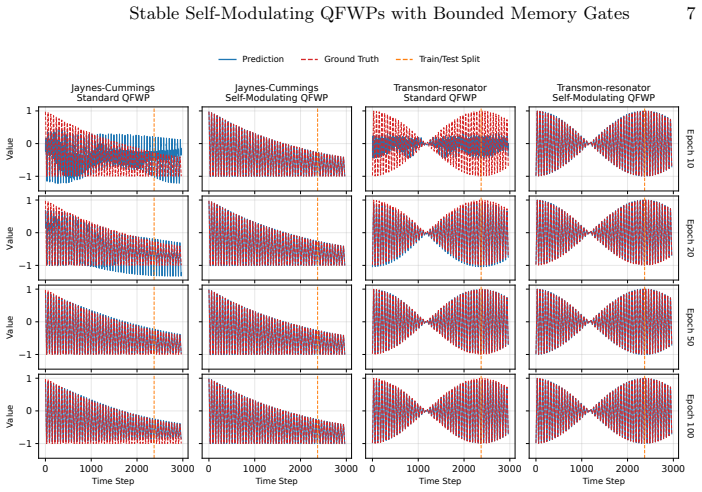
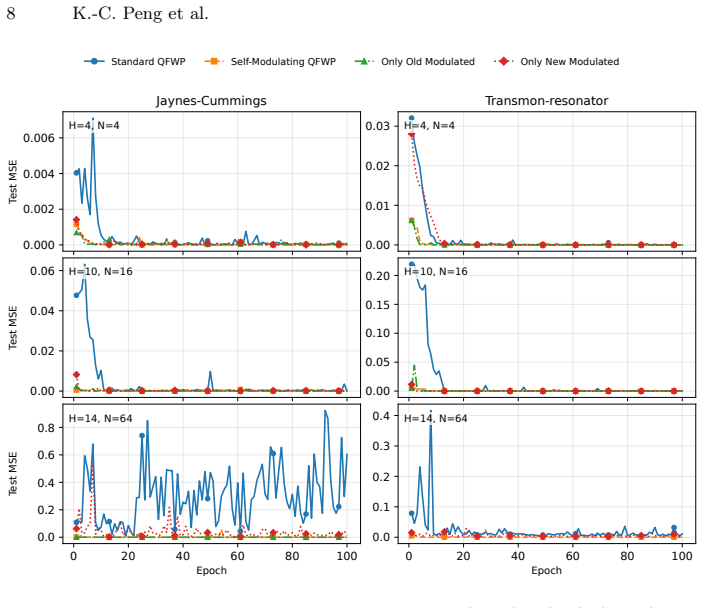
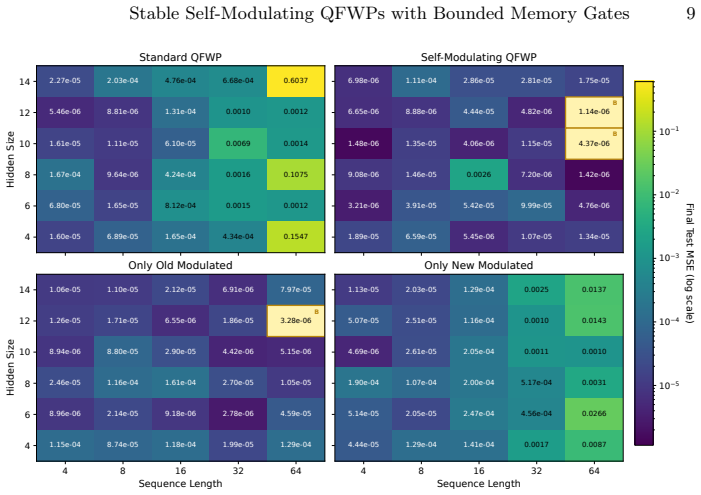
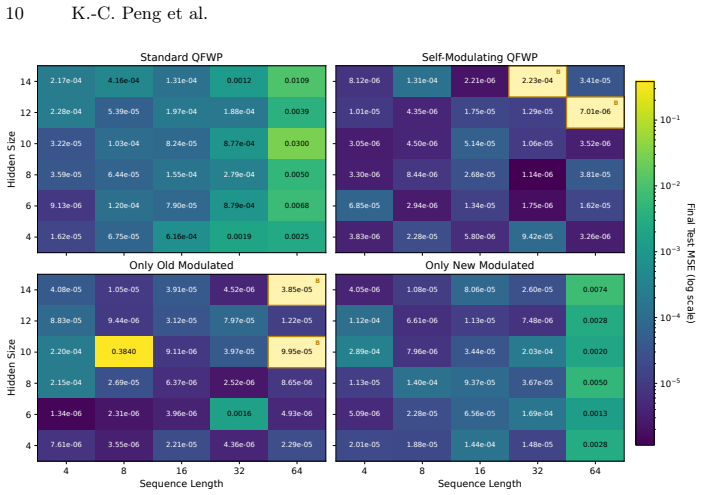
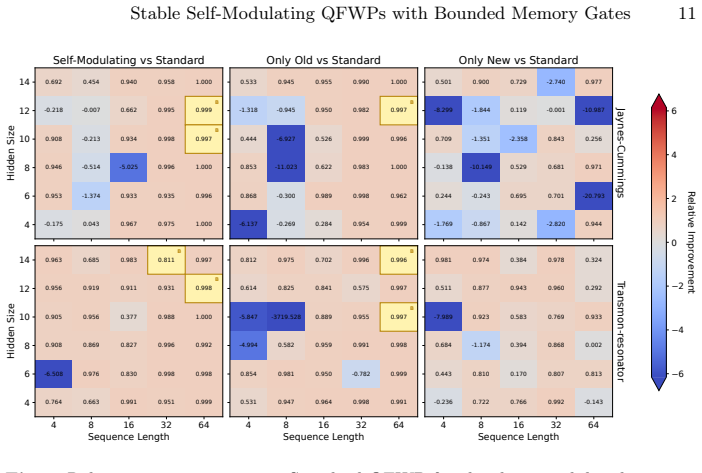
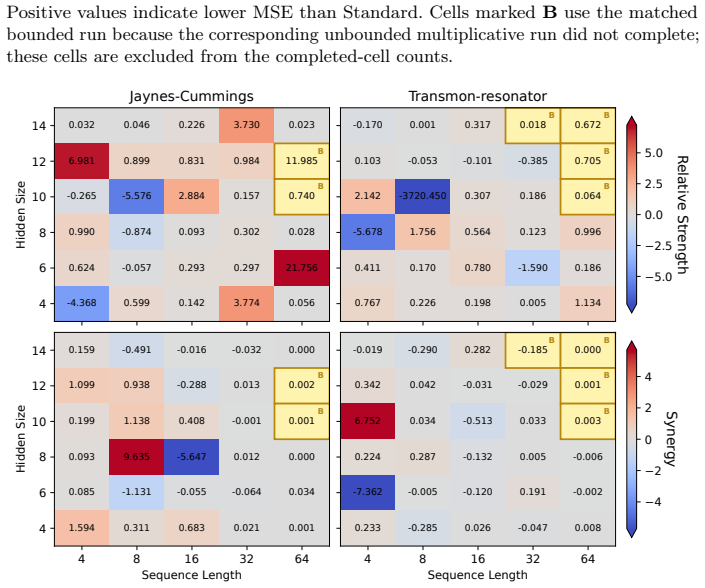
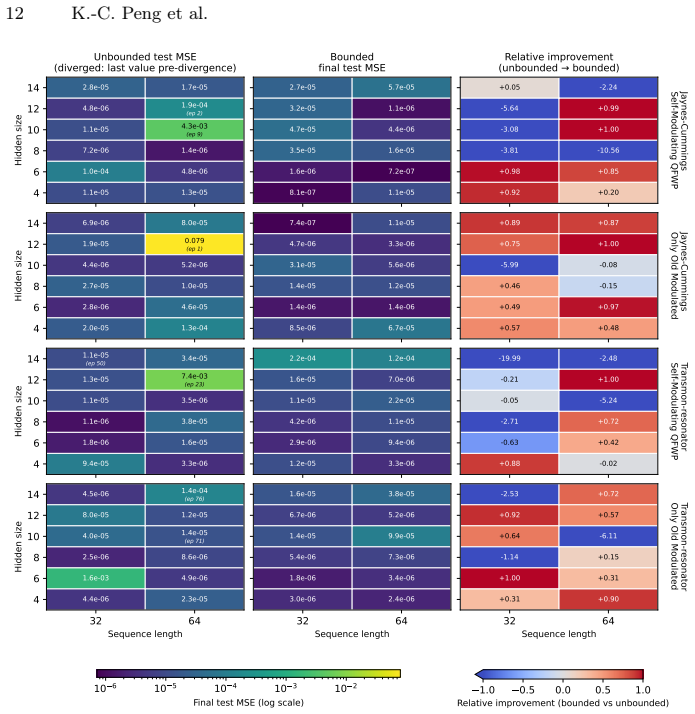
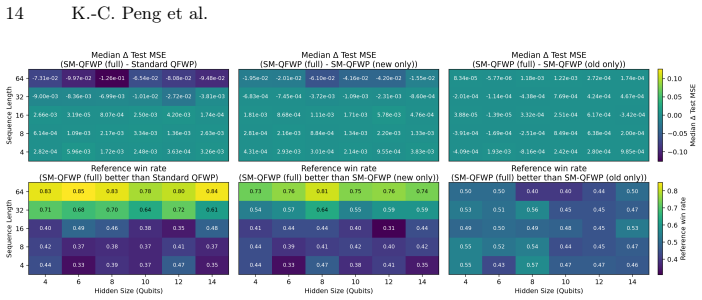
Self-Modulating QFWP uses input-dependent gates for new fast-weight updates and the accumulated state, but the unbounded old-state multiplier diverges in long sequences. The proposed method applies a sign-preserving tanh gate only to the recurrent memory branch, leaving additive updates and new-update modulation unchanged. Quantum-dynamics results indicate old-state modulation as the most consistent improvement source, and bounding it removes divergence while improving robustness. On Milan SMS, the unbounded version converges and gains at longer windows, behaving like the Only-Old ablation.
What carries the argument
The bounded old-state modulation rule that applies a sign-preserving tanh gate only to the recurrent memory branch.
If this is right
- Old-state modulation is the most consistent source of improvement over Standard QFWP.
- Bounding the old-state gate removes long-sequence divergence.
- Bounding improves aggregate robustness on the tested tasks.
- The Only-Old ablation behaves similarly to the full Self-Modulating QFWP on Milan SMS forecasting.
Where Pith is reading between the lines
- This suggests that memory bounding strategies could be useful in other quantum recurrent or fast-weight models for extended sequences.
- Future work might test the bounded gate on even longer input windows or different quantum hardware.
- The identification of old-state modulation as key could guide design of new self-modulating mechanisms in variational quantum circuits.
Load-bearing premise
That restricting the old-state multiplier with tanh preserves the performance advantages of the original unbounded self-modulation without introducing new biases or losing the key mechanism identified in the ablations.
What would settle it
Finding that the bounded version underperforms the unbounded one on Milan SMS at long windows or still shows divergence in quantum-dynamics tasks would falsify the claim.
Figures
read the original abstract
Quantum Fast-Weight Programmers (QFWPs) store temporal information in dynamically programmed variational-circuit parameters rather than in nonlinear recurrent hidden states, offering a practical route to quantum sequence modeling. Self-Modulating QFWP improves this framework by using input-dependent gates for both new fast-weight updates and the accumulated fast-weight state, but its unbounded old-state multiplier can diverge in long-sequence regimes. We propose a bounded old-state modulation rule that applies a sign-preserving tanh gate only to the recurrent memory branch while leaving the additive update and new-update modulation unchanged. We evaluate standard QFWP, full Self-Modulating QFWP, Only-New, and Only-Old variants on two CUDA-Q quantum-dynamics forecasting tasks and on Milan SMS telecommunication activity prediction. The quantum-dynamics results show that old-state modulation is the most consistent source of improvement over Standard QFWP, and that bounding the old-state gate removes long-sequence divergence while improving aggregate robustness. On Milan SMS forecasting, the original unbounded Self-Modulating QFWP converges across the tested grid and shows its clearest gains at longer input windows, with behavior close to the Only-Old ablation. These findings identify accumulated-memory modulation as the key mechanism of Self-Modulating QFWP and bounded old-state gating as a targeted stabilization strategy.
Editorial analysis
A structured set of objections, weighed in public.
Referee Report
Summary. The paper proposes replacing the unbounded old-state multiplier in Self-Modulating Quantum Fast-Weight Programmers (QFWPs) with a sign-preserving tanh gate applied only to the recurrent memory branch. It evaluates four variants (Standard QFWP, full Self-Modulating QFWP, Only-New, Only-Old) on two CUDA-Q quantum-dynamics forecasting tasks and Milan SMS activity prediction, concluding that old-state modulation is the dominant source of gains over the baseline and that tanh bounding eliminates long-sequence divergence while retaining those gains.
Significance. If the ablation results hold, the work supplies both a targeted stabilization method for quantum sequence models and a mechanistic dissection that isolates accumulated-memory modulation as the operative component. The explicit four-variant comparison on two distinct task families constitutes a clear empirical strength that directly tests the central mechanism.
minor comments (3)
- [Abstract] The abstract asserts that bounding removes divergence and improves robustness yet supplies no numerical values (e.g., sequence lengths at which divergence appears, performance deltas, or error bars). Adding at least one concrete metric would strengthen the summary.
- The precise algebraic form of the bounded old-state gate (tanh applied to the recurrent branch while leaving the additive update untouched) should be written as an explicit equation in the methods section for reproducibility.
- Figure or table captions for the quantum-dynamics and Milan SMS results should state the number of independent runs, the exact input-window lengths tested, and whether error bars represent standard deviation or standard error.
Simulated Author's Rebuttal
We thank the referee for the positive summary, significance assessment, and recommendation of minor revision. No specific major comments were provided in the report, so we have no individual points requiring detailed rebuttal or clarification at this stage. We are prepared to address any minor issues that may arise during the revision process.
Circularity Check
No significant circularity; empirical claims rest on direct task comparisons
full rationale
The manuscript evaluates four QFWP variants (Standard, full Self-Modulating, Only-New, Only-Old) on quantum-dynamics forecasting and Milan SMS tasks. The key claims—that old-state modulation drives gains and tanh bounding stabilizes long sequences—are presented as outcomes of these explicit ablations and performance metrics. No derivation chain, fitted-parameter prediction loop, or self-citation that reduces the central result to its own inputs appears. The argument is self-contained against the reported benchmarks and does not invoke uniqueness theorems or ansatzes from prior author work as load-bearing premises.
Axiom & Free-Parameter Ledger
Reference graph
Works this paper leans on
-
[1]
PRX Quantum4(2), 020338 (2023)
Anschuetz, E.R., Hu, H.Y., Huang, J.L., Gao, X.: Interpretable quantum advantage in neural sequence learning. PRX Quantum4(2), 020338 (2023)
2023
-
[2]
Scientific data2(1), 1–15 (2015)
Barlacchi, G., et al.: A multi-source dataset of urban life in the city of milan and the province of trentino. Scientific data2(1), 1–15 (2015)
2015
-
[3]
Advances in neural information processing systems 33, 1368–1379 (2020)
Bausch, J.: Recurrent quantum neural networks. Advances in neural information processing systems 33, 1368–1379 (2020)
2020
-
[4]
Quantum Machine Intelligence 5(2), 26 (2023)
Cao, Y., Zhou, X., Fei, X., Zhao, H., Liu, W., Zhao, J.: Linear-layer-enhanced quantum long short-term memory for carbon price forecasting. Quantum Machine Intelligence 5(2), 26 (2023)
2023
-
[5]
In: ICASSP 2026-2026 IEEE International Conference on Acoustics, Speech and Signal Processing (ICASSP)
Ceschini, A., Rosato, A., Panella, M., Chen, S.Y.C.: Quantum fast weight pro- gramming for time series prediction. In: ICASSP 2026-2026 IEEE International Conference on Acoustics, Speech and Signal Processing (ICASSP). pp. 22032–22036. IEEE (2026)
2026
-
[6]
arXiv preprint arXiv:2508.04488 (2025)
Chen, C.S., Chen, S.Y.C., Tsai, Y.C.: Benchmarking quantum and classi- cal sequential models for urban telecommunication forecasting. arXiv preprint arXiv:2508.04488 (2025)
-
[7]
In: 2025 International Wireless Communications and Mobile Computing (IWCMC)
Chen, K.C., Chen, S.Y.C., Liu, C.Y., Leung, K.K.: Toward large-scale distributed quantum long short-term memory with modular quantum computers. In: 2025 International Wireless Communications and Mobile Computing (IWCMC). pp. 337–342. IEEE (2025)
2025
-
[8]
In: 2024 International Joint Conference on Neural Networks (IJCNN)
Chen, S.Y.C.: Learning to program variational quantum circuits with fast weights. In: 2024 International Joint Conference on Neural Networks (IJCNN). pp. 1–9. IEEE (2024)
2024
-
[9]
In: Icassp 2022-2022 IEEE international conference on acoustics, speech and signal processing (ICASSP)
Chen, S.Y.C., Yoo, S., Fang, Y.L.L.: Quantum long short-term memory. In: Icassp 2022-2022 IEEE international conference on acoustics, speech and signal processing (ICASSP). pp. 8622–8626. IEEE (2022)
2022
-
[10]
Chen, S.Y.C., et al.: Recursive qlstm with dynamic variational quantum circuit adaptation (2026), https://arxiv.org/abs/2606.24932
work page internal anchor Pith review Pith/arXiv arXiv 2026
-
[11]
Chen, S.Y.C., et al.: Self-modulating quantum fast-weight programmers for efficient adaptive sequential learning (2026),https://arxiv.org/abs/2606.24933
work page internal anchor Pith review Pith/arXiv arXiv 2026
-
[12]
In: 2025 International Conference on Quantum Communications, Networking, and Computing (QCNC)
Hsu, Y.C., Chen, N.Y., Li, T.Y., Lee, P.H.H., Chen, K.C.: Quantum kernel-based long short-term memory for climate time-series forecasting. In: 2025 International Conference on Quantum Communications, Networking, and Computing (QCNC). pp. 421–426. IEEE (2025)
2025
-
[13]
In: 2025 IEEE International Conference on Quantum Computing and Engineering (QCE)
Hsu, Y.C., et al.: Federated quantum kernel-based long short-term memory for human activity recognition. In: 2025 IEEE International Conference on Quantum Computing and Engineering (QCE). vol. 02, pp. 54–58 (2025).https://doi.org/ 10.1109/QCE65121.2025.10293 16 K.-C. Peng et al
-
[14]
In: 2026 International Conference on Quantum Communications, Networking, and Computing (QCNC)
Hsu, Y.C., et al.: QKAN-LSTM: Quantum-inspired Kolmogorov–Arnold long short- term memory. In: 2026 International Conference on Quantum Communications, Networking, and Computing (QCNC). pp. 650–659. IEEE (2026)
2026
-
[15]
Advances in neural information processing systems 34, 7703–7717 (2021)
Irie, K., Schlag, I., Csordás, R., Schmidhuber, J.: Going beyond linear transformers with recurrent fast weight programmers. Advances in neural information processing systems 34, 7703–7717 (2021)
2021
-
[16]
arXiv preprint arXiv:2509.14026 (2025)
Jiang, J.C., Huang, M.Y.C., Chen, T., Goan, H.S.: Quantum variational activation functions empower Kolmogorov-Arnold networks. arXiv preprint arXiv:2509.14026 (2025). https://doi.org/10.48550/arXiv.2509.14026, https://arxiv.org/abs/ 2509.14026
-
[17]
classical lstm in time series forecasting: a comparative study in solar power forecasting
Khan, S.Z., et al.: Quantum long short-term memory (qlstm) vs. classical lstm in time series forecasting: a comparative study in solar power forecasting. Frontiers in Physics 12, 1439180 (2024)
2024
-
[18]
In: 2023 60th ACM/IEEE Design Automation Conference (DAC)
Kim, J.S., et al.: Cuda quantum: The platform for integrated quantum-classical computing. In: 2023 60th ACM/IEEE Design Automation Conference (DAC). pp. 1–4. IEEE (2023)
2023
-
[19]
Adam: A Method for Stochastic Optimization
Kingma, D.P., Ba, J.: Adam: A method for stochastic optimization. arXiv preprint arXiv:1412.6980 (2014)
work page internal anchor Pith review Pith/arXiv arXiv 2014
-
[20]
Physica Scripta99(8), 085035 (2024)
Li, F., Dong, Y.: Air quality prediction based on improved quantum long short-term memory neural networks. Physica Scripta99(8), 085035 (2024)
2024
-
[21]
In: 2024 IEEE International Conference on Quantum Computing and Engineering (QCE)
Lin, C.H.A., Liu, C.Y., Chen, K.C.: Quantum-train long short-term memory: Application on flood prediction problem. In: 2024 IEEE International Conference on Quantum Computing and Engineering (QCE). vol. 2, pp. 268–273. IEEE (2024)
2024
-
[22]
Lin, Y.C., et al.: Generative quantum-inspired Kolmogorov-Arnold eigensolver (2026), https://arxiv.org/abs/2605.04604
work page internal anchor Pith review Pith/arXiv arXiv 2026
-
[23]
In: 2025 International Conference on Quantum Communications, Networking, and Computing (QCNC)
Liu, C.Y., Chen, S.Y.C., Chen, K.C., Huang, W.J., Chang, Y.J.: Programming variational quantum circuits with quantum-train agent. In: 2025 International Conference on Quantum Communications, Networking, and Computing (QCNC). pp. 544–548. IEEE (2025)
2025
-
[24]
Gated QKAN-FWP: Scalable Quantum-inspired Sequence Learning
Peng, K.C., et al.: Gated qkan-fwp: Scalable quantum-inspired sequence learning. arXiv preprint arXiv:2605.06734 (2026)
work page internal anchor Pith review Pith/arXiv arXiv 2026
-
[25]
Peng, K.C., et al.: Parameter-efficient quantum-inspired fast weight programmers for traffic-matrix forecasting (2026)
2026
-
[26]
In: International conference on machine learning
Schlag, I., Irie, K., Schmidhuber, J.: Linear transformers are secretly fast weight programmers. In: International conference on machine learning. pp. 9355–9366. PMLR (2021)
2021
-
[27]
Neural Computation4(1), 131–139 (1992)
Schmidhuber, J.: Learning to control fast-weight memories: An alternative to dynamic recurrent networks. Neural Computation4(1), 131–139 (1992)
1992
-
[28]
Humanities and Social Sciences Communications12(1), 1–15 (2025)
Su, L., Li, D., Qiu, D.: Bls-qlstm: a novel hybrid quantum neural network for stock index forecasting. Humanities and Social Sciences Communications12(1), 1–15 (2025)
2025
-
[29]
IEEE Internet of Things Journal (2025)
Tran, B.N.D., et al.: Quantum lstm model for estimation of energy expenditure in human aging using wearable iot healthcare technology. IEEE Internet of Things Journal (2025)
2025
-
[30]
arXiv preprint arXiv:2504.20823 (2025)
Tsurkan, O., et al.: Hybrid quantum recurrent neural network for remaining useful life prediction. arXiv preprint arXiv:2504.20823 (2025)
-
[31]
EPJ Quantum Technology13(1), 14 (2026)
Zhang, L., Xu, Y., Wu, M., Wang, L., Xu, H.: Quantum long short-term memory for drug discovery. EPJ Quantum Technology13(1), 14 (2026)
2026
discussion (0)
Sign in with ORCID, Apple, or X to comment. Anyone can read and Pith papers without signing in.