One-loop matching of QCD currents to power-suppressed two-jet operators
Pith reviewed 2026-07-03 19:15 UTC · model grok-4.3
The pith
QCD quark-antiquark currents are matched at one loop to two- and three-particle SCET two-jet operators up to second power in transverse momentum over energy.
A machine-rendered reading of the paper's core claim, the machinery that carries it, and where it could break.
Core claim
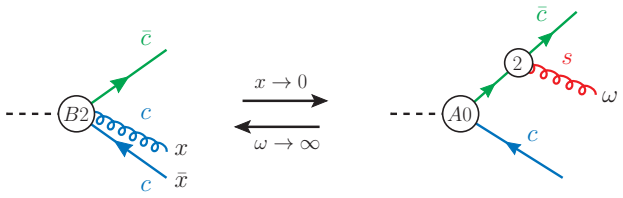
We compute the matching of QCD quark-antiquark currents onto the set of the two-particle and three-particle two-jet operators in soft-collinear effective theory (SCET) at next-to-leading order (NLO) in the perturbative QCD series, including for the first time operators up to second order in the power expansion in the transverse momentum over energy. These results contribute to the ongoing programme of computing power corrections and summing power-suppressed logarithmically enhanced terms for event shapes in the two-jet region and deep-inelastic scattering in the Bjorken-x→1 limit. The three-particle operators depend on the partonic momentum fractions of two partons moving into the same direc
What carries the argument
The NLO matching coefficients for the two-particle and three-particle SCET two-jet operators up to O(λ²) that relate QCD currents to the effective-theory basis.
Load-bearing premise
The SCET operator basis and power counting in λ = k⊥/Q remain valid and complete up to O(λ²), with the three-particle operators correctly capturing all contributions that produce endpoint singularities requiring factorization relations for cancellation.
What would settle it
A direct NLO QCD calculation of a specific power correction to a two-jet event shape or DIS structure function that disagrees numerically with the prediction obtained by inserting these matching coefficients into the SCET factorization formula.
Figures
read the original abstract
We compute the matching of QCD quark-antiquark currents onto the set of the two-particle and three-particle two-jet operators in soft-collinear effective theory (SCET) at next-to-leading order (NLO) in the perturbative QCD series, including for the first time operators up to second order in the power expansion in the transverse momentum over energy. These results contribute to the ongoing programme of computing power corrections and summing power-suppressed logarithmically enhanced terms for event shapes in the two-jet region and deep-inelastic scattering in the Bjorken-$x\to 1$ limit. The three-particle operators depend on the partonic momentum fractions of two partons moving into the same direction. When one of the momentum fractions approaches zero, the coefficient functions are shown to satisfy endpoint factorization relations, which allow for a consistent cancellation of endpoint singularities among various terms in the complete factorization formula for power corrections.
Editorial analysis
A structured set of objections, weighed in public.
Referee Report
Summary. The paper computes the NLO matching of QCD quark-antiquark currents onto the complete set of two-particle and three-particle two-jet operators in SCET through O(λ²) with λ = k⊥/Q. It derives the coefficient functions explicitly and verifies that they obey endpoint factorization relations when a parton momentum fraction approaches zero, ensuring consistent cancellation of endpoint singularities in the full factorization formula for power corrections to event shapes and DIS at x→1.
Significance. If the matching holds, the results supply the missing NLO ingredients for systematic power-correction calculations in the two-jet region. The explicit demonstration of endpoint factorization relations is a concrete technical advance that strengthens the consistency of the SCET power expansion. The work directly supports ongoing programs for resumming power-suppressed logarithms.
minor comments (3)
- §2: the operator basis is stated to be complete up to O(λ²), but the text does not explicitly list the full set of three-particle operators with their momentum-fraction dependence; adding a compact table would improve traceability of the matching results.
- Eq. (3.12) and following: the endpoint factorization relations are verified numerically for a subset of coefficients; stating the analytic form of the relation used for the check would make the cancellation argument more transparent.
- The manuscript cites prior SCET matching papers but does not compare the new O(λ²) coefficients against any existing partial results at lower orders; a brief consistency check paragraph would strengthen the presentation.
Simulated Author's Rebuttal
We thank the referee for the positive assessment of our work, the clear summary of the NLO matching calculation, and the recommendation for minor revision. No specific major comments were provided in the report.
Circularity Check
No significant circularity
full rationale
The paper reports a direct one-loop perturbative matching computation equating matrix elements of QCD quark-antiquark currents to a stated basis of SCET two- and three-particle operators through O(λ²). The coefficient functions are obtained from explicit diagram evaluation in full QCD and SCET; endpoint factorization relations are verified as an output of the calculation rather than imposed by definition or prior self-citation. No fitted parameters are renamed as predictions, no uniqueness theorem is invoked from overlapping prior work, and the derivation chain remains externally anchored to QCD Feynman rules without reduction to the paper's own inputs.
Axiom & Free-Parameter Ledger
axioms (2)
- domain assumption SCET power counting with λ = k⊥/Q organizes the two-jet region and remains valid through O(λ²)
- domain assumption The complete set of two- and three-particle operators at O(λ²) captures all relevant contributions
Reference graph
Works this paper leans on
-
[1]
P. A. Movilla Fernandez, S. Bethke, O. Biebel, and S. Kluth,Tests of power corrections for event shapes in e+ e- annihilation,Eur. Phys. J. C22(2001) 1–15, [hep-ex/0105059]
work page internal anchor Pith review Pith/arXiv arXiv 2001
-
[2]
P. Nason and G. Zanderighi,Fits ofα s using power corrections in the three-jet region,JHEP06(2023) 058, [arXiv:2301.03607]
- [3]
- [4]
-
[5]
M. van Beekveld, E. Laenen, J. Sinninghe Damst´ e, and L. Vernazza, Next-to-leading power threshold corrections for finite order and resummed colour-singlet cross sections,JHEP05(2021) 114, [arXiv:2101.07270]
- [6]
-
[7]
Boussarieet al., (2023), arXiv:2304.03302 [hep-ph]
R. Boussarie et al.,TMD Handbook,arXiv:2304.03302
-
[8]
C. W. Bauer, S. Fleming, D. Pirjol, and I. W. Stewart,An Effective field theory for collinear and soft gluons: Heavy to light decays,Phys. Rev. D63(2001) 114020, [hep-ph/0011336]
work page internal anchor Pith review Pith/arXiv arXiv 2001
-
[9]
C. W. Bauer, D. Pirjol, and I. W. Stewart,Soft collinear factorization in effective field theory,Phys. Rev. D65(2002) 054022, [hep-ph/0109045]
work page internal anchor Pith review Pith/arXiv arXiv 2002
-
[10]
Soft-collinear effective theory and heavy-to-light currents beyond leading power
M. Beneke, A. P. Chapovsky, M. Diehl, and T. Feldmann,Soft collinear effective theory and heavy to light currents beyond leading power,Nucl. Phys. B643(2002) 431–476, [hep-ph/0206152]
work page internal anchor Pith review Pith/arXiv arXiv 2002
-
[11]
Multipole-expanded soft-collinear effective theory with non-abelian gauge symmetry
M. Beneke and T. Feldmann,Multipole expanded soft collinear effective theory with non-abelian gauge symmetry,Phys. Lett. B553(2003) 267–276, [hep-ph/0211358]
work page internal anchor Pith review Pith/arXiv arXiv 2003
-
[12]
Anomalous dimension of subleading-power N-jet operators
M. Beneke, M. Garny, R. Szafron, and J. Wang,Anomalous dimension of subleading-power N-jet operators,JHEP03(2018) 001, [arXiv:1712.04416]
work page internal anchor Pith review Pith/arXiv arXiv 2018
-
[13]
Anomalous dimension of subleading-power ${N}$-jet operators II
M. Beneke, M. Garny, R. Szafron, and J. Wang,Anomalous dimension of subleading-powerN-jet operators. Part II,JHEP11(2018) 112, [arXiv:1808.04742]
work page internal anchor Pith review Pith/arXiv arXiv 2018
-
[14]
C. W. Bauer, C. Lee, A. V. Manohar, and M. B. Wise,Enhanced nonperturbative effects in Z decays to hadrons,Phys. Rev. D70(2004) 034014, [hep-ph/0309278]. 30
work page internal anchor Pith review Pith/arXiv arXiv 2004
- [15]
-
[16]
Loop corrections to sub-leading heavy quark currents in SCET
M. Beneke, Y. Kiyo, and D. s. Yang,Loop corrections to subleading heavy quark currents in SCET,Nucl. Phys. B692(2004) 232–248, [hep-ph/0402241]
work page internal anchor Pith review Pith/arXiv arXiv 2004
-
[17]
R. J. Hill, T. Becher, S. J. Lee, and M. Neubert,Sudakov resummation for subleading SCET currents and heavy-to-light form-factors,JHEP07(2004) 081, [hep-ph/0404217]
work page internal anchor Pith review Pith/arXiv arXiv 2004
-
[18]
Strohm,Reparameterization Constraints on Renormalization and Matching of SCET at Sub-Leading Power, Master Thesis, Technische Universit¨ at M¨ unchen, 2020
J. Strohm,Reparameterization Constraints on Renormalization and Matching of SCET at Sub-Leading Power, Master Thesis, Technische Universit¨ at M¨ unchen, 2020
2020
-
[19]
A. Vladimirov, V. Moos, and I. Scimemi,Transverse momentum dependent operator expansion at next-to-leading power,JHEP01(2022) 110, [arXiv:2109.09771]
-
[20]
Asymptotic expansion of Feynman integrals near threshold
M. Beneke and V. A. Smirnov,Asymptotic expansion of Feynman integrals near threshold,Nucl. Phys. B522(1998) 321–344, [hep-ph/9711391]
work page internal anchor Pith review Pith/arXiv arXiv 1998
-
[21]
V. Shtabovenko, R. Mertig, and F. Orellana,FeynCalc 10: Do multiloop integrals dream of computer codes?,Comput. Phys. Commun.306(2025) 109357, [arXiv:2312.14089]
-
[22]
H. H. Patel,Package-X: A Mathematica package for the analytic calculation of one-loop integrals,Comput. Phys. Commun.197(2015) 276–290, [arXiv:1503.01469]
work page internal anchor Pith review Pith/arXiv arXiv 2015
-
[23]
A. V. Manohar, T. Mehen, D. Pirjol, and I. W. Stewart,Reparameterization invariance for collinear operators,Phys. Lett. B539(2002) 59–66, [hep-ph/0204229]
work page internal anchor Pith review Pith/arXiv arXiv 2002
-
[24]
B. V. Geshkenbein and M. V. Terentev,The enhanced power corrections to the asymptotics of the pion form-factor,Phys. Lett. B117(1982) 243–246
1982
-
[25]
M. Beneke, G. Buchalla, M. Neubert, and C. T. Sachrajda,QCD factorization for exclusive, nonleptonic B meson decays: General arguments and the case of heavy light final states,Nucl. Phys. B591(2000) 313–418, [hep-ph/0006124]
work page internal anchor Pith review Pith/arXiv arXiv 2000
-
[26]
Factorization of heavy-to-light form factors in soft-collinear effective theory
M. Beneke and T. Feldmann,Factorization of heavy to light form-factors in soft collinear effective theory,Nucl. Phys. B685(2004) 249–296, [hep-ph/0311335]
work page internal anchor Pith review Pith/arXiv arXiv 2004
-
[27]
B -> chi_cJ K decays revisited
M. Beneke and L. Vernazza,B→χ cJ Kdecays revisited,Nucl. Phys. B811(2009) 155–181, [arXiv:0810.3575]
work page internal anchor Pith review Pith/arXiv arXiv 2009
- [28]
- [29]
- [30]
- [31]
- [32]
-
[33]
Leading-logarithmic threshold resummation of the Drell-Yan process at next-to-leading power
M. Beneke, A. Broggio, M. Garny, S. Jaskiewicz, R. Szafron, L. Vernazza, and J. Wang,Leading-logarithmic threshold resummation of the Drell-Yan process at next-to-leading power,JHEP03(2019) 043, [arXiv:1809.10631]
work page internal anchor Pith review Pith/arXiv arXiv 2019
- [34]
discussion (0)
Sign in with ORCID, Apple, or X to comment. Anyone can read and Pith papers without signing in.