The impact of new (α, n) reaction rates on the weak s-process in metal-poor massive stars
Pith reviewed 2026-05-25 08:27 UTC · model grok-4.3
The pith
Updated 17O(α,n) and 22Ne(α,n) rates increase weak s-process isotope production by tens of times in metal-poor massive stars.
A machine-rendered reading of the paper's core claim, the machinery that carries it, and where it could break.
Core claim
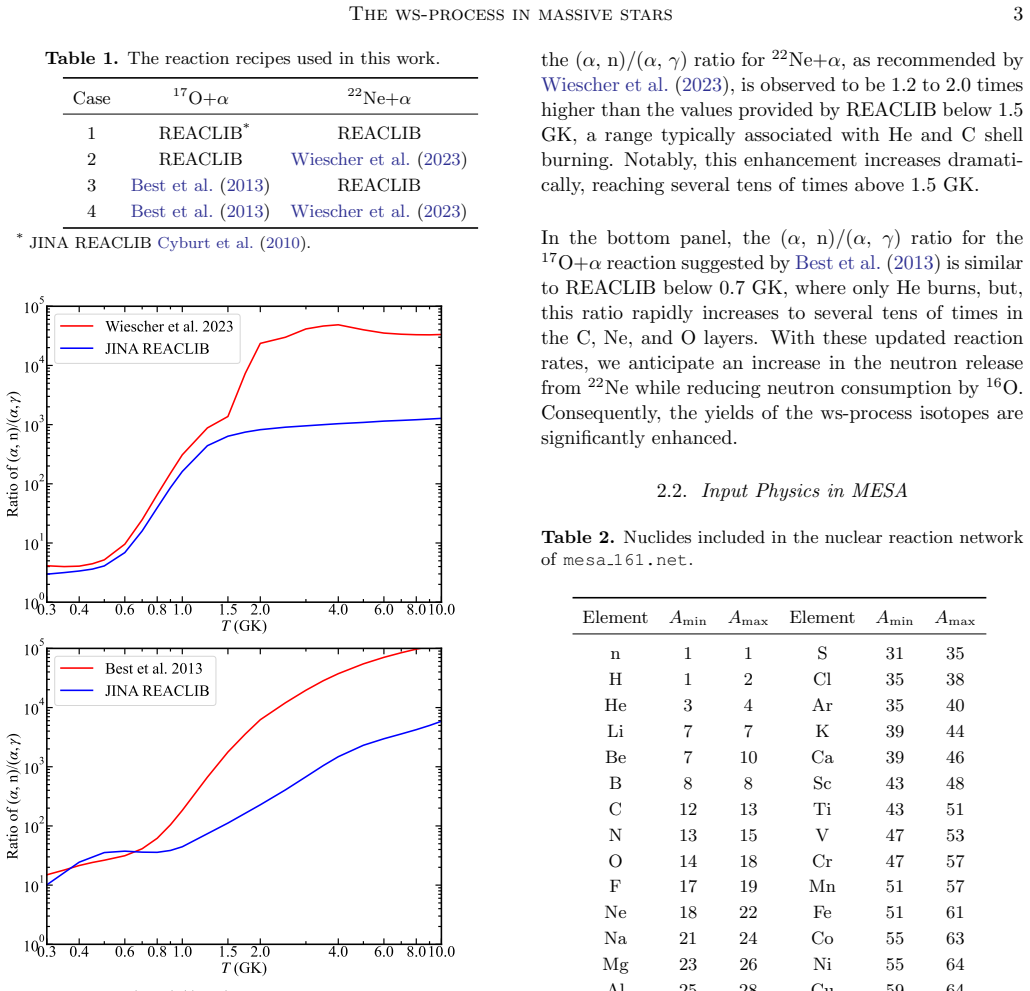
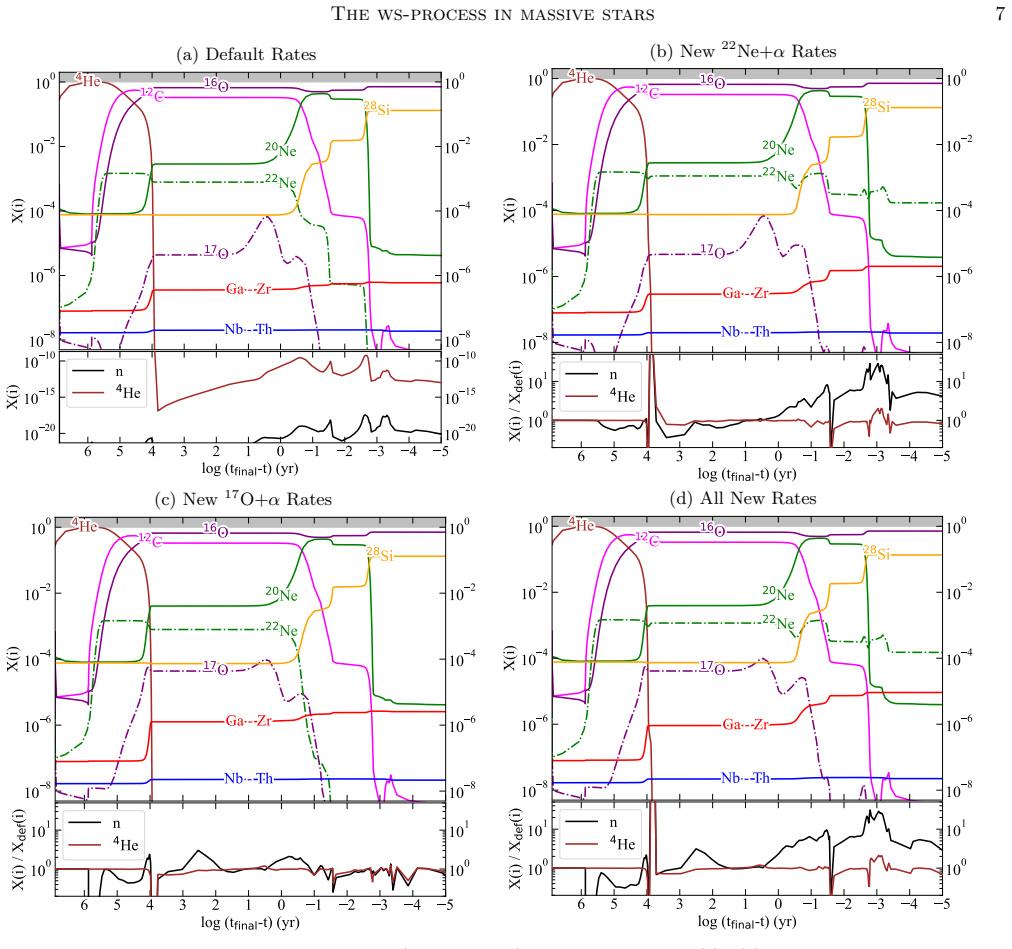
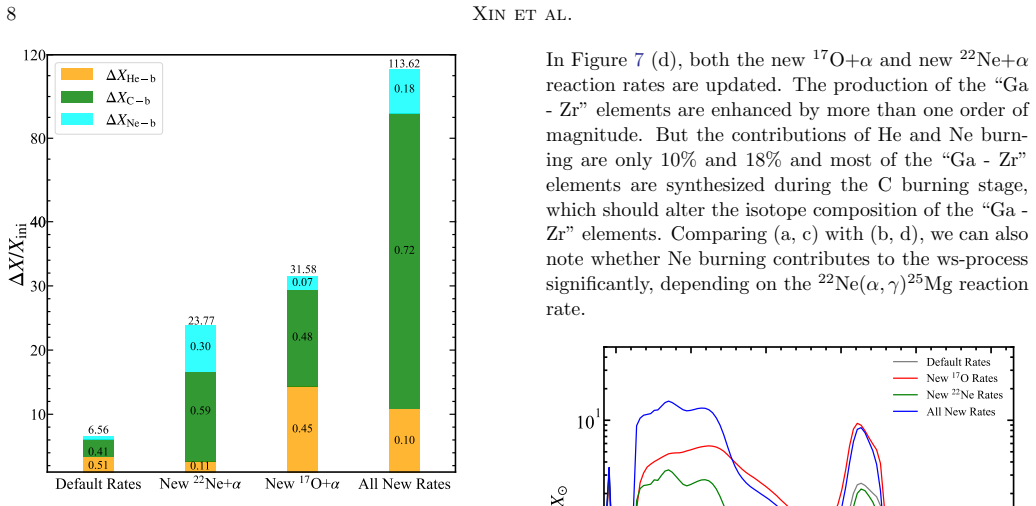
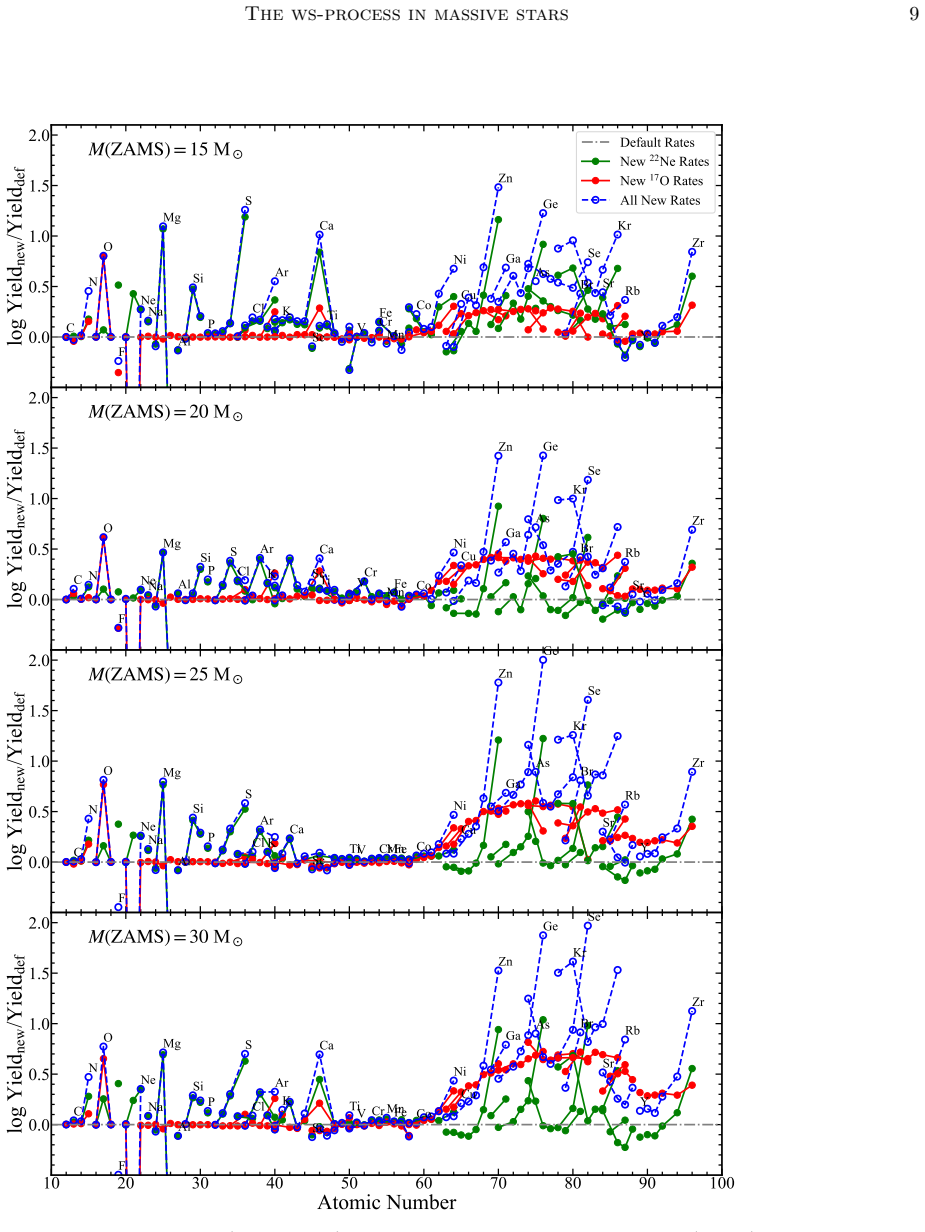
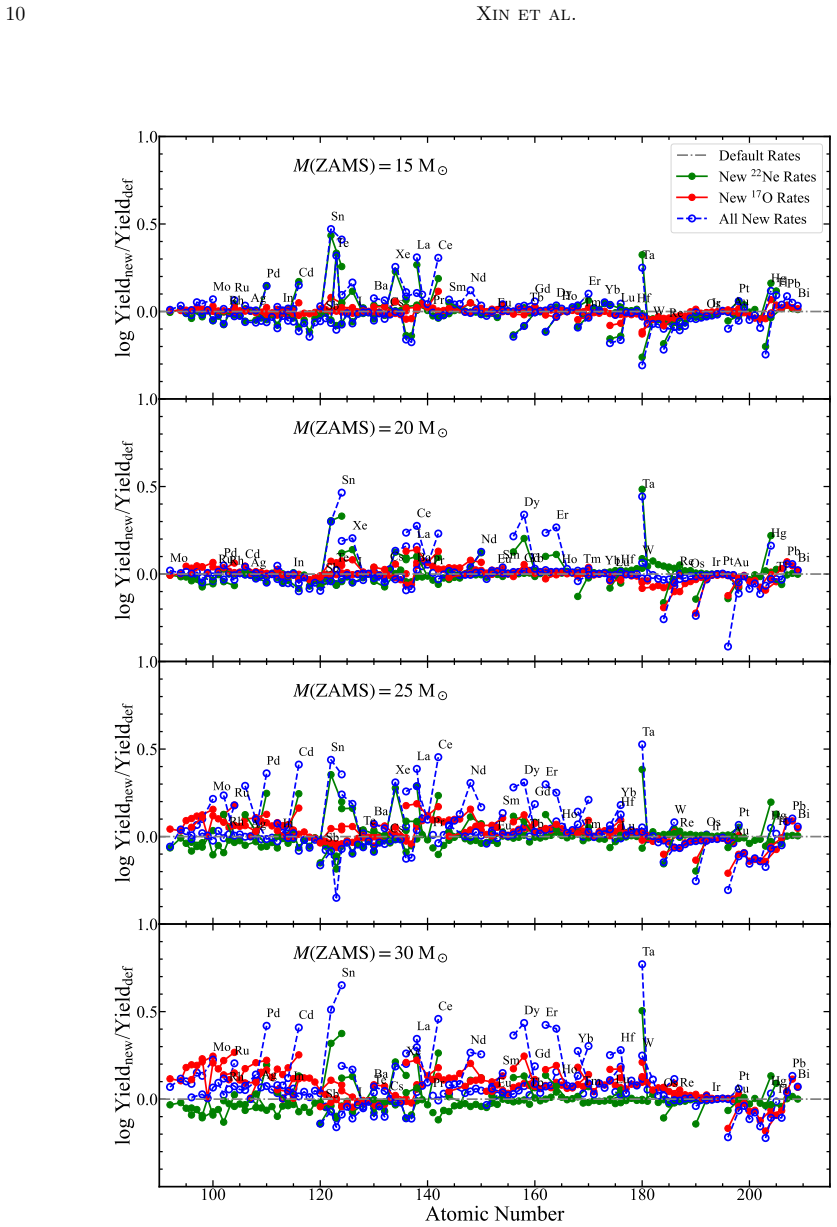
Adopting the new 17O(α,n)20Ne, 17O(α,γ)21Ne, 22Ne(α,n)25Mg and 22Ne(α,γ)26Mg rates increases the yields of ws-process isotopes by tens of times relative to JINA REACLIB defaults. The 17O+α reactions raise the process in every burning stage while the 22Ne+α reactions act mainly during carbon and neon burning; the 17O-driven enhancement grows more pronounced as stellar mass increases from 15 to 30 solar masses.
What carries the argument
The 17O(α,n)20Ne reaction, which supplies neutrons when the metallicity-limited 22Ne reservoir is small and 16O is abundant.
If this is right
- Metal-poor massive stars contribute substantially more to certain s-process isotopes than models using older rates had indicated.
- Yields of isotopes produced during carbon and neon burning must be recomputed with the updated rates for all metallicities below solar.
- The relative importance of the weak s-process versus other neutron-capture channels shifts upward in the early universe.
- More massive stars within the 15–30 solar-mass range experience the largest fractional increase in s-process output.
Where Pith is reading between the lines
- Galactic chemical-evolution calculations that rely on older massive-star yields may under-predict the s-process contribution at low metallicity.
- Three-dimensional hydrodynamical simulations could test whether convective overshoot or rotation changes the exposure of material to the 17O(α,n) neutron source.
- Laboratory re-measurement of the 17O(α,n) cross section near the Gamow peak would directly tighten the yield predictions.
Load-bearing premise
One-dimensional stellar models with standard convective mixing and mass-loss prescriptions correctly place the temperature-density conditions where the adopted alpha-capture rates operate.
What would settle it
A direct comparison of predicted versus observed isotopic ratios among s-process elements in the atmospheres of extremely metal-poor halo stars or in the ejecta of core-collapse supernovae at low metallicity.
Figures






read the original abstract
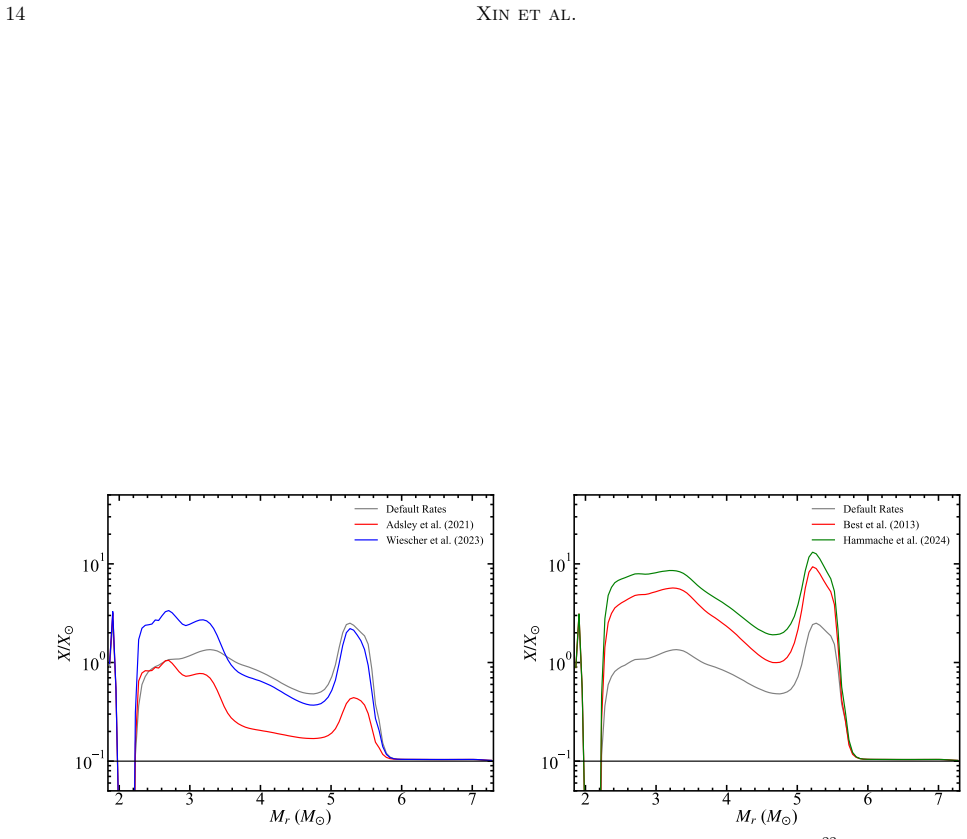
Massive stars are significant sites for the weak s-process (ws-process). $^{22}$Ne and $^{16}$O are, respectively, the main neutron source and poison for the ws-process. In the metal-poor stars, the abundance of $^{22}$Ne is limited by the metallicity, so that the contribution of $^{22}$Ne($\alpha$, n)$^{25}$Mg reaction on the s-process is weaker. Conversely, the $^{17}$O($\alpha$, n)$^{20}$Ne reaction becomes more prominent in these stars due to the most abundant $^{16}$O in all metallicities. In this work, we calculate the evolution of four metal-poor models ($Z=10^{-3}$) for the Zero-Age Main-Sequence (ZAMS) masses of $M ({\rm ZAMS})=$ 15, 20, 25, and 30 M$_{\odot}$ to investigate the effect of reaction rates on the ws-process. We adopt the new $^{17}$O($\alpha$, n)$^{20}$Ne and $^{17}$O($\alpha, \gamma$)$^{21}$Ne reaction rates suggested by Best et al. (2013) and $^{22}$Ne($\alpha$, n)$^{25}$Mg and $^{22}$Ne($\alpha, \gamma$)$^{26}$Mg from Wiescher et al. (2023). The yields of the s-process isotope with updated reaction rates are compared with the results using default reaction rates from JINA REACLIB. We find that the new $^{17}$O+$\alpha$ reaction rates increase the ws-process mainly in all the stages, while the new $^{22}$Ne+$\alpha$ reaction rates only increase the ws-process in C and Ne burning stages. Updating these new reaction rates would increase the production of ws-process isotopes by tens of times. We also note that for more massive stars, the enhancement by new $^{17}$O+$\alpha$ reaction rates become more significant.
Editorial analysis
A structured set of objections, weighed in public.
Referee Report
Summary. The paper calculates the evolution of four metal-poor (Z=10^{-3}) massive star models (15, 20, 25, 30 M⊙) to assess the effect of updated 17O(α,n)20Ne, 17O(α,γ)21Ne, 22Ne(α,n)25Mg and 22Ne(α,γ)26Mg reaction rates on the weak s-process. It reports that the new rates (from Best et al. 2013 and Wiescher et al. 2023) increase ws-process isotope yields by tens of times relative to JINA REACLIB defaults, with the 17O+α rates dominating the enhancement across burning stages and the effect strengthening with stellar mass.
Significance. If the central quantitative claim holds after addressing model sensitivities, the result would revise estimates of s-process contributions from low-metallicity massive stars, with direct consequences for galactic chemical evolution models of elements between Fe and Ba. The work supplies explicit yield comparisons for a grid of masses and metallicities.
major comments (2)
- [Stellar models] Stellar models section: the manuscript fixes standard 1D prescriptions for convection, overshooting, semiconvection and mass loss without any parameter variations or code comparisons. Because neutron exposure in C/Ne burning is known to be sensitive to these choices at the level of factors of several (comparable to the reported tens-of-times enhancement), the attribution of the yield increase primarily to the reaction-rate updates cannot be verified from the presented evidence.
- [Results] Yield comparison results: the abstract states that new rates increase production 'by tens of times,' yet no convergence tests, resolution studies, or details on how final yields are extracted from the models are supplied. This leaves the central quantitative claim load-bearing on untested numerical and post-processing choices.
minor comments (1)
- [Abstract] The abstract and text would benefit from explicit statements of the default JINA REACLIB version and the precise temperature-density ranges over which the new rates differ most from the old ones.
Simulated Author's Rebuttal
We thank the referee for the thoughtful report and the recommendation for major revision. Below we respond point-by-point to the two major comments. We propose targeted revisions to improve clarity and context while preserving the paper's focus on the reaction-rate updates.
read point-by-point responses
-
Referee: [Stellar models] Stellar models section: the manuscript fixes standard 1D prescriptions for convection, overshooting, semiconvection and mass loss without any parameter variations or code comparisons. Because neutron exposure in C/Ne burning is known to be sensitive to these choices at the level of factors of several (comparable to the reported tens-of-times enhancement), the attribution of the yield increase primarily to the reaction-rate updates cannot be verified from the presented evidence.
Authors: We agree that neutron exposure during C/Ne burning is sensitive to convective mixing and related prescriptions. The present study deliberately holds all stellar-model parameters fixed at their standard 1D values in order to isolate the effect of the updated 17O+α and 22Ne+α rates relative to the JINA REACLIB defaults. This controlled comparison is the central methodological choice. We will add an explicit paragraph in the stellar-models section (and a short discussion subsection) that acknowledges the known sensitivities, cites the relevant literature on mixing-parameter effects, and states that a full parameter survey lies outside the scope of this reaction-rate focused work. revision: partial
-
Referee: [Results] Yield comparison results: the abstract states that new rates increase production 'by tens of times,' yet no convergence tests, resolution studies, or details on how final yields are extracted from the models are supplied. This leaves the central quantitative claim load-bearing on untested numerical and post-processing choices.
Authors: The reported yield ratios are obtained directly from the final surface abundances of the four stellar models after all burning stages. We will revise the manuscript to include a concise methods paragraph that (i) specifies the numerical resolution and time-step criteria used in the evolution calculations and (ii) describes the post-processing procedure by which the s-process isotope yields are extracted and normalized. Because the models were computed with the code's standard settings and no additional resolution studies were performed, we cannot supply new convergence tests in this revision; the added text will instead make the existing numerical choices transparent. revision: yes
Circularity Check
No circularity: yields from externally sourced rates vs. JINA defaults
full rationale
The paper performs a direct numerical comparison of s-process yields in 1D stellar models using reaction rates taken from independent external sources (Best et al. 2013 for 17O+α; Wiescher et al. 2023 for 22Ne+α) against the JINA REACLIB defaults. No parameter is fitted inside the work, no prediction reduces to a self-defined input, and no load-bearing step relies on self-citation. The reported factor-of-tens enhancement is the computed difference between two sets of external rates; the derivation chain is self-contained against those benchmarks.
Axiom & Free-Parameter Ledger
axioms (2)
- domain assumption 1D stellar evolution with standard mixing-length theory and convective boundaries accurately represents the temperature-density history experienced by the burning shells.
- domain assumption The reaction rates from Best et al. (2013) and Wiescher et al. (2023) are directly applicable without additional temperature-dependent corrections inside the stellar models.
Lean theorems connected to this paper
-
IndisputableMonolith/Cost/FunctionalEquation.leanwashburn_uniqueness_aczel unclear?
unclearRelation between the paper passage and the cited Recognition theorem.
We adopt the new 17O(α,n)20Ne and 17O(α,γ)21Ne reaction rates suggested by Best et al. (2013) and 22Ne(α,n)25Mg and 22Ne(α,γ)26Mg from Wiescher et al. (2023).
-
IndisputableMonolith/Foundation/AlphaDerivationExplicit.leanalphaProvenanceCert unclear?
unclearRelation between the paper passage and the cited Recognition theorem.
Updating these new reaction rates would increase the production of ws-process isotopes by tens of times.
What do these tags mean?
- matches
- The paper's claim is directly supported by a theorem in the formal canon.
- supports
- The theorem supports part of the paper's argument, but the paper may add assumptions or extra steps.
- extends
- The paper goes beyond the formal theorem; the theorem is a base layer rather than the whole result.
- uses
- The paper appears to rely on the theorem as machinery.
- contradicts
- The paper's claim conflicts with a theorem or certificate in the canon.
- unclear
- Pith found a possible connection, but the passage is too broad, indirect, or ambiguous to say the theorem truly supports the claim.
Reference graph
Works this paper leans on
-
[1]
2021, PhRvC, 103, 015805, doi: 10.1103/PhysRevC.103.015805
Adsley, P., Battino, U., Best, A., et al. 2021, PhRvC, 103, 015805, doi: 10.1103/PhysRevC.103.015805
-
[2]
1989, Geochimica et Cosmochimica Acta, 53, 197, doi: 10.1016/0016-7037(89)90286-X
Anders, E., & Grevesse, N. 1989, Geochimica et Cosmochimica Acta, 53, 197, doi: 10.1016/0016-7037(89)90286-X
-
[3]
Aoki, W., Honda, S., Beers, T. C., et al. 2005, The Astrophysical Journal, 632, 611, doi: 10.1086/432862
-
[4]
2006, The Astrophysical Journal, 639, 897, doi: 10.1086/497906
Aoki, W., Frebel, A., Christlieb, N., et al. 2006, The Astrophysical Journal, 639, 897, doi: 10.1086/497906
-
[5]
Arnett, W. D., & Thielemann, F. K. 1985, The Astrophysical Journal, 295, 589, doi: 10.1086/163402
-
[6]
Arnett, W. D., & Truran, J. W. 1969, The Astrophysical Journal, 157, 339, doi: 10.1086/150072
-
[7]
Baraffe, I., El Eid, M. F., & Prantzos, N. 1992, Astronomy and Astrophysics, 258, 357 The ws-process in massive stars17
work page 1992
-
[8]
2013, Physical Review C, 87, 045805, doi: 10.1103/PhysRevC.87.045805
Best, A., Beard, M., G¨ orres, J., et al. 2013, Physical Review C, 87, 045805, doi: 10.1103/PhysRevC.87.045805
-
[9]
2011, Nature, 472, 454, doi: 10.1038/nature10000
Chiappini, C., Frischknecht, U., Meynet, G., et al. 2011, Nature, 472, 454, doi: 10.1038/nature10000
-
[10]
2018, Astronomy and Astrophysics, 618, A133, doi: 10.1051/0004-6361/201833283
Choplin, A., Hirschi, R., Meynet, G., et al. 2018, Astronomy and Astrophysics, 618, A133, doi: 10.1051/0004-6361/201833283
-
[11]
Couch, R. G., Schmiedekamp, A. B., & Arnett, W. D. 1974, The Astrophysical Journal, 190, 95, doi: 10.1086/152851
-
[12]
Cyburt, R. H., Amthor, A. M., Ferguson, R., et al. 2010, The Astrophysical Journal Supplement Series, 189, 240, doi: 10.1088/0067-0049/189/1/240
-
[13]
Timmes, F. X. 2022, The Astrophysical Journal, 937, 112, doi: 10.3847/1538-4357/ac8b83
-
[14]
Farmer, R., Fields, C. E., Petermann, I., et al. 2016, The Astrophysical Journal Supplement Series, 227, 22, doi: 10.3847/1538-4365/227/2/22
-
[15]
2023, The Astrophysical Journal, 948, 111, doi: 10.3847/1538-4357/acc315
Justham, S. 2023, The Astrophysical Journal, 948, 111, doi: 10.3847/1538-4357/acc315
-
[16]
Frischknecht, U., Hirschi, R., & Thielemann, F. K. 2012, Astronomy and Astrophysics, 538, L2, doi: 10.1051/0004-6361/201117794
-
[17]
2024, PhRvL, 132, 182701, doi: 10.1103/PhysRevLett.132.182701
Hammache, F., Adsley, P., Lamia, L., et al. 2024, PhRvL, 132, 182701, doi: 10.1103/PhysRevLett.132.182701
-
[18]
1962, Progress of Theoretical Physics Supplement, 22, 1, doi: 10.1143/PTPS.22.1
Hayashi, C., H¯ oshi, R., & Sugimoto, D. 1962, Progress of Theoretical Physics Supplement, 22, 1, doi: 10.1143/PTPS.22.1
-
[19]
Heger, A., & Woosley, S. E. 2010, The Astrophysical Journal, 724, 341, doi: 10.1088/0004-637X/724/1/341
-
[20]
2023, Slow Neutron-Capture Process in Evolved Stars, ed
Hirschi, R. 2023, Slow Neutron-Capture Process in Evolved Stars, ed. I. Tanihata, H. Toki, & T. Kajino (Singapore: Springer Nature Singapore), 3537–3571, doi: 10.1007/978-981-19-6345-2 118
-
[21]
Hoffman, R. D., Woosley, S. E., & Weaver, T. A. 2001, The Astrophysical Journal, 549, 1085, doi: 10.1086/319463
-
[22]
Jermyn, A. S., Bauer, E. B., Schwab, J., et al. 2023, The Astrophysical Journal Supplement Series, 265, 15, doi: 10.3847/1538-4365/acae8d
-
[23]
1989, Reports on Progress in Physics, 52, 945, doi: 10.1088/0034-4885/52/8/002
Kappeler, F., Beer, H., & Wisshak, K. 1989, Reports on Progress in Physics, 52, 945, doi: 10.1088/0034-4885/52/8/002
-
[24]
2013, Stellar Structure and Evolution, doi: 10.1007/978-3-642-30304-3
Kippenhahn, R., Weigert, A., & Weiss, A. 2013, Stellar Structure and Evolution, doi: 10.1007/978-3-642-30304-3
-
[25]
Kravchuk, P. A., & Yakovlev, D. G. 2014, Physical Review C, 89, 015802, doi: 10.1103/PhysRevC.89.015802
-
[26]
2001, Atomic Data and Nuclear Data Tables, 79, 1, doi: 10.1006/adnd.2001.0865
Langanke, K., & Mart´ ınez-Pinedo, G. 2001, Atomic Data and Nuclear Data Tables, 79, 1, doi: 10.1006/adnd.2001.0865
-
[27]
Langer, N., Arcoragi, J. P., & Arnould, M. 1989, Astronomy and Astrophysics, 210, 187
work page 1989
-
[28]
2003, The Astrophysical Journal, 592, 404, doi: 10.1086/375703
Limongi, M., & Chieffi, A. 2003, The Astrophysical Journal, 592, 404, doi: 10.1086/375703
-
[29]
2018, The Astrophysical Journal Supplement Series, 237, 13, doi: 10.3847/1538-4365/aacb24
Limongi, M., & Chieffi, A. 2018, The Astrophysical Journal Supplement Series, 237, 13, doi: 10.3847/1538-4365/aacb24
-
[30]
Longland, R., Iliadis, C., & Karakas, A. I. 2012, Phys. Rev. C, 85, 065809, doi: 10.1103/PhysRevC.85.065809
-
[31]
Meyer, B. S., Weaver, T. A., & Woosley, S. E. 1995, Meteoritics, 30, 325, doi: 10.1111/j.1945-5100.1995.tb01131.x
-
[32]
Nishimura, N., Hirschi, R., Rauscher, T., St. J. Murphy, A., & Cescutti, G. 2017, Monthly Notices of the Royal Astronomical Society, 469, 1752, doi: 10.1093/mnras/stx696
-
[33]
2009, The Astrophysical Journal, 706, 1184, doi: 10.1088/0004-637X/706/2/1184
Tsuruta, S. 2009, The Astrophysical Journal, 706, 1184, doi: 10.1088/0004-637X/706/2/1184
-
[34]
1966, Publications of the Astronomical Society of Japan, 18, 384
Osaki, Y. 1966, Publications of the Astronomical Society of Japan, 18, 384
work page 1966
-
[35]
Modules for Experiments in Stellar Astrophysics (MESA)
Paxton, B., Bildsten, L., Dotter, A., et al. 2011, The Astrophysical Journal Supplement Series, 192, 3, doi: 10.1088/0067-0049/192/1/3
-
[36]
Paxton, B., Cantiello, M., Arras, P., et al. 2013, The Astrophysical Journal Supplement Series, 208, 4, doi: 10.1088/0067-0049/208/1/4
work page internal anchor Pith review doi:10.1088/0067-0049/208/1/4 2013
-
[37]
2015, The Astrophysical Journal Supplement Series, 220, 15, doi: 10.1088/0067-0049/220/1/15
Paxton, B., Marchant, P., Schwab, J., et al. 2015, The Astrophysical Journal Supplement Series, 220, 15, doi: 10.1088/0067-0049/220/1/15
work page internal anchor Pith review doi:10.1088/0067-0049/220/1/15 2015
-
[38]
Paxton, B., Schwab, J., Bauer, E. B., et al. 2018, The Astrophysical Journal Supplement Series, 234, 34, doi: 10.3847/1538-4365/aaa5a8
work page internal anchor Pith review doi:10.3847/1538-4365/aaa5a8 2018
-
[39]
2019, The Astrophysical Journal Supplement Series, 243, 10, doi: 10.3847/1538-4365/ab2241
Paxton, B., Smolec, R., Schwab, J., et al. 2019, The Astrophysical Journal Supplement Series, 243, 10, doi: 10.3847/1538-4365/ab2241
-
[40]
Peters, J. G. 1968, The Astrophysical Journal, 154, 225, doi: 10.1086/149753
-
[41]
2010, The Astrophysical Journal, 710, 1557, doi: 10.1088/0004-637X/710/2/1557
Pignatari, M., Gallino, R., Heil, M., et al. 2010, The Astrophysical Journal, 710, 1557, doi: 10.1088/0004-637X/710/2/1557
-
[42]
1990, Astronomy and Astrophysics, 234, 211
Prantzos, N., Hashimoto, M., & Nomoto, K. 1990, Astronomy and Astrophysics, 234, 211
work page 1990
-
[43]
M., Busso, M., Gallino, R., & Picchio, G
Raiteri, C. M., Busso, M., Gallino, R., & Picchio, G. 1991a, The Astrophysical Journal, 371, 665, doi: 10.1086/169932
-
[44]
1991b, The Astrophysical Journal, 367, 228, doi: 10.1086/169622
Pulone, L. 1991b, The Astrophysical Journal, 367, 228, doi: 10.1086/169622
-
[45]
Raiteri, C. M., Gallino, R., & Busso, M. 1992, The Astrophysical Journal, 387, 263, doi: 10.1086/171078 18Xin et al
-
[46]
1993, The Astrophysical Journal, 419, 207, doi: 10.1086/173476
Kaeppeler, F. 1993, The Astrophysical Journal, 419, 207, doi: 10.1086/173476
-
[47]
Rauscher, T., Heger, A., Hoffman, R. D., & Woosley, S. E. 2002, The Astrophysical Journal, 576, 323, doi: 10.1086/341728
-
[48]
2023, The Astrophysical Journal Supplement Series, 268, 66, doi: 10.3847/1538-4365/acf033
Reichert, M., Winteler, C., Korobkin, O., et al. 2023, The Astrophysical Journal Supplement Series, 268, 66, doi: 10.3847/1538-4365/acf033
-
[49]
Salpeter, E. E. 1955, The Astrophysical Journal, 121, 161, doi: 10.1086/145971
-
[50]
2015, Structure and Evolution of Stars, doi: 10.1515/9781400879175
Schwarzschild, M. 2015, Structure and Evolution of Stars, doi: 10.1515/9781400879175
-
[51]
1980, Space Science Reviews, 25, 155, doi: 10.1007/BF00212318
Sugimoto, D., & Nomoto, K. 1980, Space Science Reviews, 25, 155, doi: 10.1007/BF00212318
-
[52]
Janka, H. T. 2016, The Astrophysical Journal, 821, 38, doi: 10.3847/0004-637X/821/1/38
work page internal anchor Pith review doi:10.3847/0004-637x/821/1/38 2016
-
[53]
The, L. S., El Eid, M. F., & Meyer, B. S. 2000, The Astrophysical Journal, 533, 998, doi: 10.1086/308677
-
[54]
The, L.-S., El Eid, M. F., & Meyer, B. S. 2007, The Astrophysical Journal, 655, 1058, doi: 10.1086/509753
-
[55]
Timmes, F. X., & Arnett, D. 1999, The Astrophysical Journal Supplement Series, 125, 277, doi: 10.1086/313271
-
[56]
Tur, C., Heger, A., & Austin, S. M. 2009, The Astrophysical Journal, 702, 1068, doi: 10.1088/0004-637X/702/2/1068
-
[57]
Weaver, T. A., Zimmerman, G. B., & Woosley, S. E. 1978, The Astrophysical Journal, 225, 1021, doi: 10.1086/156569
-
[58]
Wiescher, M., deBoer, R. J., & G¨ orres, J. 2023, European Physical Journal A, 59, 11, doi: 10.1140/epja/s10050-023-00917-9
-
[59]
Woosley, S. E., & Heger, A. 2007, Physics Reports, 442, 269, doi: 10.1016/j.physrep.2007.02.009
-
[60]
Woosley, S. E., Heger, A., & Weaver, T. A. 2002, Reviews of Modern Physics, 74, 1015, doi: 10.1103/RevModPhys.74.1015
-
[61]
Woosley, S. E., & Weaver, T. A. 1995, The Astrophysical Journal Supplement Series, 101, 181, doi: 10.1086/192237
-
[62]
2025, arXiv e-prints, arXiv:2502.11012, doi: 10.48550/arXiv.2502.11012
Xin, W., Nomoto, K., & Zhao, G. 2025, arXiv e-prints, arXiv:2502.11012, doi: 10.48550/arXiv.2502.11012
-
[63]
2023, Chinese Physics C, 47, 034107, doi: 10.1088/1674-1137/aca1ff
Xin, W., Nomoto, K., Zhao, G., & Wu, W. 2023, Chinese Physics C, 47, 034107, doi: 10.1088/1674-1137/aca1ff
discussion (0)
Sign in with ORCID, Apple, or X to comment. Anyone can read and Pith papers without signing in.