REVIEW 2 major objections 4 minor 7 cited by
Plancraft: an evaluation dataset for planning with LLM agents
T0 review · 2 major / 4 minor · reviewed 2026-08-10 · deepseek-v4-flash
Pith's one-line read Plancraft, a new Minecraft-crafting benchmark with text and image observations, an oracle recipe retriever, and unsolvable tasks, shows that LLM agents plan poorly: exact recipe lookups help most, vision-language models fail at grounding…
desk verdict A genuinely useful Minecraft-crafting benchmark for LLM agents, but the advertised RAG evaluation is really an oracle-lookup result and should be re-framed. read the letter →
The pith
A machine-rendered reading of the paper's core claim, the machinery that carries it, and where it could break.
The reading
What carries the argument
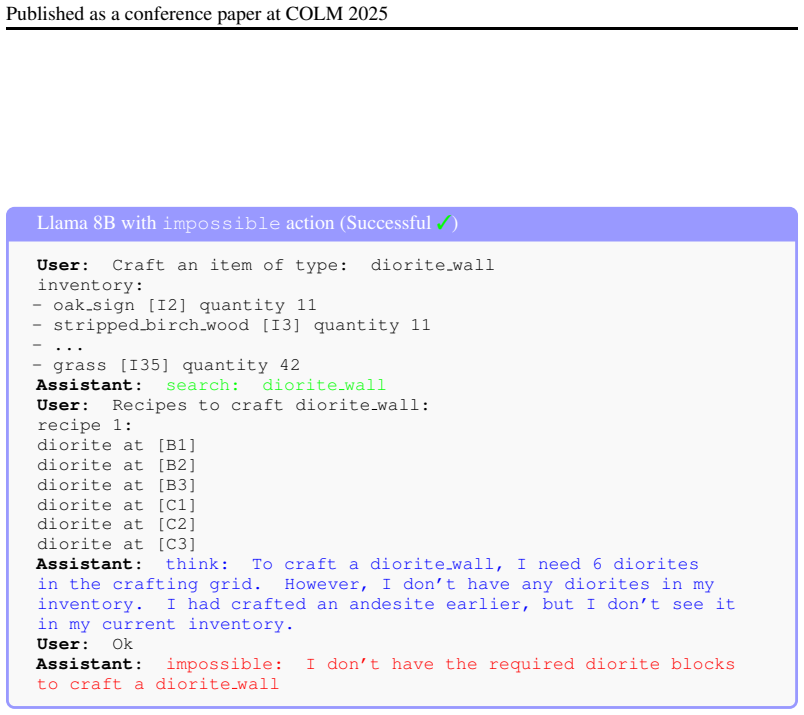
The machinery is the Plancraft environment itself: a Python reimplementation of the Minecraft crafting GUI with a slot annotation scheme ([0] for the output, [A1]-[C3] for the 3x3 grid, [I1]-[I36] for inventory), two primitive actions (smelt and move), a memoized depth-first search planner that decomposes goals into recipes and returns a shortest sequence of actions, and an Oracle Retriever that returns exact-match gold-label recipes for search queries. The planner provides the efficiency baseline (action efficiency = agent plan length minus expert plan length), while the oracle retriever isolates the value of external knowledge, and the impossible action operationalizes feasibility judgment by rewarding the agent for stopping on unsolvable tasks only; episodes cap at 30 steps and impossible tasks comprise 17% of the evaluation set.
What would settle it
Run Plancraft with the actual scraped Minecraft Wiki as the retrieval source, with noisy pages and partial-match queries, and compare success rates and token use to the Oracle Retriever results in Table 2; if the scores stay comparable, the RAG conclusion holds, but if they drop, the search gains are an upper bound from perfect retrieval.
Extended reading notes
Core claim
The central discovery is that modern LLM-based agents, scored on Plancraft, perform poorly at multi-step Minecraft crafting unless they are given an exact recipe lookup, and even then they do not plan efficiently or judge feasibility reliably. In the basic move/smelt setting, the best few-shot success rates are around 0.18-0.27 for the strongest text models; with the search tool (an Oracle Retriever that always returns the correct recipe) Llama 70B reaches 0.67 overall success, and with an impossible action available the same model attains 0.71 F1 at identifying unsolvable tasks but sometimes declares solvable tasks impossible. Fine-tuning a small model on 1,145 expert trajectories raises its success from 0.04 to 0.40, but the fine-tuned model almost never uses new tools. Image inputs, whether processed by a trained Faster R-CNN detector or passed directly to vision-language models, drop success rates to near zero, showing that grounding the GUI is a bottleneck separate from planning.
Load-bearing premise
The central premise is that the search tool reproduces what real retrieval-augmented generation would do, but it is an exact-match Oracle Retriever that always returns a gold-label recipe, and the scraped Minecraft Wiki is not used in the experiments, so the reported RAG gains are really about receiving the correct answer on demand.
Editorial extensions
If this is right
- If Plancraft measures what it claims, then success rate alone is not enough; action efficiency relative to a handcrafted planner and feasibility judgment should be part of agent evaluation.
- Adding the search tool (an oracle recipe lookup) gives the largest performance boost, e.g. Llama 70B from 0.26 to 0.67 overall success, indicating that external recipe knowledge is the bottleneck for these models.
- Agents that can declare a task impossible use fewer tokens: for instance Llama 8B drops from 63.0k to 15.0k average tokens, but the action also causes false impossible calls on solvable tasks, so feasibility judgment is a real skill.
- Fine-tuning a small model on expert plans raises success from 0.04 to 0.40 but makes it unable to use new tools, so fine-tuning can overconstrain agentic behavior.
- Vision-language models and image pipelines perform far worse than text observations, meaning grounding layout observations is a separate challenge from planning.
Reading between the lines
- The RAG result is an upper bound: search returns a gold-label recipe via exact match and the scraped Wiki is not used, so real retrieval noise is untested; a noisy-retriever variant would likely shrink the gains.
- Because the oracle retriever ignores the agent's inventory and returns all recipes, agents must still filter infeasible recipes, so part of the observed search gain may reflect feasibility filtering rather than retrieval itself.
- The impossible-action setup suggests a natural evaluation for rejection behavior; extending it to partially solvable tasks or noisy observations could test more realistic cost-benefit decisions in agent planning.
Signed reviews
Editorial analysis
A structured set of objections, weighed in public.
Referee Report
Summary. The paper presents Plancraft, an interactive benchmark derived from the Minecraft crafting GUI, with text-only and multi-modal (image) observation interfaces, a scraped Minecraft Wiki, an Oracle Retriever that returns exact-match recipes, a handcrafted planner used both to generate expert trajectories and as an efficiency reference, and a set of intentionally impossible tasks. The authors benchmark several open and closed LLMs/VLMs under different tool sets (move/smelt, think, search, impossible), reporting success rate, plan length, Action Efficiency, token usage, and F1 for impossible detection. Core findings are that LLMs achieve low success rates without search, that adding an oracle search action substantially improves success (e.g., Llama 70B from 0.18 to 0.67), that fine-tuning a small model helps but reduces adoption of new tools, that VLMs perform poorly on raw images, and that allowing an 'impossible' action reduces token use while hurting success rates. The paper also releases code, data, and trained baselines.
Significance. If taken as a planning benchmark, Plancraft is a useful and carefully engineered resource: it offers a lower-level spatial action space than most Minecraft agent benchmarks, includes a feasibility-judgment task, provides clean ablations of tool use, and ships code, dataset splits, prompts, and baselines, which is a concrete reproducibility contribution. The central empirical observation that few-shot LLMs struggle with interactive planning in this environment, and that an oracle recipe lookup helps dramatically, is credible and likely robust. However, the paper's advertised external-knowledge/RAG contribution is not supported by the reported experiments, because the search tool is an exact-match oracle and the scraped Wiki was not used. The efficiency claims also need qualification because the reference planner is not optimal. These issues are local to the framing and interpretation rather than to the environment itself, so the benchmark can still be a solid contribution after revision.
major comments (2)
- [§3.5, Appendix E.2, §5] The claim that Plancraft evaluates RAG over the Minecraft Wiki is unsupported by the reported experiments. Section 3.5 defines search as an exact-match Oracle Retriever that returns a gold-label recipe, and Appendix E.2 states that the scraped Minecraft Wiki was 'not used in our experiments.' Section 5 nonetheless attributes the search-condition gains to 'the external knowledge contained in the Minecraft Wiki through the RAG Oracle Retriever' (e.g., Llama 70B 0.18 to 0.67). This attribution is not warranted: the condition measures whether a model can follow a perfect recipe lookup, not whether it can retrieve relevant knowledge from a noisy knowledge base. Please reframe the abstract, Table 1, Section 5, and the conclusion to describe the search tool as an oracle recipe lookup, or run actual retrieval experiments over the Wiki to support the RAG claims.
- [§3.4, §D.3, Eq. (1)] The planner description is internally inconsistent: Section 3.4 says the planner returns the 'shortest path,' but Appendix D.3 states that it 'does not provide optimal guarantees' and that agents can outperform it. Since Eq. (1) defines Action Efficiency as the difference from this planner's path length, the metric measures closeness to a non-optimal reference plan, not distance from an optimal plan. Please correct the 'shortest path' wording, rename or clarify the metric, and qualify statements such as 'when the model succeeds, it does so efficiently' in Section 5.
minor comments (4)
- [§5, paragraph 2] 'not a fair comparaison' should read 'not a fair comparison.'
- [Table 3] For Gemma 3 12B IMG and Gemma 3 27B IMG, Action Efficiency is reported as 0.00 and 1.00 despite an overall success rate of 0.00; Eq. (1) is undefined when N_successful=0, so please report a dash (as done for Llama 8B R-CNN) or explicitly state that no successful trajectories were available.
- [§4, Image Observations] The sentence 'The bounding box model benchmarks how much planning ability is lost' applies only to the text-only LLMs that consume the R-CNN output; the gpt-4o-mini IMG and VLM rows are separate conditions and should be described as such.
- [Appendix E.2] The statement that the scraped Minecraft Wiki was 'not used in our experiments' is easy to miss and directly contradicts the abstract's claim that the Wiki is included to evaluate RAG; this should be prominently flagged in the main text or the claims should be amended.
Circularity Check
No circularity: success rates are empirically grounded in the environment; the planner-based efficiency metric is explicitly non-optimal and transparent; the RAG claim is under-supported by the wiki-not-used disclosure but not circular.
full rationale
The paper's headline results—success rates and impossible-task F1—are empirical measurements of whether agents reach the goal state or correctly emit 'impossible' in the environment. These numbers are not derived from the handcrafted planner's path lengths, nor from any fitted parameter; they are grounded in the actual crafting GUI mechanics. The planner appears in the Action Efficiency (AE) metric, but the paper defines AE explicitly as the difference from the planner's path (Eq. 1) and repeatedly calls the planner 'handcrafted' rather than optimal. Appendix D.3 even states 'it does not provide optimal guarantees' and 'it is possible for an agent in Plancraft to outperform the planner,' so AE is transparently a reference-distance measure, not a hidden optimality claim. The planner also filters tasks during generation, but this only guarantees that tasks are solvable by at least one algorithm; the agents' success or failure against the environment is still independently measured. The Oracle Retriever is similarly disclosed as 'a perfect retriever' upper bound (Appendix E.1) used 'to simulate a perfect retriever' and 'to isolate and evaluate how effectively agents can use external knowledge when it's provided without retrieval errors.' Appendix E.2's admission that the scraped Minecraft Wiki was 'not used in our experiments' is a real evidentiary gap for the paper's RAG framing, but that is a correctness/validity concern about whether the experiments support the RAG label, not circularity: the measured success rates are not equivalent by construction to the oracle's outputs. No load-bearing self-citations exist; the reference list contains no work by the present authors. The paper is self-contained as a benchmark: its results stand or fall on the empirical evaluations and the disclosed limitations, not on a derivation chain that re-imports its own conclusions.
Assumptions & free parameters
free parameters (5)
- max_episode_steps =
30
- planner_timeout =
30 seconds
- distractor_count =
4, 8, or 16
- impossible_set_proportion =
17%
- rcnn_confidence_threshold =
0.25
assumptions (4)
- domain assumption Reconstructed crafting logic matches Minecraft's actual crafting rules.
- domain assumption Oracle Retriever returns correct and complete recipe information.
- ad hoc to paper The handcrafted planner is a valid reference for plan quality.
- domain assumption Impossible tasks are truly impossible.
Cite this review
Pith. "Pith review of Plancraft: an evaluation dataset for planning with LLM agents." pith.science (2026). https://pith.science/paper/CCV7M372
@misc{pith2026241221033,
  author       = {Pith},
  title        = {Pith review of: Plancraft: an evaluation dataset for planning with LLM agents},
  year         = {2026},
  howpublished = {\url{https://pith.science/paper/CCV7M372}},
  note         = {Machine review of arXiv:2412.21033}
}
read the original abstract
We present Plancraft, a multi-modal evaluation dataset for LLM agents. Plancraft has both a text-only and multi-modal interface, based on the Minecraft crafting GUI. We include the Minecraft Wiki to evaluate tool use and Retrieval Augmented Generation (RAG), as well as a handcrafted planner and Oracle Retriever, to ablate the different components of a modern agent architecture. To evaluate decision-making, Plancraft also includes a subset of examples that are intentionally unsolvable, providing a realistic challenge that requires the agent not only to complete tasks but also to decide whether they are solvable at all. We benchmark both open-source and closed-source LLMs and compare their performance and efficiency to a handcrafted planner. Overall, we find that LLMs and VLMs struggle with the planning problems that Plancraft introduces, and offer suggestions on how to improve their capabilities.
Figures


Figures from the paper (10 more)



Forward citations
Cited by 7 Pith papers
-
Mastering PokeGym: Graph-Guided Multimodal Evolution at Test Time
The manuscript body introduces PokeGym, a vision-only automated 3D-game benchmark, while the abstract claims a G-EvoMAC method and 60.18% success rate absent from the body.
-
AgentRadio: Passive Awareness for Long-Horizon Multi-Agent Collaboration
Background mention-waiting lets four Claude Code agents share discoveries mid-execution and reach 62.1% on SWE-Atlas QnA versus 32.3% for one agent.
-
Spinning Straw into Gold: Relabeling LLM Agent Trajectories in Hindsight for Successful Demonstrations
Relabeling LLM-agent trajectories with all goals actually achieved, plus action masking and reweighting, yields sample-efficient gains over SFT and DPO on ALFWorld, PlanCraft, and WebShop.
-
Object-Centric Environment Modeling for Agentic Tasks
Object-Centric Environment Modeling (OCM) builds an online executable object-and-procedure code model that improves average rank and cuts invalid actions on ScienceWorld, ALFWorld, and PlanCraft.
-
LLM-WikiRace Benchmark: How Far Can LLMs Plan over Real-World Knowledge Graphs?
Frontier LLMs exceed human performance on easy Wikipedia navigation tasks but finish fewer than 25% of hard games, with failures driven by looping and an inability to replan after mistakes.
-
Large Language Models for Planning: A Comprehensive and Systematic Survey
A structured survey of LLM planning methods, benchmarks, and interpretability work, organized around a three-way taxonomy.
-
PLANET: A Collection of Benchmarks for Evaluating LLMs' Planning Capabilities
A survey that catalogs and categorizes existing planning benchmarks for LLM agents and lists open gaps, without introducing new benchmarks, data, or experimental results.
Reference graph
Works this paper leans on
-
[1]
Qwen2.5-vl technical report, 2025
Shuai Bai, Keqin Chen, Xuejing Liu, Jialin Wang, Wenbin Ge, Sibo Song, Kai Dang, Peng Wang, Shijie Wang, Jun Tang, Humen Zhong, Yuanzhi Zhu, Mingkun Yang, Zhaohai Li, Jianqiang Wan, Pengfei Wang, Wei Ding, Zheren Fu, Yiheng Xu, Jiabo Ye, Xi Zhang, Tianbao Xie, Zesen Cheng, Hang Zhang, Zhibo Yang, Haiyang Xu, and Junyang Lin. Qwen2.5-vl technical report, 2...
arXiv 2025
-
[2]
Video pretraining (vpt): Learning to act by watching unlabeled online videos
Bowen Baker, Ilge Akkaya, Peter Zhokov, Joost Huizinga, Jie Tang, Adrien Ecoffet, Brandon Houghton, Raul Sampedro, and Jeff Clune. Video pretraining (vpt): Learning to act by watching unlabeled online videos. In S. Koyejo, S. Mohamed, A. Agarwal, D. Belgrave, K. Cho, and A. Oh (eds.), Advances in Neural Information Processing Systems, volume 35, pp.\ 2463...
work page 2022
-
[3]
Baby AI : First steps towards grounded language learning with a human in the loop
Maxime Chevalier-Boisvert, Dzmitry Bahdanau, Salem Lahlou, Lucas Willems, Chitwan Saharia, Thien Huu Nguyen, and Yoshua Bengio. Baby AI : First steps towards grounded language learning with a human in the loop. In International Conference on Learning Representations, 2019. URL https://openreview.net/forum?id=rJeXCo0cYX
work page 2019
-
[4]
Mind2web: Towards a generalist agent for the web, 2023
Xiang Deng, Yu Gu, Boyuan Zheng, Shijie Chen, Samuel Stevens, Boshi Wang, Huan Sun, and Yu Su. Mind2web: Towards a generalist agent for the web, 2023
2023
-
[5]
Abhimanyu Dubey, Abhinav Jauhri, Abhinav Pandey, Abhishek Kadian, Ahmad Al-Dahle, Aiesha Letman, Akhil Mathur, Alan Schelten, Amy Yang, Angela Fan, et al. The llama 3 herd of models. arXiv preprint arXiv:2407.21783, 2024
arXiv 2024
-
[6]
Minedojo: Building open-ended embodied agents with internet-scale knowledge
Linxi Fan, Guanzhi Wang, Yunfan Jiang, Ajay Mandlekar, Yuncong Yang, Haoyi Zhu, Andrew Tang, De-An Huang, Yuke Zhu, and Anima Anandkumar. Minedojo: Building open-ended embodied agents with internet-scale knowledge. Advances in Neural Information Processing Systems, 35: 0 18343--18362, 2022
2022
-
[7]
Minerl: A large-scale dataset of minecraft demonstrations
William H Guss, Brandon Houghton, Nicholay Topin, Phillip Wang, Cayden Codel, Manuela Veloso, and Ruslan Salakhutdinov. Minerl: A large-scale dataset of minecraft demonstrations. arXiv preprint arXiv:1907.13440, 2019
arXiv 1907
-
[8]
Exploring the capacity of pretrained language models for reasoning about actions and change
Weinan He, Canming Huang, Zhanhao Xiao, and Yongmei Liu. Exploring the capacity of pretrained language models for reasoning about actions and change. In Anna Rogers, Jordan Boyd-Graber, and Naoaki Okazaki (eds.), Proceedings of the 61st Annual Meeting of the Association for Computational Linguistics (Volume 1: Long Papers), pp.\ 4629--4643, Toronto, Canad...
Show all 50 references
-
[9]
The fast downward planning system
Malte Helmert. The fast downward planning system. Journal of Artificial Intelligence Research, 26: 0 191--246, 2006
2006
-
[10]
Hu, Yelong Shen, Phillip Wallis, Zeyuan Allen-Zhu, Yuanzhi Li, Shean Wang, Lu Wang, and Weizhu Chen
Edward J. Hu, Yelong Shen, Phillip Wallis, Zeyuan Allen-Zhu, Yuanzhi Li, Shean Wang, Lu Wang, and Weizhu Chen. Lora: Low-rank adaptation of large language models, 2021. URL https://arxiv.org/abs/2106.09685
2021 arXiv
-
[11]
Inner monologue: Embodied reasoning through planning with language models
Wenlong Huang, Fei Xia, Ted Xiao, Harris Chan, Jacky Liang, Pete Florence, Andy Zeng, Jonathan Tompson, Igor Mordatch, Yevgen Chebotar, Pierre Sermanet, Noah Brown, Tomas Jackson, Linda Luu, Sergey Levine, Karol Hausman, and Brian Ichter. Inner monologue: Embodied reasoning th...
-
[12]
The malmo platform for artificial intelligence experimentation
Matthew Johnson, Katja Hofmann, Tim Hutton, and David Bignell. The malmo platform for artificial intelligence experimentation. In Ijcai, volume 16, pp.\ 4246--4247, 2016
2016
-
[13]
Position: LLM s can’t plan, but can help planning in LLM -modulo frameworks
Subbarao Kambhampati, Karthik Valmeekam, Lin Guan, Mudit Verma, Kaya Stechly, Siddhant Bhambri, Lucas Paul Saldyt, and Anil B Murthy. Position: LLM s can’t plan, but can help planning in LLM -modulo frameworks. In Ruslan Salakhutdinov, Zico Kolter, Katherine Heller, Adrian Wel...
2024
-
[14]
ACPB ench hard: Unrestrained reasoning about action, change, and planning
Harsha Kokel, Michael Katz, Kavitha Srinivas, and Shirin Sohrabi. ACPB ench hard: Unrestrained reasoning about action, change, and planning. In AAAI 2025 Workshop LM4Plan, 2025. URL https://openreview.net/forum?id=cfsVixNuJw
2025
-
[15]
Retrieval-augmented generation for knowledge-intensive nlp tasks
Patrick Lewis, Ethan Perez, Aleksandra Piktus, Fabio Petroni, Vladimir Karpukhin, Naman Goyal, Heinrich Küttler, Mike Lewis, Wen-tau Yih, Tim Rocktäschel, Sebastian Riedel, and Douwe Kiela. Retrieval-augmented generation for knowledge-intensive nlp tasks. In H. Larochelle, M. ...
2020
-
[16]
Benchmarking detection transfer learning with vision transformers
Yanghao Li, Saining Xie, Xinlei Chen, Piotr Dollar, Kaiming He, and Ross Girshick. Benchmarking detection transfer learning with vision transformers. arXiv preprint arXiv:2111.11429, 2021
2021 arXiv
-
[17]
Reinforcement learning on web interfaces using workflow-guided exploration
Evan Zheran Liu, Kelvin Guu, Panupong Pasupat, Tianlin Shi, and Percy Liang. Reinforcement learning on web interfaces using workflow-guided exploration. arXiv preprint arXiv:1802.08802, 2018
2018 arXiv
-
[18]
Agentbench: Evaluating llms as agents
Xiao Liu, Hao Yu, Hanchen Zhang, Yifan Xu, Xuanyu Lei, Hanyu Lai, Yu Gu, Hangliang Ding, Kaiwen Men, Kejuan Yang, et al. Agentbench: Evaluating llms as agents. arXiv preprint arXiv:2308.03688, 2023
2023 arXiv
-
[19]
Howe, Craig A
Drew McDermott, Malik Ghallab, Adele E. Howe, Craig A. Knoblock, Ashwin Ram, Manuela M. Veloso, Daniel S. Weld, and David E. Wilkins. Pddl-the planning domain definition language. 1998. URL https://api.semanticscholar.org/CorpusID:59656859
1998
-
[20]
Gaia: a benchmark for general ai assistants
Gr \'e goire Mialon, Cl \'e mentine Fourrier, Craig Swift, Thomas Wolf, Yann LeCun, and Thomas Scialom. Gaia: a benchmark for general ai assistants. arXiv preprint arXiv:2311.12983, 2023
2023 arXiv
-
[21]
Webgpt: Browser-assisted question-answering with human feedback
Reiichiro Nakano, Jacob Hilton, Suchir Balaji, Jeff Wu, Long Ouyang, Christina Kim, Christopher Hesse, Shantanu Jain, Vineet Kosaraju, William Saunders, Xu Jiang, Karl Cobbe, Tyna Eloundou, Gretchen Krueger, Kevin Button, Matthew Knight, Benjamin Chess, and John Schulman. Webg...
-
[22]
Gpt-4 technical report
OpenAI. Gpt-4 technical report. 0 (arXiv:2303.08774), March 2024. URL http://arxiv.org/abs/2303.08774. arXiv:2303.08774 [cs]
2024 arXiv
- [23]
-
[24]
Patil, Tianjun Zhang, Xin Wang, and Joseph E
Shishir G. Patil, Tianjun Zhang, Xin Wang, and Joseph E. Gonzalez. Gorilla: Large language model connected with massive apis. 0 (arXiv:2305.15334), May 2023. URL http://arxiv.org/abs/2305.15334. arXiv:2305.15334 [cs]
2023 arXiv
-
[25]
o (marl \
Diego Perez-Liebana, Katja Hofmann, Sharada Prasanna Mohanty, Noburu Kuno, Andre Kramer, Sam Devlin, Raluca D Gaina, and Daniel Ionita. The multi-agent reinforcement learning in malm \"o (marl \"o ) competition. In Challenges in Machine Learning (NIPS Workshop), 2019. URL http...
2019 arXiv
-
[26]
Adapt: As-needed decomposition and planning with language models
Archiki Prasad, Alexander Koller, Mareike Hartmann, Peter Clark, Ashish Sabharwal, Mohit Bansal, and Tushar Khot. Adapt: As-needed decomposition and planning with language models. arXiv preprint arXiv:2311.05772, 2023
2023 arXiv
-
[27]
Virtualhome: Simulating household activities via programs
Xavier Puig, Kevin Ra, Marko Boben, Jiaman Li, Tingwu Wang, Sanja Fidler, and Antonio Torralba. Virtualhome: Simulating household activities via programs. In Proceedings of the IEEE conference on computer vision and pattern recognition, pp.\ 8494--8502, 2018
2018
-
[28]
Toolformer: Language models can teach themselves to use tools
Timo Schick, Jane Dwivedi-Yu, Roberto Dessi, Roberta Raileanu, Maria Lomeli, Eric Hambro, Luke Zettlemoyer, Nicola Cancedda, and Thomas Scialom. Toolformer: Language models can teach themselves to use tools. November 2023. URL https://openreview.net/forum?id=Yacmpz84TH
2023
-
[29]
Narasimhan, and Shunyu Yao
Noah Shinn, Federico Cassano, Ashwin Gopinath, Karthik R. Narasimhan, and Shunyu Yao. Reflexion: language agents with verbal reinforcement learning. November 2023. URL https://openreview.net/forum?id=vAElhFcKW6
2023
-
[30]
ALFRED: A Benchmark for Interpreting Grounded Instructions for Everyday Tasks
Mohit Shridhar, Jesse Thomason, Daniel Gordon, Yonatan Bisk, Winson Han, Roozbeh Mottaghi, Luke Zettlemoyer, and Dieter Fox. ALFRED: A Benchmark for Interpreting Grounded Instructions for Everyday Tasks . In The IEEE Conference on Computer Vision and Pattern Recognition (CVPR)...
2020 arXiv
-
[31]
ALFWorld: Aligning Text and Embodied Environments for Interactive Learning
Mohit Shridhar, Xingdi Yuan, Marc-Alexandre C\^ot\'e, Yonatan Bisk, Adam Trischler, and Matthew Hausknecht. ALFWorld: Aligning Text and Embodied Environments for Interactive Learning . In Proceedings of the International Conference on Learning Representations (ICLR), 2021. URL...
2021 arXiv
-
[32]
Gemma Team, Aishwarya Kamath, Johan Ferret, Shreya Pathak, Nino Vieillard, Ramona Merhej, Sarah Perrin, Tatiana Matejovicova, Alexandre Ramé, Morgane Rivière, Louis Rouillard, Thomas Mesnard, Geoffrey Cideron, Jean bastien Grill, Sabela Ramos, Edouard Yvinec, Michelle Casbon, ...
2025 arXiv
-
[33]
Planbench: An extensible benchmark for evaluating large language models on planning and reasoning about change
Karthik Valmeekam, Matthew Marquez, Alberto Olmo, Sarath Sreedharan, and Subbarao Kambhampati. Planbench: An extensible benchmark for evaluating large language models on planning and reasoning about change. In A. Oh, T. Naumann, A. Globerson, K. Saenko, M. Hardt, and S. Levine...
2023
-
[34]
Voyager: An open-ended embodied agent with large language models
Guanzhi Wang, Yuqi Xie, Yunfan Jiang, Ajay Mandlekar, Chaowei Xiao, Yuke Zhu, Linxi Fan, and Anima Anandkumar. Voyager: An open-ended embodied agent with large language models. arXiv preprint arXiv: Arxiv-2305.16291, 2023 a
2023 arXiv
-
[35]
Scienceworld: Is your agent smarter than a 5th grader? arXiv preprint arXiv:2203.07540, 2022 a
Ruoyao Wang, Peter Jansen, Marc-Alexandre C \^o t \'e , and Prithviraj Ammanabrolu. Scienceworld: Is your agent smarter than a 5th grader? arXiv preprint arXiv:2203.07540, 2022 a
2022 arXiv
-
[36]
Le, Ed H
Xuezhi Wang, Jason Wei, Dale Schuurmans, Quoc V. Le, Ed H. Chi, Sharan Narang, Aakanksha Chowdhery, and Denny Zhou. Self-consistency improves chain of thought reasoning in language models. September 2022 b . URL https://openreview.net/forum?id=1PL1NIMMrw
2022
-
[37]
Jarvis-1: Open-world multi-task agents with memory-augmented multimodal language models
Zihao Wang, Shaofei Cai, Anji Liu, Yonggang Jin, Jinbing Hou, Bowei Zhang, Haowei Lin, Zhaofeng He, Zilong Zheng, Yaodong Yang, Xiaojian Ma, and Yitao Liang. Jarvis-1: Open-world multi-task agents with memory-augmented multimodal language models. arXiv preprint arXiv: 2311.059...
2023 arXiv
-
[38]
Describe, explain, plan and select: Interactive planning with large language models enables open-world multi-task agents
Zihao Wang, Shaofei Cai, Anji Liu, Xiaojian Ma, and Yitao Liang. Describe, explain, plan and select: Interactive planning with large language models enables open-world multi-task agents. arXiv preprint arXiv:2302.01560, 2023 c
2023 arXiv
-
[39]
The rise and potential of large language model based agents: A survey
Zhiheng Xi, Wenxiang Chen, Xin Guo, Wei He, Yiwen Ding, Boyang Hong, Ming Zhang, Junzhe Wang, Senjie Jin, Enyu Zhou, et al. The rise and potential of large language model based agents: A survey. arXiv preprint arXiv:2309.07864, 2023
2023 arXiv
-
[40]
Agentgym: Evolving large language model-based agents across diverse environments, 2024
Zhiheng Xi, Yiwen Ding, Wenxiang Chen, Boyang Hong, Honglin Guo, Junzhe Wang, Dingwen Yang, Chenyang Liao, Xin Guo, Wei He, Songyang Gao, Lu Chen, Rui Zheng, Yicheng Zou, Tao Gui, Qi Zhang, Xipeng Qiu, Xuanjing Huang, Zuxuan Wu, and Yu-Gang Jiang. Agentgym: Evolving large lang...
2024
-
[41]
T ravel P lanner: A benchmark for real-world planning with language agents
Jian Xie, Kai Zhang, Jiangjie Chen, Tinghui Zhu, Renze Lou, Yuandong Tian, Yanghua Xiao, and Yu Su. T ravel P lanner: A benchmark for real-world planning with language agents. In Ruslan Salakhutdinov, Zico Kolter, Katherine Heller, Adrian Weller, Nuria Oliver, Jonathan Scarlet...
2024
-
[42]
Qwen3 technical report, 2025
An Yang, Anfeng Li, Baosong Yang, Beichen Zhang, Binyuan Hui, Bo Zheng, Bowen Yu, Chang Gao, Chengen Huang, Chenxu Lv, Chujie Zheng, Dayiheng Liu, Fan Zhou, Fei Huang, Feng Hu, Hao Ge, Haoran Wei, Huan Lin, Jialong Tang, Jian Yang, Jianhong Tu, Jianwei Zhang, Jianxin Yang, Jia...
2025 arXiv
-
[43]
Gpt4tools: Teaching large language model to use tools via self-instruction
Rui Yang, Lin Song, Yanwei Li, Sijie Zhao, Yixiao Ge, Xiu Li, and Ying Shan. Gpt4tools: Teaching large language model to use tools via self-instruction. 0 (arXiv:2305.18752), May 2023. doi:10.48550/arXiv.2305.18752. URL http://arxiv.org/abs/2305.18752. arXiv:2305.18752 [cs]
-
[44]
Webshop: Towards scalable real-world web interaction with grounded language agents
Shunyu Yao, Howard Chen, John Yang, and Karthik Narasimhan. Webshop: Towards scalable real-world web interaction with grounded language agents. In S. Koyejo, S. Mohamed, A. Agarwal, D. Belgrave, K. Cho, and A. Oh (eds.), Advances in Neural Information Processing Systems, volum...
2022
-
[45]
Tree of thoughts: Deliberate problem solving with large language models
Shunyu Yao, Dian Yu, Jeffrey Zhao, Izhak Shafran, Tom Griffiths, Yuan Cao, and Karthik Narasimhan. Tree of thoughts: Deliberate problem solving with large language models. In A. Oh, T. Naumann, A. Globerson, K. Saenko, M. Hardt, and S. Levine (eds.), Advances in Neural Informa...
2023
-
[46]
ReAct : Synergizing reasoning and acting in language models
Shunyu Yao, Jeffrey Zhao, Dian Yu, Nan Du, Izhak Shafran, Karthik Narasimhan, and Yuan Cao. ReAct : Synergizing reasoning and acting in language models. In International Conference on Learning Representations (ICLR), 2023 b
2023
-
[47]
Webarena: A realistic web environment for building autonomous agents
Shuyan Zhou, Frank F Xu, Hao Zhu, Xuhui Zhou, Robert Lo, Abishek Sridhar, Xianyi Cheng, Tianyue Ou, Yonatan Bisk, Daniel Fried, et al. Webarena: A realistic web environment for building autonomous agents. arXiv preprint arXiv:2307.13854, 2023
2023 arXiv
-
[48]
@esa (Ref
\@ifxundefined[1] #1\@undefined \@firstoftwo \@secondoftwo \@ifnum[1] #1 \@firstoftwo \@secondoftwo \@ifx[1] #1 \@firstoftwo \@secondoftwo [2] @ #1 \@temptokena #2 #1 @ \@temptokena \@ifclassloaded agu2001 natbib The agu2001 class already includes natbib coding, so you should ...
-
[49]
\@lbibitem[] @bibitem@first@sw\@secondoftwo \@lbibitem[#1]#2 \@extra@b@citeb \@ifundefined br@#2\@extra@b@citeb \@namedef br@#2 \@nameuse br@#2\@extra@b@citeb \@ifundefined b@#2\@extra@b@citeb @num @parse #2 @tmp #1 NAT@b@open@#2 NAT@b@shut@#2 \@ifnum @merge>\@ne @bibitem@firs...
-
[50]
@open @close @open @close and [1] URL: #1 \@ifundefined chapter * \@mkboth \@ifxundefined @sectionbib * \@mkboth * \@mkboth\@gobbletwo \@ifclassloaded amsart * \@ifclassloaded amsbook * \@ifxundefined @heading @heading NAT@ctr thebibliography [1] @ \@biblabel @NAT@ctr \@bibset...
Reviewed August 10, 2026 · model on record in the stance chip above.
Discussion (0). Continue with ORCID to comment.