REVIEW 4 major objections 5 minor 1 cited by
CogAD: Cognitive-Hierarchy Guided End-to-End Autonomous Driving
T0 review · 4 major / 5 minor · reviewed 2026-08-07 · deepseek-v4-flash
Pith's one-line read CogAD claims state-of-the-art end-to-end driving with a cognitive hierarchy and zero collisions at the 1s horizon.
desk verdict A coherent end-to-end driving architecture with a dual uncertainty hierarchy and a notable no-ego-state result, but the SOTA claims outrun the evidence: tiny long-tail sets, selective closed-loop baselines, and a text/table contradiction on overtake collision rate. read the letter →
The pith
A machine-rendered reading of the paper's core claim, the machinery that carries it, and where it could break.
The reading
What carries the argument
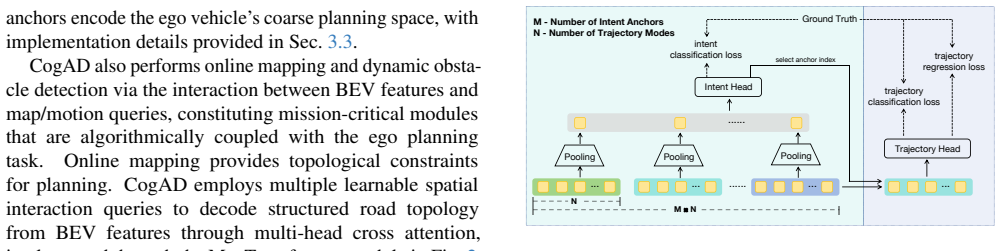
The central machinery is the dual-level uncertainty hierarchy. Intent anchors—coarse trajectory prototypes obtained by online K-means clustering on training data—define the high-level planning space and carry intent uncertainty; learnable mode embeddings shared between planning and motion prediction carry trajectory uncertainty. A BEV adapter per task lets each instance query first absorb dense scene context, and a bidirectional ego-motion self-attention plus map cross-attention couples planning to the predicted futures of others. This hierarchy is what lets the model produce diverse intent-level and trajectory-level multimodal outputs and, according to the paper, is what lowers collision rate by 62.5% versus non-hierarchical planning in ablation.
What would settle it
Expand the long-tail validation set to the full nuScenes scenes that contain these maneuvers, rerun the open-loop table with the omitted baselines (SparseDrive, DiffusionDrive, VADv2, Hydra-MDP) under the same 60-epoch protocol, and check whether CogAD still holds 0.00% collision at 1 s, 0.48 m average L2, and 0.06% average collision; likewise rerun Bench2Drive with those methods included and see if the 48.30 Driving Score stands.
Extended reading notes
Core claim
Dual hierarchical mechanisms drive the design. In perception, the ego query first attends to dense BEV features to gather global context, then interacts with instance-level agent and map queries through self- and cross-attention, so scene context is processed before object details. In planning, a set of K-means-derived intent anchors represents high-level goals and carries intent-level uncertainty; after the ego query selects an anchor, a trajectory head generates multiple fine-grained trajectory modes conditioned on that intent, with trajectory-level uncertainty encoded by learnable mode embeddings shared between planning and motion prediction. Training uses an intent-grounding loss, a winner-takes-all trajectory imitation loss, map/detection/motion losses, and planning constraints. The paper reports that this combination achieves a state-of-the-art average L2 error of 0.48 m on nuScenes, an average collision rate of 0.06%, 0.00% at 1 s, and a 48.30 Driving Score with 24.00% Success Rate on Bench2Drive.
Load-bearing premise
The state-of-the-art claim depends on the long-tail validation set (only 25 frames for three-point turns, 40 for resume-from-stop, and 102 for overtake) and the closed-loop baseline list being representative and fairly chosen; if either is unrepresentative or selective, the central performance claims do not follow.
Editorial extensions
If this is right
- A no-ego-state planner can reach 0% collision at the 1 s horizon on nuScenes, suggesting that open-loop planning need not rely on the ego vehicle's own state or history to be safe at short horizons.
- Four inference modes—deterministic, intent sampling, trajectory sampling, and dual-level sampling—let the same model shift between a single confident plan and diverse candidate plans, which the authors use in closed-loop evaluation to avoid getting stuck.
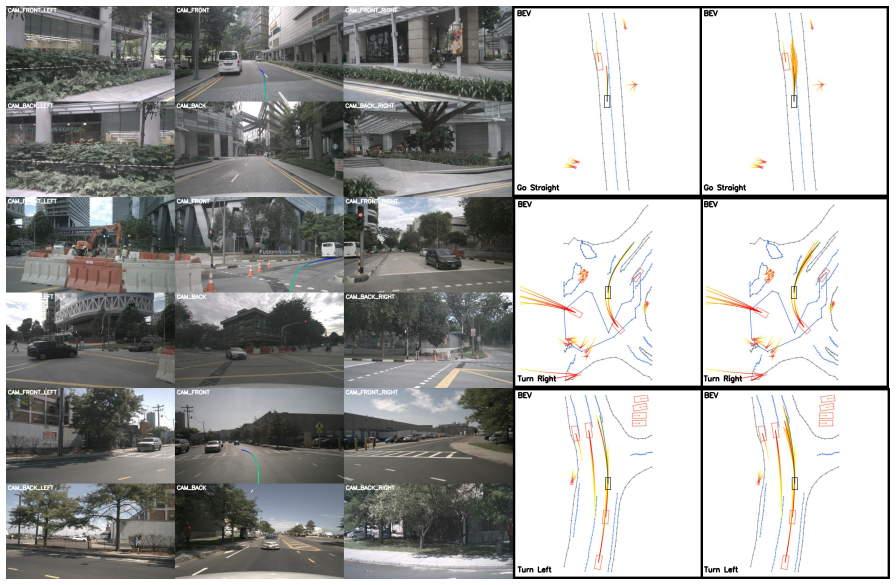
- Long-tail performance improves most where data are scarce: a zero-shot three-point turn case improves L2 by about 10% over the prior best, and resume-from-stop L2 drops from 0.65 m to 0.34 m average.
- The reported latencies (92.9 ms on nuScenes, 121.3 ms on Bench2Drive) put the approach in a range compatible with real-time control, assuming the hosting platform reflects deployment conditions.
Reading between the lines
- If the 0%-at-1s result survives evaluation on the full nuScenes split, it would shift attention away from ego-state features toward scene-context and intent features as the main short-horizon safety signal.
- The sharing of mode embeddings between planning and motion prediction suggests a single learned motion-pattern vocabulary could unify prediction and planning across agents, a direction the paper does not itself develop.
- Intent anchors derived from online K-means could be extended to carry explicit semantic goals (e.g., navigation commands or traffic-rule constraints) without hand-crafted meta-actions, connecting to LLM-style planners in a data-driven way.
- A direct testable extension is to use the intent-sampling inference mode as an exploratory policy in closed-loop simulation and measure how often it recovers the ego vehicle from suboptimal states compared with deterministic inference.
Editorial analysis
A structured set of objections, weighed in public.
Referee Report
Summary. CogAD proposes a hierarchical end-to-end driving architecture with two main components: hierarchical perception, which first fuses task-specific queries with BEV features and then performs cross-task instance interaction, and hierarchical planning, which first predicts high-level intent anchors obtained by online K-means clustering and then generates multi-mode trajectories with shared mode embeddings. The paper evaluates open-loop planning on nuScenes, closed-loop planning on Bench2Drive, and a manually curated long-tail subset, reporting state-of-the-art L2 error and collision rate, low latency (92.9 ms on nuScenes, 121.3 ms on Bench2Drive), and an explicit design choice to avoid ego-state and historical ego information. The central claims are that CogAD achieves state-of-the-art performance in open-loop, closed-loop, and long-tail scenarios.
Significance. If the empirical claims hold, the paper would make a useful contribution: the architecture is clearly described, the latency numbers are competitive, the no-ego-state design is a clean protocol choice, and the internal ablations are coherent and support the value of both hierarchical perception and hierarchical planning. The paper also deserves credit for transparently listing the composition of the long-tail set in Supplementary Table 6 and for reporting latency alongside quality metrics. However, the strongest comparative claims rest on a very small manually curated long-tail set and a selective closed-loop baseline list. The stress-test concern about these two evaluation gaps is, on close reading, justified: the paper does not provide confidence intervals or repeated-seed statistics, and the closed-loop table omits several strong baselines that are discussed in the related work. The ablations are internally consistent, but the headline state-of-the-art claims are not yet supported by the evidence as presented.
major comments (4)
- [Sec. 4.1, Table 2, Supplementary Table 6] The long-tail state-of-the-art claim is not supported by the evidence as presented. The validation set contains only 25 frames for three-point turns, 40 for resume-from-stop, and 102 for overtake, all manually curated from nuScenes. With per-frame collision metrics, a single collision changes the overtake collision rate by roughly 1%. The paper reports no confidence intervals, no repeated-seed variation, and no frame-level breakdowns. Under these conditions, the cited improvements (e.g., the 0.18 m average L2 gain over TOKEN in overtake) are within plausible stochastic variation, so the claim of particularly significant long-tail improvements does not follow.
- [Sec. 4.1, Table 3] The closed-loop state-of-the-art claim is not verifiable from Table 3. The table compares CogAD only with UniAD, VAD, GenAD, and MomAD, and omits SparseDrive, DiffusionDrive, VADv2, and Hydra-MDP, all of which are discussed in Sec. 2 as strong end-to-end planners. If the omission is due to the no-ego-state protocol, the paper should state explicitly which of these methods use ego-state or historical ego information and should still provide their Bench2Drive numbers under the same protocol. Without this, the claim of state-of-the-art closed-loop performance is an unsupported comparative statement.
- [Sec. 4.1, Table 2] The long-tail paragraph states that CogAD 'achieves a competitively low collision rate that nearly matches TOKEN [49]'s performance' in the overtake scenario, but Table 2 reports TOKEN at 0.00% and CogAD at 0.28%. Since one collision on 102 frames is about 0.98%, this difference is in the opposite direction of the claimed near-match. The text should be corrected, or the table and frame set should be justified if the difference is considered negligible.
- [Tables 1-5] All planning and ablation results are point estimates with no error bars or repeated-seed statistics. Given the rare-event nature of collision rates, the headline 0.00% collision rate at the 1 s horizon and the ablation differences (e.g., Table 5: 0.06 vs 0.13) need variance estimates or multiple seeds to rule out chance. This is particularly important for the claim of being the first to achieve 0% collision at the 1 s horizon without ego-state information.
minor comments (5)
- [Table 1] The TOKEN row reports no collision rates; the table should state why (e.g., unavailable in the original paper) rather than leaving blank cells.
- [Table 4] The heading 'BEV Ineraction' contains a typo and should read 'BEV Interaction'.
- [Eqs. (1)-(5)] The notation 'T ransf ormer' contains unintended spacing and should be typeset as 'Transformer'.
- [Sec. 4.2] The sentence 'L2 Error remains statistically comparable (showing minimal variation)' uses statistical language without any statistical test; it should be rephrased as 'similar in magnitude'.
- [General] The paper does not state whether code or trained models will be released; a reproducibility statement would strengthen the submission.
Circularity Check
No significant circularity; CogAD's results are empirical supervised-learning claims with no construction-level reduction or load-bearing self-citation.
full rationale
CogAD is an empirical systems paper whose claimed derivation chain is the standard supervised learning pipeline from sensor inputs to planning outputs. The intent anchors are produced by online K-means clustering on training trajectories, and the intent and trajectory heads are trained with anchor-selection and winner-takes-all losses against ground-truth ego trajectories; this is conventional imitation learning, not a prediction that is equivalent to its input by construction. The nuScenes and Bench2Drive metrics are measured on held-out or benchmark data, so reporting low L2 and collision values is an empirical result, not a restatement of the training objective. There are no load-bearing self-citations: the cited prior works (VADv2, Hydra-MDP, MultiPath++, SparseDrive, TOKEN) are external and used for standard components such as K-means anchors, mode embeddings, bidirectional interaction, and evaluation-set curation. No uniqueness theorem is imported from the authors, and no ansatz is smuggled in via self-citation. The small long-tail validation set and the selective closed-loop baseline list raised in the surrounding review are concerns about statistical support and fair comparison, but they are not circularity reductions. Accordingly, no circular step can be quoted, and the score is 0.
Assumptions & free parameters
free parameters (3)
- Number of intent anchors M =
30
- Number of trajectory modes N =
6
- Planning loss weights lambda =
lambda1=lambda2=2.0, lambda3=0.2, lambda4=lambda5=lambda6=lambda7=1.0
assumptions (5)
- domain assumption Pre-attentive two-stage visual perception and the BDI cognitive model justify global-to-local perception and intent-to-trajectory planning.
- domain assumption Trajectory uncertainty follows intrinsic motion patterns representable by shared learnable mode embeddings.
- domain assumption Online K-means on the training set yields intent anchors that are stable and transfer to long-tail events.
- standard math Transformer attention and K-means clustering behave as in standard implementations.
- domain assumption Open-loop L2 error and collision rate on nuScenes, plus closed-loop Driving Score and Success Rate on Bench2Drive, are sufficient to establish state-of-the-art end-to-end planning.
invented entities (2)
-
Intent anchors
-
Shared trajectory mode embeddings
Cite this review
Pith. "Pith review of CogAD: Cognitive-Hierarchy Guided End-to-End Autonomous Driving." pith.science (2026). https://pith.science/paper/CJ4OACXM
@misc{pith2026250521581,
  author       = {Pith},
  title        = {Pith review of: CogAD: Cognitive-Hierarchy Guided End-to-End Autonomous Driving},
  year         = {2026},
  howpublished = {\url{https://pith.science/paper/CJ4OACXM}},
  note         = {Machine review of arXiv:2505.21581}
}
read the original abstract
While end-to-end autonomous driving has advanced significantly, prevailing methods remain fundamentally misaligned with human cognitive principles in both perception and planning. In this paper, we propose CogAD, a novel end-to-end autonomous driving model that emulates the hierarchical cognition mechanisms of human drivers. CogAD implements dual hierarchical mechanisms: global-to-local context processing for human-like perception and intent-conditioned multi-mode trajectory generation for cognitively-inspired planning. The proposed method demonstrates three principal advantages: comprehensive environmental understanding through hierarchical perception, robust planning exploration enabled by multi-level planning, and diverse yet reasonable multi-modal trajectory generation facilitated by dual-level uncertainty modeling. Extensive experiments on nuScenes and Bench2Drive demonstrate that CogAD achieves state-of-the-art performance in end-to-end planning, exhibiting particular superiority in long-tail scenarios and robust generalization to complex real-world driving conditions.
Figures


Figures from the paper (6 more)


Forward citations
Cited by 1 Pith paper
-
HAD: Combining Hierarchical Diffusion with Metric-Decoupled RL for End-to-End Driving
Hierarchical diffusion plus polar structure-preserving expansion and metric-decoupled RL yields SOTA open- and closed-loop planning scores on NAVSIM and HUGSIM.
Reference graph
Works this paper leans on
-
[49]
Ran Tian, Boyi Li, Xinshuo Weng, Yuxiao Chen, Edward Schmerling, Yue Wang, Boris Ivanovic, and Marco Pavone. Tokenize the world into object-level knowledge to address long-tail events in autonomous driving.arXiv preprint arXiv:2407.00959, 2024. 2, 5, 6, 9
arXiv 2024
-
[1]
End to end learning for self-driving cars.arXiv preprint arXiv:1604.07316, 2016
Mariusz Bojarski, Davide Del Testa, Daniel Dworakowski, Bernhard Firner, Beat Flepp, Prasoon Goyal, Lawrence D Jackel, Mathew Monfort, Urs Muller, Jiakai Zhang, et al. End to end learning for self-driving cars.arXiv preprint arXiv:1604.07316, 2016. 2
arXiv 2016
-
[2]
Intention, plans, and practical reason
Michael Bratman. Intention, plans, and practical reason. 1987. 1
work page 1987
-
[3]
nuscenes: A multimodal dataset for autonomous driving
Holger Caesar, Varun Bankiti, Alex H Lang, Sourabh V ora, Venice Erin Liong, Qiang Xu, Anush Krishnan, Yu Pan, Giancarlo Baldan, and Oscar Beijbom. nuscenes: A multimodal dataset for autonomous driving. InProceedings of the IEEE/CVF conference on computer vision and pattern recognition, pages 11621–11631, 2020. 6
work page 2020
-
[4]
Yuning Chai, Benjamin Sapp, Mayank Bansal, and Dragomir Anguelov. Multipath: Multiple probabilistic anchor trajectory hypotheses for behavior prediction.arXiv preprint arXiv:1910.05449, 2019. 5
arXiv 1910
-
[5]
Shaoyu Chen, Bo Jiang, Hao Gao, Bencheng Liao, Qing Xu, Qian Zhang, Chang Huang, Wenyu Liu, and Xinggang Wang. Vadv2: End-to-end vectorized autonomous driving via probabilistic planning.arXiv preprint arXiv:2402.13243,
-
[6]
Xuesong Chen, Shaoshuai Shi, Tao Ma, Jingqiu Zhou, Simon See, Ka Chun Cheung, and Hongsheng Li. M3net: Multimodal multi-task learning for 3d detection, segmentation, and occupancy prediction in autonomous driving. InProceedings of the AAAI Conference on Artificial Intelligence, pages 2275–2283, 2025. 4
work page 2025
-
[7]
Asynchronous large language model enhanced planner for autonomous driving
Yuan Chen, Zi-han Ding, Ziqin Wang, Yan Wang, Lijun Zhang, and Si Liu. Asynchronous large language model enhanced planner for autonomous driving. InEuropean Conference on Computer Vision, pages 22–38. Springer, 2024. 2
work page 2024
Show all 62 references
-
[8]
Ppad: Iterative interactions of prediction and planning for end-to-end autonomous driving
Zhili Chen, Maosheng Ye, Shuangjie Xu, Tongyi Cao, and Qifeng Chen. Ppad: Iterative interactions of prediction and planning for end-to-end autonomous driving. InEuropean Conference on Computer Vision, pages 239–256. Springer,
-
[9]
Transfuser: Imitation with transformer-based sensor fusion for autonomous driving.IEEE transactions on pattern analysis and machine intelligence, 45(11):12878–12895, 2022
Kashyap Chitta, Aditya Prakash, Bernhard Jaeger, Zehao Yu, Katrin Renz, and Andreas Geiger. Transfuser: Imitation with transformer-based sensor fusion for autonomous driving.IEEE transactions on pattern analysis and machine intelligence, 45(11):12878–12895, 2022. 2
2022
-
[10]
End-to-end driving via conditional imitation learning
Felipe Codevilla, Matthias Müller, Antonio López, Vladlen Koltun, and Alexey Dosovitskiy. End-to-end driving via conditional imitation learning. In2018 IEEE international conference on robotics and automation (ICRA), pages 4693–
-
[11]
Dualad: Disentangling the dynamic and static world for end-to-end driving
Simon Doll, Niklas Hanselmann, Lukas Schneider, Richard Schulz, Marius Cordts, Markus Enzweiler, and Hendrik Lensch. Dualad: Disentangling the dynamic and static world for end-to-end driving. InProceedings of the IEEE/CVF Conference on Computer Vision and Pattern Recognition, ...
2024
-
[12]
Hierarchical motion planning and tracking for autonomous vehicles using global heuristic based potential field and reinforcement learning based predictive control
Guodong Du, Yuan Zou, Xudong Zhang, Zirui Li, and Qi Liu. Hierarchical motion planning and tracking for autonomous vehicles using global heuristic based potential field and reinforcement learning based predictive control. IEEE Transactions on Intelligent Transportation Systems...
2023
-
[13]
Distributed hierarchical processing in the primate cerebral cortex
Daniel J Felleman and David C Van Essen. Distributed hierarchical processing in the primate cerebral cortex. Cerebral cortex (New York, NY: 1991), 1(1):1–47, 1991. 1
1991
-
[14]
End-to-end autonomous driving without costly modularization and 3d manual annotation.arXiv preprint arXiv:2406.17680, 2024
Mingzhe Guo, Zhipeng Zhang, Yuan He, Ke Wang, and Liping Jing. End-to-end autonomous driving without costly modularization and 3d manual annotation.arXiv preprint arXiv:2406.17680, 2024. 2
2024 arXiv
-
[15]
Vdt-auto: End-to-end autonomous driving with vlm-guided diffusion transformers.arXiv preprint arXiv:2502.20108, 2025
Ziang Guo, Konstantin Gubernatorov, Selamawit Asfaw, Zakhar Yagudin, and Dzmitry Tsetserukou. Vdt-auto: End-to-end autonomous driving with vlm-guided diffusion transformers.arXiv preprint arXiv:2502.20108, 2025. 2
2025 arXiv
-
[16]
Distilling multi- modal large language models for autonomous driving.arXiv preprint arXiv:2501.09757, 2025
Deepti Hegde, Rajeev Yasarla, Hong Cai, Shizhong Han, Apratim Bhattacharyya, Shweta Mahajan, Litian Liu, Risheek Garrepalli, Vishal M Patel, and Fatih Porikli. Distilling multi- modal large language models for autonomous driving.arXiv preprint arXiv:2501.09757, 2025. 6
2025 arXiv
-
[17]
Rules of the road: Predicting driving behavior with a convolutional model of semantic interactions
Joey Hong, Benjamin Sapp, and James Philbin. Rules of the road: Predicting driving behavior with a convolutional model of semantic interactions. InProceedings of the IEEE/CVF Conference on Computer Vision and Pattern Recognition, pages 8454–8462, 2019. 5
2019
-
[18]
St-p3: End-to-end vision-based autonomous driving via spatial-temporal feature learning
Shengchao Hu, Li Chen, Penghao Wu, Hongyang Li, Junchi Yan, and Dacheng Tao. St-p3: End-to-end vision-based autonomous driving via spatial-temporal feature learning. In European Conference on Computer Vision, pages 533–549. Springer, 2022. 2
2022
-
[19]
Planning-oriented autonomous driving
Yihan Hu, Jiazhi Yang, Li Chen, Keyu Li, Chonghao Sima, Xizhou Zhu, Siqi Chai, Senyao Du, Tianwei Lin, Wenhai Wang, et al. Planning-oriented autonomous driving. In Proceedings of the IEEE/CVF Conference on Computer Vision and Pattern Recognition, pages 17853–17862, 2023. 1, 2, 5, 6
2023
-
[20]
Drivlme: Enhancing llm-based autonomous driving agents with embodied and social experiences
Yidong Huang, Jacob Sansom, Ziqiao Ma, Felix Gervits, and Joyce Chai. Drivlme: Enhancing llm-based autonomous driving agents with embodied and social experiences. In2024 IEEE/RSJ International Conference on Intelligent Robots and Systems (IROS), pages 3153–3160. IEEE, 2024. 2
2024
-
[21]
Fuller: Unified multi-modality multi-task 3d perception via multi- level gradient calibration
Zhijian Huang, Sihao Lin, Guiyu Liu, Mukun Luo, Chaoqiang Ye, Hang Xu, Xiaojun Chang, and Xiaodan Liang. Fuller: Unified multi-modality multi-task 3d perception via multi- level gradient calibration. InProceedings of the IEEE/CVF International Conference on Computer Vision, pa...
2023
-
[22]
Bench2drive: Towards multi-ability benchmarking of closed-loop end-to-end autonomous driving
Xiaosong Jia, Zhenjie Yang, Qifeng Li, Zhiyuan Zhang, and Junchi Yan. Bench2drive: Towards multi-ability benchmarking of closed-loop end-to-end autonomous driving. arXiv preprint arXiv:2406.03877, 2024. 6
2024 arXiv
-
[23]
Drivetransformer: Unified transformer for scalable end-to- end autonomous driving.arXiv preprint arXiv:2503.07656,
Xiaosong Jia, Junqi You, Zhiyuan Zhang, and Junchi Yan. Drivetransformer: Unified transformer for scalable end-to- end autonomous driving.arXiv preprint arXiv:2503.07656,
-
[24]
Vad: Vectorized scene representation for efficient autonomous driving
Bo Jiang, Shaoyu Chen, Qing Xu, Bencheng Liao, Jiajie Chen, Helong Zhou, Qian Zhang, Wenyu Liu, Chang Huang, 14 and Xinggang Wang. Vad: Vectorized scene representation for efficient autonomous driving. InProceedings of the IEEE/CVF International Conference on Computer Vision, ...
2023
-
[25]
Senna: Bridging large vision-language models and end- to-end autonomous driving.arXiv preprint arXiv:2410.22313,
Bo Jiang, Shaoyu Chen, Bencheng Liao, Xingyu Zhang, Wei Yin, Qian Zhang, Chang Huang, Wenyu Liu, and Xinggang Wang. Senna: Bridging large vision-language models and end- to-end autonomous driving.arXiv preprint arXiv:2410.22313,
-
[26]
A hierarchical motion planning framework for autonomous driving in structured highway environments
Dongchan Kim, Gihoon Kim, Hayoung Kim, and Kunsoo Huh. A hierarchical motion planning framework for autonomous driving in structured highway environments. IEEE Access, 10:20102–20117, 2022. 2
2022
-
[27]
Shifts in selective visual attention: towards the underlying neural circuitry
Christof Koch and Shimon Ullman. Shifts in selective visual attention: towards the underlying neural circuitry. In Matters of intelligence: Conceptual structures in cognitive neuroscience, pages 115–141. Springer, 1987. 1
1987
-
[28]
Stochastic multiple choice learning for training diverse deep ensembles.Advances in Neural Information Processing Systems, 29, 2016
Stefan Lee, Senthil Purushwalkam Shiva Prakash, Michael Cogswell, Viresh Ranjan, David Crandall, and Dhruv Batra. Stochastic multiple choice learning for training diverse deep ensembles.Advances in Neural Information Processing Systems, 29, 2016. 5
2016
-
[29]
Enhancing end-to-end autonomous driving with latent world model.arXiv preprint arXiv:2406.08481, 2024
Yingyan Li, Lue Fan, Jiawei He, Yuqi Wang, Yuntao Chen, Zhaoxiang Zhang, and Tieniu Tan. Enhancing end-to-end autonomous driving with latent world model.arXiv preprint arXiv:2406.08481, 2024. 2
2024 arXiv
-
[30]
Bevformer: Learning bird’s-eye-view representation from multi-camera images via spatiotemporal transformers.arXiv preprint arXiv:2203.17270, 2022
Zhiqi Li, Wenhai Wang, Hongyang Li, Enze Xie, Chonghao Sima, Tong Lu, Yu Qiao, and Jifeng Dai. Bevformer: Learning bird’s-eye-view representation from multi-camera images via spatiotemporal transformers.arXiv preprint arXiv:2203.17270, 2022. 3
2022 arXiv
-
[31]
Hydra-mdp: End-to-end multimodal planning with multi- target hydra-distillation.arXiv preprint arXiv:2406.06978,
Zhenxin Li, Kailin Li, Shihao Wang, Shiyi Lan, Zhiding Yu, Yishen Ji, Zhiqi Li, Ziyue Zhu, Jan Kautz, Zuxuan Wu, et al. Hydra-mdp: End-to-end multimodal planning with multi- target hydra-distillation.arXiv preprint arXiv:2406.06978,
-
[32]
Zhiqi Li, Zhiding Yu, Shiyi Lan, Jiahan Li, Jan Kautz, Tong Lu, and Jose M Alvarez. Is ego status all you need for open- loop end-to-end autonomous driving? InProceedings of the IEEE/CVF Conference on Computer Vision and Pattern Recognition, pages 14864–14873, 2024. 2, 6
2024
-
[33]
Diffusiondrive: Truncated diffusion model for end-to-end autonomous driving.arXiv preprint arXiv:2411.15139, 2024
Bencheng Liao, Shaoyu Chen, Haoran Yin, Bo Jiang, Cheng Wang, Sixu Yan, Xinbang Zhang, Xiangyu Li, Ying Zhang, Qian Zhang, et al. Diffusiondrive: Truncated diffusion model for end-to-end autonomous driving.arXiv preprint arXiv:2411.15139, 2024. 1, 2, 5
2024 arXiv
-
[34]
Sgdr: Stochastic gradient descent with warm restarts.arXiv preprint arXiv:1608.03983,
Ilya Loshchilov and Frank Hutter. Sgdr: Stochastic gradient descent with warm restarts.arXiv preprint arXiv:1608.03983,
-
[35]
Decoupled weight decay regularization.arXiv preprint arXiv:1711.05101, 2017
Ilya Loshchilov and Frank Hutter. Decoupled weight decay regularization.arXiv preprint arXiv:1711.05101, 2017. 9
2017 arXiv
-
[36]
Hierarchical reinforcement learning for autonomous decision making and motion planning of intelligent vehicles
Yang Lu, Xin Xu, Xinglong Zhang, Lilin Qian, and Xing Zhou. Hierarchical reinforcement learning for autonomous decision making and motion planning of intelligent vehicles. IEEE Access, 8:209776–209789, 2020. 2
2020
-
[37]
Continuously learning, adapting, and improving: A dual-process approach to autonomous driving.arXiv preprint arXiv:2405.15324, 2024
Jianbiao Mei, Yukai Ma, Xuemeng Yang, Licheng Wen, Xinyu Cai, Xin Li, Daocheng Fu, Bo Zhang, Pinlong Cai, Min Dou, et al. Continuously learning, adapting, and improving: A dual-process approach to autonomous driving.arXiv preprint arXiv:2405.15324, 2024. 2
2024 arXiv
-
[38]
Alvinn: An autonomous land vehicle in a neural network.Advances in neural information processing systems, 1, 1988
Dean A Pomerleau. Alvinn: An autonomous land vehicle in a neural network.Advances in neural information processing systems, 1, 1988. 2
1988
-
[39]
Hierarchical motion planning for autonomous vehicles in unstructured dynamic environments.IEEE Robotics and Automation Letters, 8(2):496–503, 2022
Yao Qi, Binbing He, Rendong Wang, Le Wang, and Youchun Xu. Hierarchical motion planning for autonomous vehicles in unstructured dynamic environments.IEEE Robotics and Automation Letters, 8(2):496–503, 2022. 2
2022
-
[40]
Fasionad: Fast and slow fusion thinking systems for human-like autonomous driving with adaptive feedback
Kangan Qian, Zhikun Ma, Yangfan He, Ziang Luo, Tianyu Shi, Tianze Zhu, Jiayin Li, Jianhui Wang, Ziyu Chen, Xiao He, et al. Fasionad: Fast and slow fusion thinking systems for human-like autonomous driving with adaptive feedback. arXiv preprint arXiv:2411.18013, 2024. 2
2024 arXiv
-
[41]
Bdi agents: from theory to practice
Anand S Rao, Michael P Georgeff, et al. Bdi agents: from theory to practice. InIcmas, pages 312–319, 1995. 1
1995
-
[42]
R2p2: A reparameterized pushforward policy for diverse, precise generative path forecasting
Nicholas Rhinehart, Kris M Kitani, and Paul Vernaza. R2p2: A reparameterized pushforward policy for diverse, precise generative path forecasting. InProceedings of the European Conference on Computer Vision (ECCV), pages 772–788,
-
[43]
Perceive, predict, and plan: Safe motion planning through interpretable semantic representations
Abbas Sadat, Sergio Casas, Mengye Ren, Xinyu Wu, Pranaab Dhawan, and Raquel Urtasun. Perceive, predict, and plan: Safe motion planning through interpretable semantic representations. InComputer Vision–ECCV 2020: 16th European Conference, Glasgow, UK, August 23–28, 2020, Procee...
2020
-
[44]
Divide and merge: Motion and semantic learning in end-to-end autonomous driving.arXiv preprint arXiv:2502.07631, 2025
Yinzhe Shen, Ömer ¸ Sahin Ta¸ s, Kaiwen Wang, Royden Wagner, and Christoph Stiller. Divide and merge: Motion and semantic learning in end-to-end autonomous driving.arXiv preprint arXiv:2502.07631, 2025. 2
2025
-
[45]
Don’t shake the wheel: Momentum- aware planning in end-to-end autonomous driving.arXiv preprint arXiv:2503.03125, 2025
Ziying Song, Caiyan Jia, Lin Liu, Hongyu Pan, Yongchang Zhang, Junming Wang, Xingyu Zhang, Shaoqing Xu, Lei Yang, and Yadan Luo. Don’t shake the wheel: Momentum- aware planning in end-to-end autonomous driving.arXiv preprint arXiv:2503.03125, 2025. 6
2025 arXiv
-
[46]
Difsd: Ego-centric fully sparse paradigm with uncertainty denoising and iterative refinement for efficient end-to-end autonomous driving.arXiv preprint arXiv:2409.09777, 2024
Haisheng Su, Wei Wu, and Junchi Yan. Difsd: Ego-centric fully sparse paradigm with uncertainty denoising and iterative refinement for efficient end-to-end autonomous driving.arXiv preprint arXiv:2409.09777, 2024. 2
2024
-
[47]
Sparsedrive: End-to-end autonomous driving via sparse scene representation.arXiv preprint arXiv:2405.19620, 2024
Wenchao Sun, Xuewu Lin, Yining Shi, Chuang Zhang, Haoran Wu, and Sifa Zheng. Sparsedrive: End-to-end autonomous driving via sparse scene representation.arXiv preprint arXiv:2405.19620, 2024. 1, 2, 4, 5
2024 arXiv
-
[48]
Hip-ad: Hierarchical and multi-granularity planning with deformable attention for autonomous driving in a single decoder.arXiv preprint arXiv:2503.08612, 2025
Yingqi Tang, Zhuoran Xu, Zhaotie Meng, and Erkang Cheng. Hip-ad: Hierarchical and multi-granularity planning with deformable attention for autonomous driving in a single decoder.arXiv preprint arXiv:2503.08612, 2025. 2
2025 arXiv
-
[50]
Drivevlm: The convergence of autonomous driving and large vision-language models.arXiv preprint arXiv:2402.12289, 2024
Xiaoyu Tian, Junru Gu, Bailin Li, Yicheng Liu, Yang Wang, Zhiyong Zhao, Kun Zhan, Peng Jia, Xianpeng Lang, and 15 Hang Zhao. Drivevlm: The convergence of autonomous driving and large vision-language models.arXiv preprint arXiv:2402.12289, 2024. 2, 5
2024 arXiv
-
[51]
A hierarchical control system for autonomous driving towards urban challenges.Applied Sciences, 10(10): 3543, 2020
Nam Dinh Van, Muhammad Sualeh, Dohyeong Kim, and Gon-Woo Kim. A hierarchical control system for autonomous driving towards urban challenges.Applied Sciences, 10(10): 3543, 2020. 2
2020
-
[52]
Multipath++: Efficient information fusion and trajectory aggregation for behavior prediction
Balakrishnan Varadarajan, Ahmed Hefny, Avikalp Srivastava, Khaled S Refaat, Nigamaa Nayakanti, Andre Cornman, Kan Chen, Bertrand Douillard, Chi Pang Lam, Dragomir Anguelov, et al. Multipath++: Efficient information fusion and trajectory aggregation for behavior prediction. In ...
2022
-
[53]
Attention is all you need.Advances in neural information processing systems, 30, 2017
Ashish Vaswani, Noam Shazeer, Niki Parmar, Jakob Uszkoreit, Llion Jones, Aidan N Gomez, Łukasz Kaiser, and Illia Polosukhin. Attention is all you need.Advances in neural information processing systems, 30, 2017. 3
2017
-
[54]
Learning hierarchical behavior and motion planning for autonomous driving
Jingke Wang, Yue Wang, Dongkun Zhang, Yezhou Yang, and Rong Xiong. Learning hierarchical behavior and motion planning for autonomous driving. In2020 IEEE/RSJ International Conference on Intelligent Robots and Systems (IROS), pages 2235–2242. IEEE, 2020. 2
2020
-
[55]
Driving into the future: Multiview visual forecasting and planning with world model for autonomous driving
Yuqi Wang, Jiawei He, Lue Fan, Hongxin Li, Yuntao Chen, and Zhaoxiang Zhang. Driving into the future: Multiview visual forecasting and planning with world model for autonomous driving. InProceedings of the IEEE/CVF Conference on Computer Vision and Pattern Recognition, pages 1...
2024
-
[56]
Para-drive: Parallelized architecture for real- time autonomous driving
Xinshuo Weng, Boris Ivanovic, Yan Wang, Yue Wang, and Marco Pavone. Para-drive: Parallelized architecture for real- time autonomous driving. InProceedings of the IEEE/CVF Conference on Computer Vision and Pattern Recognition, pages 15449–15458, 2024. 1, 2, 5, 6
2024
-
[57]
Goalflow: Goal-driven flow matching for multimodal trajectories generation in end-to-end autonomous driving.arXiv preprint arXiv:2503.05689, 2025
Zebin Xing, Xingyu Zhang, Yang Hu, Bo Jiang, Tong He, Qian Zhang, Xiaoxiao Long, and Wei Yin. Goalflow: Goal-driven flow matching for multimodal trajectories generation in end-to-end autonomous driving.arXiv preprint arXiv:2503.05689, 2025. 2
2025
-
[58]
Vlm-ad: End-to-end autonomous driving through vision-language model supervision.arXiv preprint arXiv:2412.14446, 2024
Yi Xu, Yuxin Hu, Zaiwei Zhang, Gregory P Meyer, Siva Karthik Mustikovela, Siddhartha Srinivasa, Eric M Wolff, and Xin Huang. Vlm-ad: End-to-end autonomous driving through vision-language model supervision.arXiv preprint arXiv:2412.14446, 2024. 2, 5
2024 arXiv
-
[59]
Fusionad: Multi-modality fusion for prediction and planning tasks of autonomous driving.arXiv preprint arXiv:2308.01006, 2023
Tengju Ye, Wei Jing, Chunyong Hu, Shikun Huang, Lingping Gao, Fangzhen Li, Jingke Wang, Ke Guo, Wencong Xiao, Weibo Mao, et al. Fusionad: Multi-modality fusion for prediction and planning tasks of autonomous driving.arXiv preprint arXiv:2308.01006, 2023. 2
2023 arXiv
-
[60]
Rethinking the open-loop evaluation of end-to-end autonomous driving in nuscenes.arXiv preprint arXiv:2305.10430, 2023
Jiang-Tian Zhai, Ze Feng, Jinhao Du, Yongqiang Mao, Jiang- Jiang Liu, Zichang Tan, Yifu Zhang, Xiaoqing Ye, and Jingdong Wang. Rethinking the open-loop evaluation of end-to-end autonomous driving in nuscenes.arXiv preprint arXiv:2305.10430, 2023. 6
2023 arXiv
-
[61]
Sparsead: Sparse query-centric paradigm for efficient end-to-end autonomous driving.arXiv preprint arXiv:2404.06892, 2024
Diankun Zhang, Guoan Wang, Runwen Zhu, Jianbo Zhao, Xiwu Chen, Siyu Zhang, Jiahao Gong, Qibin Zhou, Wenyuan Zhang, Ningzi Wang, et al. Sparsead: Sparse query-centric paradigm for efficient end-to-end autonomous driving.arXiv preprint arXiv:2404.06892, 2024. 2
2024 arXiv
-
[62]
Genad: Generative end-to-end autonomous driving
Wenzhao Zheng, Ruiqi Song, Xianda Guo, Chenming Zhang, and Long Chen. Genad: Generative end-to-end autonomous driving. InEuropean Conference on Computer Vision, pages 87–104. Springer, 2024. 2, 6 16
2024
Reviewed August 7, 2026 · model on record in the stance chip above.
Discussion (0). Sign in to comment.