REVIEW 5 major objections 7 minor 1 cited by
Analyzing Fine-Grained Alignment and Enhancing Vision Understanding in Multimodal Language Models
T0 review · 5 major / 7 minor · reviewed 2026-08-07 · deepseek-v4-flash
Pith's one-line read Patch-level loss lifts vision-language grounding by 16%.
desk verdict Patch-aligned training gives plausible grounding gains but the alignment evidence is circular and the intervention bundles a new loss with new data; needs an ablation before acceptance. read the letter →
The pith
A machine-rendered reading of the paper's core claim, the machinery that carries it, and where it could break.
The reading
What carries the argument
The load-bearing object is the patch-alignment loss, defined as one minus the mean cosine similarity between the mean vision embedding of patches inside an object's segmentation mask and the text embedding of the object label, where the label embedding is the average of its subword embeddings from the frozen LLM embedding matrix. Because the loss is computed directly against that matrix, it adds negligible compute compared with caption loss and can run during projector-only pretraining. The paper also uses von Neumann entropy of the normalized covariance matrix of embeddings to measure information compression, and matching pursuit over the word-embedding basis to decode each patch's multiple semantic components.
What would settle it
Train the same patch-aligned objective with semantically mismatched label-to-mask assignments (for example, random labels shuffled across masks) and check whether the downstream grounding gain persists; if it does, the improvement comes from the loss's geometry rather than from semantic alignment. A second check is to evaluate the patch-aligned projector on attribute-heavy grounding queries (colors, materials, states) that fall outside the label vocabulary, where a sharp drop would indicate that averaged-label supervision discards information the caption loss preserves.
Extended reading notes
Core claim
The paper's central claim is that caption-loss pretraining leaves patch-level vision–language alignment weak and coarse, and that an explicit patch-alignment objective closes much of that gap. The authors state a multi-semantic alignment hypothesis: each vision patch embedding is a sparse linear combination of word embeddings for the semantic content within the patch, and they support it with matching pursuit over the LLM embedding dictionary. Their patch-alignment loss, one minus the averaged cosine similarity between mask-selected vision embeddings and averaged label embeddings, is added to the caption loss in stage-1 pretraining. The resulting projector shows a larger von Neumann entropy drop (3.84 versus 2.80 for the baseline), a doubled mIoU alignment score (0.279 versus 0.142), and a jump in vision–text cosine similarity from 0.07 to 0.56, alongside the downstream benchmark gains.
Load-bearing premise
The method assumes that averaging an object label's subword embeddings yields a semantically faithful text target for the image region, and that the LLM's word-embedding space is a reliable basis for representing visual content; if either fails, the patch loss could distort the projector's geometry without improving genuine understanding.
Editorial extensions
If this is right
- Together with the caption loss, the patch-alignment loss yields a projector that produces higher-quality captions at stage 1, measured by METEOR, ROUGE-L, and SPICE, before any supervised fine-tuning.
- Using the same LLaVA-1.5 architecture, pretraining data, and SFT pipeline, the only change being the added patch loss, the model gains about 16% on RefCOCO/RefCOCO+/RefCOCOg, 4% on VQA benchmark suites, and 3% on instruction-following benchmarks.
- The alignment improvement transfers when the base LLM is switched from Vicuna-7B to Llama-3.1-8B and when the projector is switched from an MLP to a C-Abstractor, so the benefit is not tied to one model family.
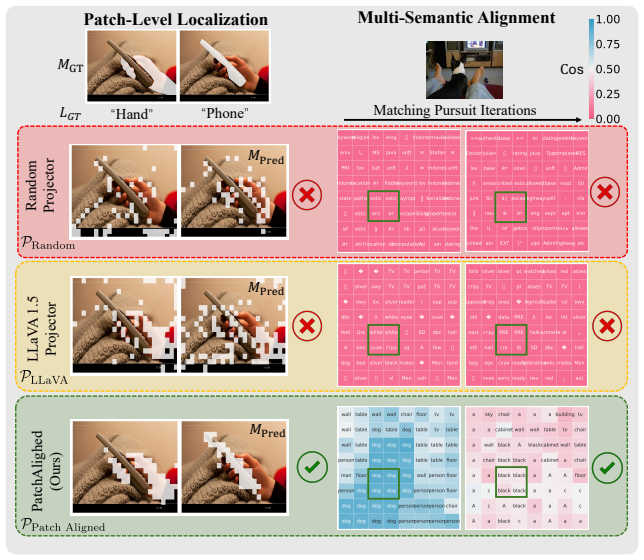
- The matching-pursuit tokenmaps show that the patch-aligned projector assigns interpretable words to most patches, whereas the LLaVA projector leaves many patches matched to garbled or meaningless tokens.
- The released Patch-Aligned Dataset and annotation pipeline provide a reusable resource for pretraining other multimodal models with patch-level supervision.
Reading between the lines
- The size of the grounding gain suggests current caption-only pretraining leaves substantial spatial alignment headroom, so models that already use stronger projectors or grounding-aware objectives may show smaller but still positive gains from this loss.
- The matching-pursuit decoding could be turned into a quantitative multi-label alignment metric if patch-level ground-truth semantic labels were available, enabling direct comparisons of projector quality across model families.
- Because the patch loss operates entirely in embedding space before the LLM, the same recipe could be applied to other modalities, such as audio or video, by using the corresponding tokenizer's embedding matrix as the target basis.
- The entropy-compression results imply a possible trade-off: compressing toward a finite label vocabulary could erase visual attributes not covered by labels, so expanding the label set with attribute tags might push fine-grained understanding further.
Editorial analysis
A structured set of objections, weighed in public.
Referee Report
Summary. This paper studies the projector in LLaVA-style multimodal LLMs. It proposes measuring information compression via von Neumann entropy (Definition 3.1) and patch-level alignment via an IoU-based metric Align(V,W) using mask-label pairs (Eq. 4), together with a multi-semantic alignment hypothesis stated as Hypothesis 3.1. To improve alignment, it introduces patch-aligned training: during stage-1 projector pretraining, it adds Lpatch (Eq. 5), which maximizes cosine similarity between mask-selected averaged vision embeddings and averaged subtoken word embeddings of object labels, using the automatically annotated PAD dataset. Experiments report larger entropy reduction, higher Align and cosine similarity (Table 3), better caption metrics (Table 4), and gains on RefCOCO-family grounding, VQA, and instruction-following benchmarks under the same SFT setting as LLaVA-1.5. The authors release the annotation pipeline and PAD.
Significance. The paper addresses an important question—what the projector does and how to improve fine-grained vision-language alignment—and the proposed loss is simple, cheap, and easy to adopt. The release of PAD and the annotation pipeline is a concrete contribution, and the downstream gains, if attributable to the method, would be practically useful. The entropy-compression analysis is suggestive. However, the paper's central causal claim—that adding Lpatch improves alignment and that this improved alignment drives downstream gains—is currently underdetermined because the alignment metrics are close to the training objective and because the intervention changes both the loss and the pretraining data. These issues require additional experiments before the claim can be accepted.
major comments (5)
- [Eq. (5) and Table 3] The evaluation metrics Align(V,W) and cosine similarity in Table 3 are computed with the same cosine-similarity operation and the same mask-selected vision embeddings and averaged subtoken text embeddings that Lpatch directly optimizes. The improvement from 0.07 to 0.56 in Cos Sim and from 0.142 to 0.279 in Align therefore largely reflects fitting the training objective on new images; it does not independently establish that the embeddings have become more semantically aligned. Please provide an external or task-based alignment measure, or an ablation showing the gain is not simply an artifact of measuring the training objective.
- [Section 5.1 and Appendix B] The stage-1 intervention changes two factors simultaneously: the loss (adding Lpatch) and the training data (PAD provides 2.3M mask-label regions). The downstream gains in Tables 5-7 could come from the extra region-level supervision provided by the RAM/Grounding-DINO/SAM pipeline rather than from the specific cosine patch-alignment objective. No ablation isolates these factors; for example, training with PAD but without Lpatch, or training with Lpatch on the original caption-only data, is missing. This is load-bearing for the attribution claim.
- [Eq. (3) in Section 3.2.1] The adaptive threshold c in Eq. (3) is never specified or analyzed. Align(V,W) and the localization results in Tables 2 and 3 depend on this threshold, and no sensitivity analysis or selection criterion is given, making the numerical comparisons difficult to interpret.
- [Tables 1 and 3] The entropy and alignment numbers are computed on only 100 selected images from COCO2017 with no statement of selection criteria, no error bars, and no significance tests. Given the small reported differences and the threshold dependence, the observations that a pretrained projector compresses and that patch-aligned training improves alignment need stronger statistical support. Please also clarify whether these 100 images overlap with the PAD pretraining set.
- [Section 3.2.2 / Hypothesis 3.1] The paper states that it verifies the multi-semantic alignment hypothesis, but the evidence is qualitative matching-pursuit visualizations (Figure 1 and Appendix D) with no ground-truth multi-semantic labels and no quantitative measure of how much variance of vision embeddings is explained by sparse word combinations. Since the hypothesis motivates the analysis, it should be either substantiated or explicitly framed as a motivation rather than a verified claim.
minor comments (7)
- [Definition 3.1] The name "V on Neumann entropy" should be "von Neumann entropy" throughout.
- [Table 4] The model name "MLLaV A" appears to be a typo; it should be "MLLaVA" or "M LLaVA."
- [Eq. (2)] Equation (2) writes W(phi(L(p))) as if W is a function; please clarify that W is the embedding matrix and the expression means looking up the embeddings of the tokenizer outputs.
- [Table 7] Several column names (MMB EN, MMEC, MMEP) are not standard benchmark names and lack references; please document their definitions and reporting protocol.
- [Section 5.1] The linear schedule for beta from 0 to 5 is stated but never ablated or justified; please provide an ablation or a reference for this choice.
- [Table 4] The caption-metric differences are small (e.g., METEOR 0.1220 vs 0.1256); please report variance or significance, or temper the claim of higher-quality captions.
- [Appendix D] The tokenmap figures (Figures 5 and 6) are difficult to read in the preprint; please enlarge them or provide higher-resolution versions.
Circularity Check
The stage-1 evidence for improved patch-level alignment is essentially the training objective itself; the downstream benchmarks are independent and keep the paper from being fully circular.
-
self definitional
[Section 4, Eq. (5), and Section 5.2.1, Table 3]
"We then introduce the patch-alignment loss to maximize the cosine similarity between the mask-selected vision embedding v(p) and the corresponding text embedding t(p): Lpatch = 1− 1/P Σ_{n=1}^P COS(v(p),t(p)). ... As shown in Table 3, compared to baselines PRandom and PLLaVA on 100 COCO 2017 images, our projector achieves higher entropy reduction and better performance on both mIoU and cosine similarity, demonstrating superior patch-level alignment."
The 'cosine similarity' row of Table 3 is the same cosine-similarity term that Eq. (5) directly minimizes: Lpatch is 1 minus the average COS between mask-selected vision embeddings and subtoken-averaged word embeddings. The Align(V,W) metric is built from the same operation, because Eq. (3) thresholds COS(t(p), v_i) to form the predicted mask used in the IoU. Thus the Table 3 evidence for 'superior patch-level alignment' restates the training objective: optimizing Lpatch raises exactly the quantity being reported as alignment. Measuring it on 100 held-out COCO images shows the objective transfers, but it does not independently show that the embeddings are semantically aligned beyond the cosine geometry that the loss enforces.
full rationale
The paper's method is to add a cosine-similarity loss Lpatch during projector pretraining, and its main stage-1 evidence that patch-level alignment 'improves' is an alignment metric computed from the same cosine-similarity operation. This is a partial self-definitional loop: the measured quantity is essentially the optimized objective, so the mechanistic claim 'better alignment causes better understanding' is not independently established by Table 3. The upstream analysis and the multi-semantic hypothesis are not circularly derived; they are borrowed with attribution and used as interpretation. The downstream referring-expression, VQA, and instruction-following results are external benchmarks and are not forced by the loss, so they provide independent evidence that the intervention helps. There is additionally a real experimental confound, because the intervention changes both the loss and the pretraining data (PAD adds region-level supervision), but that is a causal-attribution gap rather than a circularity. No load-bearing self-citation chain or imported uniqueness theorem is present.
Assumptions & free parameters
free parameters (4)
- beta (patch loss weight) =
linear schedule from 0 to 5
- adaptive threshold c =
not specified
- matching pursuit iterations K =
5 (in appendix)
- mask coverage threshold =
half of patch area
assumptions (4)
- ad hoc to paper Multi-semantic alignment hypothesis: vision patch embeddings are sparse linear combinations of LLM word embeddings.
- domain assumption Averaging subtoken word embeddings faithfully represents a label's semantics.
- domain assumption The RAM, Grounding DINO, and SAM annotation pipeline produces accurate masks and labels.
- domain assumption Von Neumann entropy of the normalized covariance matrix is a valid measure of information content in vision embeddings.
invented entities (1)
-
Multi-semantic alignment construct
Cite this review
Pith. "Pith review of Analyzing Fine-Grained Alignment and Enhancing Vision Understanding in Multimodal Language Models." pith.science (2026). https://pith.science/paper/CN2ZDQK7
@misc{pith2026250517316,
  author       = {Pith},
  title        = {Pith review of: Analyzing Fine-Grained Alignment and Enhancing Vision Understanding in Multimodal Language Models},
  year         = {2026},
  howpublished = {\url{https://pith.science/paper/CN2ZDQK7}},
  note         = {Machine review of arXiv:2505.17316}
}
read the original abstract
Achieving better alignment between vision embeddings and Large Language Models (LLMs) is crucial for enhancing the abilities of Multimodal LLMs (MLLMs), particularly for recent models that rely on powerful pretrained vision encoders and LLMs. A common approach to connect the pretrained vision encoder and LLM is through a projector applied after the vision encoder. However, the projector is often trained to enable the LLM to generate captions, and hence the mechanism by which LLMs understand each vision token remains unclear. In this work, we first investigate the role of the projector in compressing vision embeddings and aligning them with word embeddings. We show that the projector significantly compresses visual information, removing redundant details while preserving essential elements necessary for the LLM to understand visual content. We then examine patch-level alignment -- the alignment between each vision patch and its corresponding semantic words -- and propose a *multi-semantic alignment hypothesis*. Our analysis indicates that the projector trained by caption loss improves patch-level alignment but only to a limited extent, resulting in weak and coarse alignment. To address this issue, we propose *patch-aligned training* to efficiently enhance patch-level alignment. Our experiments show that patch-aligned training (1) achieves stronger compression capability and improved patch-level alignment, enabling the MLLM to generate higher-quality captions, (2) improves the MLLM's performance by 16% on referring expression grounding tasks, 4% on question-answering tasks, and 3% on modern instruction-following benchmarks when using the same supervised fine-tuning (SFT) setting. The proposed method can be easily extended to other multimodal models.
Figures


Figures from the paper (2 more)


Forward citations
Cited by 1 Pith paper
-
Text as Partial Constraint: Core-Residual Alignment for Robust Vision-Language Learning
Aligning images to multi-view caption cores while suppressing orthogonal residual text and disagreement-aware temperature improves robust zero-shot recognition and LVLM transfer.
Reference graph
Works this paper leans on
-
[1]
H. Liu, C. Li, Q. Wu, and Y . J. Lee, “Visual instruction tuning,”Advances in neural information processing systems, vol. 36, 2024
work page 2024
-
[2]
Improved baselines with visual instruction tuning,
H. Liu, C. Li, Y . Li, and Y . J. Lee, “Improved baselines with visual instruction tuning,” inPro- ceedings of the IEEE/CVF Conference on Computer Vision and Pattern Recognition, pp. 26296– 26306, 2024
work page 2024
-
[3]
Blip: Bootstrapping language-image pre-training for unified vision-language understanding and generation,
J. Li, D. Li, C. Xiong, and S. Hoi, “Blip: Bootstrapping language-image pre-training for unified vision-language understanding and generation,” inInternational conference on machine learning, pp. 12888–12900, PMLR, 2022
2022
-
[4]
Blip-2: Bootstrapping language-image pre-training with frozen image encoders and large language models,
J. Li, D. Li, S. Savarese, and S. Hoi, “Blip-2: Bootstrapping language-image pre-training with frozen image encoders and large language models,” inInternational conference on machine learning, pp. 19730–19742, PMLR, 2023
2023
-
[5]
Minigpt-4: Enhancing vision-language understanding with advanced large language models,
D. Zhu, J. Chen, X. Shen, X. Li, and M. Elhoseiny, “Minigpt-4: Enhancing vision-language understanding with advanced large language models,”arXiv preprint arXiv:2304.10592, 2023
arXiv 2023
-
[6]
Flamingo: a visual language model for few-shot learning,
J.-B. Alayrac, J. Donahue, P. Luc, A. Miech, I. Barr, Y . Hasson, K. Lenc, A. Mensch, K. Millican, M. Reynolds,et al., “Flamingo: a visual language model for few-shot learning,”Advances in neural information processing systems, vol. 35, pp. 23716–23736, 2022
2022
-
[7]
Language is not all you need: Aligning perception with language models,
S. Huang, L. Dong, W. Wang, Y . Hao, S. Singhal, S. Ma, T. Lv, L. Cui, O. K. Mohammed, B. Patra,et al., “Language is not all you need: Aligning perception with language models,” Advances in Neural Information Processing Systems, vol. 36, pp. 72096–72109, 2023
work page 2023
-
[8]
Multimodal chain-of-thought reasoning in language models,
Z. Zhang, A. Zhang, M. Li, H. Zhao, G. Karypis, and A. Smola, “Multimodal chain-of-thought reasoning in language models,”arXiv preprint arXiv:2302.00923, 2023
arXiv 2023
Show all 52 references
-
[9]
Kimi k1.5: Scaling reinforcement learning with llms,
K. Team, A. Du, B. Gao, B. Xing, C. Jiang, C. Chen, C. Li, C. Xiao, C. Du, C. Liao, C. Tang, C. Wang, D. Zhang, E. Yuan, E. Lu, F. Tang, F. Sung, G. Wei, G. Lai, H. Guo, H. Zhu, H. Ding, H. Hu, H. Yang, H. Zhang, H. Yao, H. Zhao, H. Lu, H. Li, H. Yu, H. Gao, H. Zheng, H. Yuan,...
2025
-
[10]
Multimodal transformer with multi-view visual representation for image captioning,
J. Yu, J. Li, Z. Yu, and Q. Huang, “Multimodal transformer with multi-view visual representation for image captioning,”IEEE transactions on circuits and systems for video technology, vol. 30, no. 12, pp. 4467–4480, 2019
2019
-
[11]
Vqa: Visual question answering,
S. Antol, A. Agrawal, J. Lu, M. Mitchell, D. Batra, C. L. Zitnick, and D. Parikh, “Vqa: Visual question answering,” inProceedings of the IEEE international conference on computer vision, pp. 2425–2433, 2015
2015
-
[12]
Eyes wide shut? exploring the visual shortcomings of multimodal llms,
S. Tong, Z. Liu, Y . Zhai, Y . Ma, Y . LeCun, and S. Xie, “Eyes wide shut? exploring the visual shortcomings of multimodal llms,” inProceedings of the IEEE/CVF Conference on Computer Vision and Pattern Recognition, pp. 9568–9578, 2024
2024
-
[13]
Gpt4roi: Instruction tuning large language model on region-of-interest,
S. Zhang, P. Sun, S. Chen, M. Xiao, W. Shao, W. Zhang, Y . Liu, K. Chen, and P. Luo, “Gpt4roi: Instruction tuning large language model on region-of-interest,”arXiv preprint arXiv:2307.03601, 2023
2023 arXiv
-
[14]
Kosmos-2: Grounding multimodal large language models to the world,
Z. Peng, W. Wang, L. Dong, Y . Hao, S. Huang, S. Ma, and F. Wei, “Kosmos-2: Grounding multimodal large language models to the world,”arXiv preprint arXiv:2306.14824, 2023
2023 arXiv
-
[15]
Glamm: Pixel grounding large multimodal model,
H. Rasheed, M. Maaz, S. Shaji, A. Shaker, S. Khan, H. Cholakkal, R. M. Anwer, E. Xing, M.-H. Yang, and F. S. Khan, “Glamm: Pixel grounding large multimodal model,” inProceedings of the IEEE/CVF Conference on Computer Vision and Pattern Recognition, pp. 13009–13018, 2024. 11
2024
-
[16]
Hallucination of multimodal large language models: A survey,
Z. Bai, P. Wang, T. Xiao, T. He, Z. Han, Z. Zhang, and M. Z. Shou, “Hallucination of multimodal large language models: A survey,”arXiv preprint arXiv:2404.18930, 2024
2024 arXiv
-
[17]
Honeybee: Locality-enhanced projector for multi- modal llm,
J. Cha, W. Kang, J. Mun, and B. Roh, “Honeybee: Locality-enhanced projector for multi- modal llm,”2024 IEEE/CVF Conference on Computer Vision and Pattern Recognition (CVPR), pp. 13817–13827, 2023
2024
-
[18]
The platonic representation hypothesis,
M. Huh, B. Cheung, T. Wang, and P. Isola, “The platonic representation hypothesis,”arXiv preprint arXiv:2405.07987, 2024
2024 arXiv
-
[19]
von Neumann,Mathematische Grundlagen der Quantenmechanik
J. von Neumann,Mathematische Grundlagen der Quantenmechanik. Berlin, Germany: Springer,
-
[20]
Linear algebraic structure of word senses, with applications to polysemy,
S. Arora, Y . Li, Y . Liang, T. Ma, and A. Risteski, “Linear algebraic structure of word senses, with applications to polysemy,”Transactions of the Association for Computational Linguistics, vol. 6, pp. 483–495, 2018
2018
-
[21]
Transformer visualization via dictionary learning: contextualized embedding as a linear superposition of transformer factors,
Z. Yun, Y . Chen, B. A. Olshausen, and Y . LeCun, “Transformer visualization via dictionary learning: contextualized embedding as a linear superposition of transformer factors,”arXiv preprint arXiv:2103.15949, 2021
2021 arXiv
-
[22]
Signal recovery from random measurements via orthogonal matching pursuit,
J. A. Tropp and A. C. Gilbert, “Signal recovery from random measurements via orthogonal matching pursuit,”IEEE Transactions on information theory, vol. 53, no. 12, pp. 4655–4666, 2007
2007
-
[23]
Recognize anything: A strong image tagging model,
Y . Zhang, X. Huang, J. Ma, Z. Li, Z. Luo, Y . Xie, Y . Qin, T. Luo, Y . Li, S. Liu,et al., “Recognize anything: A strong image tagging model,” inProceedings of the IEEE/CVF Conference on Computer Vision and Pattern Recognition, pp. 1724–1732, 2024
2024
-
[24]
Grounding dino: Marrying dino with grounded pre-training for open-set object detection,
S. Liu, Z. Zeng, T. Ren, F. Li, H. Zhang, J. Yang, Q. Jiang, C. Li, J. Yang, H. Su,et al., “Grounding dino: Marrying dino with grounded pre-training for open-set object detection,” in European Conference on Computer Vision, pp. 38–55, Springer, 2025
2025
-
[25]
Segment anything,
A. Kirillov, E. Mintun, N. Ravi, H. Mao, C. Rolland, L. Gustafson, T. Xiao, S. Whitehead, A. C. Berg, W.-Y . Lo,et al., “Segment anything,” inProceedings of the IEEE/CVF International Conference on Computer Vision, pp. 4015–4026, 2023
2023
-
[26]
Llava-next-interleave: Tack- ling multi-image, video, and 3d in large multimodal models,
F. Li, R. Zhang, H. Zhang, Y . Zhang, B. Li, W. Li, Z. Ma, and C. Li, “Llava-next-interleave: Tack- ling multi-image, video, and 3d in large multimodal models,”arXiv preprint arXiv:2407.07895, 2024
2024 arXiv
-
[27]
Instructblip: Towards general-purpose vision-language models with instruction tuning. arxiv 2023,
W. Dai, J. Li, D. Li, A. Tiong, J. Zhao, W. Wang, B. Li, P. Fung, and S. Hoi, “Instructblip: Towards general-purpose vision-language models with instruction tuning. arxiv 2023,”arXiv preprint arXiv:2305.06500, vol. 2, 2023
2023 arXiv
-
[28]
Mimic-it: Multi-modal in-context instruction tuning,
B. Li, Y . Zhang, L. Chen, J. Wang, F. Pu, J. Yang, C. Li, and Z. Liu, “Mimic-it: Multi-modal in-context instruction tuning,”arXiv preprint arXiv:2306.05425, 2023
2023 arXiv
-
[29]
mplug- owl: Modularization empowers large language models with multimodality,
Q. Ye, H. Xu, G. Xu, J. Ye, M. Yan, Y . Zhou, J. Wang, A. Hu, P. Shi, Y . Shi,et al., “mplug- owl: Modularization empowers large language models with multimodality,”arXiv preprint arXiv:2304.14178, 2023
2023 arXiv
-
[30]
Prismatic vlms: Investigating the design space of visually-conditioned language models,
S. Karamcheti, S. Nair, A. Balakrishna, P. Liang, T. Kollar, and D. Sadigh, “Prismatic vlms: Investigating the design space of visually-conditioned language models,”arXiv preprint arXiv:2402.07865, 2024
2024 arXiv
-
[31]
Cambrian-1: A fully open, vision-centric exploration of multimodal llms,
S. Tong, E. Brown, P. Wu, S. Woo, M. Middepogu, S. C. Akula, J. Yang, S. Yang, A. Iyer, X. Pan,et al., “Cambrian-1: A fully open, vision-centric exploration of multimodal llms,”arXiv preprint arXiv:2406.16860, 2024
2024 arXiv
-
[32]
Law of vision representation in mllms,
S. Yang, B. Zhai, Q. You, J. Yuan, H. Yang, and C. Xu, “Law of vision representation in mllms,” arXiv preprint arXiv:2408.16357, 2024. 12
2024
-
[33]
Learning transferable visual models from natural language supervi- sion,
A. Radford, J. W. Kim, C. Hallacy, A. Ramesh, G. Goh, S. Agarwal, G. Sastry, A. Askell, P. Mishkin, J. Clark,et al., “Learning transferable visual models from natural language supervi- sion,” inInternational conference on machine learning, pp. 8748–8763, PMLR, 2021
2021
-
[34]
Deciphering cross-modal alignment in large vision-language models with modality integration rate,
Q. Huang, X. Dong, P. Zhang, Y . Zang, Y . Cao, J. Wang, D. Lin, W. Zhang, and N. Yu, “Deciphering cross-modal alignment in large vision-language models with modality integration rate,”arXiv preprint arXiv:2410.07167, 2024
2024 arXiv
-
[35]
Towards interpreting visual information processing in vision-language models,
C. Neo, L. Ong, P. Torr, M. Geva, D. Krueger, and F. Barez, “Towards interpreting visual information processing in vision-language models,”arXiv preprint arXiv:2410.07149, 2024
2024 arXiv
-
[36]
Advancing fine-grained visual understanding with multi-scale alignment in multi-modal models,
W. Wang, Z. Li, Q. Xu, L. Li, Y . Cai, B. Jiang, H. Song, X. Hu, P. Wang, and L. Xiao, “Advancing fine-grained visual understanding with multi-scale alignment in multi-modal models,”arXiv preprint arXiv:2411.09691, 2024
2024 arXiv
-
[37]
Sea: Supervised embedding alignment for token-level visual-textual integration in mllms,
Y . Yin, Y . Zhao, Y . Zhang, K. Lin, J. Wang, X. Tao, P. Wan, D. Zhang, B. Yin, and W. Zhang, “Sea: Supervised embedding alignment for token-level visual-textual integration in mllms,” arXiv preprint arXiv:2408.11813, 2024
2024 arXiv
-
[38]
Honeybee: Locality-enhanced projector for multimodal llm,
J. Cha, W. Kang, J. Mun, and B. Roh, “Honeybee: Locality-enhanced projector for multimodal llm,” inProceedings of the IEEE/CVF Conference on Computer Vision and Pattern Recognition, pp. 13817–13827, 2024
2024
-
[39]
Microsoft coco: Common objects in context,
T.-Y . Lin, M. Maire, S. Belongie, J. Hays, P. Perona, D. Ramanan, P. Dollár, and C. L. Zitnick, “Microsoft coco: Common objects in context,” inComputer Vision–ECCV 2014: 13th European Conference, Zurich, Switzerland, September 6-12, 2014, Proceedings, Part V 13, pp. 740–755, ...
2014
-
[40]
Referitgame: Referring to objects in photographs of natural scenes,
S. Kazemzadeh, V . Ordonez, M. Matten, and T. Berg, “Referitgame: Referring to objects in photographs of natural scenes,” inProceedings of the 2014 conference on empirical methods in natural language processing (EMNLP), pp. 787–798, 2014
2014
-
[41]
Generation and comprehension of unambiguous object descriptions,
J. Mao, J. Huang, A. Toshev, O. Camburu, A. L. Yuille, and K. Murphy, “Generation and comprehension of unambiguous object descriptions,” inProceedings of the IEEE conference on computer vision and pattern recognition, pp. 11–20, 2016
2016
-
[42]
Shikra: Unleashing multimodal llm’s referential dialogue magic,
K. Chen, Z. Zhang, W. Zeng, R. Zhang, F. Zhu, and R. Zhao, “Shikra: Unleashing multimodal llm’s referential dialogue magic,”arXiv preprint arXiv:2306.15195, 2023
2023 arXiv
-
[43]
Introducing idefics: An open reproduction of state-of-the-art visual language model,
H. Laurençon, D. van Strien, S. Bekman, L. Tronchon, L. Saulnier, T. Wang, S. Karamcheti, A. Singh, G. Pistilli, Y . Jernite, and V . Sanh, “Introducing idefics: An open reproduction of state-of-the-art visual language model,” 2023. Accessed: 2025-01-30
2023
-
[44]
Qwen-vl: A frontier large vision-language model with versatile abilities,
J. Bai, S. Bai, S. Yang, S. Wang, S. Tan, P. Wang, J. Lin, C. Zhou, and J. Zhou, “Qwen-vl: A frontier large vision-language model with versatile abilities,”arXiv preprint arXiv:2308.12966, 2023
2023 arXiv
-
[45]
Instruction tuning with gpt-4,
B. Peng, C. Li, P. He, M. Galley, and J. Gao, “Instruction tuning with gpt-4,”arXiv preprint arXiv:2304.03277, 2023
2023 arXiv
-
[46]
The llama 3 herd of models,
A. Grattafiori, A. Dubey, A. Jauhri, A. Pandey, A. Kadian, A. Al-Dahle, A. Letman, A. Mathur, A. Schelten, A. Vaughan,et al., “The llama 3 herd of models,”arXiv preprint arXiv:2407.21783, 2024
2024 arXiv
-
[47]
Vicuna: An open-source chatbot impressing gpt-4 with 90%* chatgpt quality,
W.-L. Chiang, Z. Li, Z. Lin, Y . Sheng, Z. Wu, H. Zhang, L. Zheng, S. Zhuang, Y . Zhuang, J. E. Gonzalez,et al., “Vicuna: An open-source chatbot impressing gpt-4 with 90%* chatgpt quality,” See https://vicuna. lmsys. org (accessed 14 April 2023), vol. 2, no. 3, p. 6, 2023
2023
-
[48]
Towards vqa models that can read,
A. Singh, V . Natarajan, M. Shah, Y . Jiang, X. Chen, D. Batra, D. Parikh, and M. Rohrbach, “Towards vqa models that can read,” inProceedings of the IEEE/CVF conference on computer vision and pattern recognition, pp. 8317–8326, 2019
2019
-
[49]
Gqa: A new dataset for real-world visual reasoning and compositional question answering,
D. A. Hudson and C. D. Manning, “Gqa: A new dataset for real-world visual reasoning and compositional question answering,” inProceedings of the IEEE/CVF conference on computer vision and pattern recognition, pp. 6700–6709, 2019. 13
2019
-
[50]
Ocr-vqa: Visual question answering by reading text in images,
A. Mishra, S. Shekhar, A. K. Singh, and A. Chakraborty, “Ocr-vqa: Visual question answering by reading text in images,” in2019 international conference on document analysis and recognition (ICDAR), pp. 947–952, IEEE, 2019
2019
-
[51]
Visual genome: Connecting language and vision using crowdsourced dense image annotations,
R. Krishna, Y . Zhu, O. Groth, J. Johnson, K. Hata, J. Kravitz, S. Chen, Y . Kalantidis, L.-J. Li, D. A. Shamma,et al., “Visual genome: Connecting language and vision using crowdsourced dense image annotations,”International journal of computer vision, vol. 123, pp. 32–73, 201...
2017
-
[1932]
English translation:Mathematical Foundations of Quantum Mechanics, Princeton University Press, 1955
1955
Reviewed August 7, 2026 · model on record in the stance chip above.
Discussion (0). Continue with ORCID to comment.