REVIEW 3 major objections 6 minor 20 references
Positional schemes set the default spectral algebra of attention heads: a fingerprint after function, not a hard constraint.
Reviewed by Pith at T0; open to challenge. T0 means a machine referee read the full paper against a public rubric. the ladder, T0–T4 →
T0 review · grok-4.5
2026-07-11 01:21 UTC pith:CQXRTEKJ
load-bearing objection Solid three-level evidence that positional schemes set default QK spectral solutions for prev-token heads; model-family sparsity is real but does not erase the aligned static/dynamic/causal package. the 3 major comments →
Fingerprint, Not Blueprint: How Positional Schemes Set the Default Spectral Algebra of Attention
The pith
A machine-rendered reading of the paper's core claim, the machinery that carries it, and where it could break.
Core claim
Within the settings examined, the positional scheme sets the default spectral algebra of an attention head's solution: the strongest previous-token heads are spectrally rotational under RoPE and non-rotational (content-like) under learned-absolute and ALiBi positions, and this profile is a fingerprint sculpted after function, not a hard constraint upon it.
What carries the argument
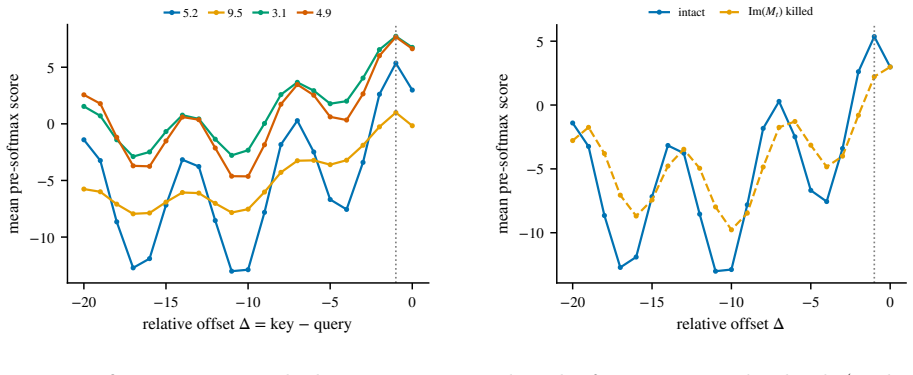
The gauge-invariant QK operator M = W_q^T W_k, read through a complex directionality metric D_head against a matched Ginibre random-orientation null, and (under RoPE) the per-frequency imaginary phase Im(M_t) that carries relative-position asymmetry.
Load-bearing premise
That the clean spectral contrast across only seven models and three positional schemes is driven by the positional scheme itself rather than by confounds such as training corpus, local-attention layers, grouping of keys, or normalization choices.
What would settle it
Train or evaluate additional full-RoPE and ALiBi model families with matched head dimension and detectors; if their top previous-token heads no longer sit in top-quintile versus bottom-quartile D_head percentiles, the architecture-conditional claim fails.
Editorial analysis
A structured set of objections, weighed in public.
Referee Report
Summary. The paper studies the complex eigenspectrum of the attention QK operator M = W_q^T W_k for previous-token and induction circuits at three levels. Statically, across seven pretrained models spanning learned-absolute, ALiBi, and RoPE schemes, the strongest previous-token heads are spectrally rotational (high D_head) under RoPE and content-like (low D_head) under absolute/ALiBi positions, with perfect model-level separation of top-k D_head percentiles (exact permutation p=0.029). Mechanistically, D_head tracks RoPE phase Im(M_t), and zeroing Im(M_t) destroys induction on pre-identified previous-token heads in all three RoPE models. Dynamically, over Pythia checkpoints every head starts at a matched Ginibre null; the rotational signature locks in with circuit formation, and population-median suppression follows formation. Causally, constrained two-layer training shows no spectral channel is necessary (rerouting preserves capability) but each ban imposes a significant, scheme-dependent formation delay (four pre-registered contrasts, q_BH ≤ 0.016). The unifying claim is that the positional scheme sets the default spectral algebra of attention solutions—a fingerprint sculpted after function, not a hard constraint.
Significance. If the result holds within the stated scope, it gives the non-Hermitian/complex-spectrum program for transformers a concrete, behavior-anchored home: complex structure of the QK operator does causal work precisely when position is encoded as rotary phase, while remaining largely decorative under absolute positions. The three-level design (static multi-model, checkpoint natural history, pre-registered constrained interventions), the matched Ginibre null, the algebraic dissociation of static antisymmetry from RoPE phase, and the honest reporting of falsified pre-registered predictions (Q3, P2-strong, P3, P4-timing) are genuine methodological strengths. Public code, per-head tables, checkpoint trajectories, and pre-registration documents further raise the bar for reproducibility in mechanistic interpretability. The practical reading for weight-only head triage under RoPE is immediately useful.
major comments (3)
- [§6 / Table 2] §6, Table 2, and the model-level permutation test (exact p=1/C(7,3)=0.029): the central attribution of the rotational vs content-like profile to positional scheme rests on seven models with severe family imbalance—three learned-absolute, one ALiBi (BLOOM only), two partial-RoPE Pythia variants that share training lineage, and one full-RoPE family (Llama-3). Holding d_k=64 for GPT-2/OPT/Pythia-410m controls head dimension but not corpus, GQA, RMSNorm, or GPT-Neo’s alternating local-attention layers (all flagged in Limitations). Leave-one-model-out preserves separation within this sample but cannot resolve family-level confounds. The abstract/conclusion claim that “the positional scheme sets the default spectral algebra” therefore overreaches the design; either additional independent model families (e.g., a non-Llama full-RoPE and a second ALiBi) or a more tightly scoped claim limited to “
- [§6 / Limitations] Limitations (vi) and the profile statistic in §6: the architecture-conditional signature is defined on detector-selected top-k previous-token heads, yet “the prev-detector’s bulk-ordering reliability is unquantified” across schemes. If detector ranking is scheme-dependent (e.g., RoPE heads are easier to flag as previous-token because of oscillatory kernels), the perfect model-level separation partly reflects detector behavior rather than pure head function. A cross-scheme calibration—e.g., agreement of the previous-token detector with an independent behavioral or circuit criterion on held-out sequences, or sensitivity of the percentile contrast to detector threshold—is needed before the profile can be treated as scheme-pure evidence.
- [§10] §10 and the necessity claim: “no spectral channel is necessary” is established only in 2-layer attention-only toys (d=128, 4 heads, d_k=32) on a per-sequence random-map task. The four pre-registered contrasts are clean, the sym-M vs Im(M_t) dissociation is algebraically valuable, and formation delays are significant (q_BH ≤ 0.016). However, the leap from toy search costs to the claim that pretrained-LLM spectral profiles are “fingerprints not blueprints” is under-bridged. The manuscript should either (i) qualify the necessity claim strictly to toy scale and treat the LLM static/dynamic results as descriptive defaults only, or (ii) supply evidence that analogous soft spectral constraints at larger scale still permit rerouting. As written, the three-way distinction (trained-circuit dependence / developmental preference / necessity) mixes scales in a way that overstates the necessity result
minor comments (6)
- [§7] §7 / Table 3: the attenuation analysis is correctly labeled shared-variance among co-derived features, not causal mediation. Keep abstract and §7 language from blending this correlational attenuation with the causal Im(M_t) ablation of §8; a one-sentence separation at the start of §7 would help.
- [Figure 2] Figure 2b caption and surrounding text suggest a dose–response of attenuation with RoPE fraction while the body text correctly declines to press that reading (two dose levels, within-dose spread comparable to the gap). Align caption with body.
- [§7 / Eq. (5)] Eq. (5) and the rotate-half convention: a brief explicit statement that the pairing was verified against the model’s own RoPE implementation (already done in text) would be clearer if moved next to the equation rather than buried in the method paragraph.
- [Table 1 / §4] Table 1: the pre-registered hypothesis that induction heads would be directional failed; this is reported honestly in §4. Consider flagging the failed prediction in the table caption as well for readers who sample tables first.
- [§3 / Figure 1] Minor notation: M_eff folding for LayerNorm vs RMSNorm is stated clearly in §3; a single line in the caption of Figure 1 reminding the reader that all metrics are on the norm-folded operator would reduce ambiguity for skimmers.
- [Related work] References: concurrent Jamil & Kapadia (9) is handled fairly; ensure the arXiv identifiers and “concurrent work” labels remain accurate at camera-ready time.
Circularity Check
No significant circularity: spectral metrics are deterministic weight functions tested against external behavioral detectors, public checkpoints, held-out losses, and pre-registered interventions whose falsifications are reported.
full rationale
The paper's load-bearing claims are empirical observations and interventions, not closed-form derivations. dir_frac, D_head, rope_imag_frac and related quantities are defined directly from the (norm-folded) QK operator M and its complex/Schur spectrum; they are then correlated with, and ablated against, independent behavioral detectors (previous-token, induction, K-composition, ICL proxy) taken from the literature and applied to public models/checkpoints. The Ginibre/random-orientation null is an external random-matrix baseline, not fitted to the target heads. Shared-variance attenuation of D_head by RoPE-phase features is explicitly labeled non-causal mediation. Dynamics questions Q1–Q3 and intervention predictions P1–P4 were pre-registered before data collection; several are reported as falsified. Constrained-training arms reroute around every spectral ban while preserving capability, so necessity is not assumed by construction. The single companion note by the same author is cited only as context and is not used to justify any claim in the present manuscript. No self-definitional loop, fitted-input-as-prediction, load-bearing self-citation uniqueness theorem, or ansatz smuggling appears in the derivation chain. The work is therefore self-contained against external benchmarks.
Axiom & Free-Parameter Ledger
free parameters (3)
- top-k for previous-token head profile (k=5 primary; sensitivity k∈{1,3,5,10})
- soft spectral penalty strengths in constrained training
- toy model hyperparameters (d=128, 4 heads, dk=32, 2 layers, random-map task noise 0.1)
axioms (5)
- domain assumption Pre-softmax attention score is the bilinear form x_i^T M x_j with M = W_q^T W_k (gauge-invariant under GL(d_k) reparametrization).
- standard math A random low-rank M (matched singular values, random frames) has dir_frac ≈ 1/√2 and D_head null ≈ 0.608 (Ginibre/random-orientation null).
- domain assumption Standard behavioral detectors (previous-token, induction/prefix-matching, K-composition) correctly identify the functional heads used for profile and ablation claims.
- domain assumption Norm folding (fold_ln) and float64 spectral work on the effective M preserve the model's pre-softmax scores to stated precision.
- ad hoc to paper Soft penalties that drive ||M_A|| or ||Im(M_t)|| to near zero implement the intended spectral bans without destroying expressivity of the remaining channels.
invented entities (2)
-
D_head (complex/Schur directionality metric)
no independent evidence
-
Matched random-orientation (Ginibre) null for low-rank QK operators
independent evidence
read the original abstract
The pre-softmax score of an attention head is a bilinear form $score(i,j) = x_i^T M x_j$ in a learned operator $M = W_q^T W_k$. Because M is generally non-symmetric, hence non-normal, it has a complex eigenspectrum and non-orthogonal eigenvectors, the regime where non-Hermitian and random-matrix tools apply. We ask what this spectrum encodes, at three levels for previous-token and induction circuits. Statically, across seven pretrained models spanning three positional schemes, the strongest previous-token heads are spectrally rotational under RoPE and non-rotational, or content-like, where position enters outside QK (learned-absolute and ALiBi); the model-level separation is perfect at every top-k examined (exact permutation $p=0.029$), and zeroing the per-frequency RoPE phase $Im(M_t)$ eliminates induction on a pre-identified previous-token head in all three RoPE models. Dynamically, over public Pythia checkpoints every head originates at the random-matrix (Ginibre) null; the rotational signature emerges with the behavior, not before it, and the population-median suppression that yields the final profile follows circuit formation, so the profile is a consolidated fingerprint, not a precursor. Causally, and at toy scale, no spectral channel is necessary: constrained two-layer training reroutes around every ban with capability intact, albeit at a significant formation delay (four pre-registered contrasts, $q_BH <= 0.016$). The cost structure exposes each scheme's default: imposing symmetry slows learned-absolute models by a factor of 2.9, whereas a RoPE head with a fully symmetric static M still routes directionally via the phase channel, impossible under absolute positions. Within the settings examined, the positional scheme sets the default spectral algebra of an attention head's solution: a fingerprint sculpted after function, not a hard constraint upon it.
Figures




Reference graph
Works this paper leans on
-
[1]
Round and Round We Go! What makes Rotary Positional Encodings useful?
Federico Barbero, Alex Vitvitskyi, Christos Perivolaropoulos, Razvan Pascanu, and Petar Veličković. Round and round we go! what makes rotary positional encodings useful? In International Conference on Learning Representations (ICLR), 2025. arXiv:2410.06205
work page internal anchor Pith review Pith/arXiv arXiv 2025
-
[2]
Birth of a Transformer: A Memory Viewpoint
Alberto Bietti, Vivien Cabannes, Diane Bouchacourt, Hervé Jégou, and Léon Bottou. Birth of a transformer: A memory viewpoint. InNeurIPS, 2023. arXiv:2306.00802
work page internal anchor Pith review Pith/arXiv arXiv 2023
-
[3]
From embeddings to dyson series: Transformer mechanics as non-hermitian operator theory, 2026
Po-Hao Chang. From embeddings to dyson series: Transformer mechanics as non-hermitian operator theory, 2026. arXiv:2603.11322
-
[4]
Sudden Drops in the Loss: Syntax Acquisition, Phase Transitions, and Simplicity Bias in MLMs
Angelica Chen, Ravid Shwartz-Ziv, Kyunghyun Cho, Matthew L. Leavitt, and Naomi Saphra. Sudden drops in the loss: Syntax acquisition, phase transitions, and simplicity bias in mlms. InICLR, 2024. arXiv:2309.07311
work page internal anchor Pith review Pith/arXiv arXiv 2024
-
[5]
Symmetric Dot-Product Attention for Efficient Training of BERT Language Models
Martin Courtois, Malte Ostendorff, Leonhard Hennig, and Georg Rehm. Symmetric dot- product attention for efficient training of BERT language models. InFindings of ACL, 2024. arXiv:2406.06366. 14
work page internal anchor Pith review Pith/arXiv arXiv 2024
-
[6]
A mathematical framework for transformer circuits.Transformer Circuits Thread, 2021
Nelson Elhage, Neel Nanda, Catherine Olsson, Tom Henighan, Nicholas Joseph, Ben Mann, et al. A mathematical framework for transformer circuits.Transformer Circuits Thread, 2021. https://transformer-circuits.pub/2021/framework/index.html
work page 2021
-
[7]
Dynamics of the Transformer Residual Stream: Coupling Spectral Geometry to Network Topology
Jesseba Fernando and Grigori Guitchounts. Dynamics of the transformer residual stream: Coupling spectral geometry to network topology, 2026. arXiv:2605.14258
work page internal anchor Pith review Pith/arXiv arXiv 2026
-
[8]
Huang et al. Dissecting multimodal in-context learning: Modality asymmetries and circuit dynamics in modern transformers, 2026. arXiv:2601.20796
work page internal anchor Pith review Pith/arXiv arXiv 2026
-
[9]
The Routing and Filtering Structure of Attention
Shafayeth Jamil and Rehan Kapadia. The routing and filtering structure of attention, 2026. arXiv:2605.18826; concurrent work
work page internal anchor Pith review Pith/arXiv arXiv 2026
-
[10]
Reformer: The Efficient Transformer
Nikita Kitaev, Lukasz Kaiser, and Anselm Levskaya. Reformer: The efficient transformer. In ICLR, 2020. arXiv:2001.04451
work page internal anchor Pith review Pith/arXiv arXiv 2020
-
[11]
Steering is cheaper than banning: Assistance-based selection of attention’s spectral solutions, 2026
Hengyu Li. Steering is cheaper than banning: Assistance-based selection of attention’s spectral solutions, 2026. Companion note; preprint
work page 2026
-
[12]
The singular value decompositions of transformer weight ma- trices are highly interpretable
Beren Millidge and Sid Black. The singular value decompositions of transformer weight ma- trices are highly interpretable. AI Alignment Forum / Conjecture, 2022.https://www. alignmentforum.org/posts/mkbGjzxD8d8XqKHzA
work page 2022
-
[13]
In-context Learning and Induction Heads
Catherine Olsson, Nelson Elhage, Neel Nanda, Nicholas Joseph, et al. In-context learning and induction heads.Transformer Circuits Thread, 2022. arXiv:2209.11895
work page internal anchor Pith review Pith/arXiv arXiv 2022
-
[14]
The mechanistic basis of data dependence and abrupt learning in an in-context classification task
Gautam Reddy. The mechanistic basis of data dependence and abrupt learning in an in-context classification task. InICLR, 2024. arXiv:2312.03002
work page internal anchor Pith review Pith/arXiv arXiv 2024
-
[15]
Matteo Saponati, Pascal Sager, Pau Vilimelis Aceituno, Thilo Stadelmann, and Benjamin Grewe. The underlying structures of self-attention: symmetry, directionality, and emergent dynamics in transformer training. InInternational Conference on Machine Learning (ICML),
-
[16]
Aaditya K. Singh, Ted Moskovitz, Felix Hill, Stephanie C.Y. Chan, and Andrew M. Saxe. What needs to go right for an induction head? a mechanistic study of in-context learning circuits and their formation. InICML, 2024. arXiv:2404.07129
work page internal anchor Pith review Pith/arXiv arXiv 2024
-
[17]
RoFormer: Enhanced Transformer with Rotary Position Embedding
Jianlin Su, Yu Lu, Shengfeng Pan, Ahmed Murtadha, Bo Wen, and Yunfeng Liu. Ro- Former: Enhanced transformer with rotary position embedding.Neurocomputing, 2024. arXiv:2104.09864 (2021)
work page internal anchor Pith review Pith/arXiv arXiv 2024
-
[18]
LLM Circuit Analyses Are Consistent Across Training and Scale
Curt Tigges, Michael Hanna, Qinan Yu, and Stella Biderman. Llm circuit analyses are consis- tent across training and scale. InNeurIPS, 2024. arXiv:2407.10827
work page internal anchor Pith review Pith/arXiv arXiv 2024
-
[19]
Decoupling positional and symbolic attention behavior in transformers,
Felipe Urrutia, Jorge Salas, Alexander Kozachinskiy, Cristian Buc Calderon, Hector Pasten, and Cristobal Rojas. Decoupling positional and symbolic attention behavior in transformers,
-
[20]
Interpretability in the Wild: a Circuit for Indirect Object Identification in GPT-2 small
Kevin Wang, Alexandre Variengien, Arthur Conmy, Buck Shlegeris, and Jacob Steinhardt. Interpretability in the wild: a circuit for indirect object identification in GPT-2 small. In International Conference on Learning Representations (ICLR), 2023. arXiv:2211.00593. 15
work page internal anchor Pith review Pith/arXiv arXiv 2023
discussion (0)
Sign in with ORCID, Apple, or X to comment. Anyone can read and Pith papers without signing in.