REVIEW 3 major objections 5 minor 64 references
A foundation model fine-tuned for air quality can forecast skillfully while lacking the chemical constraints that keep process-based models physically consistent.
Reviewed by Pith at T0; open to challenge. T0 means a machine referee read the full paper against a public rubric. the ladder, T0–T4 →
T0 review · deepseek-v4-flash
2026-08-01 09:24 UTC pith:CY7IEZC2
load-bearing objection First serious mechanistic-interpretability pass at a chemistry fine-tuned weather FM, with a reusable evaluation template; the headline chemistry claim is under-supported by one missing control run. the 3 major comments →
Toward Mechanistic Interpretability of an AI Foundation Model Fine-Tuned for Atmospheric Chemistry
The pith
A machine-rendered reading of the paper's core claim, the machinery that carries it, and where it could break.
Core claim
On the paper's own terms, the discovery is that a skillful end-to-end AI composition forecaster can carry useful short-range chemical sensitivities while lacking the constraints that make a process-based model physically consistent. Aurora Air Pollution responds to a uniform +5 ppb NOx perturbation by suppressing surface ozone in 89% of grid cells at 12 h (median −6.1 ppb), consistent with NO titration; but the same forecasts contain negative ozone, the NOx partitioning and Leighton-derived photolysis diagnostics are noisy and extensively masked by nonpositive concentrations, and fire-borne CO plumes are smoothed toward background within 24–48 h. Internally, the dominant PCA modes of encoder
What carries the argument
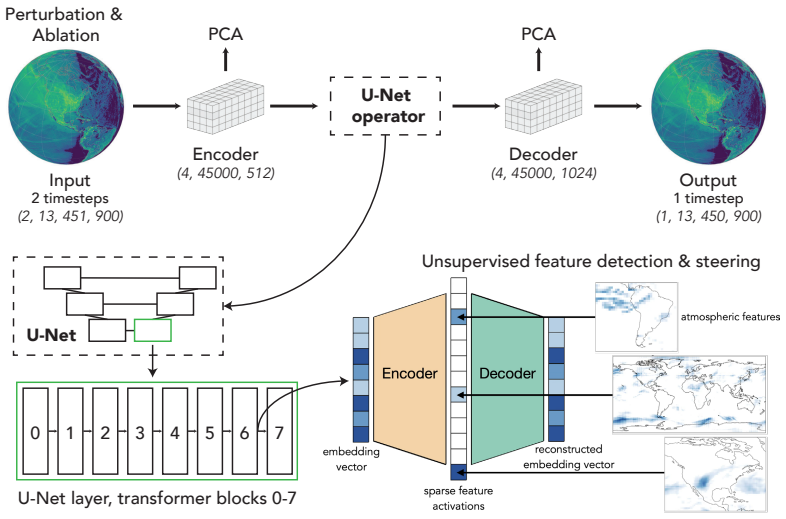
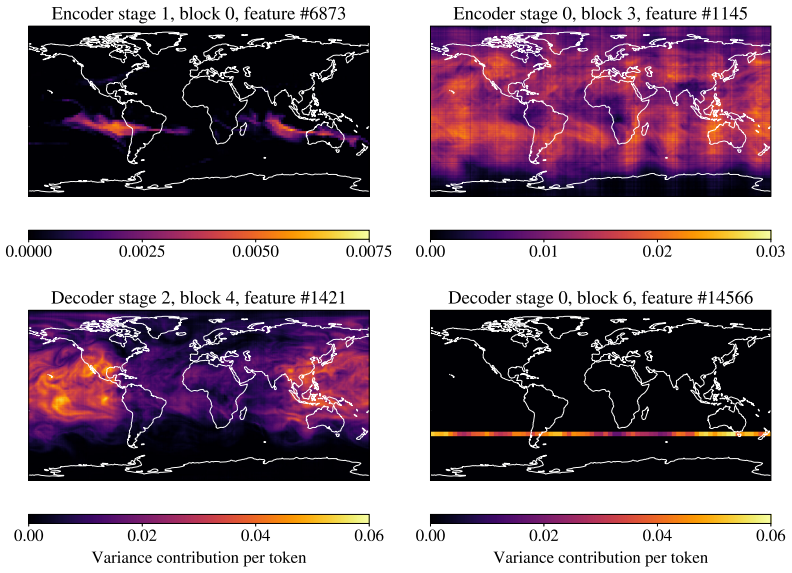
The argument rests on three probes applied to Aurora Air Pollution: (1) controlled NOx perturbation rollouts (uniform +0.5, +5, and +20 ppb additions to NO and NO2 in the initial conditions, compared against baseline over five days) to test for learned NOx–ozone coupling; (2) photochemical consistency diagnostics — the NO2 fraction fNO2 = [NO2]/([NO]+[NO2]) and a Leighton-derived photolysis proxy J1 ≈ k3[NO][O3]/[NO2] — computed from predicted fields and used to detect chemically inconsistent species combinations; and (3) sparse autoencoders (AuroraScope) trained on operator residual-stream activations, with zero-ablation steering to determine whether individual learned features causally alt
Load-bearing premise
The NOx perturbation experiments assume that uniformly adding +5 ppb to NO and NO2 is a chemically meaningful probe, and that the resulting ozone decline reflects learned NOx–ozone chemistry rather than the model's generic reaction to any large, out-of-distribution input.
What would settle it
Perturb an inert or weakly coupled species (e.g., CO added uniformly by +5 ppb, matching the NOx experiment). If surface ozone falls by a comparable amount and negative concentrations appear at similar rates, the ozone-suppression result is an artifact of perturbation magnitude, not evidence of learned chemistry.
If this is right
- Short-lead RMSE skill against reanalysis does not establish that an AI forecaster has learned chemistry; a model can look accurate while producing impossible states.
- Models trained without positivity or cross-species constraints can output negative ozone and other chemically inconsistent combinations even in operationally plausible forecasts.
- Autoregressive rollout damps localized emission features such as wildfire plumes, so exposure-relevant pollution maxima may be under-forecast even when broad patterns match.
- Composition forecasts intended for policy should be evaluated with mechanistic and consistency diagnostics in addition to aggregate error metrics.
- Causally steering single sparse features shifts forecasts in spatially structured but species-entangled ways, so feature-level interventions do not by themselves yield process-level interpretation.
Where Pith is reading between the lines
- Adding an inert-species control perturbation (e.g., CO or SO2 at the same magnitudes) would test whether the ozone-suppression result is specific to NOx or merely a generic response to out-of-distribution inputs; the paper does not include such a control.
- Because fine-tuning uses low-rank updates to a pretrained weather model, the persistence of meteorological organization may be a general property of fine-tuned Earth-system foundation models; applying this test battery across models and checkpoints would reveal how much chemistry structure fine-tuning can actually add.
- If the tropical ozone increases under +0.5 ppb NOx are driven by learned geographic correlations rather than VOC-sensitive chemistry, the model may mispredict under changing land use and emission patterns—an implication the paper leaves open.
- A practical extension: use the same sparse-autoencoder steering pipeline on forecasts initialized from independent reanalyses to test whether discovered features are robust or initialization-specific.
Editorial analysis
A structured set of objections, weighed in public.
Referee Report
Summary. The paper analyzes Microsoft's Aurora Air Pollution, a fine-tuned Earth system foundation model, using a combination of external chemical diagnostics, perturbation experiments, latent-space visualization, and sparse-autoencoder (SAE) feature steering. The authors report that Aurora reproduces some broad composition patterns and a first-order ozone response to NOx perturbations, but also produces negative concentrations, chemically inconsistent species combinations, patch-scale artifacts, and weak wildfire plume persistence. They conclude that the model has learned useful short-range chemical sensitivities without acquiring the physical constraints of a process-based model, and that its internal representations remain largely meteorological. They release the trained SAEs as AuroraScope.
Significance. If the central claims hold, this is a valuable and timely contribution: it is the first mechanistic interpretability study of an atmospheric-chemistry foundation model, it introduces a reusable SAE suite (AuroraScope), and its diagnostics are external to the model, involving no fitted parameters. The paper also makes a falsifiable prediction — that a skillful reanalysis-trained FM can lack robust chemical constraints — which is important for the deployment of such models in policy-relevant air quality forecasting. The public release of code and SAEs strengthens reproducibility. However, as described below, the main evidence for the positive chemical-sensitivity claim is currently incomplete, and several conclusions are stated more strongly than the presented experiments support.
major comments (3)
- [§2.2.2, §3.2, Text S1] The central evidence that Aurora has 'learned useful short-range chemical sensitivities' is the global NOx perturbation experiment. A uniform +5 ppb offset to NO and NO2 across all grid cells, pressure levels, and input timesteps is far outside the training distribution, especially in the stratosphere and clean remote regions. The observed response — median surface ozone −6.1 ppb at 12 h, negative in 89% of cells, including nonphysical negative ozone — could be produced by a generic autoregressive reaction to any large anomalous input, such as regression to the mean, output clipping, or learned spatial covariance between polluted states and low ozone. No control perturbation with a chemically inert or weakly coupled species (e.g., CO or SO2) is presented. The manuscript itself acknowledges in §3.2 that 'it is not possible to further interpret its response to an initial condition perturba
- [§3.4] The claim that the latent representations remain 'largely organized around meteorology inherited during pretraining' rests on visual inspection of RGB maps of the first three PCA components. No quantitative comparison is made between the principal components and known meteorological fields (temperature, winds, geopotential, etc.) or chemical fields, and no null model (e.g., PCA on randomized or shuffled latents) is provided. The paper itself repeatedly notes that 'PCA alone cannot determine' the physical meaning of the modes. Because this is one of the paper's central conclusions, it should be supported by a quantitative test, such as correlation of PC loadings with candidate fields, or explicitly labeled as a qualitative hypothesis rather than a demonstrated result.
- [§3.2] The headline statistics (median −6.1 ppb, 89% of grid cells, sign reversal at 72 h) are reported without any measure of spread across the year-long set of initializations. Since the model is autoregressive and initialized from different CAMS states, it would be straightforward to report the distribution or bootstrap confidence intervals over initializations. As written, it is unclear whether these numbers are stable and robust or dominated by a few seasons or weather regimes. This is needed to support the quantitative strength of the claimed ozone response.
minor comments (5)
- [Eq. (3)] The quantity v_k(t) is described as the 'fraction of token reconstruction variance' attributable to feature k, but the formula uses ||x(t)-b_dec||^2, which is a squared norm, not a centered variance. Consider renaming it 'fraction of squared reconstruction magnitude' or explicitly defining the centering.
- [Figure 3/S1] The distribution of surface ozone under the +0.5 ppb perturbation is visually almost indistinguishable from baseline. Plotting differences from baseline, or using separate panels for each perturbation, would make the response easier to read.
- [§2.2.2] The perturbation is applied to both input timesteps, so it is not a pure initial-condition perturbation in the usual sense; it also modifies the second input frame. This choice is legitimate but should be stated explicitly as a design decision, since it may affect the interpretation of the 12-h response.
- [§3.1] The phrase 'ship track structures' appears without explanation. If these are known artifacts in CAMS or in the model, a brief description or reference would help the reader.
- [General] Some notation is used inconsistently: the model is called 'Aurora Air Pollution' in some places and 'Aurora' in others. For clarity, define the checkpoint name at first use and maintain it throughout.
Circularity Check
No significant circularity: the paper's central diagnostics use external photochemical relationships and CAMS comparisons, and its self-citations are background only.
full rationale
The paper's central claims about Aurora's learned chemistry are tested against external, independently established relationships: the Leighton photostationary relationship for NO2 photolysis, the known NOx-O3 titration/regime behavior, and comparisons with CAMS forecasts and FINN fire detections. These diagnostics are not fitted to Aurora's outputs, and no parameter is extracted from Aurora and then renamed as a prediction. The NOx perturbation experiments lack a chemically inert control perturbation, which is a real external-validity concern (the response could be a generic out-of-distribution artifact), but this is not a circularity: the paper itself flags the ambiguity in §3.2, stating 'It is not clear if Aurora ... is extending an emissions perturbation of NOx or rolling out a response consistent with atmospheric chemical relationships.' The SAE steering experiments select features by variance contribution and then measure the effect of ablation; the causal effect is measured independently and is not defined in terms of the selection criterion, so this is not a reduction by construction. Self-citations (Kelp et al., Sturm & Wexler) appear only as background motivation or as prior technical context, not as load-bearing justification for the paper's conclusions, and no uniqueness theorem or ansatz is imported from the authors' prior work. The internal-representation analysis is descriptive and explicitly hedged. Overall, the derivation chain is self-contained, with no circular step that equates an input to an output by definition or fits a parameter and then calls it a prediction.
Axiom & Free-Parameter Ledger
free parameters (4)
- NOx perturbation offsets =
+0.5, +5, +20 ppb
- Steering feature selection count =
top 10 by max per-token variance
- SAE expansion factor =
8×
- Principal component count =
3
axioms (4)
- domain assumption Leighton photostationary relationship J1 ≈ k3[NO][O3]/[NO2]
- domain assumption CAMS fields are adequate initial conditions and reference for evaluating Aurora
- domain assumption Zero-ablation of an SAE feature is a valid causal intervention
- ad hoc to paper PCA projection and visual inspection can distinguish meteorological from chemical organization in latent spaces
read the original abstract
Weather forecasting foundation models (FMs) are increasingly fine-tuned to predict air quality, offering fast global pollution forecasts at lower computational cost than conventional chemical transport models. These FMs are typically trained on reanalysis data and generate forecasts through autoregressive rollout. They do not explicitly represent governing physical or chemical processes. Therefore, high forecast skill does not reveal whether a model has learned physical mechanisms or exploits statistical regularities in its training data. Here, we present the first study of what a FM fine-tuned for atmospheric chemistry has learned by examining Microsoft's Aurora model. We impose controlled chemical perturbations on its forecasts and test them against known photochemical relationships. We then examine the internal representations that generate these forecasts. We find that Aurora captures a first-order ozone response to reactive nitrogen but does not enforce the chemical constraints that a process-based model encodes. It generates chemically inconsistent combinations of related species and relaxes localized emission features such as wildfire plumes toward background. Internally, its representations remain largely organized around the meteorology inherited during pretraining, with little structure specific to chemistry. Using sparse autoencoders, we identify internal components that causally control the chemical forecast but do not map cleanly onto individual atmospheric processes. This work provides a framework for testing whether AI forecasting systems learn atmospheric chemistry from reanalysis data. As these models are increasingly positioned to inform environmental policy decisions, we argue that composition forecasts should also be judged by their internal mechanisms rather than by benchmark skill alone.
Figures



Reference graph
Works this paper leans on
-
[1]
anenbergEstimatesGlobalBurden2018a APACrefauthors Anenberg, S C. , Henze, D K. , Tinney, V. , Kinney, P L. , Raich, W. , Fann, N. Kuylenstierna, J C. APACrefauthors \ 2018 . Estimates of the Global Burden of Ambient PM2 .5, Ozone , and NO2 on Asthma Incidence and Emergency Room Visits Estimates of the Global Burden of Ambient PM2 .5, Ozone , and NO2 on As...
-
[2]
bereskaMechanisticInterpretabilityAI2024 APACrefauthors Bereska, L. \ Gavves, E. APACrefauthors \ 2024 . Mechanistic Interpretability for AI Safety -- A Review Mechanistic Interpretability for AI Safety -- A Review . arXiv . APACrefDOI doi:10.48550/arXiv.2404.14082 APACrefDOI
-
[3]
biAccurateMediumrangeGlobal2023 APACrefauthors Bi, K. , Xie, L. , Zhang, H. , Chen, X. , Gu, X. \ Tian, Q. APACrefauthors \ 2023 . Accurate Medium-Range Global Weather Forecasting with 3D Neural Networks Accurate medium-range global weather forecasting with 3D neural networks . Nature 619 7970 533--538 . APACrefDOI doi:10.1038/s41586-023-06185-3 APACrefDOI
-
[4]
bodnarFoundationModelEarth2025 APACrefauthors Bodnar, C. , Bruinsma, W P. , Lucic, A. , Stanley, M. , Allen, A. , Brandstetter, J. Perdikaris, P. APACrefauthors \ 2025 . A Foundation Model for the Earth System A foundation model for the Earth system . Nature 641 8065 1180--1187 . APACrefDOI doi:10.1038/s41586-025-09005-y APACrefDOI
-
[5]
bommerFindingRightXAI2024 APACrefauthors Bommer, P L. , Kretschmer, M. , Hedstr \"o m, A. , Bareeva, D. \ H \"o hne, M M C. APACrefauthors \ 2024 . Finding the Right XAI Method --- A Guide for the Evaluation and Ranking of Explainable AI Methods in Climate Science Finding the Right XAI Method --- A Guide for the Evaluation and Ranking of Explainable AI Me...
-
[6]
brasseurModelingAtmosphericChemistry2017 APACrefauthors Brasseur, G P. \ Jacob, D J. APACrefauthors \ 2017 . Modeling of Atmospheric Chemistry Modeling of Atmospheric Chemistry . Cambridge Cambridge University Press . APACrefDOI doi:10.1017/9781316544754 APACrefDOI
-
[7]
brenowitzInterpretingStabilizingMachineLearning2020 APACrefauthors Brenowitz, N D. , Beucler, T. , Pritchard, M. \ Bretherton, C S. APACrefauthors \ 2020 . Interpreting and Stabilizing Machine-Learning Parametrizations of Convection Interpreting and Stabilizing Machine-Learning Parametrizations of Convection . Journal of the Atmospheric Sciences 77 12 435...
-
[8]
calvertAcidGenerationTroposphere1983 APACrefauthors Calvert, J G. \ Stockwell, W R. APACrefauthors \ 1983 . Acid Generation in the Troposphere by Gas-Phase Chemistry Acid generation in the troposphere by gas-phase chemistry . Environmental Science & Technology 17 9 428A-443A . APACrefDOI doi:10.1021/es00115a727 APACrefDOI
-
[9]
, Fern \'a ndez-Torres , M \'A
camps-vallsArtificialIntelligenceModeling2025 APACrefauthors Camps-Valls , G. , Fern \'a ndez-Torres , M \'A . , Cohrs, K H. , H \"o hl, A. , Castelletti, A. , Pacal, A. Williams, T. APACrefauthors \ 2025 . Artificial Intelligence for Modeling and Understanding Extreme Weather and Climate Events Artificial intelligence for modeling and understanding extre...
-
[10]
chalnevImprovingSteeringVectors2024 APACrefauthors Chalnev, S. , Siu, M. \ Conmy, A. APACrefauthors \ 2024 . Improving Steering Vectors by Targeting Sparse Autoencoder Features Improving Steering Vectors by Targeting Sparse Autoencoder Features . arXiv . APACrefDOI doi:10.48550/arXiv.2411.02193 APACrefDOI
-
[11]
chouCausalLanguageControl2025 APACrefauthors Chou, C T. , Liu, G. , Sun, J. , Blondin, C. , Zhu, K. , Sharma, V. \ O'Brien, S. APACrefauthors \ 2025 . Causal Language Control in Multilingual Transformers via Sparse Feature Steering Causal Language Control in Multilingual Transformers via Sparse Feature Steering . arXiv . APACrefDOI doi:10.48550/arXiv.2507...
-
[12]
No One Knows the State of the Art in Geospatial Foundation Models
corleyNoOneKnows2026 APACrefauthors Corley, I. , Lehmann, N. , Robinson, C. , Tseng, G. , Fuller, A. , Alemohammad, H. Kerner, H. APACrefauthors \ 2026 . No One Knows the State of the Art in Geospatial Foundation Models No One Knows the State of the Art in Geospatial Foundation Models . arXiv . APACrefDOI doi:10.48550/arXiv.2605.12678 APACrefDOI
work page internal anchor Pith review Pith/arXiv arXiv doi:10.48550/arxiv.2605.12678 2026
-
[13]
cunninghamSparseAutoencodersFind2023 APACrefauthors Cunningham, H. , Ewart, A. , Riggs, L. , Huben, R. \ Sharkey, L. APACrefauthors \ 2023 . Sparse Autoencoders Find Highly Interpretable Features in Language Models Sparse Autoencoders Find Highly Interpretable Features in Language Models . arXiv . APACrefDOI doi:10.48550/arXiv.2309.08600 APACrefDOI
-
[14]
diEnsemblebasedModelPM252019 APACrefauthors Di, Q. , Amini, H. , Shi, L. , Kloog, I. , Silvern, R. , Kelly, J. Schwartz, J. APACrefauthors \ 2019 . An Ensemble-Based Model of PM2 .5 Concentration across the Contiguous United States with High Spatiotemporal Resolution An ensemble-based model of PM2 .5 concentration across the contiguous United States with ...
arXiv 2019
-
[15]
, Long, M S
easthamGEOSChemHighPerformance2018 APACrefauthors Eastham, S D. , Long, M S. , Keller, C A. , Lundgren, E. , Yantosca, R M. , Zhuang, J. Jacob, D J. APACrefauthors \ 2018 . GEOS-Chem High Performance ( GCHP V11-02c): A next-Generation Implementation of the GEOS-Chem Chemical Transport Model for Massively Parallel Applications GEOS-Chem High Performance ( ...
2018
-
[16]
Benchmarking and Improving Monitors for Out-Of-Distribution Alignment Failure in LLMs
fengBenchmarkingImprovingMonitors2026 APACrefauthors Feng, D. , Srivastava, P. , Dragan, A. \ Laidlaw, C. APACrefauthors \ 2026 . Benchmarking and Improving Monitors for Out-Of-Distribution Alignment Failure in LLMs Benchmarking and Improving Monitors for Out-Of-Distribution Alignment Failure in LLMs . arXiv . APACrefDOI doi:10.48550/arXiv.2605.21602 APACrefDOI
work page internal anchor Pith review Pith/arXiv arXiv doi:10.48550/arxiv.2605.21602 2026
-
[17]
gomez-pedreroIncrementalPCAAlgorithm2022 APACrefauthors G \'o mez-Pedrero , J A. , Estrada, J C. , Alonso, J. , Quiroga, J A. \ Vargas, J. APACrefauthors \ 2022 . Incremental PCA Algorithm for Fringe Pattern Demodulation Incremental PCA algorithm for fringe pattern demodulation . Optics Express 30 8 12278--12293 . APACrefDOI doi:10.1364/OE.452463 APACrefDOI
-
[18]
gouldsbroughMachineLearningApproach2024a APACrefauthors Gouldsbrough, L. , Hossaini, R. , Eastoe, E. , Young, P J. \ Vieno, M. APACrefauthors \ 2024 . A Machine Learning Approach to Downscale EMEP4UK : Analysis of UK Ozone Variability and Trends A machine learning approach to downscale EMEP4UK : Analysis of UK ozone variability and trends . Atmospheric Ch...
-
[19]
hickmanApplicationsMachineLearning2025a APACrefauthors Hickman, S H M. , Kelp, M M. , Griffiths, P T. , Doerksen, K. , Miyazaki, K. , Pennington, E A. Liu, Z. APACrefauthors \ 2025 . Applications of Machine Learning and Artificial Intelligence in Tropospheric Ozone Research Applications of Machine Learning and Artificial Intelligence in Tropospheric Ozone...
-
[20]
huLoRALowRankAdaptation2021 APACrefauthors Hu, E J. , Shen, Y. , Wallis, P. , Allen-Zhu , Z. , Li, Y. , Wang, S. Chen, W. APACrefauthors \ 2021 . LoRA : Low-Rank Adaptation of Large Language Models LoRA : Low-Rank Adaptation of Large Language Models . arXiv . APACrefDOI doi:10.48550/arXiv.2106.09685 APACrefDOI
-
[21]
ivattImprovingPredictionAtmospheric2020b APACrefauthors Ivatt, P D. \ Evans, M J. APACrefauthors \ 2020 . Improving the Prediction of an Atmospheric Chemistry Transport Model Using Gradient-Boosted Regression Trees Improving the prediction of an atmospheric chemistry transport model using gradient-boosted regression trees . Atmospheric Chemistry and Physi...
-
[22]
PhysMetrics.Weather: An Evaluation Framework for Physical Consistency in ML Weather Models
kasteleynPhysMetricsWeatherEvaluationFramework2026 APACrefauthors Kasteleyn, E. , Maier, T. , Lauer, A. , Eyring, V. , Gentine, P. \ Lucic, A. APACrefauthors \ 2026 . PhysMetrics . Weather : An Evaluation Framework for Physical Consistency in ML Weather Models PhysMetrics . Weather : An Evaluation Framework for Physical Consistency in ML Weather Models . ...
work page internal anchor Pith review Pith/arXiv arXiv doi:10.48550/arxiv.2606.10642 2026
-
[23]
kellerApplicationRandomForest2019 APACrefauthors Keller, C A. \ Evans, M J. APACrefauthors \ 2019 . Application of Random Forest Regression to the Calculation of Gas-Phase Chemistry within the GEOS-Chem Chemistry Model V10 Application of random forest regression to the calculation of gas-phase chemistry within the GEOS-Chem chemistry model v10 . Geoscient...
-
[24]
kellerDescriptionNASAGEOS2021 APACrefauthors Keller, C A. , Knowland, K E. , Duncan, B N. , Liu, J. , Anderson, D C. , Das, S. Pawson, S. APACrefauthors \ 2021 . Description of the NASA GEOS Composition Forecast Modeling System GEOS-CF v1.0 Description of the NASA GEOS Composition Forecast Modeling System GEOS-CF v1.0 . Journal of Advances in Modeling Ear...
-
[25]
, Hickman, S
kelpAI4O3FoundationalData2025a APACrefauthors Kelp, M. , Hickman, S. , Miyazaki, K. , Chang, K L. , Griffiths, P. , Zhu, Q. Schultz, M G. APACrefauthors \ 2025 . AI4O3 : A Foundational Data Collection for Artificial Intelligence in Tropospheric Ozone Research AI4O3 : A Foundational Data Collection for Artificial Intelligence in Tropospheric Ozone Research...
2025
-
[26]
kelpStableGeneralMachineLearned2020 APACrefauthors Kelp, M. , Jacob, D J. , Kutz, J N. , Marshall, J D. \ Tessum, C W. APACrefauthors \ 2020 . Toward Stable , General Machine-Learned Models of the Atmospheric Chemical System Toward Stable , General Machine-Learned Models of the Atmospheric Chemical System . Journal of Geophysical Research: Atmospheres 125...
-
[27]
kelpOnlineLearnedNeuralNetwork2022 APACrefauthors Kelp, M. , Jacob, D J. , Lin, H. \ Sulprizio, M P. APACrefauthors \ 2022 . An Online-Learned Neural Network Chemical Solver for Stable Long-Term Global Simulations of Atmospheric Chemistry An Online-Learned Neural Network Chemical Solver for Stable Long-Term Global Simulations of Atmospheric Chemistry . Jo...
-
[28]
Orders-of-magnitude speedup in atmospheric chemistry modeling through neural network-based emulation
kelpOrdersofmagnitudeSpeedupAtmospheric2018 APACrefauthors Kelp, M. , Tessum, C W. \ Marshall, J D. APACrefauthors \ 2018 . Orders-of-Magnitude Speedup in Atmospheric Chemistry Modeling through Neural Network-Based Emulation Orders-of-magnitude speedup in atmospheric chemistry modeling through neural network-based emulation . arXiv . APACrefDOI doi:10.485...
work page internal anchor Pith review Pith/arXiv arXiv doi:10.48550/arxiv.1808.03874 2018
-
[29]
kingmaAdamMethodStochastic2017 APACrefauthors Kingma, D P. \ Ba, J. APACrefauthors \ 2017 . Adam: A Method for Stochastic Optimization Adam: A Method for Stochastic Optimization . arXiv . APACrefDOI doi:10.48550/arXiv.1412.6980 APACrefDOI
-
[30]
kumarFineTuningCanDistort2022a APACrefauthors Kumar, A. , Raghunathan, A. , Jones, R. , Ma, T. \ Liang, P. APACrefauthors \ 2022 . Fine- Tuning Can Distort Pretrained Features and Underperform Out-of-Distribution Fine- Tuning can Distort Pretrained Features and Underperform Out-of-Distribution . arXiv . APACrefDOI doi:10.48550/arXiv.2202.10054 APACrefDOI
-
[31]
Machine learning for climate physics and simulations
laiMachineLearningClimate2024 APACrefauthors Lai, C Y. , Hassanzadeh, P. , Sheshadri, A. , Sonnewald, M. , Ferrari, R. \ Balaji, V. APACrefauthors \ 2024 . Machine Learning for Climate Physics and Simulations Machine learning for climate physics and simulations . arXiv . APACrefDOI doi:10.48550/arXiv.2404.13227 APACrefDOI
work page internal anchor Pith review Pith/arXiv arXiv doi:10.48550/arxiv.2404.13227 2024
-
[32]
lamLearningSkillfulMediumrange2023 APACrefauthors Lam, R. , Sanchez-Gonzalez , A. , Willson, M. , Wirnsberger, P. , Fortunato, M. , Alet, F. Battaglia, P. APACrefauthors \ 2023 . Learning Skillful Medium-Range Global Weather Forecasting Learning skillful medium-range global weather forecasting . Science 382 6677 1416--1421 . APACrefDOI doi:10.1126/science...
-
[33]
langAIFSECMWFsDatadriven2024a APACrefauthors Lang, S. , Alexe, M. , Chantry, M. , Dramsch, J. , Pinault, F. , Raoult, B. Rabier, F. APACrefauthors \ 2024 . AIFS -- ECMWF 's Data-Driven Forecasting System AIFS -- ECMWF 's data-driven forecasting system . arXiv . APACrefDOI doi:10.48550/arXiv.2406.01465 APACrefDOI
-
[34]
leeSurgicalFineTuningImproves2023 APACrefauthors Lee, Y. , Chen, A S. , Tajwar, F. , Kumar, A. , Yao, H. , Liang, P. \ Finn, C. APACrefauthors \ 2023 . Surgical Fine-Tuning Improves Adaptation to Distribution Shifts Surgical Fine-Tuning Improves Adaptation to Distribution Shifts . arXiv . APACrefDOI doi:10.48550/arXiv.2210.11466 APACrefDOI
-
[35]
APACrefauthors \ 1961
leightonPhotochemistryAirPollution2012 APACrefauthors Leighton, P. APACrefauthors \ 1961 . Photochemistry of Air Pollution Photochemistry of Air Pollution . Elsevier
1961
-
[36]
liRethinkingHyperparametersFinetuning2020 APACrefauthors Li, H. , Chaudhari, P. , Yang, H. , Lam, M. , Ravichandran, A. , Bhotika, R. \ Soatto, S. APACrefauthors \ 2020 . Rethinking the Hyperparameters for Fine-tuning Rethinking the Hyperparameters for Fine-tuning . arXiv . APACrefDOI doi:10.48550/arXiv.2002.11770 APACrefDOI
-
[37]
liGrowingImpactsFire2026 APACrefauthors Li, Y. , Jin, X. , Kelp, M. , Sun, H Z. \ Qiu, M. APACrefauthors \ 2026 . Growing Impacts of Fire Smoke on Ozone Pollution and Associated Mortality Burden in the United States Growing impacts of fire smoke on ozone pollution and associated mortality burden in the United States . Science Advances 12 18 eaec2903 . APA...
-
[38]
liuCorrectingOzoneBiases2022a APACrefauthors Liu, Z. , Doherty, R M. , Wild, O. , O'Connor, F M. \ Turnock, S T. APACrefauthors \ 2022 . Correcting Ozone Biases in a Global Chemistry--Climate Model: Implications for Future Ozone Correcting ozone biases in a global chemistry--climate model: Implications for future ozone . Atmospheric Chemistry and Physics ...
-
[39]
lundbergUnifiedApproachInterpreting2017 APACrefauthors Lundberg, S. \ Lee, S I. APACrefauthors \ 2017 . A Unified Approach to Interpreting Model Predictions A Unified Approach to Interpreting Model Predictions . arXiv . APACrefDOI doi:10.48550/arXiv.1705.07874 APACrefDOI
-
[40]
macmillanMechanisticUnderstandingDatadriven2025a APACrefauthors MacMillan, T. \ Ouellette, N T. APACrefauthors \ 2025 . Towards Mechanistic Understanding in a Data-Driven Weather Model: Internal Activations Reveal Interpretable Physical Features Towards mechanistic understanding in a data-driven weather model: Internal activations reveal interpretable phy...
-
[41]
millsOzonePollutionWill2018 APACrefauthors Mills, G. , Sharps, K. , Simpson, D. , Pleijel, H. , Broberg, M. , Uddling, J. Van Dingenen, R. APACrefauthors \ 2018 . Ozone Pollution Will Compromise Efforts to Increase Global Wheat Production Ozone pollution will compromise efforts to increase global wheat production . Global Change Biology 24 8 3560--3574 . ...
-
[42]
nandaProgressMeasuresGrokking2023 APACrefauthors Nanda, N. , Chan, L. , Lieberum, T. , Smith, J. \ Steinhardt, J. APACrefauthors \ 2023 . Progress Measures for Grokking via Mechanistic Interpretability Progress measures for grokking via mechanistic interpretability . arXiv . APACrefDOI doi:10.48550/arXiv.2301.05217 APACrefDOI
-
[43]
nationalresearchcouncilNationalStrategyAdvancing2012 APACrefauthors National Research Council . APACrefauthors \ 2012 . A National Strategy for Advancing Climate Modeling A National Strategy for Advancing Climate Modeling \ . The National Academies Press . APACrefDOI doi:10.17226/13430 APACrefDOI
-
[44]
nguyenClimaXFoundationModel2023 APACrefauthors Nguyen, T. , Brandstetter, J. , Kapoor, A. , Gupta, J K. \ Grover, A. APACrefauthors \ 2023 . ClimaX : A Foundation Model for Weather and Climate ClimaX : A foundation model for weather and climate . arXiv . APACrefDOI doi:10.48550/arXiv.2301.10343 APACrefDOI
-
[45]
, Jacob, D J
oakBiascorrectedGEMSGeostationary2024 APACrefauthors Oak, Y J. , Jacob, D J. , Balasus, N. , Yang, L H. , Chong, H. , Park, J. Kim, J. APACrefauthors \ 2024 . A Bias-Corrected GEMS Geostationary Satellite Product for Nitrogen Dioxide Using Machine Learning to Enforce Consistency with the TROPOMI Satellite Instrument A bias-corrected GEMS geostationary sat...
2024
-
[46]
olahZoomIntroductionCircuits2020 APACrefauthors Olah, C. , Cammarata, N. , Schubert, L. , Goh, G. , Petrov, M. \ Carter, S. APACrefauthors \ 2020 . Zoom In : An Introduction to Circuits Zoom In : An Introduction to Circuits . Distill 5 3 . APACrefDOI doi:10.23915/distill.00024.001 APACrefDOI
-
[47]
qiuWildfireSmokeExposure2025b APACrefauthors Qiu, M. , Li, J. , Gould, C F. , Jing, R. , Kelp, M. , Childs, M L. Burke, M. APACrefauthors \ 2025 . Wildfire Smoke Exposure and Mortality Burden in the USA under Climate Change Wildfire smoke exposure and mortality burden in the USA under climate change . Nature 647 8091 935--943 . APACrefDOI doi:10.1038/s415...
-
[48]
raspCoupledOnlineLearning2020a APACrefauthors Rasp, S. APACrefauthors \ 2020 . Coupled Online Learning as a Way to Tackle Instabilities and Biases in Neural Network Parameterizations: General Algorithms and Lorenz 96 Case Study (v1.0) Coupled online learning as a way to tackle instabilities and biases in neural network parameterizations: General algorithm...
-
[49]
sadeghitabasGFSPoweredMachineLearning2025 APACrefauthors Sadeghi Tabas, S. , Wang, J. , Lei, W. , Row, M. , Zhang, Z. , Zhu, L. Carley, J R. APACrefauthors \ 2025 . GFS-Powered Machine Learning Weather Prediction : A Comparative Study on Training GraphCast with NOAA 's GDAS Data for Global Weather Forecasts GFS-Powered Machine Learning Weather Prediction ...
-
[50]
\ Pandis, S N
seinfeldAtmosphericChemistryPhysics2016 APACrefauthors Seinfeld, J H. \ Pandis, S N. APACrefauthors \ 2006 . Atmospheric Chemistry and Physics : From Air Pollution to Climate Change Atmospheric Chemistry and Physics : From Air Pollution to Climate Change . John Wiley & Sons
2006
-
[51]
, Jacob, D J
shenAdaptiveMethodSpeeding2020 APACrefauthors Shen, L. , Jacob, D J. , Santillana, M. , Wang, X. \ Chen, W. APACrefauthors \ 2020 . An Adaptive Method for Speeding up the Numerical Integration of Chemical Mechanisms in Atmospheric Chemistry Models: Application to GEOS-Chem Version 12.0.0 An adaptive method for speeding up the numerical integration of chem...
2020
-
[52]
shenEnhancingGlobalEstimation2024 APACrefauthors Shen, S. , Li, C. , van Donkelaar , A. , Jacobs, N. , Wang, C. \ Martin, R V. APACrefauthors \ 2024 . Enhancing Global Estimation of Fine Particulate Matter Concentrations by Including Geophysical a Priori Information in Deep Learning Enhancing Global Estimation of Fine Particulate Matter Concentrations by ...
-
[53]
silvaLimitationsXAIMethods2024 APACrefauthors Silva, S J. \ Keller, C A. APACrefauthors \ 2024 . Limitations of XAI Methods for Process-Level Understanding in the Atmospheric Sciences Limitations of XAI Methods for Process-Level Understanding in the Atmospheric Sciences . Artificial Intelligence for the Earth Systems 3 1 e230045 . APACrefDOI doi:10.1175/A...
-
[54]
, Manders, A
sturmAdvectingSuperspeciesEfficiently2023 APACrefauthors Sturm, P O. , Manders, A. , Janssen, R. , Segers, A. , Wexler, A S. \ Lin, H X. APACrefauthors \ 2023 . Advecting Superspecies : Efficiently Modeling Transport of Organic Aerosol With a Mass-Conserving Dimensionality Reduction Method Advecting Superspecies : Efficiently Modeling Transport of Organic...
2023
-
[55]
sturmMassEnergyconservingFramework2020a APACrefauthors Sturm, P O. \ Wexler, A S. APACrefauthors \ 2020 . A Mass- and Energy-Conserving Framework for Using Machine Learning to Speed Computations: A Photochemistry Example A mass- and energy-conserving framework for using machine learning to speed computations: A photochemistry example . Geoscientific Model...
-
[56]
sturmConservationLawsNeural2022a APACrefauthors Sturm, P O. \ Wexler, A S. APACrefauthors \ 2022 . Conservation Laws in a Neural Network Architecture: Enforcing the Atom Balance of a Julia-based Photochemical Model (v0.2.0) Conservation laws in a neural network architecture: Enforcing the atom balance of a Julia-based photochemical model (v0.2.0) . Geosci...
-
[57]
tomsPhysicallyInterpretableNeural2020 APACrefauthors Toms, B A. , Barnes, E A. \ Ebert-Uphoff , I. APACrefauthors \ 2020 . Physically Interpretable Neural Networks for the Geosciences : Applications to Earth System Variability Physically Interpretable Neural Networks for the Geosciences : Applications to Earth System Variability . Journal of Advances in M...
-
[58]
weberChemistrydrivenChangesStrongly2022 APACrefauthors Weber, J. , Archer-Nicholls , S. , Abraham, N L. , Shin, Y M. , Griffiths, P. , Grosvenor, D P. Archibald, A T. APACrefauthors \ 2022 . Chemistry-Driven Changes Strongly Influence Climate Forcing from Vegetation Emissions Chemistry-driven changes strongly influence climate forcing from vegetation emis...
-
[59]
, Kimura, Y
gmd-16-3873-2023 APACrefauthors Wiedinmyer, C. , Kimura, Y. , McDonald-Buller, E C. , Emmons, L K. , Buchholz, R R. , Tang, W. Yokelson, R. APACrefauthors \ 2023 . The Fire Inventory from NCAR version 2.5: an updated global fire emissions model for climate and chemistry applications The fire inventory from ncar version 2.5: an updated global fire emission...
2023
-
[60]
wiserAMOREIsopreneV10New2023 APACrefauthors Wiser, F. , Place, B K. , Sen, S. , Pye, H O T. , Yang, B. , Westervelt, D M. McNeill, V F. APACrefauthors \ 2023 . AMORE-Isoprene v1.0: A New Reduced Mechanism for Gas-Phase Isoprene Oxidation AMORE-Isoprene v1.0: A new reduced mechanism for gas-phase isoprene oxidation . Geoscientific Model Development 16 6 18...
-
[61]
, Zhao, C
xiaAdvancingSophisticatedPhotochemistry2025 APACrefauthors Xia, Z. , Zhao, C. , Du, Q. , Yang, Z. , Zhang, M. \ Qiao, L. APACrefauthors \ 2025 . Advancing Sophisticated Photochemistry Simulation in Atmospheric Numerical Models With Artificial Intelligence PhotoChemistry ( AIPC ) Scheme Using the Feature-Mapping Subspace Self-Attention Algorithm Advancing ...
2025
-
[62]
xiaoGeneratingLongterm200320202022 APACrefauthors Xiao, Y. , Wang, Y. , Yuan, Q. , He, J. \ Zhang, L. APACrefauthors \ 2022 . Generating a Long-Term (2003-2020) Hourly 0.25 ^ Global PM2 .5 Dataset via Spatiotemporal Downscaling of CAMS with Deep Learning ( DeepCAMS ) Generating a long-term (2003-2020) hourly 0.25 ^ global PM2 .5 dataset via spatiotemporal...
arXiv 2022
-
[63]
yuDeepLearningbasedDownscaling2021 APACrefauthors Yu, M. \ Liu, Q. APACrefauthors \ 2021 . Deep Learning-Based Downscaling of Tropospheric Nitrogen Dioxide Using Ground-Level and Satellite Observations Deep learning-based downscaling of tropospheric nitrogen dioxide using ground-level and satellite observations . Science of The Total Environment 773 14514...
arXiv 2021
-
[64]
zhuUncertainNaturalEmissions2026 APACrefauthors Zhu, Q. , Neumann, N. , Fiore, A M. , Pincus, R. , Guan, J. , Milly, G. Giani, P. APACrefauthors \ 2026 . Uncertain Natural Emissions Dampen the Increase in Tropospheric Hydroxyl Radical ( OH ) With Idealized Surface Warming Uncertain Natural Emissions Dampen the Increase in Tropospheric Hydroxyl Radical ( O...
discussion (0)
Sign in with ORCID, Apple, or X to comment. Anyone can read and Pith papers without signing in.