Chemical Abundances of the Bioessential Elements C, O and S, and the Refractory Elements Fe and Ni, in Solar-type Exoplanet-hosting Stars from HARPS North and South
Pith reviewed 2026-07-01 01:48 UTC · model grok-4.3
The pith
Stars hosting giant exoplanets show enhanced abundances of C, O, S, Fe, and Ni compared to small planet hosts.
A machine-rendered reading of the paper's core claim, the machinery that carries it, and where it could break.
Core claim
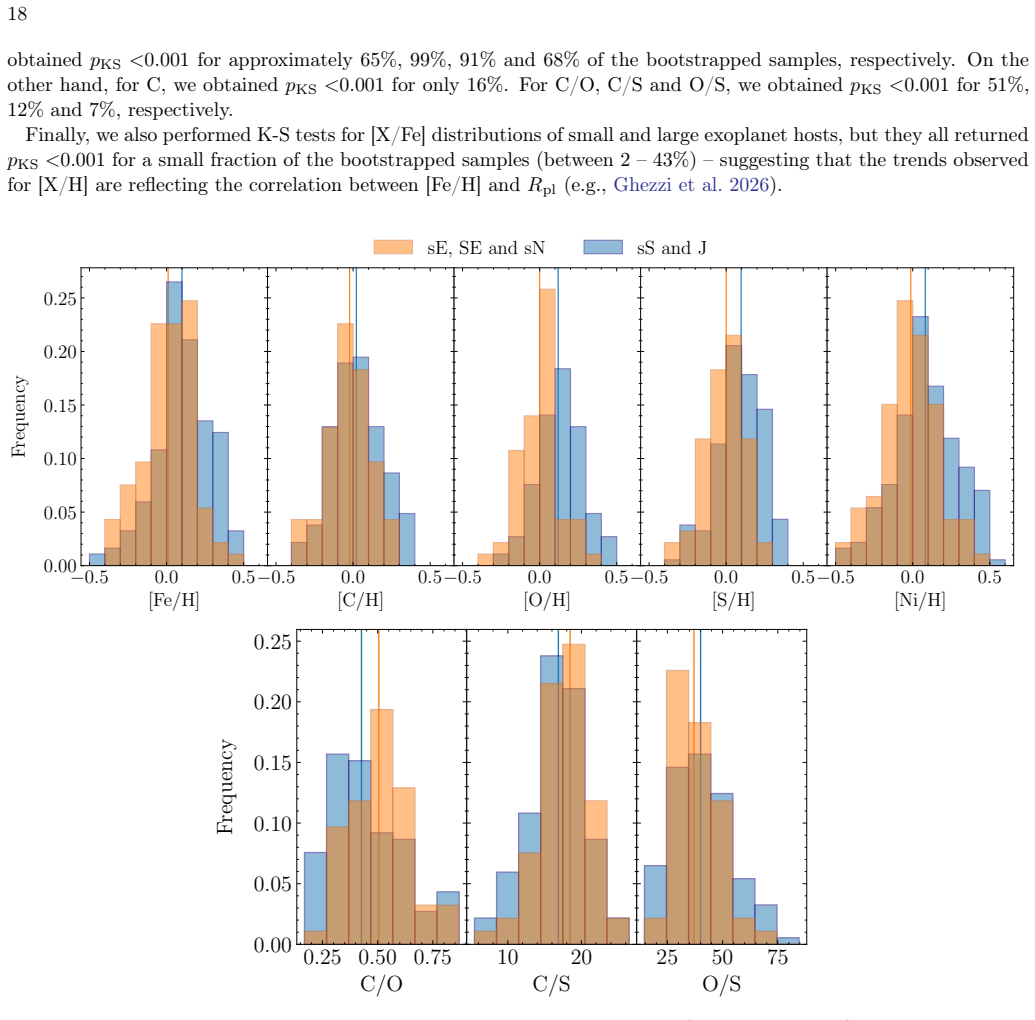
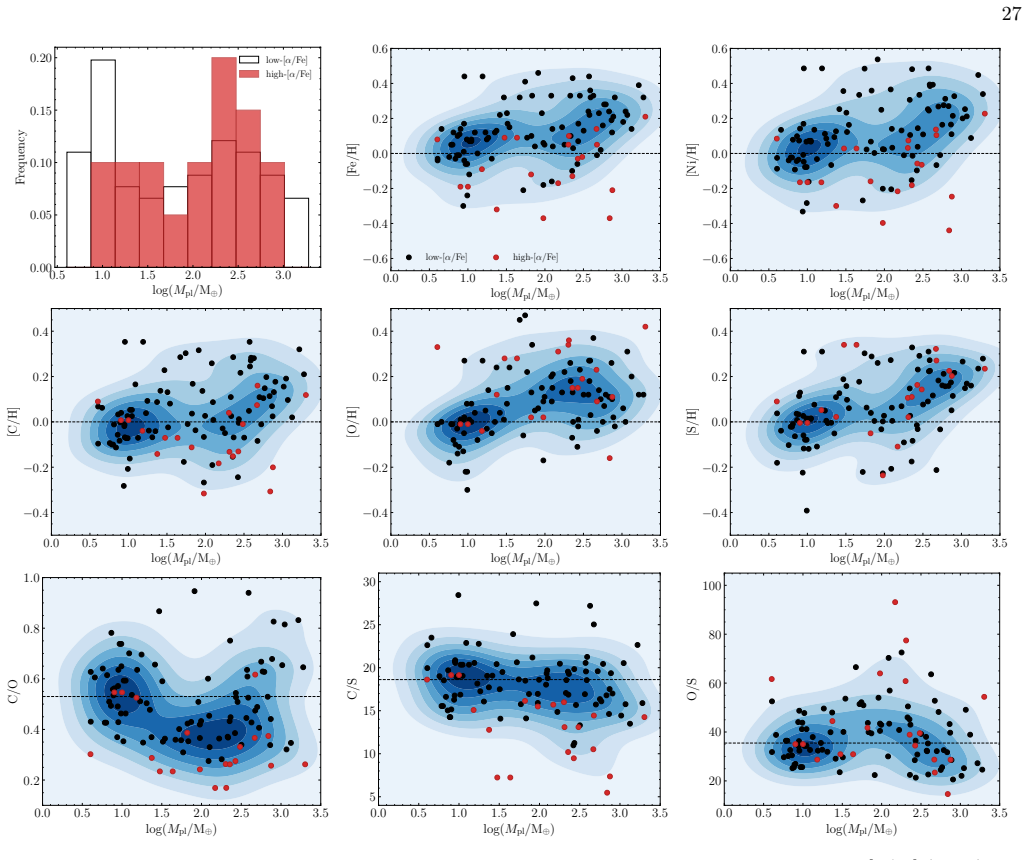
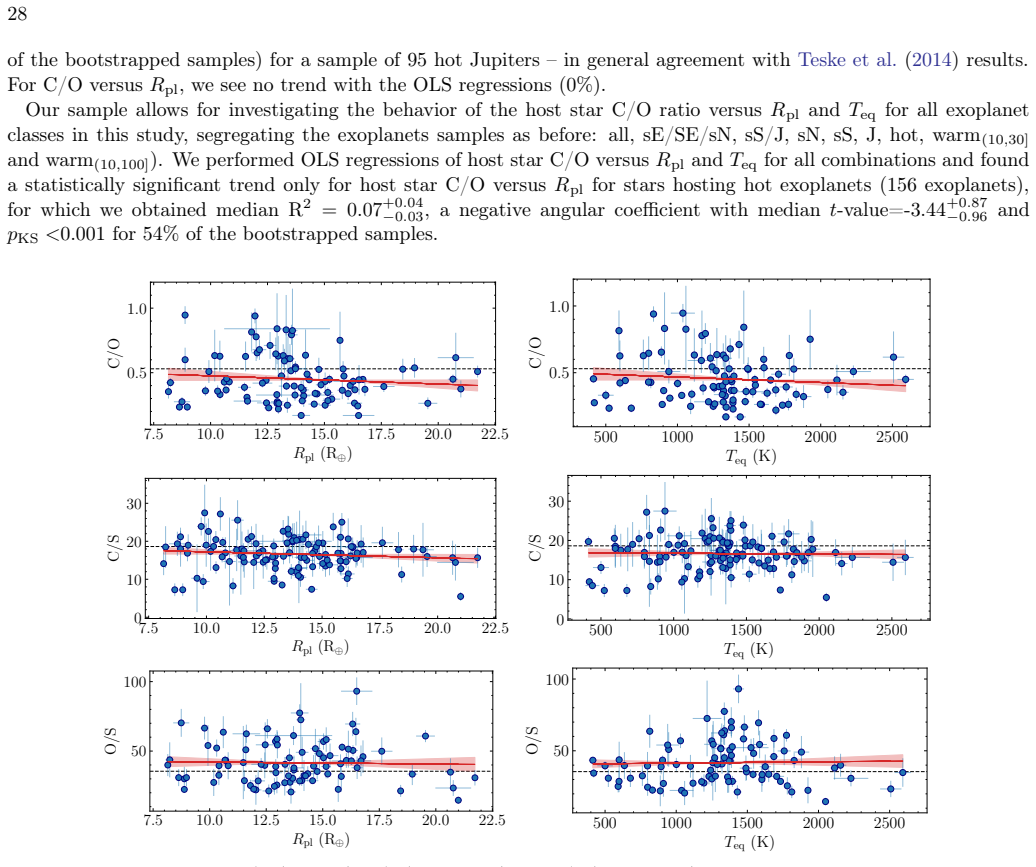
Stars hosting giant exoplanets (R_pl > 4 R_⊕) show enhanced [X/H] abundances compared to small exoplanet hosts for C, O, S, Fe, and Ni. For short-period planets, [Fe/H] anti-correlates with orbital period, but this trend reverses at longer periods. Giant planet hosts have the lowest median C/O ratios, while sub-Neptune hosts have the highest. Correlations between [O/H] and [S/H] with planet mass appear only for warm exoplanets and in low-[α/Fe] stars.
What carries the argument
The radius threshold of 4 Earth radii used to separate giant from small exoplanets, allowing comparison of host star chemical abundances [X/H] across planet populations.
Load-bearing premise
The radius cut at 4 Earth radii cleanly divides planets into groups with distinct formation pathways, and the abundance measurements have no large systematic errors from analysis methods.
What would settle it
Finding a sample of exoplanet-hosting stars where giant and small planet hosts show no difference in these abundances after controlling for stellar parameters would challenge the result.
Figures
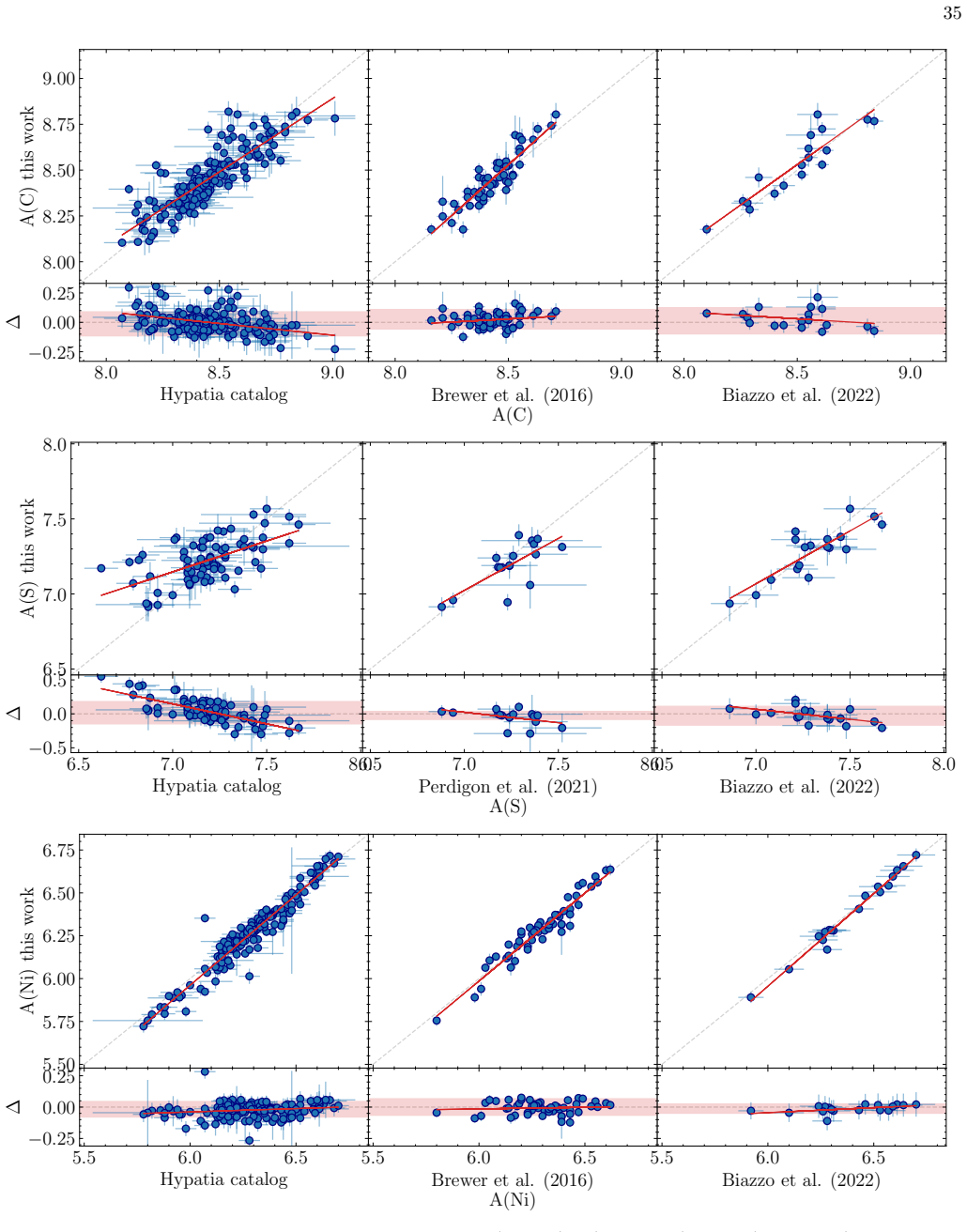
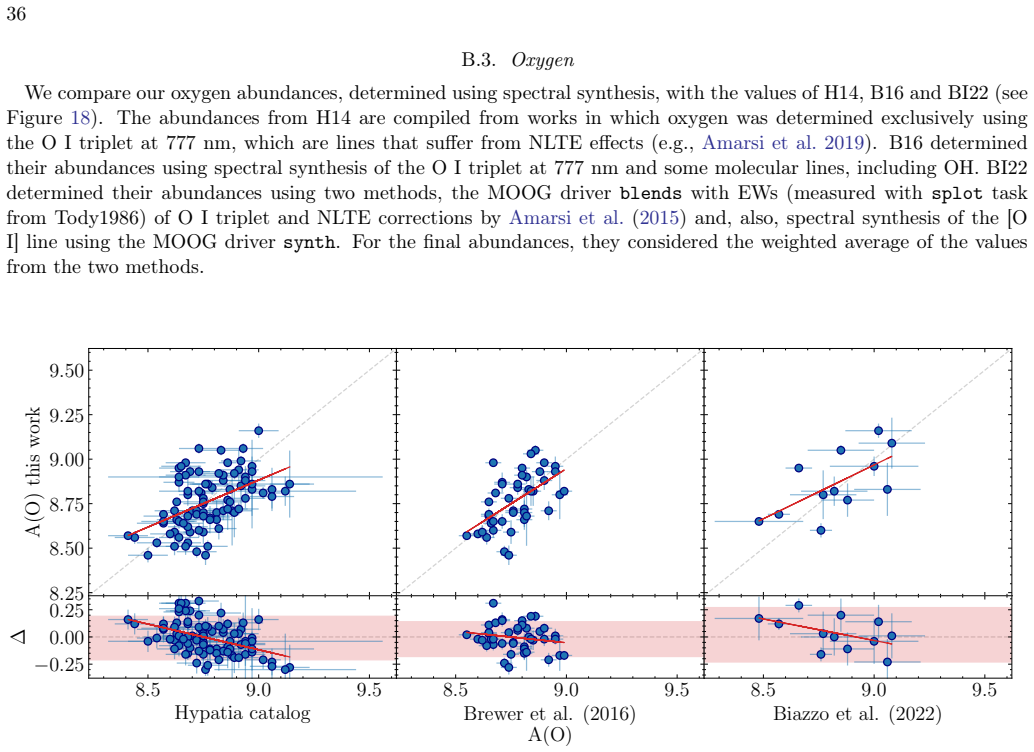
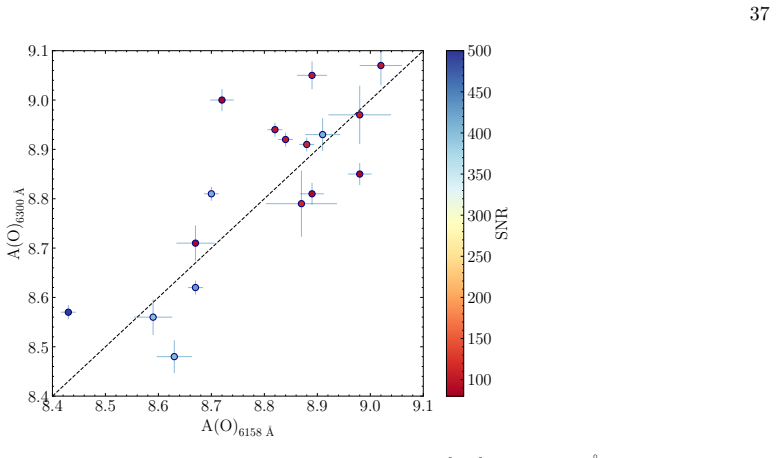
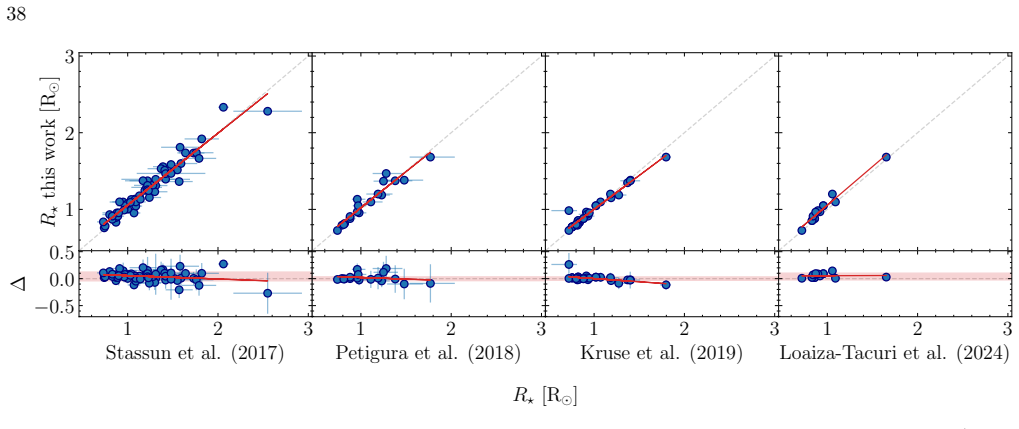
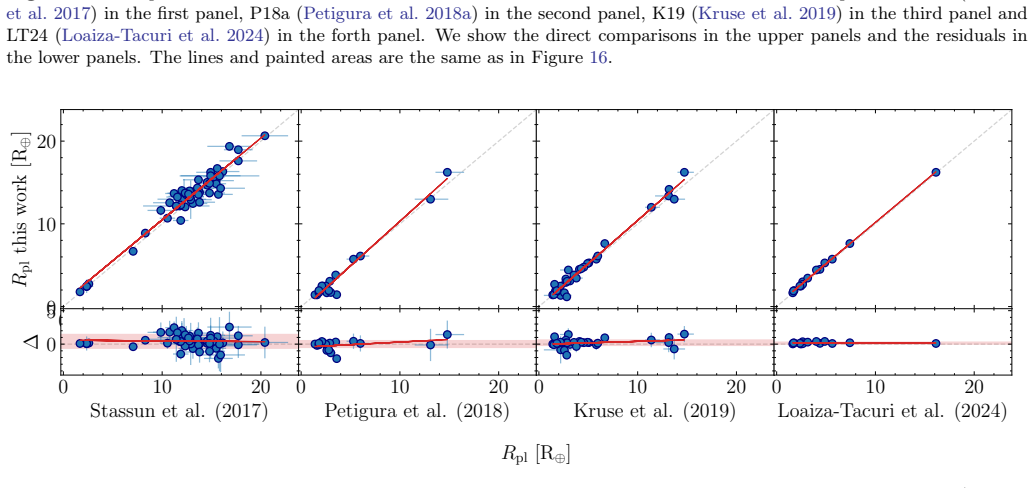
read the original abstract
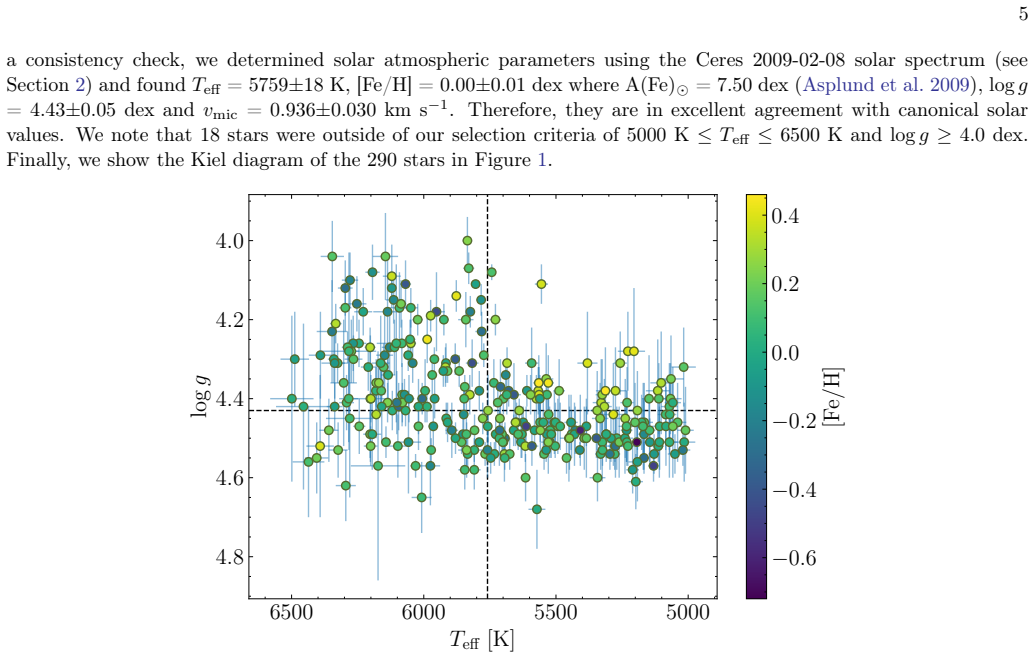
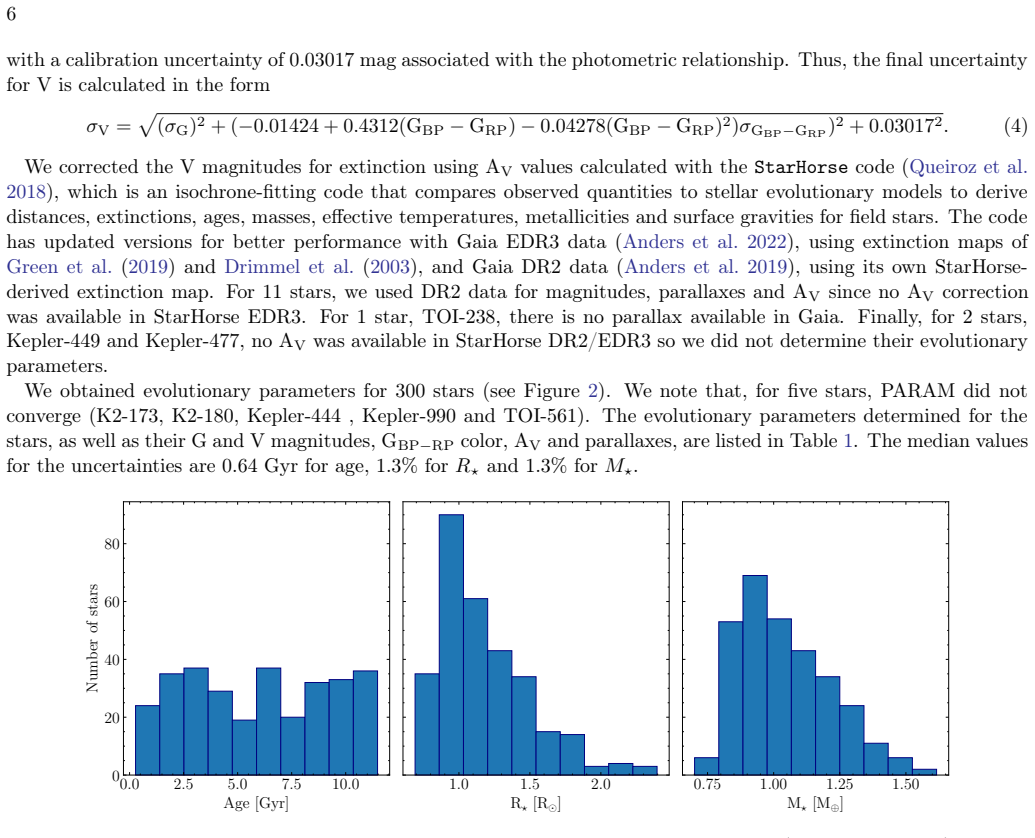
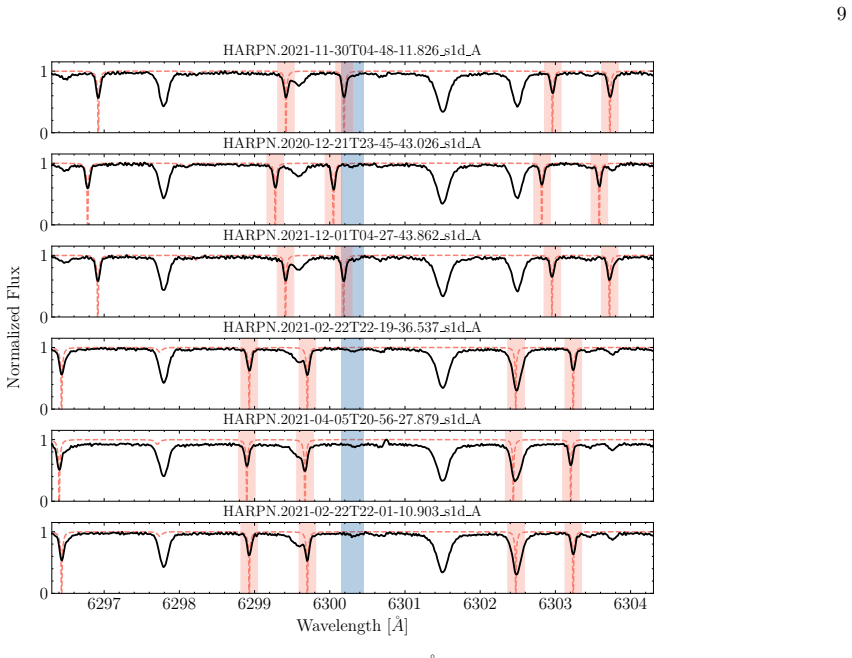
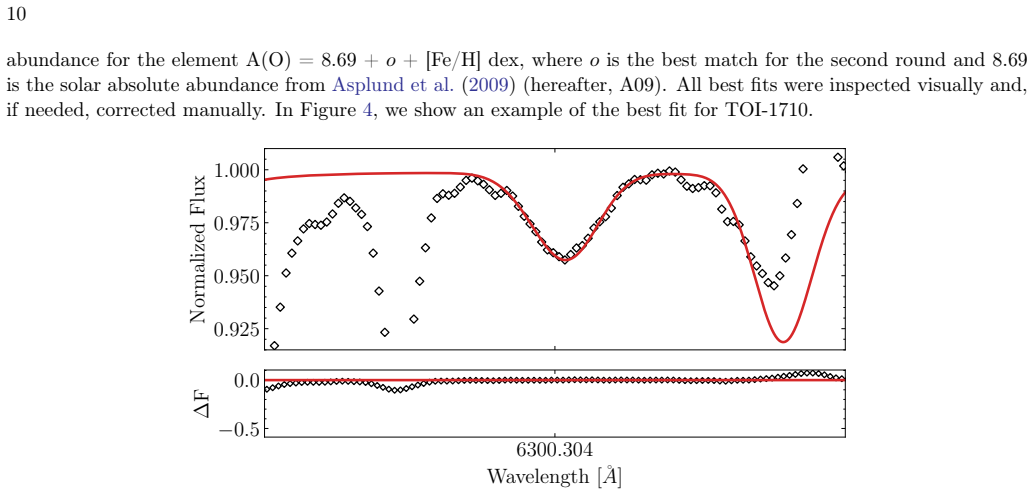
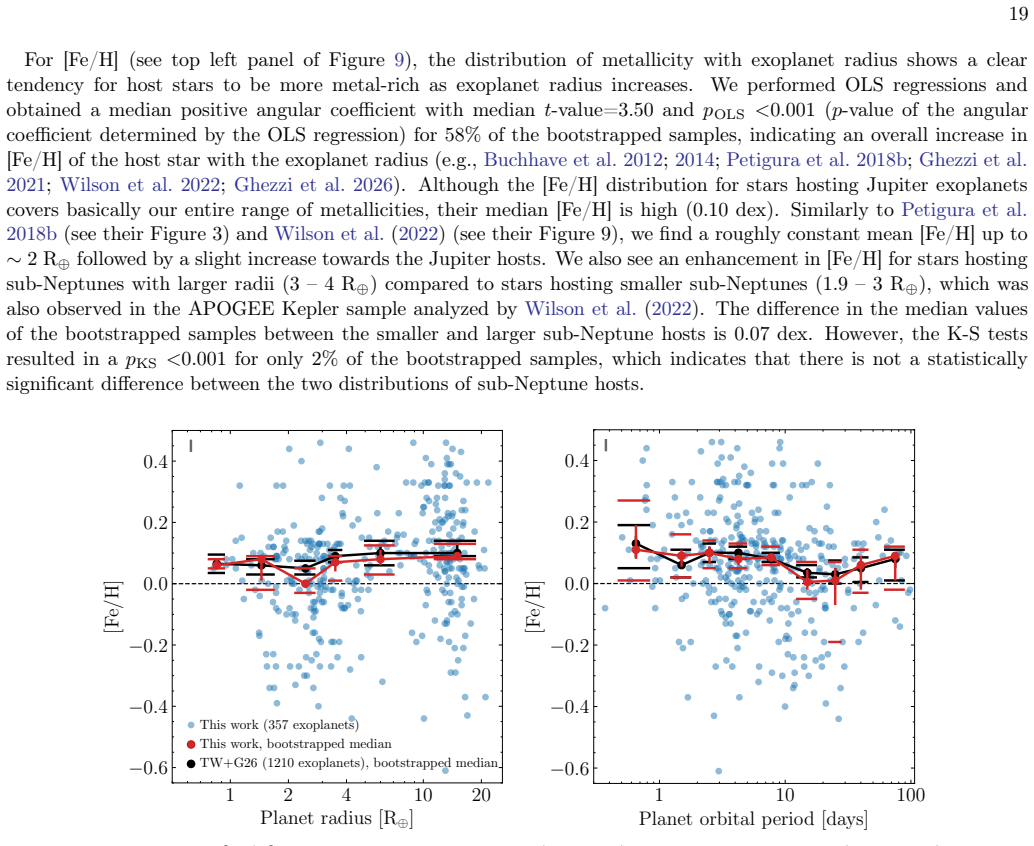
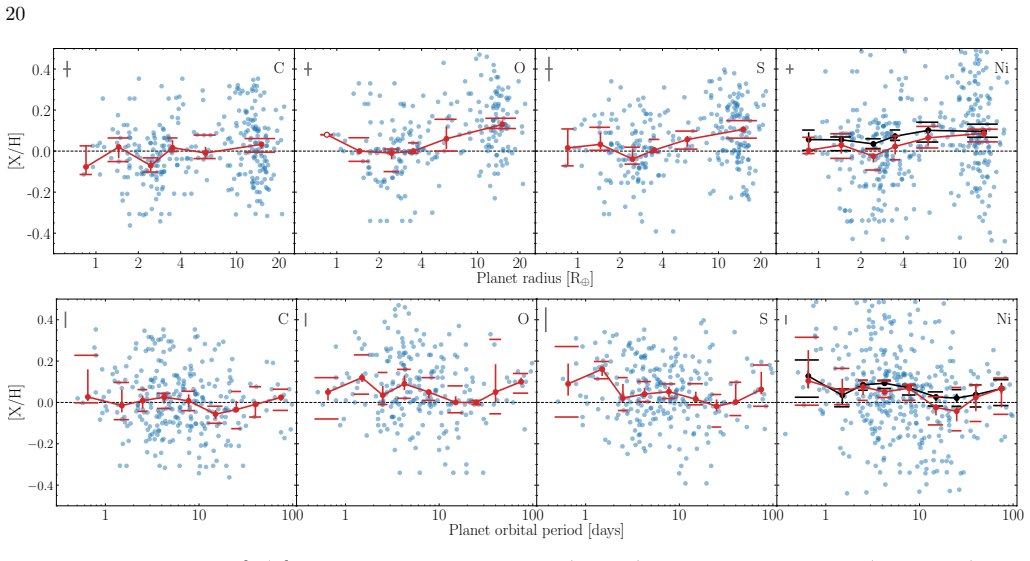
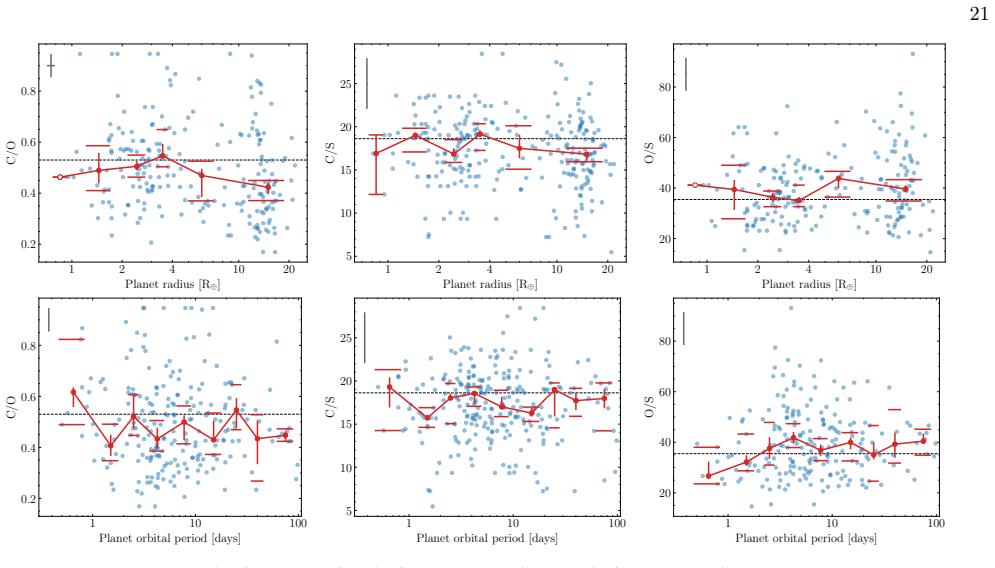
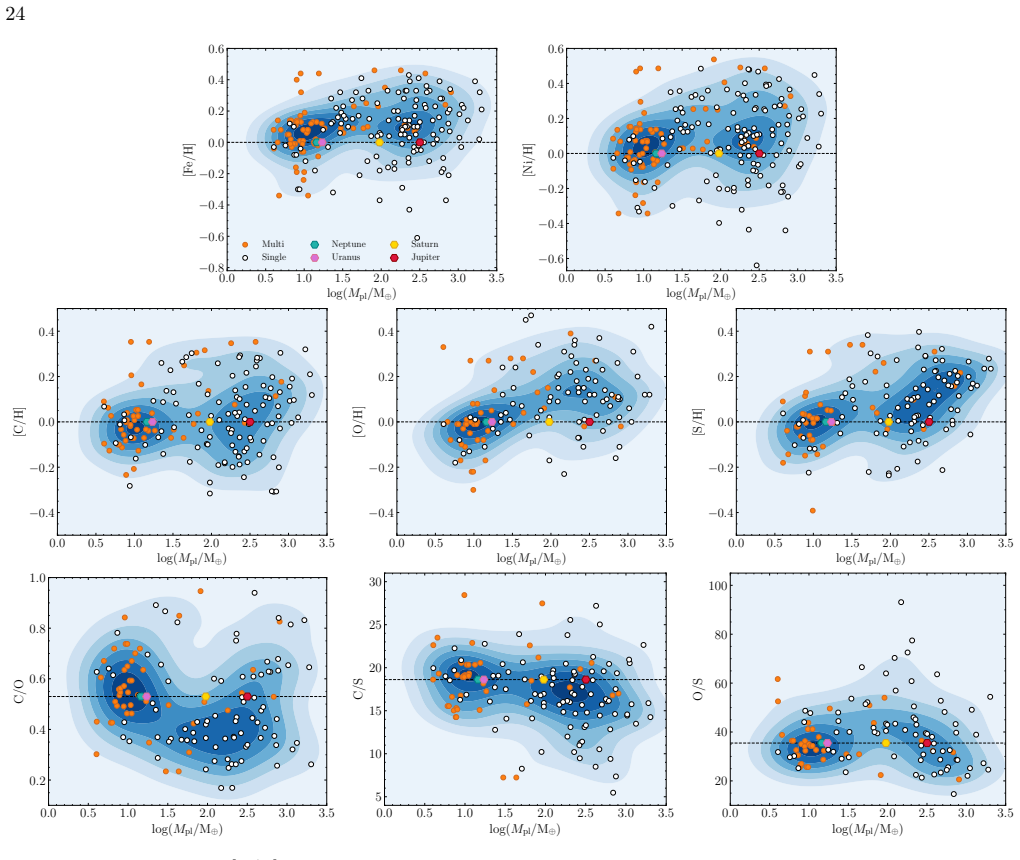
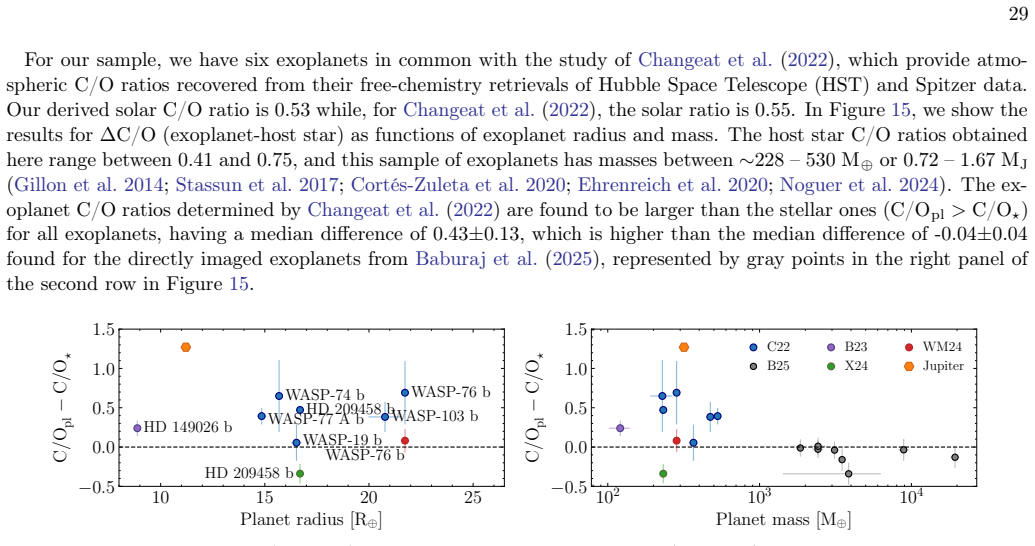
We determined atmospheric and evolutionary parameters, along with chemical abundances of C, O, S, Fe, and Ni for 290 solar-type exoplanet hosting stars using high-resolution HARPS-North and HARPS-South spectra, and radii for 373 exoplanets using literature transit depths. We find that stars hosting giant exoplanets (R$_{\text{pl}}>4\ \text{R}_{\oplus}$) show enhanced [X/H] abundances compared to small exoplanet hosts for all elements analyzed. When considering only exoplanets with $P_{\text{orb}}\leq30$ days, there is a statistically significant anti-correlation between host star [Fe/H] and $P_{\text{orb}}$. However, [Fe/H] does not continue to decline as the orbital period increases, but rather rises again for exoplanets with larger orbital periods. Stars hosting only small exoplanets or hosting at least one sub-Saturn show significant differences between the populations of hot and warm exoplanets for all elements. In contrast, stars hosting at least one Jupiter-sized planet show no abundance differences. The host star C/O ratios obtained vary from 0.17 to 0.95, with giant exoplanet hosts exhibiting the lowest median C/O ratios (0.43$^{+0.02}_{-0.03}$), while the 3 -- 4 R$_\oplus$ sub-Neptune hosts in our sample exhibit the highest median C/O ratios (0.55$^{+0.05}_{-0.01}$). Our sample has 199 exoplanets with estimated masses and we find correlations between host star [O/H] and [S/H] and $\log(M_{\text{pl}}/\text{M}_\oplus)$. When segregating the sample into hot and warm exoplanet hosts, these trends are only found for warm exoplanets. Dividing the sample between low- (91 exoplanets) and high-[$\alpha$/Fe] (20 exoplanets) stars, there are trends between host star [O/H], [S/H], [Fe/H] and [Ni/H] and $\log(M_{\text{pl}}/\text{M}_\oplus)$ only for the low-[$\alpha$/Fe] sample.
Editorial analysis
A structured set of objections, weighed in public.
Referee Report
Summary. The manuscript reports spectroscopic analysis of 290 solar-type exoplanet-hosting stars using HARPS-N and HARPS-S spectra to derive atmospheric/evolutionary parameters and abundances of C, O, S, Fe, and Ni. It identifies enhanced [X/H] abundances in hosts of giant planets (R_pl > 4 R_⊕) versus small-planet hosts for all five elements, reports period-dependent [Fe/H] trends that reverse beyond ~30 days, differences in C/O ratios by planet type (lowest median for giant hosts), mass-abundance correlations only for warm planets and low-[α/Fe] stars, and separate behaviors for sub-Saturn hosts.
Significance. If the reported abundance offsets and correlations prove robust after bias checks, the work would strengthen evidence that host-star chemistry (metallicity, C/O, α-elements) correlates with planet radius and formation channel, with implications for core-accretion models and the distinction between giant and sub-Neptune populations. The sample size and multi-element coverage are strengths, but the absence of explicit robustness tests against the radius cut and stellar-parameter systematics reduces the immediate impact.
major comments (3)
- [Abstract] Abstract: The central claim of enhanced [X/H] for all elements in R_pl > 4 R_⊕ hosts is load-bearing, yet the manuscript provides no explicit test (e.g., Kolmogorov-Smirnov comparison or matching on T_eff, log g, [Fe/H]) of whether the offset survives after controlling for known correlations between metallicity and giant-planet detectability or after varying the 4 R_⊕ boundary.
- [Abstract] Abstract: The reported reversal in the [Fe/H]–P_orb trend (anti-correlation only for P_orb ≤ 30 d, then rise at longer periods) and the separate treatment of sub-Saturn hosts are presented as statistically significant, but without the sample-selection criteria, completeness corrections, or full error budget (including non-LTE effects on C, O, S), it is impossible to assess whether these trends are driven by the radius classification or by unaccounted systematics.
- [Abstract] Abstract: The C/O ratio medians (0.43 for giant hosts vs. 0.55 for 3–4 R_⊕ hosts) and the mass-abundance correlations (only in warm planets and low-[α/Fe] subsample) rely on the same radius-based segregation; the paper does not demonstrate that these differences remain after propagating uncertainties in the transit-derived radii or after excluding the 199 planets with mass estimates.
minor comments (2)
- [Abstract] Notation: The abstract uses inconsistent subscript formatting (R$_{\text{pl}}$ vs. P$_{\text{orb}}$) and reports asymmetric uncertainties on medians without stating whether they are 16th/84th percentiles or formal errors.
- [Abstract] The abstract states 'statistically significant' trends multiple times but does not specify the exact test (Spearman, Pearson, etc.) or p-value threshold used.
Simulated Author's Rebuttal
We thank the referee for their constructive feedback, which highlights opportunities to strengthen the robustness of our claims. We respond to each major comment below, indicating planned revisions where appropriate.
read point-by-point responses
-
Referee: [Abstract] Abstract: The central claim of enhanced [X/H] for all elements in R_pl > 4 R_⊕ hosts is load-bearing, yet the manuscript provides no explicit test (e.g., Kolmogorov-Smirnov comparison or matching on T_eff, log g, [Fe/H]) of whether the offset survives after controlling for known correlations between metallicity and giant-planet detectability or after varying the 4 R_⊕ boundary.
Authors: We agree that explicit robustness tests would strengthen the central claim. In the revised manuscript we will add Kolmogorov-Smirnov tests on the [X/H] distributions after matching the giant- and small-planet host samples on T_eff, log g and [Fe/H], together with a sensitivity analysis varying the radius threshold (3.5 R_⊕ and 4.5 R_⊕). These additions will directly address concerns about metallicity-driven detectability biases. revision: yes
-
Referee: [Abstract] Abstract: The reported reversal in the [Fe/H]–P_orb trend (anti-correlation only for P_orb ≤ 30 d, then rise at longer periods) and the separate treatment of sub-Saturn hosts are presented as statistically significant, but without the sample-selection criteria, completeness corrections, or full error budget (including non-LTE effects on C, O, S), it is impossible to assess whether these trends are driven by the radius classification or by unaccounted systematics.
Authors: Sample selection criteria are already detailed in Section 2. We will expand the text to include an explicit discussion of possible completeness biases in the period distribution and will add a dedicated paragraph on the error budget, citing literature estimates of non-LTE corrections for C, O and S in solar-type stars. The statistical significance of the reversal and sub-Saturn differences will be re-stated with these caveats included. revision: partial
-
Referee: [Abstract] Abstract: The C/O ratio medians (0.43 for giant hosts vs. 0.55 for 3–4 R_⊕ hosts) and the mass-abundance correlations (only in warm planets and low-[α/Fe] subsample) rely on the same radius-based segregation; the paper does not demonstrate that these differences remain after propagating uncertainties in the transit-derived radii or after excluding the 199 planets with mass estimates.
Authors: We will add an analysis that propagates the reported uncertainties in transit-derived radii into the C/O distributions and mass-abundance correlations. We will also present the mass-abundance trends after excluding the 199 planets that have mass estimates, thereby testing whether the reported differences persist under these conditions. revision: yes
Circularity Check
No circularity: purely empirical abundance measurements and correlations
full rationale
The paper reports direct spectroscopic determinations of atmospheric parameters and [X/H] abundances for C, O, S, Fe, Ni from HARPS spectra, followed by statistical comparisons and correlations with exoplanet radii, periods, and masses. No equations, derivations, or predictions are presented that reduce by construction to fitted parameters or self-citations. The central claims rest on observed differences (e.g., enhanced [X/H] for giant-planet hosts) without any self-definitional loops, fitted-input predictions, or load-bearing self-citations. This is a standard observational study whose results are externally falsifiable via independent spectra or samples.
Axiom & Free-Parameter Ledger
axioms (2)
- domain assumption Local thermodynamic equilibrium and standard model atmospheres suffice for abundance determinations from HARPS spectra of solar-type stars
- domain assumption Literature transit depths yield radii accurate enough to classify planets as giant or small at the 4 R_⊕ boundary
Reference graph
Works this paper leans on
-
[1]
Planetary Systems , publisher =. doi:10.26133/NEA12 , url =
-
[2]
Super-adiabatic temperature gradient at Jupiter's equatorial zone and implications for the water abundance. , keywords =. doi:10.1016/j.icarus.2024.116028 , archivePrefix =. 2403.05363 , primaryClass =
-
[3]
, year = 2000, month = jan, volume =
Formation of Protoplanets from Planetesimals in the Solar Nebula. , year = 2000, month = jan, volume =. doi:10.1006/icar.1999.6237 , adsurl =
-
[4]
Protoplanetary Disks and Their Evolution
Protoplanetary Disks and Their Evolution. , keywords =. doi:10.1146/annurev-astro-081710-102548 , archivePrefix =. 1103.0556 , primaryClass =
work page internal anchor Pith review Pith/arXiv arXiv doi:10.1146/annurev-astro-081710-102548
-
[5]
Silicon and Nickel Enrichment in Planet Host Stars: Observations and Implications for the Core Accretion Theory of Planet Formation. , keywords =. doi:10.1086/502795 , archivePrefix =. astro-ph/0601656 , primaryClass =
work page internal anchor Pith review Pith/arXiv arXiv doi:10.1086/502795
-
[6]
Coupled 1D Chemical Kinetic Transport and 2D Hydrodynamic Modeling Supports a Modest 1─1.5 Supersolar Oxygen Abundance in Jupiter's Atmosphere. , keywords =. doi:10.3847/PSJ/ae28d5 , archivePrefix =. 2508.05007 , primaryClass =
-
[7]
Metal enrichment leads to low atmospheric C/O ratios in transiting giant exoplanets
Metal Enrichment Leads to Low Atmospheric C/O Ratios in Transiting Giant Exoplanets. , keywords =. doi:10.3847/2041-8213/aa65ca , archivePrefix =. 1611.08616 , primaryClass =
work page internal anchor Pith review Pith/arXiv arXiv doi:10.3847/2041-8213/aa65ca 2041
-
[8]
Metallicities of M Dwarf Planet Host Stars from Kepler, K2, and TESS Observed by APOGEE: Trends with Exoplanetary Radii and Orbital Periods. , keywords =. doi:10.3847/1538-3881/adef12 , archivePrefix =. 2507.04066 , primaryClass =
-
[9]
A modified CoRoT detrend algorithm and the discovery of a new planetary companion
A modified CoRoT detrend algorithm and the discovery of a new planetary companion. , keywords =. doi:10.1093/mnras/stx2187 , archivePrefix =. 1709.00351 , primaryClass =
work page internal anchor Pith review Pith/arXiv arXiv doi:10.1093/mnras/stx2187
-
[10]
New ephemerides and detection of transit-timing variations in the K2-138 system using high-precision CHEOPS photometry. , keywords =. doi:10.1051/0004-6361/202348013 , archivePrefix =. 2406.18267 , primaryClass =
-
[11]
Transiting exoplanet candidates from K2 Campaigns 5 and 6
Transiting exoplanet candidates from K2 Campaigns 5 and 6. , keywords =. doi:10.1093/mnras/stw1373 , archivePrefix =. 1606.01264 , primaryClass =
work page internal anchor Pith review Pith/arXiv arXiv doi:10.1093/mnras/stw1373
-
[12]
, year = 2010, month = mar, volume =
A transiting giant planet with a temperature between 250K and 430K. , year = 2010, month = mar, volume =. doi:10.1038/nature08856 , adsurl =
-
[13]
Three s Company: An Additional Non-transiting Super-Earth in the Bright HD 3167 System, and Masses for All Three Planets. , keywords =. doi:10.3847/1538-3881/aa832d , archivePrefix =. 1706.01892 , primaryClass =
work page internal anchor Pith review Pith/arXiv arXiv doi:10.3847/1538-3881/aa832d
-
[14]
Transiting exoplanets from the CoRoT space mission. XI. CoRoT-8b: a hot and dense sub-Saturn around a K1 dwarf. , keywords =. doi:10.1051/0004-6361/201014775 , archivePrefix =. 1008.0325 , primaryClass =
work page internal anchor Pith review Pith/arXiv arXiv doi:10.1051/0004-6361/201014775
-
[15]
CHEOPS observations of the HD 108236 planetary system: a fifth planet, improved ephemerides, and planetary radii. , keywords =. doi:10.1051/0004-6361/202039608 , archivePrefix =. 2101.00663 , primaryClass =
-
[16]
A Spin-Orbit Alignment for the Hot Jupiter HATS-3b
A Spin-Orbit Alignment for the Hot Jupiter HATS-3b. , keywords =. doi:10.1088/0004-637X/792/2/112 , archivePrefix =. 1407.7710 , primaryClass =
work page internal anchor Pith review Pith/arXiv arXiv doi:10.1088/0004-637x/792/2/112
-
[17]
HARPS reduced data obtained by standard ESO pipeline processing , publisher =. 2014 , copyright =. doi:10.18727/ARCHIVE/33 , url =
-
[18]
Planetary Candidates Observed by Kepler. VI. Planet Sample from Q1--Q16 (47 Months). , keywords =. doi:10.1088/0067-0049/217/2/31 , archivePrefix =. 1502.02038 , primaryClass =
work page internal anchor Pith review Pith/arXiv arXiv doi:10.1088/0067-0049/217/2/31
-
[19]
Spin-orbit alignments for Three Transiting Hot Jupiters: WASP-103b, WASP-87b, & WASP-66b
Spin-orbit Alignment for Three Transiting Hot Jupiters: WASP-103b, WASP-87b, and WASP-66b. , keywords =. doi:10.3847/0004-637X/823/1/29 , archivePrefix =. 1603.05754 , primaryClass =
work page internal anchor Pith review Pith/arXiv arXiv doi:10.3847/0004-637x/823/1/29
-
[20]
275 Candidates and 149 Validated Planets Orbiting Bright Stars in K2 Campaigns 0-10
275 Candidates and 149 Validated Planets Orbiting Bright Stars in K2 Campaigns 0-10. , keywords =. doi:10.3847/1538-3881/aaadff , archivePrefix =. 1802.05277 , primaryClass =
work page internal anchor Pith review Pith/arXiv arXiv doi:10.3847/1538-3881/aaadff
-
[21]
TESS Input Catalog versions 8.1 and 8.2: Phantoms in the 8.0 Catalog and How to Handle Them. arXiv e-prints , keywords =. doi:10.48550/arXiv.2108.04778 , archivePrefix =. 2108.04778 , primaryClass =
-
[22]
High-precision transit observations of the exoplanet WASP-13b with the RISE instrument. , keywords =. doi:10.1111/j.1365-2966.2011.19784.x , archivePrefix =. 1108.3996 , primaryClass =
-
[23]
Chemical evidence for planetary ingestion in a quarter of Sun-like stars. Nature Astronomy , keywords =. doi:10.1038/s41550-021-01451-8 , archivePrefix =. 2108.12040 , primaryClass =
-
[24]
Abundances in the Local Region. I. G and K Giants. , keywords =. doi:10.1088/0004-6256/150/3/88 , archivePrefix =. 1507.01466 , primaryClass =
work page internal anchor Pith review Pith/arXiv arXiv doi:10.1088/0004-6256/150/3/88
-
[25]
Sulfur and zinc abundances of red giant stars
Sulfur and zinc abundances of red giant stars. , keywords =. doi:10.1093/pasj/psw071 , archivePrefix =. 1607.04385 , primaryClass =
work page internal anchor Pith review Pith/arXiv arXiv doi:10.1093/pasj/psw071
-
[26]
Behavior of Sulfur Abundances in Metal-Poor Giants and Dwarfs
Behavior of Sulfur Abundances in Metal-poor Giants and Dwarfs. , keywords =. doi:10.1086/340748 , archivePrefix =. astro-ph/0103481 , primaryClass =
work page internal anchor Pith review Pith/arXiv arXiv doi:10.1086/340748
-
[27]
Abundances in the Local Region. III. Southern F, G, and K Dwarfs. , keywords =. doi:10.3847/1538-3881/aaa9b5 , adsurl =
-
[28]
Dwarfs in the Local Region. , keywords =. doi:10.1086/504080 , adsurl =
-
[29]
Multiple Populations of Extrasolar Gas Giants
Multiple Populations of Extrasolar Gas Giants. , keywords =. doi:10.3847/1538-4357/ab0f9c , archivePrefix =. 1903.05317 , primaryClass =
work page internal anchor Pith review Pith/arXiv arXiv doi:10.3847/1538-4357/ab0f9c 1903
-
[30]
A library of self-consistent simulated exoplanet atmospheres. , keywords =. doi:10.1093/mnras/staa2300 , archivePrefix =. 2008.01856 , primaryClass =
-
[31]
The Consistency of Chemical Clocks among Coeval Stars. , keywords =. doi:10.3847/1538-4357/ac15fd , archivePrefix =. 2105.01096 , primaryClass =
-
[32]
A high-precision chemical abundance analysis of the HAT-P-1 stellar binary: constraints on planet formation. , keywords =. doi:10.1093/mnrasl/slu055 , archivePrefix =. 1404.2112 , primaryClass =
work page internal anchor Pith review Pith/arXiv arXiv doi:10.1093/mnrasl/slu055
-
[33]
The GAPS programme at TNG. XLIV. Projected rotational velocities of 273 exoplanet-host stars observed with HARPS-N. , keywords =. doi:10.1051/0004-6361/202245564 , archivePrefix =. 2306.13468 , primaryClass =
-
[34]
VizieR Online Data Catalog: Catalog of Stellar Rotational Velocities (Glebocki+ 2005)
2005
-
[35]
The James Webb Space Telescope
The James Webb Space Telescope. , keywords =. doi:10.1007/s11214-006-8315-7 , archivePrefix =. astro-ph/0606175 , primaryClass =
work page internal anchor Pith review Pith/arXiv arXiv doi:10.1007/s11214-006-8315-7
-
[36]
The James Webb Space Telescope Mission. , keywords =. doi:10.1088/1538-3873/acd1b5 , archivePrefix =. 2304.04869 , primaryClass =
-
[37]
Early Release Science of the exoplanet WASP-39b with JWST NIRSpec G395H. , keywords =. doi:10.1038/s41586-022-05591-3 , archivePrefix =. 2211.10488 , primaryClass =
-
[38]
The Apache Point Observatory Galactic Evolution Experiment (APOGEE)
The Apache Point Observatory Galactic Evolution Experiment (APOGEE). , keywords =. doi:10.3847/1538-3881/aa784d , archivePrefix =. 1509.05420 , primaryClass =
work page internal anchor Pith review Pith/arXiv arXiv doi:10.3847/1538-3881/aa784d
-
[39]
On the age of Gliese 504. , keywords =. doi:10.1088/0004-637X/806/2/163 , adsurl =
-
[40]
The Mass Dependence Between Protoplanetary Disks and their Stellar Hosts
The Mass Dependence between Protoplanetary Disks and their Stellar Hosts. , keywords =. doi:10.1088/0004-637X/771/2/129 , archivePrefix =. 1305.5262 , primaryClass =
work page internal anchor Pith review Pith/arXiv arXiv doi:10.1088/0004-637x/771/2/129
-
[41]
Experimental Astronomy , keywords =
A chemical survey of exoplanets with ARIEL. Experimental Astronomy , keywords =. doi:10.1007/s10686-018-9598-x , adsurl =
-
[42]
The GALAH Survey: Scientific Motivation
The GALAH survey: scientific motivation. , keywords =. doi:10.1093/mnras/stv327 , archivePrefix =. 1502.04767 , primaryClass =
work page internal anchor Pith review Pith/arXiv arXiv doi:10.1093/mnras/stv327
-
[43]
ASPCAP: The Apogee Stellar Parameter and Chemical Abundances Pipeline
ASPCAP: The APOGEE Stellar Parameter and Chemical Abundances Pipeline. , keywords =. doi:10.3847/0004-6256/151/6/144 , archivePrefix =. 1510.07635 , primaryClass =
work page internal anchor Pith review Pith/arXiv arXiv doi:10.3847/0004-6256/151/6/144
-
[44]
How drifting and evaporating pebbles shape giant planets. I. Heavy element content and atmospheric C/O. , keywords =. 2021a , month = oct, volume =. doi:10.1051/0004-6361/202039640 , archivePrefix =. 2105.13267 , primaryClass =
-
[45]
How drifting and evaporating pebbles shape giant planets. II. Volatiles and refractories in atmospheres. , keywords =. 2021b , month = oct, volume =. doi:10.1051/0004-6361/202141096 , archivePrefix =. 2109.03589 , primaryClass =
-
[46]
Evolution of Snow Line in Optically Thick Protoplanetary Disks: Effects of Water Ice Opacity and Dust Grain Size. , keywords =. doi:10.1088/0004-637X/738/2/141 , archivePrefix =. 1106.2682 , primaryClass =
work page internal anchor Pith review Pith/arXiv arXiv doi:10.1088/0004-637x/738/2/141
-
[47]
doi:10.1051/0004-6361/202141096e , adsurl =
How drifting and evaporating pebbles shape giant planets (Corrigendum). doi:10.1051/0004-6361/202141096e , adsurl =
-
[48]
Solar System Abundances and Condensation Temperatures of the Elements. , keywords =. doi:10.1086/375492 , adsurl =
-
[49]
Creating the Radius Gap without Mass Loss. , keywords =. doi:10.3847/1538-4357/ac9c66 , archivePrefix =. 2201.09898 , primaryClass =
-
[50]
Kepler Planets: A Tale of Evaporation. , keywords =. doi:10.1088/0004-637X/775/2/105 , archivePrefix =. 1303.3899 , primaryClass =
work page internal anchor Pith review Pith/arXiv arXiv doi:10.1088/0004-637x/775/2/105
-
[51]
Understanding the Mass-Radius Relation for Sub-Neptunes: Radius as a Proxy for Composition
Understanding the Mass-Radius Relation for Sub-neptunes: Radius as a Proxy for Composition. , keywords =. doi:10.1088/0004-637X/792/1/1 , archivePrefix =. 1311.0329 , primaryClass =
work page internal anchor Pith review Pith/arXiv arXiv doi:10.1088/0004-637x/792/1/1
-
[52]
How formation time-scales affect the period dependence of the transition between rocky super-Earths and gaseous sub-Neptunesand implications for _. , keywords =. doi:10.1093/mnras/sty1707 , archivePrefix =. 1610.09390 , primaryClass =
work page internal anchor Pith review Pith/arXiv arXiv doi:10.1093/mnras/sty1707
-
[53]
The imprint of exoplanet formation history on observable present-day spectra of hot Jupiters
The Imprint of Exoplanet Formation History on Observable Present-day Spectra of Hot Jupiters. , keywords =. doi:10.3847/0004-637X/832/1/41 , archivePrefix =. 1609.03019 , primaryClass =
work page internal anchor Pith review Pith/arXiv arXiv doi:10.3847/0004-637x/832/1/41
-
[54]
Absence of a metallicity effect for ultra-short-period planets
Absence of a Metallicity Effect for Ultra-short-period Planets. , keywords =. doi:10.3847/1538-3881/aa7b7c , archivePrefix =. 1704.00203 , primaryClass =
work page internal anchor Pith review Pith/arXiv arXiv doi:10.3847/1538-3881/aa7b7c
-
[55]
Chemical Diversity in Protoplanetary Disks and Its Impact on the Formation History of Giant Planets. , keywords =. doi:10.3847/1538-4357/ac8b11 , archivePrefix =. 2206.14685 , primaryClass =
-
[56]
Interpreting the Atmospheric Composition of Exoplanets: Sensitivity to Planet Formation Assumptions. , keywords =. doi:10.3847/1538-4357/ac6a56 , archivePrefix =. 2204.13714 , primaryClass =
-
[57]
Chemical Consequences of the C/O Ratio on Hot Jupiters: Examples from WASP-12b, CoRoT-2b, XO-1b, and HD 189733b. , keywords =. doi:10.1088/0004-637X/763/1/25 , archivePrefix =. 1211.2996 , primaryClass =
work page internal anchor Pith review Pith/arXiv arXiv doi:10.1088/0004-637x/763/1/25
-
[58]
Detection of Carbon Monoxide and Water Absorption Lines in an Exoplanet Atmosphere
Detection of Carbon Monoxide and Water Absorption Lines in an Exoplanet Atmosphere. Science , keywords =. doi:10.1126/science.1232003 , archivePrefix =. 1303.3280 , primaryClass =
work page internal anchor Pith review Pith/arXiv arXiv doi:10.1126/science.1232003
-
[59]
Gas composition of the main volatile elements in protoplanetary discs and its implication for planet formation. , keywords =. 2015a , month = feb, volume =. doi:10.1051/0004-6361/201424868 , adsurl =
-
[60]
On the Dayside Thermal Emission of Hot Jupiters
On the Dayside Thermal Emission of Hot Jupiters. , keywords =. doi:10.1086/444411 , archivePrefix =. astro-ph/0504212 , primaryClass =
work page internal anchor Pith review Pith/arXiv arXiv doi:10.1086/444411
-
[61]
HAT-P-26b: A Low-Density Neptune-Mass Planet Transiting a K Star
HAT-P-26b: A Low-density Neptune-mass Planet Transiting a K Star. , keywords =. doi:10.1088/0004-637X/728/2/138 , archivePrefix =. 1010.1008 , primaryClass =
work page internal anchor Pith review Pith/arXiv arXiv doi:10.1088/0004-637x/728/2/138
-
[62]
JWST-TST DREAMS: Sulfur Dioxide in the Atmosphere of the Neptune-mass Planet HAT-P-26 b from NIRSpec G395H Transmission Spectroscopy. , keywords =. doi:10.3847/1538-3881/ae0929 , archivePrefix =. 2509.16082 , primaryClass =
-
[63]
Tracing the Formation History of Giant Planets in Protoplanetary Disks with Carbon, Oxygen, Nitrogen, and Sulfur. , keywords =. doi:10.3847/1538-4357/abd6e5 , archivePrefix =. 2012.14315 , primaryClass =
-
[64]
Sulphur species as indicators of metallicity and C/O ratio
H _ 2 S and SO _ 2 detectability in hot Jupiters. Sulphur species as indicators of metallicity and C/O ratio. , keywords =. doi:10.1051/0004-6361/202244647 , archivePrefix =. 2208.00469 , primaryClass =
-
[65]
Jupiter Formed with More Tar than Ice. , keywords =. doi:10.1086/421970 , adsurl =
-
[66]
C/O Ratios of Stars with Transiting Hot Jupiter Exoplanets
C/O Ratios of Stars with Transiting Hot Jupiter Exoplanets. , keywords =. doi:10.1088/0004-637X/788/1/39 , archivePrefix =. 1403.6891 , primaryClass =
work page internal anchor Pith review Pith/arXiv arXiv doi:10.1088/0004-637x/788/1/39
-
[67]
The carbon-to-oxygen ratio in stars with planets
The carbon-to-oxygen ratio in stars with planets. , keywords =. doi:10.1051/0004-6361/201321234 , archivePrefix =. 1303.1726 , primaryClass =
work page internal anchor Pith review Pith/arXiv arXiv doi:10.1051/0004-6361/201321234
-
[68]
Revisiting the atmosphere of the exoplanet 51 Eridani b with VLT/SPHERE. , keywords =. doi:10.1051/0004-6361/202244826 , archivePrefix =. 2211.14330 , primaryClass =
-
[69]
, year = 1996, month = nov, volume =
Formation of the Giant Planets by Concurrent Accretion of Solids and Gas. , year = 1996, month = nov, volume =. doi:10.1006/icar.1996.0190 , adsurl =
-
[70]
The effects of snowlines on C/O in planetary atmospheres
The Effects of Snowlines on C/O in Planetary Atmospheres. , keywords =. doi:10.1088/2041-8205/743/1/L16 , archivePrefix =. 1110.5567 , primaryClass =
work page internal anchor Pith review Pith/arXiv arXiv doi:10.1088/2041-8205/743/1/l16 2041
-
[71]
Nitrogen as a Tracer of Giant Planet Formation. II. Comprehensive Study of Nitrogen Photochemistry and Implications for Observing NH _ 3 and HCN in Transmission and Emission Spectra. , keywords =. doi:10.3847/1538-4357/ace531 , archivePrefix =. 2211.16877 , primaryClass =
-
[72]
Enhancing Exoplanet Ephemerides by Leveraging Professional and Citizen Science Data: A Test Case with WASP-77 A b. , keywords =. doi:10.1088/1538-3873/ad57f5 , archivePrefix =. 2405.19615 , primaryClass =
-
[73]
Nightside condensation of iron in an ultrahot giant exoplanet. , keywords =. doi:10.1038/s41586-020-2107-1 , archivePrefix =. 2003.05528 , primaryClass =
-
[74]
TraMoS. V. Updated ephemeris and multi-epoch monitoring of the hot Jupiters WASP-18Ab, WASP-19b, and WASP-77Ab. , keywords =. doi:10.1051/0004-6361/201936279 , archivePrefix =. 2001.11112 , primaryClass =
-
[75]
WASP-103b: a new planet at the edge of tidal disruption
WASP-103 b: a new planet at the edge of tidal disruption. , keywords =. doi:10.1051/0004-6361/201323014 , archivePrefix =. 1401.2784 , primaryClass =
work page internal anchor Pith review Pith/arXiv arXiv doi:10.1051/0004-6361/201323014
-
[76]
Volatile-to-sulfur Ratios Can Recover a Gas Giant's Accretion History. , keywords =. doi:10.3847/2041-8213/ace35f , archivePrefix =. 2303.17622 , primaryClass =
-
[77]
Abundant Refractory Sulfur in Protoplanetary Disks. , keywords =. doi:10.3847/1538-4357/ab45f8 , archivePrefix =. 1908.05169 , primaryClass =
-
[78]
C/O ratio as a Dimension for Characterizing Exoplanetary Atmospheres
C/O Ratio as a Dimension for Characterizing Exoplanetary Atmospheres. , keywords =. doi:10.1088/0004-637X/758/1/36 , archivePrefix =. 1209.2412 , primaryClass =
work page internal anchor Pith review Pith/arXiv arXiv doi:10.1088/0004-637x/758/1/36
-
[79]
Exoplanetary Atmospheres: Key Insights, Challenges, and Prospects. , keywords =. doi:10.1146/annurev-astro-081817-051846 , archivePrefix =. 1904.03190 , primaryClass =
-
[80]
Assessing the C/O Ratio Formation Diagnostic: A Potential Trend with Companion Mass. , keywords =. doi:10.3847/1538-3881/ace442 , archivePrefix =. 2212.04557 , primaryClass =
discussion (0)
Sign in with ORCID, Apple, or X to comment. Anyone can read and Pith papers without signing in.