REVIEW 3 major objections 3 minor 42 references
The mass-sheet factor λ(r) itself maps where strong and weak lensing reconstructions trade reliability in galaxy clusters.
Reviewed by Pith at T0; open to challenge. T0 means a machine referee read the full paper against a public rubric. the ladder, T0–T4 →
T0 review · grok-4.5
2026-07-10 10:01 UTC pith:DEWM6BAA
load-bearing objection Clean simulation demo that radial λ_rec can flag the SL–WL reliability transition; useful method paper, not yet production-ready. the 3 major comments →
Lambda as a Probe of Lensing Consistency
The pith
A machine-rendered reading of the paper's core claim, the machinery that carries it, and where it could break.
Core claim
The radial profile of the effective mass-sheet parameter λ_rec(r) ≡ (κ_wl,mes(r)−1)/(κ_sl(r)−1) identifies the transition radius at which strong- and weak-lensing reconstructions achieve comparable precision; the tightest constraint on the global λ is obtained precisely inside that transition zone.
What carries the argument
The spatially resolved mass-sheet parameter λ(r) (or λ_rec when both reconstructions are used), defined by the local ratio of (reconstructed convergence − 1) values; its radial scatter and peak location quantify relative probe reliability without requiring knowledge of the true mass map.
Load-bearing premise
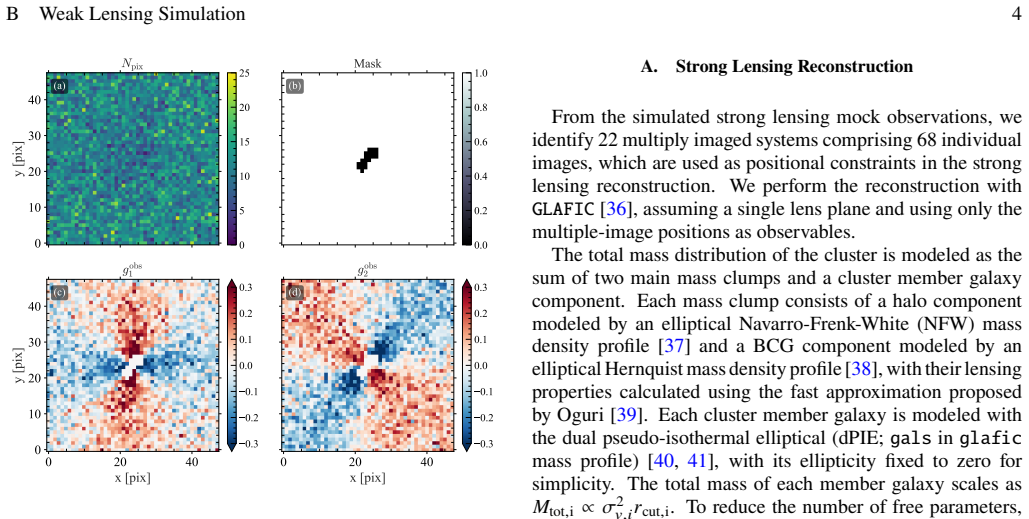
The chosen weak-lensing reconstruction method recovers the true convergence up to one single, spatially uniform mass-sheet factor even after realistic shape noise and masking are included.
What would settle it
On an independent set of simulated clusters (or real clusters with independent mass tracers), measure whether the radial bin of minimal scatter in λ_rec coincides with the bin of equal strong- and weak-lensing RMSE and whether that bin recovers the true global λ to within a few percent.
If this is right
- Observers can locate the SL–WL reliability transition from data alone by plotting the radial scatter of λ_rec, without needing the true mass map.
- The global mass-sheet factor should be constrained using only the radial annulus of minimal λ_rec scatter, yielding the least-biased joint map.
- Joint SL+WL pipelines can weight the two probes radially according to the local behaviour of λ(r) rather than by an arbitrary hand-off radius.
- The same diagnostic can be applied to any pair of reconstruction algorithms to test whether one method introduces spatially varying systematics.
Where Pith is reading between the lines
- The method naturally extends to multi-wavelength mass tracers (X-ray, SZ, stellar dynamics) by replacing one of the two lensing maps with an independent convergence estimate.
- Next-generation surveys with denser background-galaxy samples will shrink the transition zone and therefore tighten the joint λ constraint still further.
- Clusters whose λ(r) profile never shows a clear minimum may flag systems whose mass models are still systematically incomplete.
Editorial analysis
A structured set of objections, weighed in public.
Referee Report
Summary. The paper proposes that the mass-sheet degeneracy itself can diagnose the radial transition in reconstruction reliability between strong lensing (SL) and weak lensing (WL) in galaxy clusters. It defines a spatially resolved effective parameter λ(r) (and its observable counterpart λ_rec(r) ≡ (κ_wl,mes(r)−1)/(κ_sl(r)−1)) and shows, on a MOKA-simulated merging cluster with realistic shape noise, magnification bias, positional errors and a multi-component GLAFIC model (Δ_rms = 0.186″, χ²_ u ≈ 0.95), that the radial profile of λ_rec identifies the zone where SL and WL RMSE become comparable; the tightest constraint on the global mass-sheet factor is obtained precisely in that transition region (abstract; §IV.C, Figs. 5–7). The decomposition in Eq. (26) attributes radial variations in λ_rec to the declining reliability of the SL map while the WL factor supplies only a global offset plus shape-noise scatter.
Significance. If the result holds, the framework supplies a quantitative, observation-driven criterion for where to trust SL versus WL (and where to break the mass-sheet degeneracy most cleanly) without arbitrary radial cuts. This is directly useful for joint mass mapping of clusters with next-generation multi-probe data. Strengths include controlled end-to-end simulations that incorporate realistic observational effects, an explicit decomposition of λ_rec, and cross-checks against true RMSE profiles and corrected κ profiles. The diagnostic is in principle measurable on real data because λ_rec is formed from the two reconstructed maps alone.
major comments (3)
- [§IV.B, Figs. 3–4; Eq. (26); Fig. 6] The central interpretation of λ_rec(r) as a pure relative-reliability indicator rests on the claim that the first factor in Eq. (26), (κ_wl,mes−1)/(κ_true−1), is a spatially uniform global offset λ_P plus shape-noise scatter (so that radial structure in λ_rec is carried entirely by the SL factor). §IV.B and Figs. 3–4 show only the aggregate PDF of this factor over all unmasked pixels in 100–700 kpc h⁻¹; they do not demonstrate that its median (or mode) is radially flat. Given the radially declining n_gal(R) (Eq. 16), the |g|>0.5 mask, and the iterative Fourier nature of A2, a mild residual radial bias in the recovered WL mass-sheet factor remains possible and would shift the apparent location of the λ_rec scatter minimum relative to the true RMSE crossover (Fig. 6). A radial profile of the median of (κ_wl,mes−1)/(κ_true−1) (or an equivalent binned test) is required to close this loop.
- [§III; §IV.C] Only a single merging cluster is analysed. While the authors motivate the choice by enhanced SL cross-section and mass complexity, the location and width of the transition zone identified by λ_rec could depend on mass, concentration, dynamical state or source-redshift distribution. At minimum the paper should state the expected sensitivity or show a second, qualitatively different realisation (e.g., a relaxed NFW halo) so that the reader can judge how general the reported transition radius is.
- [§III.B; §IV.B; Discussion] The free parameters that control the WL data vector (Gaussian smoothing scale θ_sm = 1.5 pixels, reduced-shear mask threshold |g|>0.5, and the functional form of n_gal(R)) are fixed without a systematic variation study. Although a brief check with |g|>0.7 is mentioned in the Discussion, a quantitative demonstration that the identified transition radius (and the recovered λ_P) is stable under reasonable changes in these choices is needed before the method can be applied to real data where the analogous choices are less clear-cut.
minor comments (3)
- [§IV.A; Figs. 1–7] Typographical: “we further access the model” (§IV.A) should be “assess”; several figure panels contain residual OCR artefacts (e.g., “/uni00000…”) that should be cleaned for production.
- [Eqs. (24)–(26); Fig. captions] Notation: the same symbol λ is used for the global mass-sheet factor, the pixel-wise effective parameter, and the peak of the PDF (λ_P). A more distinctive subscripting (e.g., λ_global, λ_eff(r), λ_peak) would reduce ambiguity when reading Eqs. (24)–(26) and the figure captions.
- [§V] The Discussion correctly notes that photometric-redshift uncertainties and other systematics must be treated for real data; a short quantitative estimate of how photo-z scatter would broaden the λ_rec distribution would strengthen the forward-looking claims.
Circularity Check
No significant circularity: λ_rec(r) is an independent diagnostic formed from the two reconstructions and validated against known simulation truth; the sole self-citation supplies the reconstruction engine but is re-checked here.
specific steps
-
self citation load bearing
[§IV.B, paragraph introducing the reconstruction; citation [24]]
"We reconstruct the convergence field using the AKRA-based iterative framework developed in Shi and Cui [24], which employs a prior-free maximum-likelihood estimator to iteratively reconstruct the convergence from the reduced shear. We refer the reader to that work for a full description of the five reconstruction methods (K1, K2, A1, A2, and A3)"
The reconstruction engine and the claim that A2 recovers a spatially uniform mass-sheet factor originate in the authors’ own prior paper. However, the present work re-validates that property on the current mocks (Figs. 3–4) and the central diagnostic λ_rec does not reduce by construction to any fitted quantity of [24]; the step is therefore only a minor, non-load-bearing self-citation.
full rationale
The derivation chain is self-contained. The mass-sheet transformation is the standard global invariance of reduced shear (Eqs. 7–8). The paper defines the pixel-wise effective factors λ(r) = (κ_wl,mes-1)/(κ_true-1) and λ_rec(r) = (κ_wl,mes-1)/(κ_sl-1) (Eqs. 24–25) and decomposes the latter (Eq. 26). All quantitative claims—that the A2 first factor is peaked at a nearly constant λ_P, that the radial scatter minimum of λ_rec coincides with the RMSE crossover, and that the tightest global-λ constraint occurs there—are obtained by direct comparison of the reconstructed maps to the known MOKA truth maps under controlled noise and masking (Figs. 3–7, §IV.B–C). No parameter is fitted to data and then re-presented as a prediction; no uniqueness theorem is imported; the diagnostic itself is measurable on real data without truth. The only self-citation is to the authors’ prior AKRA paper for the iterative reconstruction engine; the key property used here (spatially uniform mass-sheet recovery for A2) is re-demonstrated on the present mocks, so the citation is not load-bearing for the circularity of the central claim. Score 1 reflects that minor self-reference only.
Axiom & Free-Parameter Ledger
free parameters (4)
- Gaussian smoothing scale θ_sm =
1.5 pixels
- Reduced-shear mask threshold =
0.5
- Background galaxy density model n_gal(R) =
n_0=432, R_s=300 kpc
- Image positional uncertainty σ_pos =
0.15 arcsec
axioms (3)
- domain assumption The mass-sheet transformation κ → λκ+(1−λ), γ → λγ leaves the reduced shear invariant (standard lensing identity).
- ad hoc to paper The AKRA A2 iterative reconstructor recovers the true convergence up to a single global mass-sheet factor even with realistic noise and masks.
- domain assumption Flat ΛCDM cosmology with Ω_m=0.3, Ω_Λ=0.7, h=0.7.
invented entities (1)
-
Spatially resolved effective mass-sheet parameter λ(r) / λ_rec(r)
no independent evidence
read the original abstract
We introduce a framework to identify the radial transition in mass reconstruction reliability between strong and weak gravitational lensing in galaxy clusters. In weak lensing reconstruction, the convergence recovered from the reduced shear is subject to the mass-sheet degeneracy. We demonstrate that the degeneracy itself can serve as an indicator of the reconstruction reliability, and introduce a spatially resolved parameter $\lambda(r)$ to characterize this as a function of radius. We validate this approach on simulated clusters with realistic observational noise, and show that $\lambda(r)$ naturally quantifies the relative reliability of the two probes. Furthermore, when the global mass-sheet parameter $\lambda$ is constrained directly using strong lensing information, the tightest constraints arise where the two probes achieve comparable precision. This provides a quantitative basis for joint strong and weak lensing mass reconstruction.
Figures


Reference graph
Works this paper leans on
-
[1]
Cosmological Constraints from Strong Gravitational Lensing in Galaxy Clusters
E. Jullo, P. Natarajan, J. P. Kneib, A. D’ Aloisio, M. Limousin, J. Richard, and C. Schimd, Science329, 924 (2010), 1008.4802
work page internal anchor Pith review Pith/arXiv arXiv 2010
-
[2]
K. Umetsu, A. Zitrin, D. Gruen, J. Merten, M. Donahue, and M. Postman, Astrophys. J.821, 116 (2016), 1507.04385
work page internal anchor Pith review Pith/arXiv arXiv 2016
-
[3]
Cluster Lensing And Supernova survey with Hubble (CLASH): An Overview
M. Postman, D. Coe, N. Ben ´ıtez, L. Bradley, T. Broadhurst, M. Donahue, H. Ford, O. Graur, G. Graves, S. Jouvel, et al., ApJS199, 25 (2012), 1106.3328
work page internal anchor Pith review Pith/arXiv arXiv 2012
-
[4]
N. Martinet, P. Schneider, H. Hildebrandt, H. Shan, M. As- gari, J. P. Dietrich, J. Harnois-D ´eraps, T. Erben, A. Grado, C. Heymans, et al., Mon. Not. R. Astron. Soc.474, 712 (2018), 1709.07678
work page internal anchor Pith review Pith/arXiv arXiv 2018
-
[5]
R. G. Carlberg, H. K. C. Yee, E. Ellingson, R. Abraham, P. Gravel, S. Morris, and C. J. Pritchet, Astrophys. J.462, 32 (1996), astro-ph/9509034
work page internal anchor Pith review Pith/arXiv arXiv 1996
-
[6]
Chandra Cluster Cosmology Project III: Cosmological Parameter Constraints
A. Vikhlinin, A. V. Kravtsov, R. A. Burenin, H. Ebeling, W. R. Forman, A. Hornstrup, C. Jones, S. S. Murray, D. Nagai, H. Quintana, et al., Astrophys. J.692, 1060 (2009), 0812.2720
work page internal anchor Pith review Pith/arXiv arXiv 2009
-
[7]
Planck Collaboration, P. A. R. Ade, N. Aghanim, C. Armitage- Caplan, M. Arnaud, M. Ashdown, F. Atrio-Barandela, J. Au- mont, C. Baccigalupi, A. J. Banday, et al., A&A571, A20 (2014), 1303.5080
work page internal anchor Pith review Pith/arXiv arXiv 2014
-
[8]
T. Mroczkowski, D. Nagai, K. Basu, J. Chluba, J. Sayers, R. Adam, E. Churazov, A. Crites, L. Di Mascolo, D. Eckert, et al., Space Sci. Rev.215, 17 (2019), 1811.02310
work page internal anchor Pith review Pith/arXiv arXiv 2019
-
[9]
P. Schneider and C. Seitz, A&A294, 411 (1995), astro- ph/9407032
-
[10]
M. Brada ˇc, M. Lombardi, and P. Schneider, A&A424, 13 (2004), astro-ph/0405357
work page internal anchor Pith review Pith/arXiv arXiv 2004
- [11]
-
[12]
J. B. Oke, ApJS27, 21 (1974)
work page 1974
- [13]
-
[14]
Meneghetti, Introduction to gravitational lensing, Lecture notes in physics, volume 956 (2021)
M. Meneghetti, Introduction to gravitational lensing, Lecture notes in physics, volume 956 (2021)
work page 2021
-
[15]
MOKA: a new tool for Strong Lensing Studies
C. Giocoli, M. Meneghetti, M. Bartelmann, L. Moscardini, and M. Boldrin, Mon. Not. R. Astron. Soc.421, 3343 (2012), 1109.0285
work page internal anchor Pith review Pith/arXiv arXiv 2012
-
[16]
The Frontier Fields Lens Modeling Comparison Project
M. Meneghetti, P. Natarajan, D. Coe, E. Contini, G. De Lucia, C. Giocoli, A. Acebron, S. Borgani, M. Bradac, J. M. Diego, et al., Mon. Not. R. Astron. Soc.472, 3177 (2017), 1606.04548
work page internal anchor Pith review Pith/arXiv arXiv 2017
-
[17]
L. Wang, C. Li, G. Kauffmann, and G. De Lucia, Mon. Not. R. Astron. Soc.371, 537 (2006), astro-ph/0603546
work page internal anchor Pith review Pith/arXiv arXiv 2006
-
[18]
Cosmology in 2D: the concentration-mass relation for galaxy clusters
C. Giocoli, M. Meneghetti, S. Ettori, and L. Moscardini, Mon. Not. R. Astron. Soc.426, 1558 (2012), 1205.2375
work page internal anchor Pith review Pith/arXiv arXiv 2012
-
[19]
The impact of cluster mergers on arc statistics
E. Torri, M. Meneghetti, M. Bartelmann, L. Moscardini, E. Ra- sia, and G. Tormen, Mon. Not. R. Astron. Soc.349, 476 (2004), astro-ph/0310898
work page internal anchor Pith review Pith/arXiv arXiv 2004
-
[20]
M. Jauzac, J. Richard, E. Jullo, B. Cl ´ement, M. Limousin, J.-P. Kneib, H. Ebeling, P. Natarajan, S. Rodney, H. Atek, et al., Mon. Not. R. Astron. Soc.452, 1437 (2015), 1409.8663
work page internal anchor Pith review Pith/arXiv arXiv 2015
-
[21]
P. Bergamini, C. Grillo, P. Rosati, E. Vanzella, U. Me ˇstri´c, A. Mercurio, A. Acebron, G. B. Caminha, G. Granata, M. Meneghetti, et al., A&A674, A79 (2023), 2208.14020
work page internal anchor Pith review Pith/arXiv arXiv 2023
-
[22]
Frontier Fields: Subaru Weak-Lensing Analysis of the Merging Galaxy Cluster A2744
E. Medezinski, K. Umetsu, N. Okabe, M. Nonino, S. Molnar, R. Massey, R. Dupke, and J. Merten, Astrophys. J.817, 24 (2016), 1507.03992
work page internal anchor Pith review Pith/arXiv arXiv 2016
-
[23]
D. Clowe, M. Markevitch, M. Brada ˇc, A. H. Gonzalez, S. M. Chung, R. Massey, and D. Zaritsky, Astrophys. J.758, 128 (2012), 1209.2143
work page internal anchor Pith review Pith/arXiv arXiv 2012
-
[24]
Nonlinear Weak Lensing reconstruction for Galaxy Clusters
Y. Shi and L. Cui, Phys. Rev. D113, 103514 (2026), 2601.02816
work page internal anchor Pith review Pith/arXiv arXiv 2026
-
[25]
The Star Formation Rate Density and Dust Attenuation Evolution over 12 Gyr with the VVDS Surveys
O. Cucciati, L. Tresse, O. Ilbert, O. Le F `evre, B. Garilli, V. Le Brun, P. Cassata, P. Franzetti, D. Maccagni, M. Scodeggio, et al., A&A539, A31 (2012), 1109.1005
work page internal anchor Pith review Pith/arXiv arXiv 2012
-
[26]
R. J. Bouwens, P. A. Oesch, M. Stefanon, G. Illingworth, I. Labb ´e, N. Reddy, H. Atek, M. Montes, R. Naidu, T. Nanayakkara, et al., AJ162, 47 (2021), 2102.07775
work page internal anchor Pith review Pith/arXiv arXiv 2021
-
[27]
R. Bezanson, I. Labbe, K. E. Whitaker, J. Leja, S. H. Price, M. Franx, G. Brammer, D. Marchesini, A. Zitrin, B. Wang, et al., Astrophys. J.974, 92 (2024), 2212.04026
work page internal anchor Pith review Pith/arXiv arXiv 2024
- [28]
-
[29]
D. R. Harvey and R. Massey, Mon. Not. R. Astron. Soc.529, 802 (2024), 2401.16478
work page internal anchor Pith review Pith/arXiv arXiv 2024
-
[30]
T. J. Broadhurst, A. N. Taylor, and J. A. Peacock, Astrophys. J. 438, 49 (1995), astro-ph/9406052
work page internal anchor Pith review Pith/arXiv arXiv 1995
-
[31]
F. Schmidt, E. Rozo, S. Dodelson, L. Hui, and E. Sheldon, Phys. Rev. Lett.103, 051301 (2009), 0904.4702
work page internal anchor Pith review Pith/arXiv arXiv 2009
-
[32]
S. Cha, B. Y. Cho, H. Joo, W. Lee, K. HyeongHan, Z. P. Scofield, K. Finner, and M. J. Jee, ApJ987, L15 (2025), 2503.21870
work page internal anchor Pith review Pith/arXiv arXiv 2025
-
[33]
M. Bartelmann and P. Schneider, Phys. Rep.340, 291 (2001), astro-ph/9912508
work page internal anchor Pith review Pith/arXiv arXiv 2001
-
[34]
Weak Gravitational Lensing with COSMOS: Galaxy Selection and Shape Measurements
A. Leauthaud, R. Massey, J.-P. Kneib, J. Rhodes, D. E. Johnston, P. Capak, C. Heymans, R. S. Ellis, A. M. Koekemoer, O. Le F`evre, et al., ApJS172, 219 (2007), astro-ph/0702359
work page internal anchor Pith review Pith/arXiv arXiv 2007
- [35]
-
[36]
The Mass Distribution of SDSS J1004+4112 Revisited
M. Oguri, Publ. Astron. Soc. Jpn.62, 1017 (2010), 1005.3103
work page internal anchor Pith review Pith/arXiv arXiv 2010
-
[37]
J. F. Navarro, C. S. Frenk, and S. D. M. White, Astrophys. J. 462, 563 (1996), astro-ph/9508025
work page internal anchor Pith review Pith/arXiv arXiv 1996
- [38]
-
[39]
M. Oguri, PASP133, 074504 (2021), 2106.11464
work page internal anchor Pith review Pith/arXiv arXiv 2021
- [40]
-
[41]
C. R. Keeton, arXiv e-prints astro-ph/0102341 (2001), astro- ph/0102341
work page internal anchor Pith review Pith/arXiv arXiv 2001
-
[42]
The Subversive Role of Excessive External Shear in Concealing Lensing Anomalies
A. Alfred, S. Singh, R. F. Lewis, A. Chow, J. Lim, M. Oguri, J. M. Diego, and T. Broadhurst (2026), 2607.07709
work page internal anchor Pith review Pith/arXiv arXiv 2026
discussion (0)
Sign in with ORCID, Apple, or X to comment. Anyone can read and Pith papers without signing in.