REVIEW 3 major objections 3 minor 4 references
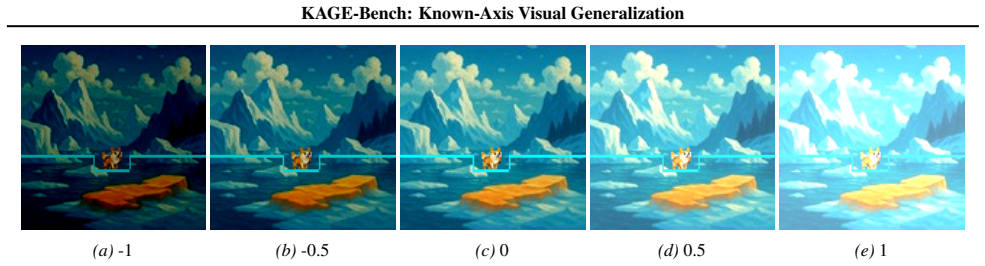
KAGE-Bench shows that visual generalization in RL is strongly axis-dependent, with background and photometric shifts collapsing success while agent-appearance shifts remain mild.
Reviewed by Pith at T0; open to challenge. T0 means a machine referee read the full paper against a public rubric. the ladder, T0–T4 →
2026-08-03 09:14 UTC pith:DJ4JCGTU
KAGE-Bench: Fast Known-Axis Visual Generalization Evaluation for Reinforcement Learning
The pith
A machine-rendered reading of the paper's core claim, the machinery that carries it, and where it could break.
Core claim
The paper's central claim is that visual generalization in reinforcement learning should be studied as a known-axis, controlled variation of the observation kernel, and that doing so reveals strong axis-dependence: some visual changes (backgrounds, filters, lighting) cause catastrophic failure of task completion even when forward motion is preserved, while others (agent sprites) are comparatively benign. The formal anchor is Theorem 4.2: for any reactive pixel policy, executing it in a visual POMDP induces the same state-action law as executing the marginalized state policy in the latent MDP; hence the visual train-eval gap is exactly the performance difference between two induced state poli
What carries the argument
The central object is the induced state policy πξ(a|s) = ∫ π(a|o) Oξ(do|s), which marginalizes the renderer's observation distribution over the policy's action distribution. Theorem 4.2 shows that this single construction carries the whole argument: the state-action process under (Mξ, π) equals in law the process under (M, πξ), so return and any trajectory functional are preserved. This reduces visual generalization to policy shift in a fixed latent MDP and justifies the benchmark's axis-isolated pairing protocol.
Load-bearing premise
The 34 train-eval pairs were deliberately chosen from a pilot sweep to 'exhibit a range of generalization behavior,' so the reported axis ordering depends on which pairs were selected; a different set of pairs along the same axes might yield a different ranking.
What would settle it
Train a PPO-CNN on a random sample of many configurations per axis (rather than the curated 34 pairs) and check whether the success-rate ranking by axis (filters worst, agent mild) changes or reverses; if it changes, the axis-dependence claim is an artifact of pair selection.
If this is right
- Because transition dynamics and rewards are fixed across configurations, any gap in KAGE-Bench is attributable to the changed visual axis; no confound from altered task structure remains.
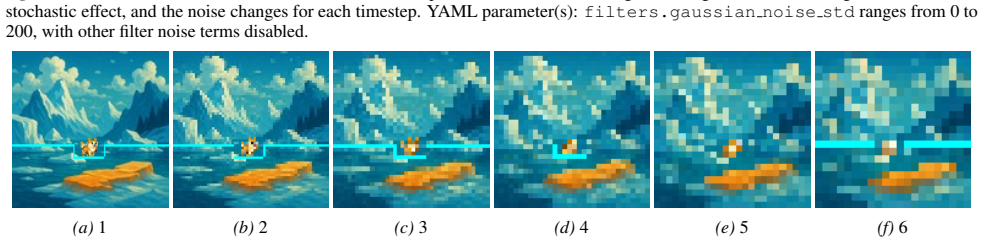
- Filters and effects show large success-rate gaps (87% and 80%) while distance gaps remain moderate, so return alone can hide catastrophic completion failures; joint reporting of distance, progress, and success is necessary.
- Training with more visual diversity along an axis reduces the gap (e.g., 3-image backgrounds generalize better than black backgrounds), suggesting that diversity within an axis is a mitigating factor.
- The induced-policy equivalence means visual generalization can be analyzed as a policy-shift problem in a fixed MDP, enabling standard RL tools to be applied to perception failures.
- The environment's throughput (up to 33M steps/s on one GPU) makes large-scale axis-wise sweeps practical, supporting reproducible hyperparameter and method comparisons.
Where Pith is reading between the lines
- The 34 pairs are curated from a pilot sweep of the same PPO-CNN baseline, so the axis ordering (filters worst, agent mild) is partly a function of pair selection; a random sample of pairs per axis could change the ranking.
- The reduction theorem suggests a diagnostic test: if a policy is augmented with an explicit one-hot visual-axis indicator, its induced state policy should become independent of the axis; measuring the gap after such augmentation could directly test whether representations are axis-invariant.
- The same factorization could be applied to 3D or manipulation environments, but 'known-axis' isolation is harder to guarantee when rendering pipelines involve lighting, materials, and geometry simultaneously.
- The preserved-motion-but-collapsed-completion pattern implies that reward shaping that gives small forward-progress bonuses can mask perception failures; in deployment, separate success metrics may be more reliable signals.
Editorial analysis
A structured set of objections, weighed in public.
Referee Report
Summary. The paper introduces KAGE-Env, a JAX-native 2D platformer with 93 controllable rendering parameters, and KAGE-Bench, a benchmark of 34 train/evaluation configuration pairs grouped into six visual axes (agent appearance, background, distractors, effects, filters, layout). The central formal claim (Theorem 4.2, Appendix A) is that, because transitions P and rewards r are held fixed across visual configurations ξ, any change in expected return or trajectory-level metrics under a visual shift is exactly the difference between the induced state policies πξ and πξ′ in the same latent MDP. Using a PPO-CNN baseline, the authors report a strong axis-dependent ordering of success-rate gaps (filters 86.8%, effects 80.5%, layout 62.8%, background 53.3%, distractors 30.9%, agent 21.1%) and argue that several photometric/lighting shifts preserve forward motion while breaking task completion. The environment reaches up to 33M steps/second on a single GPU, and code is provided.
Significance. If the empirical claims withstand scrutiny, KAGE-Bench would be a useful diagnostic tool for visual generalization in RL: the environment is fast, fully vectorized, and open-source, and the explicit factorization of rendering axes with fixed latent dynamics/rewards is a principled design. The formal reduction in Theorem 4.2 is correct under the stated measurability assumptions; it is, however, an elementary marginalization identity rather than a substantive empirical result. The paper's main contribution is therefore the benchmark infrastructure and the empirical axis-difficulty ranking. That ranking is currently the weakest part of the paper: the pairs were curated from a pilot sweep of the same PPO-CNN baseline, and perturbation magnitudes are not matched across axes, so the observed ordering is partly an artifact of configuration selection rather than a robust property of visual axes. With a revised, pre-registered or magnitude-matched construction, this could become a valuable community benchmark.
major comments (3)
- [Section 6, Benchmark construction] The 34 train/evaluation pairs are curated from a pilot sweep using the same PPO-CNN baseline 'to exhibit a range of generalization behavior, including both severe and mild gaps.' This makes the axis-level ranking in Table 1 a property of the selected pairs, not an independent discovery about the visual axes. For example, the agent-appearance pairs are predominantly mild (teal→pink, circle→line, skelet→clown), while the filters pairs include brightness=1, contrast=128, hue_shift=180, and saturation=0. The central claim that 'agent-appearance shifts are comparatively benign' is therefore not established by the data. To support the cross-axis comparison, the authors must either sample pairs per axis without using the baseline's eval performance as a selection criterion, or explicitly reframe the results as characteristics of a curated suite rather than of axes per se. This issue is load-bea
- [Table 2 and Section 7] There is no common metric for 'amount of visual change' across axes. The Filters suite uses extreme parameter values (e.g., hue_shift=180, contrast=128, saturation=0) and Effects uses point_light_count=4, while Agent pairs use small local color/shape changes. The differing gaps could reflect perturbation magnitude rather than axis identity. A concrete test would be to add multiple intensity levels per axis (as done in Figure 6 for backgrounds and distractors) and compare axes at matched pixel-space or perceptual distances; without this, the cross-axis ordering (Table 1) is confounded. The paper should either provide such matched comparisons or restrict its conclusions to within-axis dose-response effects.
- [Section 6, Evaluation protocol; Tables 1 and 3] The maximum-over-training statistic for all metrics is nonstandard and can overstate achievable performance: taking the maximum over checkpoints separately for train and eval means the reported gap is between two upper envelopes, not between final or fixed-checkpoint policies. The paper should justify this choice with a sensitivity analysis (e.g., comparing final-checkpoint, best-on-train, and best-on-eval results). Additionally, Table 1 reports 'mean±SEM' across configurations, but the Layout axis has N=1, so its SEM is 0.0 and masks the substantial seed variance visible in Table 3 (Layout SR 0.86±0.10). The generalization-gap columns in Tables 1 and 2 have no error bars, making cross-axis comparisons underpowered; per-configuration bootstrap or per-seed gap distributions should be reported.
minor comments (3)
- [Table 2 and Appendix D] Typographical inconsistencies: 'vinegrette' should be 'vignette' (Filters row 8), 'fallof' should be 'falloff' (Effects row 2). Also, the paper says '34 train-evaluation configuration pairs'; the count is correct, but the Layout suite contains only one pair, which should be explicitly flagged when discussing axis-level summaries.
- [Section 4 and Appendix A] The proof of Theorem 4.2 is correct but somewhat repetitive (steps 1d and 1e repeat the same argument). Consider condensing. Also, the statement in Section 4 that 'any performance difference can be attributed to changes in the observation process' is a direct consequence of fixing P and r; it would be clearer to state this as a design guarantee rather than a discovery.
- [Figure 6] The x-axis label 'Step 1e7' is ambiguous; the total training budget is 2.5e7 steps, and the figure appears to show 1.0e7 on the axis. Please make the axis units explicit.
Circularity Check
Axis-difficulty ranking is partially constructed by the benchmark's own pair-selection procedure.
specific steps
-
fitted input called prediction
[Section 6, Benchmark construction; Section 7, Results; Table 1]
"We first conduct a pilot sweep over KAGE-Env’s rendering parameters using a standard PPO-CNN... Based on these results, we curate 34 train–evaluation configuration pairs that exhibit a range of generalization behavior, including both severe and mild gaps."
The headline empirical finding—'Generalization is strongly axis-dependent' with the ranking filters (86.8%) > effects (80.5%) > layout (62.8%) > background (53.3%) > distractors (30.9%) > agent (21.1%)—is computed on pairs that were explicitly curated from a pilot sweep of the same PPO-CNN baseline to exhibit a range of gaps. The observed range and axis ordering are therefore partly inputs to the benchmark construction rather than independent outputs. Moreover, the selected perturbations are not magnitude-matched across axes (e.g., filters use hue_shift=180, saturation=0, contrast=128, while agent pairs use mild color/sprite changes), so the axis ranking conflates axis identity with perturbation intensity. The conclusion that agent-appearance shifts are 'comparatively benign' is thus force
full rationale
The formal core of the paper—Theorem 4.2 and its appendix proof—is a self-contained marginalization identity: for a fixed reactive pixel policy, the visual POMDP and the induced state policy generate the same latent state–action law. This is not circular; it is a mathematical equivalence proven from the stated definitions, and it does not rely on self-citation or on any fitted value. The throughput results are also independent external measurements. The circularity concern is limited to the empirical axis-difficulty claims. Section 6 states that the 34 train–eval pairs were curated 'based on' a pilot sweep using the same PPO-CNN baseline 'to exhibit a range of generalization behavior.' The paper then presents the resulting spread of gaps as evidence of strong axis-dependence and ranks the axes. Because the benchmark was deliberately constructed to include both severe and mild gaps, the existence of a wide range of gaps is guaranteed by selection rather than discovered. The specific ranking is further confounded by unmatched perturbation magnitudes across axes. This makes the empirical diagnostic partially circular, but the formal reduction and the environment infrastructure remain independent contributions, so the overall circularity score is moderate.
Axiom & Free-Parameter Ledger
free parameters (4)
- reward coefficients α1..α4 (forward_reward_scale=0.2, jump_penalty=10, timestep_penalty=0.1, idle_penalty=5) =
0.2, 10.0, 0.1, 5.0
- success threshold D (dist_to_success) =
490.0
- episode length T =
500
- visual shift intensities for eval pairs (e.g., brightness=1, contrast=128, hue_shift=180, pixelate=3) =
various
axioms (4)
- standard math Tower property and measurability of kernels (Weiss et al., standard probability)
- domain assumption P and r are invariant across visual configurations ξ
- domain assumption Policies are reactive (memoryless): π(a|o), no recurrent state
- domain assumption Each visual axis is independently controllable in the renderer
Cite this review
Pith. "Pith review of KAGE-Bench: Fast Known-Axis Visual Generalization Evaluation for Reinforcement Learning." pith.science (2026). https://pith.science/paper/DJ4JCGTU
@misc{pith2026260114232,
  author       = {Pith},
  title        = {Pith review of: KAGE-Bench: Fast Known-Axis Visual Generalization Evaluation for Reinforcement Learning},
  year         = {2026},
  howpublished = {\url{https://pith.science/paper/DJ4JCGTU}},
  note         = {Machine review of arXiv:2601.14232}
}
read the original abstract
Pixel-based reinforcement learning agents often fail under purely visual distribution shift even when latent dynamics and rewards are unchanged, but existing benchmarks entangle multiple sources of shift and hinder systematic analysis. We introduce KAGE-Env, a JAX-native 2D platformer that factorizes the observation process into independently controllable visual axes while keeping the underlying control problem fixed. By construction, varying a visual axis affects performance only through the induced state-conditional action distribution of a pixel policy, providing a clean abstraction for visual generalization. Building on this environment, we define KAGE-Bench, a benchmark of six known-axis suites comprising 34 train-evaluation configuration pairs that isolate individual visual shifts. Using a standard PPO-CNN baseline, we observe strong axis-dependent failures, with background and photometric shifts often collapsing success, while agent-appearance shifts are comparatively benign. Several shifts preserve forward motion while breaking task completion, showing that return alone can obscure generalization failures. Finally, the fully vectorized JAX implementation enables up to 33M environment steps per second on a single GPU, enabling fast and reproducible sweeps over visual factors. Code: https://avanturist322.github.io/KAGEBench/.
Figures






Reference graph
Works this paper leans on
-
[1]
(Conditional action law.) For every timet≥0and every measurable action setB∈ A, PMξ,π(at ∈B|s t) =π ξ(B|s t)a.s.(12) That is, after conditioning on the latent state, the intermediate observation variable can be integrated out and the resulting action distribution is exactlyπ ξ(· |st)
-
[2]
(Equality in law of state–action processes.) The state–action process (st, at)t≥0 induced by executing π in Mξ has the same law as the state–action process induced by executingπ ξ in the latent MDPM
-
[3]
averaging over renderings
(Return equivalence.) Consequently, the expected discounted return is preserved: J(π;M ξ) =J(π ξ;M), J(π;M ξ) :=E Mξ,π h ∞X t=0 γtr(st, at) i .(13) A.4. Proof of Theorem A.4 Step 0 (Generative dynamics in Mξ).By definition of the POMDP Mξ (Definition A.3) and the reactive policy π, the interaction at timetis: ot ∼O ξ(· |st) at ∼π(· |ot) st+1 ∼P(· ...
2005
-
[1289]
Cobbe, K., Hesse, C., Hilton, J., and Schulman, J
PMLR, 2019. Cobbe, K., Hesse, C., Hilton, J., and Schulman, J. Lever- aging procedural generation to benchmark reinforcement learning. InInternational conference on machine learn- ing, pp. 2048–2056. PMLR, 2020. Cobbe, K. W., Hilton, J., Klimov, O., and Schulman, J. Phasic policy gradient. InInternational Conference on Machine Learning, pp. 2020–2027. PML...
Pith/arXiv arXiv 2019
This paper was first reviewed by deepseek-v4-flash on August 3, 2026.
discussion (0)
Sign in with ORCID, Apple, or X to comment. Anyone can read and Pith papers without signing in.