REVIEW 4 major objections 6 minor 74 references
Proteus claims a learned LiDAR codec whose significant range bit-planes form a self-contained block and whose insignificant bit-planes can be truncated in transit, so geometry degrades deterministically and the stream stays decodable up to
Reviewed by Pith at T0; open to challenge. T0 means a machine referee read the full paper against a public rubric. the ladder, T0–T4 →
T0 review · deepseek-v4-flash
2026-08-05 00:31 UTC pith:DYINR6OY
load-bearing objection Proteus is a genuinely new way to make learned LiDAR range-image codecs truncation-robust, but the paper's central claim outruns its evidence in a few specific, fixable places. the 4 major comments →
Proteus: A Truncation-Robust Entropy Model for Progressive LiDAR Compression
The pith
A machine-rendered reading of the paper's core claim, the machinery that carries it, and where it could break.
Core claim
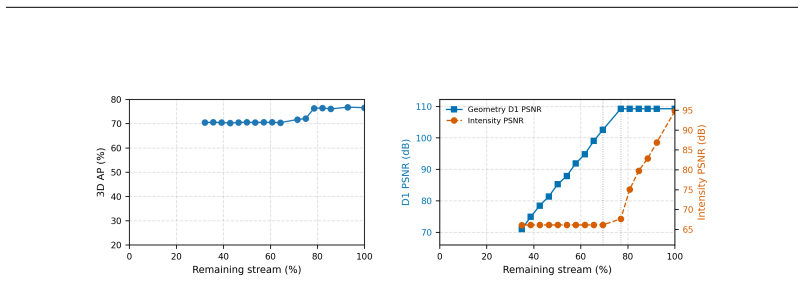
Proteus's central claim is that truncation robustness and high-efficiency learned entropy coding can be made compatible by decoupling the bitstream. The significant range bit-planes (SIG), roughly 30% of the bitstream, are encoded with a bits-back coder whose initial bits are generated internally by an autoregressive split, so the block is self-contained and cannot be truncated. The insignificant range bit-planes and attributes (INS) are encoded with a FIFO range coder in bit-plane order, geometry before attributes. Truncating N low range planes reconstructs the range image as the significant planes shifted by N bits, i.e. precision Delta_N = 2^N Delta_0; attributes, when truncated, are reco
What carries the argument
The key machinery is the SIG/INS stream decoupling. SIG is a self-contained bits-back coder for the s most significant range bit-planes, using the Autoregressive Initial Bits mechanism so the mid sub-block supplies the initial bits; INS is a FIFO range coder for the remaining range tail planes and attribute bit-planes, serialized geometry-first. This split turns truncation into bit-plane slicing: any dropped INS suffix corresponds to zero-padding the range at a known precision, and the decoded geometry then serves as a structural prior for lossless-predictive attribute reconstruction.
Load-bearing premise
The claim assumes every truncation of the INS stream cuts on a whole bit-plane boundary, or that the decoder can tell from the prefix which planes are complete; a cut through a plane breaks the formula Delta_N = 2^N Delta_0.
What would settle it
Take a trained Proteus model and truncate the INS stream mid-way through a range bit-plane rather than at a plane boundary. If the decoder fails, decodes that plane incorrectly, or produces a precision that does not match Delta_N = 2^N Delta_0 for any integer N, then the claim that any INS suffix can be dropped is falsified.
If this is right
- A receiver can drop any suffix of the INS stream on the fly, so no rate renegotiation or retransmission is needed, removing a latency loop in V2X and swarm links.
- Geometry quality under truncation is predictable from the truncation point alone: each dropped range bit-plane doubles the range quantization step, so safety bounds can be computed before decoding.
- Attributes degrade before geometry under bandwidth dips, so downstream detectors that rely on object shape keep most of their performance while intensity quality drops first.
- The per-frame, self-contained SIG block means a lost frame does not corrupt subsequent frames, unlike inter-frame LiDAR codecs.
- Under ideal channels the decoupled design costs only a small rate overhead relative to coupled ArIB-BPS (about 6.56% in the paper's ablation), so truncation robustness does not require abandoning learned compression gains.
Where Pith is reading between the lines
- The deterministic precision mapping assumes truncation lands on whole bit-plane boundaries. If a transmission cuts inside a plane, the decoder would need explicit per-plane framing or length markers to know which bits are complete; the paper does not specify such framing, so arbitrary byte-level truncation may need an alignment layer.
- The same decoupling idea could extend to any sensor modality whose values are quantized physical measurements with subordinate attributes, such as depth cameras or radar range images; the bit-plane-to-precision mapping is what makes the degradation verifiable.
- Because attributes are predicted from decoded geometry, geometry errors at high truncation will propagate into attribute estimates; per-plane error analysis would make this coupling explicit.
- Intra-frame-only coding buys packet-loss resistance at the cost of leaving temporal redundancy on the table; combining this stream structure with inter-frame prediction at the sequence level is a natural next step, though it would re-introduce reference-frame dependencies.
Editorial analysis
A structured set of objections, weighed in public.
Referee Report
Summary. The paper proposes Proteus, a learned LiDAR range-image codec that splits the bitstream into a significant (SIG) block, coded with a bits-back/ANS scheme, and an insignificant (INS) block, coded with a FIFO range coder. The central claims are: under ideal channels, Proteus achieves state-of-the-art BD-Rate results relative to G-PCC, Draco, JPEG XL, and Unicorn; under truncation, the INS stream can be progressively dropped so that geometry degrades deterministically as Δ_N = 2^N Δ_0, attributes are reconstructed via a lossless prefix plus a learned remainder, and the codec tolerates up to about 70% overall truncation because SIG occupies roughly 30% of the bitstream.
Significance. The problem is relevant to V2X and collaborative perception, where truncation robustness matters. The design principle—preserving physically measured range rather than statistically hallucinating missing geometry—is a useful and potentially safety-relevant contribution. The proposed bit-plane slicing with FIFO coding is a natural extension of ArIB-BPS, and the reported BD-Rate gains and runtimes are promising. The ablation studies are also informative. However, the manuscript contains a central inconsistency about which stream initializes the ANS stack, and it does not specify how partial-bit-plane truncations are handled, so the main robustness claim is not yet established. If these issues are resolved, the paper could be a solid contribution.
major comments (4)
- [§4.2 vs. Appendix B.3] There is a direct contradiction about what provides the initial bits for bits-back decoding. §4.2 states that the mid sub-block supplies the initial bits internally and that 'SIG requires no padding and does not depend on INS.' Appendix B.3, however, states that 'Proteus utilizes the Insignificant Planes (INS) stream as the initial ANS stack state' and Step 1 of the compression pipeline initializes the ANS coder from the encoded INS planes. If the Appendix is correct, truncating INS destroys the ANS state needed to decode SIG, invalidating the 70% truncation tolerance. If §4.2 is correct, the Appendix must be corrected. This is load-bearing and must be reconciled.
- [§4.3, Eq. (7), properties (i)–(iv)] The deterministic precision-degradation claim is only true when truncation of the INS stream ends exactly at a bit-plane boundary. The paper does not specify per-plane termination symbols, length headers, or a decoder rule for detecting and discarding a partially received plane. A range/ANS coder cut inside a plane can decode an incorrect last symbol or a corrupted plane; zero-padding a partial plane is not equivalent to zeroing the whole plane. The truncation sweep in §5.2/Fig. 3 is described as a ratio sweep, which does not imply boundary alignment. Consequently, the statements 'any INS suffix can be dropped' and 'progressive decoding from any stream prefix' are asserted rather than established. The authors should either add per-plane framing/CRCs or restrict the definition of valid truncations to whole planes and test accordingly.
- [§5.1, Fig. 2] The hyperparameters h and s are selected on the same datasets (SemanticKITTI and WOD) that are later used to report BD-Rate and downstream AP. The text says h is set from the inflection points in Fig. 2(a,b) and s is set from the PointPillars evaluation in Fig. 2(c), with no mention of a separate validation split. Selecting hyperparameters on the evaluation data can inflate the reported compression and perception numbers. Please provide a validation/test split or otherwise demonstrate that the reported gains are not an artifact of evaluation-set tuning.
- [Table 1(b), Abstract] Unicorn is reported as '—' on WOD, yet the abstract and contributions state that Proteus outperforms Unicorn. This claim is only supported on SemanticKITTI. Either run the Unicorn baseline on WOD or qualify the claim to the SemanticKITTI configuration. As written, the abstract overstates the evidence.
minor comments (6)
- [§4.3, Eq. (7)] The notation mixes Δ_N/Δ_0 for range precision and δ_{k_a} for attribute cell width. Consider using a consistent symbol family or explicitly distinguishing the two.
- [§5.2] The statement 'SIG accounts for roughly 30% of the bitstream' is presented without a supporting measurement. Please report the actual SIG/INS size ratios per dataset and configuration, since the 'up to 70% truncation' figure depends directly on this ratio.
- [§4.3, property (ii)] The term 'No geometric hallucination' is strong. If partial-plane truncation is permitted, the decoder may produce an incorrect last symbol for a partially received plane, so the property should be rephrased or the valid truncation domain restricted.
- [§4.1] The three-part split (head, mid, tail) is introduced before the reader has seen the notation for x_{1:s}, x_{h+1:s}, etc. A brief example or a pointer to Section 3.3 would improve readability.
- [Fig. 2 caption] The phrase 'BPD savings achieved using latent variables used to determine h' is awkward. Consider 'BPD savings from using latent variables, used to select h'.
- [Appendix C] The analysis of WOD vs. SemanticKITTI intensity distributions is useful but not referenced in the main text. Cite it when discussing the large BD-Rate gap for intensity on WOD.
Circularity Check
No significant circularity: Eq. 7 and the 70% decodability bound are construction-level arithmetic, and load-bearing prior work is externally cited.
full rationale
The paper's central truncation-robustness claim is a construction property, not a fitted prediction. The deterministic precision degradation Δ_N = 2^N·Δ_0 (Eq. 7) is the definition of zero-padding the N least-significant bit-planes of a fixed-point range value; it is not an output of the learned model and does not depend on any fitted parameter. The 'up to approximately 70% truncation' claim is likewise arithmetic: since SIG is intentionally non-truncatable and accounts for about 30% of the stream, the decodable prefix bound is 100% − 30% = 70%. The split index s = 10 that controls this ratio is selected a priori from a perception sweep (Fig. 2c), so the bound is a design consequence rather than an empirical discovery being passed off as independent, and it is not circular. The only learned reconstruction component, the attribute prediction head h_θ (Eq. 8), is trained on sampled truncation states (Eq. 10) and evaluated on the progressive sweep; this is standard supervised generalization, not a prediction that reduces to its training input. The load-bearing methodological citations—bits-back coding, SHVC/ArIB, and ArIB-BPS—are to external prior work (Townsend, Ryder, Zhang), not to the present authors. The few self-citations (e.g., Gao et al. survey, Song et al., Fu et al.) appear only in background/related work and are not load-bearing for the truncation argument. A real gap exists regarding arbitrary truncation inside an INS bit-plane without framing, but that is a correctness/framing limitation, not a circular derivation. Therefore no circular step is present.
Axiom & Free-Parameter Ledger
free parameters (2)
- head depth h =
7 for SemanticKITTI, 6 for WOD
- split index s =
10 for both datasets
axioms (5)
- domain assumption A1: Bit-plane physical meaning: truncating N least significant bits of a range value halves precision N times.
- domain assumption A2: Attributes are subordinate to range in downstream perception.
- domain assumption A3: High range bit-planes predict both low range bit-planes and attribute channels.
- ad hoc to paper The mid sub-block in SIG always supplies enough initial bits for the bits-back decode of z, requiring no external padding.
- domain assumption Beam emission angles theta and phi are known a priori at the receiver.
Cite this review
Pith. "Pith review of Proteus: A Truncation-Robust Entropy Model for Progressive LiDAR Compression." pith.science (2026). https://pith.science/paper/DYINR6OY
@misc{pith2026260800687,
  author       = {Pith},
  title        = {Pith review of: Proteus: A Truncation-Robust Entropy Model for Progressive LiDAR Compression},
  year         = {2026},
  howpublished = {\url{https://pith.science/paper/DYINR6OY}},
  note         = {Machine review of arXiv:2608.00687}
}
read the original abstract
LiDAR point clouds provide explicit, deterministic physical boundaries critical for collaborative safety-critical perception. However, wireless channels inherently impair and corrupt transmitted signals. Existing robust frameworks (such as deep JSCC or MDC) attempt to counter these channel impairments through statistical or parametric estimation, turning exact physical measurements into unverified algorithmic estimates. To address this, we propose Proteus, a learned LiDAR codec operating on 2D range images. By decoupling the frame representation into independent coders for the \textbf{sig}nificant range bit-planes (SIG) and the \textbf{ins}ignificant range bit-planes and attributes (INS), Proteus achieves overall stream-level truncation robustness. The non-truncatable SIG block encodes the most significant range bit-planes to establish a necessary, self-contained perceptual lower bound, below which the reconstructed point cloud is severely degraded. Meanwhile, INS employs bit-plane slicing representation and coding, ensuring that range truncation mathematically maps to a deterministic spatial precision degradation. Subordinate attributes are reconstructed via a hybrid lossless-predictive method, leveraging the decoded geometry as a strong structural prior for fine-grained approximation. Furthermore, strategic ordering within INS prioritizes geometry over attributes under bandwidth drops. Experimental results on the Waymo Open Dataset and SemanticKITTI demonstrate that Proteus tolerates up to approximately 70\% bitstream truncation, while outperforming established standards (G-PCC, Draco, and JPEG XL) and the representative learned compressor Unicorn under ideal channel conditions.
Figures




Reference graph
Works this paper leans on
-
[1]
Martini and Yuriy Reznik , title =
Nabajeet Barman and Maria G. Martini and Yuriy Reznik , title =. 2024 , howpublished =. 2401.04039 , archivePrefix =
Pith/arXiv arXiv 2024
-
[2]
Jens Behley and Martin Garbade and Andres Milioto and Jan Quenzel and Sven Behnke and Cyrill Stachniss and Juergen Gall , title =. 2019 , booktitle =. 1904.01416 , archivePrefix =
Pith/arXiv arXiv 2019
-
[3]
MuSCLE: Multi Sweep Compression of LiDAR using Deep Entropy Models
Sourav Biswas and Jerry Liu and Kelvin Wong and Shenlong Wang and Raquel Urtasun , title =. 2020 , booktitle =. 2011.07590 , archivePrefix =
work page internal anchor Pith review Pith/arXiv arXiv 2020
-
[4]
Eirina Bourtsoulatze and David Burth Kurka and Deniz Gündüz , title =. 2019 , journal =. 1809.01733 , archivePrefix =
Pith/arXiv arXiv 2019
-
[5]
Anthony Chen and Shiwen Mao and Zhu Li and Minrui Xu and Hongliang Zhang and Dusit Niyato and Zhu Han , title =. 2024 , booktitle =
work page 2024
-
[6]
GRACE: Loss-Resilient Real-Time Video through Neural Codecs
Yihua Cheng and Ziyi Zhang and Hanchen Li and Anton Arapin and Yue Zhang and Qizheng Zhang and Yuhan Liu and Kuntai Du and Xu Zhang and Francis Y. Yan and Amrita Mazumdar and Nick Feamster and Junchen Jiang , title =. 2024 , booktitle =. 2305.12333 , archivePrefix =
work page internal anchor Pith review Pith/arXiv arXiv 2024
-
[7]
Tiago Cortinhal and George Tzelepis and Eren Erdal Aksoy , title =. 2020 , booktitle =. 2003.03653 , archivePrefix =
Pith/arXiv arXiv 2020
-
[8]
Jarek Duda , title =. 2013 , howpublished =. 1311.2540 , archivePrefix =
Pith/arXiv arXiv 2013
-
[9]
Abbas A. El Gamal and Thomas M. Cover , title =. 1982 , journal =
work page 1982
-
[10]
Ecenaz Erdemir and Tze-Yang Tung and Pier Luigi Dragotti and Deniz Gündüz , title =. 2023 , journal =. 2211.13772 , archivePrefix =
Pith/arXiv arXiv 2023
-
[11]
D-DPCC: Deep Dynamic Point Cloud Compression via 3D Motion Prediction
Tingyu Fan and Linyao Gao and Yiling Xu and Zhu Li and Dong Wang , title =. 2022 , booktitle =. 2205.01135 , archivePrefix =
work page internal anchor Pith review Pith/arXiv arXiv 2022
-
[12]
Global Sensing and Measurements Reuse for Image Compressed Sensing
Zi-En Fan and Feng Lian and Jia-Ni Quan , title =. 2022 , booktitle =. 2206.11629 , archivePrefix =
work page internal anchor Pith review Pith/arXiv arXiv 2022
-
[13]
3DAC: Learning Attribute Compression for Point Clouds
Guangchi Fang and Qingyong Hu and Hanyun Wang and Yiling Xu and Yulan Guo , title =. 2022 , booktitle =. 2203.09931 , archivePrefix =
work page internal anchor Pith review Pith/arXiv arXiv 2022
-
[14]
Real-Time Spatio-Temporal LiDAR Point Cloud Compression
Yu Feng and Shaoshan Liu and Yuhao Zhu , title =. 2020 , booktitle =. 2008.06972 , archivePrefix =
work page internal anchor Pith review Pith/arXiv arXiv 2020
-
[15]
OctAttention: Octree-Based Large-Scale Contexts Model for Point Cloud Compression
Chunyang Fu and Ge Li and Rui Song and Wei Gao and Shan Liu , title =. 2022 , journal =. 2202.06028 , archivePrefix =
work page internal anchor Pith review Pith/arXiv arXiv 2022
-
[16]
Wei Gao and Liang Xie and Songlin Fan and Ge Li and Shan Liu and Wen Gao , title =. 2025 , journal =
work page 2025
-
[17]
2023 , howpublished =
2023
-
[18]
D. Graziosi and O. Nakagami and S. Kuma and A. Zaghetto and T. Suzuki and A. Tabatabai , title =. 2020 , journal =
work page 2020
-
[19]
Yulan Guo and Hanyun Wang and Qingyong Hu and Hao Liu and Li Liu and Mohammed Bennamoun , title =. 2021 , journal =. 1912.12033 , archivePrefix =
Pith/arXiv arXiv 2021
-
[20]
Density-preserving Deep Point Cloud Compression
Yun He and Xinlin Ren and Danhang Tang and Yinda Zhang and Xiangyang Xue and Yanwei Fu , title =. 2022 , booktitle =. 2204.12684 , archivePrefix =
work page internal anchor Pith review Pith/arXiv arXiv 2022
-
[21]
Compression with Flows via Local Bits-Back Coding
Jonathan Ho and Evan Lohn and Pieter Abbeel , title =. 2019 , booktitle =. 1905.08500 , archivePrefix =
work page internal anchor Pith review Pith/arXiv arXiv 2019
-
[22]
Yue Hu and Shaoheng Fang and Zixing Lei and Yiqi Zhong and Siheng Chen , title =. 2022 , booktitle =. 2209.12836 , archivePrefix =
Pith/arXiv arXiv 2022
-
[23]
OctSqueeze: Octree-Structured Entropy Model for LiDAR Compression
Lila Huang and Shenlong Wang and Kelvin Wong and Jerry Liu and Raquel Urtasun , title =. 2020 , booktitle =. 2005.07178 , archivePrefix =
work page internal anchor Pith review Pith/arXiv arXiv 2020
-
[24]
Tzu-Kuan Hung and I-Chun Huang and Samuel Rhys Cox and Wei Tsang Ooi and Cheng-Hsin Hsu , title =. 2022 , booktitle =
work page 2022
- [25]
-
[26]
Context-Based Trit-Plane Coding for Progressive Image Compression
Seungmin Jeon and Kwang Pyo Choi and Youngo Park and Chang-Su Kim , title =. 2023 , booktitle =. 2303.05715 , archivePrefix =
work page internal anchor Pith review Pith/arXiv arXiv 2023
-
[27]
Diederik P. Kingma and Jimmy Ba , title =. 2015 , booktitle =. 1412.6980 , archivePrefix =
Pith/arXiv arXiv 2015
-
[28]
Bit-Swap: Recursive Bits-Back Coding for Lossless Compression with Hierarchical Latent Variables
Friso Kingma and Pieter Abbeel and Jonathan Ho , title =. 2019 , booktitle =. 1905.06845 , archivePrefix =
work page internal anchor Pith review Pith/arXiv arXiv 2019
-
[29]
Lang and Sourabh Vora and Holger Caesar and Lubing Zhou and Jiong Yang and Oscar Beijbom , title =
Alex H. Lang and Sourabh Vora and Holger Caesar and Lubing Zhou and Jiong Yang and Oscar Beijbom , title =. 2019 , booktitle =. 1812.05784 , archivePrefix =
Pith/arXiv arXiv 2019
-
[30]
Jooyoung Lee and Seunghyun Cho and Seung-Kwon Beack , title =. 2019 , booktitle =. 1809.10452 , archivePrefix =
Pith/arXiv arXiv 2019
-
[31]
DPICT: Deep Progressive Image Compression Using Trit-Planes
Jae-Han Lee and Seungmin Jeon and Kwang Pyo Choi and Youngo Park and Chang-Su Kim , title =. 2022 , booktitle =. 2112.06334 , archivePrefix =
work page internal anchor Pith review Pith/arXiv arXiv 2022
-
[32]
Latency-Aware Collaborative Perception
Zixing Lei and Shunli Ren and Yue Hu and Wenjun Zhang and Siheng Chen , title =. 2022 , booktitle =. 2207.08560 , archivePrefix =
work page internal anchor Pith review Pith/arXiv arXiv 2022
-
[33]
PU-GAN: a Point Cloud Upsampling Adversarial Network
Ruihui Li and Xianzhi Li and Chi-Wing Fu and Daniel Cohen-Or and Pheng-Ann Heng , title =. 2019 , booktitle =. 1907.10844 , archivePrefix =
work page internal anchor Pith review Pith/arXiv arXiv 2019
-
[34]
Efficient and Effective Context-Based Convolutional Entropy Modeling for Image Compression
Mu Li and Kede Ma and Jane You and David Zhang and Wangmeng Zuo , title =. 2020 , journal =. 1906.10057 , archivePrefix =
work page internal anchor Pith review Pith/arXiv arXiv 2020
-
[35]
Learning for Vehicle-to-Vehicle Cooperative Perception under Lossy Communication
Jinlong Li and Runsheng Xu and Xinyu Liu and Jin Ma and Zicheng Chi and Jiaqi Ma and Hongkai Yu , title =. 2023 , journal =. 2212.08273 , archivePrefix =
work page internal anchor Pith review Pith/arXiv arXiv 2023
-
[36]
Improving Adaptive Real-Time Video Communication Via Cross-layer Optimization
Yueheng Li and Hao Chen and Bowei Xu and Zicheng Zhang and Zhan Ma , title =. 2024 , journal =. 2304.03505 , archivePrefix =
work page internal anchor Pith review Pith/arXiv arXiv 2024
- [37]
-
[38]
BIRD-PCC: Bi-directional Range Image-based Deep LiDAR Point Cloud Compression
Chia-Sheng Liu and Jia-Fong Yeh and Hao Hsu and Hung-Ting Su and Ming-Sui Lee and Winston H. Hsu , title =. 2023 , booktitle =. 2303.04027 , archivePrefix =
work page internal anchor Pith review Pith/arXiv arXiv 2023
-
[39]
Bojun Liu and Yangzhi Ma and Li Li and Dong Liu and Zhu Li and Houqiang Li , title =. 2026 , journal =
work page 2026
-
[40]
Progressive Neural Image Compression with Nested Quantization and Latent Ordering
Yadong Lu and Yinhao Zhu and Yang Yang and Amir Said and Taco S. Cohen , title =. 2021 , booktitle =. 2102.02913 , archivePrefix =
work page internal anchor Pith review Pith/arXiv arXiv 2021
-
[41]
Don't Blame the ELBO! A Linear VAE Perspective on Posterior Collapse
James Lucas and George Tucker and Roger Grosse and Mohammad Norouzi , title =. 2019 , booktitle =. 1911.02469 , archivePrefix =
work page internal anchor Pith review Pith/arXiv arXiv 2019
-
[42]
Shitong Luo and Wei Hu , title =. 2021 , booktitle =. 2103.01458 , archivePrefix =
Pith/arXiv arXiv 2021
-
[43]
3D Object Detection for Autonomous Driving: A Comprehensive Survey
Jiageng Mao and Shaoshuai Shi and Xiaogang Wang and Hongsheng Li , title =. 2023 , journal =. 2206.09474 , archivePrefix =
work page internal anchor Pith review Pith/arXiv arXiv 2023
-
[44]
LaserNet: An Efficient Probabilistic 3D Object Detector for Autonomous Driving
Gregory P. Meyer and Ankit Laddha and Eric Kee and Carlos Vallespi-Gonzalez and Carl K. Wellington , title =. 2019 , booktitle =. 1903.08701 , archivePrefix =
work page internal anchor Pith review Pith/arXiv arXiv 2019
-
[45]
Andres Milioto and Ignacio Vizzo and Jens Behley and Cyrill Stachniss , title =. 2019 , booktitle =
work page 2019
-
[46]
VoxelContext-Net: An Octree based Framework for Point Cloud Compression
Zizheng Que and Guo Lu and Dong Xu , title =. 2021 , booktitle =. 2105.02158 , archivePrefix =
work page internal anchor Pith review Pith/arXiv arXiv 2021
-
[47]
Interruption-Aware Cooperative Perception for V2X Communication-Aided Autonomous Driving
Shunli Ren and Zixing Lei and Zi Wang and Mehrdad Dianati and Yafei Wang and Siheng Chen and Wenjun Zhang , title =. 2024 , journal =. 2304.11821 , archivePrefix =
work page internal anchor Pith review Pith/arXiv arXiv 2024
- [48]
-
[49]
Split Hierarchical Variational Compression
Tom Ryder and Chen Zhang and Ning Kang and Shifeng Zhang , title =. 2022 , booktitle =. 2204.02071 , archivePrefix =
work page internal anchor Pith review Pith/arXiv arXiv 2022
- [50]
-
[51]
Athanassios Skodras and Charilaos Christopoulos and Touradj Ebrahimi , title =. 2001 , journal =
work page 2001
-
[52]
The JPEG XL Image Coding System: History, Features, Coding Tools, Design Rationale, and Future
Jon Sneyers and Jyrki Alakuijala and Luca Versari and Zoltán Szabadka and Sami Boukortt and Amnon Cohen-Tidhar and Moritz Firsching and Evgenii Kliuchnikov and Tal Lev-Ami and Eric Portis and Thomas Richter and Osamu Watanabe , title =. 2025 , howpublished =. 2506.05987 , archivePrefix =
work page internal anchor Pith review Pith/arXiv arXiv 2025
-
[53]
Rui Song and Chunyang Fu and Shan Liu and Ge Li , title =. 2023 , booktitle =
work page 2023
-
[54]
Rui Song and Yan Wang and Tongda Xu and Zhening Liu and Zehong Lin and Jun Zhang , title =. 2026 , booktitle =
work page 2026
-
[55]
Pei Sun and Henrik Kretzschmar and Xerxes Dotiwalla and Aurelien Chouard and Vijaysai Patnaik and Paul Tsui and James Guo and Yin Zhou and Yuning Chai and Benjamin Caine and Vijay Vasudevan and Wei Han and Jiquan Ngiam and Hang Zhao and Aleksei Timofeev and Scott Ettinger and Maxim Krivokon and Amy Gao and Aditya Joshi and Yu Zhang and Jonathon Shlens and...
Pith/arXiv arXiv 2020
-
[56]
Cohen and Anthony Vetro , title =
Dong Tian and Hideaki Ochimizu and Chen Feng and Robert A. Cohen and Anthony Vetro , title =. 2017 , booktitle =
work page 2017
-
[57]
James Townsend and Thomas Bird and David Barber , title =. 2019 , booktitle =. 1901.04866 , archivePrefix =
Pith/arXiv arXiv 2019
-
[58]
Yue Wang and Yongbin Sun and Ziwei Liu and Sanjay E. Sarma and Michael M. Bronstein and Justin M. Solomon , title =. 2019 , journal =. 1801.07829 , archivePrefix =
Pith/arXiv arXiv 2019
-
[59]
Tsun-Hsuan Wang and Sivabalan Manivasagam and Ming Liang and Bin Yang and Wenyuan Zeng and Raquel Urtasun , title =. 2020 , booktitle =. 2008.07519 , archivePrefix =
Pith/arXiv arXiv 2020
-
[60]
R-PCC: A Baseline for Range Image-based Point Cloud Compression
Sukai Wang and Jianhao Jiao and Peide Cai and Lujia Wang , title =. 2022 , booktitle =. 2109.07717 , archivePrefix =
work page internal anchor Pith review Pith/arXiv arXiv 2022
-
[61]
Jianqiang Wang and Dandan Ding and Zhu Li and Xiaoxing Feng and Chuntong Cao and Zhan Ma , title =. 2023 , journal =. 2111.10633 , archivePrefix =
Pith/arXiv arXiv 2023
-
[62]
Jianqiang Wang and Ruixiang Xue and Jiaxin Li and Dandan Ding and Yi Lin and Zhan Ma , title =. 2025 , journal =
work page 2025
-
[63]
Sullivan and Gisle Bjøntegaard and Ajay Luthra , title =
Thomas Wiegand and Gary J. Sullivan and Gisle Bjøntegaard and Ajay Luthra , title =. 2003 , journal =
work page 2003
-
[64]
Ian H. Witten and Radford M. Neal and John G. Cleary , title =. 1987 , journal =
work page 1987
-
[65]
Point Transformer V2: Grouped Vector Attention and Partition-based Pooling
Xiaoyang Wu and Yixing Lao and Li Jiang and Xihui Liu and Hengshuang Zhao , title =. 2022 , booktitle =. 2210.05666 , archivePrefix =
work page internal anchor Pith review Pith/arXiv arXiv 2022
-
[66]
Xiaoyang Wu and Li Jiang and Peng-Shuai Wang and Zhijian Liu and Xihui Liu and Yu Qiao and Wanli Ouyang and Tong He and Hengshuang Zhao , title =. 2024 , booktitle =. 2312.10035 , archivePrefix =
Pith/arXiv arXiv 2024
-
[67]
Xiaodong Yang and Yiting Shao and Shan Liu and Thomas H. Li and Ge Li , title =. 2023 , booktitle =
work page 2023
-
[68]
Lihe Yang and Bingyi Kang and Zilong Huang and Zhen Zhao and Xiaogang Xu and Jiashi Feng and Hengshuang Zhao , title =. 2024 , booktitle =. 2406.09414 , archivePrefix =
Pith/arXiv arXiv 2024
-
[69]
RENO: Real-Time Neural Compression for 3D LiDAR Point Clouds
Kang You and Tong Chen and Dandan Ding and M. Salman Asif and Zhan Ma , title =. 2025 , booktitle =. 2503.12382 , archivePrefix =
work page internal anchor Pith review Pith/arXiv arXiv 2025
-
[70]
iFlow: Numerically Invertible Flows for Efficient Lossless Compression via a Uniform Coder
Shifeng Zhang and Ning Kang and Tom Ryder and Zhenguo Li , title =. 2021 , booktitle =. 2111.00965 , archivePrefix =
work page internal anchor Pith review Pith/arXiv arXiv 2021
-
[71]
Zhe Zhang and Huairui Wang and Zhenzhong Chen and Shan Liu , title =. 2024 , booktitle =
work page 2024
-
[72]
Deep joint source-channel coding for wireless point cloud transmission
Cixiao Zhang and Mufan Liu and Wenjie Huang and Yin Xu and Yiling Xu and Dazhi He , title =. 2025 , booktitle =. 2408.04889 , archivePrefix =
work page internal anchor Pith review Pith/arXiv arXiv 2025
-
[73]
RIDDLE: Lidar Data Compression with Range Image Deep Delta Encoding
Xuanyu Zhou and Charles R. Qi and Yin Zhou and Dragomir Anguelov , title =. 2022 , booktitle =. 2206.01738 , archivePrefix =
work page internal anchor Pith review Pith/arXiv arXiv 2022
-
[74]
Efficient LiDAR Reflectance Compression via Scanning Serialization
Jiahao Zhu and Kang You and Dandan Ding and Zhan Ma , title =. 2025 , booktitle =. 2505.09433 , archivePrefix =
work page internal anchor Pith review Pith/arXiv arXiv 2025
discussion (0)
Sign in with ORCID, Apple, or X to comment. Anyone can read and Pith papers without signing in.